TSEM:
Plagiarism and
APA Style
Laksamee Putnam – Research &
Instruction Librarian
Slides:
http://bit.ly/tsemthompsonsp17c1
Please login to a computer and
go to this URL
First…
 Laksamee Putnam
 lputnam@towson.edu
 Cook Library Reference:
 410.704.2462.
 IM/email
 Phone: 410.704.3746.
 Twitter: @CookLibraryofTU
 Albert S. Cook Facebook profile
Agenda
 Class discussion
 APA citation style
 APA practice
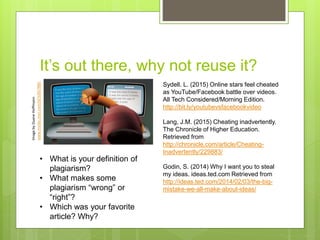
It’s out there, why not reuse it?
ImagebyDuaneHoffmann
www.msnbc.msn.com/id/32657885
Sydell. L. (2015) Online stars feel cheated
as YouTube/Facebook battle over videos.
All Tech Considered/Morning Edition.
http://bit.ly/youtubevsfacebookvideo
Lang, J.M. (2015) Cheating inadvertently.
The Chronicle of Higher Education.
Retrieved from
http://chronicle.com/article/Cheating-
Inadvertently/229883/
Godin, S. (2014) Why I want you to steal
my ideas. ideas.ted.com Retrieved from
http://ideas.ted.com/2014/02/03/the-big-
mistake-we-all-make-about-ideas/
• What is your definition of
plagiarism?
• What makes some
plagiarism “wrong” or
“right”?
• Which was your favorite
article? Why?
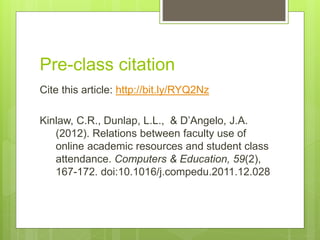
Pre-class citation
Cite this article: http://bit.ly/RYQ2Nz
Kinlaw, C.R., Dunlap, L.L., & D’Angelo, J.A.
(2012). Relations between faculty use of
online academic resources and student class
attendance. Computers & Education, 59(2),
167-172. doi:10.1016/j.compedu.2011.12.028
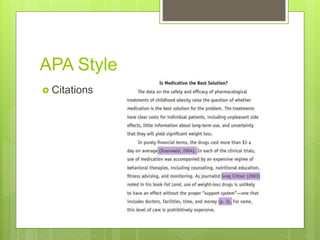
APA Style
 Citations
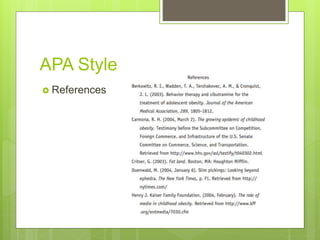
APA Style
 References
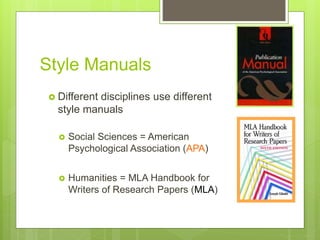
Style Manuals
 Different disciplines use different
style manuals
 Social Sciences = American
Psychological Association (APA)
 Humanities = MLA Handbook for
Writers of Research Papers (MLA)
The point is…
 Acknowledge where you found the
information
 Briefly identify the source
 Allows others to find additional information
What needs to be cited?
 Books
 Web Pages
 Magazine articles
 Graphics
 VHS,DVD, audio, etc.
 Government reports
 Statistics
 Encyclopedia articles
 Any source of information!
What needs to be cited?
 Direct quotes
 Ideas borrowed
 Paraphrased material
In-text Citation needs:
 Direct Quote
 All authors’ last names
 Year of publication
 Page number
 Paraphrase
 All authors’ last names
 Year of publication
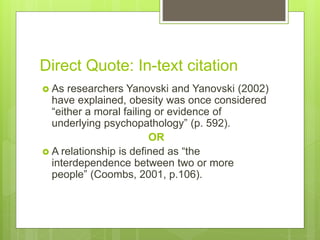
Direct Quote: In-text citation
 As researchers Yanovski and Yanovski (2002)
have explained, obesity was once considered
“either a moral failing or evidence of
underlying psychopathology” (p. 592).
OR
 A relationship is defined as “the
interdependence between two or more
people” (Coombs, 2001, p.106).
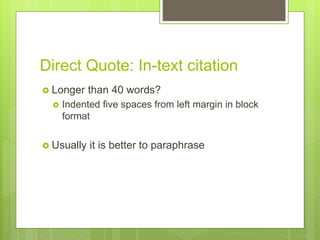
Direct Quote: In-text citation
 Longer than 40 words?
 Indented five spaces from left margin in block
format
 Usually it is better to paraphrase
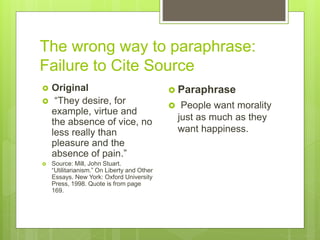
The wrong way to paraphrase:
Failure to Cite Source
 Original
 “They desire, for
example, virtue and
the absence of vice, no
less really than
pleasure and the
absence of pain.”
 Source: Mill, John Stuart.
“Utilitarianism.” On Liberty and Other
Essays. New York: Oxford University
Press, 1998. Quote is from page
169.
 Paraphrase
 People want morality
just as much as they
want happiness.
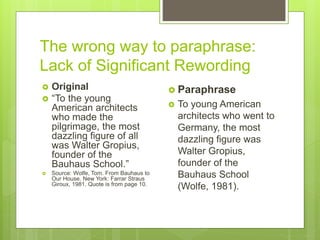
The wrong way to paraphrase:
Lack of Significant Rewording
 Original
 “To the young
American architects
who made the
pilgrimage, the most
dazzling figure of all
was Walter Gropius,
founder of the
Bauhaus School.”
 Source: Wolfe, Tom. From Bauhaus to
Our House. New York: Farrar Straus
Giroux, 1981. Quote is from page 10.
 Paraphrase
 To young American
architects who went to
Germany, the most
dazzling figure was
Walter Gropius,
founder of the
Bauhaus School
(Wolfe, 1981).
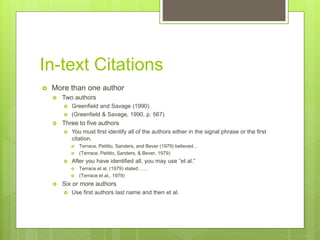
In-text Citations
 More than one author
 Two authors
 Greenfield and Savage (1990)
 (Greenfield & Savage, 1990, p. 567)
 Three to five authors
 You must first identify all of the authors either in the signal phrase or the first
citation.
 Terrace, Petitto, Sanders, and Bever (1979) believed…
 (Terrace, Petitto, Sanders, & Bever, 1979)
 After you have identified all, you may use “et al.”
 Terrace et al. (1979) stated……
 (Terrace et al., 1979)
 Six or more authors
 Use first authors last name and then et al.
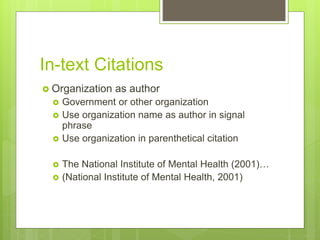
In-text Citations
 Organization as author
 Government or other organization
 Use organization name as author in signal
phrase
 Use organization in parenthetical citation
 The National Institute of Mental Health (2001)…
 (National Institute of Mental Health, 2001)
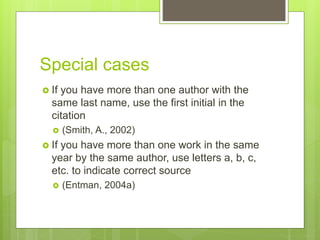
Special cases
 If you have more than one author with the
same last name, use the first initial in the
citation
 (Smith, A., 2002)
 If you have more than one work in the same
year by the same author, use letters a, b, c,
etc. to indicate correct source
 (Entman, 2004a)
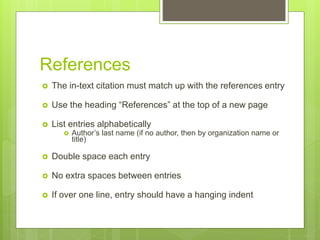
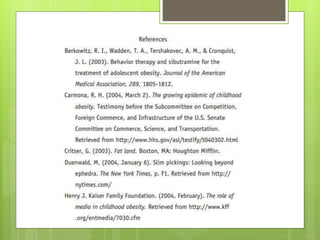
References
 The in-text citation must match up with the references entry
 Use the heading “References” at the top of a new page
 List entries alphabetically
 Author’s last name (if no author, then by organization name or
title)
 Double space each entry
 No extra spaces between entries
 If over one line, entry should have a hanging indent
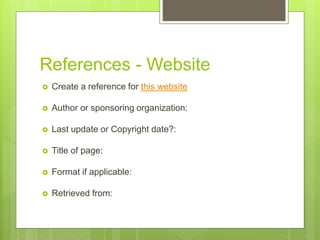
References - Website
 Create a reference for this website
 Author or sponsoring organization:
 Last update or Copyright date?:
 Title of page:
 Format if applicable:
 Retrieved from:
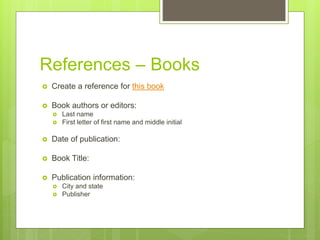
References – Books
 Create a reference for this book
 Book authors or editors:
 Last name
 First letter of first name and middle initial
 Date of publication:
 Book Title:
 Publication information:
 City and state
 Publisher
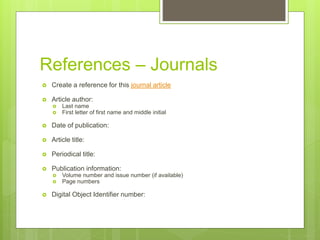
References – Journals
 Create a reference for this journal article
 Article author:
 Last name
 First letter of first name and middle initial
 Date of publication:
 Article title:
 Periodical title:
 Publication information:
 Volume number and issue number (if available)
 Page numbers
 Digital Object Identifier number:
Journal Articles Extra Info
 Articles retrieved from a database such as
EBSCO or PsycINFO do not need to include
database information
 Articles not including a doi number should
contain the journal URL after the page
numbers such as
 Retrieved from http://js.sagamorepub.com/pe
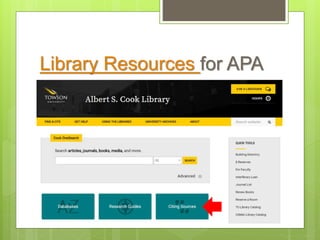
Library Resources for APA
Citations Relay
 Rules:
 Only one person from each team maybe writing on
the board
 No corrections until after designated writer is
finished and the judge has checked the citation
 No cheating and using the built in citation creator!!!
 First team to complete the citation correctly wins!
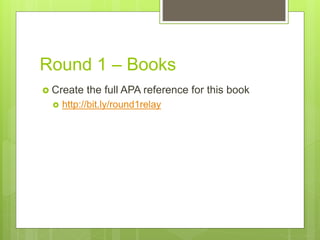
Round 1 – Books
 Create the full APA reference for this book
 http://bit.ly/round1relay
Round 2 – Journal Article
 Create a full APA reference for this article
 http://bit.ly/round2relay
Practice creating citations
 Go here to practice more citations
 http://bit.ly/1UO9ZmP
 Please ask if you have questions!
 Please provide feedback for the library
sessions here
 http://bit.ly/TUlibraryfeedback
Questions?
 Feel free to contact me:
 Laksamee Putnam
 lputnam@towson.edu
 410.704.3746.
 Twitter: @CookLibraryofTU
 Or any reference librarian:
 Visit Cook Library Reference Desk
 410.704.2462.
 IM – tucookchat

TSEM Spring 2017 Thompson Class 1

  • 1.
    TSEM: Plagiarism and APA Style LaksameePutnam – Research & Instruction Librarian Slides: http://bit.ly/tsemthompsonsp17c1 Please login to a computer and go to this URL
  • 2.
    First…  Laksamee Putnam lputnam@towson.edu  Cook Library Reference:  410.704.2462.  IM/email  Phone: 410.704.3746.  Twitter: @CookLibraryofTU  Albert S. Cook Facebook profile
  • 3.
    Agenda  Class discussion APA citation style  APA practice
  • 4.
    It’s out there,why not reuse it? ImagebyDuaneHoffmann www.msnbc.msn.com/id/32657885 Sydell. L. (2015) Online stars feel cheated as YouTube/Facebook battle over videos. All Tech Considered/Morning Edition. http://bit.ly/youtubevsfacebookvideo Lang, J.M. (2015) Cheating inadvertently. The Chronicle of Higher Education. Retrieved from http://chronicle.com/article/Cheating- Inadvertently/229883/ Godin, S. (2014) Why I want you to steal my ideas. ideas.ted.com Retrieved from http://ideas.ted.com/2014/02/03/the-big- mistake-we-all-make-about-ideas/ • What is your definition of plagiarism? • What makes some plagiarism “wrong” or “right”? • Which was your favorite article? Why?
  • 5.
    Pre-class citation Cite thisarticle: http://bit.ly/RYQ2Nz Kinlaw, C.R., Dunlap, L.L., & D’Angelo, J.A. (2012). Relations between faculty use of online academic resources and student class attendance. Computers & Education, 59(2), 167-172. doi:10.1016/j.compedu.2011.12.028
  • 6.
  • 7.
  • 8.
    Style Manuals  Differentdisciplines use different style manuals  Social Sciences = American Psychological Association (APA)  Humanities = MLA Handbook for Writers of Research Papers (MLA)
  • 9.
    The point is… Acknowledge where you found the information  Briefly identify the source  Allows others to find additional information
  • 10.
    What needs tobe cited?  Books  Web Pages  Magazine articles  Graphics  VHS,DVD, audio, etc.  Government reports  Statistics  Encyclopedia articles  Any source of information!
  • 11.
    What needs tobe cited?  Direct quotes  Ideas borrowed  Paraphrased material
  • 12.
    In-text Citation needs: Direct Quote  All authors’ last names  Year of publication  Page number  Paraphrase  All authors’ last names  Year of publication
  • 13.
    Direct Quote: In-textcitation  As researchers Yanovski and Yanovski (2002) have explained, obesity was once considered “either a moral failing or evidence of underlying psychopathology” (p. 592). OR  A relationship is defined as “the interdependence between two or more people” (Coombs, 2001, p.106).
  • 14.
    Direct Quote: In-textcitation  Longer than 40 words?  Indented five spaces from left margin in block format  Usually it is better to paraphrase
  • 15.
    The wrong wayto paraphrase: Failure to Cite Source  Original  “They desire, for example, virtue and the absence of vice, no less really than pleasure and the absence of pain.”  Source: Mill, John Stuart. “Utilitarianism.” On Liberty and Other Essays. New York: Oxford University Press, 1998. Quote is from page 169.  Paraphrase  People want morality just as much as they want happiness.
  • 16.
    The wrong wayto paraphrase: Lack of Significant Rewording  Original  “To the young American architects who made the pilgrimage, the most dazzling figure of all was Walter Gropius, founder of the Bauhaus School.”  Source: Wolfe, Tom. From Bauhaus to Our House. New York: Farrar Straus Giroux, 1981. Quote is from page 10.  Paraphrase  To young American architects who went to Germany, the most dazzling figure was Walter Gropius, founder of the Bauhaus School (Wolfe, 1981).
  • 17.
    In-text Citations  Morethan one author  Two authors  Greenfield and Savage (1990)  (Greenfield & Savage, 1990, p. 567)  Three to five authors  You must first identify all of the authors either in the signal phrase or the first citation.  Terrace, Petitto, Sanders, and Bever (1979) believed…  (Terrace, Petitto, Sanders, & Bever, 1979)  After you have identified all, you may use “et al.”  Terrace et al. (1979) stated……  (Terrace et al., 1979)  Six or more authors  Use first authors last name and then et al.
  • 18.
    In-text Citations  Organizationas author  Government or other organization  Use organization name as author in signal phrase  Use organization in parenthetical citation  The National Institute of Mental Health (2001)…  (National Institute of Mental Health, 2001)
  • 19.
    Special cases  Ifyou have more than one author with the same last name, use the first initial in the citation  (Smith, A., 2002)  If you have more than one work in the same year by the same author, use letters a, b, c, etc. to indicate correct source  (Entman, 2004a)
  • 20.
    References  The in-textcitation must match up with the references entry  Use the heading “References” at the top of a new page  List entries alphabetically  Author’s last name (if no author, then by organization name or title)  Double space each entry  No extra spaces between entries  If over one line, entry should have a hanging indent
  • 22.
    References - Website Create a reference for this website  Author or sponsoring organization:  Last update or Copyright date?:  Title of page:  Format if applicable:  Retrieved from:
  • 23.
    References – Books Create a reference for this book  Book authors or editors:  Last name  First letter of first name and middle initial  Date of publication:  Book Title:  Publication information:  City and state  Publisher
  • 24.
    References – Journals Create a reference for this journal article  Article author:  Last name  First letter of first name and middle initial  Date of publication:  Article title:  Periodical title:  Publication information:  Volume number and issue number (if available)  Page numbers  Digital Object Identifier number:
  • 25.
    Journal Articles ExtraInfo  Articles retrieved from a database such as EBSCO or PsycINFO do not need to include database information  Articles not including a doi number should contain the journal URL after the page numbers such as  Retrieved from http://js.sagamorepub.com/pe
  • 26.
  • 27.
    Citations Relay  Rules: Only one person from each team maybe writing on the board  No corrections until after designated writer is finished and the judge has checked the citation  No cheating and using the built in citation creator!!!  First team to complete the citation correctly wins!
  • 28.
    Round 1 –Books  Create the full APA reference for this book  http://bit.ly/round1relay
  • 29.
    Round 2 –Journal Article  Create a full APA reference for this article  http://bit.ly/round2relay
  • 30.
    Practice creating citations Go here to practice more citations  http://bit.ly/1UO9ZmP  Please ask if you have questions!  Please provide feedback for the library sessions here  http://bit.ly/TUlibraryfeedback
  • 31.
    Questions?  Feel freeto contact me:  Laksamee Putnam  lputnam@towson.edu  410.704.3746.  Twitter: @CookLibraryofTU  Or any reference librarian:  Visit Cook Library Reference Desk  410.704.2462.  IM – tucookchat