

Try Hard – Driver Behavior
Prepared By
Manu Melwin Joy
Assistant Professor
Ilahia School of Management Studies
Kerala, India.
Phone – 9744551114
Mail – manu_melwinjoy@yahoo.com
Kindly restrict the use of slides for personal purpose.
Please seek permission to reproduce the same in public forms and presentations.
Try Hard
Words : Often the person in Try
Hard will use the word try.
When used in driver fashion,
try always conveys “ I will try
to do it instead of doing it”.
Other typical words are
difficult, can’t, what? Don’t get
you, it is hard.. And
interrogative grunts like huh?
Uh?
Example :
– “ What I am trying to tell you
is…”
– “ I will try and do what we
agreed.”
Try Hard
Tones
– The person will sometimes
tense up the throat muscles
so that the voice sounds
muffled or strangled.
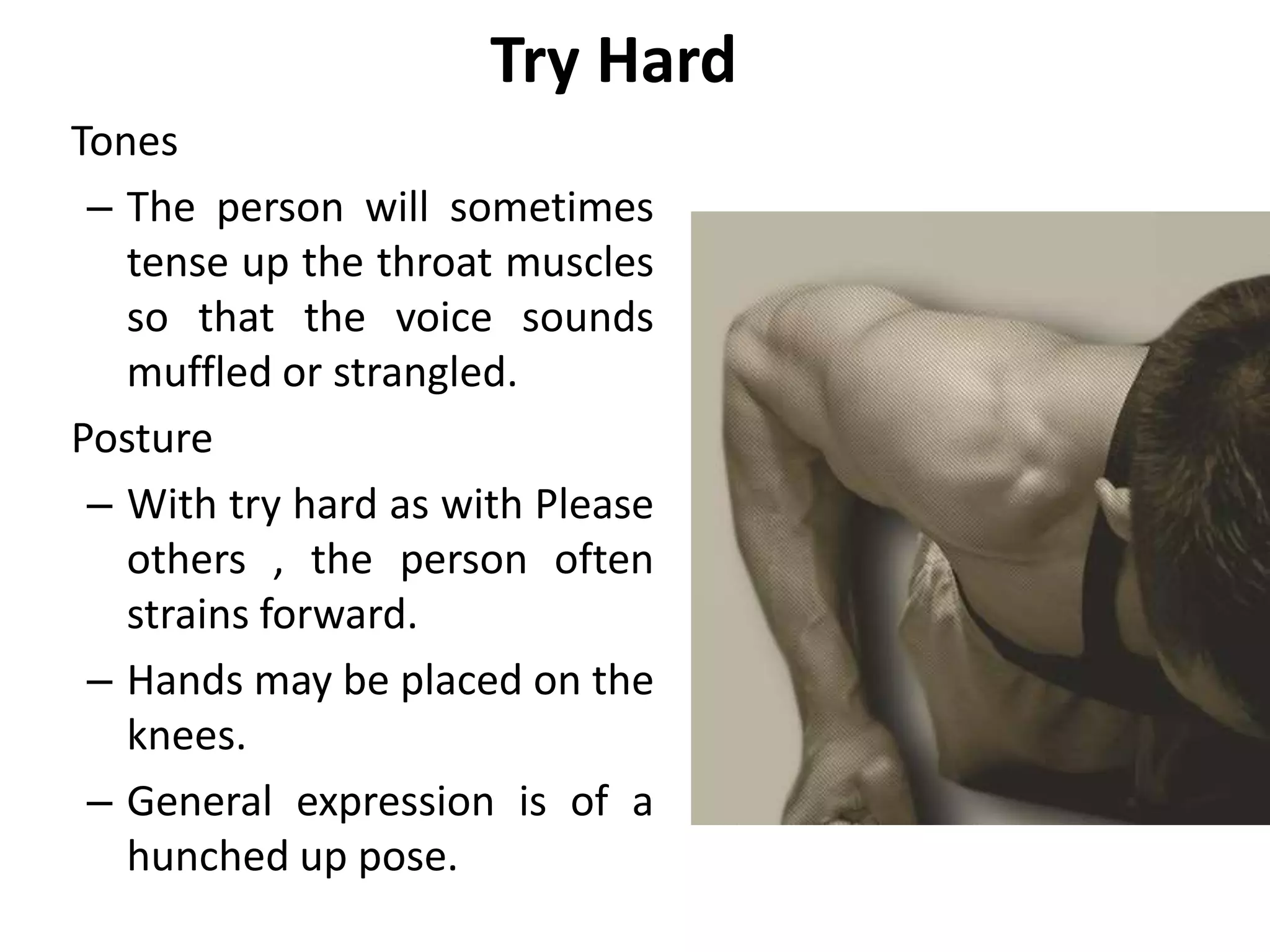
Posture
– With try hard as with Please
others , the person often
strains forward.
– Hands may be placed on the
knees.
– General expression is of a
hunched up pose.
Try Hard
Gestures
– Often one hand is placed beside
the eyes or besides one ear, as
though the person were straining
to hear or see something.
– Fists may be clenched.
Facial expressions
– A frequent clue for try hard is
that the person crunches his
brow up so that two vertical lines
appear above his nose.
– The eyes and sometimes the
whole face may be screwed up
into tight wrinkles.
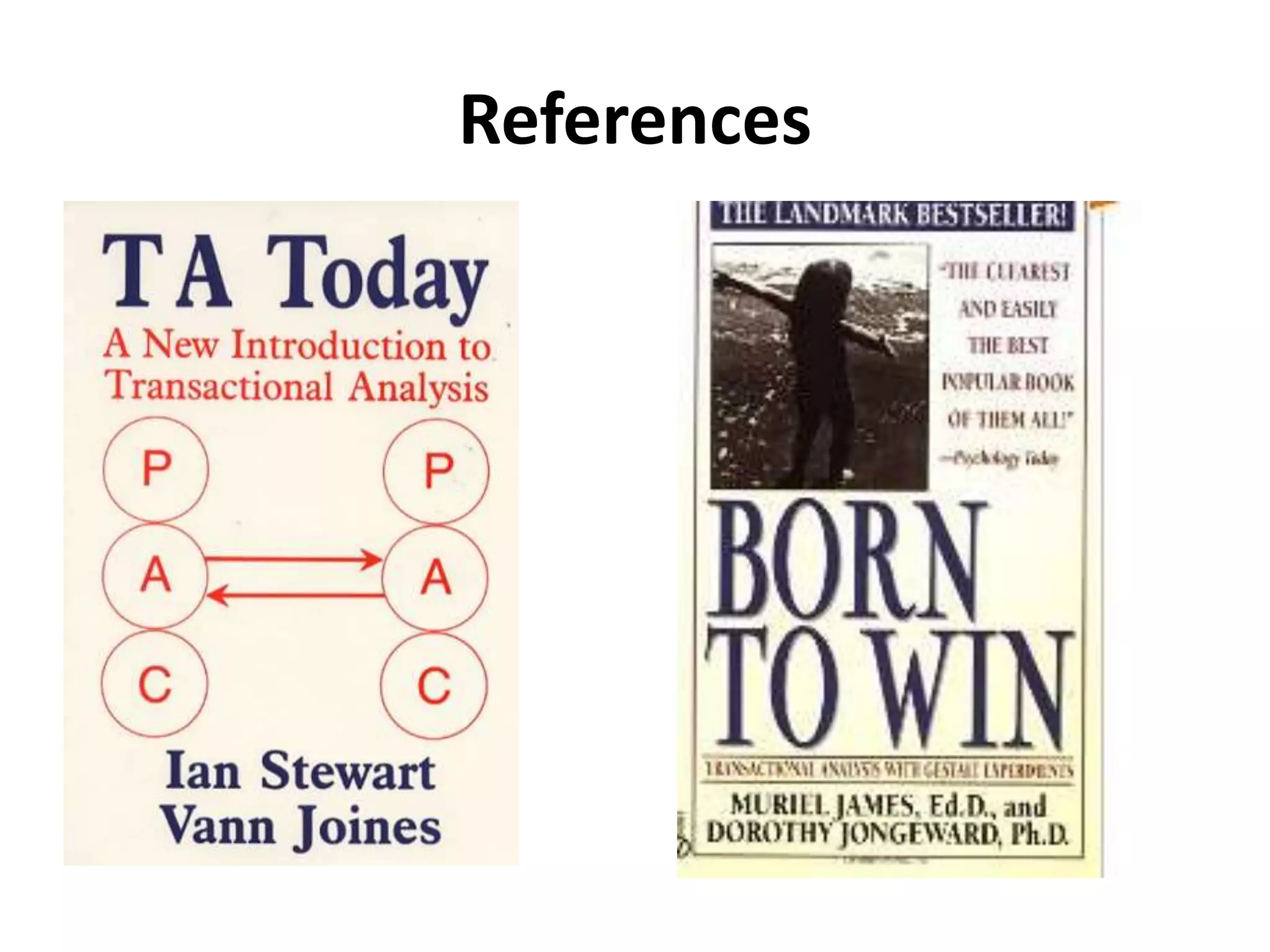
References
Thank You
Other TA topics available on slideshare
1. Strokes - http://www.slideshare.net/manumjoy/strokes-24081607.
2. Games People Play - http://www.slideshare.net/manumjoy/psychological-
games-people-play.
3. Structural Analysis - http://www.slideshare.net/manumjoy/the-ego-state-model.
4. What is TA? - http://www.slideshare.net/manumjoy/what-ta-is
5. Cycles of Development - http://www.slideshare.net/manumjoy/cycles-of-
developement-pamela-levin-transactional-analysis.
6. Stages of Cure - http://www.slideshare.net/manumjoy/stages-of-cure.
7. Transactions - http://www.slideshare.net/manumjoy/transactions-33677298.
8. Time Structuring - http://www.slideshare.net/manumjoy/time-structuring.
9. Life Position - http://www.slideshare.net/manumjoy/life-position.
10. Autonomy - http://www.slideshare.net/manumjoy/autonomy-33690557.
11. Structural Pathology - http://www.slideshare.net/manumjoy/structural-pathology.
12. Game Analysis - http://www.slideshare.net/manumjoy/game-analysis-33725636.
13. Integrated Adult - http://www.slideshare.net/manumjoy/integrated-adult.
14. Stroke Economy - http://www.slideshare.net/manumjoy/stroke-economy-
33826702.

Try Hard - Driver Behavior

  • 1.
    Try Hard –Driver Behavior
  • 2.
    Prepared By Manu MelwinJoy Assistant Professor Ilahia School of Management Studies Kerala, India. Phone – 9744551114 Mail – manu_melwinjoy@yahoo.com Kindly restrict the use of slides for personal purpose. Please seek permission to reproduce the same in public forms and presentations.
  • 3.
    Try Hard Words :Often the person in Try Hard will use the word try. When used in driver fashion, try always conveys “ I will try to do it instead of doing it”. Other typical words are difficult, can’t, what? Don’t get you, it is hard.. And interrogative grunts like huh? Uh? Example : – “ What I am trying to tell you is…” – “ I will try and do what we agreed.”
  • 4.
    Try Hard Tones – Theperson will sometimes tense up the throat muscles so that the voice sounds muffled or strangled. Posture – With try hard as with Please others , the person often strains forward. – Hands may be placed on the knees. – General expression is of a hunched up pose.
  • 5.
    Try Hard Gestures – Oftenone hand is placed beside the eyes or besides one ear, as though the person were straining to hear or see something. – Fists may be clenched. Facial expressions – A frequent clue for try hard is that the person crunches his brow up so that two vertical lines appear above his nose. – The eyes and sometimes the whole face may be screwed up into tight wrinkles.
  • 6.
  • 7.
  • 8.
    Other TA topicsavailable on slideshare 1. Strokes - http://www.slideshare.net/manumjoy/strokes-24081607. 2. Games People Play - http://www.slideshare.net/manumjoy/psychological- games-people-play. 3. Structural Analysis - http://www.slideshare.net/manumjoy/the-ego-state-model. 4. What is TA? - http://www.slideshare.net/manumjoy/what-ta-is 5. Cycles of Development - http://www.slideshare.net/manumjoy/cycles-of- developement-pamela-levin-transactional-analysis. 6. Stages of Cure - http://www.slideshare.net/manumjoy/stages-of-cure. 7. Transactions - http://www.slideshare.net/manumjoy/transactions-33677298. 8. Time Structuring - http://www.slideshare.net/manumjoy/time-structuring. 9. Life Position - http://www.slideshare.net/manumjoy/life-position. 10. Autonomy - http://www.slideshare.net/manumjoy/autonomy-33690557. 11. Structural Pathology - http://www.slideshare.net/manumjoy/structural-pathology. 12. Game Analysis - http://www.slideshare.net/manumjoy/game-analysis-33725636. 13. Integrated Adult - http://www.slideshare.net/manumjoy/integrated-adult. 14. Stroke Economy - http://www.slideshare.net/manumjoy/stroke-economy- 33826702.