




Basic Rate
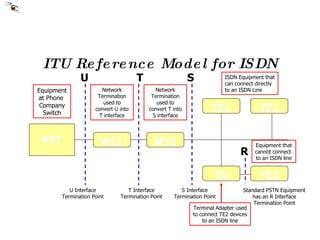
ITU Reference Model for ISDN PTT Equipment at Phone  Company Switch U Interface Termination Point T Interface Termination Point S Interface Termination Point Standard PSTN Equipment has an R Interface Termination Point U T S R TE2 TA TE1 TE1 NT1 NT2 ISDN Equipment that can connect directly to an ISDN Line Terminal Adapter used to connect TE2 devices to an ISDN line Equipment that cannot connect  to an ISDN line Network Termination used to convert U into T interface Network Termination used to convert T into S interface
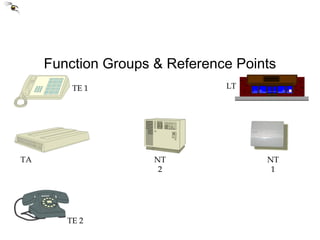
Function Groups & Reference Points LT NT 1 NT 2 TE 1 TE 2 TA
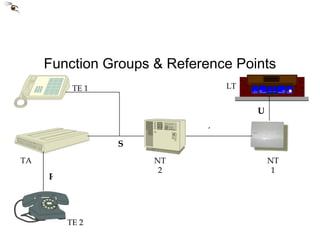
Function Groups & Reference Points LT NT 1 NT 2 TE 1 TE 2 TA U T S R
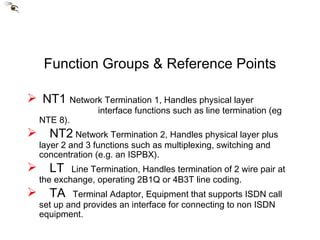
Function Groups & Reference Points NT1  Network Termination 1, Handles physical layer  interface functions such as line termination (eg NTE 8). NT2  Network Termination 2, Handles physical layer plus layer 2 and 3 functions such as multiplexing, switching and concentration (e.g. an ISPBX). LT   Line Termination, Handles termination of 2 wire pair at the exchange, operating 2B1Q or 4B3T line coding. TA   Terminal Adaptor, Equipment that supports ISDN call set up and provides an interface for connecting to non ISDN equipment.
Function Groups & Reference Points TE1   Terminal Equipment 1, End user equipment such as ISDN telephones or data terminals compliant with ISDN call set up procedures and capable of interfacing directly to the S-bus. TE2   Terminal Equipment 2, End user equipment for non ISDN environments (typically uses an RS232 interface)
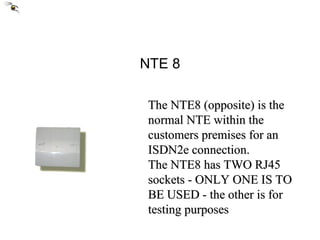
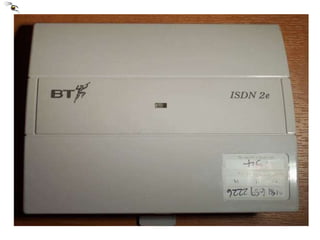
NTE 8 The NTE8 (opposite) is the normal NTE within the customers premises for an ISDN2e connection. The NTE8 has TWO RJ45 sockets - ONLY ONE IS TO BE USED - the other is for testing purposes
NTE 8 The NTE8  has a green LED which indicates the presence of the ISDN service. NTE8 is only available on local exchanges which use ‘Line Cards’ I-MUX exchanges will use NTE6
 
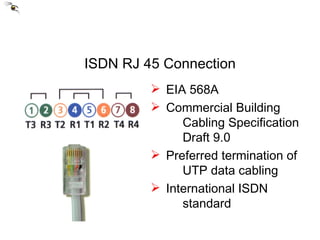
ISDN RJ 45 Connection EIA 568A Commercial Building  Cabling Specification  Draft 9.0 Preferred termination of  UTP data cabling International ISDN  standard
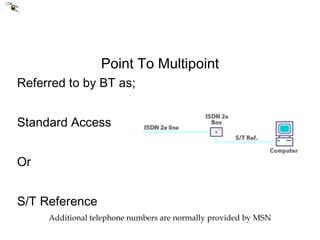
Point To Multipoint Referred to by BT as; Standard Access Or S/T Reference Additional telephone numbers are normally provided by MSN
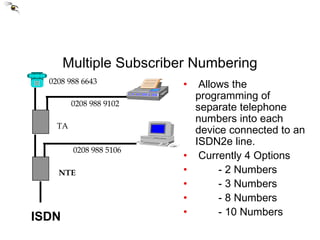
Multiple Subscriber Numbering Allows the programming of separate telephone numbers into each device connected to an ISDN2e line. Currently 4 Options   - 2 Numbers   - 3 Numbers   - 8 Numbers   - 10 Numbers ISDN NTE TA 0208 988 6643 0208 988 9102 0208 988 5106
Sub Addressing For ISDN2e to ISDN2e calls. Allows up to 20 Alphanumeric characters to be  sent (not #). For ISDN2e to ISDN2 or ISDN 30 Allows up to 6 Alphanumeric characters to be  sent (not #).
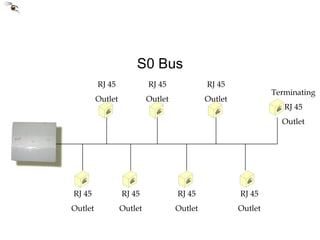
S0 Bus RJ 45 Outlet Terminating RJ 45 Outlet RJ 45 Outlet RJ 45 Outlet RJ 45 Outlet RJ 45 Outlet RJ 45 Outlet RJ 45 Outlet
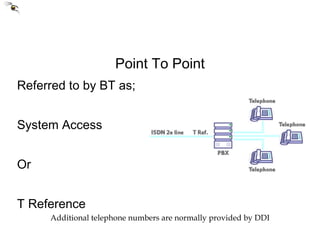
Point To Point Referred to by BT as; System Access Or T Reference Additional telephone numbers are normally provided by DDI
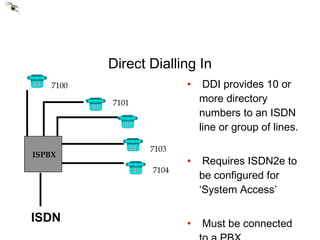
Direct Dialling In DDI provides 10 or more directory numbers to an ISDN line or group of lines. Requires ISDN2e to be configured for ‘System Access’ Must be connected to a PBX ISDN ISPBX 7100 7101 7103 7104
PRIMARY RATE
 
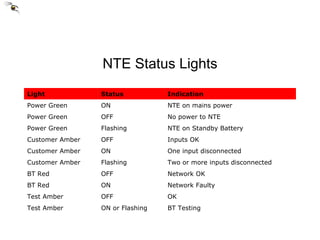
NTE Status Lights BT Testing ON or Flashing Test Amber OK OFF Test Amber Network Faulty ON BT Red Network OK OFF BT Red Two or more inputs disconnected Flashing Customer Amber One input disconnected ON Customer Amber Inputs OK OFF Customer Amber NTE on Standby Battery Flashing Power Green No power to NTE OFF Power Green NTE on mains power ON Power Green Indication Status Light
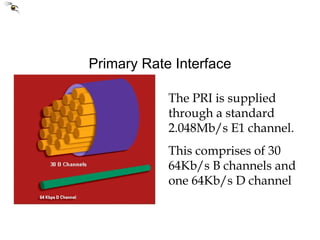
Primary Rate Interface The PRI is supplied through a standard 2.048Mb/s E1 channel. This comprises of 30 64Kb/s B channels and one 64Kb/s D channel
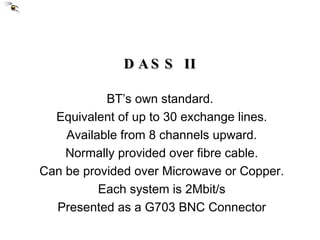
DASS II BT’s own standard. Equivalent of up to 30 exchange lines. Available from 8 channels upward. Normally provided over fibre cable. Can be provided over Microwave or Copper. Each system is 2Mbit/s Presented as a G703 BNC Connector
DASS II Is presented Like This
ISDN 30
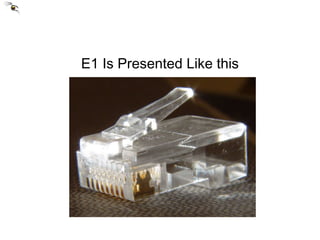
E1 Is Presented Like this
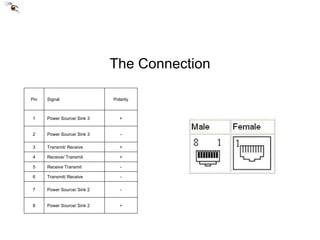
The Connection + Power Source/ Sink 2 8 - Power Source/ Sink 2 7 - Transmit/ Receive 6 - Receive Transmit 5 + Receive/ Transmit 4 + Transmit/ Receive 3 - Power Source/ Sink 3 2 + Power Source/ Sink 3 1 Polarity Signal Pin
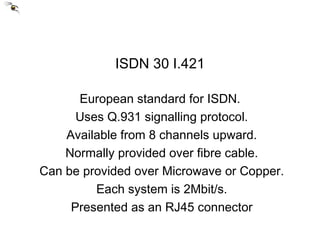
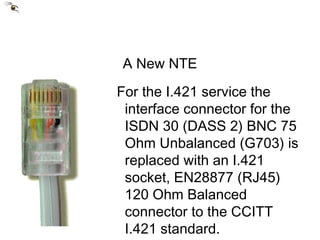
ISDN 30 I.421 European standard for ISDN. Uses Q.931 signalling protocol. Available from 8 channels upward. Normally provided over fibre cable. Can be provided over Microwave or Copper. Each system is 2Mbit/s. Presented as an RJ45 connector
Signalling For the I.421 service, DASS 2 signalling is replaced with Q.931 signalling to the ETSI standard
Numbering The numbering options for the I.421 service are different than for DASS; Numbers can not be allocated to dedicated channels. The options per 2 Meg Bearer are; Single Directory Number (Hunt Group) DDI Range (up to 5)
Numbering In most cases it will be possible for a user to keep their existing analogue directory number when they migrate to ISDN - but this can not be guaranteed. It is dependant on whether or not the number can  be transferred to a local digital exchange - which in a small number of cases is not possible.
A New NTE For the I.421 service the interface connector for the ISDN 30 (DASS 2) BNC 75 Ohm Unbalanced (G703) is replaced with an I.421 socket, EN28877 (RJ45) 120 Ohm Balanced connector to the CCITT I.421 standard.
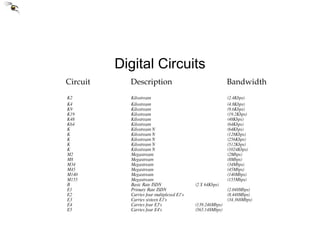
Digital Circuits K2 Kilostream (2.4Kbps) K4 Kilostream (4.8Kbps) K9 Kilostream (9.6Kbps) K19 Kilostream (19.2Kbps) K48 Kilostream (48Kbps) K64 Kilostream (64Kbps) K Kilostream N (64Kbps) K Kilostream N (128Kbps) K Kilostream N (256Kbps) K Kilostream N (512Kbps) K Kilostream N (1024Kbps) M2 Megastream (2Mbps) M8 Megastream (8Mbps) M34 Megastream (34Mbps) M45 Megastream (45Mbps) M140 Megastream (140Mbps) M155 Megastream (155Mbps) B Basic Rate ISDN (2 X 64Kbps) E1 Primary Rate ISDN  (2.048Mbps) E2 Carries four multiplexed E1's  (8.448Mbps) E3 Carries sixteen E1's  (34.368Mbps) E4 Carries four E3's  (139.246Mbps) E5 Carries four E4's  (565.148Mbps) Circuit  Description  Bandwidth
Recap  What sort of circuit is it? Can the customer ring out? Can you ring in? What lights are on, on the NTE?

Trunks

  • 1.
  • 2.
    ITU Reference Modelfor ISDN PTT Equipment at Phone Company Switch U Interface Termination Point T Interface Termination Point S Interface Termination Point Standard PSTN Equipment has an R Interface Termination Point U T S R TE2 TA TE1 TE1 NT1 NT2 ISDN Equipment that can connect directly to an ISDN Line Terminal Adapter used to connect TE2 devices to an ISDN line Equipment that cannot connect to an ISDN line Network Termination used to convert U into T interface Network Termination used to convert T into S interface
  • 3.
    Function Groups &Reference Points LT NT 1 NT 2 TE 1 TE 2 TA
  • 4.
    Function Groups &Reference Points LT NT 1 NT 2 TE 1 TE 2 TA U T S R
  • 5.
    Function Groups &Reference Points NT1 Network Termination 1, Handles physical layer interface functions such as line termination (eg NTE 8). NT2 Network Termination 2, Handles physical layer plus layer 2 and 3 functions such as multiplexing, switching and concentration (e.g. an ISPBX). LT Line Termination, Handles termination of 2 wire pair at the exchange, operating 2B1Q or 4B3T line coding. TA Terminal Adaptor, Equipment that supports ISDN call set up and provides an interface for connecting to non ISDN equipment.
  • 6.
    Function Groups &Reference Points TE1 Terminal Equipment 1, End user equipment such as ISDN telephones or data terminals compliant with ISDN call set up procedures and capable of interfacing directly to the S-bus. TE2 Terminal Equipment 2, End user equipment for non ISDN environments (typically uses an RS232 interface)
  • 7.
    NTE 8 TheNTE8 (opposite) is the normal NTE within the customers premises for an ISDN2e connection. The NTE8 has TWO RJ45 sockets - ONLY ONE IS TO BE USED - the other is for testing purposes
  • 8.
    NTE 8 TheNTE8 has a green LED which indicates the presence of the ISDN service. NTE8 is only available on local exchanges which use ‘Line Cards’ I-MUX exchanges will use NTE6
  • 9.
  • 10.
    ISDN RJ 45Connection EIA 568A Commercial Building Cabling Specification Draft 9.0 Preferred termination of UTP data cabling International ISDN standard
  • 11.
    Point To MultipointReferred to by BT as; Standard Access Or S/T Reference Additional telephone numbers are normally provided by MSN
  • 12.
    Multiple Subscriber NumberingAllows the programming of separate telephone numbers into each device connected to an ISDN2e line. Currently 4 Options - 2 Numbers - 3 Numbers - 8 Numbers - 10 Numbers ISDN NTE TA 0208 988 6643 0208 988 9102 0208 988 5106
  • 13.
    Sub Addressing ForISDN2e to ISDN2e calls. Allows up to 20 Alphanumeric characters to be sent (not #). For ISDN2e to ISDN2 or ISDN 30 Allows up to 6 Alphanumeric characters to be sent (not #).
  • 14.
    S0 Bus RJ45 Outlet Terminating RJ 45 Outlet RJ 45 Outlet RJ 45 Outlet RJ 45 Outlet RJ 45 Outlet RJ 45 Outlet RJ 45 Outlet
  • 15.
    Point To PointReferred to by BT as; System Access Or T Reference Additional telephone numbers are normally provided by DDI
  • 16.
    Direct Dialling InDDI provides 10 or more directory numbers to an ISDN line or group of lines. Requires ISDN2e to be configured for ‘System Access’ Must be connected to a PBX ISDN ISPBX 7100 7101 7103 7104
  • 17.
  • 18.
  • 19.
    NTE Status LightsBT Testing ON or Flashing Test Amber OK OFF Test Amber Network Faulty ON BT Red Network OK OFF BT Red Two or more inputs disconnected Flashing Customer Amber One input disconnected ON Customer Amber Inputs OK OFF Customer Amber NTE on Standby Battery Flashing Power Green No power to NTE OFF Power Green NTE on mains power ON Power Green Indication Status Light
  • 20.
    Primary Rate InterfaceThe PRI is supplied through a standard 2.048Mb/s E1 channel. This comprises of 30 64Kb/s B channels and one 64Kb/s D channel
  • 21.
    DASS II BT’sown standard. Equivalent of up to 30 exchange lines. Available from 8 channels upward. Normally provided over fibre cable. Can be provided over Microwave or Copper. Each system is 2Mbit/s Presented as a G703 BNC Connector
  • 22.
    DASS II Ispresented Like This
  • 23.
  • 24.
    E1 Is PresentedLike this
  • 25.
    The Connection +Power Source/ Sink 2 8 - Power Source/ Sink 2 7 - Transmit/ Receive 6 - Receive Transmit 5 + Receive/ Transmit 4 + Transmit/ Receive 3 - Power Source/ Sink 3 2 + Power Source/ Sink 3 1 Polarity Signal Pin
  • 26.
    ISDN 30 I.421European standard for ISDN. Uses Q.931 signalling protocol. Available from 8 channels upward. Normally provided over fibre cable. Can be provided over Microwave or Copper. Each system is 2Mbit/s. Presented as an RJ45 connector
  • 27.
    Signalling For theI.421 service, DASS 2 signalling is replaced with Q.931 signalling to the ETSI standard
  • 28.
    Numbering The numberingoptions for the I.421 service are different than for DASS; Numbers can not be allocated to dedicated channels. The options per 2 Meg Bearer are; Single Directory Number (Hunt Group) DDI Range (up to 5)
  • 29.
    Numbering In mostcases it will be possible for a user to keep their existing analogue directory number when they migrate to ISDN - but this can not be guaranteed. It is dependant on whether or not the number can be transferred to a local digital exchange - which in a small number of cases is not possible.
  • 30.
    A New NTEFor the I.421 service the interface connector for the ISDN 30 (DASS 2) BNC 75 Ohm Unbalanced (G703) is replaced with an I.421 socket, EN28877 (RJ45) 120 Ohm Balanced connector to the CCITT I.421 standard.
  • 31.
    Digital Circuits K2Kilostream (2.4Kbps) K4 Kilostream (4.8Kbps) K9 Kilostream (9.6Kbps) K19 Kilostream (19.2Kbps) K48 Kilostream (48Kbps) K64 Kilostream (64Kbps) K Kilostream N (64Kbps) K Kilostream N (128Kbps) K Kilostream N (256Kbps) K Kilostream N (512Kbps) K Kilostream N (1024Kbps) M2 Megastream (2Mbps) M8 Megastream (8Mbps) M34 Megastream (34Mbps) M45 Megastream (45Mbps) M140 Megastream (140Mbps) M155 Megastream (155Mbps) B Basic Rate ISDN (2 X 64Kbps) E1 Primary Rate ISDN (2.048Mbps) E2 Carries four multiplexed E1's (8.448Mbps) E3 Carries sixteen E1's (34.368Mbps) E4 Carries four E3's (139.246Mbps) E5 Carries four E4's (565.148Mbps) Circuit Description Bandwidth
  • 32.
    Recap Whatsort of circuit is it? Can the customer ring out? Can you ring in? What lights are on, on the NTE?

Editor's Notes

  • #19 Primary Rate NTE 4
  • #21 YES I KNOW we said 32 channels earlier BUT if you remember we gave channel 16 a specific purpose (DPNSS, QSIG etc) SO for many customers channel 16 does not exist (YEAH I KNOW channel 0 does not add up to much for them but for the sake of customer relations we will admit to one and keep the other up our sleeves for later!!