International Journal of Trend in Scientific Research and Development (IJTSRD)
Volume 3 Issue 6, October 2019 Available Online: www.ijtsrd.com e-ISSN: 2456 – 6470
@ IJTSRD | Unique Paper ID – IJTSRD28121 | Volume – 3 | Issue – 6 | September - October 2019 Page 398
An Experimental Paper on
Compressive Strength of Pervious Concrete
S. Suryasri1, Mr. K. S. B. Prasad2
1M. Tech Student, 2Assistant Professor
1,2Department of Civil Engineering, GMRIT, Rajam, Andhra Pradesh, India
ABSTRACT
Pervious concrete has been in use inmanycountriesover morethana century.
Its higher porosity helps in percolating rain water directly to ground and
thereby helps in recharging groundwater aquifer. In this study, pervious
concrete of sizes of 6.3mm size aggregate were prepared with different water
cement ratios to find the compressive strength. The purpose of this project is
to analyze the feasibility of producing highly sustainable no-fine concrete
mixtures and evaluating the effect of W/c ratio on the properties of pervious
concrete. Porous concrete is produced by using ordinary Portland cement,
coarse aggregates, and water. This concrete is tested for its property
compressive strength. The resultsshowedthatthewatercement ratioshowed
significant effect on compressive strength of Pervious concrete.
KEYWORDS: Pervious concrete, Compressive strength.
How to cite this paper: S. Suryasri | Mr.K.
S. B. Prasad "An Experimental Paper on
Compressive Strength of Pervious
Concrete"Published
in International
Journal of Trend in
Scientific Research
and Development
(ijtsrd), ISSN: 2456-
6470, Volume-3 |
Issue-6, October
2019, pp.398-400, URL:
https://www.ijtsrd.com/papers/ijtsrd28
121.pdf
Copyright © 2019 by author(s) and
International Journal ofTrendinScientific
Research and Development Journal. This
is an Open Access article distributed
under the terms of
the Creative
CommonsAttribution
License (CC BY 4.0)
(http://creativecommons.org/licenses/by
/4.0)
I. INTRODUCTION
With population growth,continual urbanizationhas ledtoan
increase of impervious surface areas, which block the
percolation of precipitation from rainfall through the
ground. This increases the potential for excess surface
runoff, which can lead to downstreamflooding, bank erosion
and possibly transport of pollutants into potable water
supplies. On the other hand, permeable pavements have the
ability to reduce runoff volume and improve water quality.
Indeed, they can store storm water runoff until infiltrating
into soil or conveyed downstream in the storm water
management system by a drain. For this reason, many
communities are now exploring their use as an alternative
low impact development design for storm water control
measures. Suchpermeablepavementsystemscancontribute
to solving drainage problems and reducing the risk of flash
flooding, resulting from continuous urban developments.
Portland cement pervious concrete (PCPC) is a special type
of concrete characterized by an interconnected pore
structure. The use of pervious concrete may reduce loading
risk, recharge ground water, reduce storm water runoff,
reduce noise when in contact with vehicle tires, and prevent
glare and skidding during rainy season by allowing water to
infiltrate freely through its pores [2,3]. In addition, pervious
concrete is produced at low cost, thus it can be considered
among the most attractive sustainable urban drainage
systems (SUDS). PCPC requires, however, regular
maintenance to prevent any clogging of the pores by
sediments and vegetation which might change its high
permeability.
While its constituent materials are similar to that of normal
concrete, PCPC contains little or no fine aggregate. It is also
known as no-fines concrete, permeable concrete, porous
concrete and enhanced porosity concrete.Perviousconcrete
has been used in a variety of applications, notable among
which are low-traffic pavements such as parking lots and
sidewalks, around buildings, and on highway shoulders and
medians.
This study is an attempt to reduce sand in the consecutive
order proportion till 100% reduction of sand from the
previous concrete to determine the compressive strength
and infiltration rate; also find the optimum sand proportion
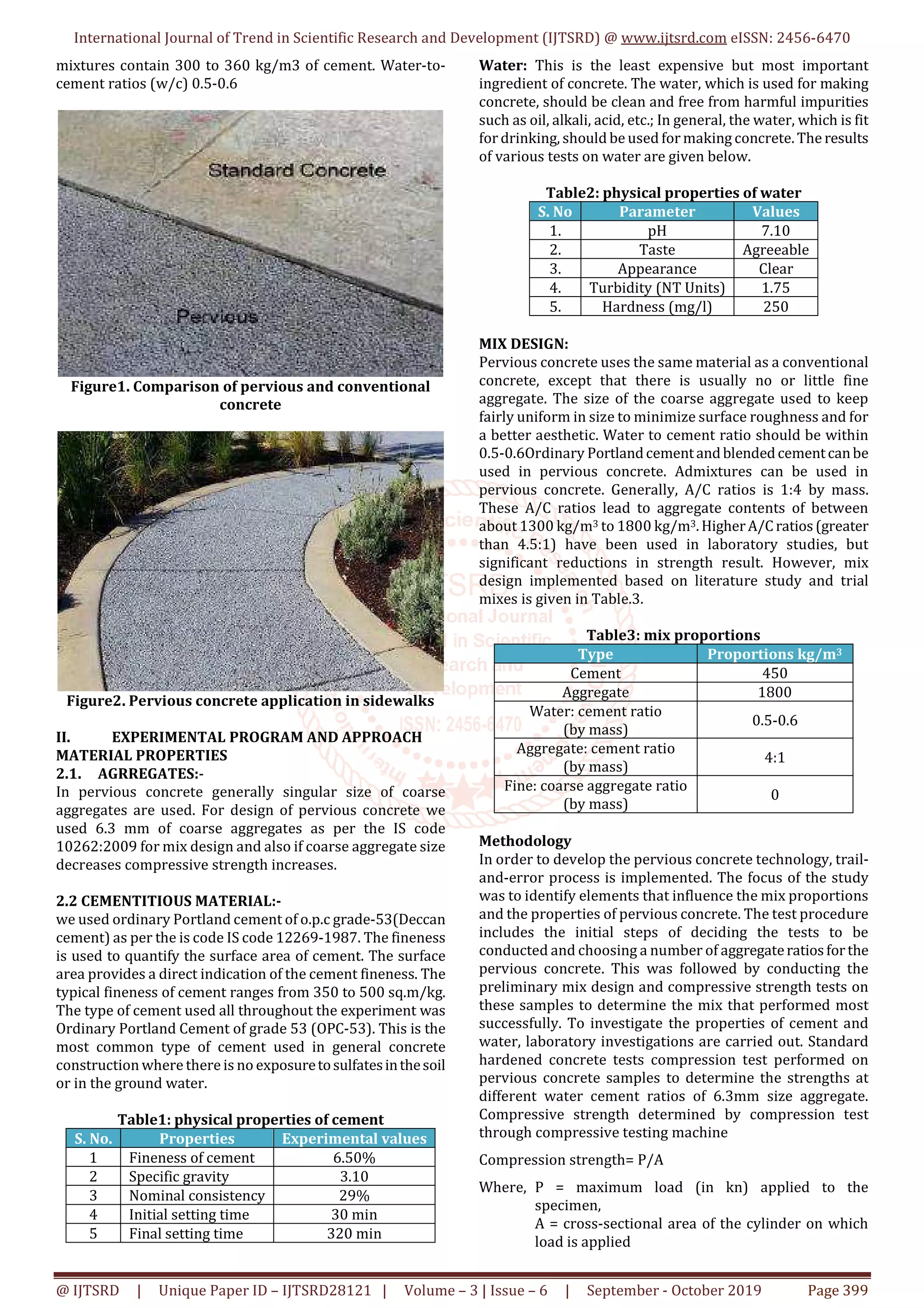
to produce pervious concrete. The comparison of pervious
concrete with standard concreteisshowninFigure1and the
application of pervious concrete in sidewalks is shown in
Figure 2. Correct paste viscosity allows complete coating of
the coarse aggregate without paste draining away and
clogging the pore space. Desired paste viscosity is achieved
by balancing water content, fine aggregate, and admixtures.
Workability of the mixture is influenced by the paste
consistency, thickness of cementous paste between coarse
aggregate particles, and surface characteristics ofthecoarse
aggregate. While many mixtures are possible, typical
IJTSRD28121
International Journal of Trend in Scientific Research and Development (IJTSRD) @ www.ijtsrd.com eISSN: 2456-6470
@ IJTSRD | Unique Paper ID – IJTSRD28121 | Volume – 3 | Issue – 6 | September - October 2019 Page 399
mixtures contain 300 to 360 kg/m3 of cement. Water-to-
cement ratios (w/c) 0.5-0.6
Figure1. Comparison of pervious and conventional
concrete
Figure2. Pervious concrete application in sidewalks
II. EXPERIMENTAL PROGRAM AND APPROACH
MATERIAL PROPERTIES
2.1. AGRREGATES:-
In pervious concrete generally singular size of coarse
aggregates are used. For design of pervious concrete we
used 6.3 mm of coarse aggregates as per the IS code
10262:2009 for mix design and also if coarse aggregate size
decreases compressive strength increases.
2.2 CEMENTITIOUS MATERIAL:-
we used ordinary Portland cement of o.p.c grade-53(Deccan
cement) as per the is code IS code 12269-1987. The fineness
is used to quantify the surface area of cement. The surface
area provides a direct indication of the cement fineness. The
typical fineness of cement ranges from 350 to 500 sq.m/kg.
The type of cement used all throughout the experiment was
Ordinary Portland Cement of grade 53 (OPC-53). This is the
most common type of cement used in general concrete
construction where there is no exposuretosulfatesinthesoil
or in the ground water.
Table1: physical properties of cement
S. No. Properties Experimental values
1 Fineness of cement 6.50%
2 Specific gravity 3.10
3 Nominal consistency 29%
4 Initial setting time 30 min
5 Final setting time 320 min
Water: This is the least expensive but most important
ingredient of concrete. The water, which is used for making
concrete, should be clean and free from harmful impurities
such as oil, alkali, acid, etc.; In general, the water, which is fit
for drinking, should be used for making concrete. The results
of various tests on water are given below.
Table2: physical properties of water
S. No Parameter Values
1. pH 7.10
2. Taste Agreeable
3. Appearance Clear
4. Turbidity (NT Units) 1.75
5. Hardness (mg/l) 250
MIX DESIGN:
Pervious concrete uses the same material as a conventional
concrete, except that there is usually no or little fine
aggregate. The size of the coarse aggregate used to keep
fairly uniform in size to minimize surface roughness and for
a better aesthetic. Water to cement ratio should be within
0.5-0.6Ordinary Portlandcementandblendedcementcanbe
used in pervious concrete. Admixtures can be used in
pervious concrete. Generally, A/C ratios is 1:4 by mass.
These A/C ratios lead to aggregate contents of between
about 1300 kg/m3 to 1800 kg/m3.HigherA/Cratios(greater
than 4.5:1) have been used in laboratory studies, but
significant reductions in strength result. However, mix
design implemented based on literature study and trial
mixes is given in Table.3.
Table3: mix proportions
Type Proportions kg/m3
Cement 450
Aggregate 1800
Water: cement ratio
(by mass)
0.5-0.6
Aggregate: cement ratio
(by mass)
4:1
Fine: coarse aggregate ratio
(by mass)
0
Methodology
In order to develop the pervious concrete technology, trail-
and-error process is implemented. The focus of the study
was to identify elements that influence the mix proportions
and the properties of pervious concrete. The test procedure
includes the initial steps of deciding the tests to be
conducted and choosing a number of aggregateratiosforthe
pervious concrete. This was followed by conducting the
preliminary mix design and compressive strength tests on
these samples to determine the mix that performed most
successfully. To investigate the properties of cement and
water, laboratory investigations are carried out. Standard
hardened concrete tests compression test performed on
pervious concrete samples to determine the strengths at
different water cement ratios of 6.3mm size aggregate.
Compressive strength determined by compression test
through compressive testing machine
Compression strength= P/A
Where, P = maximum load (in kn) applied to the
specimen,
A = cross-sectional area of the cylinder on which
load is applied
International Journal of Trend in Scientific Research and Development (IJTSRD) @ www.ijtsrd.com eISSN: 2456-6470
@ IJTSRD | Unique Paper ID – IJTSRD28121 | Volume – 3 | Issue – 6 | September - October 2019 Page 400
In general compressive strength is dependent on size of
coarse aggregate, void ratio, bond between mortar and
coarse aggregate. In 7 days cubesofpermeableconcretegain
30% of its strength, in 21 days of permeable concrete gain
70% of its strength, and for 28 days it gains 95% strength.
Figure3. Testing of cylinder for Compressive strength
III. RESULTS AND CONCLUSION
After the curing period of 28days the cylindrical samplesare
taken out and surface dried in room temperature without
exposure to direct sunlight. Then the capping is done with
gypsum on both top and bottom of cylinder to get even
surface for equal distribution of load throughout the area of
cylinder. All the compressive strength values are average of
3 samples. The test results are given below
Tabel4. Compressive strength of 6.3mm-9.5mm size of
aggregate for 28 days curing
Cement
aggregate
ratio
Water
Cement ratio
Load
(P)
(kn)
Compressive
strength
(N/mm²)
1:4
0.53 85.16 10.79705
0.56 78.46 9.990663
0.6 53.46 6.807572
Figure4: Graph showing compressive strength of
28Days cured cylinders
The following are the conclusions made by this study.
According to the Experimental results, it has been observed
that The compressive strength of pervious concrete of
6.3mm-9.5mm size aggregateisgreaterfor0.53comparedto
0.57, 0.60 water cement ratios.
REFERENCES
[1] Tanvir hossain et al., “Experimental study on Pervious
concrete using brick chips as coarse aggregate”, 2005:
p. 5-10
[2] Journal of Materials in Civil Engineering, 1995: 7(4): p.
286-289.
[3] Bashir Alam et al “Experimental study on Mechanical
properties of no-fines bloated slate aggregateconcrete
for construction application”, International journal of
Civil engineering,2001 : p. 264-21
[4] Gafoori, N. and Dutta, S. (1995): “Laboratory
investigation of compacted no-fine concreteforpaving
materials”, J. Mater. Civ. Eng., 7(3), pp. l83-191.
[5] Sneha Sanjay Ganpule, S. V. Pataskar (2011),“Use of
Porous Concrete as a Green Construction Material for
Pavement” International Journal of Earth Sciences and
Engineering, ISSN 0974-5904,
[6] Schaefer, V.R., et al., Mix design development for
pervious concrete in cold weather climates. National
Concrete Pavement Technology Centre, 2006: p. 83.
[7] Scholz, M. and P. Grabowiecki, Review of permeable
pavement systems. Building and Environment, 2007:
42(11): p. 3830-3836.
[8] Tennis, P. D., Leming, M. L. and Akers, DJ. (2004):
“Pervious concrete pavement”, Hydrologic design of
pervious concrete, Portland CementAssociation,Silver
spring, MD; National Ready Mixed Concrete
Association, Skokie JL, pp. l-25.
[9] Chopra, M. M., Kakuturu, S., Ballock, C., Spence, S. and
Wanielista, M. M. (2010): “Effect of rejuvenation
methods on the infiltration rates of pervious concrete
pavements”, J. ASCE, 15(6), pp. 426-433.
[10] Harber, P. J. (2005): “Application of No-fines concrete
as a Road Pavement”, Rep. Univ., of Southern
Queensland, pp. l-130.
[11] Joung, Y. and Grasley, Z. C. (2008): “Evaluation and
Optimization of Durable pervious concrete for use in
urban Areas”, Research Rep. SWUTC, pp. l -117
[12] Kevern, J. T., Wang, K. and Schaefer, V. R. (2008):
“Pervious concreteinsevere exposuresdevelopmentof
pollution-reducing pavement for northern cities”,
Concrete Int. Mag. ACI, 30(7), pp. 43-49.
[13] McCain, G. N. and Dewoolkar, M. M. (2010): “A
Laboratory study on the effect of winter surface
application on the hydraulic conductivity of porous
concrete pavements”, TRB Annual Meeting, CD-ROM.,
Washington D.C, pp. 1-18.
[14] CCPs and FGD by-products impermeable roadway base
construction, in Centrefor By-Products Utilization,
2002: p. 95.
[15] Nguyen, N. T., et al., Porous concrete - preliminary
research in Vietnam. The 2004 International
Symposium on Advanced Science and Engineering,
2004: p.415-418.29. Montes, F. and L
[16] Darshan S. Shah, Prof. J. R. Pitroda, “Pervious Concrete:
New Era for Rural Road Pavement”, International
Journal of Engineering Trends and Technology (IJETT)
ISSN No. 2231-5381, Volume: 4, Issue: 8, August 2013,
Page: 3496 – 3500
[17] Darshan S. Shah, Prof. J. R. Pitroda, “Assessmentforuse
of Gravel in Pervious Concrete”, International Journal
of Engineering Trends and Technology (IJETT) ISSN
No. 2231-5381, Volume: 4, Issue: 10, October 2013,
Page: 4306 – 4310
[18] S. O. Ajamu , A. A. Jimoh , J. R. Oluremi Evaluation of
Structural Performance of Pervious Concrete in
Construction International Journal of Engineering and
Technology Volume 2 No. 5, May, 2012
[19] M. UmaMaguesvaria, and V. L. Narasimha Studies on
Characterization of Pervious Concrete for Pavement
Applications Science Direct Procedia - Social and
Behavioral Sciences 104 ( 2013 ) 198 – 207

An Experimental Paper on Compressive Strength of Pervious Concrete

  • 1.
    International Journal ofTrend in Scientific Research and Development (IJTSRD) Volume 3 Issue 6, October 2019 Available Online: www.ijtsrd.com e-ISSN: 2456 – 6470 @ IJTSRD | Unique Paper ID – IJTSRD28121 | Volume – 3 | Issue – 6 | September - October 2019 Page 398 An Experimental Paper on Compressive Strength of Pervious Concrete S. Suryasri1, Mr. K. S. B. Prasad2 1M. Tech Student, 2Assistant Professor 1,2Department of Civil Engineering, GMRIT, Rajam, Andhra Pradesh, India ABSTRACT Pervious concrete has been in use inmanycountriesover morethana century. Its higher porosity helps in percolating rain water directly to ground and thereby helps in recharging groundwater aquifer. In this study, pervious concrete of sizes of 6.3mm size aggregate were prepared with different water cement ratios to find the compressive strength. The purpose of this project is to analyze the feasibility of producing highly sustainable no-fine concrete mixtures and evaluating the effect of W/c ratio on the properties of pervious concrete. Porous concrete is produced by using ordinary Portland cement, coarse aggregates, and water. This concrete is tested for its property compressive strength. The resultsshowedthatthewatercement ratioshowed significant effect on compressive strength of Pervious concrete. KEYWORDS: Pervious concrete, Compressive strength. How to cite this paper: S. Suryasri | Mr.K. S. B. Prasad "An Experimental Paper on Compressive Strength of Pervious Concrete"Published in International Journal of Trend in Scientific Research and Development (ijtsrd), ISSN: 2456- 6470, Volume-3 | Issue-6, October 2019, pp.398-400, URL: https://www.ijtsrd.com/papers/ijtsrd28 121.pdf Copyright © 2019 by author(s) and International Journal ofTrendinScientific Research and Development Journal. This is an Open Access article distributed under the terms of the Creative CommonsAttribution License (CC BY 4.0) (http://creativecommons.org/licenses/by /4.0) I. INTRODUCTION With population growth,continual urbanizationhas ledtoan increase of impervious surface areas, which block the percolation of precipitation from rainfall through the ground. This increases the potential for excess surface runoff, which can lead to downstreamflooding, bank erosion and possibly transport of pollutants into potable water supplies. On the other hand, permeable pavements have the ability to reduce runoff volume and improve water quality. Indeed, they can store storm water runoff until infiltrating into soil or conveyed downstream in the storm water management system by a drain. For this reason, many communities are now exploring their use as an alternative low impact development design for storm water control measures. Suchpermeablepavementsystemscancontribute to solving drainage problems and reducing the risk of flash flooding, resulting from continuous urban developments. Portland cement pervious concrete (PCPC) is a special type of concrete characterized by an interconnected pore structure. The use of pervious concrete may reduce loading risk, recharge ground water, reduce storm water runoff, reduce noise when in contact with vehicle tires, and prevent glare and skidding during rainy season by allowing water to infiltrate freely through its pores [2,3]. In addition, pervious concrete is produced at low cost, thus it can be considered among the most attractive sustainable urban drainage systems (SUDS). PCPC requires, however, regular maintenance to prevent any clogging of the pores by sediments and vegetation which might change its high permeability. While its constituent materials are similar to that of normal concrete, PCPC contains little or no fine aggregate. It is also known as no-fines concrete, permeable concrete, porous concrete and enhanced porosity concrete.Perviousconcrete has been used in a variety of applications, notable among which are low-traffic pavements such as parking lots and sidewalks, around buildings, and on highway shoulders and medians. This study is an attempt to reduce sand in the consecutive order proportion till 100% reduction of sand from the previous concrete to determine the compressive strength and infiltration rate; also find the optimum sand proportion to produce pervious concrete. The comparison of pervious concrete with standard concreteisshowninFigure1and the application of pervious concrete in sidewalks is shown in Figure 2. Correct paste viscosity allows complete coating of the coarse aggregate without paste draining away and clogging the pore space. Desired paste viscosity is achieved by balancing water content, fine aggregate, and admixtures. Workability of the mixture is influenced by the paste consistency, thickness of cementous paste between coarse aggregate particles, and surface characteristics ofthecoarse aggregate. While many mixtures are possible, typical IJTSRD28121
  • 2.
    International Journal ofTrend in Scientific Research and Development (IJTSRD) @ www.ijtsrd.com eISSN: 2456-6470 @ IJTSRD | Unique Paper ID – IJTSRD28121 | Volume – 3 | Issue – 6 | September - October 2019 Page 399 mixtures contain 300 to 360 kg/m3 of cement. Water-to- cement ratios (w/c) 0.5-0.6 Figure1. Comparison of pervious and conventional concrete Figure2. Pervious concrete application in sidewalks II. EXPERIMENTAL PROGRAM AND APPROACH MATERIAL PROPERTIES 2.1. AGRREGATES:- In pervious concrete generally singular size of coarse aggregates are used. For design of pervious concrete we used 6.3 mm of coarse aggregates as per the IS code 10262:2009 for mix design and also if coarse aggregate size decreases compressive strength increases. 2.2 CEMENTITIOUS MATERIAL:- we used ordinary Portland cement of o.p.c grade-53(Deccan cement) as per the is code IS code 12269-1987. The fineness is used to quantify the surface area of cement. The surface area provides a direct indication of the cement fineness. The typical fineness of cement ranges from 350 to 500 sq.m/kg. The type of cement used all throughout the experiment was Ordinary Portland Cement of grade 53 (OPC-53). This is the most common type of cement used in general concrete construction where there is no exposuretosulfatesinthesoil or in the ground water. Table1: physical properties of cement S. No. Properties Experimental values 1 Fineness of cement 6.50% 2 Specific gravity 3.10 3 Nominal consistency 29% 4 Initial setting time 30 min 5 Final setting time 320 min Water: This is the least expensive but most important ingredient of concrete. The water, which is used for making concrete, should be clean and free from harmful impurities such as oil, alkali, acid, etc.; In general, the water, which is fit for drinking, should be used for making concrete. The results of various tests on water are given below. Table2: physical properties of water S. No Parameter Values 1. pH 7.10 2. Taste Agreeable 3. Appearance Clear 4. Turbidity (NT Units) 1.75 5. Hardness (mg/l) 250 MIX DESIGN: Pervious concrete uses the same material as a conventional concrete, except that there is usually no or little fine aggregate. The size of the coarse aggregate used to keep fairly uniform in size to minimize surface roughness and for a better aesthetic. Water to cement ratio should be within 0.5-0.6Ordinary Portlandcementandblendedcementcanbe used in pervious concrete. Admixtures can be used in pervious concrete. Generally, A/C ratios is 1:4 by mass. These A/C ratios lead to aggregate contents of between about 1300 kg/m3 to 1800 kg/m3.HigherA/Cratios(greater than 4.5:1) have been used in laboratory studies, but significant reductions in strength result. However, mix design implemented based on literature study and trial mixes is given in Table.3. Table3: mix proportions Type Proportions kg/m3 Cement 450 Aggregate 1800 Water: cement ratio (by mass) 0.5-0.6 Aggregate: cement ratio (by mass) 4:1 Fine: coarse aggregate ratio (by mass) 0 Methodology In order to develop the pervious concrete technology, trail- and-error process is implemented. The focus of the study was to identify elements that influence the mix proportions and the properties of pervious concrete. The test procedure includes the initial steps of deciding the tests to be conducted and choosing a number of aggregateratiosforthe pervious concrete. This was followed by conducting the preliminary mix design and compressive strength tests on these samples to determine the mix that performed most successfully. To investigate the properties of cement and water, laboratory investigations are carried out. Standard hardened concrete tests compression test performed on pervious concrete samples to determine the strengths at different water cement ratios of 6.3mm size aggregate. Compressive strength determined by compression test through compressive testing machine Compression strength= P/A Where, P = maximum load (in kn) applied to the specimen, A = cross-sectional area of the cylinder on which load is applied
  • 3.
    International Journal ofTrend in Scientific Research and Development (IJTSRD) @ www.ijtsrd.com eISSN: 2456-6470 @ IJTSRD | Unique Paper ID – IJTSRD28121 | Volume – 3 | Issue – 6 | September - October 2019 Page 400 In general compressive strength is dependent on size of coarse aggregate, void ratio, bond between mortar and coarse aggregate. In 7 days cubesofpermeableconcretegain 30% of its strength, in 21 days of permeable concrete gain 70% of its strength, and for 28 days it gains 95% strength. Figure3. Testing of cylinder for Compressive strength III. RESULTS AND CONCLUSION After the curing period of 28days the cylindrical samplesare taken out and surface dried in room temperature without exposure to direct sunlight. Then the capping is done with gypsum on both top and bottom of cylinder to get even surface for equal distribution of load throughout the area of cylinder. All the compressive strength values are average of 3 samples. The test results are given below Tabel4. Compressive strength of 6.3mm-9.5mm size of aggregate for 28 days curing Cement aggregate ratio Water Cement ratio Load (P) (kn) Compressive strength (N/mm²) 1:4 0.53 85.16 10.79705 0.56 78.46 9.990663 0.6 53.46 6.807572 Figure4: Graph showing compressive strength of 28Days cured cylinders The following are the conclusions made by this study. According to the Experimental results, it has been observed that The compressive strength of pervious concrete of 6.3mm-9.5mm size aggregateisgreaterfor0.53comparedto 0.57, 0.60 water cement ratios. REFERENCES [1] Tanvir hossain et al., “Experimental study on Pervious concrete using brick chips as coarse aggregate”, 2005: p. 5-10 [2] Journal of Materials in Civil Engineering, 1995: 7(4): p. 286-289. [3] Bashir Alam et al “Experimental study on Mechanical properties of no-fines bloated slate aggregateconcrete for construction application”, International journal of Civil engineering,2001 : p. 264-21 [4] Gafoori, N. and Dutta, S. (1995): “Laboratory investigation of compacted no-fine concreteforpaving materials”, J. Mater. Civ. Eng., 7(3), pp. l83-191. [5] Sneha Sanjay Ganpule, S. V. Pataskar (2011),“Use of Porous Concrete as a Green Construction Material for Pavement” International Journal of Earth Sciences and Engineering, ISSN 0974-5904, [6] Schaefer, V.R., et al., Mix design development for pervious concrete in cold weather climates. National Concrete Pavement Technology Centre, 2006: p. 83. [7] Scholz, M. and P. Grabowiecki, Review of permeable pavement systems. Building and Environment, 2007: 42(11): p. 3830-3836. [8] Tennis, P. D., Leming, M. L. and Akers, DJ. (2004): “Pervious concrete pavement”, Hydrologic design of pervious concrete, Portland CementAssociation,Silver spring, MD; National Ready Mixed Concrete Association, Skokie JL, pp. l-25. [9] Chopra, M. M., Kakuturu, S., Ballock, C., Spence, S. and Wanielista, M. M. (2010): “Effect of rejuvenation methods on the infiltration rates of pervious concrete pavements”, J. ASCE, 15(6), pp. 426-433. [10] Harber, P. J. (2005): “Application of No-fines concrete as a Road Pavement”, Rep. Univ., of Southern Queensland, pp. l-130. [11] Joung, Y. and Grasley, Z. C. (2008): “Evaluation and Optimization of Durable pervious concrete for use in urban Areas”, Research Rep. SWUTC, pp. l -117 [12] Kevern, J. T., Wang, K. and Schaefer, V. R. (2008): “Pervious concreteinsevere exposuresdevelopmentof pollution-reducing pavement for northern cities”, Concrete Int. Mag. ACI, 30(7), pp. 43-49. [13] McCain, G. N. and Dewoolkar, M. M. (2010): “A Laboratory study on the effect of winter surface application on the hydraulic conductivity of porous concrete pavements”, TRB Annual Meeting, CD-ROM., Washington D.C, pp. 1-18. [14] CCPs and FGD by-products impermeable roadway base construction, in Centrefor By-Products Utilization, 2002: p. 95. [15] Nguyen, N. T., et al., Porous concrete - preliminary research in Vietnam. The 2004 International Symposium on Advanced Science and Engineering, 2004: p.415-418.29. Montes, F. and L [16] Darshan S. Shah, Prof. J. R. Pitroda, “Pervious Concrete: New Era for Rural Road Pavement”, International Journal of Engineering Trends and Technology (IJETT) ISSN No. 2231-5381, Volume: 4, Issue: 8, August 2013, Page: 3496 – 3500 [17] Darshan S. Shah, Prof. J. R. Pitroda, “Assessmentforuse of Gravel in Pervious Concrete”, International Journal of Engineering Trends and Technology (IJETT) ISSN No. 2231-5381, Volume: 4, Issue: 10, October 2013, Page: 4306 – 4310 [18] S. O. Ajamu , A. A. Jimoh , J. R. Oluremi Evaluation of Structural Performance of Pervious Concrete in Construction International Journal of Engineering and Technology Volume 2 No. 5, May, 2012 [19] M. UmaMaguesvaria, and V. L. Narasimha Studies on Characterization of Pervious Concrete for Pavement Applications Science Direct Procedia - Social and Behavioral Sciences 104 ( 2013 ) 198 – 207