TripleO	
  

OpenStack-­‐on-­‐OpenStack	
  
Deploy OpenStack using OpenStack
Problem	
  
Installing,	
  Upgrading	
  and	
  Opera1ng	
  OpenStack	
  Cloud	
  
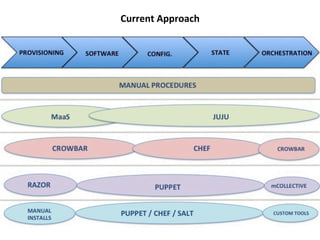
Current	
  Approach	
  
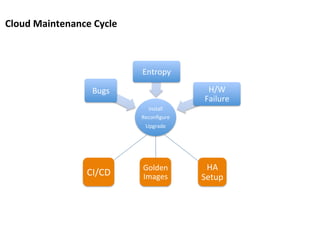
Cloud	
  Maintenance	
  Cycle	
  

Entropy	
  
H/W	
  
Failure	
  

Bugs	
  
Install	
  
Reconfigure	
  
Upgrade	
  

CI/CD	
  

Golden	
  
Images	
  

HA	
  
Setup	
  
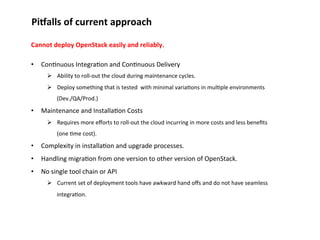
Pi;alls	
  of	
  current	
  approach	
  
Cannot	
  deploy	
  OpenStack	
  easily	
  and	
  reliably.	


•  Con1nuous	
  Integra1on	
  and	
  Con1nuous	
  Delivery	
  	
  
Ø  Ability	
  to	
  roll-­‐out	
  the	
  cloud	
  during	
  maintenance	
  cycles.	
  
Ø  Deploy	
  something	
  that	
  is	
  tested	
  	
  with	
  minimal	
  varia1ons	
  in	
  mul1ple	
  environments	
  
(Dev./QA/Prod.)	
  

•  Maintenance	
  and	
  Installa1on	
  Costs	
  
Ø  Requires	
  more	
  efforts	
  to	
  roll-­‐out	
  the	
  cloud	
  incurring	
  in	
  more	
  costs	
  and	
  less	
  benefits	
  
(one	
  1me	
  cost).	
  

•  Complexity	
  in	
  installa1on	
  and	
  upgrade	
  processes.	
  
•  Handling	
  migra1on	
  from	
  one	
  version	
  to	
  other	
  version	
  of	
  OpenStack.	
  
•  No	
  single	
  tool	
  chain	
  or	
  API	
  
Ø  Current	
  set	
  of	
  deployment	
  tools	
  have	
  awkward	
  hand	
  offs	
  and	
  do	
  not	
  have	
  seamless	
  
integra1on.	
  
Solu?on	
  
TripleO	
  

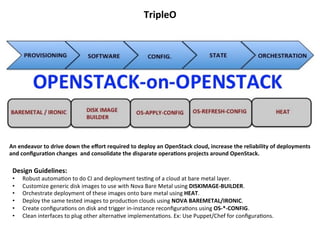
An	
  endeavor	
  to	
  drive	
  down	
  the	
  effort	
  required	
  to	
  deploy	
  an	
  OpenStack	
  cloud,	
  increase	
  the	
  reliability	
  of	
  deployments	
  
and	
  configura?on	
  changes	
  	
  and	
  consolidate	
  the	
  disparate	
  opera?ons	
  projects	
  around	
  OpenStack.	
  

Design	
  Guidelines:	
  
• 
• 
• 
• 
• 
• 

Robust	
  automa1on	
  to	
  do	
  CI	
  and	
  deployment	
  tes1ng	
  of	
  a	
  cloud	
  at	
  bare	
  metal	
  layer.	
  
Customize	
  generic	
  disk	
  images	
  to	
  use	
  with	
  Nova	
  Bare	
  Metal	
  using	
  DISKIMAGE-­‐BUILDER.	
  
Orchestrate	
  deployment	
  of	
  these	
  images	
  onto	
  bare	
  metal	
  using	
  HEAT.	
  
Deploy	
  the	
  same	
  tested	
  images	
  to	
  produc1on	
  clouds	
  using	
  NOVA	
  BAREMETAL/IRONIC.	
  
Create	
  configura1ons	
  on	
  disk	
  and	
  trigger	
  in-­‐instance	
  reconfigura1ons	
  using	
  OS-­‐*-­‐CONFIG.	
  
Clean	
  interfaces	
  to	
  plug	
  other	
  alterna1ve	
  implementa1ons.	
  Ex:	
  Use	
  Puppet/Chef	
  for	
  configura1ons.	
  
Benefits	
  of	
  TripleO	
  
• 

Driving	
  the	
  cost	
  of	
  opera1ons	
  down.	
  

• 

Increasing	
  reliability	
  of	
  deployments	
  and	
  consolida1ng	
  on	
  a	
  single	
  API	
  for	
  deploying	
  machine	
  images.	
  

• 

Use	
  of	
  gold	
  images	
  allows	
  one	
  to	
  test	
  precisely	
  what	
  will	
  be	
  running	
  in	
  produc1on	
  or	
  test	
  environment	
  -­‐	
  
either	
  virtual	
  or	
  physical	
  and	
  provides	
  early	
  detec1on	
  of	
  many	
  issues.	


• 

Gold	
  image	
  also	
  ensures	
  that	
  there	
  is	
  no	
  varia1on	
  between	
  machines	
  in	
  produc1on	
  -­‐	
  no	
  late	
  discovery	
  of	
  
version	
  conflicts,	
  for	
  instance.	
  

• 

Using	
  CI/CD	
  tes1ng	
  in	
  the	
  deployment	
  pipeline	
  gives	
  us:	
  
Ø  Ability	
  to	
  deploy	
  something	
  that	
  has	
  been	
  tested.	
  
Ø  No	
  means	
  to	
  invalidate	
  the	
  above	
  tests	
  (e.g.	
  kernel	
  version,	
  OpenStack	
  calls	
  etc.)	
  
Ø  Implement	
  varia1ons	
  in	
  configura1ons	
  (e.g.	
  network	
  topology	
  could	
  vary	
  between	
  staging	
  and	
  
produc1on.)	
  

• 

Use	
  of	
  cloud	
  APIs	
  for	
  bare	
  metal	
  deployment	
  permit	
  trivial	
  migra1on	
  of	
  machine	
  between	
  roles.	
  

• 

A	
  single	
  tool	
  chain	
  to	
  provision	
  and	
  deploy	
  onto	
  hardware	
  is	
  simpler	
  and	
  lower	
  cost	
  to	
  maintain	
  than	
  
having	
  heterogeneous	
  systems.	
  
Hypervisor	
  Driver	
  vs.	
  Bare	
  Metal	
  Driver	
  
•  Tenant/Project	
  has	
  full	
  and	
  direct	
  access	
  to	
  the	
  hardware,	
  and	
  that	
  hardware	
  is	
  dedicated	
  
to	
  a	
  single	
  instance.	
  
•  Nova	
  does	
  not	
  have	
  any	
  access	
  to	
  manipulate	
  a	
  baremetal	
  instance	
  except	
  for	
  what	
  is	
  
provided	
  at	
  the	
  hardware	
  level	
  and	
  exposed	
  over	
  the	
  network,	
  such	
  as	
  IPMI	
  control.	
  	
  
•  Some	
  func1onality	
  (instance	
  snapshots,	
  aZach	
  and	
  detach	
  network	
  volumes	
  to	
  a	
  running	
  
instance)	
  implemented	
  by	
  other	
  hypervisor	
  drivers	
  is	
  not	
  available	
  via	
  the	
  baremetal	
  driver	
  
•  Security	
  concerns	
  created	
  by	
  tenants	
  having	
  direct	
  access	
  to	
  the	
  network	
  (e.g.,	
  MAC	
  
spoofing,	
  packet	
  sniffing,	
  etc.).	
  
Ø  Other	
  hypervisors	
  mi1gate	
  this	
  with	
  virtualized	
  networking.	
  
Ø  Neutron	
  +	
  OpenFlow	
  can	
  be	
  used	
  if	
  network	
  hardware	
  supports	
  it.	
  
•  Public	
  cloud	
  images	
  may	
  not	
  work	
  on	
  some	
  hardware,	
  par1cularly	
  if	
  your	
  hardware	
  
requires	
  addi1onal	
  drivers	
  to	
  be	
  loaded.	
  
Nova	
  Bare	
  Metal	
  
FEATURES	
  
• 
• 
• 
• 

• 
• 
• 

Hypervisor	
  driver	
  for	
  Openstack	
  Nova	
  Compute.	
  
Same	
  role	
  as	
  drivers	
  for	
  other	
  hypervisors	
  (KVM,	
  ESXi,	
  etc).	
  
No	
  hypervisor	
  between	
  the	
  tenants	
  and	
  the	
  physical	
  hardware.	
  
Exposes	
  hardware	
  via	
  Openstack's	
  API	
  using	
  pluggable	
  drivers	
  
Ø  Power	
  Control	
  of	
  enrolled	
  H/W	
  via	
  IPMI.	
  
Ø  PXE	
  boot	
  of	
  the	
  bare	
  metal	
  nodes.	
  
Support	
  for	
  x86_64	
  &	
  i386	
  architectures.	
  
Support	
  for	
  Flat	
  Network	
  environments.	
  
Cloud-­‐init	
  is	
  used	
  to	
  pass	
  the	
  user	
  data	
  into	
  the	
  bare	
  metal	
  instances	
  ager	
  provisioning	


Projects	


Project	
  

NOVA	
  Compute	
  +	
  
Hypervisor	
  Driver	
  

NOVA	
  Compute	
  +	
  
Bare	
  Metal	
  Driver	
  

Hypervisor	
  
(KVM/ESXi)	
  
Physical	
  Hardware	
  

NOVA	
  HYPERVISOR	
  DRIVER	
  

I	
  
P	
  
M	
  
I	
  

P	
  
X	
  
E	
  

Physical	
  Hardware	
  

NOVA	
  BARE	
  METAL	
  DRIVER	
  
Bare	
  Metal	
  Driver	
  is	
  now	
  IRONIC	
  
Mo?va?on	
  for	
  split	
  
•  Maintain	
  ‘One	
  DB’	
  per	
  project.	
  
• 

Bare	
  Metal	
  Driver	
  needs	
  to	
  store	
  non-­‐Nova	
  details	
  in	
  a	
  separate	
  DB.	
  

•  Create	
  separa1on	
  between	
  physical	
  and	
  virtual	
  environments	
  
• 
• 
• 

Remove	
  unnecessary	
  interac1ons.	
  
HW	
  Specific	
  tasks	
  (HW	
  RAID,	
  Firmware	
  Updates	
  etc.).	
  
Interac1ons	
  with	
  other	
  projects	
  –	
  Cinder,	
  Quantum	
  etc.	
  

Ironic	
  is	
  s1ll	
  gekng	
  refactored	
  and	
  heavily	
  under	
  development.	
  
Use	
  Nova	
  Bare	
  Metal	
  for	
  now.	
  
Future	
  Plans	
  (implementa?on	
  to	
  be	
  done	
  in	
  Ironic)	
  
• 
• 
• 
• 
• 
• 
• 
• 

Improve	
  performance/scalability	
  of	
  PXE	
  deployment	
  process.	
  
BeZer	
  support	
  for	
  complex	
  non-­‐SDN	
  environments	
  (Ex:	
  sta1c	
  VLANs).	
  
BeZer	
  integra1on	
  with	
  neutron-­‐dhcp.	
  
Support	
  for	
  persistent	
  storage	
  through	
  Cinder.	
  
Support	
  snapshot	
  and	
  migrate	
  of	
  baremetal	
  instances.	
  
Support	
  non-­‐PXE	
  image	
  deployment.	
  
Support	
  other	
  architectures	
  (arm,	
  1lepro).	
  
Support	
  fault-­‐tolerance	
  of	
  baremetal	
  nova-­‐compute	
  node.	
  
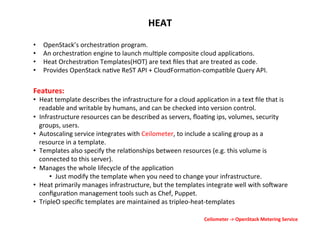
HEAT	
  
• 
• 
• 
• 

OpenStack’s	
  orchestra1on	
  program.	
  
An	
  orchestra1on	
  engine	
  to	
  launch	
  mul1ple	
  composite	
  cloud	
  applica1ons.	
  
Heat	
  Orchestra1on	
  Templates(HOT)	
  are	
  text	
  files	
  that	
  are	
  treated	
  as	
  code.	
  
Provides	
  OpenStack	
  na1ve	
  ReST	
  API	
  +	
  CloudForma1on-­‐compa1ble	
  Query	
  API.	
  

Features:	
  

•  Heat	
  template	
  describes	
  the	
  infrastructure	
  for	
  a	
  cloud	
  applica1on	
  in	
  a	
  text	
  file	
  that	
  is	
  
readable	
  and	
  writable	
  by	
  humans,	
  and	
  can	
  be	
  checked	
  into	
  version	
  control.	
  
•  Infrastructure	
  resources	
  can	
  be	
  described	
  as	
  servers,	
  floa1ng	
  ips,	
  volumes,	
  security	
  
groups,	
  users.	
  
•  Autoscaling	
  service	
  integrates	
  with	
  Ceilometer,	
  to	
  include	
  a	
  scaling	
  group	
  as	
  a	
  
resource	
  in	
  a	
  template.	
  
•  Templates	
  also	
  specify	
  the	
  rela1onships	
  between	
  resources	
  (e.g.	
  this	
  volume	
  is	
  
connected	
  to	
  this	
  server).	
  
•  Manages	
  the	
  whole	
  lifecycle	
  of	
  the	
  applica1on	
  	
  
•  Just	
  modify	
  the	
  template	
  when	
  you	
  need	
  to	
  change	
  your	
  infrastructure.	
  
•  Heat	
  primarily	
  manages	
  infrastructure,	
  but	
  the	
  templates	
  integrate	
  well	
  with	
  sogware	
  
configura1on	
  management	
  tools	
  such	
  as	
  Chef,	
  Puppet.	
  
•  TripleO	
  specific	
  templates	
  are	
  maintained	
  as	
  tripleo-­‐heat-­‐templates	
  
Ceilometer	
  -­‐>	
  OpenStack	
  Metering	
  Service	
  
Heat	
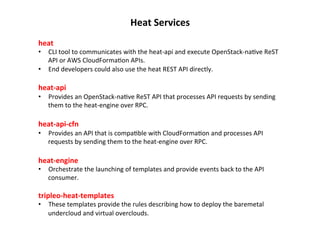
  Services	
  
heat	


•  CLI	
  tool	
  to	
  communicates	
  with	
  the	
  heat-­‐api	
  and	
  execute	
  OpenStack-­‐na1ve	
  ReST	
  
API	
  or	
  AWS	
  CloudForma1on	
  APIs.	
  	
  
•  End	
  developers	
  could	
  also	
  use	
  the	
  heat	
  REST	
  API	
  directly.	


heat-­‐api	


•  Provides	
  an	
  OpenStack-­‐na1ve	
  ReST	
  API	
  that	
  processes	
  API	
  requests	
  by	
  sending	
  
them	
  to	
  the	
  heat-­‐engine	
  over	
  RPC.	


heat-­‐api-­‐cfn	


•  Provides	
  an	
  API	
  that	
  is	
  compa1ble	
  with	
  CloudForma1on	
  and	
  processes	
  API	
  
requests	
  by	
  sending	
  them	
  to	
  the	
  heat-­‐engine	
  over	
  RPC.	


heat-­‐engine	


•  Orchestrate	
  the	
  launching	
  of	
  templates	
  and	
  provide	
  events	
  back	
  to	
  the	
  API	
  
consumer.	
  

tripleo-­‐heat-­‐templates	
  

•  These	
  templates	
  provide	
  the	
  rules	
  describing	
  how	
  to	
  deploy	
  the	
  baremetal	
  
undercloud	
  and	
  virtual	
  overclouds.	
  	
  
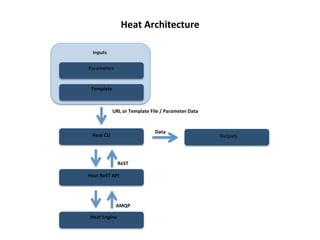
Heat	
  Architecture	
  
Inputs	
  
Parameters	
  

Template	
  

URL	
  or	
  Template	
  File	
  /	
  Parameter	
  Data	
  

Data	
  

Heat	
  CLI	
  

ReST	
  
Heat	
  ReST	
  API	
  

AMQP	
  
Heat	
  Engine	
  

Outputs	
  
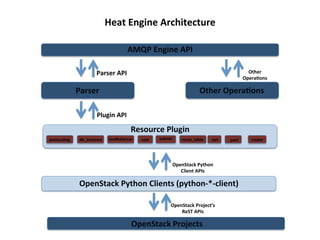
Heat	
  Engine	
  Architecture	
  
AMQP	
  Engine	
  API	
  
Other	
  
Opera?ons	
  

Parser	
  API	
  

Other	
  Opera?ons	
  

Parser	
  
Plugin	
  API	
  

Resource	
  Plugin	
  
autoscaling	
  

db_instance	
  

loadbalancer	
  

user	
  

subnet	
  

route_table	
  

net	
  

port	
  

OpenStack	
  Python	
  	
  
Client	
  APIs	
  

OpenStack	
  Python	
  Clients	
  (python-­‐*-­‐client)	
  
OpenStack	
  Project’s	
  
ReST	
  APIs	
  

OpenStack	
  Projects	
  

router	
  
Sample	
  HOT	
  
parameters:!
InstanceType:!
type: string!
description: Instance type to create!
default: m1.small!
hidden: False!
constraints:!
­ allowed_values {m1.tiny, m1.small, m1.large}!
resources:!
MyInstance:!
type: OS::Nova::Server!
properties:!
KeyName: { get_param: KeyName }!
ImageId: { get_param: ImageId }!
InstanceType: { get_param: InstanceType }!

outputs:!
InstanceIP:!
description: The IP address of the instance!
value: {get_attr: [MyInstance, PublicIP] }!
Disk	
  Image	
  Builder	
  
•  Responsible	
  for	
  building	
  disk	
  images,	
  file	
  system	
  &	
  ramdisk	
  images	
  to	
  use	
  with	
  
OpenStack	
  (both	
  virtual	
  and	
  bare	
  metal).	
  
•  Core	
  func1onality	
  includes	
  the	
  various	
  opera1ng	
  system	
  specific	
  modules	
  for	
  disk/	
  
filesystem	
  images,	
  and	
  deployment	
  and	
  hardware	
  inventory	
  ramdisks.	
  
•  Builds	
  an	
  image	
  by	
  set	
  of	
  hooks	
  –	
  root	
  image,	
  preinstall,	
  install	
  packages	
  &	
  perform	
  
post	
  installa1on	
  steps.	
  
•  An	
  image	
  build	
  is	
  parameterized	
  by	
  including	
  Elements,	
  where	
  elements	
  could	
  be	
  
some	
  specific	
  s/w	
  you	
  wanted	
  to	
  install	
  or	
  add	
  some	
  plugin	
  for	
  a	
  specific	
  task.	
  
•  During	
  an	
  image	
  build	
  process	
  most	
  of	
  the	
  things	
  get	
  cached,	
  like	
  pypi	
  packages,	
  
yum/apt	
  packages.	
  

tripleo-­‐image-­‐elements	
  

•  These	
  elements	
  create	
  build-­‐1me	
  specialized	
  disk/par11on	
  images	
  for	
  TripleO.	
  	
  
•  The	
  elements	
  build	
  images	
  with	
  sogware	
  installed	
  but	
  not	
  configured	
  -­‐	
  and	
  hooks	
  to	
  
configure	
  the	
  sogware	
  with	
  os-­‐apply-­‐config.	
  

Limita?ons:	
  

•  No	
  support	
  for	
  image	
  based	
  updates	
  yet.	
  
•  Full	
  HA	
  is	
  not	
  yet	
  implemented.	
  
•  Bootstrap	
  removal	
  is	
  not	
  yet	
  implemented	
  (depends	
  on	
  full	
  HA).	
  
os-­‐*-­‐config	
  
•  These	
  tools	
  work	
  with	
  metadata	
  that	
  is	
  delivered	
  by	
  Heat	
  to	
  create	
  
configura1on	
  files	
  on	
  disk	
  (os-­‐apply-­‐config),	
  and	
  to	
  trigger	
  in-­‐instance	
  
reconfigura1on	
  including	
  shukng	
  down	
  services	
  and	
  performing	
  data	
  
migra1ons.	
  
•  os-­‐apply-­‐config	
  reads	
  a	
  JSON	
  metadata	
  file	
  and	
  generates	
  templates.	
  It	
  can	
  
be	
  used	
  with	
  any	
  orchestra1on	
  layer	
  that	
  generates	
  a	
  JSON	
  metadata	
  file	
  
on	
  disk.	
  
•  os-­‐refresh-­‐config	
  subscribes	
  to	
  the	
  Heat	
  metadata	
  and	
  then	
  invokes	
  hooks	
  
-­‐	
  it	
  can	
  be	
  used	
  to	
  drive	
  os-­‐apply-­‐config,	
  or	
  Chef/Puppet/Salt	
  or	
  other	
  
configura1on	
  management	
  tools.	
  
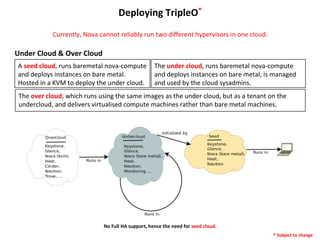
Deploying	
  TripleO*	
  
Currently,	
  Nova	
  cannot	
  reliably	
  run	
  two	
  different	
  hypervisors	
  in	
  one	
  cloud.	
  

Under	
  Cloud	
  &	
  Over	
  Cloud	
  
A	
  seed	
  cloud,	
  runs	
  baremetal	
  nova-­‐compute	
   The	
  under	
  cloud,	
  runs	
  baremetal	
  nova-­‐compute	
  
and	
  deploys	
  instances	
  on	
  bare	
  metal.	
  
and	
  deploys	
  instances	
  on	
  bare	
  metal,	
  is	
  managed	
  
Hosted	
  in	
  a	
  KVM	
  to	
  deploy	
  the	
  under	
  cloud.	
   and	
  used	
  by	
  the	
  cloud	
  sysadmins.	
  
The	
  over	
  cloud,	
  which	
  runs	
  using	
  the	
  same	
  images	
  as	
  the	
  under	
  cloud,	
  but	
  as	
  a	
  tenant	
  on	
  the	
  
undercloud,	
  and	
  delivers	
  virtualised	
  compute	
  machines	
  rather	
  than	
  bare	
  metal	
  machines.	
  

No	
  Full	
  HA	
  support,	
  hence	
  the	
  need	
  for	
  seed	
  cloud.	
  
*	
  Subject	
  to	
  change	
  
References	
  
hZps://wiki.openstack.org/wiki/TripleO	
  
hZps://github.com/openstack/tripleo-­‐incubator	
  
hZp://docs.openstack.org/developer/tripleo-­‐incubator/deploying.html	
  
hZp://docs.openstack.org/developer/tripleo-­‐incubator/devtest.html	


hZps://wiki.openstack.org/wiki/Baremetal	
  
hZps://wiki.openstack.org/wiki/BaremetalSplitRa1onale	
  
hZps://wiki.openstack.org/wiki/Ironic	


hZps://wiki.openstack.org/wiki/Heat	
  
hZps://github.com/openstack/tripleo-­‐heat-­‐templates	


hZps://github.com/openstack/diskimage-­‐builder	
  
hZps://github.com/openstack/tripleo-­‐image-­‐elements	


hZps://github.com/openstack/os-­‐apply-­‐config	
  
hZps://github.com/openstack/os-­‐refresh-­‐config	
  
hZps://github.com/openstack/os-­‐collect-­‐config	


Future	
  Development:	
  
•  Etherpads	
  of	
  Icehouse	
  (Next	
  release	
  of	
  OpenStack)	
  
•  Github	
  code	
  repositories	
  
•  Launchpad	
  –	
  Blueprints	
  &	
  Bug	
  Tracking	
  

TripleO

  • 1.
  • 2.
    Problem   Installing,  Upgrading  and  Opera1ng  OpenStack  Cloud  
  • 3.
  • 4.
    Cloud  Maintenance  Cycle   Entropy   H/W   Failure   Bugs   Install   Reconfigure   Upgrade   CI/CD   Golden   Images   HA   Setup  
  • 5.
    Pi;alls  of  current  approach   Cannot  deploy  OpenStack  easily  and  reliably.     •  Con1nuous  Integra1on  and  Con1nuous  Delivery     Ø  Ability  to  roll-­‐out  the  cloud  during  maintenance  cycles.   Ø  Deploy  something  that  is  tested    with  minimal  varia1ons  in  mul1ple  environments   (Dev./QA/Prod.)   •  Maintenance  and  Installa1on  Costs   Ø  Requires  more  efforts  to  roll-­‐out  the  cloud  incurring  in  more  costs  and  less  benefits   (one  1me  cost).   •  Complexity  in  installa1on  and  upgrade  processes.   •  Handling  migra1on  from  one  version  to  other  version  of  OpenStack.   •  No  single  tool  chain  or  API   Ø  Current  set  of  deployment  tools  have  awkward  hand  offs  and  do  not  have  seamless   integra1on.  
  • 6.
  • 7.
    TripleO   An  endeavor  to  drive  down  the  effort  required  to  deploy  an  OpenStack  cloud,  increase  the  reliability  of  deployments   and  configura?on  changes    and  consolidate  the  disparate  opera?ons  projects  around  OpenStack.   Design  Guidelines:   •  •  •  •  •  •  Robust  automa1on  to  do  CI  and  deployment  tes1ng  of  a  cloud  at  bare  metal  layer.   Customize  generic  disk  images  to  use  with  Nova  Bare  Metal  using  DISKIMAGE-­‐BUILDER.   Orchestrate  deployment  of  these  images  onto  bare  metal  using  HEAT.   Deploy  the  same  tested  images  to  produc1on  clouds  using  NOVA  BAREMETAL/IRONIC.   Create  configura1ons  on  disk  and  trigger  in-­‐instance  reconfigura1ons  using  OS-­‐*-­‐CONFIG.   Clean  interfaces  to  plug  other  alterna1ve  implementa1ons.  Ex:  Use  Puppet/Chef  for  configura1ons.  
  • 8.
    Benefits  of  TripleO   •  Driving  the  cost  of  opera1ons  down.   •  Increasing  reliability  of  deployments  and  consolida1ng  on  a  single  API  for  deploying  machine  images.   •  Use  of  gold  images  allows  one  to  test  precisely  what  will  be  running  in  produc1on  or  test  environment  -­‐   either  virtual  or  physical  and  provides  early  detec1on  of  many  issues.     •  Gold  image  also  ensures  that  there  is  no  varia1on  between  machines  in  produc1on  -­‐  no  late  discovery  of   version  conflicts,  for  instance.   •  Using  CI/CD  tes1ng  in  the  deployment  pipeline  gives  us:   Ø  Ability  to  deploy  something  that  has  been  tested.   Ø  No  means  to  invalidate  the  above  tests  (e.g.  kernel  version,  OpenStack  calls  etc.)   Ø  Implement  varia1ons  in  configura1ons  (e.g.  network  topology  could  vary  between  staging  and   produc1on.)   •  Use  of  cloud  APIs  for  bare  metal  deployment  permit  trivial  migra1on  of  machine  between  roles.   •  A  single  tool  chain  to  provision  and  deploy  onto  hardware  is  simpler  and  lower  cost  to  maintain  than   having  heterogeneous  systems.  
  • 9.
    Hypervisor  Driver  vs.  Bare  Metal  Driver   •  Tenant/Project  has  full  and  direct  access  to  the  hardware,  and  that  hardware  is  dedicated   to  a  single  instance.   •  Nova  does  not  have  any  access  to  manipulate  a  baremetal  instance  except  for  what  is   provided  at  the  hardware  level  and  exposed  over  the  network,  such  as  IPMI  control.     •  Some  func1onality  (instance  snapshots,  aZach  and  detach  network  volumes  to  a  running   instance)  implemented  by  other  hypervisor  drivers  is  not  available  via  the  baremetal  driver   •  Security  concerns  created  by  tenants  having  direct  access  to  the  network  (e.g.,  MAC   spoofing,  packet  sniffing,  etc.).   Ø  Other  hypervisors  mi1gate  this  with  virtualized  networking.   Ø  Neutron  +  OpenFlow  can  be  used  if  network  hardware  supports  it.   •  Public  cloud  images  may  not  work  on  some  hardware,  par1cularly  if  your  hardware   requires  addi1onal  drivers  to  be  loaded.  
  • 10.
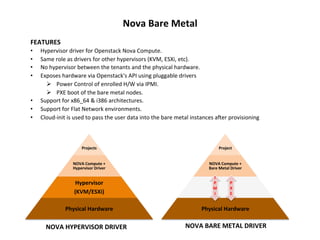
    Nova  Bare  Metal   FEATURES   •  •  •  •  •  •  •  Hypervisor  driver  for  Openstack  Nova  Compute.   Same  role  as  drivers  for  other  hypervisors  (KVM,  ESXi,  etc).   No  hypervisor  between  the  tenants  and  the  physical  hardware.   Exposes  hardware  via  Openstack's  API  using  pluggable  drivers   Ø  Power  Control  of  enrolled  H/W  via  IPMI.   Ø  PXE  boot  of  the  bare  metal  nodes.   Support  for  x86_64  &  i386  architectures.   Support  for  Flat  Network  environments.   Cloud-­‐init  is  used  to  pass  the  user  data  into  the  bare  metal  instances  ager  provisioning     Projects     Project   NOVA  Compute  +   Hypervisor  Driver   NOVA  Compute  +   Bare  Metal  Driver   Hypervisor   (KVM/ESXi)   Physical  Hardware   NOVA  HYPERVISOR  DRIVER   I   P   M   I   P   X   E   Physical  Hardware   NOVA  BARE  METAL  DRIVER  
  • 11.
    Bare  Metal  Driver  is  now  IRONIC   Mo?va?on  for  split   •  Maintain  ‘One  DB’  per  project.   •  Bare  Metal  Driver  needs  to  store  non-­‐Nova  details  in  a  separate  DB.   •  Create  separa1on  between  physical  and  virtual  environments   •  •  •  Remove  unnecessary  interac1ons.   HW  Specific  tasks  (HW  RAID,  Firmware  Updates  etc.).   Interac1ons  with  other  projects  –  Cinder,  Quantum  etc.   Ironic  is  s1ll  gekng  refactored  and  heavily  under  development.   Use  Nova  Bare  Metal  for  now.   Future  Plans  (implementa?on  to  be  done  in  Ironic)   •  •  •  •  •  •  •  •  Improve  performance/scalability  of  PXE  deployment  process.   BeZer  support  for  complex  non-­‐SDN  environments  (Ex:  sta1c  VLANs).   BeZer  integra1on  with  neutron-­‐dhcp.   Support  for  persistent  storage  through  Cinder.   Support  snapshot  and  migrate  of  baremetal  instances.   Support  non-­‐PXE  image  deployment.   Support  other  architectures  (arm,  1lepro).   Support  fault-­‐tolerance  of  baremetal  nova-­‐compute  node.  
  • 12.
    HEAT   •  •  •  •  OpenStack’s  orchestra1on  program.   An  orchestra1on  engine  to  launch  mul1ple  composite  cloud  applica1ons.   Heat  Orchestra1on  Templates(HOT)  are  text  files  that  are  treated  as  code.   Provides  OpenStack  na1ve  ReST  API  +  CloudForma1on-­‐compa1ble  Query  API.   Features:   •  Heat  template  describes  the  infrastructure  for  a  cloud  applica1on  in  a  text  file  that  is   readable  and  writable  by  humans,  and  can  be  checked  into  version  control.   •  Infrastructure  resources  can  be  described  as  servers,  floa1ng  ips,  volumes,  security   groups,  users.   •  Autoscaling  service  integrates  with  Ceilometer,  to  include  a  scaling  group  as  a   resource  in  a  template.   •  Templates  also  specify  the  rela1onships  between  resources  (e.g.  this  volume  is   connected  to  this  server).   •  Manages  the  whole  lifecycle  of  the  applica1on     •  Just  modify  the  template  when  you  need  to  change  your  infrastructure.   •  Heat  primarily  manages  infrastructure,  but  the  templates  integrate  well  with  sogware   configura1on  management  tools  such  as  Chef,  Puppet.   •  TripleO  specific  templates  are  maintained  as  tripleo-­‐heat-­‐templates   Ceilometer  -­‐>  OpenStack  Metering  Service  
  • 13.
    Heat  Services   heat     •  CLI  tool  to  communicates  with  the  heat-­‐api  and  execute  OpenStack-­‐na1ve  ReST   API  or  AWS  CloudForma1on  APIs.     •  End  developers  could  also  use  the  heat  REST  API  directly.     heat-­‐api     •  Provides  an  OpenStack-­‐na1ve  ReST  API  that  processes  API  requests  by  sending   them  to  the  heat-­‐engine  over  RPC.     heat-­‐api-­‐cfn     •  Provides  an  API  that  is  compa1ble  with  CloudForma1on  and  processes  API   requests  by  sending  them  to  the  heat-­‐engine  over  RPC.     heat-­‐engine     •  Orchestrate  the  launching  of  templates  and  provide  events  back  to  the  API   consumer.   tripleo-­‐heat-­‐templates   •  These  templates  provide  the  rules  describing  how  to  deploy  the  baremetal   undercloud  and  virtual  overclouds.    
  • 14.
    Heat  Architecture   Inputs   Parameters   Template   URL  or  Template  File  /  Parameter  Data   Data   Heat  CLI   ReST   Heat  ReST  API   AMQP   Heat  Engine   Outputs  
  • 15.
    Heat  Engine  Architecture   AMQP  Engine  API   Other   Opera?ons   Parser  API   Other  Opera?ons   Parser   Plugin  API   Resource  Plugin   autoscaling   db_instance   loadbalancer   user   subnet   route_table   net   port   OpenStack  Python     Client  APIs   OpenStack  Python  Clients  (python-­‐*-­‐client)   OpenStack  Project’s   ReST  APIs   OpenStack  Projects   router  
  • 16.
    Sample  HOT   parameters:! InstanceType:! type:string! description: Instance type to create! default: m1.small! hidden: False! constraints:! ­ allowed_values {m1.tiny, m1.small, m1.large}! resources:! MyInstance:! type: OS::Nova::Server! properties:! KeyName: { get_param: KeyName }! ImageId: { get_param: ImageId }! InstanceType: { get_param: InstanceType }! outputs:! InstanceIP:! description: The IP address of the instance! value: {get_attr: [MyInstance, PublicIP] }!
  • 17.
    Disk  Image  Builder   •  Responsible  for  building  disk  images,  file  system  &  ramdisk  images  to  use  with   OpenStack  (both  virtual  and  bare  metal).   •  Core  func1onality  includes  the  various  opera1ng  system  specific  modules  for  disk/   filesystem  images,  and  deployment  and  hardware  inventory  ramdisks.   •  Builds  an  image  by  set  of  hooks  –  root  image,  preinstall,  install  packages  &  perform   post  installa1on  steps.   •  An  image  build  is  parameterized  by  including  Elements,  where  elements  could  be   some  specific  s/w  you  wanted  to  install  or  add  some  plugin  for  a  specific  task.   •  During  an  image  build  process  most  of  the  things  get  cached,  like  pypi  packages,   yum/apt  packages.   tripleo-­‐image-­‐elements   •  These  elements  create  build-­‐1me  specialized  disk/par11on  images  for  TripleO.     •  The  elements  build  images  with  sogware  installed  but  not  configured  -­‐  and  hooks  to   configure  the  sogware  with  os-­‐apply-­‐config.   Limita?ons:   •  No  support  for  image  based  updates  yet.   •  Full  HA  is  not  yet  implemented.   •  Bootstrap  removal  is  not  yet  implemented  (depends  on  full  HA).  
  • 18.
    os-­‐*-­‐config   •  These  tools  work  with  metadata  that  is  delivered  by  Heat  to  create   configura1on  files  on  disk  (os-­‐apply-­‐config),  and  to  trigger  in-­‐instance   reconfigura1on  including  shukng  down  services  and  performing  data   migra1ons.   •  os-­‐apply-­‐config  reads  a  JSON  metadata  file  and  generates  templates.  It  can   be  used  with  any  orchestra1on  layer  that  generates  a  JSON  metadata  file   on  disk.   •  os-­‐refresh-­‐config  subscribes  to  the  Heat  metadata  and  then  invokes  hooks   -­‐  it  can  be  used  to  drive  os-­‐apply-­‐config,  or  Chef/Puppet/Salt  or  other   configura1on  management  tools.  
  • 19.
    Deploying  TripleO*   Currently,  Nova  cannot  reliably  run  two  different  hypervisors  in  one  cloud.   Under  Cloud  &  Over  Cloud   A  seed  cloud,  runs  baremetal  nova-­‐compute   The  under  cloud,  runs  baremetal  nova-­‐compute   and  deploys  instances  on  bare  metal.   and  deploys  instances  on  bare  metal,  is  managed   Hosted  in  a  KVM  to  deploy  the  under  cloud.   and  used  by  the  cloud  sysadmins.   The  over  cloud,  which  runs  using  the  same  images  as  the  under  cloud,  but  as  a  tenant  on  the   undercloud,  and  delivers  virtualised  compute  machines  rather  than  bare  metal  machines.   No  Full  HA  support,  hence  the  need  for  seed  cloud.   *  Subject  to  change  
  • 20.
    References   hZps://wiki.openstack.org/wiki/TripleO   hZps://github.com/openstack/tripleo-­‐incubator   hZp://docs.openstack.org/developer/tripleo-­‐incubator/deploying.html   hZp://docs.openstack.org/developer/tripleo-­‐incubator/devtest.html     hZps://wiki.openstack.org/wiki/Baremetal   hZps://wiki.openstack.org/wiki/BaremetalSplitRa1onale   hZps://wiki.openstack.org/wiki/Ironic     hZps://wiki.openstack.org/wiki/Heat   hZps://github.com/openstack/tripleo-­‐heat-­‐templates     hZps://github.com/openstack/diskimage-­‐builder   hZps://github.com/openstack/tripleo-­‐image-­‐elements     hZps://github.com/openstack/os-­‐apply-­‐config   hZps://github.com/openstack/os-­‐refresh-­‐config   hZps://github.com/openstack/os-­‐collect-­‐config     Future  Development:   •  Etherpads  of  Icehouse  (Next  release  of  OpenStack)   •  Github  code  repositories   •  Launchpad  –  Blueprints  &  Bug  Tracking