Tony Bourke
CCSI, CCNP DC, Former condescending Unix administrator @tbourke
Why OpenStack on UCS? An Intro to the Red Hat & Cisco
OpenStack Solution
SCOPE!
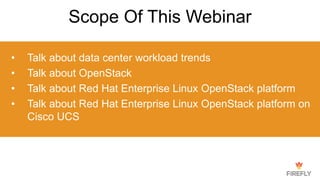
Scope Of This Webinar
• Talk about data center workload trends
• Talk about OpenStack
• Talk about Red Hat Enterprise Linux OpenStack platform
• Talk about Red Hat Enterprise Linux OpenStack platform on
Cisco UCS
 Some material in this presentation was sourced from the OpenStack.org
(an Apache 2.0 licensed project) and used here under the Creative
Commons License 3.0 or Apache 2.0 License.
 OpenStack Project: http://openstack.org
 OpenStack Documentation:
 Wiki.openstack.org (Creative Commons
http://creativecommons.org/licenses/by/3.0/legalcode)
 Docs.openstack.org (http://www.apache.org/licenses/LICENSE-2.0.html)
OpenStack Licensing/Attribution
DATA CENTER WORKLOAD TRENDS
Changes in Data Center Workloads
Moving from homogeneous workloads to heterogeneous
• Yay! More workloads means more goals achieved
• Ohh… How to manage the infrastructure of all these workloads
Moving from ticket/request based systems to self-service portals
• Yay! Users provision themselves!
• Ohh… Need to pick/maintain self-service portals
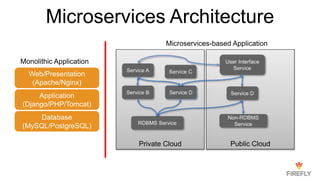
Microservices instead of 3-tierd Applications
• Yay! Allows for rapid development, deployment, iteration!
• Ohh… Requires much more agile deployments than traditional virtualization/IT
currently provides
Advent of OpenStack
• Yay! Open source cloud operating system!
• Ohh… Very difficult to deploy from source.
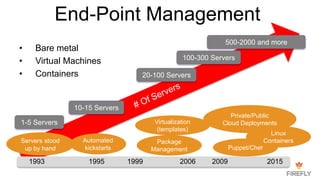
End-Point Management
• Bare metal
• Virtual Machines
• Containers
Servers stood
up by hand
Automated
kickstarts
Virtualization
(templates)
Private/Public
Cloud Deployments
Puppet/Chef
Linux
ContainersPackage
Management
1993 1995 1999 2006 2009 2015
1-5 Servers
10-15 Servers
20-100 Servers
100-300 Servers
500-2000 and more
Microservices Architecture
Web/Presentation
(Apache/Nginx)
Application
(Django/PHP/Tomcat)
Database
(MySQL/PostgreSQL)
Monolithic Application
Private Cloud Public Cloud
Microservices-based Application
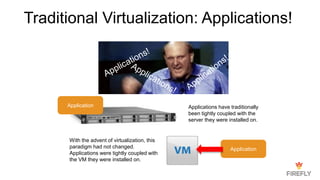
Traditional Virtualization: Applications!
Application
Applications have traditionally
been tightly coupled with the
server they were installed on.
With the advent of virtualization, this
paradigm had not changed.
Applications were tightly coupled with
the VM they were installed on.
Application
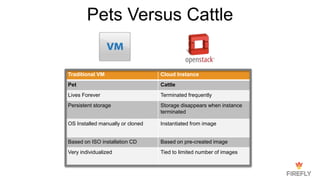
Pets Versus Cattle
Traditional VM Cloud Instance
Pet Cattle
Lives Forever Terminated frequently
Persistent storage Storage disappears when instance
terminated
OS Installed manually or cloned Instantiated from image
Based on ISO installation CD Based on pre-created image
Very individualized Tied to limited number of images
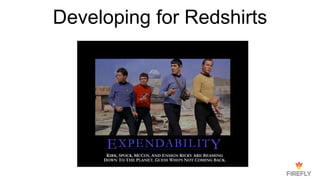
Developing for Redshirts
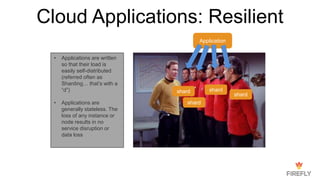
Cloud Applications: Resilient
Application
shard
shard
shard
shard
• Applications are written
so that their load is
easily self-distributed
(referred often as
Sharding… that’s with a
“d”)
• Applications are
generally stateless. The
loss of any instance or
node results in no
service disruption or
data loss
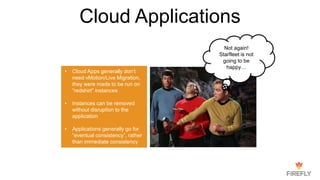
Cloud Applications
• Cloud Apps generally don’t
need vMotion/Live Migration,
they were made to be run on
“redshirt” instances
• Instances can be removed
without disruption to the
application
• Applications generally go for
“eventual consistency”, rather
than immediate consistency
Not again!
Starfleet is not
going to be
happy…
OPENSTACK
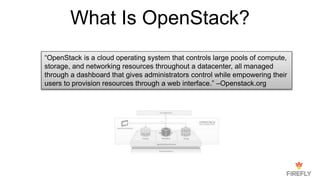
What Is OpenStack?
“OpenStack is a cloud operating system that controls large pools of compute,
storage, and networking resources throughout a datacenter, all managed
through a dashboard that gives administrators control while empowering their
users to provision resources through a web interface.” –Openstack.org
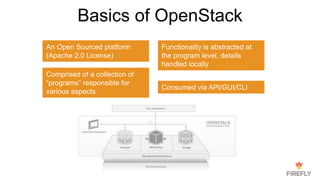
Basics of OpenStack
An Open Sourced platform
(Apache 2.0 License)
Comprised of a collection of
“programs” responsible for
various aspects
Functionality is abstracted at
the program level, details
handled locally
Consumed via API/GUI/CLI
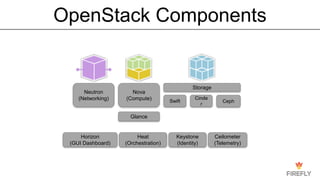
OpenStack Components
Nova
(Compute)
Neutron
(Networking)
Storage
Swift
Cinde
r
Glance
Keystone
(Identity)
Heat
(Orchestration)
Ceph
Horizon
(GUI Dashboard)
Ceilometer
(Telemetry)
Neutron
(Networking)
Horizon
(GUI Dashboard)
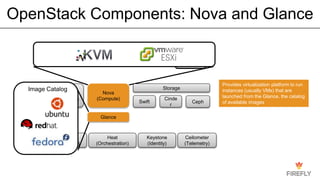
OpenStack Components: Nova and Glance
Horizon
Provides virtualization platform to run
instances (usually VMs) that are
launched from the Glance, the catalog
of available images
Nova
(Compute)
Storage
Swift
Cinde
r
Glance
Keystone
(Identity)
Heat
(Orchestration)
Ceph
Ceilometer
(Telemetry)
Image Catalog
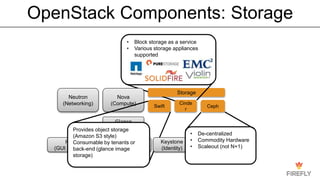
OpenStack Components: Storage
Keystone
• Block storage as a service
• Various storage appliances
supported
Nova
(Compute)
Neutron
(Networking)
Storage
Swift
Cinde
r
Glance
Keystone
(Identity)
Heat
(Orchestration)
Ceph
Horizon
(GUI Dashboard)
Ceilometer
(Telemetry)
Provides object storage
(Amazon S3 style)
Consumable by tenants or
back-end (glance image
storage)
• De-centralized
• Commodity Hardware
• Scaleout (not N+1)
Nova
(Compute)
Neutron
(Networking)
Storage
Swift
Cinde
r
Glance
Keystone
(Identity)
Heat
(Orchestration)
Ceph
Horizon
(GUI Dashboard)
Ceilometer
(Telemetry)
Identity/Authorization
Storage
Swift Cinder
Horizon
• Data store of users, projects
(tenants), roles
• Can incorporate authentication
back-end (such as LDAP)
• Provide tokens for access from
APIs
{"token": {"methods": ["password"], "roles": [{"id":
"c703057be878458588961ce9a0ce686b", "name": "admin"}],
"expires_at":
"2014-06-10T21:40:14.360795Z", "project": {"domain":
{"id": "default",
"name": "Default"}, "id":
"3d4c2c82bd5948f0bcab0cf3a7c9b48c", "name":
"demo"}, "catalog": [{"endpoints": [{"url":
"http://localhost:35357/v2.0", "region": "RegionOne",
"interface": "admin",
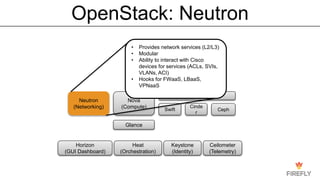
OpenStack: Neutron
Nova
(Compute)
Neutron
(Networking)
Storage
Swift
Cinde
r
Glance
Keystone
(Identity)
Heat
(Orchestration)
Ceph
Horizon
(GUI Dashboard)
Ceilometer
(Telemetry)
• Provides network services (L2/L3)
• Modular
• Ability to interact with Cisco
devices for services (ACLs, SVIs,
VLANs, ACI)
• Hooks for FWaaS, LBaaS,
VPNaaS
Nova
(Compute)
Neutron
(Networking)
Storage
Swift Cinder
Glance
Keystone
(Identity)
Heat
(Orchestration)
Ceph
Horizon
(GUI Dashboard)
Ceilometer
(Telemetry)
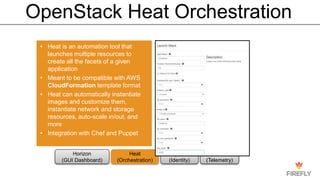
OpenStack Heat Orchestration
• Heat is an automation tool that
launches multiple resources to
create all the facets of a given
application
• Meant to be compatible with AWS
CloudFormation template format
• Heat can automatically instantiate
images and customize them,
instantiate network and storage
resources, auto-scale in/out, and
more
• Integration with Chef and Puppet
UCS AND OPENSTACK
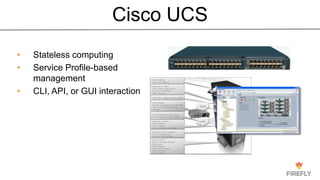
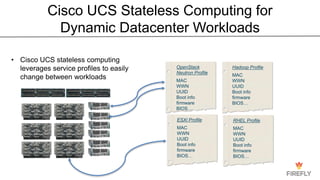
Cisco UCS
• Stateless computing
• Service Profile-based
management
• CLI, API, or GUI interaction
Cisco UCS Stateless Computing for
Dynamic Datacenter Workloads
• Cisco UCS stateless computing
leverages service profiles to easily
change between workloads
OpenStack
Neutron Profile
MAC
WWN
UUID
Boot info
firmware
BIOS…
Hadoop Profile
MAC
WWN
UUID
Boot info
firmware
BIOS…
ESXi Profile
MAC
WWN
UUID
Boot info
firmware
BIOS…
RHEL Profile
MAC
WWN
UUID
Boot info
firmware
BIOS…
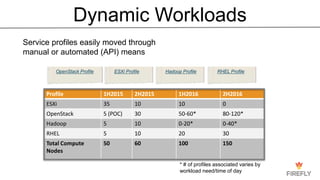
Dynamic Workloads
OpenStack Profile ESXi Profile
Profile 1H2015 2H2015 1H2016 2H2016
ESXi 35 10 10 0
OpenStack 5 (POC) 30 50-60* 80-120*
Hadoop 5 10 0-20* 0-40*
RHEL 5 10 20 30
Total Compute
Nodes
50 60 100 150
Hadoop Profile RHEL Profile
* # of profiles associated varies by
workload need/time of day
Service profiles easily moved through
manual or automated (API) means
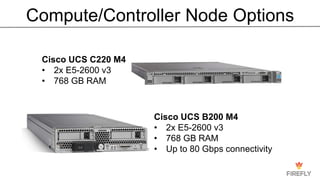
Compute/Controller Node Options
Cisco UCS C220 M4
• 2x E5-2600 v3
• 768 GB RAM
Cisco UCS B200 M4
• 2x E5-2600 v3
• 768 GB RAM
• Up to 80 Gbps connectivity
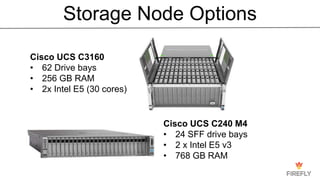
Storage Node Options
Cisco UCS C3160
• 62 Drive bays
• 256 GB RAM
• 2x Intel E5 (30 cores)
Cisco UCS C240 M4
• 24 SFF drive bays
• 2 x Intel E5 v3
• 768 GB RAM
RED HAT ENTERPRISE LINUX
OPENSTACK PLATFORM
OpenStack Is Great But…
OpenStack is a great platform for operating your private
cloud, but…
You need to pick a distribution. Like Linux, OpenStack exists
mostly as various distributions
And Red Hat makes a leading distribution, Red Hat Enterprise
Linux OpenStack Platform
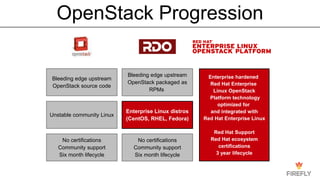
OpenStack Progression
Enterprise hardened
Red Hat Enterprise
Linux OpenStack
Platform technology
optimized for
and integrated with
Red Hat Enterprise Linux
Red Hat Support
Red Hat ecosystem
certifications
3 year lifecycle
Bleeding edge upstream
OpenStack source code
Unstable community Linux
No certifications
Community support
Six month lifecycle
Bleeding edge upstream
OpenStack packaged as
RPMs
Enterprise Linux distros
(CentOS, RHEL, Fedora)
No certifications
Community support
Six month lifecycle
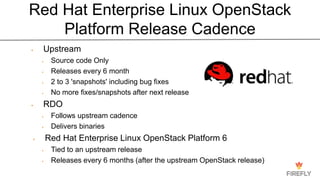
 Upstream
 Source code Only
 Releases every 6 month
 2 to 3 'snapshots' including bug fixes
 No more fixes/snapshots after next release
 RDO
 Follows upstream cadence
 Delivers binaries
 Red Hat Enterprise Linux OpenStack Platform 6
 Tied to an upstream release
 Releases every 6 months (after the upstream OpenStack release)
Red Hat Enterprise Linux OpenStack
Platform Release Cadence
Red Hat Enterprise Linux
OpenStack Platform
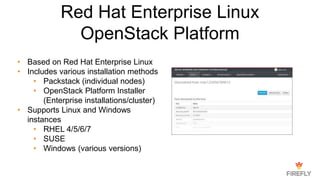
• Based on Red Hat Enterprise Linux
• Includes various installation methods
• Packstack (individual nodes)
• OpenStack Platform Installer
(Enterprise installations/cluster)
• Supports Linux and Windows
instances
• RHEL 4/5/6/7
• SUSE
• Windows (various versions)
More Information
• Red Hat Enterprise Linux OpenStack Platform:
http://www.redhat.com/en/insights/openstack
• Cisco UCS: http://www.cisco.com/c/en/us/products/servers-unified-
computing/index.html
• Cisco UCS Red Hat Enterprise Linux OpenStack Platform Cisco Validated Design:
http://www.cisco.com/c/dam/en/us/td/docs/unified_computing/ucs/UCS_CVDs/ucs_r
hos.pdf
Q&A
@tbourke
www.fireflyeducate.com
Thank you!

Why OpenStack on UCS? An Introduction to Red Hat and Cisco OpenStack Solution

  • 1.
    Tony Bourke CCSI, CCNPDC, Former condescending Unix administrator @tbourke Why OpenStack on UCS? An Intro to the Red Hat & Cisco OpenStack Solution
  • 2.
  • 3.
    Scope Of ThisWebinar • Talk about data center workload trends • Talk about OpenStack • Talk about Red Hat Enterprise Linux OpenStack platform • Talk about Red Hat Enterprise Linux OpenStack platform on Cisco UCS
  • 4.
     Some materialin this presentation was sourced from the OpenStack.org (an Apache 2.0 licensed project) and used here under the Creative Commons License 3.0 or Apache 2.0 License.  OpenStack Project: http://openstack.org  OpenStack Documentation:  Wiki.openstack.org (Creative Commons http://creativecommons.org/licenses/by/3.0/legalcode)  Docs.openstack.org (http://www.apache.org/licenses/LICENSE-2.0.html) OpenStack Licensing/Attribution
  • 5.
  • 6.
    Changes in DataCenter Workloads Moving from homogeneous workloads to heterogeneous • Yay! More workloads means more goals achieved • Ohh… How to manage the infrastructure of all these workloads Moving from ticket/request based systems to self-service portals • Yay! Users provision themselves! • Ohh… Need to pick/maintain self-service portals Microservices instead of 3-tierd Applications • Yay! Allows for rapid development, deployment, iteration! • Ohh… Requires much more agile deployments than traditional virtualization/IT currently provides Advent of OpenStack • Yay! Open source cloud operating system! • Ohh… Very difficult to deploy from source.
  • 7.
    End-Point Management • Baremetal • Virtual Machines • Containers Servers stood up by hand Automated kickstarts Virtualization (templates) Private/Public Cloud Deployments Puppet/Chef Linux ContainersPackage Management 1993 1995 1999 2006 2009 2015 1-5 Servers 10-15 Servers 20-100 Servers 100-300 Servers 500-2000 and more
  • 8.
  • 9.
    Traditional Virtualization: Applications! Application Applicationshave traditionally been tightly coupled with the server they were installed on. With the advent of virtualization, this paradigm had not changed. Applications were tightly coupled with the VM they were installed on. Application
  • 10.
    Pets Versus Cattle TraditionalVM Cloud Instance Pet Cattle Lives Forever Terminated frequently Persistent storage Storage disappears when instance terminated OS Installed manually or cloned Instantiated from image Based on ISO installation CD Based on pre-created image Very individualized Tied to limited number of images
  • 11.
  • 12.
    Cloud Applications: Resilient Application shard shard shard shard •Applications are written so that their load is easily self-distributed (referred often as Sharding… that’s with a “d”) • Applications are generally stateless. The loss of any instance or node results in no service disruption or data loss
  • 13.
    Cloud Applications • CloudApps generally don’t need vMotion/Live Migration, they were made to be run on “redshirt” instances • Instances can be removed without disruption to the application • Applications generally go for “eventual consistency”, rather than immediate consistency Not again! Starfleet is not going to be happy…
  • 14.
  • 15.
    What Is OpenStack? “OpenStackis a cloud operating system that controls large pools of compute, storage, and networking resources throughout a datacenter, all managed through a dashboard that gives administrators control while empowering their users to provision resources through a web interface.” –Openstack.org
  • 16.
    Basics of OpenStack AnOpen Sourced platform (Apache 2.0 License) Comprised of a collection of “programs” responsible for various aspects Functionality is abstracted at the program level, details handled locally Consumed via API/GUI/CLI
  • 17.
  • 18.
    Neutron (Networking) Horizon (GUI Dashboard) OpenStack Components:Nova and Glance Horizon Provides virtualization platform to run instances (usually VMs) that are launched from the Glance, the catalog of available images Nova (Compute) Storage Swift Cinde r Glance Keystone (Identity) Heat (Orchestration) Ceph Ceilometer (Telemetry) Image Catalog
  • 19.
    OpenStack Components: Storage Keystone •Block storage as a service • Various storage appliances supported Nova (Compute) Neutron (Networking) Storage Swift Cinde r Glance Keystone (Identity) Heat (Orchestration) Ceph Horizon (GUI Dashboard) Ceilometer (Telemetry) Provides object storage (Amazon S3 style) Consumable by tenants or back-end (glance image storage) • De-centralized • Commodity Hardware • Scaleout (not N+1)
  • 20.
    Nova (Compute) Neutron (Networking) Storage Swift Cinde r Glance Keystone (Identity) Heat (Orchestration) Ceph Horizon (GUI Dashboard) Ceilometer (Telemetry) Identity/Authorization Storage Swift Cinder Horizon •Data store of users, projects (tenants), roles • Can incorporate authentication back-end (such as LDAP) • Provide tokens for access from APIs {"token": {"methods": ["password"], "roles": [{"id": "c703057be878458588961ce9a0ce686b", "name": "admin"}], "expires_at": "2014-06-10T21:40:14.360795Z", "project": {"domain": {"id": "default", "name": "Default"}, "id": "3d4c2c82bd5948f0bcab0cf3a7c9b48c", "name": "demo"}, "catalog": [{"endpoints": [{"url": "http://localhost:35357/v2.0", "region": "RegionOne", "interface": "admin",
  • 21.
    OpenStack: Neutron Nova (Compute) Neutron (Networking) Storage Swift Cinde r Glance Keystone (Identity) Heat (Orchestration) Ceph Horizon (GUI Dashboard) Ceilometer (Telemetry) •Provides network services (L2/L3) • Modular • Ability to interact with Cisco devices for services (ACLs, SVIs, VLANs, ACI) • Hooks for FWaaS, LBaaS, VPNaaS
  • 22.
    Nova (Compute) Neutron (Networking) Storage Swift Cinder Glance Keystone (Identity) Heat (Orchestration) Ceph Horizon (GUI Dashboard) Ceilometer (Telemetry) OpenStackHeat Orchestration • Heat is an automation tool that launches multiple resources to create all the facets of a given application • Meant to be compatible with AWS CloudFormation template format • Heat can automatically instantiate images and customize them, instantiate network and storage resources, auto-scale in/out, and more • Integration with Chef and Puppet
  • 23.
  • 24.
    Cisco UCS • Statelesscomputing • Service Profile-based management • CLI, API, or GUI interaction
  • 25.
    Cisco UCS StatelessComputing for Dynamic Datacenter Workloads • Cisco UCS stateless computing leverages service profiles to easily change between workloads OpenStack Neutron Profile MAC WWN UUID Boot info firmware BIOS… Hadoop Profile MAC WWN UUID Boot info firmware BIOS… ESXi Profile MAC WWN UUID Boot info firmware BIOS… RHEL Profile MAC WWN UUID Boot info firmware BIOS…
  • 26.
    Dynamic Workloads OpenStack ProfileESXi Profile Profile 1H2015 2H2015 1H2016 2H2016 ESXi 35 10 10 0 OpenStack 5 (POC) 30 50-60* 80-120* Hadoop 5 10 0-20* 0-40* RHEL 5 10 20 30 Total Compute Nodes 50 60 100 150 Hadoop Profile RHEL Profile * # of profiles associated varies by workload need/time of day Service profiles easily moved through manual or automated (API) means
  • 27.
    Compute/Controller Node Options CiscoUCS C220 M4 • 2x E5-2600 v3 • 768 GB RAM Cisco UCS B200 M4 • 2x E5-2600 v3 • 768 GB RAM • Up to 80 Gbps connectivity
  • 28.
    Storage Node Options CiscoUCS C3160 • 62 Drive bays • 256 GB RAM • 2x Intel E5 (30 cores) Cisco UCS C240 M4 • 24 SFF drive bays • 2 x Intel E5 v3 • 768 GB RAM
  • 29.
    RED HAT ENTERPRISELINUX OPENSTACK PLATFORM
  • 30.
    OpenStack Is GreatBut… OpenStack is a great platform for operating your private cloud, but… You need to pick a distribution. Like Linux, OpenStack exists mostly as various distributions And Red Hat makes a leading distribution, Red Hat Enterprise Linux OpenStack Platform
  • 31.
    OpenStack Progression Enterprise hardened RedHat Enterprise Linux OpenStack Platform technology optimized for and integrated with Red Hat Enterprise Linux Red Hat Support Red Hat ecosystem certifications 3 year lifecycle Bleeding edge upstream OpenStack source code Unstable community Linux No certifications Community support Six month lifecycle Bleeding edge upstream OpenStack packaged as RPMs Enterprise Linux distros (CentOS, RHEL, Fedora) No certifications Community support Six month lifecycle
  • 32.
     Upstream  Sourcecode Only  Releases every 6 month  2 to 3 'snapshots' including bug fixes  No more fixes/snapshots after next release  RDO  Follows upstream cadence  Delivers binaries  Red Hat Enterprise Linux OpenStack Platform 6  Tied to an upstream release  Releases every 6 months (after the upstream OpenStack release) Red Hat Enterprise Linux OpenStack Platform Release Cadence
  • 33.
    Red Hat EnterpriseLinux OpenStack Platform • Based on Red Hat Enterprise Linux • Includes various installation methods • Packstack (individual nodes) • OpenStack Platform Installer (Enterprise installations/cluster) • Supports Linux and Windows instances • RHEL 4/5/6/7 • SUSE • Windows (various versions)
  • 34.
    More Information • RedHat Enterprise Linux OpenStack Platform: http://www.redhat.com/en/insights/openstack • Cisco UCS: http://www.cisco.com/c/en/us/products/servers-unified- computing/index.html • Cisco UCS Red Hat Enterprise Linux OpenStack Platform Cisco Validated Design: http://www.cisco.com/c/dam/en/us/td/docs/unified_computing/ucs/UCS_CVDs/ucs_r hos.pdf
  • 35.
  • 36.