
EFFECTIVENESS OF THE TRIPLE-LAYER HERMETIC BAG
IN CONTROLLING PROSTEPHANUS TUNCATUS (HORN)
(COLEOPTERA: BOSTRICHIDAE) AND SITOPHILUS
ZEAMAIS (MOT.) (COLEOPTERA: CURCULIONIDAE) ON
STORED MAIZE
BY
ANANKWARE PAARECHUGA JACOB
SUPERVISORS: PROF. D. OBENG-OFORI, PROF. K. AFREH-
NUAMAH & DR. FATUNBI OLUWOLE.
OUTLINE OF PRESENTATION
 INTRODUCTION
 JUSTIFICATION
 OBJECTIVES
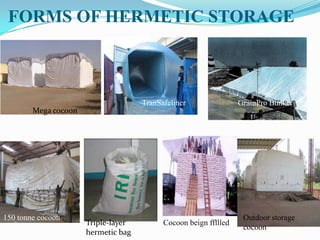
 FORMS OF HERMERTIC STORAGE
 MATERIALS AND METHODS
 LABORATORY EXPERIMENTS
 RESULTS AND DISCUSSION
 CONCLUSIONS AND RECOMMENDATIONS
INTRODUCTION
 Maize (Zea mais L, from Spanish: maíz after Taíno mahiz) is a
common name for the cereal grass widely grown for food and livestock
fodder (Faostat, 2009).
 It ranks with wheat and rice as one of the world’s chief grain crops (Anon,
2012). The global production of maize is estimated to be 817 million metric
tons annually (Faostat, 2009).
 In Sub-Saharan Africa, maize is one of the most important grain staples for
agricultural income and caloric intake, accounting for nearly 20% of the
plant-based food supply (Jones et al., 2011).
 The current value of maize production in Ghana is approximately US $
400,000,000 a year.
 Post-harvest grain storage in Ghana and other developing countries of the
world is a major constraint.
INTRODUCTION CONT’D
 Stored maize is attacked by 20 different species of insect pests including the
maize weevil, Sitophilus zeamais (Mot) (Coleoptera: Curculionidae) and the
Larger Grain Borer (LGB), Prostephanus truncatus (Horn) (Coleoptera:
Bostrichidae).
 Insect pest damage to stored grain results in major economic losses to farmers
throughout the world (Obeng-Ofori, 2008).
 Millions of rural farmers in Africa produce maize, but completely lack access
to post-harvest storage technology. This situation forces small producers to
sell their maize at the time of harvest, with the disadvantage of low market
prices.
 To minimize post-harvest losses of cereals, the Forum for Agricultural
Research in Africa (FARA) has developed programs to promote the use of
appropriate and effective technologies to support small scale farmers’ in sub-
Saharan Africa.
JUSTIFICATION
 Hermetic storage in metal drums is known to provide good control of all
storage insect pests including the Larger Grain Borer (Giles and Leon,
1974).
 However, the high initial cost of drums in some areas and the tendency for
people to use them for other purposes such as water storage limits their use
in rural grain storage. Plastic bags provide a cheaper alternative but insects
tend to perforate the bags, even if the grain is fumigated initially.
 Triple-layer hermetic bags have been used to control cowpea bruchids,
Callosobruchus maculatus (F) (Murdock et al., 2003) on cowpea,
Dinoderus spp and P. truncatus on cassava chips (Hell et al., 2010) with
very promising results.
 However, little is known about the effect of the triple layer bags on LGB in
stored maize, hence, the need for this research.
OBJECTIVES
 The goal of the study was to evaluate the effectiveness of the multi-layer
hermetic bags for the protection of stored maize against infestation by S.
zeamais and P. truncatus.
Specific objectives:
 Determine the effectiveness of hermetic triple bagging in controlling P.
truncatus and S. zeamais;
 Assess the percentage viability of the varieties of maize after hermetic storage;
 Determine the period for total depletion of oxygen in the triple bags;
 Assess the socio-economic benefit of the triple-layer hermetic bag storage
technology.
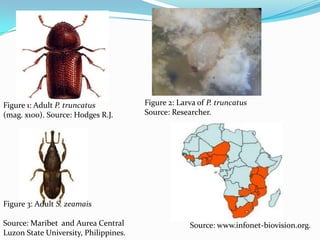
Figure 1: Adult P. truncatus
(mag. x100). Source: Hodges R.J.
Figure 2: Larva of P. truncatus
Source: Researcher.
Figure 3: Adult S. zeamais
Source: Maribet and Aurea Central
Luzon State University, Philippines.
Source: www.infonet-biovision.org.
HERMETIC STORAGE, ORIGIN & TYPES
What is hermetic storage?
We have three types of hermetic storage, these are;
a) Organic-Hermetic storage
b) Vacuum-Hermetic Fumigation(V-HF)
c) Gas-Hermetic Fumigation (G-HF)
These methods create a low oxygen modified atmosphere
which results in 100 % insect mortality of all life stages in a
few days to two weeks as well as preventing mold
development.
FORMS OF HERMETIC STORAGE
Mega cocoon
TranSafeliner GrainPro Bunker
150 tonne cocoon
Cocoon beign ffllled
Outdoor storage
cocoon
Triple-layer
hermetic bag
MATERIALS AND METHODS
 Experimental site
 Source of maize varieties
 Moisture content of maize used in the study
 Characteristics of the triple layer hermetic bags used
 Culturing of experimental insects
LABORATORY EXPERIMENTS
Effectiveness of the triple-layer bag against P. truncatus and S. zeamais
 This experiment compared the effectiveness of the triple-layer hermetic bag
with two other conventional storage.
 Three maize varieties (Obatampa, Abrodenkye and kamangkpong) were
divided into three groups, that is, A, B and C, respectively.
 Each of these maize samples weighing about 5 kg was put into each triple
layer hermetic bag and replicated 3 times.
 Fifty (50) unsexed LGBs from the culture were introduced (using camels hair
brush) into each of the maize samples.
DETERMINING % DAMAGE, WEIGHT LOSS, MOISTURE
CONTENT, AND % GERMINATION
 Two different sets of experiments were conducted; each for P. truncatus and
S. zeamais.
 Each set was sampled after one month (4 weeks), two (8 weeks), three (12
weeks) up to the sixth (24 weeks) month of storage.
 At each sampling occasion, the contents of each experimental bag were
sieved using a set of USA standard sieve series (Nos. 10 to 35).
 Adult insects and grains were collected separately.
 After sieving, each grain sample was divided into sub-samples by the cone
and quarter method.
 These sub-samples were used for the determination of the moisture content,
percentage damage, weight loss and the germination potential.
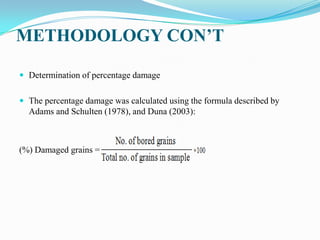
METHODOLOGY CON’T
 Determination of percentage damage
 The percentage damage was calculated using the formula described by
Adams and Schulten (1978), and Duna (2003):
(%) Damaged grains =
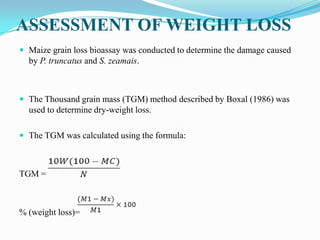
ASSESSMENT OF WEIGHT LOSS
 Maize grain loss bioassay was conducted to determine the damage caused
by P. truncatus and S. zeamais.
 The Thousand grain mass (TGM) method described by Boxal (1986) was
used to determine dry-weight loss.
 The TGM was calculated using the formula:
TGM =
% (weight loss)=
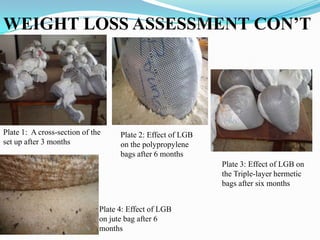
WEIGHT LOSS ASSESSMENT CON’T
Plate 1: A cross-section of the
set up after 3 months
Plate 2: Effect of LGB
on the polypropylene
bags after 6 months
Plate 3: Effect of LGB on
the Triple-layer hermetic
bags after six months
Plate 4: Effect of LGB
on jute bag after 6
months
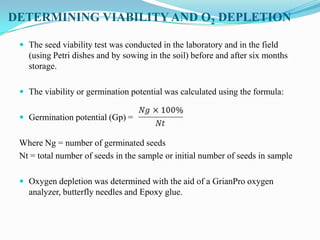
DETERMINING VIABILITY AND O2 DEPLETION
 The seed viability test was conducted in the laboratory and in the field
(using Petri dishes and by sowing in the soil) before and after six months
storage.
 The viability or germination potential was calculated using the formula:
 Germination potential (Gp) =
Where Ng = number of germinated seeds
Nt = total number of seeds in the sample or initial number of seeds in sample
 Oxygen depletion was determined with the aid of a GrianPro oxygen
analyzer, butterfly needles and Epoxy glue.
SOCIO-ECONOMIC BENEFIT ANALYSIS
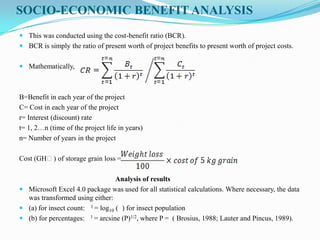
 This was conducted using the cost-benefit ratio (BCR).
 BCR is simply the ratio of present worth of project benefits to present worth of project costs.
 Mathematically,
B=Benefit in each year of the project
C= Cost in each year of the project
r= Interest (discount) rate
t= 1, 2…n (time of the project life in years)
n= Number of years in the project
Cost (GHȼ) of storage grain loss =
Analysis of results
 Microsoft Excel 4.0 package was used for all statistical calculations. Where necessary, the data
was transformed using either:
 (a) for insect count: 1 = log10 ( ) for insect population
 (b) for percentages: 1 = arcsine (P)1/2, where P = ( Brosius, 1988; Lauter and Pincus, 1989).
RESULTS AND DISCUSSION
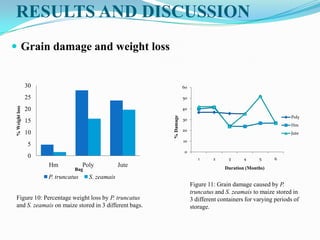
 Grain damage and weight loss
0
5
10
15
20
25
30
Hm Poly Jute
P. truncatus S. zeamais
%Weightloss
Bag
Figure 10: Percentage weight loss by P. truncatus
and S. zeamais on maize stored in 3 different bags.
0
10
20
30
40
50
60
1 2 3 4 5 6
Poly
Hm
Jute
%Damage
Duration (Months)
Figure 11: Grain damage caused by P.
truncatus and S. zeamais to maize stored in
3 different containers for varying periods of
storage.
MOISTURE CONTENT AND PERCENTAGE
GERMINATION
0
2
4
6
8
10
12
14
16
18
1 2 3 4 5 6
Hm
Jute
Poly
Moisturecontent(%)
Sorage duration (months)
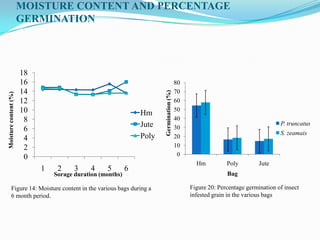
Figure 14: Moisture content in the various bags during a
6 month period.
0
10
20
30
40
50
60
70
80
Hm Poly Jute
P. truncatus
S. zeamais
Germination(%)
Bag
Figure 20: Percentage germination of insect
infested grain in the various bags
NUMBER OF LIVE INSECTS
0
100
200
300
400
500
600
700
800
900
Hm Poly Jute
P. truncatus S. zeamais
No.ofliveinsects/kggrain
Bag
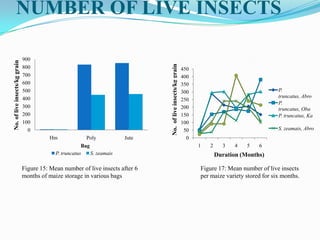
Figure 15: Mean number of live insects after 6
months of maize storage in various bags
0
50
100
150
200
250
300
350
400
450
1 2 3 4 5 6
P.
truncatus, Abro
P.
truncatus, Oba
P. truncatus, Ka
S. zeamais, Abro
No.ofliveinsects/kggrain
Duration (Months)
Figure 17: Mean number of live insects
per maize variety stored for six months.
DAILY TEMPERATURE, DEW POINT AND RELATIVE
HUMIDITY
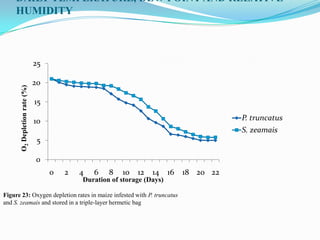
0
5
10
15
20
25
0 2 4 6 8 10 12 14 16 18 20 22
P. truncatus
S. zeamais
O2Depletionrate(%)
Duration of storage (Days)
Figure 23: Oxygen depletion rates in maize infested with P. truncatus
and S. zeamais and stored in a triple-layer hermetic bag
CONCLUSION AND RECOMMENDATIONS
 All three maize varieties were susceptible to P. truncatus and S. zeamais.
 It is possible to protect maize against P. truncatus and S. zeamias using the
triple-layer hermetic bag.
 The triple-layer hermetic bag is more cost-effective than the jute and
polypropylene bags.
 Temperature, dew point and relative humidity variations are minimal in
triple-layer hermetic bags than in conventional storage.
 Water ingress from the surrounding environment is almost absent in triple-
layer hermetic bags while jute and polypropylene bags cannot prevent that.
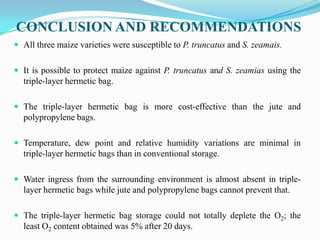
 The triple-layer hermetic bag storage could not totally deplete the O2; the
least O2 content obtained was 5% after 20 days.
CONCLUSION AND RECOMMENDATIONS
CONT’D
 The triple-layer hermetic bag has the potential to control P. truncatus and S.
zeamais in stored grain.
Recommendations
 Further studies should include investigations on effects of climate and
increased temperatures on the effectiveness and longevity of the three layer
hermetic bags.
 The development of biodegradable triple-layer bags that combines different
defense mechanisms.
 The high density polypropylene (HDP) bags should be the preferred if
available since they have least oxygen permeability.
 Knowledge gaps need to be filled to support farmers’ decision in the choice
of appropriate storage systems.

Triple layer plastic bag

  • 2.
    EFFECTIVENESS OF THETRIPLE-LAYER HERMETIC BAG IN CONTROLLING PROSTEPHANUS TUNCATUS (HORN) (COLEOPTERA: BOSTRICHIDAE) AND SITOPHILUS ZEAMAIS (MOT.) (COLEOPTERA: CURCULIONIDAE) ON STORED MAIZE BY ANANKWARE PAARECHUGA JACOB SUPERVISORS: PROF. D. OBENG-OFORI, PROF. K. AFREH- NUAMAH & DR. FATUNBI OLUWOLE.
  • 3.
    OUTLINE OF PRESENTATION INTRODUCTION  JUSTIFICATION  OBJECTIVES  FORMS OF HERMERTIC STORAGE  MATERIALS AND METHODS  LABORATORY EXPERIMENTS  RESULTS AND DISCUSSION  CONCLUSIONS AND RECOMMENDATIONS
  • 4.
    INTRODUCTION  Maize (Zeamais L, from Spanish: maíz after Taíno mahiz) is a common name for the cereal grass widely grown for food and livestock fodder (Faostat, 2009).  It ranks with wheat and rice as one of the world’s chief grain crops (Anon, 2012). The global production of maize is estimated to be 817 million metric tons annually (Faostat, 2009).  In Sub-Saharan Africa, maize is one of the most important grain staples for agricultural income and caloric intake, accounting for nearly 20% of the plant-based food supply (Jones et al., 2011).  The current value of maize production in Ghana is approximately US $ 400,000,000 a year.  Post-harvest grain storage in Ghana and other developing countries of the world is a major constraint.
  • 5.
    INTRODUCTION CONT’D  Storedmaize is attacked by 20 different species of insect pests including the maize weevil, Sitophilus zeamais (Mot) (Coleoptera: Curculionidae) and the Larger Grain Borer (LGB), Prostephanus truncatus (Horn) (Coleoptera: Bostrichidae).  Insect pest damage to stored grain results in major economic losses to farmers throughout the world (Obeng-Ofori, 2008).  Millions of rural farmers in Africa produce maize, but completely lack access to post-harvest storage technology. This situation forces small producers to sell their maize at the time of harvest, with the disadvantage of low market prices.  To minimize post-harvest losses of cereals, the Forum for Agricultural Research in Africa (FARA) has developed programs to promote the use of appropriate and effective technologies to support small scale farmers’ in sub- Saharan Africa.
  • 6.
    JUSTIFICATION  Hermetic storagein metal drums is known to provide good control of all storage insect pests including the Larger Grain Borer (Giles and Leon, 1974).  However, the high initial cost of drums in some areas and the tendency for people to use them for other purposes such as water storage limits their use in rural grain storage. Plastic bags provide a cheaper alternative but insects tend to perforate the bags, even if the grain is fumigated initially.  Triple-layer hermetic bags have been used to control cowpea bruchids, Callosobruchus maculatus (F) (Murdock et al., 2003) on cowpea, Dinoderus spp and P. truncatus on cassava chips (Hell et al., 2010) with very promising results.  However, little is known about the effect of the triple layer bags on LGB in stored maize, hence, the need for this research.
  • 7.
    OBJECTIVES  The goalof the study was to evaluate the effectiveness of the multi-layer hermetic bags for the protection of stored maize against infestation by S. zeamais and P. truncatus. Specific objectives:  Determine the effectiveness of hermetic triple bagging in controlling P. truncatus and S. zeamais;  Assess the percentage viability of the varieties of maize after hermetic storage;  Determine the period for total depletion of oxygen in the triple bags;  Assess the socio-economic benefit of the triple-layer hermetic bag storage technology.
  • 8.
    Figure 1: AdultP. truncatus (mag. x100). Source: Hodges R.J. Figure 2: Larva of P. truncatus Source: Researcher. Figure 3: Adult S. zeamais Source: Maribet and Aurea Central Luzon State University, Philippines. Source: www.infonet-biovision.org.
  • 9.
    HERMETIC STORAGE, ORIGIN& TYPES What is hermetic storage? We have three types of hermetic storage, these are; a) Organic-Hermetic storage b) Vacuum-Hermetic Fumigation(V-HF) c) Gas-Hermetic Fumigation (G-HF) These methods create a low oxygen modified atmosphere which results in 100 % insect mortality of all life stages in a few days to two weeks as well as preventing mold development.
  • 10.
    FORMS OF HERMETICSTORAGE Mega cocoon TranSafeliner GrainPro Bunker 150 tonne cocoon Cocoon beign ffllled Outdoor storage cocoon Triple-layer hermetic bag
  • 11.
    MATERIALS AND METHODS Experimental site  Source of maize varieties  Moisture content of maize used in the study  Characteristics of the triple layer hermetic bags used  Culturing of experimental insects
  • 12.
    LABORATORY EXPERIMENTS Effectiveness ofthe triple-layer bag against P. truncatus and S. zeamais  This experiment compared the effectiveness of the triple-layer hermetic bag with two other conventional storage.  Three maize varieties (Obatampa, Abrodenkye and kamangkpong) were divided into three groups, that is, A, B and C, respectively.  Each of these maize samples weighing about 5 kg was put into each triple layer hermetic bag and replicated 3 times.  Fifty (50) unsexed LGBs from the culture were introduced (using camels hair brush) into each of the maize samples.
  • 13.
    DETERMINING % DAMAGE,WEIGHT LOSS, MOISTURE CONTENT, AND % GERMINATION  Two different sets of experiments were conducted; each for P. truncatus and S. zeamais.  Each set was sampled after one month (4 weeks), two (8 weeks), three (12 weeks) up to the sixth (24 weeks) month of storage.  At each sampling occasion, the contents of each experimental bag were sieved using a set of USA standard sieve series (Nos. 10 to 35).  Adult insects and grains were collected separately.  After sieving, each grain sample was divided into sub-samples by the cone and quarter method.  These sub-samples were used for the determination of the moisture content, percentage damage, weight loss and the germination potential.
  • 14.
    METHODOLOGY CON’T  Determinationof percentage damage  The percentage damage was calculated using the formula described by Adams and Schulten (1978), and Duna (2003): (%) Damaged grains =
  • 15.
    ASSESSMENT OF WEIGHTLOSS  Maize grain loss bioassay was conducted to determine the damage caused by P. truncatus and S. zeamais.  The Thousand grain mass (TGM) method described by Boxal (1986) was used to determine dry-weight loss.  The TGM was calculated using the formula: TGM = % (weight loss)=
  • 16.
    WEIGHT LOSS ASSESSMENTCON’T Plate 1: A cross-section of the set up after 3 months Plate 2: Effect of LGB on the polypropylene bags after 6 months Plate 3: Effect of LGB on the Triple-layer hermetic bags after six months Plate 4: Effect of LGB on jute bag after 6 months
  • 17.
    DETERMINING VIABILITY ANDO2 DEPLETION  The seed viability test was conducted in the laboratory and in the field (using Petri dishes and by sowing in the soil) before and after six months storage.  The viability or germination potential was calculated using the formula:  Germination potential (Gp) = Where Ng = number of germinated seeds Nt = total number of seeds in the sample or initial number of seeds in sample  Oxygen depletion was determined with the aid of a GrianPro oxygen analyzer, butterfly needles and Epoxy glue.
  • 18.
    SOCIO-ECONOMIC BENEFIT ANALYSIS This was conducted using the cost-benefit ratio (BCR).  BCR is simply the ratio of present worth of project benefits to present worth of project costs.  Mathematically, B=Benefit in each year of the project C= Cost in each year of the project r= Interest (discount) rate t= 1, 2…n (time of the project life in years) n= Number of years in the project Cost (GHȼ) of storage grain loss = Analysis of results  Microsoft Excel 4.0 package was used for all statistical calculations. Where necessary, the data was transformed using either:  (a) for insect count: 1 = log10 ( ) for insect population  (b) for percentages: 1 = arcsine (P)1/2, where P = ( Brosius, 1988; Lauter and Pincus, 1989).
  • 19.
    RESULTS AND DISCUSSION Grain damage and weight loss 0 5 10 15 20 25 30 Hm Poly Jute P. truncatus S. zeamais %Weightloss Bag Figure 10: Percentage weight loss by P. truncatus and S. zeamais on maize stored in 3 different bags. 0 10 20 30 40 50 60 1 2 3 4 5 6 Poly Hm Jute %Damage Duration (Months) Figure 11: Grain damage caused by P. truncatus and S. zeamais to maize stored in 3 different containers for varying periods of storage.
  • 20.
    MOISTURE CONTENT ANDPERCENTAGE GERMINATION 0 2 4 6 8 10 12 14 16 18 1 2 3 4 5 6 Hm Jute Poly Moisturecontent(%) Sorage duration (months) Figure 14: Moisture content in the various bags during a 6 month period. 0 10 20 30 40 50 60 70 80 Hm Poly Jute P. truncatus S. zeamais Germination(%) Bag Figure 20: Percentage germination of insect infested grain in the various bags
  • 21.
    NUMBER OF LIVEINSECTS 0 100 200 300 400 500 600 700 800 900 Hm Poly Jute P. truncatus S. zeamais No.ofliveinsects/kggrain Bag Figure 15: Mean number of live insects after 6 months of maize storage in various bags 0 50 100 150 200 250 300 350 400 450 1 2 3 4 5 6 P. truncatus, Abro P. truncatus, Oba P. truncatus, Ka S. zeamais, Abro No.ofliveinsects/kggrain Duration (Months) Figure 17: Mean number of live insects per maize variety stored for six months.
  • 22.
    DAILY TEMPERATURE, DEWPOINT AND RELATIVE HUMIDITY 0 5 10 15 20 25 0 2 4 6 8 10 12 14 16 18 20 22 P. truncatus S. zeamais O2Depletionrate(%) Duration of storage (Days) Figure 23: Oxygen depletion rates in maize infested with P. truncatus and S. zeamais and stored in a triple-layer hermetic bag
  • 23.
    CONCLUSION AND RECOMMENDATIONS All three maize varieties were susceptible to P. truncatus and S. zeamais.  It is possible to protect maize against P. truncatus and S. zeamias using the triple-layer hermetic bag.  The triple-layer hermetic bag is more cost-effective than the jute and polypropylene bags.  Temperature, dew point and relative humidity variations are minimal in triple-layer hermetic bags than in conventional storage.  Water ingress from the surrounding environment is almost absent in triple- layer hermetic bags while jute and polypropylene bags cannot prevent that.  The triple-layer hermetic bag storage could not totally deplete the O2; the least O2 content obtained was 5% after 20 days.
  • 24.
    CONCLUSION AND RECOMMENDATIONS CONT’D The triple-layer hermetic bag has the potential to control P. truncatus and S. zeamais in stored grain. Recommendations  Further studies should include investigations on effects of climate and increased temperatures on the effectiveness and longevity of the three layer hermetic bags.  The development of biodegradable triple-layer bags that combines different defense mechanisms.  The high density polypropylene (HDP) bags should be the preferred if available since they have least oxygen permeability.  Knowledge gaps need to be filled to support farmers’ decision in the choice of appropriate storage systems.