Main goal
of this section
1. Introduce COLEAD approach on the
Access to Finance / missing middle
problem
2. Present COLEAD’s high-level strategy
in terms of investor readiness capacity
building
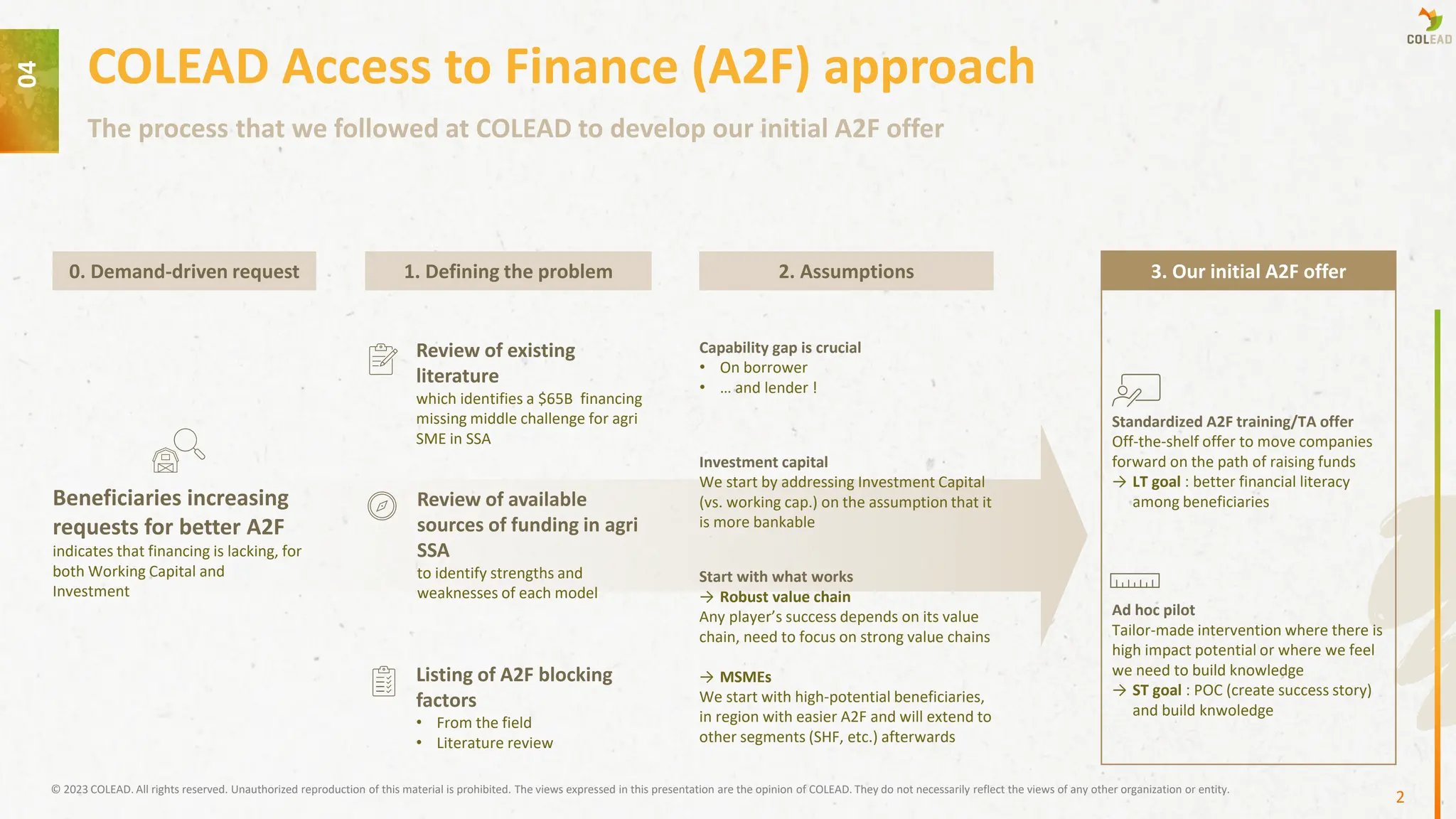
Review of existing
literature
which identifies a $65B financing
missing middle challenge for agri
SME in SSA
Listing of A2F blocking
factors
• From the field
• Literature review
Review of available
sources of funding in agri
SSA
to identify strengths and
weaknesses of each model
1. Defining the problem
Beneficiaries increasing
requests for better A2F
indicates that financing is lacking, for
both Working Capital and
Investment
0. Demand-driven request
Capability gap is crucial
• On borrower
• … and lender !
Investment capital
We start by addressing Investment Capital
(vs. working cap.) on the assumption that it
is more bankable
Start with what works
→ Robust value chain
Any player’s success depends on its value
chain, need to focus on strong value chains
→ MSMEs
We start with high-potential beneficiaries,
in region with easier A2F and will extend to
other segments (SHF, etc.) afterwards
2. Assumptions 3. Our initial A2F offer
Standardized A2F training/TA offer
Off-the-shelf offer to move companies
forward on the path of raising funds
→ LT goal : better financial literacy
among beneficiaries
Ad hoc pilot
Tailor-made intervention where there is
high impact potential or where we feel
we need to build knowledge
→ ST goal : POC (create success story)
and build knwoledge
The process that we followed at COLEAD to develop our initial A2F offer
COLEAD Access to Finance (A2F) approach
© 2023 COLEAD. All rights reserved. Unauthorized reproduction of this material is prohibited. The views expressed in this presentation are the opinion of COLEAD. They do not necessarily reflect the views of any other organization or entity.
04
2
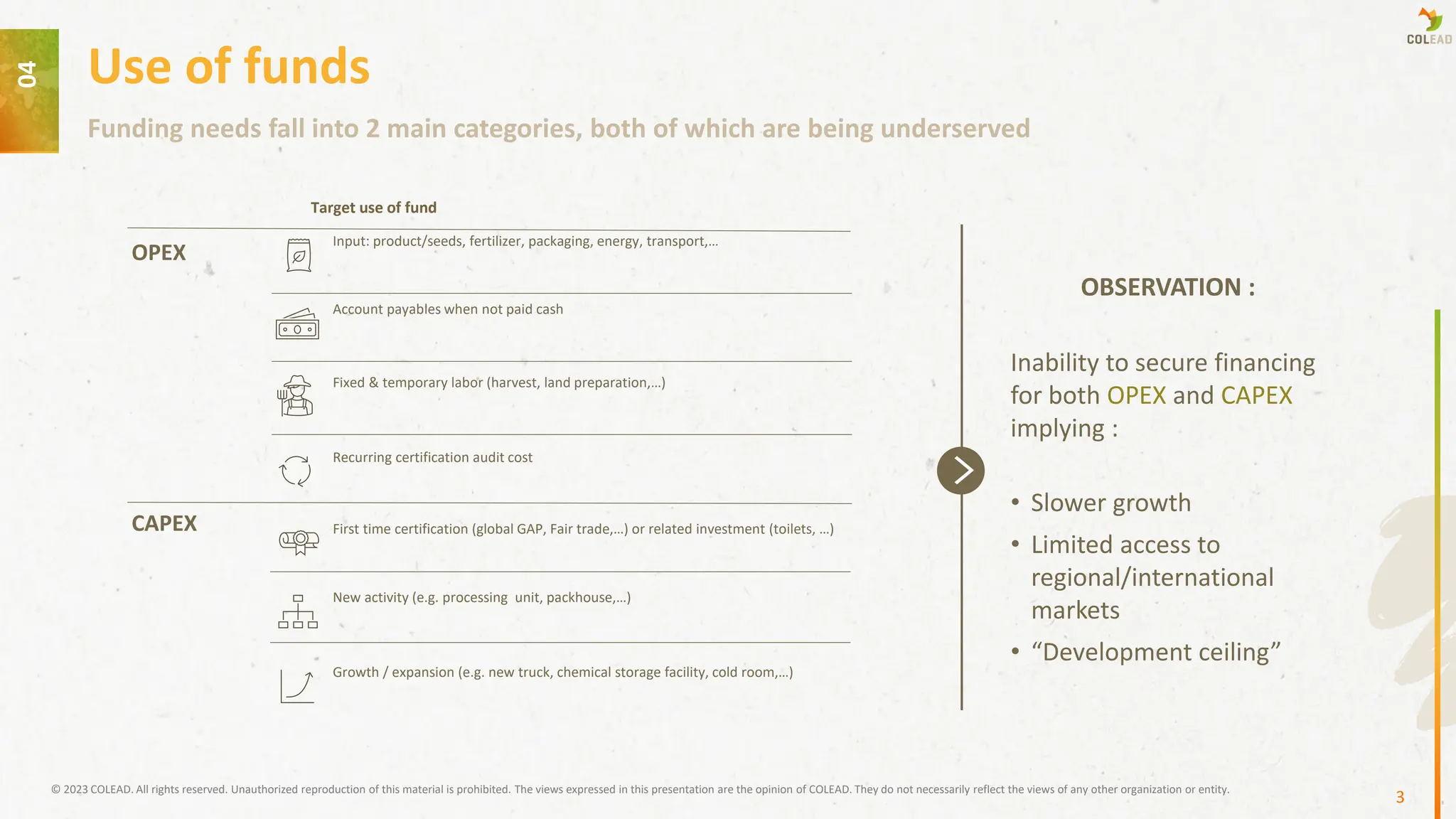
OPEX
CAPEX
Target use of fund
Input: product/seeds, fertilizer, packaging, energy, transport,…
Account payables when not paid cash
First time certification (global GAP, Fair trade,…) or related investment (toilets, …)
Fixed & temporary labor (harvest, land preparation,…)
New activity (e.g. processing unit, packhouse,…)
Growth / expansion (e.g. new truck, chemical storage facility, cold room,…)
Recurring certification audit cost
Inability to secure financing
for both OPEX and CAPEX
implying :
• Slower growth
• Limited access to
regional/international
markets
• “Development ceiling”
Funding needs fall into 2 main categories, both of which are being underserved
Use of funds
OBSERVATION :
© 2023 COLEAD. All rights reserved. Unauthorized reproduction of this material is prohibited. The views expressed in this presentation are the opinion of COLEAD. They do not necessarily reflect the views of any other organization or entity.
04
3
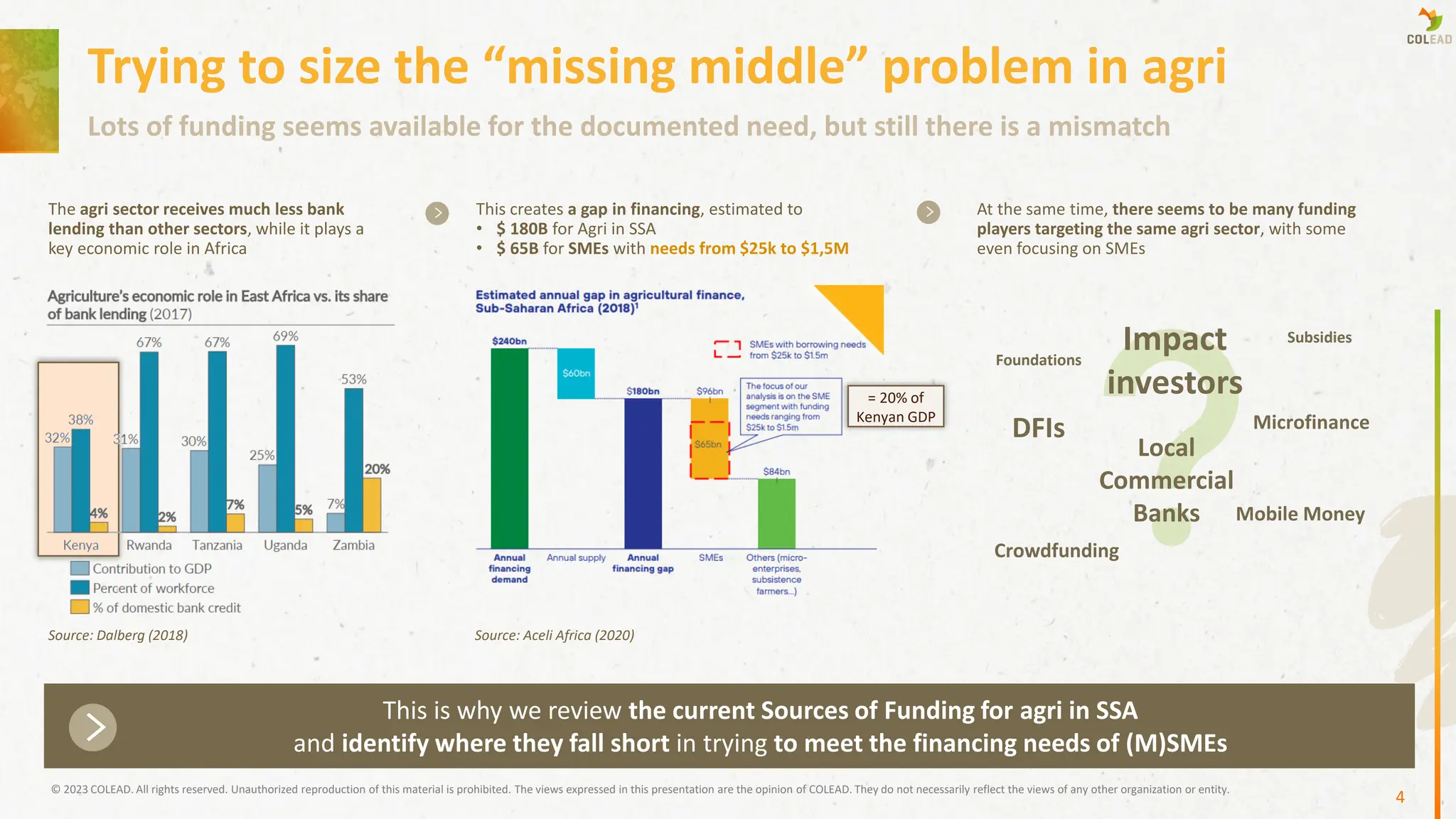
The agri sector receives much less bank
lending than other sectors, while it plays a
key economic role in Africa
Source: Dalberg (2018)
This creates a gap in financing, estimated to
• $ 180B for Agri in SSA
• $ 65B for SMEs with needs from $25k to $1,5M
Source: Aceli Africa (2020)
This is why we review the current Sources of Funding for agri in SSA
and identify where they fall short in trying to meet the financing needs of (M)SMEs
At the same time, there seems to be many funding
players targeting the same agri sector, with some
even focusing on SMEs
DFIs
Impact
investors
Foundations
Local
Commercial
Banks
Microfinance
Crowdfunding
Mobile Money
Subsidies
Lots of funding seems available for the documented need, but still there is a mismatch
Trying to size the “missing middle” problem in agri
= 20% of
Kenyan GDP
© 2023 COLEAD. All rights reserved. Unauthorized reproduction of this material is prohibited. The views expressed in this presentation are the opinion of COLEAD. They do not necessarily reflect the views of any other organization or entity.
4
Question for you
What are typical blocking factors you see for the missing
middle problem at your level, when facing a customer
applications from agri/horticulture sector ?
In other words, what is typically preventing you to grant a
loan?
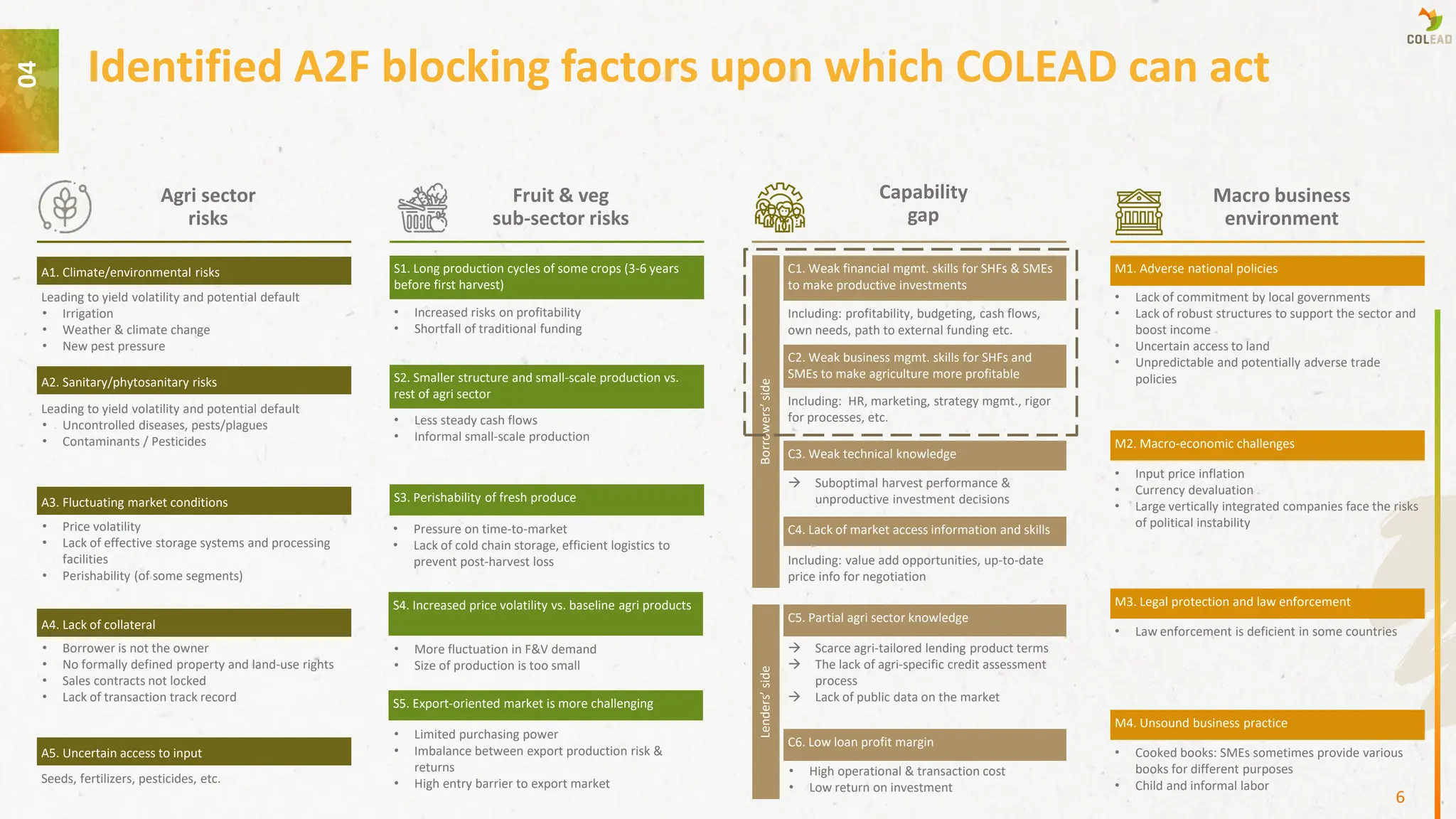
Capability
gap
Macro business
environment
A1. Climate/environmental risks
Agri sector
risks
S1. Long production cycles of some crops (3-6 years
before first harvest)
Fruit & veg
sub-sector risks
Leading to yield volatility and potential default
• Uncontrolled diseases, pests/plagues
• Contaminants / Pesticides
• Price volatility
• Lack of effective storage systems and processing
facilities
• Perishability (of some segments)
A4. Lack of collateral
A5. Uncertain access to input
A3. Fluctuating market conditions
A2. Sanitary/phytosanitary risks
Leading to yield volatility and potential default
• Irrigation
• Weather & climate change
• New pest pressure
• Borrower is not the owner
• No formally defined property and land-use rights
• Sales contracts not locked
• Lack of transaction track record
Seeds, fertilizers, pesticides, etc.
• Increased risks on profitability
• Shortfall of traditional funding
S2. Smaller structure and small-scale production vs.
rest of agri sector
S3. Perishability of fresh produce
S4. Increased price volatility vs. baseline agri products
S5. Export-oriented market is more challenging
• Less steady cash flows
• Informal small-scale production
• Pressure on time-to-market
• Lack of cold chain storage, efficient logistics to
prevent post-harvest loss
• More fluctuation in F&V demand
• Size of production is too small
• Limited purchasing power
• Imbalance between export production risk &
returns
• High entry barrier to export market
C1. Weak financial mgmt. skills for SHFs & SMEs
to make productive investments
Including: profitability, budgeting, cash flows,
own needs, path to external funding etc.
Borrowers’
side
C2. Weak business mgmt. skills for SHFs and
SMEs to make agriculture more profitable
Including: HR, marketing, strategy mgmt., rigor
for processes, etc.
C3. Weak technical knowledge
→ Suboptimal harvest performance &
unproductive investment decisions
C5. Partial agri sector knowledge
→ Scarce agri-tailored lending product terms
→ The lack of agri-specific credit assessment
process
→ Lack of public data on the market
C6. Low loan profit margin
• High operational & transaction cost
• Low return on investment
C4. Lack of market access information and skills
Including: value add opportunities, up-to-date
price info for negotiation
M1. Adverse national policies
• Lack of commitment by local governments
• Lack of robust structures to support the sector and
boost income
• Uncertain access to land
• Unpredictable and potentially adverse trade
policies
M2. Macro-economic challenges
• Input price inflation
• Currency devaluation
• Large vertically integrated companies face the risks
of political instability
M3. Legal protection and law enforcement
• Law enforcement is deficient in some countries
M4. Unsound business practice
• Cooked books: SMEs sometimes provide various
books for different purposes
• Child and informal labor
Lenders’
side
Identified A2F blocking factors upon which COLEAD can act
04
6
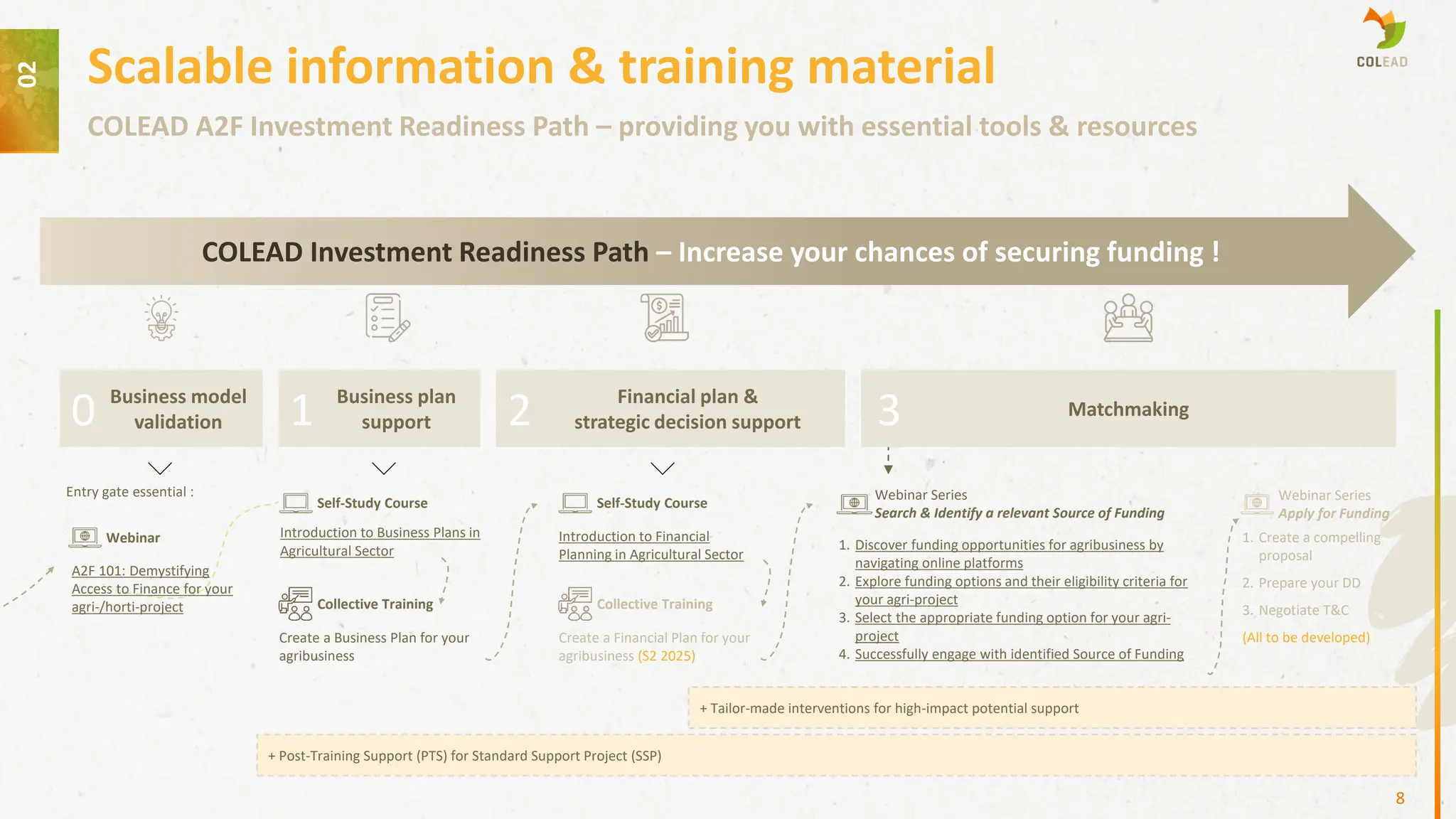
02
8
COLEAD A2F Investment Readiness Path – providing you with essential tools & resources
Scalable information & training material
+ Tailor-made interventions for high-impact potential support
+ Post-Training Support (PTS) for Standard Support Project (SSP)
Collective Training
Collective Training
COLEAD Investment Readiness Path – Increase your chances of securing funding !
Self-Study Course
Introduction to Business Plans in
Agricultural Sector
Create a Business Plan for your
agribusiness
Self-Study Course
Introduction to Financial
Planning in Agricultural Sector
Create a Financial Plan for your
agribusiness (S2 2025)
Webinar Series
Search & Identify a relevant Source of Funding
1. Discover funding opportunities for agribusiness by
navigating online platforms
2. Explore funding options and their eligibility criteria for
your agri-project
3. Select the appropriate funding option for your agri-
project
4. Successfully engage with identified Source of Funding
Webinar Series
Apply for Funding
1. Create a compelling
proposal
2. Prepare your DD
3. Negotiate T&C
(All to be developed)
Business model
validation
Business plan
support
Financial plan &
strategic decision support
Matchmaking
0 1 2 3
Webinar
A2F 101: Demystifying
Access to Finance for your
agri-/horti-project
Entry gate essential :
04
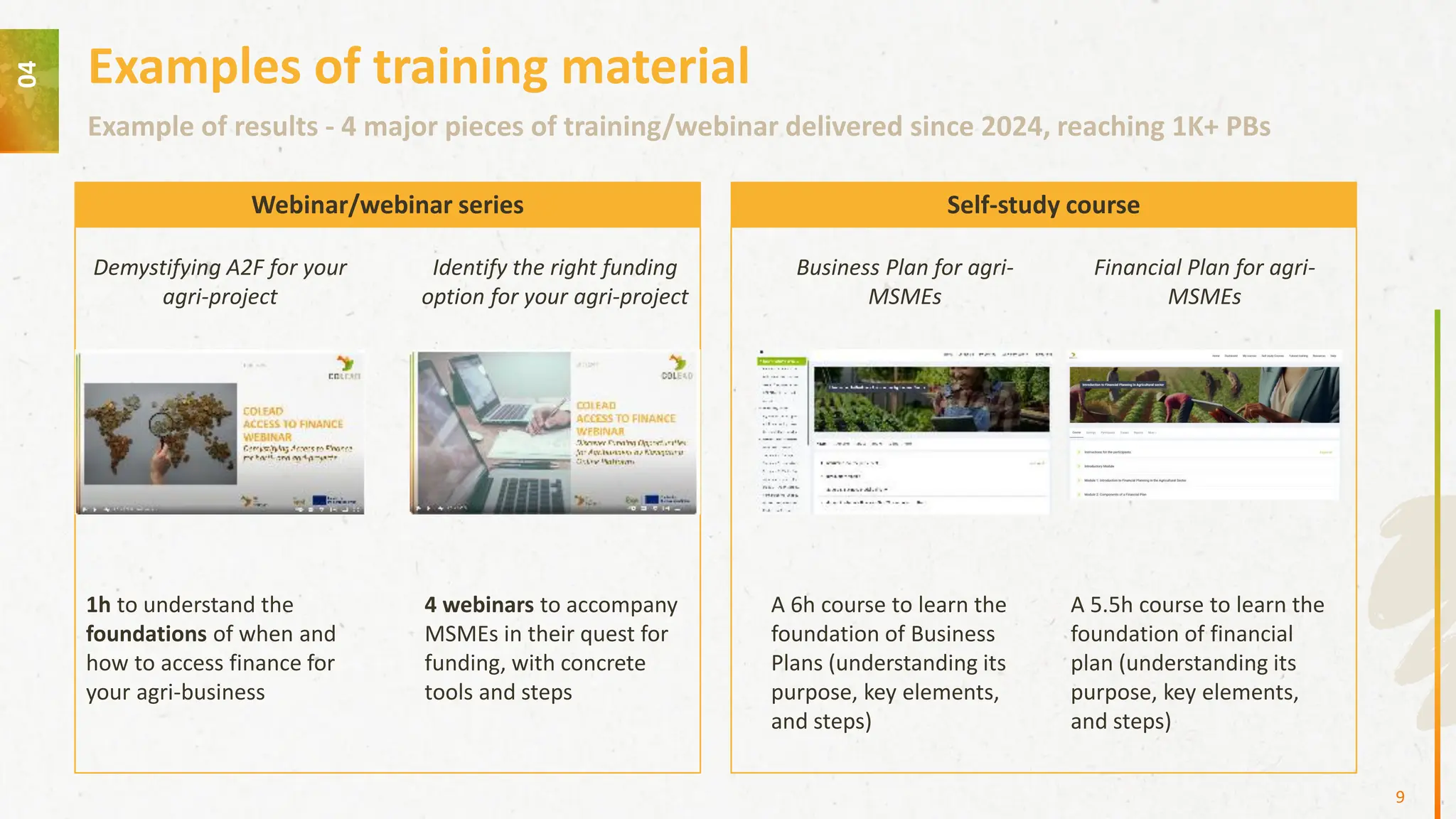
Example of results - 4 major pieces of training/webinar delivered since 2024, reaching 1K+ PBs
Examples of training material
Demystifying A2F for your
agri-project
Identify the right funding
option for your agri-project
Business Plan for agri-
MSMEs
1h to understand the
foundations of when and
how to access finance for
your agri-business
4 webinars to accompany
MSMEs in their quest for
funding, with concrete
tools and steps
A 6h course to learn the
foundation of Business
Plans (understanding its
purpose, key elements,
and steps)
9
Webinar/webinar series Self-study course
Financial Plan for agri-
MSMEs
A 5.5h course to learn the
foundation of financial
plan (understanding its
purpose, key elements,
and steps)

COLEAD A2F approach and Theory of Change

  • 1.
    Main goal of thissection 1. Introduce COLEAD approach on the Access to Finance / missing middle problem 2. Present COLEAD’s high-level strategy in terms of investor readiness capacity building
  • 2.
    Review of existing literature whichidentifies a $65B financing missing middle challenge for agri SME in SSA Listing of A2F blocking factors • From the field • Literature review Review of available sources of funding in agri SSA to identify strengths and weaknesses of each model 1. Defining the problem Beneficiaries increasing requests for better A2F indicates that financing is lacking, for both Working Capital and Investment 0. Demand-driven request Capability gap is crucial • On borrower • … and lender ! Investment capital We start by addressing Investment Capital (vs. working cap.) on the assumption that it is more bankable Start with what works → Robust value chain Any player’s success depends on its value chain, need to focus on strong value chains → MSMEs We start with high-potential beneficiaries, in region with easier A2F and will extend to other segments (SHF, etc.) afterwards 2. Assumptions 3. Our initial A2F offer Standardized A2F training/TA offer Off-the-shelf offer to move companies forward on the path of raising funds → LT goal : better financial literacy among beneficiaries Ad hoc pilot Tailor-made intervention where there is high impact potential or where we feel we need to build knowledge → ST goal : POC (create success story) and build knwoledge The process that we followed at COLEAD to develop our initial A2F offer COLEAD Access to Finance (A2F) approach © 2023 COLEAD. All rights reserved. Unauthorized reproduction of this material is prohibited. The views expressed in this presentation are the opinion of COLEAD. They do not necessarily reflect the views of any other organization or entity. 04 2
  • 3.
    OPEX CAPEX Target use offund Input: product/seeds, fertilizer, packaging, energy, transport,… Account payables when not paid cash First time certification (global GAP, Fair trade,…) or related investment (toilets, …) Fixed & temporary labor (harvest, land preparation,…) New activity (e.g. processing unit, packhouse,…) Growth / expansion (e.g. new truck, chemical storage facility, cold room,…) Recurring certification audit cost Inability to secure financing for both OPEX and CAPEX implying : • Slower growth • Limited access to regional/international markets • “Development ceiling” Funding needs fall into 2 main categories, both of which are being underserved Use of funds OBSERVATION : © 2023 COLEAD. All rights reserved. Unauthorized reproduction of this material is prohibited. The views expressed in this presentation are the opinion of COLEAD. They do not necessarily reflect the views of any other organization or entity. 04 3
  • 4.
    The agri sectorreceives much less bank lending than other sectors, while it plays a key economic role in Africa Source: Dalberg (2018) This creates a gap in financing, estimated to • $ 180B for Agri in SSA • $ 65B for SMEs with needs from $25k to $1,5M Source: Aceli Africa (2020) This is why we review the current Sources of Funding for agri in SSA and identify where they fall short in trying to meet the financing needs of (M)SMEs At the same time, there seems to be many funding players targeting the same agri sector, with some even focusing on SMEs DFIs Impact investors Foundations Local Commercial Banks Microfinance Crowdfunding Mobile Money Subsidies Lots of funding seems available for the documented need, but still there is a mismatch Trying to size the “missing middle” problem in agri = 20% of Kenyan GDP © 2023 COLEAD. All rights reserved. Unauthorized reproduction of this material is prohibited. The views expressed in this presentation are the opinion of COLEAD. They do not necessarily reflect the views of any other organization or entity. 4
  • 5.
    Question for you Whatare typical blocking factors you see for the missing middle problem at your level, when facing a customer applications from agri/horticulture sector ? In other words, what is typically preventing you to grant a loan?
  • 6.
    Capability gap Macro business environment A1. Climate/environmentalrisks Agri sector risks S1. Long production cycles of some crops (3-6 years before first harvest) Fruit & veg sub-sector risks Leading to yield volatility and potential default • Uncontrolled diseases, pests/plagues • Contaminants / Pesticides • Price volatility • Lack of effective storage systems and processing facilities • Perishability (of some segments) A4. Lack of collateral A5. Uncertain access to input A3. Fluctuating market conditions A2. Sanitary/phytosanitary risks Leading to yield volatility and potential default • Irrigation • Weather & climate change • New pest pressure • Borrower is not the owner • No formally defined property and land-use rights • Sales contracts not locked • Lack of transaction track record Seeds, fertilizers, pesticides, etc. • Increased risks on profitability • Shortfall of traditional funding S2. Smaller structure and small-scale production vs. rest of agri sector S3. Perishability of fresh produce S4. Increased price volatility vs. baseline agri products S5. Export-oriented market is more challenging • Less steady cash flows • Informal small-scale production • Pressure on time-to-market • Lack of cold chain storage, efficient logistics to prevent post-harvest loss • More fluctuation in F&V demand • Size of production is too small • Limited purchasing power • Imbalance between export production risk & returns • High entry barrier to export market C1. Weak financial mgmt. skills for SHFs & SMEs to make productive investments Including: profitability, budgeting, cash flows, own needs, path to external funding etc. Borrowers’ side C2. Weak business mgmt. skills for SHFs and SMEs to make agriculture more profitable Including: HR, marketing, strategy mgmt., rigor for processes, etc. C3. Weak technical knowledge → Suboptimal harvest performance & unproductive investment decisions C5. Partial agri sector knowledge → Scarce agri-tailored lending product terms → The lack of agri-specific credit assessment process → Lack of public data on the market C6. Low loan profit margin • High operational & transaction cost • Low return on investment C4. Lack of market access information and skills Including: value add opportunities, up-to-date price info for negotiation M1. Adverse national policies • Lack of commitment by local governments • Lack of robust structures to support the sector and boost income • Uncertain access to land • Unpredictable and potentially adverse trade policies M2. Macro-economic challenges • Input price inflation • Currency devaluation • Large vertically integrated companies face the risks of political instability M3. Legal protection and law enforcement • Law enforcement is deficient in some countries M4. Unsound business practice • Cooked books: SMEs sometimes provide various books for different purposes • Child and informal labor Lenders’ side Identified A2F blocking factors upon which COLEAD can act 04 6
  • 7.
    02 8 COLEAD A2F InvestmentReadiness Path – providing you with essential tools & resources Scalable information & training material + Tailor-made interventions for high-impact potential support + Post-Training Support (PTS) for Standard Support Project (SSP) Collective Training Collective Training COLEAD Investment Readiness Path – Increase your chances of securing funding ! Self-Study Course Introduction to Business Plans in Agricultural Sector Create a Business Plan for your agribusiness Self-Study Course Introduction to Financial Planning in Agricultural Sector Create a Financial Plan for your agribusiness (S2 2025) Webinar Series Search & Identify a relevant Source of Funding 1. Discover funding opportunities for agribusiness by navigating online platforms 2. Explore funding options and their eligibility criteria for your agri-project 3. Select the appropriate funding option for your agri- project 4. Successfully engage with identified Source of Funding Webinar Series Apply for Funding 1. Create a compelling proposal 2. Prepare your DD 3. Negotiate T&C (All to be developed) Business model validation Business plan support Financial plan & strategic decision support Matchmaking 0 1 2 3 Webinar A2F 101: Demystifying Access to Finance for your agri-/horti-project Entry gate essential :
  • 8.
    04 Example of results- 4 major pieces of training/webinar delivered since 2024, reaching 1K+ PBs Examples of training material Demystifying A2F for your agri-project Identify the right funding option for your agri-project Business Plan for agri- MSMEs 1h to understand the foundations of when and how to access finance for your agri-business 4 webinars to accompany MSMEs in their quest for funding, with concrete tools and steps A 6h course to learn the foundation of Business Plans (understanding its purpose, key elements, and steps) 9 Webinar/webinar series Self-study course Financial Plan for agri- MSMEs A 5.5h course to learn the foundation of financial plan (understanding its purpose, key elements, and steps)