Heritage AVCM (AW) Kelly Kelly United States Navy Senior Enlisted Academy
Overview The Sailor’s Creed Ethos Expectations of a First Class Petty Officer Heritage
I am a United States Sailor. I will support and defend the Constitution of the United States of America and I will obey the orders of those appointed over me. I represent the fighting spirit of the Navy and those who have gone before me to defend freedom and democracy around the world. I proudly serve my country’s Navy combat team with Honor, Courage, and Commitment. I am committed to excellence and the fair treatment of all.   The Sailor’s Creed
1992 Proposal To Align Naval Services Core Values For Use By Sailors/Marines Navy Core Values Were:  Tradition, Integrity,  And  Professionalism Marine Corps Core Values Were: Honor, Courage & Commitment Navy  Adopted  The Marine Corps Core Values To Align Naval Services Sailor’s Creed History
Topic Material (Arial 36) Arial 28 Arial 28
Sailor’s Creed History 1993 CNO Kelso Commissioned Blue Ribbon Recruit Training Panel To: Address Recruit Curriculum Training Content Develop A “Sailor’s Creed” That  Supports  Navy Core Values Admiral Kelso Personally Edited Final Version
I am a United States Sailor. I will support and defend the Constitution of the United States of America and I will obey the orders of those appointed over me. I represent the fighting spirit of the Navy and those who have gone before me to defend freedom and democracy around the world. I proudly serve my country’s Navy combat team with Honor, Courage, and Commitment. I am committed to excellence and the fair treatment of all.   The Sailor’s Creed
Original Sailor’s Creed
Creed Changes I am a United States Sailor I will support and defend the Constitution of the United Sates of America I represent the fighting spirit of the Bluejackets who have gone before me to defend freedom and democracy around the world. I proudly served my country’s Navy combat team with Honor, Commitment and Courage. I am committed to excellence and the fair treatment of all. I will obey the orders of my superiors. I am a United States Sailor. I will support and defend the Constitution of the United States of America and I will obey the orders of those appointed over me. I represent the fighting spirit of the Navy and those who have gone before me to defend freedom and democracy around the world. I proudly serve my country’s Navy combat team with Honor, Courage, and Commitment. I am committed to excellence and the fair treatment of all. 1995-CNO Boorda Approved Changes to Sailor’s Creed 1994  1995
The Sailor’s Creed I am a United States Sailor. I will support and defend the Constitution of the United States of America and I will obey the orders of those appointed over me. I represent the fighting spirit of the Navy and those who have gone before me to defend freedom and democracy around the world. I proudly serve my country’s Navy combat team with Honor, Courage, and Commitment. I am committed to excellence and the fair treatment of all. Tenacity Duty Accountability Followship Warrior Ethos Heritage Adaptability Flexibility Teamwork Integrity Professionalism Behavior Self Development Interpersonal skills
United States Navy Ethos We are the United States Navy, our Nation’s sea power – ready guardians of peace, victorious in war. We are professional Sailors and Civilians – a diverse and agile force exemplifying the highest standards of service to our Nation, at home and abroad, as sea and a shore. Integrity is the foundation of our conduct; respect for others is fundamental to our character; decisive leadership is crucial to our success. We are a team, disciplined and well-prepared, committed to mission accomplishment.  We do not waver in our dedication and accountability to our Shipmates and families. We are patriots, forged by the Navy’s core values of Honor, Courage, and Commitment.  In times of war and peace, our actions reflect our proud heritage and tradition. We defend our Nation and prevail in the face of adversity with strength, determination, and dignity. We are the United States Navy.
What Makes a Sailor a “Good Sailor” Those who Live their Lives According to The Sailor’s Creed The Sailorization Process Must Support the Competencies Found In The “Sailor’s Creed” Comprehending and Abiding by The Sailor’s Creed will Mold And Shape Our  Navy Culture
Sailorization The Navy process that Recruits, Indoctrinates, Trains, Mentors, and Invests in its members to ensure they are anchored in the Warfighting Culture of being a United States Sailor.  A phased, standardized continuum of knowledge, skills, and abilities, enhancing personal and professional growth that directly contributes to mission accomplishment through the continuing reinforcement of professional military knowledge.
Expectations of a First Class Petty Officer
First Line Leadership   First Class Petty Officers are fully engaged Deckplate Leaders who drive mission accomplishment daily.  They lead adherence to the Navy Standard through personal example and commitment to teaching their Sailors.  They must challenge, mentor and measure their division’s and command’s success through team performance and deckplate results.
Rating Expertise First Class Petty Officers are developing experts who learn from their Chief and train their division.  They demand consistent procedural compliance and accuracy from themselves and those they lead.
Professionalism   First Class Petty Officers are the Navy’s first line professionals who execute the right things at the right time for the right reasons.  Integrity governs all their actions from leadership through watchstanding and is the foundation upon which consistent mission accomplishment is built.  Their commitment to our profession is seen through dedicated self improvement and a passion for excellence in themselves and all Sailors.
Communication First Class Petty Officers clearly communicate standards to the Sailors they lead, while consistently keeping the chain of command informed.  The deckplate triad of the Division Officer, CPO, and First Class Petty Officer is only effective with their input and deckplate perspective.
Loyalty First Class Petty Officers are visibly loyal to the command, Sailors, peers, and themselves.  They utilize opportunities to provide feedback and actively support guidance.  They create circumstances which give their Sailors the opportunity to succeed.
Heritage First Class Petty Officers are proud of our shared history.  They take opportunities to weave it into daily events, so our Sailors understand that a commitment to excellence is a time-honored tradition that connects our past while forging the foundation of our future.
First Line Leadership  - First Class Petty Officers are fully engaged Deckplate Leaders who drive mission  accomplishment daily.  They lead adherence to the Navy Standard through personal example and commitment to teaching their Sailors.  They must challenge, mentor and measure their division’s and command’s success through team performance and deckplate results. Rating Expertise  - First Class Petty Officers are developing experts who learn from their Chief and train their division.  They demand consistent procedural compliance and accuracy from themselves and those they lead. Professionalism  - First Class Petty Officers are the Navy’s first line professionals who execute the right things at the right time for the right reasons.  - Integrity governs all their actions from leadership through watchstanding and is the foundation upon which  consistent mission accomplishment is built.  - Their commitment to our profession is seen through dedicated self improvement and a passion for excellence in themselves and all Sailors. Communication  - First Class Petty Officers clearly communicate standards to the Sailors they lead, while consistently keeping the chain of command informed.  The deckplate triad of the Division Officer, CPO, and First Class Petty Officer is only effective with their input and deckplate perspective. Loyalty  - First Class Petty Officers are visibly loyal to the command, Sailors, peers, and themselves.  They utilize opportunities to provide feedback and actively support guidance.  They create circumstances which give their Sailors the opportunity to succeed. Heritage  - First Class Petty Officers are proud of our shared history.  They take opportunities to weave it into daily events, so our Sailors understand that a commitment to excellence is a time-honored tradition that connects our past while forging the foundation of our future.
Chief Guiding Principles Deckplate Leadership  – Chiefs are visible leaders who set the tone.  We will know the mission, know our Sailors, and develop them beyond their expectations as a team and as individuals.  Institutional and Technical Expertise  - Chiefs are the experts in their field.  We will use experience and technical knowledge to produce a well trained enlisted and officer team.  Professionalism  – Chiefs will actively teach, uphold, and enforce standards.  We will measure ourselves by the success of our Sailors.  We will remain invested in the Navy through self-motivated military and academic education and training and will provide proactive solutions that are well founded, thoroughly considered, and linked to mission accomplishment.  Character  – Chiefs abide by an uncompromising code of integrity, take full responsibility for their actions and keep their word.  This will set a positive tone for the command, unify the Mess, and create esprit de corps.  Loyalty  – Chiefs remember that loyalty must be demonstrated to seniors, peers and subordinates alike, and that it must never be blind.  Few things are more important than people who have the moral courage to question the appropriate direction in which an organization is headed and then the strength to support whatever final decisions are made.  Active Communication  – Chiefs encourage open and frank dialog, listen to Sailors and energize the communication flow up and down the chain of command.  This will increase unit efficiency, mission readiness, and mutual respect.  Sense of Heritage  - Defines our past and guides our future.  Chiefs will use heritage to connect Sailors to their past, teach values and enhance pride in service to our country.
Why Should you learn about our Naval Heritage? What are you Doing to learn about our Naval Heritage?
It's a well-accepted fact that the past helps determine the present.  Likewise, events and personalities of our past shape today's military and those same events and personalities will contribute to our military’s future.  The senior enlisted community must make tomorrow's leaders, regardless of rank, aware of our naval heritage and the military's institutional values so they too can advance in mission and purpose without having to repeat past mistakes.
NAS Whidbey Island Commissioned - 21 Sep 1942 Ault Field – Named in memory of CDR William B. Ault, missing in action in the Battle of the Coral Sea First plane landed on 5 Aug 1942 Ships LSD 41 USS WHIDBEY ISLAND AG-141 USS WHIDBEY
 
USS HORNET (CV-8)
BMCM (MDV) Carl M. Brashear, USN, Ret. Carl Brashear  was born in 1931 in Tonieville, Larue County, Kentucky, the child of sharecroppers McDonald and Gonzella Brashear.  He attended Sonora Grade School, Sonora, Kentucky from 1937 to 1946.  Enlisting in the Navy in 1948 and under went recruit training at Great Lakes, Illinois. After initial duty as a steward, he began handling aircraft for squadron  VX-1 at Key West, Florida, and was subsequently rated as a boatswain's mate. He served in the USS Coucal (ASR-8), USS Shakori (ATF-162), and USS Hoist (ARS-40). While on board the latter in 1966 for the recovery of a nuclear weapon off Spain, Brashear was badly injured in an accident; as a result, surgeons amputated his left leg below the knee. He refused to submit to medical survey boards attempting to retire him as unfit for duty.  After demonstrating that he could still dive and perform  his other duties, he served in Harbor Clearance Unit 2, Naval Air Station  Norfolk, Experimental Diving Unit, submarine tender Hunley (AS-31);  USS Recovery (ARS-43), Naval Safety Center, and Shore Intermediate  Maintenance Activity Norfolk. In 1970 he qualified as the first black  master diver in the history of the U.S. Navy.
John Henry ("Dick") Turpin, Chief Gunner's Mate, USN. (1876-1962) John Henry Turpin was born on 20  August 1876. Enlisted in the  Navy at New York City on 4 November 1896, he was a member of USS  Maine 's crew when she was destroyed by an explosion in February 1898.  He survived that disaster, and the boiler explosion on USS  Bennington  in  July 1905, as well as serving on several other ships before he left active duty in 1916. Recalled to service when the U.S. entered World War I in April 1917, on 1 June of that that year, Turpin became Chief Gunner's Mate on USS  Marblehead , one of the Navy's first African-American Chief Petty Officers.  He served actively in that rank until transferred to the Fleet Reserve on 8 March 1919.  John Henry Turpin retired as a Chief Gunner's Mate on 5 October 1925. When not serving on active duty, Turpin was employed at the Puget Sound Navy Yard, Bremerton, Washington, as a Master Rigger. He also qualified, in his civilian capacity, as a Master Diver. From 1938 through World War II, he voluntarily made inspirational visits to Naval Training Centers and defense plants. John Henry Turpin died on 10 March 1962.
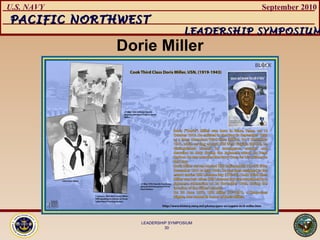
Dorie Miller
Ensign Jesse LeRoy Brown Who is Ensign Jesse Brown? First African American designated as a Naval Aviator in October 1948 Assigned to VF 32, during the Korean War, shot down on 4 December 1950, near the Chosin Reservoir, could not be rescued and died in his aircraft Awarded the Distinguished Flying Cross for Korean War combat service USS JESSE L. BROWN (DE-1089) named in his honor
Tuskegee Airman of WWII January 9, 1941 – Secretary of War stated “The era of the all-white air force had ended, and the day of the segregated air force had arrived” July 1941 – Tuskegee Experiment begins March 1942 – First black Americans earn the wings of Air Corps pilots Tuskegee Airman overcame segregation and prejudice to become one of the most highly respected fighter groups in WWII Tuskegee Airman WWII combat records 15,000 sorties Destroyed over 1,000 German aircraft Received hundreds of Air Medals Received more than 150 Distinguished Flying Crosses
Great White Fleet The "Great White Fleet" sent around the world by President Theodore Roosevelt from 16 December 1907 to 22 February 1909 consisted of sixteen new battleships of the Atlantic Fleet. The battleships were painted white except for gilded scrollwork on their bows. The Atlantic Fleet battleships only later came to be known as the "Great White Fleet.” The cruise of the Great White Fleet had many substantial results both diplomatically for the nation and technically for the Navy. On the diplomatic side, the cruise satisfied our country's desire to be recognized as a world power. It was aptly proven that the United States was capable of projecting its influence anywhere in the world on a heretofore unprecedented scale.
The Lone Sailor "You would want this guy at your battle station when it's not a drill," former Master Chief Petty Officer of the Navy Billy C. Sanders says of  The Lone Sailor© . "He is the classic American sailor. That statue looks like bronze, but there is plenty of salt, paint, sweat, fuel oil and courage stirred in."
USS INDIANAPOLIS (CA-35) The 1945 sinking of the armored cruiser USS INDIANAPOLIS by the Imperial Japanese Submarine I-58 has been called the last great Naval tragedy of World War II.
The Golden Thirteen In February 1944, the Navy commissioned  its first African-American officers. This long- hoped-for action represented a major step  forward in the status of African-Americans  in the Navy and in American society. The  twelve commissioned officers, and a warrant  officer who received his rank at the same time, came to be known as the "Golden Thirteen".
Defence of Fort McHenry
Blue Star Banner It’s an American tradition to display a Blue Star Service Banner in the window of a home when a loved one is proudly serving in the U.S. Armed Forces.
Robert Eugene Bush Awarded the Medal of Honor Born:  October 4, 1926  Tacoma, Washington War:  World War II Rank:  Hospital Apprentice First Class, US Naval Reserve (serving as Medical Corpsman with a rifle company)  Location of action:  Okinawa Jima, Ryukyu Islands Date of action:  May 2, 1945
Chief Watertender Peter Tomich Medal of Honor citation of Chief Watertender Peter Tomich   "For distinguished conduct in the line of his  profession, and extraordinary courage and  disregard of his own safety, during the attack  on the Fleet in Pearl Harbor by the Japanese  forces on 7 December 1941.  Although realizing  that the ship was capsizing, as a result of enemy bombing and torpedoing, TOMICH remained at  his post in the engineering plant of the U.S.S.  Utah , until he saw that all boilers were secured and all  fireroom personnel had left their stations, and by  so doing lost his life."
Navy Jargon Airdale.  A naval aviator. It can also refer to any member of the naval aviation community, officer or enlisted.  "Brownshoe"  also refers to an officer or chief petty officer in the aviation branch as they are authorized to wear brown shoes whereas mere mortals in other branches of naval service are forever tainted as common  "Blackshoes.“ Brown Shoes  In 1913 high laced shoes of tan leather first appeared in Uniform Regulations and were authorized for wear by aviators with khaki's. The color changed to russet brown in 1922. Uniforms exclusive to the aviation community were abolished in the 1920's and reinstated in the 1930's. The authorized color of aviators shoes has alternated between brown and black since then.
Tacking on the Crow Pea Coat Gundecking Challenge Coin Crossing the Line Taps Arlington Ladies Tailhook
Good Conduct Medal Saluting Burials at Sea Retirements Sideboys Three sheets to the wind Plank owner Ship’s Bell Quarterdeck
Heritage Heritage is the handing down of beliefs and customs from generation to generation.  As a Sailor, you have inherited a rich and proud tradition of patriotism, courage, spiritual heritage, and concern for people.  This is a privilege only a select group of Americans have had.
As leaders, we must make tomorrow’s leaders stronger and more aware due to the past experiences and knowledge gained so they too are aware of our naval heritage and the military’s institutional values.  In order to have a clear picture of where we are going, we must understand where we have been.
Summary The Sailor’s Creed Ethos Expectations of a First Class Petty Officer Heritage

2012 Navy Region NW FCPO Symposium (HERITAGE)

  • 1.
    Heritage AVCM (AW)Kelly Kelly United States Navy Senior Enlisted Academy
  • 2.
    Overview The Sailor’sCreed Ethos Expectations of a First Class Petty Officer Heritage
  • 3.
    I am aUnited States Sailor. I will support and defend the Constitution of the United States of America and I will obey the orders of those appointed over me. I represent the fighting spirit of the Navy and those who have gone before me to defend freedom and democracy around the world. I proudly serve my country’s Navy combat team with Honor, Courage, and Commitment. I am committed to excellence and the fair treatment of all. The Sailor’s Creed
  • 4.
    1992 Proposal ToAlign Naval Services Core Values For Use By Sailors/Marines Navy Core Values Were: Tradition, Integrity, And Professionalism Marine Corps Core Values Were: Honor, Courage & Commitment Navy Adopted The Marine Corps Core Values To Align Naval Services Sailor’s Creed History
  • 5.
    Topic Material (Arial36) Arial 28 Arial 28
  • 6.
    Sailor’s Creed History1993 CNO Kelso Commissioned Blue Ribbon Recruit Training Panel To: Address Recruit Curriculum Training Content Develop A “Sailor’s Creed” That Supports Navy Core Values Admiral Kelso Personally Edited Final Version
  • 7.
    I am aUnited States Sailor. I will support and defend the Constitution of the United States of America and I will obey the orders of those appointed over me. I represent the fighting spirit of the Navy and those who have gone before me to defend freedom and democracy around the world. I proudly serve my country’s Navy combat team with Honor, Courage, and Commitment. I am committed to excellence and the fair treatment of all. The Sailor’s Creed
  • 8.
  • 9.
    Creed Changes Iam a United States Sailor I will support and defend the Constitution of the United Sates of America I represent the fighting spirit of the Bluejackets who have gone before me to defend freedom and democracy around the world. I proudly served my country’s Navy combat team with Honor, Commitment and Courage. I am committed to excellence and the fair treatment of all. I will obey the orders of my superiors. I am a United States Sailor. I will support and defend the Constitution of the United States of America and I will obey the orders of those appointed over me. I represent the fighting spirit of the Navy and those who have gone before me to defend freedom and democracy around the world. I proudly serve my country’s Navy combat team with Honor, Courage, and Commitment. I am committed to excellence and the fair treatment of all. 1995-CNO Boorda Approved Changes to Sailor’s Creed 1994 1995
  • 10.
    The Sailor’s CreedI am a United States Sailor. I will support and defend the Constitution of the United States of America and I will obey the orders of those appointed over me. I represent the fighting spirit of the Navy and those who have gone before me to defend freedom and democracy around the world. I proudly serve my country’s Navy combat team with Honor, Courage, and Commitment. I am committed to excellence and the fair treatment of all. Tenacity Duty Accountability Followship Warrior Ethos Heritage Adaptability Flexibility Teamwork Integrity Professionalism Behavior Self Development Interpersonal skills
  • 11.
    United States NavyEthos We are the United States Navy, our Nation’s sea power – ready guardians of peace, victorious in war. We are professional Sailors and Civilians – a diverse and agile force exemplifying the highest standards of service to our Nation, at home and abroad, as sea and a shore. Integrity is the foundation of our conduct; respect for others is fundamental to our character; decisive leadership is crucial to our success. We are a team, disciplined and well-prepared, committed to mission accomplishment. We do not waver in our dedication and accountability to our Shipmates and families. We are patriots, forged by the Navy’s core values of Honor, Courage, and Commitment. In times of war and peace, our actions reflect our proud heritage and tradition. We defend our Nation and prevail in the face of adversity with strength, determination, and dignity. We are the United States Navy.
  • 12.
    What Makes aSailor a “Good Sailor” Those who Live their Lives According to The Sailor’s Creed The Sailorization Process Must Support the Competencies Found In The “Sailor’s Creed” Comprehending and Abiding by The Sailor’s Creed will Mold And Shape Our Navy Culture
  • 13.
    Sailorization The Navyprocess that Recruits, Indoctrinates, Trains, Mentors, and Invests in its members to ensure they are anchored in the Warfighting Culture of being a United States Sailor. A phased, standardized continuum of knowledge, skills, and abilities, enhancing personal and professional growth that directly contributes to mission accomplishment through the continuing reinforcement of professional military knowledge.
  • 14.
    Expectations of aFirst Class Petty Officer
  • 15.
    First Line Leadership First Class Petty Officers are fully engaged Deckplate Leaders who drive mission accomplishment daily. They lead adherence to the Navy Standard through personal example and commitment to teaching their Sailors. They must challenge, mentor and measure their division’s and command’s success through team performance and deckplate results.
  • 16.
    Rating Expertise FirstClass Petty Officers are developing experts who learn from their Chief and train their division. They demand consistent procedural compliance and accuracy from themselves and those they lead.
  • 17.
    Professionalism First Class Petty Officers are the Navy’s first line professionals who execute the right things at the right time for the right reasons. Integrity governs all their actions from leadership through watchstanding and is the foundation upon which consistent mission accomplishment is built. Their commitment to our profession is seen through dedicated self improvement and a passion for excellence in themselves and all Sailors.
  • 18.
    Communication First ClassPetty Officers clearly communicate standards to the Sailors they lead, while consistently keeping the chain of command informed. The deckplate triad of the Division Officer, CPO, and First Class Petty Officer is only effective with their input and deckplate perspective.
  • 19.
    Loyalty First ClassPetty Officers are visibly loyal to the command, Sailors, peers, and themselves. They utilize opportunities to provide feedback and actively support guidance. They create circumstances which give their Sailors the opportunity to succeed.
  • 20.
    Heritage First ClassPetty Officers are proud of our shared history. They take opportunities to weave it into daily events, so our Sailors understand that a commitment to excellence is a time-honored tradition that connects our past while forging the foundation of our future.
  • 21.
    First Line Leadership - First Class Petty Officers are fully engaged Deckplate Leaders who drive mission accomplishment daily. They lead adherence to the Navy Standard through personal example and commitment to teaching their Sailors. They must challenge, mentor and measure their division’s and command’s success through team performance and deckplate results. Rating Expertise - First Class Petty Officers are developing experts who learn from their Chief and train their division. They demand consistent procedural compliance and accuracy from themselves and those they lead. Professionalism - First Class Petty Officers are the Navy’s first line professionals who execute the right things at the right time for the right reasons. - Integrity governs all their actions from leadership through watchstanding and is the foundation upon which consistent mission accomplishment is built. - Their commitment to our profession is seen through dedicated self improvement and a passion for excellence in themselves and all Sailors. Communication - First Class Petty Officers clearly communicate standards to the Sailors they lead, while consistently keeping the chain of command informed. The deckplate triad of the Division Officer, CPO, and First Class Petty Officer is only effective with their input and deckplate perspective. Loyalty - First Class Petty Officers are visibly loyal to the command, Sailors, peers, and themselves. They utilize opportunities to provide feedback and actively support guidance. They create circumstances which give their Sailors the opportunity to succeed. Heritage - First Class Petty Officers are proud of our shared history. They take opportunities to weave it into daily events, so our Sailors understand that a commitment to excellence is a time-honored tradition that connects our past while forging the foundation of our future.
  • 22.
    Chief Guiding PrinciplesDeckplate Leadership – Chiefs are visible leaders who set the tone. We will know the mission, know our Sailors, and develop them beyond their expectations as a team and as individuals. Institutional and Technical Expertise - Chiefs are the experts in their field. We will use experience and technical knowledge to produce a well trained enlisted and officer team. Professionalism – Chiefs will actively teach, uphold, and enforce standards. We will measure ourselves by the success of our Sailors. We will remain invested in the Navy through self-motivated military and academic education and training and will provide proactive solutions that are well founded, thoroughly considered, and linked to mission accomplishment. Character – Chiefs abide by an uncompromising code of integrity, take full responsibility for their actions and keep their word. This will set a positive tone for the command, unify the Mess, and create esprit de corps. Loyalty – Chiefs remember that loyalty must be demonstrated to seniors, peers and subordinates alike, and that it must never be blind. Few things are more important than people who have the moral courage to question the appropriate direction in which an organization is headed and then the strength to support whatever final decisions are made. Active Communication – Chiefs encourage open and frank dialog, listen to Sailors and energize the communication flow up and down the chain of command. This will increase unit efficiency, mission readiness, and mutual respect. Sense of Heritage - Defines our past and guides our future. Chiefs will use heritage to connect Sailors to their past, teach values and enhance pride in service to our country.
  • 23.
    Why Should youlearn about our Naval Heritage? What are you Doing to learn about our Naval Heritage?
  • 24.
    It's a well-acceptedfact that the past helps determine the present. Likewise, events and personalities of our past shape today's military and those same events and personalities will contribute to our military’s future. The senior enlisted community must make tomorrow's leaders, regardless of rank, aware of our naval heritage and the military's institutional values so they too can advance in mission and purpose without having to repeat past mistakes.
  • 25.
    NAS Whidbey IslandCommissioned - 21 Sep 1942 Ault Field – Named in memory of CDR William B. Ault, missing in action in the Battle of the Coral Sea First plane landed on 5 Aug 1942 Ships LSD 41 USS WHIDBEY ISLAND AG-141 USS WHIDBEY
  • 26.
  • 27.
  • 28.
    BMCM (MDV) CarlM. Brashear, USN, Ret. Carl Brashear was born in 1931 in Tonieville, Larue County, Kentucky, the child of sharecroppers McDonald and Gonzella Brashear. He attended Sonora Grade School, Sonora, Kentucky from 1937 to 1946. Enlisting in the Navy in 1948 and under went recruit training at Great Lakes, Illinois. After initial duty as a steward, he began handling aircraft for squadron VX-1 at Key West, Florida, and was subsequently rated as a boatswain's mate. He served in the USS Coucal (ASR-8), USS Shakori (ATF-162), and USS Hoist (ARS-40). While on board the latter in 1966 for the recovery of a nuclear weapon off Spain, Brashear was badly injured in an accident; as a result, surgeons amputated his left leg below the knee. He refused to submit to medical survey boards attempting to retire him as unfit for duty. After demonstrating that he could still dive and perform his other duties, he served in Harbor Clearance Unit 2, Naval Air Station Norfolk, Experimental Diving Unit, submarine tender Hunley (AS-31); USS Recovery (ARS-43), Naval Safety Center, and Shore Intermediate Maintenance Activity Norfolk. In 1970 he qualified as the first black master diver in the history of the U.S. Navy.
  • 29.
    John Henry ("Dick")Turpin, Chief Gunner's Mate, USN. (1876-1962) John Henry Turpin was born on 20 August 1876. Enlisted in the Navy at New York City on 4 November 1896, he was a member of USS Maine 's crew when she was destroyed by an explosion in February 1898. He survived that disaster, and the boiler explosion on USS Bennington in July 1905, as well as serving on several other ships before he left active duty in 1916. Recalled to service when the U.S. entered World War I in April 1917, on 1 June of that that year, Turpin became Chief Gunner's Mate on USS Marblehead , one of the Navy's first African-American Chief Petty Officers. He served actively in that rank until transferred to the Fleet Reserve on 8 March 1919. John Henry Turpin retired as a Chief Gunner's Mate on 5 October 1925. When not serving on active duty, Turpin was employed at the Puget Sound Navy Yard, Bremerton, Washington, as a Master Rigger. He also qualified, in his civilian capacity, as a Master Diver. From 1938 through World War II, he voluntarily made inspirational visits to Naval Training Centers and defense plants. John Henry Turpin died on 10 March 1962.
  • 30.
  • 31.
    Ensign Jesse LeRoyBrown Who is Ensign Jesse Brown? First African American designated as a Naval Aviator in October 1948 Assigned to VF 32, during the Korean War, shot down on 4 December 1950, near the Chosin Reservoir, could not be rescued and died in his aircraft Awarded the Distinguished Flying Cross for Korean War combat service USS JESSE L. BROWN (DE-1089) named in his honor
  • 32.
    Tuskegee Airman ofWWII January 9, 1941 – Secretary of War stated “The era of the all-white air force had ended, and the day of the segregated air force had arrived” July 1941 – Tuskegee Experiment begins March 1942 – First black Americans earn the wings of Air Corps pilots Tuskegee Airman overcame segregation and prejudice to become one of the most highly respected fighter groups in WWII Tuskegee Airman WWII combat records 15,000 sorties Destroyed over 1,000 German aircraft Received hundreds of Air Medals Received more than 150 Distinguished Flying Crosses
  • 33.
    Great White FleetThe "Great White Fleet" sent around the world by President Theodore Roosevelt from 16 December 1907 to 22 February 1909 consisted of sixteen new battleships of the Atlantic Fleet. The battleships were painted white except for gilded scrollwork on their bows. The Atlantic Fleet battleships only later came to be known as the "Great White Fleet.” The cruise of the Great White Fleet had many substantial results both diplomatically for the nation and technically for the Navy. On the diplomatic side, the cruise satisfied our country's desire to be recognized as a world power. It was aptly proven that the United States was capable of projecting its influence anywhere in the world on a heretofore unprecedented scale.
  • 34.
    The Lone Sailor"You would want this guy at your battle station when it's not a drill," former Master Chief Petty Officer of the Navy Billy C. Sanders says of The Lone Sailor© . "He is the classic American sailor. That statue looks like bronze, but there is plenty of salt, paint, sweat, fuel oil and courage stirred in."
  • 35.
    USS INDIANAPOLIS (CA-35)The 1945 sinking of the armored cruiser USS INDIANAPOLIS by the Imperial Japanese Submarine I-58 has been called the last great Naval tragedy of World War II.
  • 36.
    The Golden ThirteenIn February 1944, the Navy commissioned its first African-American officers. This long- hoped-for action represented a major step forward in the status of African-Americans in the Navy and in American society. The twelve commissioned officers, and a warrant officer who received his rank at the same time, came to be known as the "Golden Thirteen".
  • 37.
  • 38.
    Blue Star BannerIt’s an American tradition to display a Blue Star Service Banner in the window of a home when a loved one is proudly serving in the U.S. Armed Forces.
  • 39.
    Robert Eugene BushAwarded the Medal of Honor Born: October 4, 1926 Tacoma, Washington War: World War II Rank: Hospital Apprentice First Class, US Naval Reserve (serving as Medical Corpsman with a rifle company) Location of action: Okinawa Jima, Ryukyu Islands Date of action: May 2, 1945
  • 40.
    Chief Watertender PeterTomich Medal of Honor citation of Chief Watertender Peter Tomich "For distinguished conduct in the line of his profession, and extraordinary courage and disregard of his own safety, during the attack on the Fleet in Pearl Harbor by the Japanese forces on 7 December 1941. Although realizing that the ship was capsizing, as a result of enemy bombing and torpedoing, TOMICH remained at his post in the engineering plant of the U.S.S. Utah , until he saw that all boilers were secured and all fireroom personnel had left their stations, and by so doing lost his life."
  • 41.
    Navy Jargon Airdale. A naval aviator. It can also refer to any member of the naval aviation community, officer or enlisted. "Brownshoe" also refers to an officer or chief petty officer in the aviation branch as they are authorized to wear brown shoes whereas mere mortals in other branches of naval service are forever tainted as common "Blackshoes.“ Brown Shoes In 1913 high laced shoes of tan leather first appeared in Uniform Regulations and were authorized for wear by aviators with khaki's. The color changed to russet brown in 1922. Uniforms exclusive to the aviation community were abolished in the 1920's and reinstated in the 1930's. The authorized color of aviators shoes has alternated between brown and black since then.
  • 42.
    Tacking on theCrow Pea Coat Gundecking Challenge Coin Crossing the Line Taps Arlington Ladies Tailhook
  • 43.
    Good Conduct MedalSaluting Burials at Sea Retirements Sideboys Three sheets to the wind Plank owner Ship’s Bell Quarterdeck
  • 44.
    Heritage Heritage isthe handing down of beliefs and customs from generation to generation. As a Sailor, you have inherited a rich and proud tradition of patriotism, courage, spiritual heritage, and concern for people. This is a privilege only a select group of Americans have had.
  • 45.
    As leaders, wemust make tomorrow’s leaders stronger and more aware due to the past experiences and knowledge gained so they too are aware of our naval heritage and the military’s institutional values. In order to have a clear picture of where we are going, we must understand where we have been.
  • 46.
    Summary The Sailor’sCreed Ethos Expectations of a First Class Petty Officer Heritage

Editor's Notes

  • #2 Leadership Symposium