AView From Beyond SiliconValley
1. Innovation & entrepreneurship is the only real path
to economic growth and resilience.
2. Innovators can, and do (!), find a home wherever
the “ecosystem” is ready.
3. Universities play a vital role in growing their local
innovation ecosystem and in helping local
innovators and entrepreneurs connect
internationally.
My Assumption:
Your institution has already recognized the
need to identify and support entrepreneurs
seeking to start and grow businesses.
The Question:
How can we all help our respective institutions
improve its innovation and entrepreneurship
capacity?
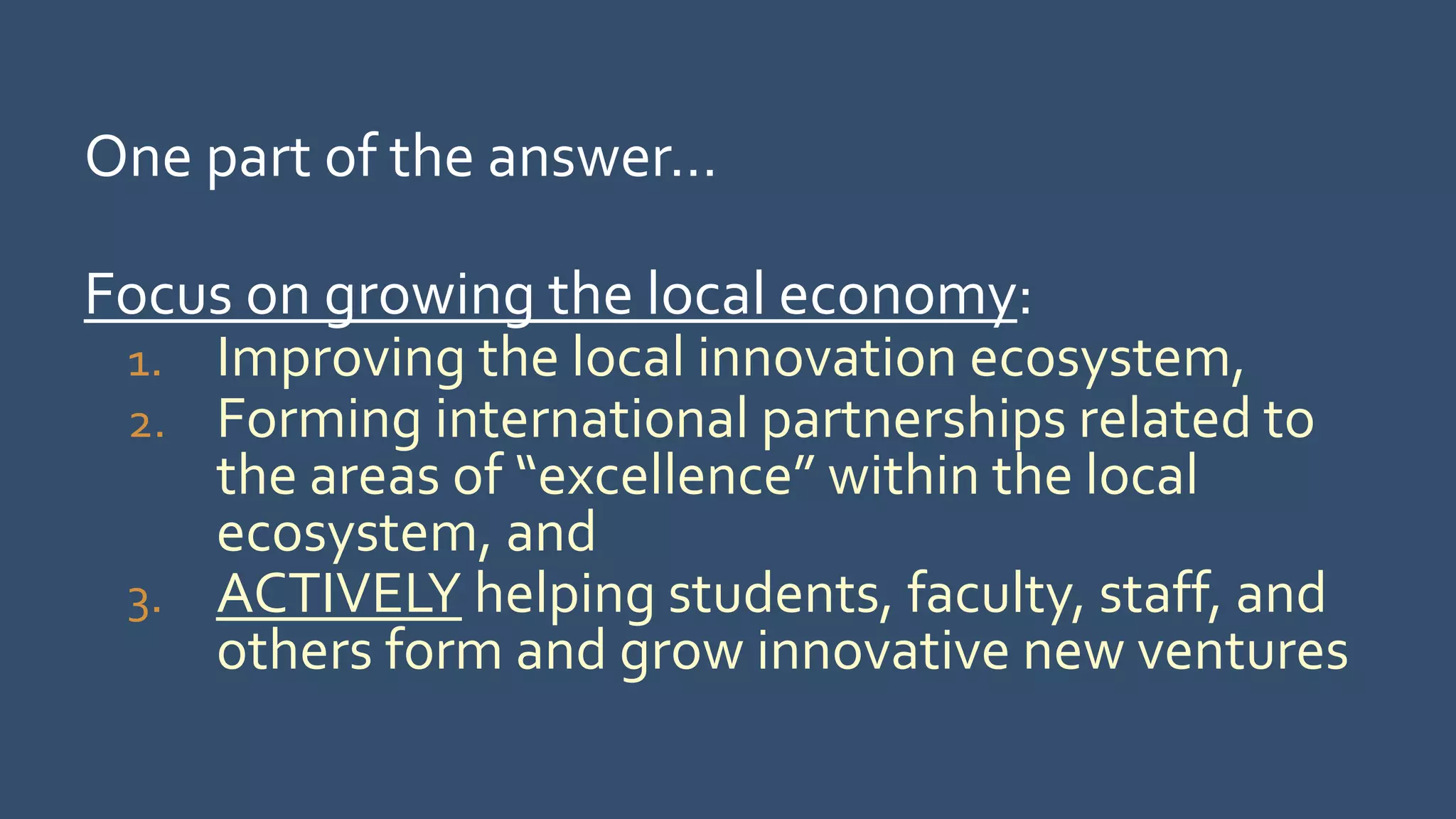
One part of the answer…
Focus on growing the local economy:
1. Improving the local innovation ecosystem,
2. Forming international partnerships related to
the areas of “excellence” within the local
ecosystem, and
3. ACTIVELY helping students, faculty, staff, and
others form and grow innovative new ventures
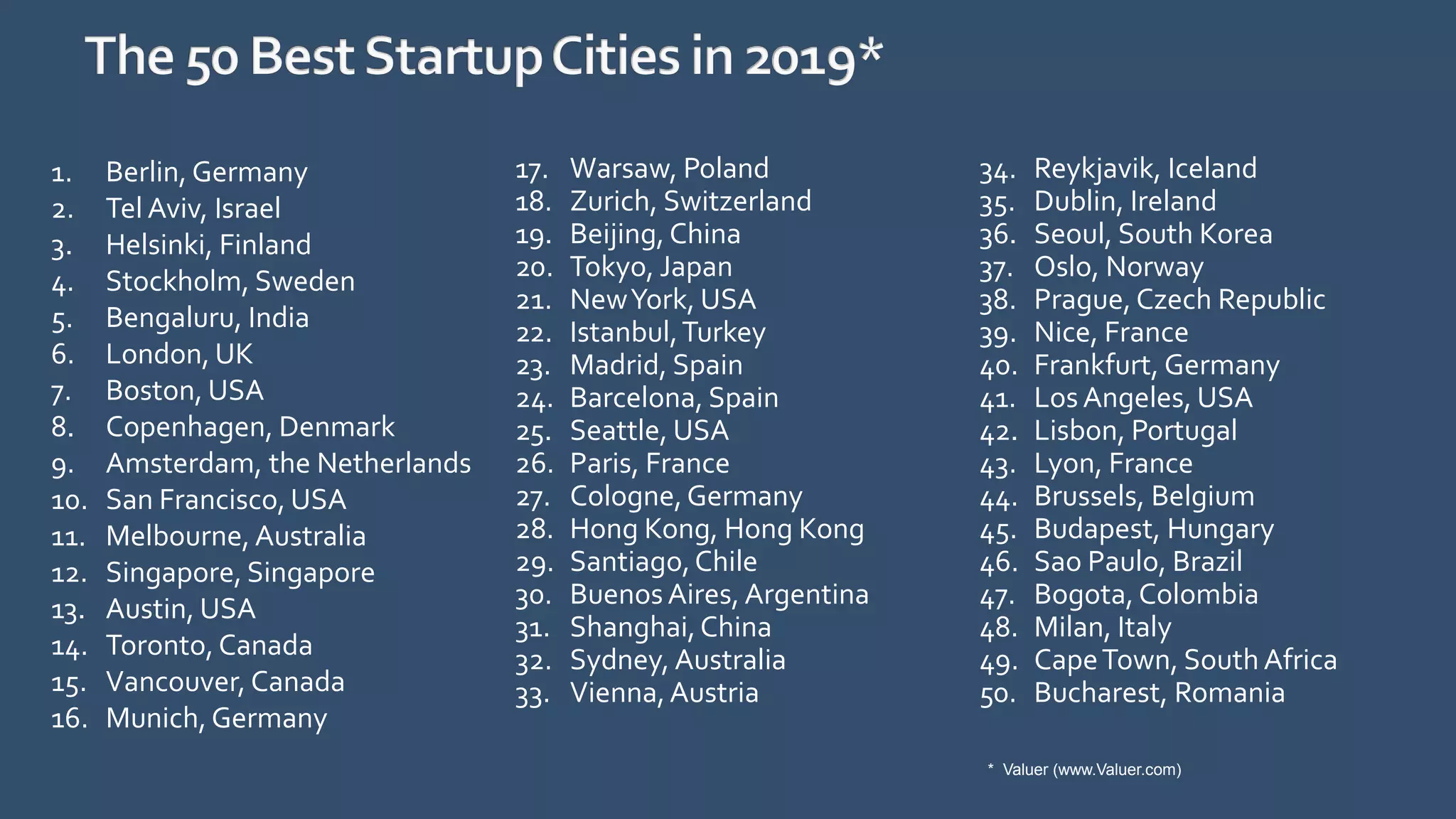
1. Berlin, Germany
2. Tel Aviv, Israel
3. Helsinki, Finland
4. Stockholm, Sweden
5. Bengaluru, India
6. London, UK
7. Boston, USA
8. Copenhagen, Denmark
9. Amsterdam, the Netherlands
10. San Francisco, USA
11. Melbourne, Australia
12. Singapore, Singapore
13. Austin, USA
14. Toronto,Canada
15. Vancouver, Canada
16. Munich, Germany
17. Warsaw, Poland
18. Zurich, Switzerland
19. Beijing, China
20. Tokyo, Japan
21. NewYork, USA
22. Istanbul,Turkey
23. Madrid, Spain
24. Barcelona, Spain
25. Seattle, USA
26. Paris, France
27. Cologne,Germany
28. Hong Kong, Hong Kong
29. Santiago,Chile
30. Buenos Aires, Argentina
31. Shanghai,China
32. Sydney, Australia
33. Vienna,Austria
34. Reykjavik, Iceland
35. Dublin, Ireland
36. Seoul, South Korea
37. Oslo, Norway
38. Prague, Czech Republic
39. Nice, France
40. Frankfurt, Germany
41. Los Angeles, USA
42. Lisbon, Portugal
43. Lyon, France
44. Brussels, Belgium
45. Budapest, Hungary
46. Sao Paulo, Brazil
47. Bogota, Colombia
48. Milan, Italy
49. CapeTown, South Africa
50. Bucharest, Romania
* Valuer (www.Valuer.com)
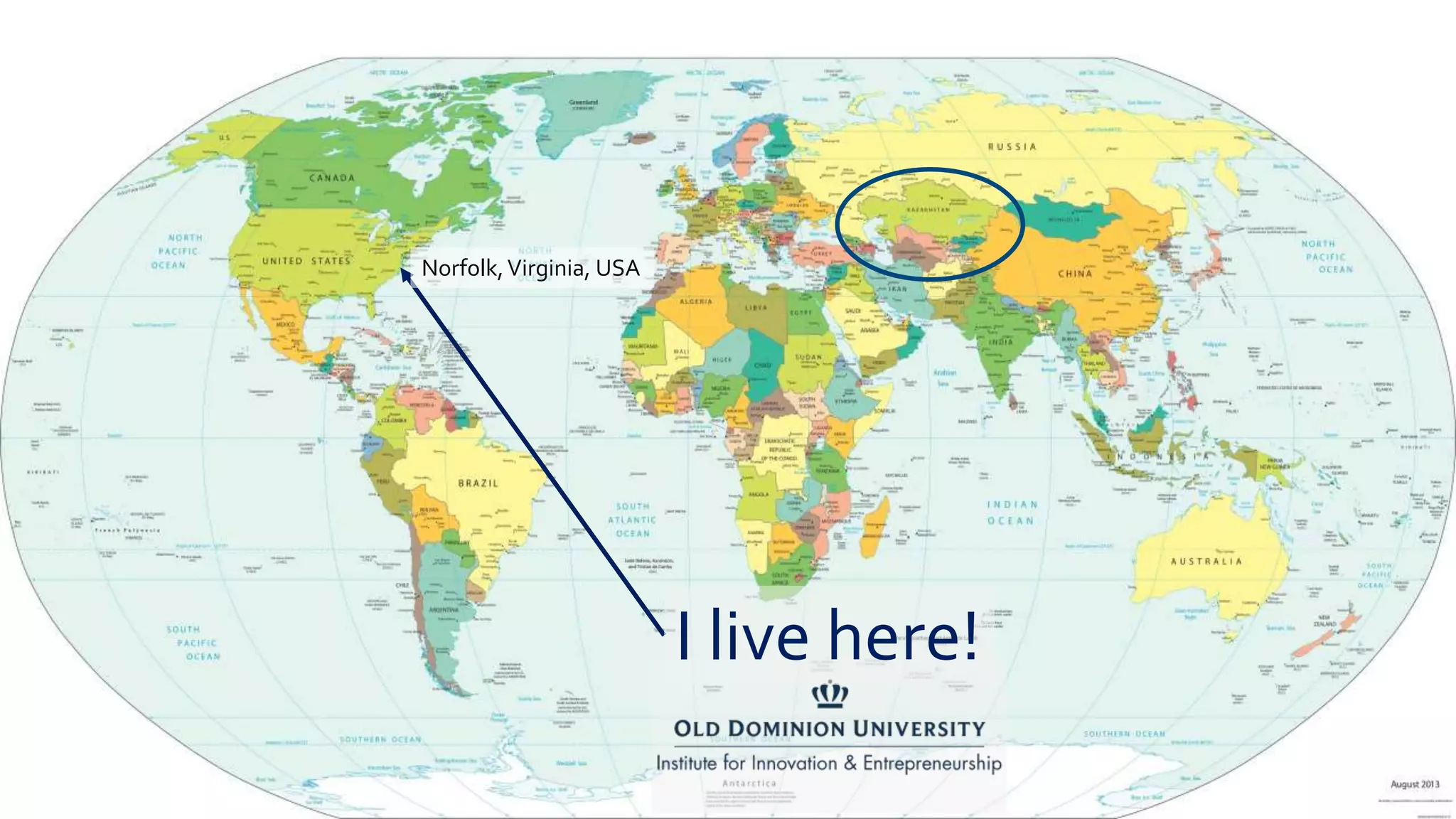
Norfolk,Virginia, USA
I live here!
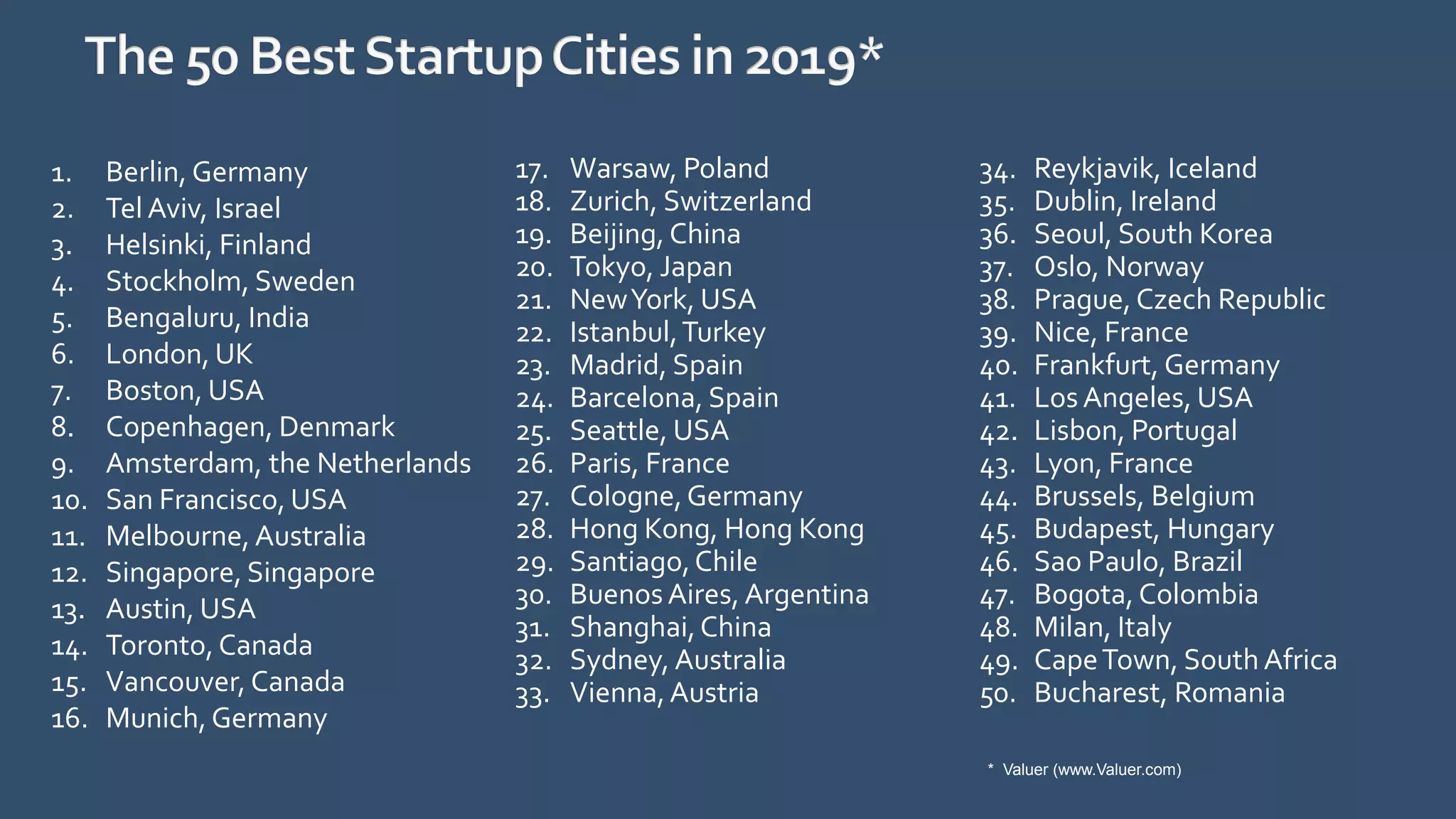
1. Berlin, Germany
2. Tel Aviv, Israel
3. Helsinki, Finland
4. Stockholm, Sweden
5. Bengaluru, India
6. London, UK
7. Boston, USA
8. Copenhagen, Denmark
9. Amsterdam, the Netherlands
10. San Francisco, USA
11. Melbourne, Australia
12. Singapore, Singapore
13. Austin, USA
14. Toronto,Canada
15. Vancouver, Canada
16. Munich, Germany
17. Warsaw, Poland
18. Zurich, Switzerland
19. Beijing, China
20. Tokyo, Japan
21. NewYork, USA
22. Istanbul,Turkey
23. Madrid, Spain
24. Barcelona, Spain
25. Seattle, USA
26. Paris, France
27. Cologne,Germany
28. Hong Kong, Hong Kong
29. Santiago,Chile
30. Buenos Aires, Argentina
31. Shanghai,China
32. Sydney, Australia
33. Vienna,Austria
34. Reykjavik, Iceland
35. Dublin, Ireland
36. Seoul, South Korea
37. Oslo, Norway
38. Prague, Czech Republic
39. Nice, France
40. Frankfurt, Germany
41. Los Angeles, USA
42. Lisbon, Portugal
43. Lyon, France
44. Brussels, Belgium
45. Budapest, Hungary
46. Sao Paulo, Brazil
47. Bogota, Colombia
48. Milan, Italy
49. CapeTown, South Africa
50. Bucharest, Romania
* Valuer (www.Valuer.com)
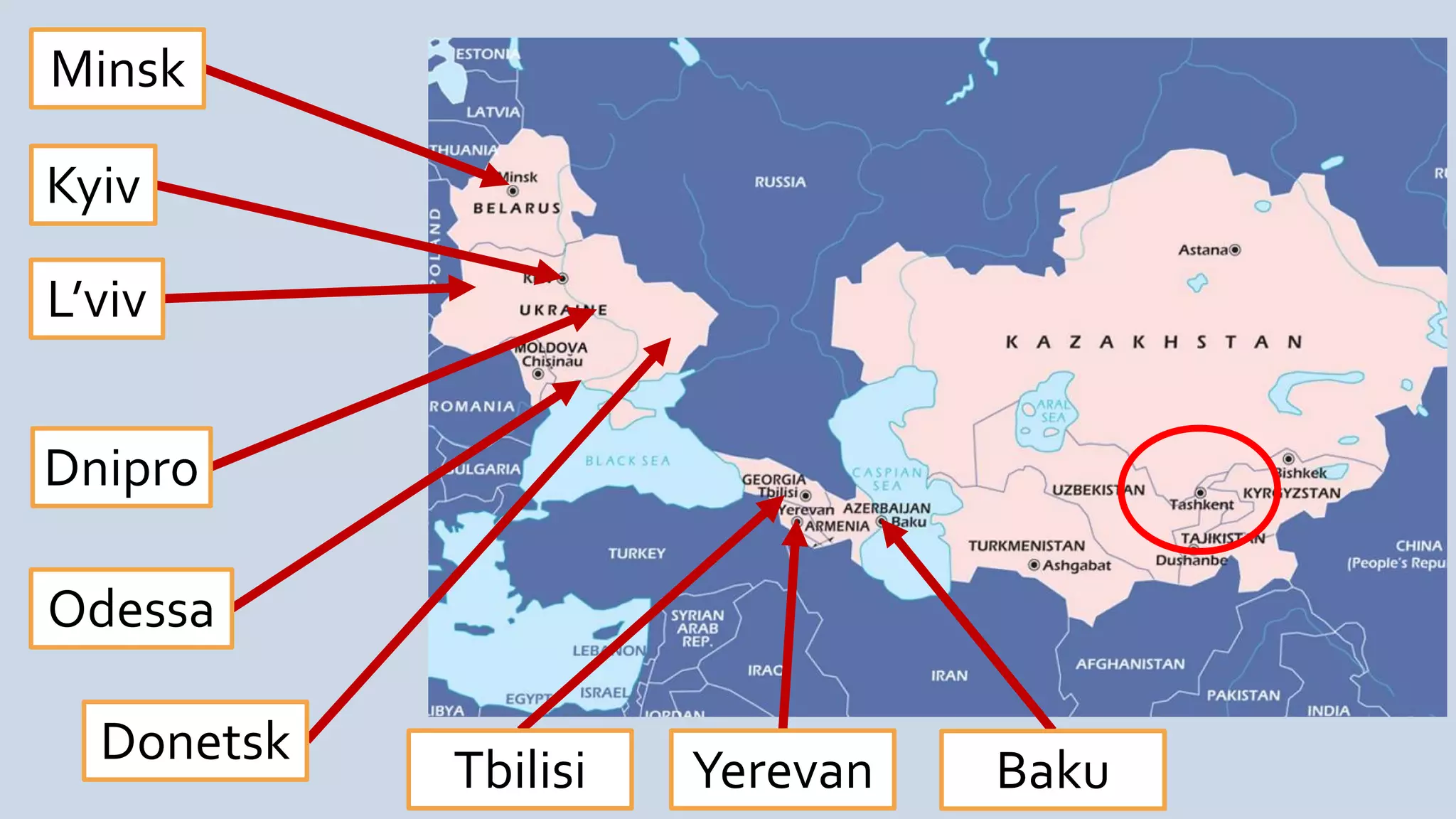
Odessa
Kyiv
L’viv
Donetsk
Dnipro
Yerevan Baku
Minsk
Tbilisi
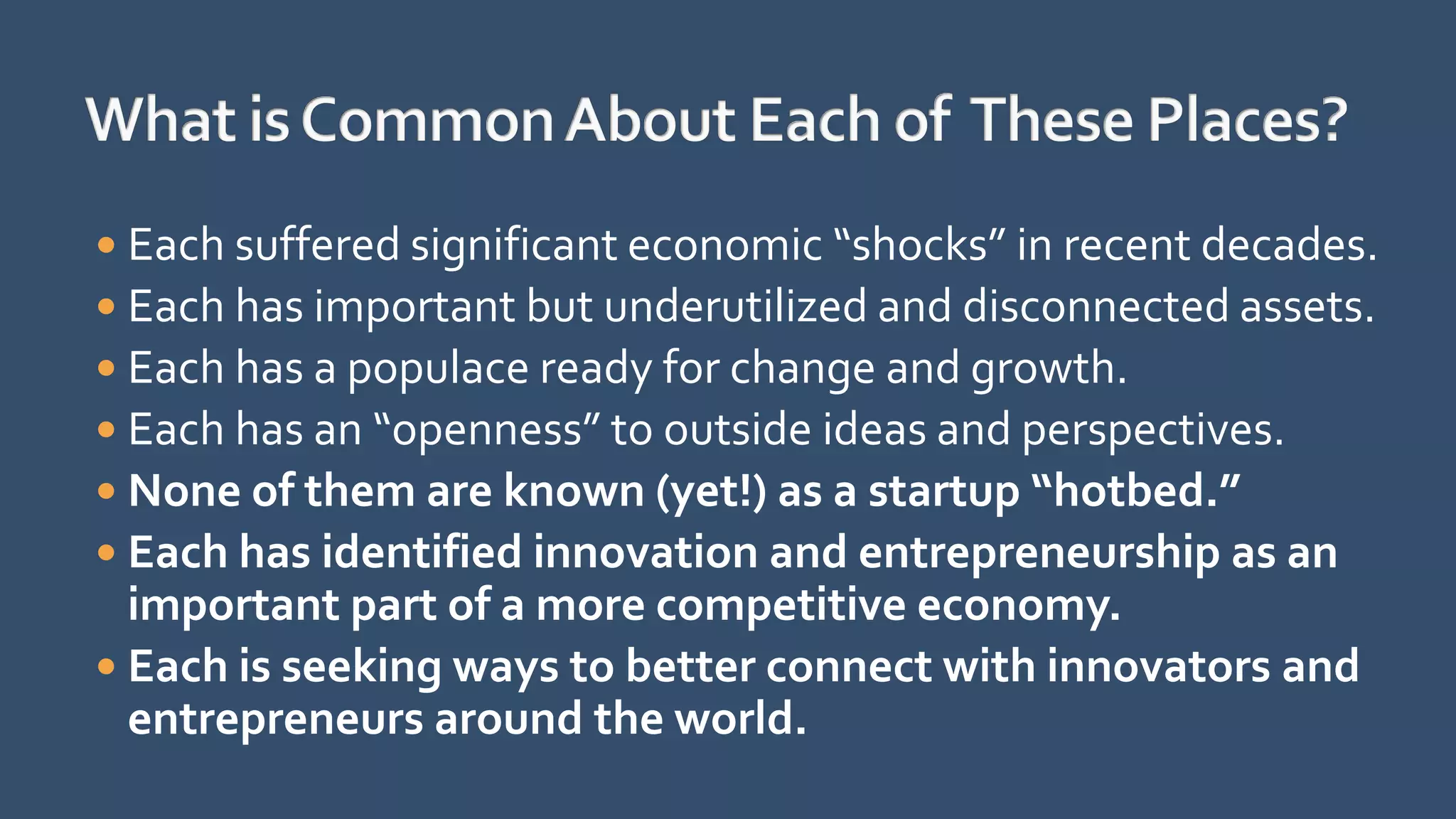
 Each suffered significant economic “shocks” in recent decades.
 Each has important but underutilized and disconnected assets.
 Each has a populace ready for change and growth.
 Each has an “openness” to outside ideas and perspectives.
 None of them are known (yet!) as a startup “hotbed.”
 Each has identified innovation and entrepreneurship as an
important part of a more competitive economy.
 Each is seeking ways to better connect with innovators and
entrepreneurs around the world.
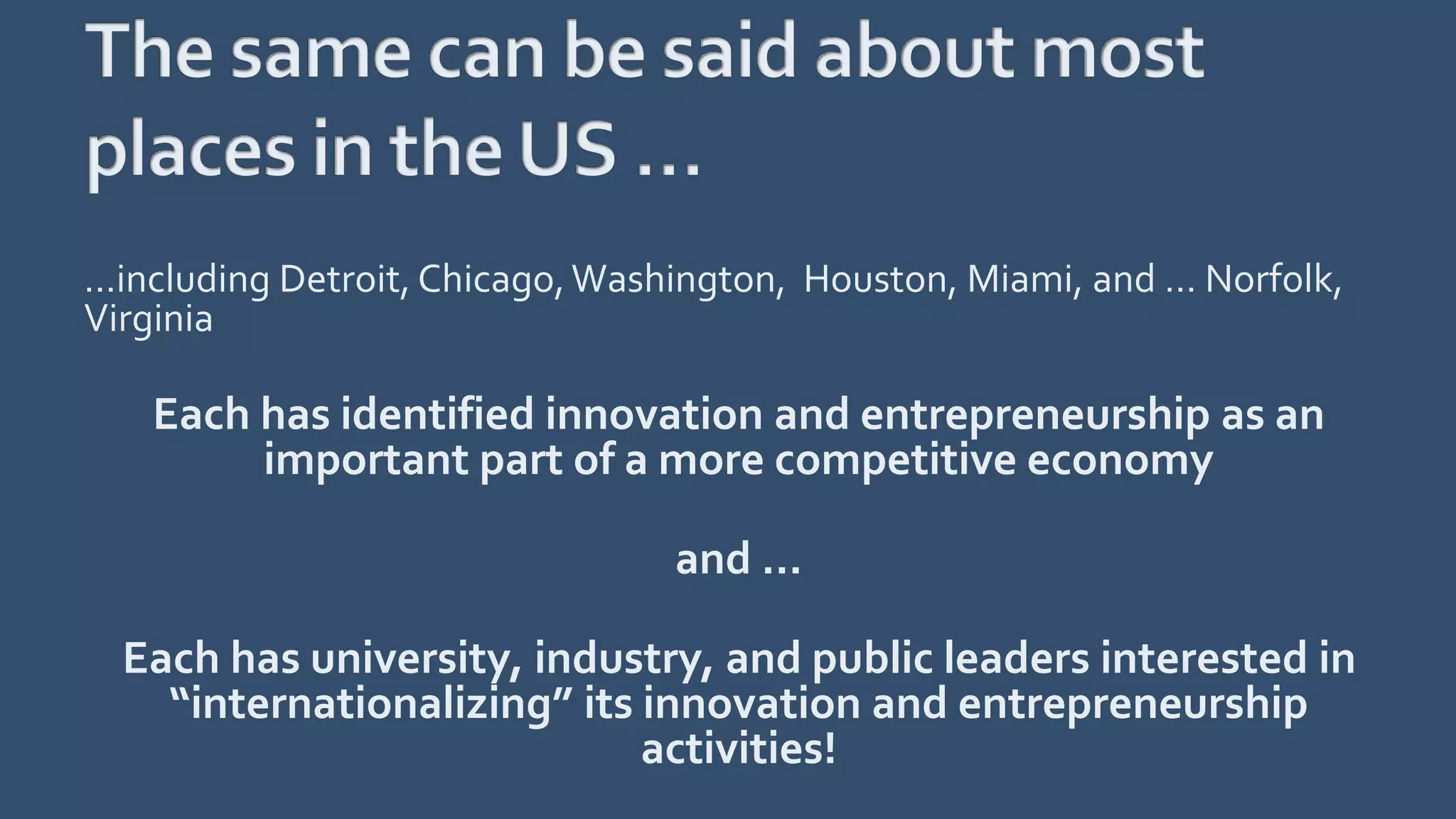
…including Detroit, Chicago,Washington, Houston, Miami, and … Norfolk,
Virginia
Each has identified innovation and entrepreneurship as an
important part of a more competitive economy
and …
Each has university, industry, and public leaders interested in
“internationalizing” its innovation and entrepreneurship
activities!
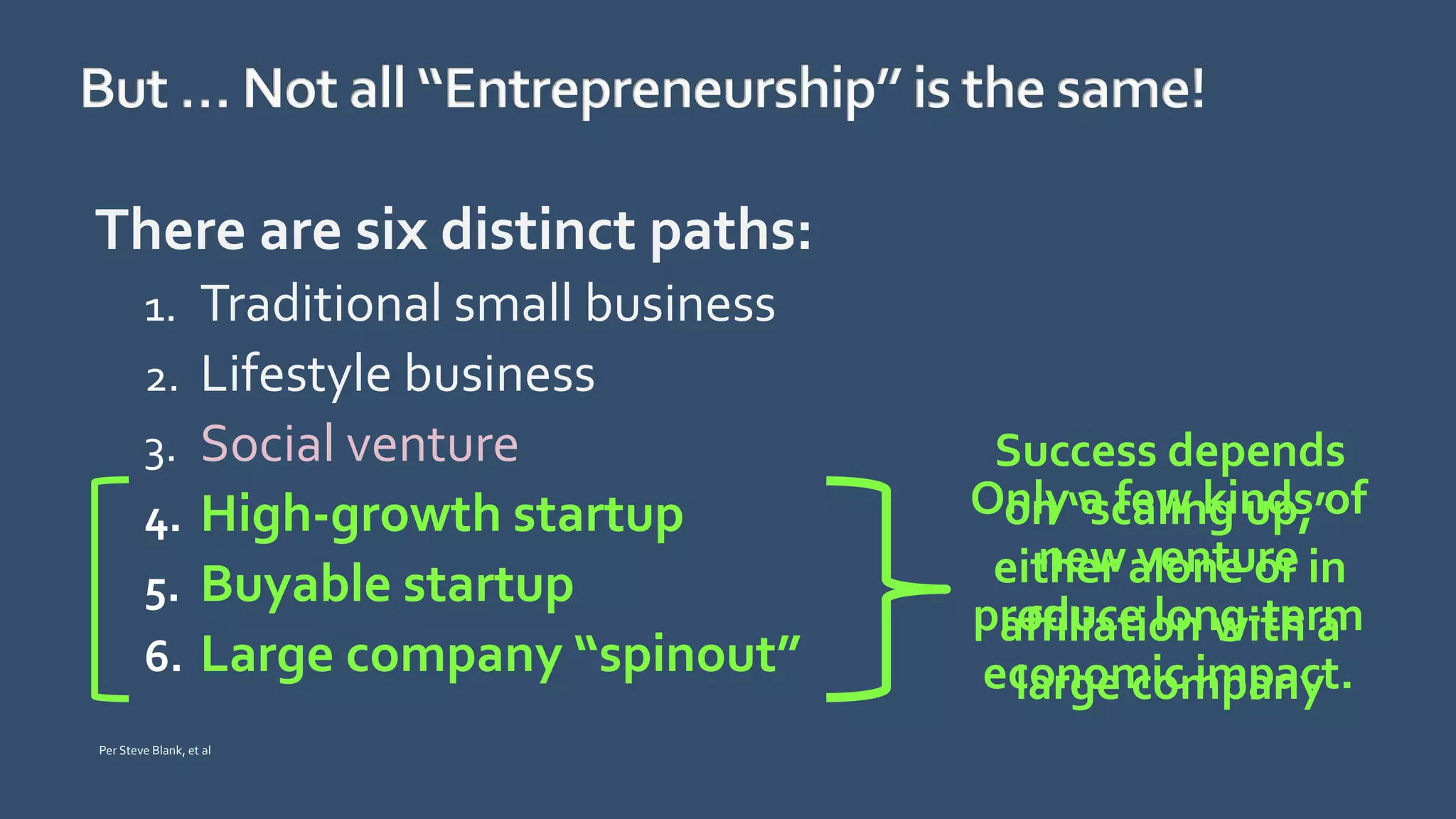
There are six distinct paths:
1. Traditional small business
2. Lifestyle business
3. Social venture
4. High-growth startup
5. Buyable startup
6. Large company “spinout”
Per Steve Blank, et al
Only a few kinds of
new venture
produce long-term
economic impact.
Success depends
on “scaling up,”
either alone or in
affiliation with a
large company
 Innovation & entrepreneurship is a set of skills that can be applied
across professions, markets, and technologies.
 Must invest in both in formal and informal programs:
 Formal programs include funded incubators, accelerators, co-
working spaces, mentoring programs, “Entrepreneur in
Residence,” pitch competitions, innovation challenges, venture
funds, technology hubs, etc.
 Informal programs include entrepreneurship clubs, expanded
networking events, “Startup meetups,” speaker series, on-going
“celebration” of entrepreneurship successes.
… creates new opportunities for local companies in both existing
and emerging local markets…
…and …
… creates opportunities for university-based research
partnerships and international collaborations!!
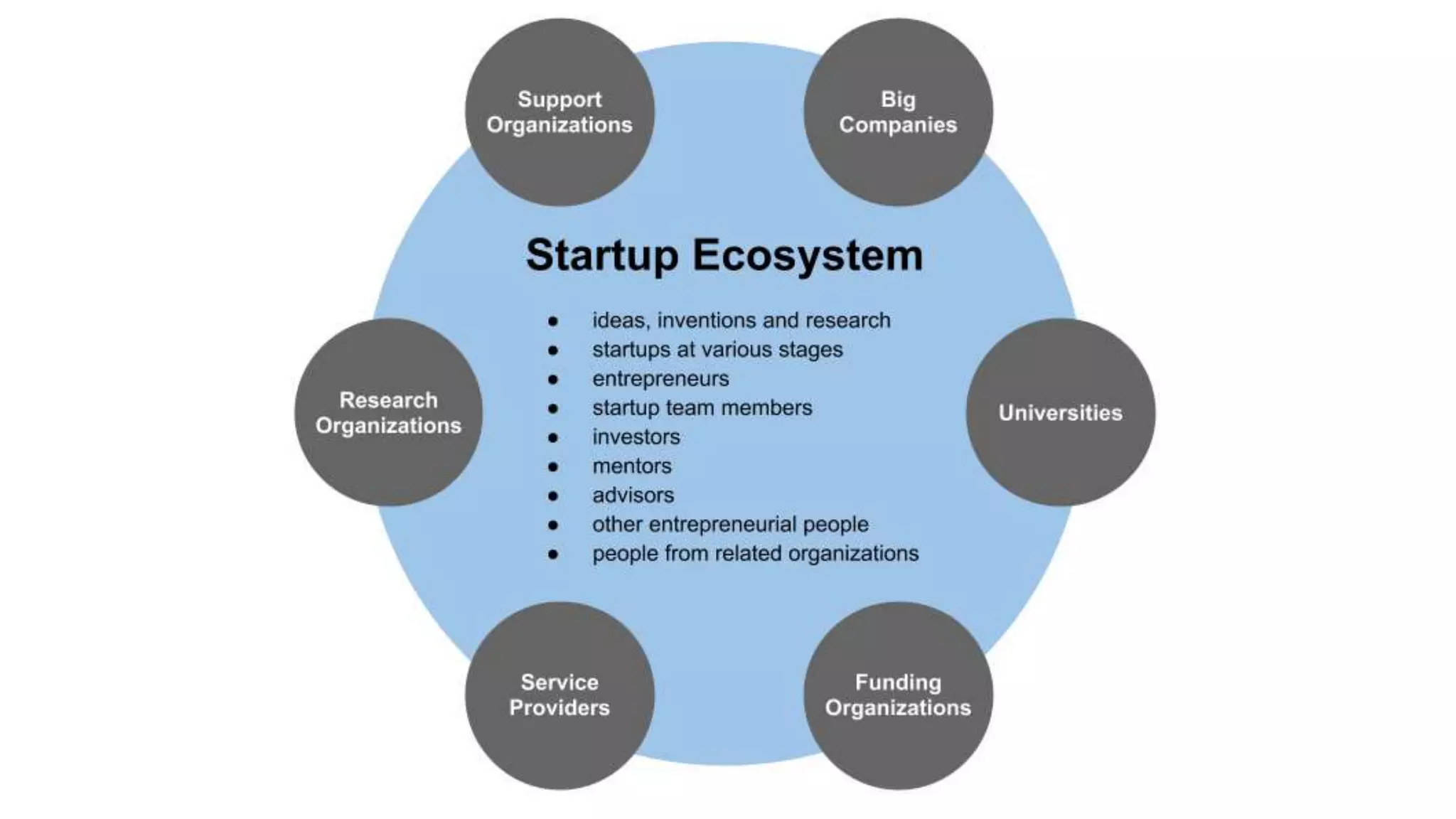
Five areas of focus are at the heart of the innovation and
entrepreneurship withinAmerica’s universities.
1. Active engagement in regional economic development;
2. Industry collaboration;
3. Student entrepreneurship;
4. Faculty entrepreneurship; and
5. Technology transfer
Source: The Innovative and Entrepreneurial University: Higher Education, Innovation & Entrepreneurship in Focus, U.S. Department of Commerce, October 2013
Make an effort to assess your region’s strengths
and weaknesses
Focus university innovation and entrepreneurship
programs on the local region’s most “excellent”
capabilities!
Establish collaborations within international
ecosystems that have similar “excellent”
capabilities and support similar industries
Specifically seek to connect with universities within
those international ecosystems that already have
effective partnerships with local economic
development organizations
 Maintain strong and sustained basic and “translational”
research to provide a pipeline of great ideas – must be

relevant to the local region’s industry and expertise!
 Explicitly link entrepreneurship programs with
translational research & development activities!
 Emphasize venture creation to commercialize
technologies and form international relationships
 “Entrepreneurs are everywhere” -- keep programs
available to ALL students & faculty
Encourage staff and faculty to engage with local
industry, investors, & policy makers
Target the kinds of new ventures that can scale,
and particularly those that have potential in
international markets
Marty Kaszubowski
Executive Director, Innovation Initiatives
Institute for Innovation & Entrepreneurship (IIE)
Old Dominion University (ODU)
MJKaszub@ODU.edu
www.ODU.edu/IIE
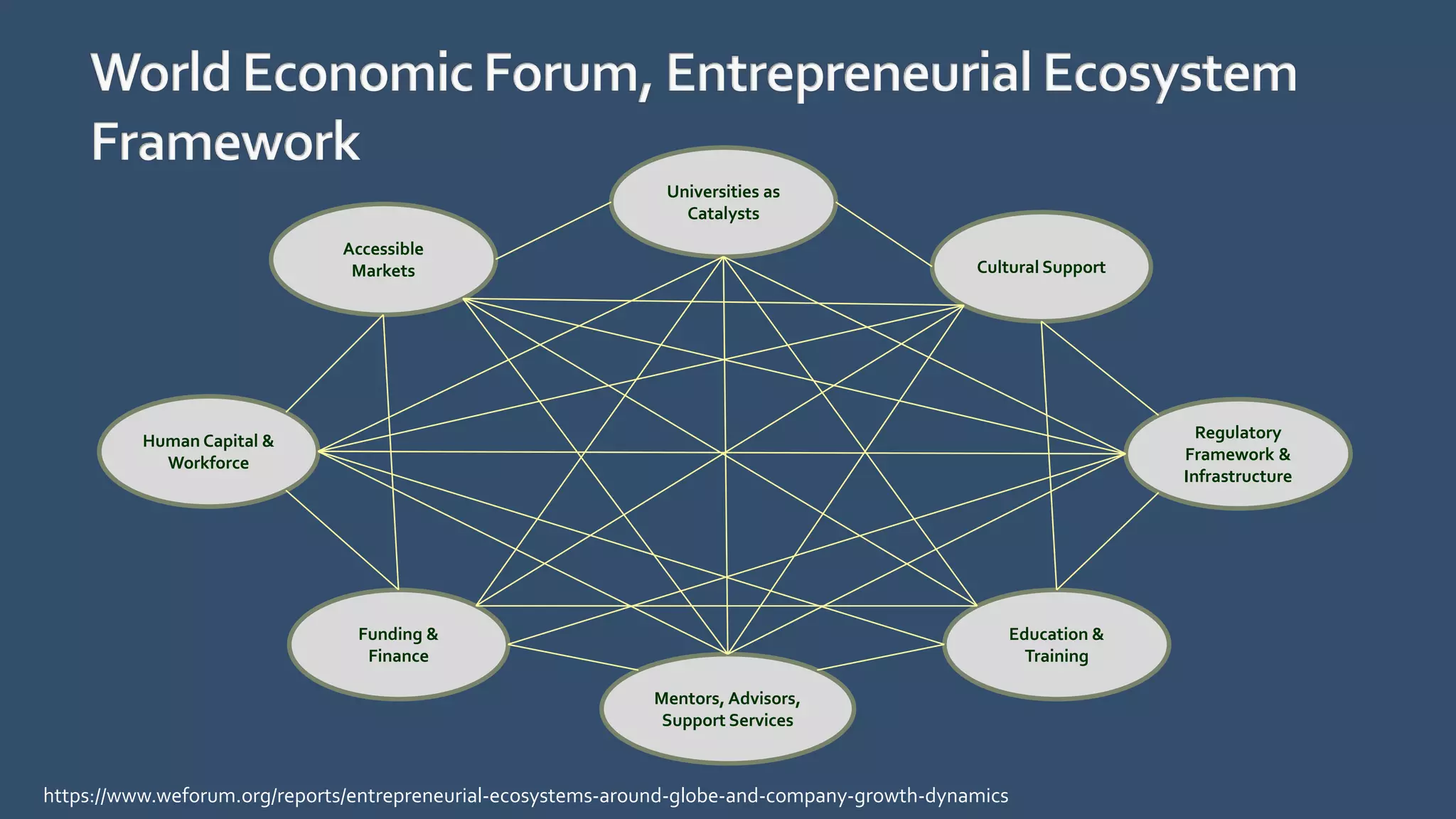
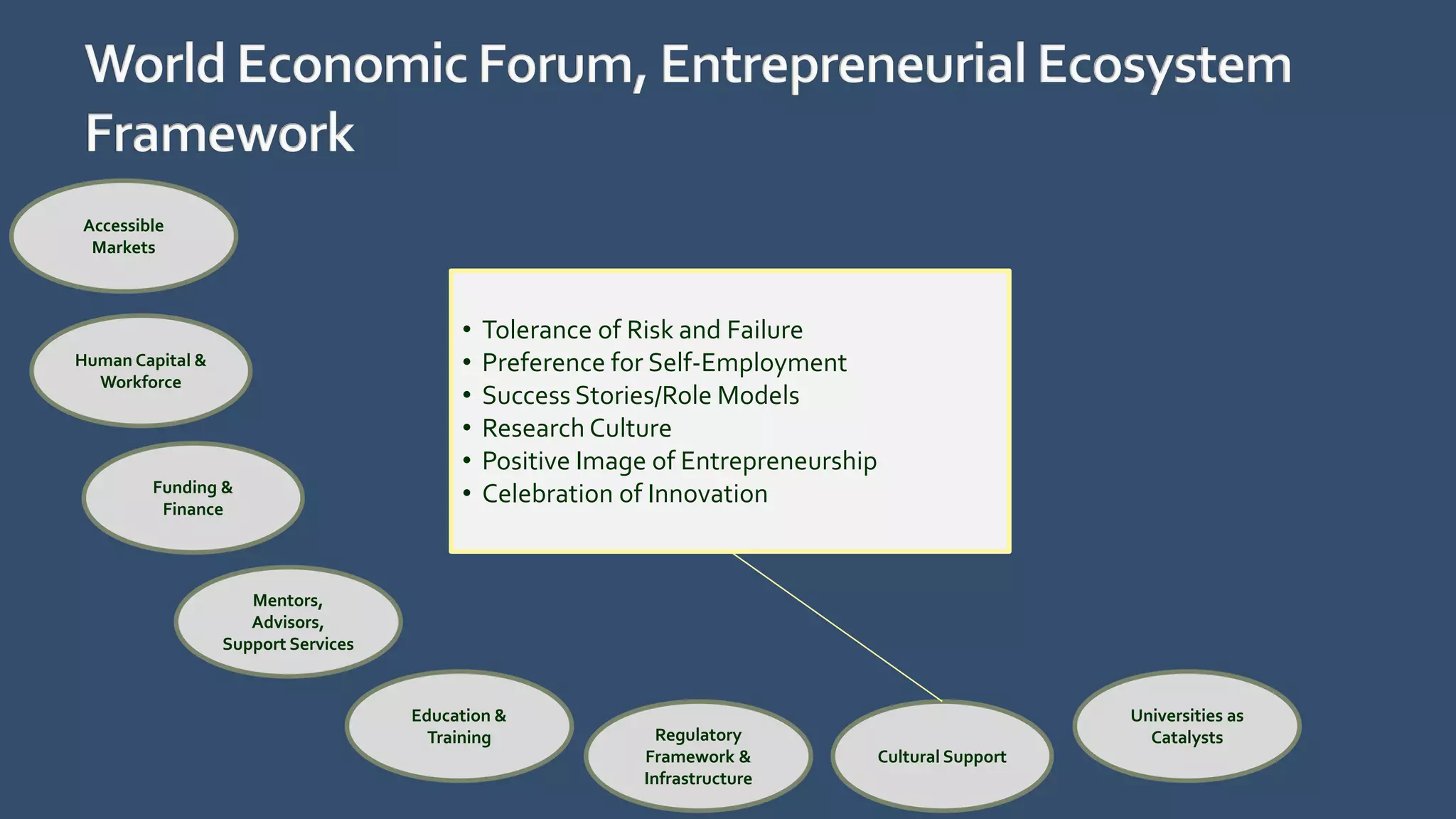
Accessible
Markets
Human Capital &
Workforce
Funding &
Finance
Mentors, Advisors,
Support Services
Regulatory
Framework &
Infrastructure
Education &
Training
Universities as
Catalysts
Cultural Support
https://www.weforum.org/reports/entrepreneurial-ecosystems-around-globe-and-company-growth-dynamics
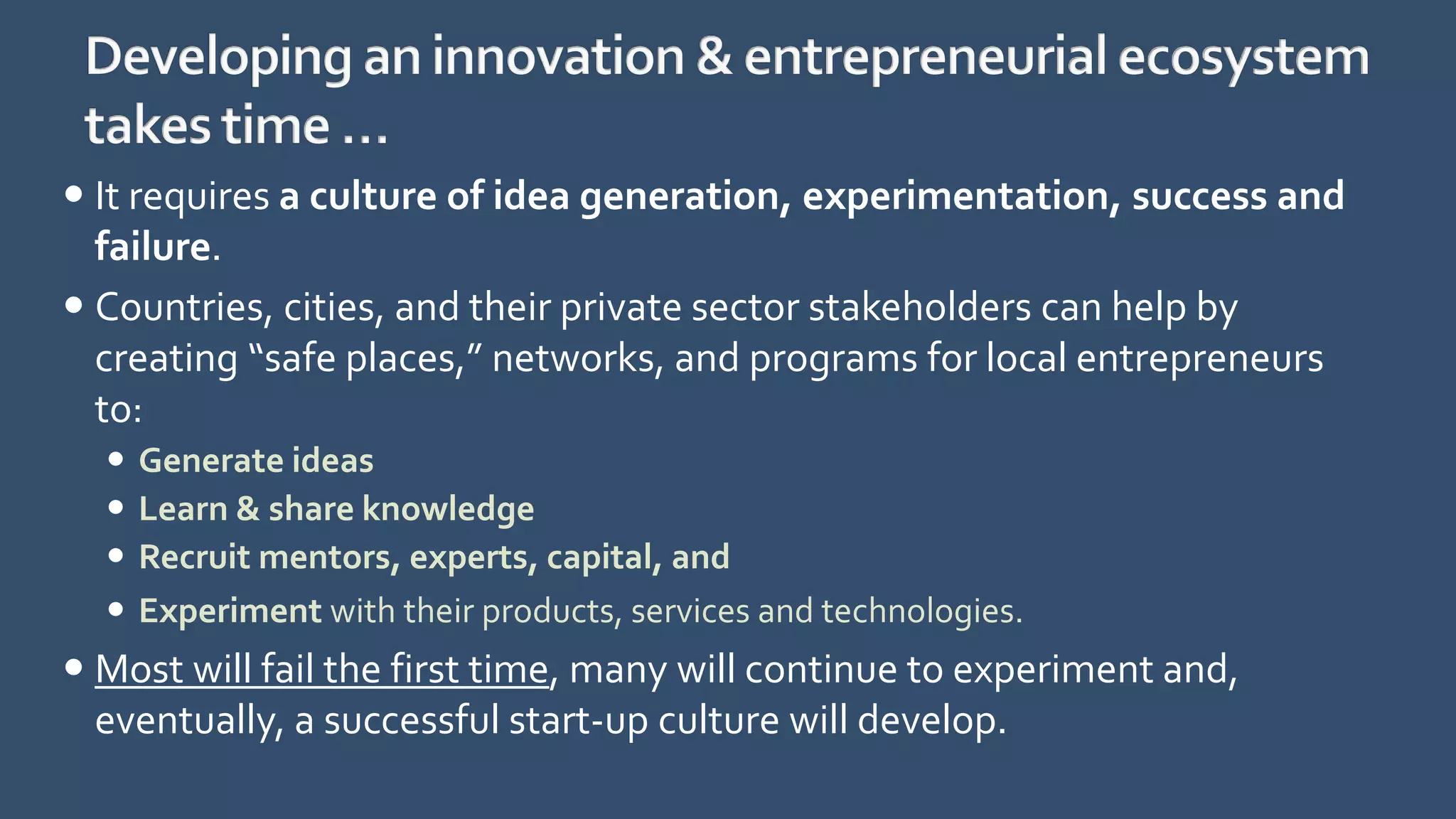
 It requires a culture of idea generation, experimentation, success and
failure.
 Countries, cities, and their private sector stakeholders can help by
creating “safe places,” networks, and programs for local entrepreneurs
to:
 Generate ideas
 Learn & share knowledge
 Recruit mentors, experts, capital, and
 Experiment with their products, services and technologies.
 Most will fail the first time, many will continue to experiment and,
eventually, a successful start-up culture will develop.
Accessible
Markets
Human Capital &
Workforce
Funding &
Finance
Mentors,
Advisors,
Support Services
Regulatory
Framework &
Infrastructure
Education &
Training
Cultural Support
Universities as
Catalysts
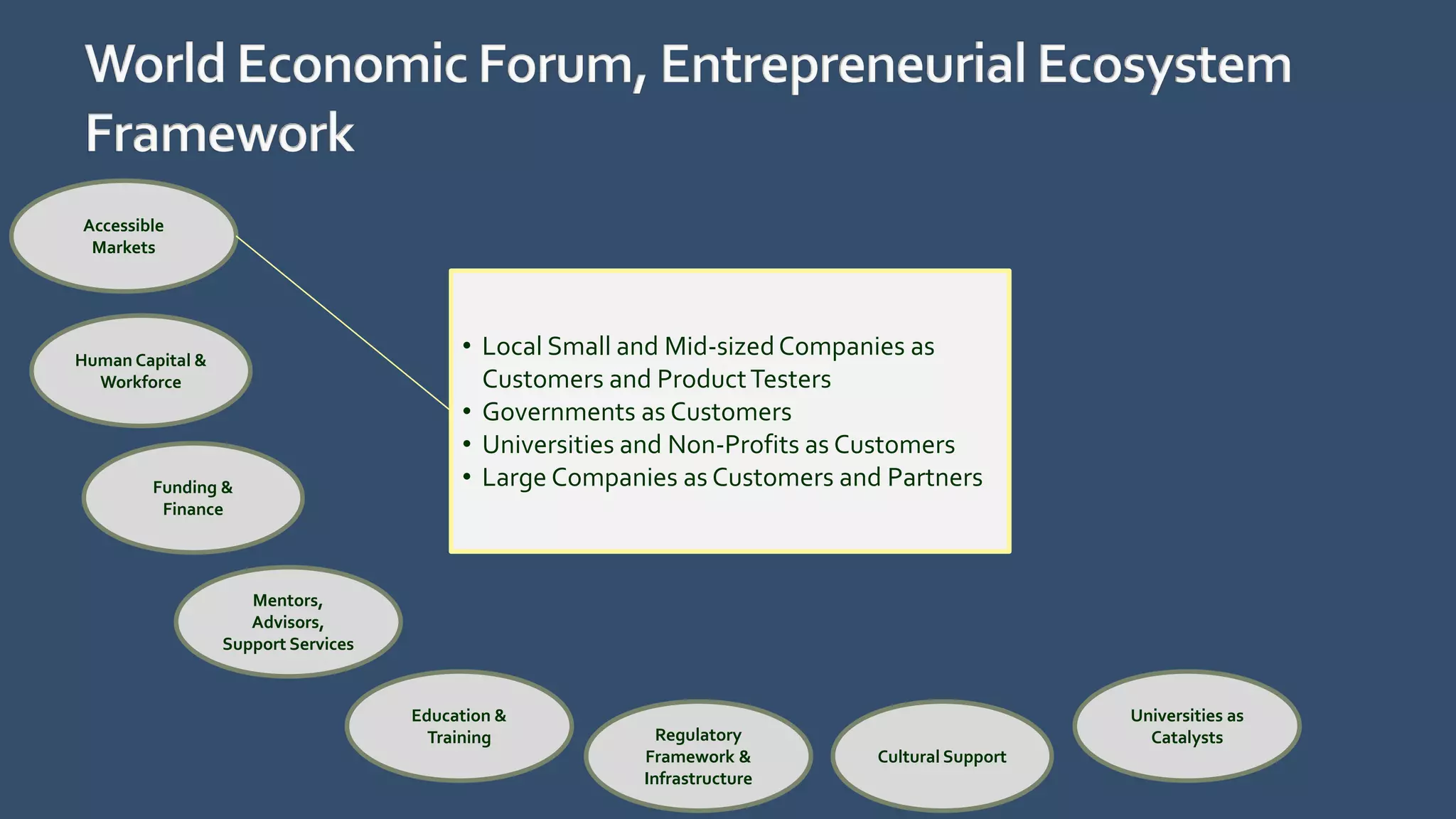
• Local Small and Mid-sizedCompanies as
Customers and ProductTesters
• Governments as Customers
• Universities and Non-Profits as Customers
• Large Companies as Customers and Partners
Accessible
Markets
Human Capital &
Workforce
Funding &
Finance
Mentors,
Advisors,
Support Services
Regulatory
Framework &
Infrastructure
Education &
Training
Cultural Support
Universities as
Catalysts
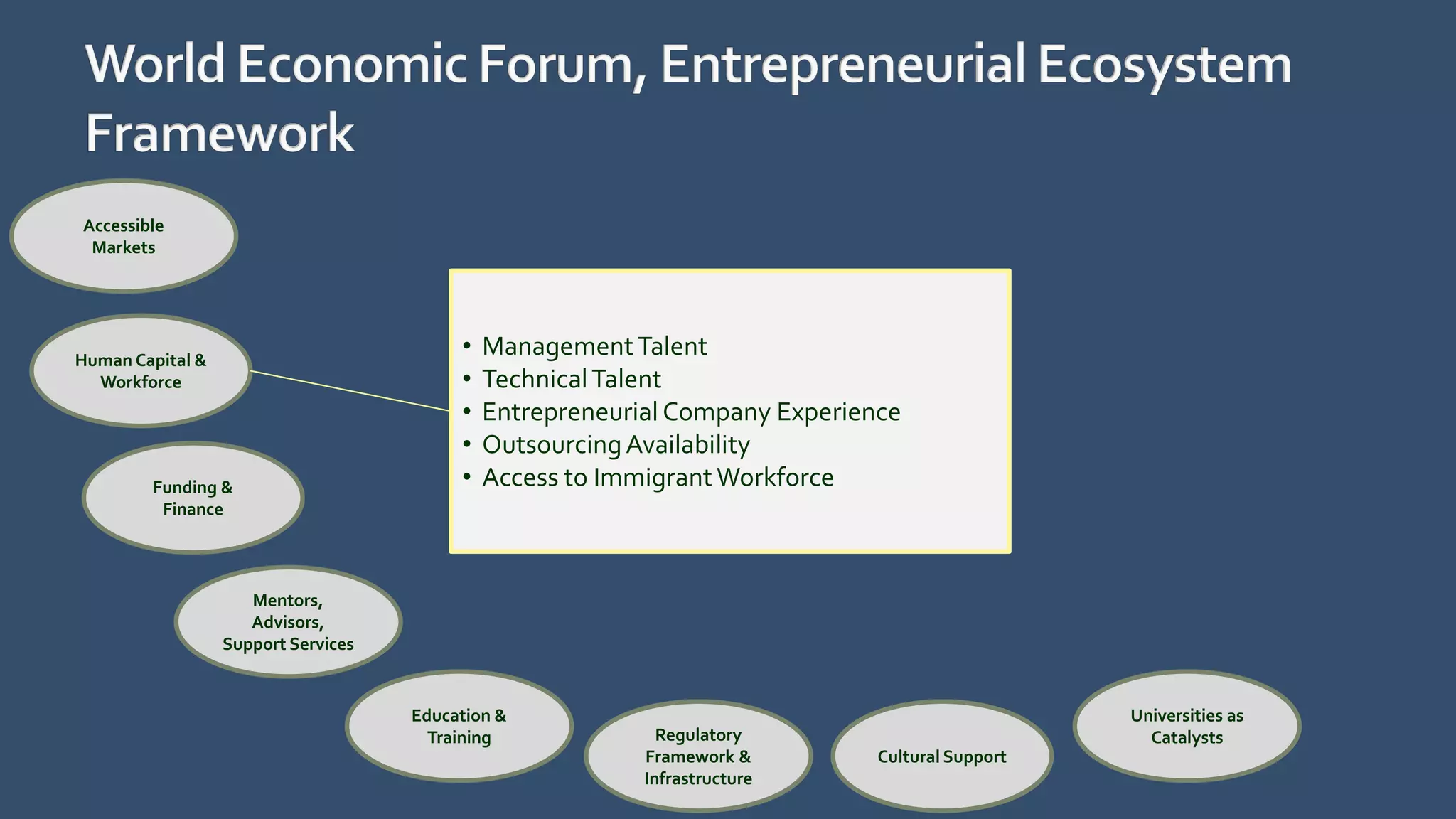
• ManagementTalent
• TechnicalTalent
• Entrepreneurial Company Experience
• OutsourcingAvailability
• Access to ImmigrantWorkforce
Accessible
Markets
Human Capital &
Workforce
Funding &
Finance
Mentors,
Advisors,
Support Services
Regulatory
Framework &
Infrastructure
Education &
Training
Cultural Support
Universities as
Catalysts
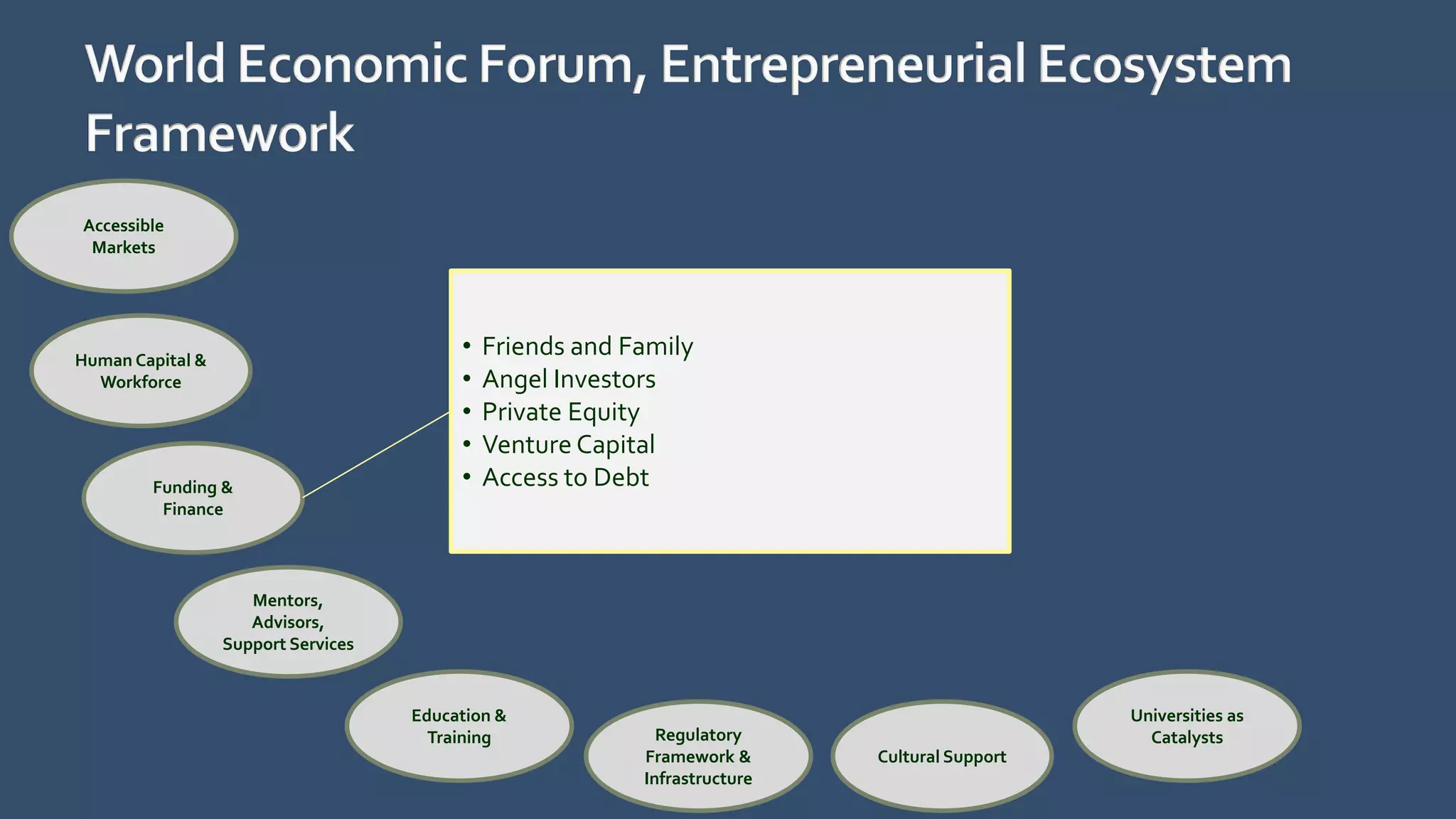
• Friends and Family
• Angel Investors
• Private Equity
• Venture Capital
• Access to Debt
Accessible
Markets
Human Capital &
Workforce
Funding &
Finance
Mentors,
Advisors,
Support Services
Regulatory
Framework &
Infrastructure
Education &
Training
Cultural Support
Universities as
Catalysts
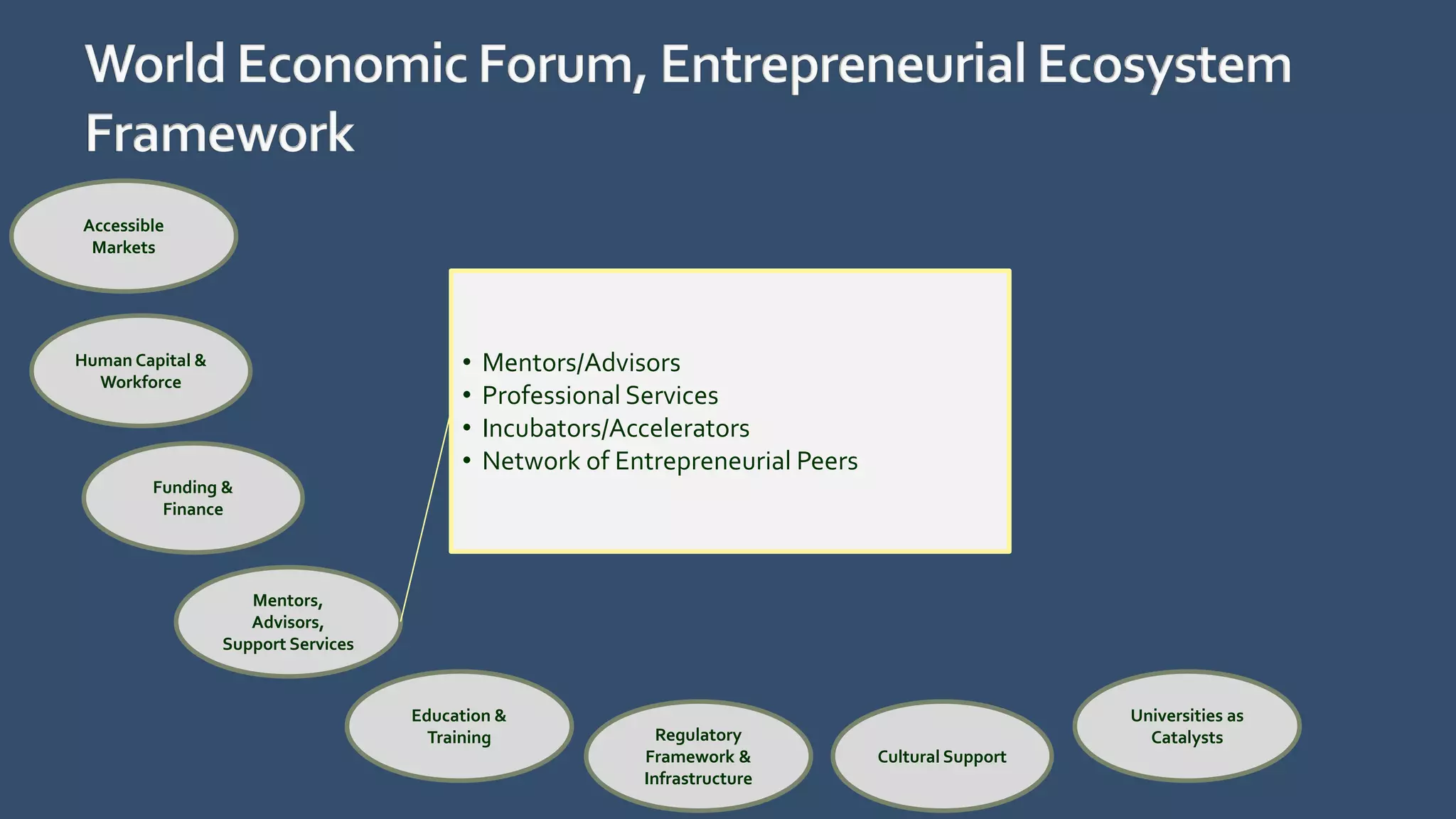
• Mentors/Advisors
• Professional Services
• Incubators/Accelerators
• Network of Entrepreneurial Peers
Accessible
Markets
Human Capital &
Workforce
Funding &
Finance
Mentors,
Advisors,
Support Services
Regulatory
Framework &
Infrastructure
Education &
Training
Cultural Support
Universities as
Catalysts
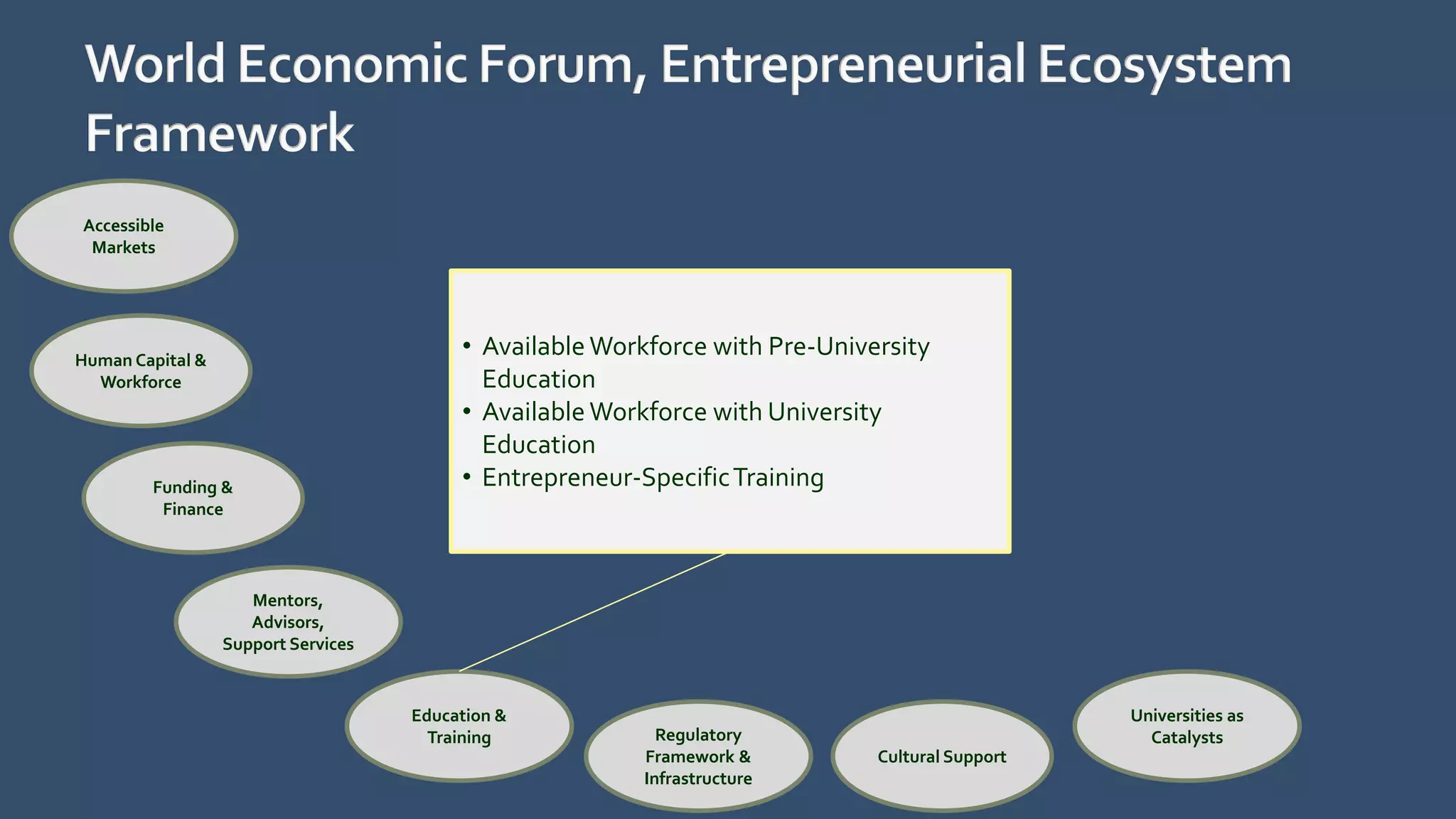
• Available Workforce with Pre-University
Education
• Available Workforce with University
Education
• Entrepreneur-SpecificTraining
Accessible
Markets
Human Capital &
Workforce
Funding &
Finance
Mentors,
Advisors,
Support Services
Regulatory
Framework &
Infrastructure
Education &
Training
Cultural Support
Universities as
Catalysts
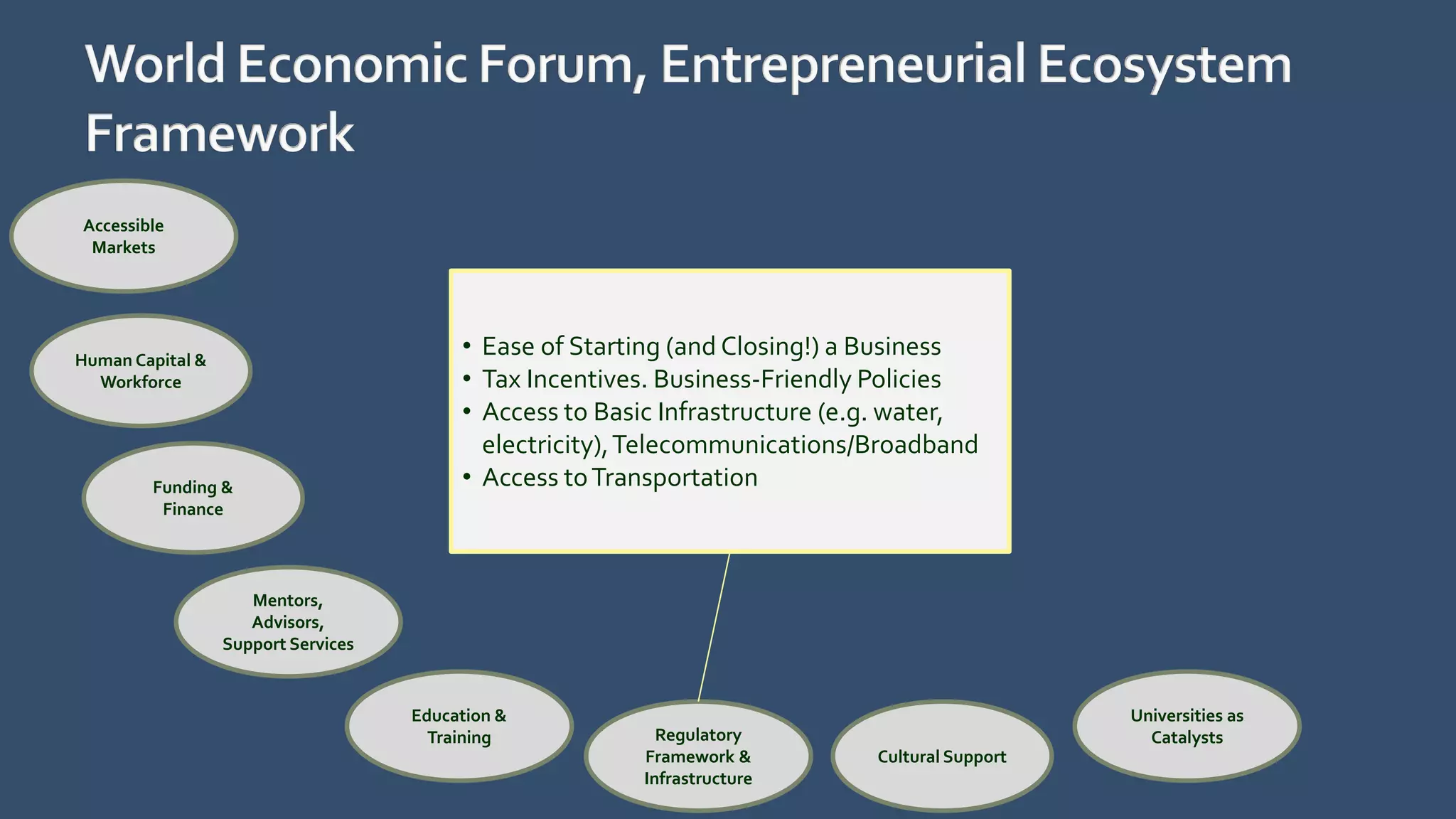
• Ease of Starting (and Closing!) a Business
• Tax Incentives. Business-Friendly Policies
• Access to Basic Infrastructure (e.g. water,
electricity),Telecommunications/Broadband
• Access toTransportation
Accessible
Markets
Human Capital &
Workforce
Funding &
Finance
Mentors,
Advisors,
Support Services
Regulatory
Framework &
Infrastructure
Education &
Training
Cultural Support
Universities as
Catalysts
• Tolerance of Risk and Failure
• Preference for Self-Employment
• Success Stories/Role Models
• Research Culture
• Positive Image of Entrepreneurship
• Celebration of Innovation
Accessible
Markets
Human Capital &
Workforce
Funding &
Finance
Mentors,
Advisors,
Support Services
Regulatory
Framework &
Infrastructure
Education &
Training
Cultural Support
Universities as
Catalysts
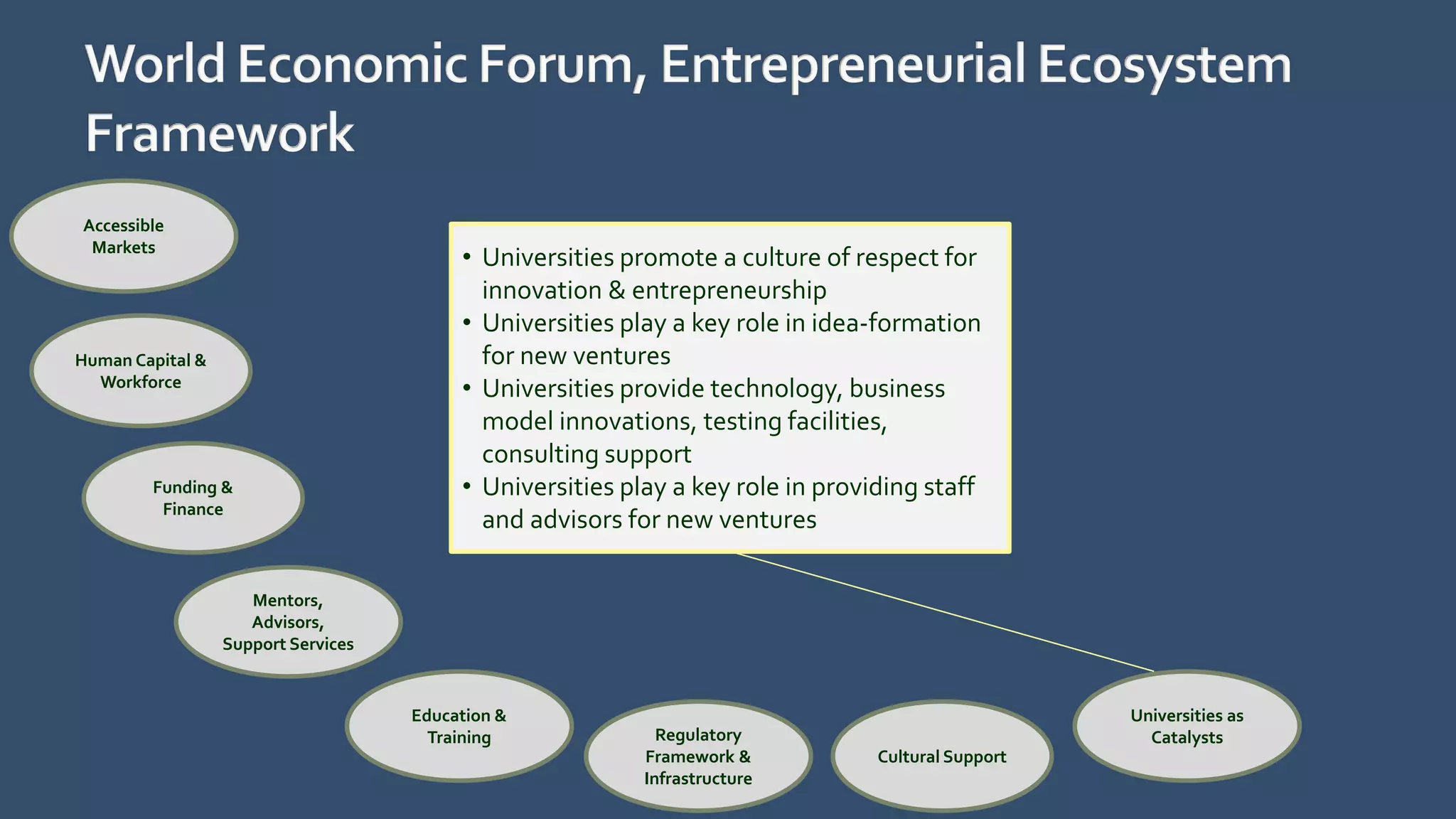
• Universities promote a culture of respect for
innovation & entrepreneurship
• Universities play a key role in idea-formation
for new ventures
• Universities provide technology, business
model innovations, testing facilities,
consulting support
• Universities play a key role in providing staff
and advisors for new ventures
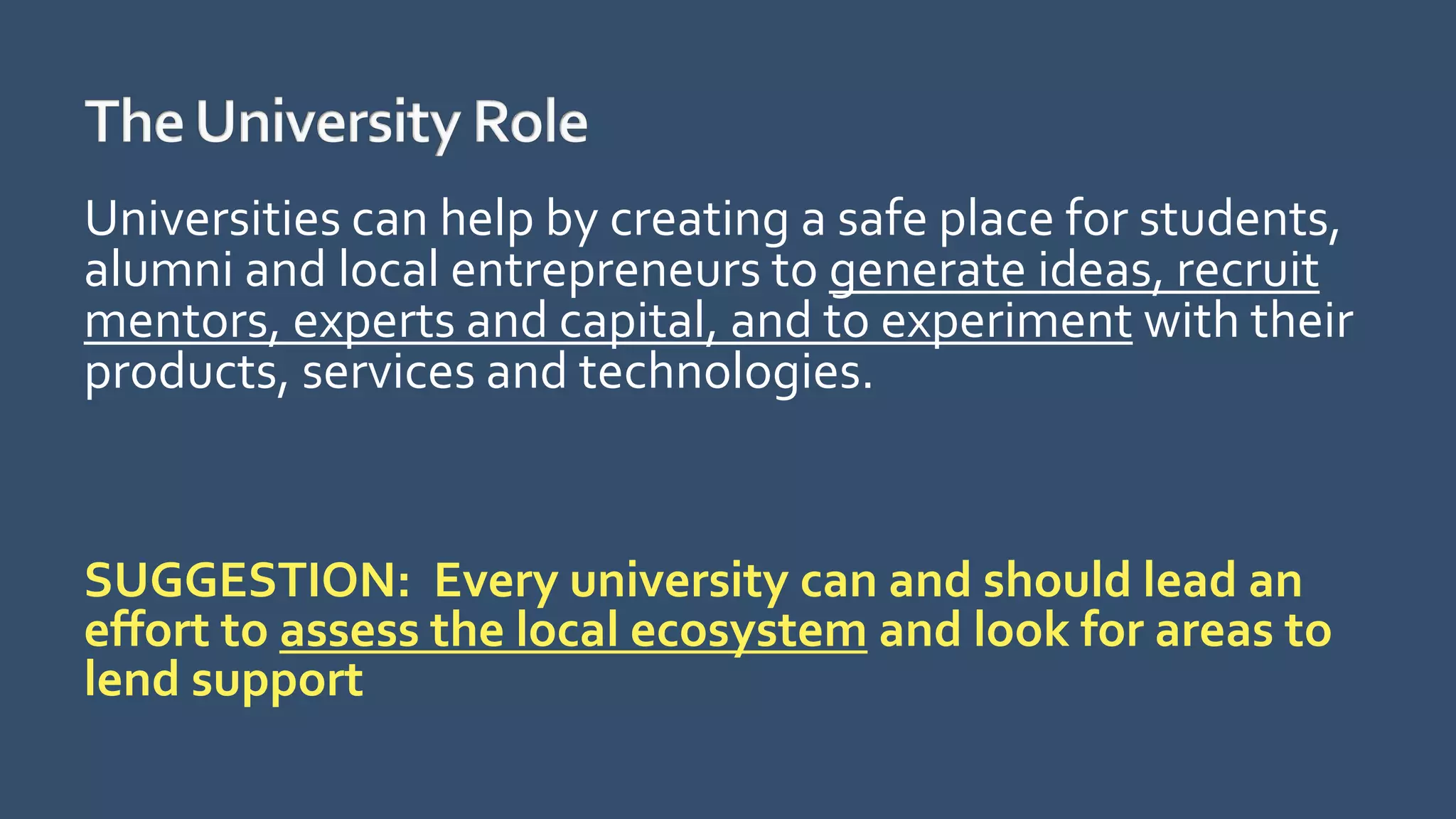
Universities can help by creating a safe place for students,
alumni and local entrepreneurs to generate ideas, recruit
mentors, experts and capital, and to experiment with their
products, services and technologies.
SUGGESTION: Every university can and should lead an
effort to assess the local ecosystem and look for areas to
lend support
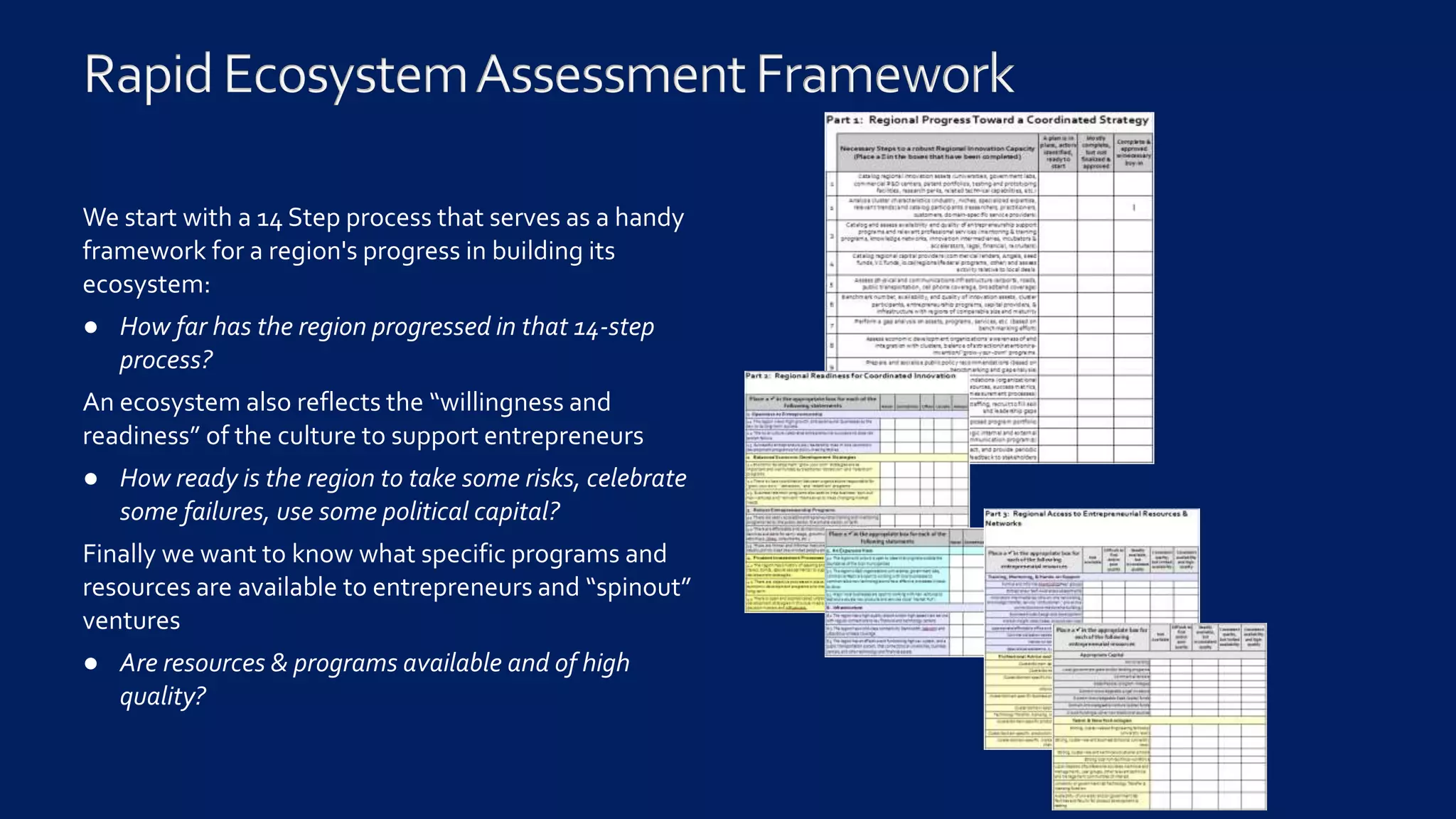
We start with a 14 Step process that serves as a handy
framework for a region's progress in building its
ecosystem:
● How far has the region progressed in that 14-step
process?
An ecosystem also reflects the “willingness and
readiness” of the culture to support entrepreneurs
● How ready is the region to take some risks, celebrate
some failures, use some political capital?
Finally we want to know what specific programs and
resources are available to entrepreneurs and “spinout”
ventures
● Are resources & programs available and of high
quality?
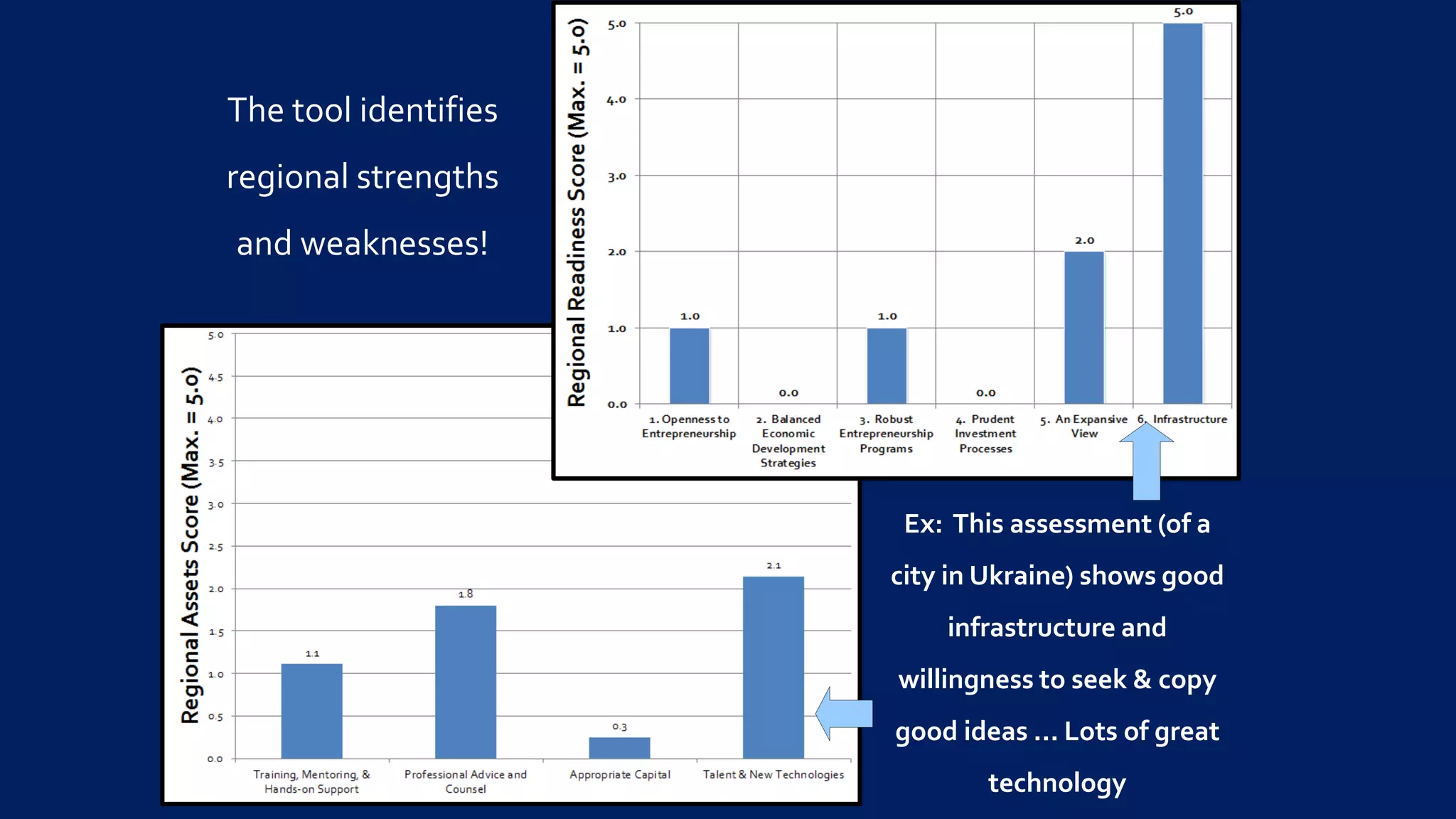
The tool identifies
regional strengths
and weaknesses!
Ex: This assessment (of a
city in Ukraine) shows good
infrastructure and
willingness to seek & copy
good ideas ... Lots of great
technology
Another
Useful
Approach
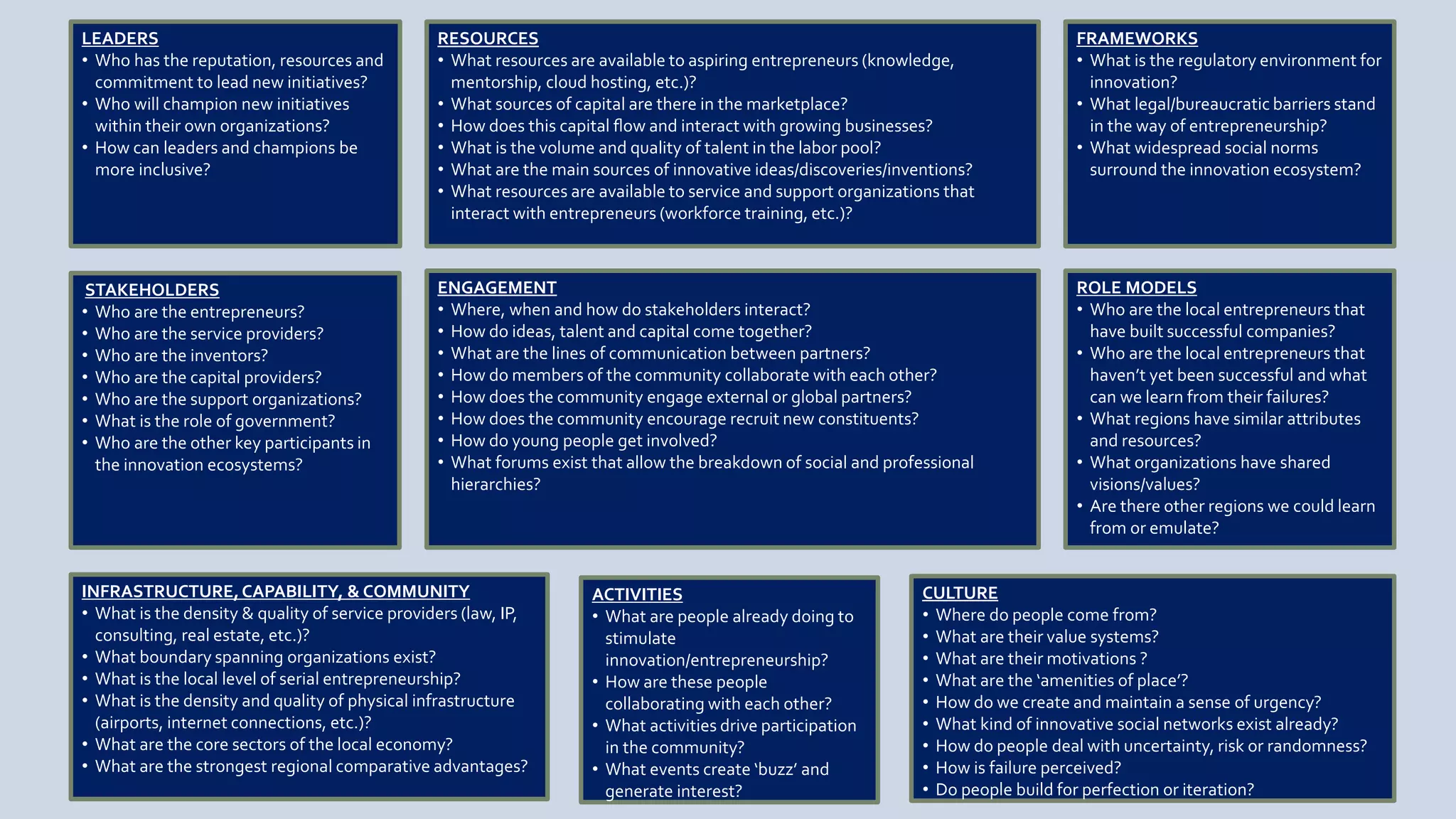
LEADERS
• Who has the reputation, resources and
commitment to lead new initiatives?
• Who will champion new initiatives
within their own organizations?
• How can leaders and champions be
more inclusive?
STAKEHOLDERS
• Who are the entrepreneurs?
• Who are the service providers?
• Who are the inventors?
• Who are the capital providers?
• Who are the support organizations?
• What is the role of government?
• Who are the other key participants in
the innovation ecosystems?
FRAMEWORKS
• What is the regulatory environment for
innovation?
• What legal/bureaucratic barriers stand
in the way of entrepreneurship?
• What widespread social norms
surround the innovation ecosystem?
RESOURCES
• What resources are available to aspiring entrepreneurs (knowledge,
mentorship, cloud hosting, etc.)?
• What sources of capital are there in the marketplace?
• How does this capital flow and interact with growing businesses?
• What is the volume and quality of talent in the labor pool?
• What are the main sources of innovative ideas/discoveries/inventions?
• What resources are available to service and support organizations that
interact with entrepreneurs (workforce training, etc.)?
ROLE MODELS
• Who are the local entrepreneurs that
have built successful companies?
• Who are the local entrepreneurs that
haven’t yet been successful and what
can we learn from their failures?
• What regions have similar attributes
and resources?
• What organizations have shared
visions/values?
• Are there other regions we could learn
from or emulate?
ACTIVITIES
• What are people already doing to
stimulate
innovation/entrepreneurship?
• How are these people
collaborating with each other?
• What activities drive participation
in the community?
• What events create ‘buzz’ and
generate interest?
ENGAGEMENT
• Where, when and how do stakeholders interact?
• How do ideas, talent and capital come together?
• What are the lines of communication between partners?
• How do members of the community collaborate with each other?
• How does the community engage external or global partners?
• How does the community encourage recruit new constituents?
• How do young people get involved?
• What forums exist that allow the breakdown of social and professional
hierarchies?
INFRASTRUCTURE,CAPABILITY, & COMMUNITY
• What is the density & quality of service providers (law, IP,
consulting, real estate, etc.)?
• What boundary spanning organizations exist?
• What is the local level of serial entrepreneurship?
• What is the density and quality of physical infrastructure
(airports, internet connections, etc.)?
• What are the core sectors of the local economy?
• What are the strongest regional comparative advantages?
CULTURE
• Where do people come from?
• What are their value systems?
• What are their motivations ?
• What are the ‘amenities of place’?
• How do we create and maintain a sense of urgency?
• What kind of innovative social networks exist already?
• How do people deal with uncertainty, risk or randomness?
• How is failure perceived?
• Do people build for perfection or iteration?
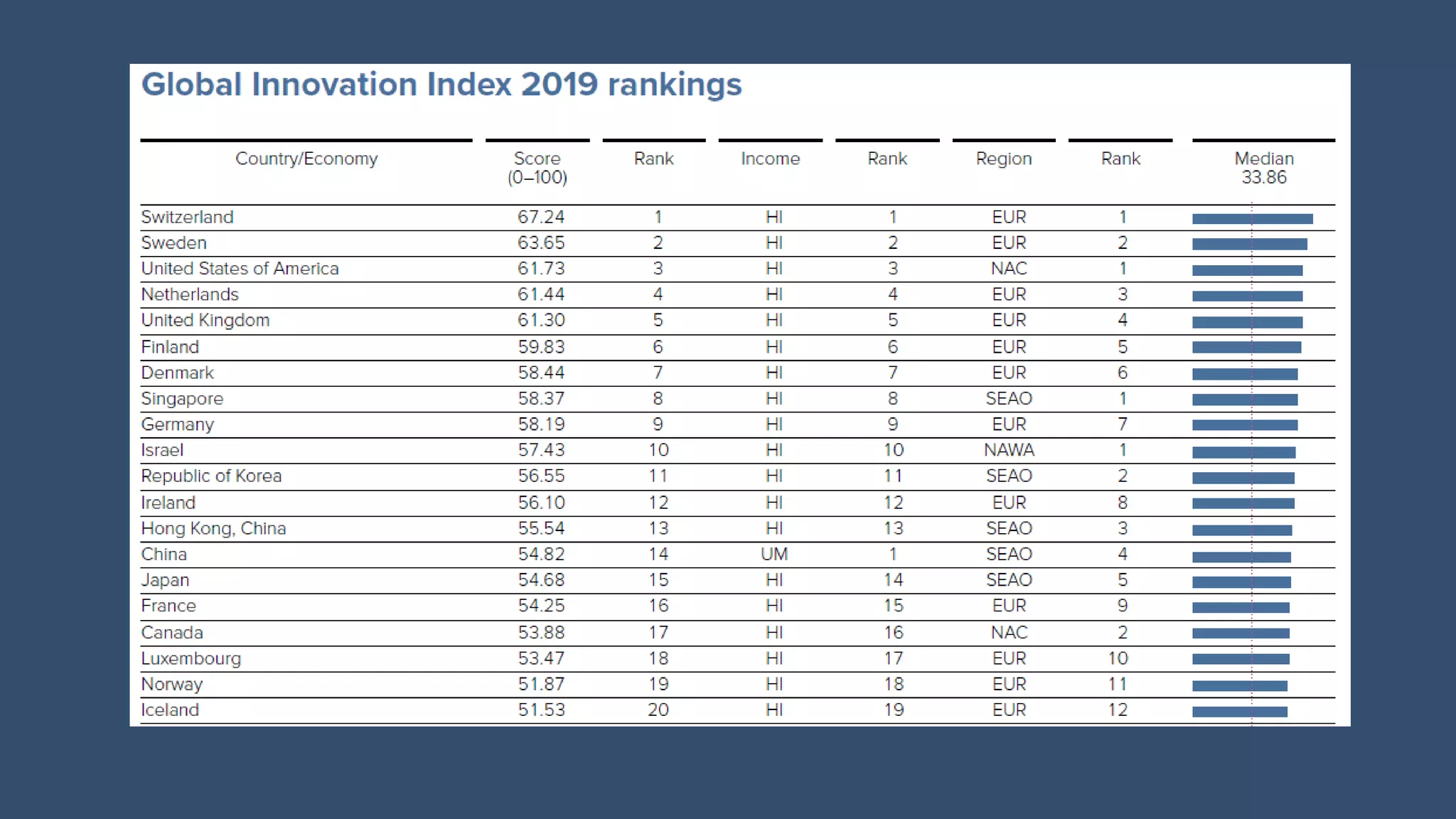
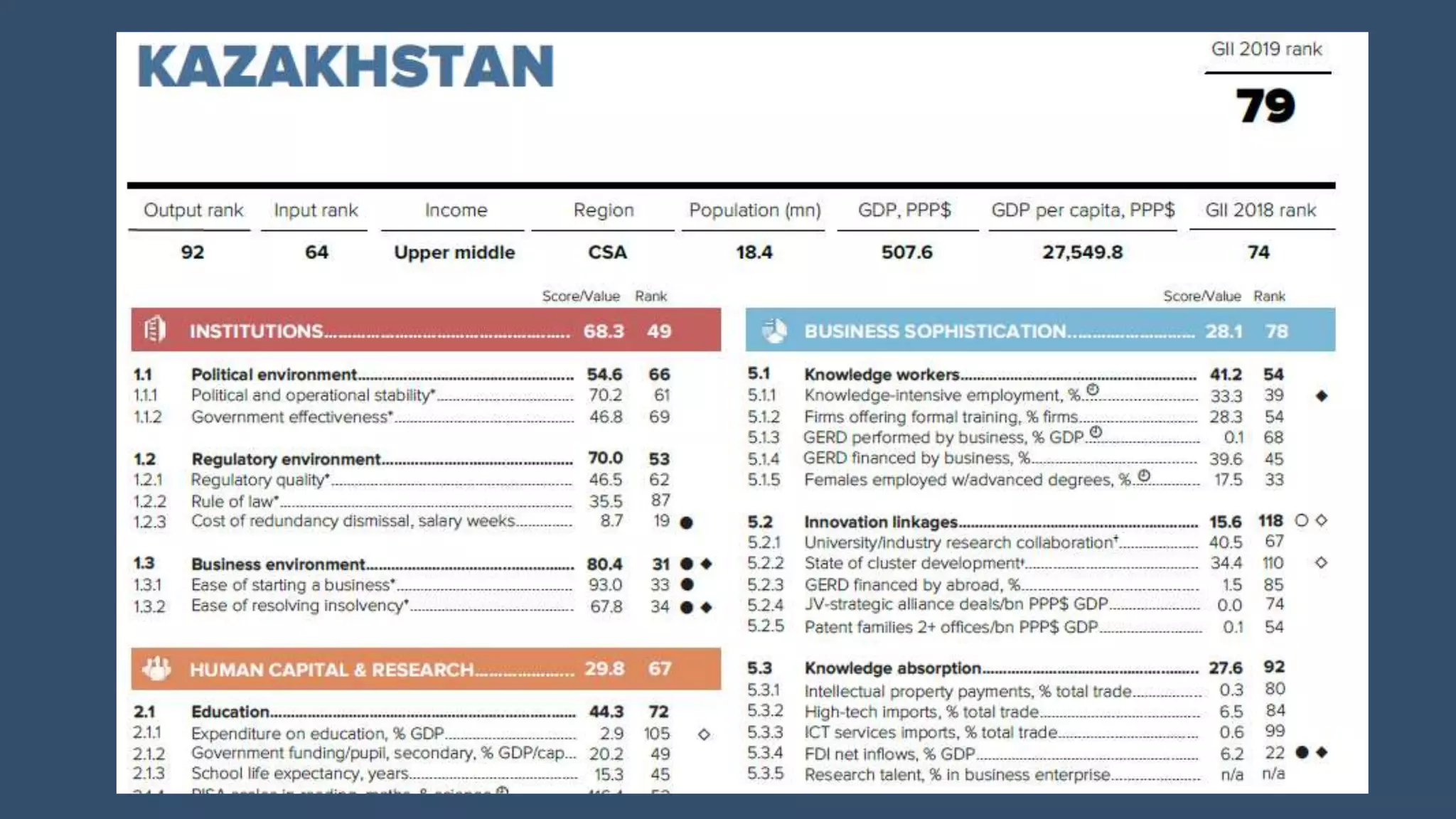
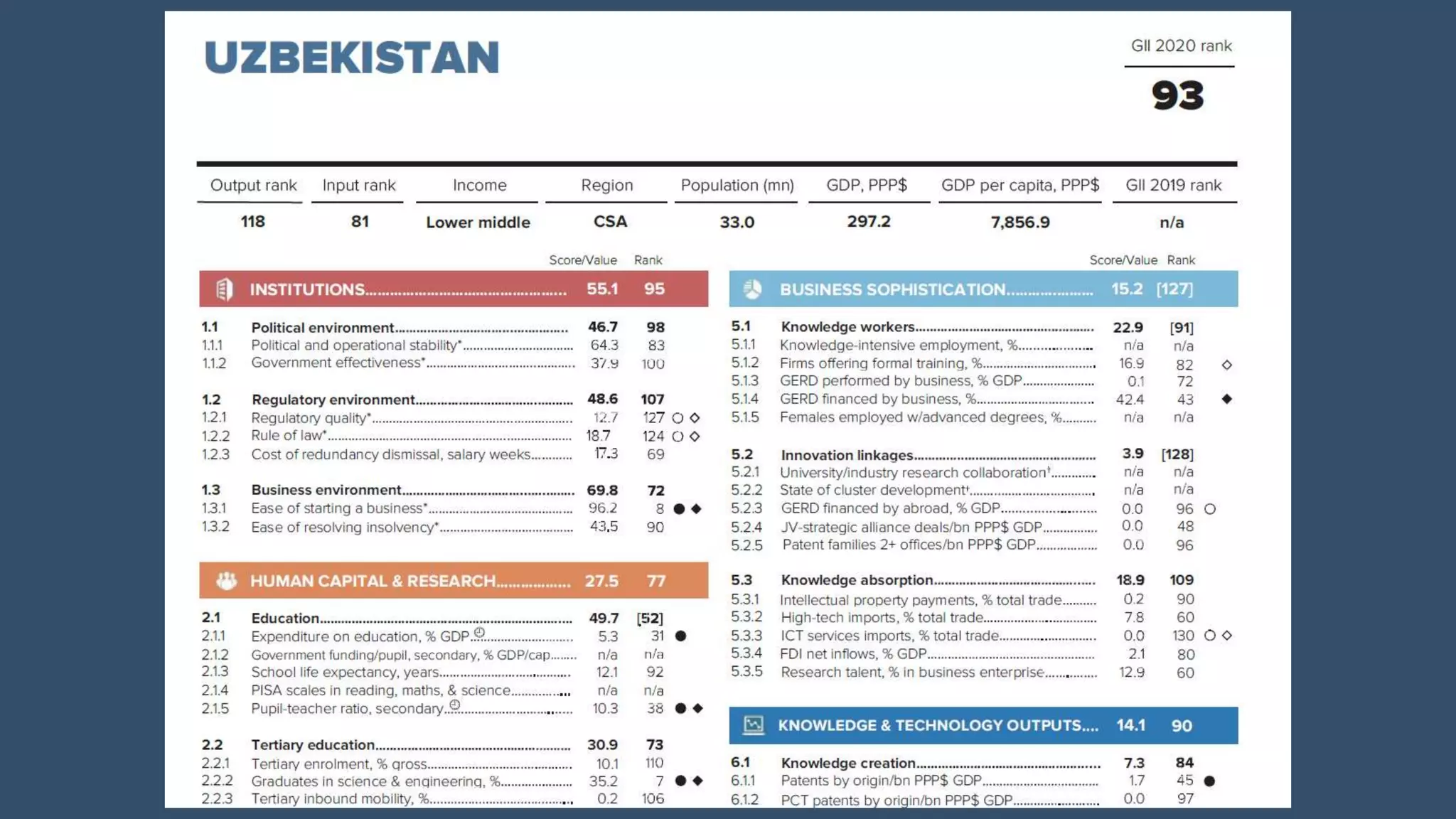
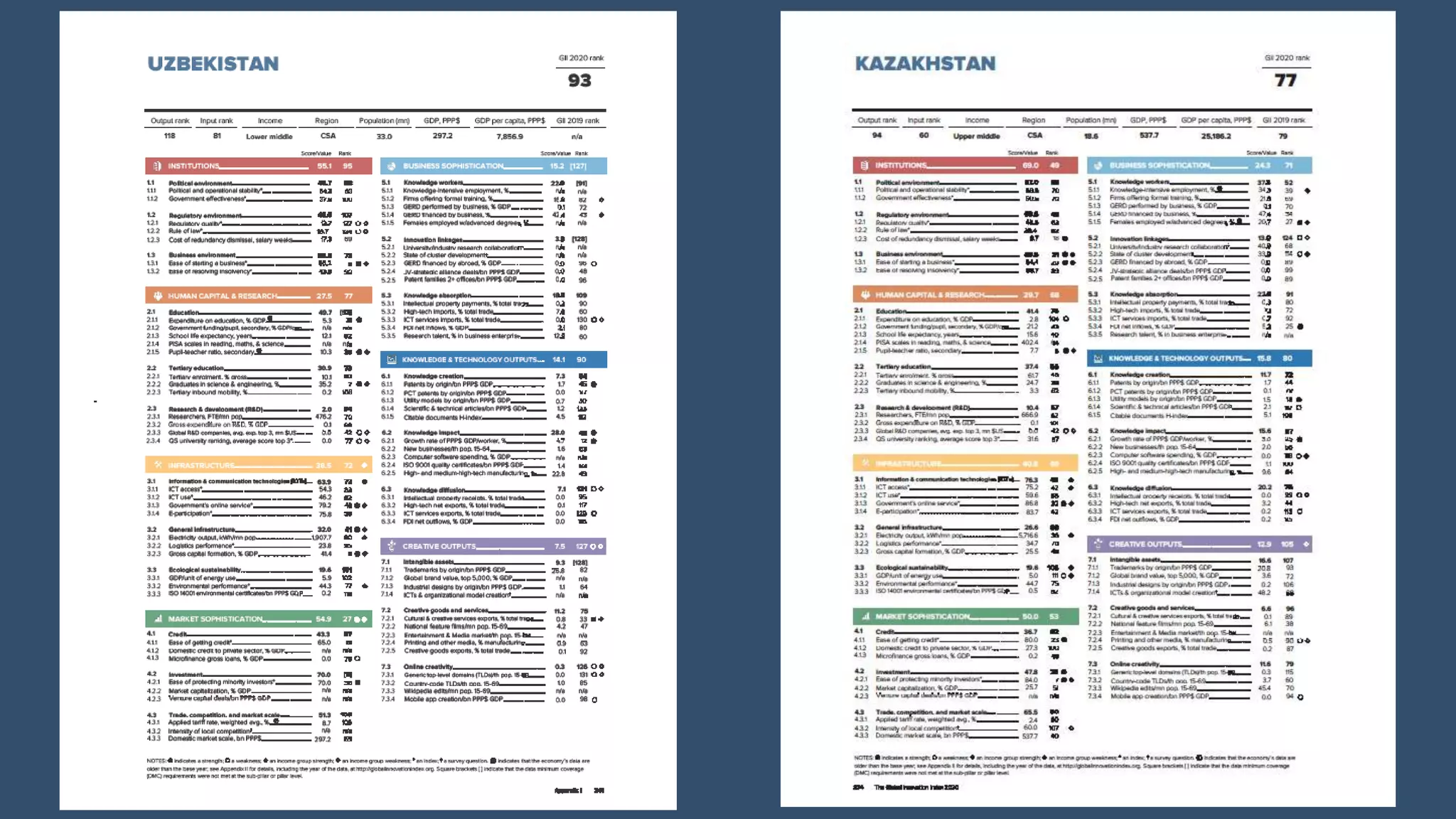
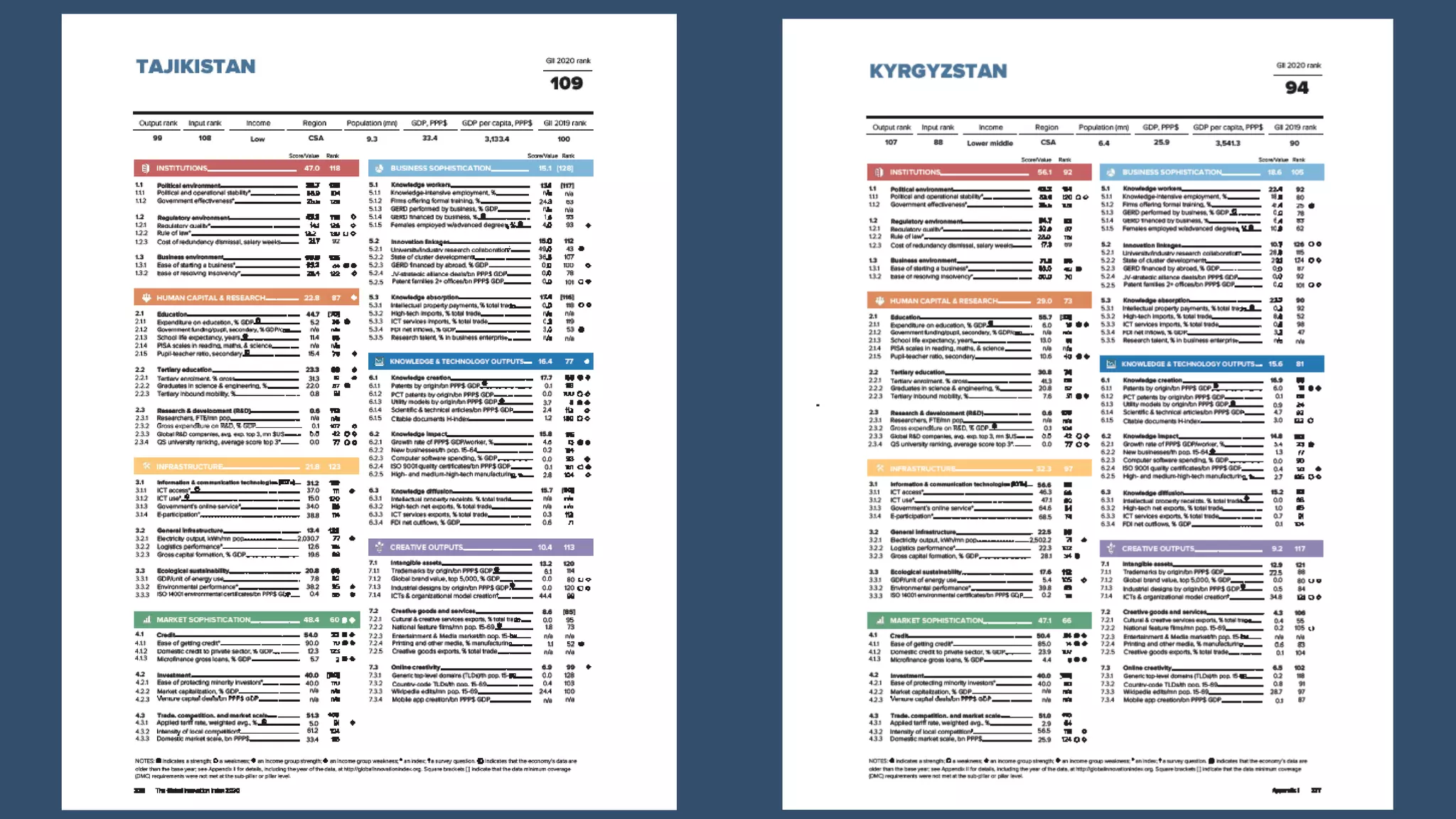
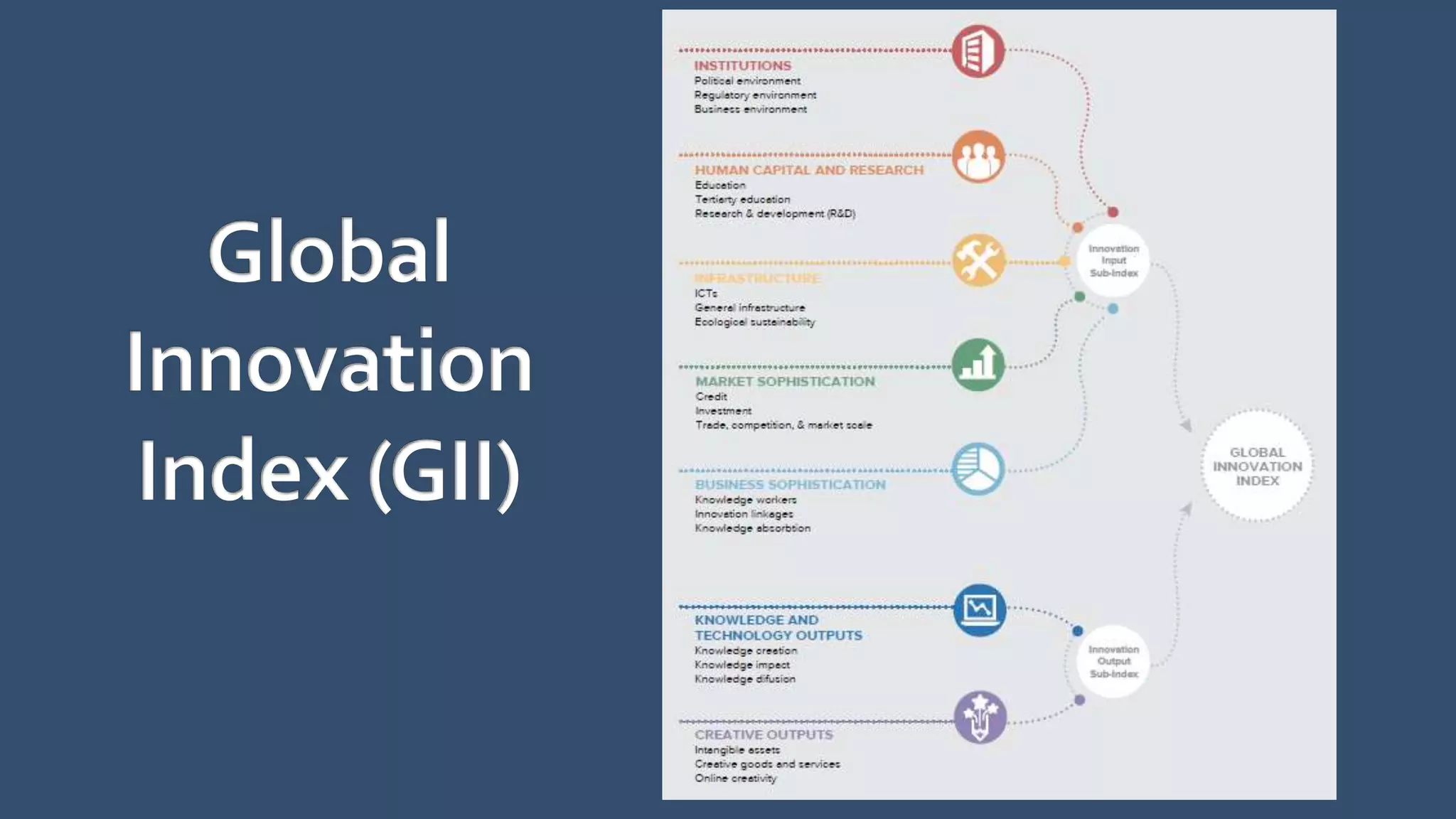
The Global Innovation Index (GII)
annually evaluates how individual
countries allocate resources to
promote innovation &
entrepreneurship.
https://www.wipo.int/global_innovation_index/en/2019/
Trends in University Innovation (GSBE presentation, 5-18-21)

Trends in University Innovation (GSBE presentation, 5-18-21)

  • 1.
    AView From BeyondSiliconValley
  • 2.
    1. Innovation &entrepreneurship is the only real path to economic growth and resilience. 2. Innovators can, and do (!), find a home wherever the “ecosystem” is ready. 3. Universities play a vital role in growing their local innovation ecosystem and in helping local innovators and entrepreneurs connect internationally.
  • 3.
    My Assumption: Your institutionhas already recognized the need to identify and support entrepreneurs seeking to start and grow businesses.
  • 4.
    The Question: How canwe all help our respective institutions improve its innovation and entrepreneurship capacity?
  • 5.
    One part ofthe answer… Focus on growing the local economy: 1. Improving the local innovation ecosystem, 2. Forming international partnerships related to the areas of “excellence” within the local ecosystem, and 3. ACTIVELY helping students, faculty, staff, and others form and grow innovative new ventures
  • 6.
    1. Berlin, Germany 2.Tel Aviv, Israel 3. Helsinki, Finland 4. Stockholm, Sweden 5. Bengaluru, India 6. London, UK 7. Boston, USA 8. Copenhagen, Denmark 9. Amsterdam, the Netherlands 10. San Francisco, USA 11. Melbourne, Australia 12. Singapore, Singapore 13. Austin, USA 14. Toronto,Canada 15. Vancouver, Canada 16. Munich, Germany 17. Warsaw, Poland 18. Zurich, Switzerland 19. Beijing, China 20. Tokyo, Japan 21. NewYork, USA 22. Istanbul,Turkey 23. Madrid, Spain 24. Barcelona, Spain 25. Seattle, USA 26. Paris, France 27. Cologne,Germany 28. Hong Kong, Hong Kong 29. Santiago,Chile 30. Buenos Aires, Argentina 31. Shanghai,China 32. Sydney, Australia 33. Vienna,Austria 34. Reykjavik, Iceland 35. Dublin, Ireland 36. Seoul, South Korea 37. Oslo, Norway 38. Prague, Czech Republic 39. Nice, France 40. Frankfurt, Germany 41. Los Angeles, USA 42. Lisbon, Portugal 43. Lyon, France 44. Brussels, Belgium 45. Budapest, Hungary 46. Sao Paulo, Brazil 47. Bogota, Colombia 48. Milan, Italy 49. CapeTown, South Africa 50. Bucharest, Romania * Valuer (www.Valuer.com)
  • 7.
  • 8.
    1. Berlin, Germany 2.Tel Aviv, Israel 3. Helsinki, Finland 4. Stockholm, Sweden 5. Bengaluru, India 6. London, UK 7. Boston, USA 8. Copenhagen, Denmark 9. Amsterdam, the Netherlands 10. San Francisco, USA 11. Melbourne, Australia 12. Singapore, Singapore 13. Austin, USA 14. Toronto,Canada 15. Vancouver, Canada 16. Munich, Germany 17. Warsaw, Poland 18. Zurich, Switzerland 19. Beijing, China 20. Tokyo, Japan 21. NewYork, USA 22. Istanbul,Turkey 23. Madrid, Spain 24. Barcelona, Spain 25. Seattle, USA 26. Paris, France 27. Cologne,Germany 28. Hong Kong, Hong Kong 29. Santiago,Chile 30. Buenos Aires, Argentina 31. Shanghai,China 32. Sydney, Australia 33. Vienna,Austria 34. Reykjavik, Iceland 35. Dublin, Ireland 36. Seoul, South Korea 37. Oslo, Norway 38. Prague, Czech Republic 39. Nice, France 40. Frankfurt, Germany 41. Los Angeles, USA 42. Lisbon, Portugal 43. Lyon, France 44. Brussels, Belgium 45. Budapest, Hungary 46. Sao Paulo, Brazil 47. Bogota, Colombia 48. Milan, Italy 49. CapeTown, South Africa 50. Bucharest, Romania * Valuer (www.Valuer.com)
  • 9.
  • 10.
     Each sufferedsignificant economic “shocks” in recent decades.  Each has important but underutilized and disconnected assets.  Each has a populace ready for change and growth.  Each has an “openness” to outside ideas and perspectives.  None of them are known (yet!) as a startup “hotbed.”  Each has identified innovation and entrepreneurship as an important part of a more competitive economy.  Each is seeking ways to better connect with innovators and entrepreneurs around the world.
  • 11.
    …including Detroit, Chicago,Washington,Houston, Miami, and … Norfolk, Virginia Each has identified innovation and entrepreneurship as an important part of a more competitive economy and … Each has university, industry, and public leaders interested in “internationalizing” its innovation and entrepreneurship activities!
  • 12.
    There are sixdistinct paths: 1. Traditional small business 2. Lifestyle business 3. Social venture 4. High-growth startup 5. Buyable startup 6. Large company “spinout” Per Steve Blank, et al Only a few kinds of new venture produce long-term economic impact. Success depends on “scaling up,” either alone or in affiliation with a large company
  • 13.
     Innovation &entrepreneurship is a set of skills that can be applied across professions, markets, and technologies.  Must invest in both in formal and informal programs:  Formal programs include funded incubators, accelerators, co- working spaces, mentoring programs, “Entrepreneur in Residence,” pitch competitions, innovation challenges, venture funds, technology hubs, etc.  Informal programs include entrepreneurship clubs, expanded networking events, “Startup meetups,” speaker series, on-going “celebration” of entrepreneurship successes.
  • 14.
    … creates newopportunities for local companies in both existing and emerging local markets… …and … … creates opportunities for university-based research partnerships and international collaborations!!
  • 15.
    Five areas offocus are at the heart of the innovation and entrepreneurship withinAmerica’s universities. 1. Active engagement in regional economic development; 2. Industry collaboration; 3. Student entrepreneurship; 4. Faculty entrepreneurship; and 5. Technology transfer Source: The Innovative and Entrepreneurial University: Higher Education, Innovation & Entrepreneurship in Focus, U.S. Department of Commerce, October 2013
  • 16.
    Make an effortto assess your region’s strengths and weaknesses Focus university innovation and entrepreneurship programs on the local region’s most “excellent” capabilities!
  • 17.
    Establish collaborations withininternational ecosystems that have similar “excellent” capabilities and support similar industries Specifically seek to connect with universities within those international ecosystems that already have effective partnerships with local economic development organizations
  • 18.
     Maintain strongand sustained basic and “translational” research to provide a pipeline of great ideas – must be relevant to the local region’s industry and expertise!  Explicitly link entrepreneurship programs with translational research & development activities!  Emphasize venture creation to commercialize technologies and form international relationships  “Entrepreneurs are everywhere” -- keep programs available to ALL students & faculty
  • 19.
    Encourage staff andfaculty to engage with local industry, investors, & policy makers Target the kinds of new ventures that can scale, and particularly those that have potential in international markets
  • 20.
    Marty Kaszubowski Executive Director,Innovation Initiatives Institute for Innovation & Entrepreneurship (IIE) Old Dominion University (ODU) MJKaszub@ODU.edu www.ODU.edu/IIE
  • 22.
    Accessible Markets Human Capital & Workforce Funding& Finance Mentors, Advisors, Support Services Regulatory Framework & Infrastructure Education & Training Universities as Catalysts Cultural Support https://www.weforum.org/reports/entrepreneurial-ecosystems-around-globe-and-company-growth-dynamics
  • 23.
     It requiresa culture of idea generation, experimentation, success and failure.  Countries, cities, and their private sector stakeholders can help by creating “safe places,” networks, and programs for local entrepreneurs to:  Generate ideas  Learn & share knowledge  Recruit mentors, experts, capital, and  Experiment with their products, services and technologies.  Most will fail the first time, many will continue to experiment and, eventually, a successful start-up culture will develop.
  • 24.
    Accessible Markets Human Capital & Workforce Funding& Finance Mentors, Advisors, Support Services Regulatory Framework & Infrastructure Education & Training Cultural Support Universities as Catalysts • Local Small and Mid-sizedCompanies as Customers and ProductTesters • Governments as Customers • Universities and Non-Profits as Customers • Large Companies as Customers and Partners
  • 25.
    Accessible Markets Human Capital & Workforce Funding& Finance Mentors, Advisors, Support Services Regulatory Framework & Infrastructure Education & Training Cultural Support Universities as Catalysts • ManagementTalent • TechnicalTalent • Entrepreneurial Company Experience • OutsourcingAvailability • Access to ImmigrantWorkforce
  • 26.
    Accessible Markets Human Capital & Workforce Funding& Finance Mentors, Advisors, Support Services Regulatory Framework & Infrastructure Education & Training Cultural Support Universities as Catalysts • Friends and Family • Angel Investors • Private Equity • Venture Capital • Access to Debt
  • 27.
    Accessible Markets Human Capital & Workforce Funding& Finance Mentors, Advisors, Support Services Regulatory Framework & Infrastructure Education & Training Cultural Support Universities as Catalysts • Mentors/Advisors • Professional Services • Incubators/Accelerators • Network of Entrepreneurial Peers
  • 28.
    Accessible Markets Human Capital & Workforce Funding& Finance Mentors, Advisors, Support Services Regulatory Framework & Infrastructure Education & Training Cultural Support Universities as Catalysts • Available Workforce with Pre-University Education • Available Workforce with University Education • Entrepreneur-SpecificTraining
  • 29.
    Accessible Markets Human Capital & Workforce Funding& Finance Mentors, Advisors, Support Services Regulatory Framework & Infrastructure Education & Training Cultural Support Universities as Catalysts • Ease of Starting (and Closing!) a Business • Tax Incentives. Business-Friendly Policies • Access to Basic Infrastructure (e.g. water, electricity),Telecommunications/Broadband • Access toTransportation
  • 30.
    Accessible Markets Human Capital & Workforce Funding& Finance Mentors, Advisors, Support Services Regulatory Framework & Infrastructure Education & Training Cultural Support Universities as Catalysts • Tolerance of Risk and Failure • Preference for Self-Employment • Success Stories/Role Models • Research Culture • Positive Image of Entrepreneurship • Celebration of Innovation
  • 31.
    Accessible Markets Human Capital & Workforce Funding& Finance Mentors, Advisors, Support Services Regulatory Framework & Infrastructure Education & Training Cultural Support Universities as Catalysts • Universities promote a culture of respect for innovation & entrepreneurship • Universities play a key role in idea-formation for new ventures • Universities provide technology, business model innovations, testing facilities, consulting support • Universities play a key role in providing staff and advisors for new ventures
  • 32.
    Universities can helpby creating a safe place for students, alumni and local entrepreneurs to generate ideas, recruit mentors, experts and capital, and to experiment with their products, services and technologies. SUGGESTION: Every university can and should lead an effort to assess the local ecosystem and look for areas to lend support
  • 33.
    We start witha 14 Step process that serves as a handy framework for a region's progress in building its ecosystem: ● How far has the region progressed in that 14-step process? An ecosystem also reflects the “willingness and readiness” of the culture to support entrepreneurs ● How ready is the region to take some risks, celebrate some failures, use some political capital? Finally we want to know what specific programs and resources are available to entrepreneurs and “spinout” ventures ● Are resources & programs available and of high quality?
  • 34.
    The tool identifies regionalstrengths and weaknesses! Ex: This assessment (of a city in Ukraine) shows good infrastructure and willingness to seek & copy good ideas ... Lots of great technology
  • 36.
  • 37.
    LEADERS • Who hasthe reputation, resources and commitment to lead new initiatives? • Who will champion new initiatives within their own organizations? • How can leaders and champions be more inclusive? STAKEHOLDERS • Who are the entrepreneurs? • Who are the service providers? • Who are the inventors? • Who are the capital providers? • Who are the support organizations? • What is the role of government? • Who are the other key participants in the innovation ecosystems? FRAMEWORKS • What is the regulatory environment for innovation? • What legal/bureaucratic barriers stand in the way of entrepreneurship? • What widespread social norms surround the innovation ecosystem? RESOURCES • What resources are available to aspiring entrepreneurs (knowledge, mentorship, cloud hosting, etc.)? • What sources of capital are there in the marketplace? • How does this capital flow and interact with growing businesses? • What is the volume and quality of talent in the labor pool? • What are the main sources of innovative ideas/discoveries/inventions? • What resources are available to service and support organizations that interact with entrepreneurs (workforce training, etc.)? ROLE MODELS • Who are the local entrepreneurs that have built successful companies? • Who are the local entrepreneurs that haven’t yet been successful and what can we learn from their failures? • What regions have similar attributes and resources? • What organizations have shared visions/values? • Are there other regions we could learn from or emulate? ACTIVITIES • What are people already doing to stimulate innovation/entrepreneurship? • How are these people collaborating with each other? • What activities drive participation in the community? • What events create ‘buzz’ and generate interest? ENGAGEMENT • Where, when and how do stakeholders interact? • How do ideas, talent and capital come together? • What are the lines of communication between partners? • How do members of the community collaborate with each other? • How does the community engage external or global partners? • How does the community encourage recruit new constituents? • How do young people get involved? • What forums exist that allow the breakdown of social and professional hierarchies? INFRASTRUCTURE,CAPABILITY, & COMMUNITY • What is the density & quality of service providers (law, IP, consulting, real estate, etc.)? • What boundary spanning organizations exist? • What is the local level of serial entrepreneurship? • What is the density and quality of physical infrastructure (airports, internet connections, etc.)? • What are the core sectors of the local economy? • What are the strongest regional comparative advantages? CULTURE • Where do people come from? • What are their value systems? • What are their motivations ? • What are the ‘amenities of place’? • How do we create and maintain a sense of urgency? • What kind of innovative social networks exist already? • How do people deal with uncertainty, risk or randomness? • How is failure perceived? • Do people build for perfection or iteration?
  • 38.
    The Global InnovationIndex (GII) annually evaluates how individual countries allocate resources to promote innovation & entrepreneurship. https://www.wipo.int/global_innovation_index/en/2019/