12	 Numéro 67 – Hiver 2016-2017 – 	
Edtech & Entreprises, nouveaux concepts
UBIQUITY :
Live local - Learn global, or
Reinventing Education
n An exclusive Interview of Professor Jim Garrison, Ph.D., Founder & President of Ubiquity University, by Oliver T. Ernst, Associate Editor, Point de Mire
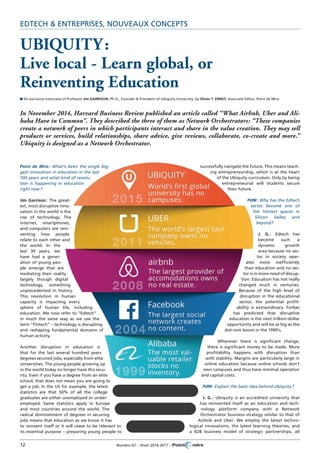
In November 2014, Harvard Business Review published an article called “What Airbnb, Uber and Ali-
baba Have in Common”. They described the three of them as Network Orchestrators: “These companies
create a network of peers in which participants interact and share in the value creation. They may sell
products or services, build relationships, share advice, give reviews, collaborate, co-create and more.”
Ubiquity is designed as a Network Orchestrator.
Point de Mire : What’s been the single big-
gest innovation in education in the last
100 years and what kind of revolu-
tion is happening in education
right now ?
Jim Garrison : The great-
est, most disruptive inno-
vation in the world is the
rise of technology. The
internet, smartphones,
and computers are rein-
venting how people
relate to each other and
the world. In the
last 30 years, we
have had a gener-
ation of young peo-
ple emerge that are
mediating their reality
largely though digital
technology, something
unprecedented in history.
This revolution in human
capacity is impacting every
sphere of human life, including
education. We now refer to “Edtech”
in much the same way as we use the
term “Fintech” – technology is disrupting
and reshaping fundamental domains of
human activity.
Another disruption in education is
that for the last several hundred years
degrees secured jobs, especially from elite
universities. The young people growing up
in the world today no longer have this secu-
rity. Even if you have a degree from an elite
school, that does not mean you are going to
get a job. In the US for example, the latest
statistics are that 50% of all the college
graduates are either unemployed or under-
employed. Same statistics apply in Europe
and most countries around the world. The
radical diminishment of degrees in securing
jobs means that education as we know it has
to reinvent itself or it will cease to be relevant to
its essential purpose – preparing young people to
successfully navigate the future. This means teach-
ing entrepreneurship, which is at the heart
of the Ubiquity curriculum. Only by being
entrepreneurial will students secure
their future.
PdM : Why has the Edtech
sector become one of
the hottest spaces in
Silicon Valley and
beyond?
J. G. : Edtech has
become such a
dynamic growth
area because no sec-
tor in society oper-
ates more inefficiently
than education and no sec-
tor is in more need of disrup-
tion. Education has not really
changed much in centuries.
Because of the high level of
disruption in the educational
sector, the potential profit-
ability is extraordinary. Forbes
has predicted that disruptive
education is the next trillion-dollar
opportunity and will be as big as the
dot-com boom in the 1990’s.
Wherever there is significant change,
there is significant money to be made. More
profitability happens with disruption than
with stability. Margins are particularly large in
online education because online schools don’t
own campuses and thus have minimal operation
and capital costs.
PdM : Explain the basic idea behind Ubiquity ?
J. G. : Ubiquity is an accredited university that
has reinvented itself as an education and tech-
nology platform company with a Network
Orchestrator business strategy similar to that of
Airbnb and Uber. We employ the latest techno-
logical innovations, the latest learning theories, and
a B2B business model of strategic partnerships, all
Numéro 67 – Hiver 2016-2017 – 	 13
Edtech & Entreprises, nouveaux concepts
focused on offering affordable
entrepreneurial focused edu-
cation to young people world-
wide. All our partners share
in the revenue generated and
Ubiquity invests in its students.
It is a whole new kind of educa-
tion and business model.
PdM : Who is the perfect Gene-
va-based investor for your next
step ?
J. G. : Someone interested in
investing in the frontiers of
Edtech and Fintech at a global
level in a global company, in a
business with extremely high
profitability. Someone who
deeply cares about the future of
our children and wants to partic-
ipate in a university dedicated to
preparing them with everything
they need to be successful in a
world of hypercomplexity.
PdM : Why is Ubiquity a Network
Orchestrator ?
J. G. : This is a new phenomenon
in the global economy. Network
orchestrator companies include
Uber, Facebook, and Alibaba.
They don’t own commodities but
simply create synergies between
buyers and sellers globally. Ubiq-
uity is in some ways the “Airbnb
of Education” because like
Airbnb, which owns no hotels,
Ubiquity does not own any cam-
puses. Instead, like Airbnb, we
have B2B partnerships with hun-
dreds of schools and educational
networks around the world and
our students learn in pods. We
create synergies between part-
ners with each interaction having
a financial exchange.
PdM : To what extent do you
think the Ubiquity approach may
be useful for tomorrow’s training
needs in finance ?
J. G. : We are partnering with a
number of Fintech companies
and are establishing the first
global Fintech-Edtech partner-
ship that we know of in the
global learning space. Because
our students are going to be
in the middle of breakthrough
educational and financial tech-
nologies, our graduates are
going to be more prepared
than the ones from traditional
universities. Through Ubiquity,
they will learn the key compe-
tencies they need – collabora-
tive creativity and entrepre-
neurship.
PdM : What is the compatibility
between Edtech and Fintech ?
J. G. : Since degrees no longer
secure jobs, we have reinvented
the meaning of university by
focusing on entrepreneurship
training rather than just degrees.
All Ubiquity students are required
to take entrepreneurial training.
Our promise to our students is
that as they progress Ubiquity
will mentor and finance them.
We also take an equity stake in
what they produce. You can think
of Ubiquity as a venture capi-
tal support system for our stu-
dents as they become entrepre-
neurs. We have partnered with
Fundsurfer in the UK to provide
crowdfunding training and sup-
port to all our students. We are
in discussion with other Fintech
companies, several in Geneva, to
join this partnership. We believe
that the future will be character-
ized by cross-sector partnerships
between Edtech and Fintech. It’s
a very exiting frontier between
education and finance.
Jim Garrison is the President
of Ubiquity University, dedi-
cated to providing affordable
education at the graduate,
undergraduate, and public
education levels worldwide. In
1991, he founded the Interna-
tional Foreign Policy Institute
with Eduard Shevardnadze. At
the request of Mr. Gorbachev,
Jim Garrison founded and ser-
ved as President of the Gor-
bachev Foundation (USA) in
1992, which set the stage for
the establishment of the State
of the World Forum in 1995.
Réservez la Date !
2 Février 2017, à Genève
1ER
COLLOQUE ANNUEL TSFC
Matin : Fintech - Concilier le digital et l’humain – Repenser l’organisation de l’activité financière
Conférences et table ronde
Après-midi : Fintech - Et après ? Quelle régulation, quelle technologie, quelle concurrence, quels partenariats ?
Conférences et table ronde
16h00 : Finale TSFC Pitch Contest
Informations complémentaires et inscriptions sur
www.tsfc.ch

PdM_67_article_jimgarrison_ubiquity

  • 1.
    12 Numéro 67– Hiver 2016-2017 – Edtech & Entreprises, nouveaux concepts UBIQUITY : Live local - Learn global, or Reinventing Education n An exclusive Interview of Professor Jim Garrison, Ph.D., Founder & President of Ubiquity University, by Oliver T. Ernst, Associate Editor, Point de Mire In November 2014, Harvard Business Review published an article called “What Airbnb, Uber and Ali- baba Have in Common”. They described the three of them as Network Orchestrators: “These companies create a network of peers in which participants interact and share in the value creation. They may sell products or services, build relationships, share advice, give reviews, collaborate, co-create and more.” Ubiquity is designed as a Network Orchestrator. Point de Mire : What’s been the single big- gest innovation in education in the last 100 years and what kind of revolu- tion is happening in education right now ? Jim Garrison : The great- est, most disruptive inno- vation in the world is the rise of technology. The internet, smartphones, and computers are rein- venting how people relate to each other and the world. In the last 30 years, we have had a gener- ation of young peo- ple emerge that are mediating their reality largely though digital technology, something unprecedented in history. This revolution in human capacity is impacting every sphere of human life, including education. We now refer to “Edtech” in much the same way as we use the term “Fintech” – technology is disrupting and reshaping fundamental domains of human activity. Another disruption in education is that for the last several hundred years degrees secured jobs, especially from elite universities. The young people growing up in the world today no longer have this secu- rity. Even if you have a degree from an elite school, that does not mean you are going to get a job. In the US for example, the latest statistics are that 50% of all the college graduates are either unemployed or under- employed. Same statistics apply in Europe and most countries around the world. The radical diminishment of degrees in securing jobs means that education as we know it has to reinvent itself or it will cease to be relevant to its essential purpose – preparing young people to successfully navigate the future. This means teach- ing entrepreneurship, which is at the heart of the Ubiquity curriculum. Only by being entrepreneurial will students secure their future. PdM : Why has the Edtech sector become one of the hottest spaces in Silicon Valley and beyond? J. G. : Edtech has become such a dynamic growth area because no sec- tor in society oper- ates more inefficiently than education and no sec- tor is in more need of disrup- tion. Education has not really changed much in centuries. Because of the high level of disruption in the educational sector, the potential profit- ability is extraordinary. Forbes has predicted that disruptive education is the next trillion-dollar opportunity and will be as big as the dot-com boom in the 1990’s. Wherever there is significant change, there is significant money to be made. More profitability happens with disruption than with stability. Margins are particularly large in online education because online schools don’t own campuses and thus have minimal operation and capital costs. PdM : Explain the basic idea behind Ubiquity ? J. G. : Ubiquity is an accredited university that has reinvented itself as an education and tech- nology platform company with a Network Orchestrator business strategy similar to that of Airbnb and Uber. We employ the latest techno- logical innovations, the latest learning theories, and a B2B business model of strategic partnerships, all
  • 2.
    Numéro 67 –Hiver 2016-2017 – 13 Edtech & Entreprises, nouveaux concepts focused on offering affordable entrepreneurial focused edu- cation to young people world- wide. All our partners share in the revenue generated and Ubiquity invests in its students. It is a whole new kind of educa- tion and business model. PdM : Who is the perfect Gene- va-based investor for your next step ? J. G. : Someone interested in investing in the frontiers of Edtech and Fintech at a global level in a global company, in a business with extremely high profitability. Someone who deeply cares about the future of our children and wants to partic- ipate in a university dedicated to preparing them with everything they need to be successful in a world of hypercomplexity. PdM : Why is Ubiquity a Network Orchestrator ? J. G. : This is a new phenomenon in the global economy. Network orchestrator companies include Uber, Facebook, and Alibaba. They don’t own commodities but simply create synergies between buyers and sellers globally. Ubiq- uity is in some ways the “Airbnb of Education” because like Airbnb, which owns no hotels, Ubiquity does not own any cam- puses. Instead, like Airbnb, we have B2B partnerships with hun- dreds of schools and educational networks around the world and our students learn in pods. We create synergies between part- ners with each interaction having a financial exchange. PdM : To what extent do you think the Ubiquity approach may be useful for tomorrow’s training needs in finance ? J. G. : We are partnering with a number of Fintech companies and are establishing the first global Fintech-Edtech partner- ship that we know of in the global learning space. Because our students are going to be in the middle of breakthrough educational and financial tech- nologies, our graduates are going to be more prepared than the ones from traditional universities. Through Ubiquity, they will learn the key compe- tencies they need – collabora- tive creativity and entrepre- neurship. PdM : What is the compatibility between Edtech and Fintech ? J. G. : Since degrees no longer secure jobs, we have reinvented the meaning of university by focusing on entrepreneurship training rather than just degrees. All Ubiquity students are required to take entrepreneurial training. Our promise to our students is that as they progress Ubiquity will mentor and finance them. We also take an equity stake in what they produce. You can think of Ubiquity as a venture capi- tal support system for our stu- dents as they become entrepre- neurs. We have partnered with Fundsurfer in the UK to provide crowdfunding training and sup- port to all our students. We are in discussion with other Fintech companies, several in Geneva, to join this partnership. We believe that the future will be character- ized by cross-sector partnerships between Edtech and Fintech. It’s a very exiting frontier between education and finance. Jim Garrison is the President of Ubiquity University, dedi- cated to providing affordable education at the graduate, undergraduate, and public education levels worldwide. In 1991, he founded the Interna- tional Foreign Policy Institute with Eduard Shevardnadze. At the request of Mr. Gorbachev, Jim Garrison founded and ser- ved as President of the Gor- bachev Foundation (USA) in 1992, which set the stage for the establishment of the State of the World Forum in 1995. Réservez la Date ! 2 Février 2017, à Genève 1ER COLLOQUE ANNUEL TSFC Matin : Fintech - Concilier le digital et l’humain – Repenser l’organisation de l’activité financière Conférences et table ronde Après-midi : Fintech - Et après ? Quelle régulation, quelle technologie, quelle concurrence, quels partenariats ? Conférences et table ronde 16h00 : Finale TSFC Pitch Contest Informations complémentaires et inscriptions sur www.tsfc.ch