Disruptive
Innovation…
What if?
March 2015
Maria Spies, General Manager
Learning, Teaching and Technology
Services, Navitas PEP Division
Overview
• Concept of ‘disruptive innovation’ explored
• Current trends in global education sector
• ‘Higher Education is a business that doesn’t know it’s going out
of business’!
• ‘Education sector….is set to experience profound change’
• Consideration of possible future ‘disrupted’
scenarios
https://www.edsurge.com/n/2014-04-22-mark-cuban-s-foray-into-the-edtech-industry
http://www2.deloitte.com/au/en/pages/building-lucky-country/articles/digital-disruption-harnessing-the-bang.html
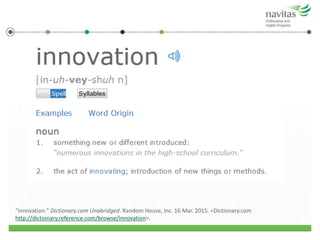
"innovation." Dictionary.com Unabridged. Random House, Inc. 16 Mar. 2015. <Dictionary.com
http://dictionary.reference.com/browse/innovation>.
Innovation… broadly defined!
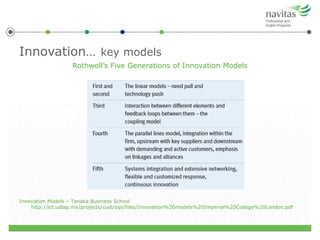
Innovation… key models
Rothwell’s Five Generations of Innovation Models
Innovation Models – Tanaka Business School
http://ict.udlap.mx/projects/cudi/sipi/files/Innovation%20models%20Imperial%20College%20London.pdf
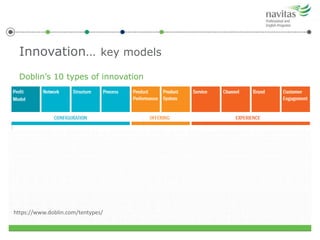
Innovation… key models
Doblin’s 10 types of innovation
https://www.doblin.com/tentypes/
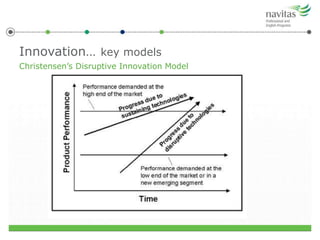
Innovation… key models
Christensen’s Disruptive Innovation Model
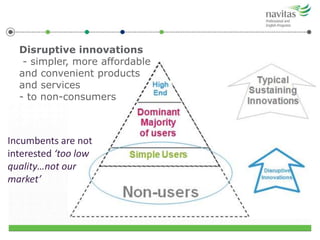
Disruptive innovations
- simpler, more affordable
and convenient products
and services
- to non-consumers
Incumbents are not
interested ‘too low
quality…not our
market’
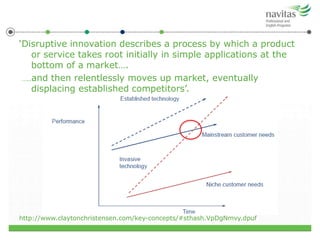
‘Disruptive innovation describes a process by which a product
or service takes root initially in simple applications at the
bottom of a market….
…..and then relentlessly moves up market, eventually
displacing established competitors’.
http://www.claytonchristensen.com/key-concepts/#sthash.VpDgNmvy.dpuf
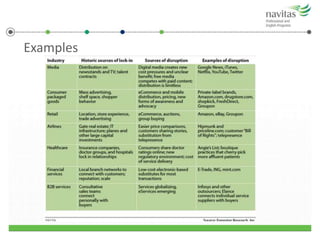
Examples
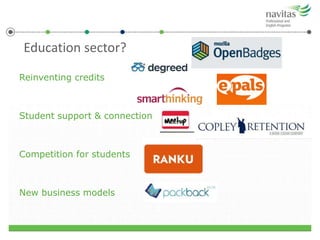
Reinventing credits
Student support & connection
Competition for students
New business models
Education sector?
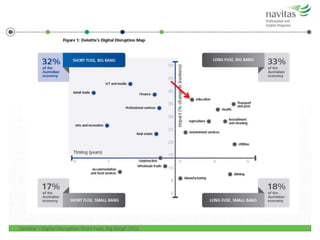
Deloitte – Digital Disruption Short Fuse, Big Bang? 2012
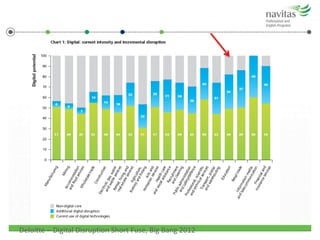
Deloitte – Digital Disruption Short Fuse, Big Bang 2012
Yes!
• We see it every day – improvements to programs,
products & services, student experience, systems and
processes – the list goes on! (don’t stop)
• According to the OECD, education is one of the most
innovative sectors of society, especially for innovation
in knowledge or methods.
But…
• Are our innovations sustaining innovations only? Are
there new entrants at the low end of our markets
with new products or new business models?
The education sector innovates…doesn’t it?
http://www.oecd.org/edu/skills-beyond-school/EDIF24-eng%282014%29EN.pdf
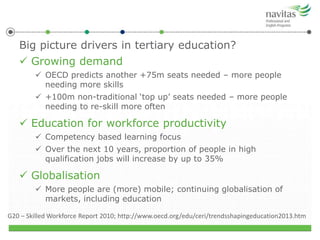
Big picture drivers in tertiary education?
 Growing demand
 OECD predicts another +75m seats needed – more people
needing more skills
 +100m non-traditional ‘top up’ seats needed – more people
needing to re-skill more often
 Education for workforce productivity
 Competency based learning focus
 Over the next 10 years, proportion of people in high
qualification jobs will increase by up to 35%
 Globalisation
 More people are (more) mobile; continuing globalisation of
markets, including education
G20 – Skilled Workforce Report 2010; http://www.oecd.org/edu/ceri/trendsshapingeducation2013.htm
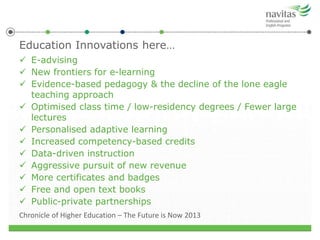
Education Innovations here…
 E-advising
 New frontiers for e-learning
 Evidence-based pedagogy & the decline of the lone eagle
teaching approach
 Optimised class time / low-residency degrees / Fewer large
lectures
 Personalised adaptive learning
 Increased competency-based credits
 Data-driven instruction
 Aggressive pursuit of new revenue
 More certificates and badges
 Free and open text books
 Public-private partnerships
Chronicle of Higher Education – The Future is Now 2013
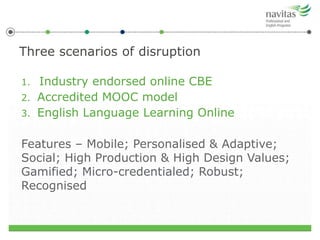
1. Industry endorsed online CBE
2. Accredited MOOC model
3. English Language Learning Online
Features – Mobile; Personalised & Adaptive;
Social; High Production & High Design Values;
Gamified; Micro-credentialed; Robust;
Recognised
Three scenarios of disruption
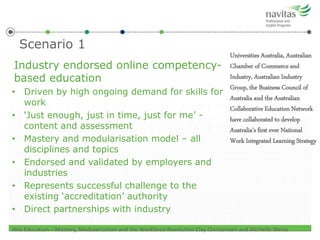
Scenario 1
Industry endorsed online competency-
based education
• Driven by high ongoing demand for skills for
work
• ‘Just enough, just in time, just for me’ -
content and assessment
• Mastery and modularisation model – all
disciplines and topics
• Endorsed and validated by employers and
industries
• Represents successful challenge to the
existing ‘accreditation’ authority
• Direct partnerships with industry
Universities Australia, Australian
Chamber of Commerce and
Industry, Australian Industry
Group, the Business Council of
Australia and the Australian
Collaborative Education Network
have collaborated to develop
Australia's first ever National
Work Integrated Learning Strategy
Hire Education – Mastery, Modularization and the Workforce Revolution Clay Christensen and Michelle Weise
Scenario 2
Accredited MOOC model
• Student experience very high quality
• Sophisticated analytics and personalisation
• Acceptance by industry as evidence of ‘life-
learner’ – through to ‘training provider’
• Security and identity issues overcome
• Commercialisation & accreditation model/s
sorted, partnering with IP owners
• The ‘MOOC’ business model dominates the mass
tertiary education market
• Universities and other providers partner but
must re-think their core
• Lower end traditional providers suffer
‘We are a technology
company, not an education
company. Our purpose is to
provide access to education to
those who otherwise couldn’t
afford it.’ Daphne Koller,
Coursera
Scenario 3
English Language Online – sorted!
• Arguably one of the largest education
sectors globally
• Technology ‘cracks’ machine-based
language learning problem
• Apple, Google, Microsoft and Facebook are
all investing significantly (‘Speakeasy’) as
are media and telecom companies (e.g.
SBS, ABC)
• Gamified, personalised, adaptive,
immersive
‘…currently seeking a better
solution to the statistical-based
recognition of voice to text
and/or commands - which at
present faces immense
challenges associated with
machine understanding,
particularly context.
Yikes! What to do about it?
• Re-examine the core…what are we really good at,
what do we have that we can use in other ways?
• Really good at teaching English or ability to mobilise
highly trained teaching workforce?
• Access to large global teaching workforce
• Deep links to industry
• Expertise in non-traditional learners
• Global footprint of learning spaces
• Massive stock of under-utilized IP
• 80,000 students (advocates, clients, customers)
Yikes! What to do about it?
• Examine current and invest in new business models…
• What is the customer need? Now & in future? How will
we organise ourselves to meet that need?
• Partnering with /acquiring technology companies (we
have content, design and teachers, they have platforms,
channels)
• Think along the value chain…
• Students ultimately want jobs/better jobs
• Does a combination of our core (workforce talent;
industry network) throw up new possibilities in the job
placement/job readiness area?
‘Moving forward, sustaining a robust tertiary education
institution will require a new outlook: fresh sources of revenue,
improved cost management; innovative means of delivering
education and an increased understanding of students’ new
needs’.
Higher Education in the 21st century: meeting real-world demands
The Economist Intelligence Unit 2014
Seminar - Disruptive innovation, what if... - Maria Spies

Seminar - Disruptive innovation, what if... - Maria Spies

  • 1.
    Disruptive Innovation… What if? March 2015 MariaSpies, General Manager Learning, Teaching and Technology Services, Navitas PEP Division
  • 2.
    Overview • Concept of‘disruptive innovation’ explored • Current trends in global education sector • ‘Higher Education is a business that doesn’t know it’s going out of business’! • ‘Education sector….is set to experience profound change’ • Consideration of possible future ‘disrupted’ scenarios https://www.edsurge.com/n/2014-04-22-mark-cuban-s-foray-into-the-edtech-industry http://www2.deloitte.com/au/en/pages/building-lucky-country/articles/digital-disruption-harnessing-the-bang.html
  • 3.
    "innovation." Dictionary.com Unabridged.Random House, Inc. 16 Mar. 2015. <Dictionary.com http://dictionary.reference.com/browse/innovation>.
  • 4.
  • 5.
    Innovation… key models Rothwell’sFive Generations of Innovation Models Innovation Models – Tanaka Business School http://ict.udlap.mx/projects/cudi/sipi/files/Innovation%20models%20Imperial%20College%20London.pdf
  • 6.
    Innovation… key models Doblin’s10 types of innovation https://www.doblin.com/tentypes/
  • 7.
    Innovation… key models Christensen’sDisruptive Innovation Model
  • 8.
    Disruptive innovations - simpler,more affordable and convenient products and services - to non-consumers Incumbents are not interested ‘too low quality…not our market’
  • 9.
    ‘Disruptive innovation describesa process by which a product or service takes root initially in simple applications at the bottom of a market…. …..and then relentlessly moves up market, eventually displacing established competitors’. http://www.claytonchristensen.com/key-concepts/#sthash.VpDgNmvy.dpuf
  • 11.
  • 12.
    Reinventing credits Student support& connection Competition for students New business models Education sector?
  • 13.
    Deloitte – DigitalDisruption Short Fuse, Big Bang? 2012
  • 14.
    Deloitte – DigitalDisruption Short Fuse, Big Bang 2012
  • 15.
    Yes! • We seeit every day – improvements to programs, products & services, student experience, systems and processes – the list goes on! (don’t stop) • According to the OECD, education is one of the most innovative sectors of society, especially for innovation in knowledge or methods. But… • Are our innovations sustaining innovations only? Are there new entrants at the low end of our markets with new products or new business models? The education sector innovates…doesn’t it? http://www.oecd.org/edu/skills-beyond-school/EDIF24-eng%282014%29EN.pdf
  • 16.
    Big picture driversin tertiary education?  Growing demand  OECD predicts another +75m seats needed – more people needing more skills  +100m non-traditional ‘top up’ seats needed – more people needing to re-skill more often  Education for workforce productivity  Competency based learning focus  Over the next 10 years, proportion of people in high qualification jobs will increase by up to 35%  Globalisation  More people are (more) mobile; continuing globalisation of markets, including education G20 – Skilled Workforce Report 2010; http://www.oecd.org/edu/ceri/trendsshapingeducation2013.htm
  • 17.
    Education Innovations here… E-advising  New frontiers for e-learning  Evidence-based pedagogy & the decline of the lone eagle teaching approach  Optimised class time / low-residency degrees / Fewer large lectures  Personalised adaptive learning  Increased competency-based credits  Data-driven instruction  Aggressive pursuit of new revenue  More certificates and badges  Free and open text books  Public-private partnerships Chronicle of Higher Education – The Future is Now 2013
  • 18.
    1. Industry endorsedonline CBE 2. Accredited MOOC model 3. English Language Learning Online Features – Mobile; Personalised & Adaptive; Social; High Production & High Design Values; Gamified; Micro-credentialed; Robust; Recognised Three scenarios of disruption
  • 19.
    Scenario 1 Industry endorsedonline competency- based education • Driven by high ongoing demand for skills for work • ‘Just enough, just in time, just for me’ - content and assessment • Mastery and modularisation model – all disciplines and topics • Endorsed and validated by employers and industries • Represents successful challenge to the existing ‘accreditation’ authority • Direct partnerships with industry Universities Australia, Australian Chamber of Commerce and Industry, Australian Industry Group, the Business Council of Australia and the Australian Collaborative Education Network have collaborated to develop Australia's first ever National Work Integrated Learning Strategy Hire Education – Mastery, Modularization and the Workforce Revolution Clay Christensen and Michelle Weise
  • 20.
    Scenario 2 Accredited MOOCmodel • Student experience very high quality • Sophisticated analytics and personalisation • Acceptance by industry as evidence of ‘life- learner’ – through to ‘training provider’ • Security and identity issues overcome • Commercialisation & accreditation model/s sorted, partnering with IP owners • The ‘MOOC’ business model dominates the mass tertiary education market • Universities and other providers partner but must re-think their core • Lower end traditional providers suffer ‘We are a technology company, not an education company. Our purpose is to provide access to education to those who otherwise couldn’t afford it.’ Daphne Koller, Coursera
  • 21.
    Scenario 3 English LanguageOnline – sorted! • Arguably one of the largest education sectors globally • Technology ‘cracks’ machine-based language learning problem • Apple, Google, Microsoft and Facebook are all investing significantly (‘Speakeasy’) as are media and telecom companies (e.g. SBS, ABC) • Gamified, personalised, adaptive, immersive ‘…currently seeking a better solution to the statistical-based recognition of voice to text and/or commands - which at present faces immense challenges associated with machine understanding, particularly context.
  • 22.
    Yikes! What todo about it? • Re-examine the core…what are we really good at, what do we have that we can use in other ways? • Really good at teaching English or ability to mobilise highly trained teaching workforce? • Access to large global teaching workforce • Deep links to industry • Expertise in non-traditional learners • Global footprint of learning spaces • Massive stock of under-utilized IP • 80,000 students (advocates, clients, customers)
  • 23.
    Yikes! What todo about it? • Examine current and invest in new business models… • What is the customer need? Now & in future? How will we organise ourselves to meet that need? • Partnering with /acquiring technology companies (we have content, design and teachers, they have platforms, channels) • Think along the value chain… • Students ultimately want jobs/better jobs • Does a combination of our core (workforce talent; industry network) throw up new possibilities in the job placement/job readiness area?
  • 24.
    ‘Moving forward, sustaininga robust tertiary education institution will require a new outlook: fresh sources of revenue, improved cost management; innovative means of delivering education and an increased understanding of students’ new needs’. Higher Education in the 21st century: meeting real-world demands The Economist Intelligence Unit 2014

Editor's Notes

  • #2 In this seminar, the concept of ‘disruptive innovation’ will be explored. Some predict that disruption is imminent in the global education sector Current drivers and trends in global education, along with possible future ‘disrupted’ scenarios will be examined. What is the future if disruption occurs? How is our business placed in these scenarios? What can we do to plan for such scenarios
  • #3 In this seminar, the concept of ‘disruptive innovation’ will be explored. Some predict that disruption is imminent in the global education sector Current trends in global education, along with possible future ‘disrupted’ scenarios will be examined. What is the future if disruption occurs? How is our business placed in these scenarios? What can we do to plan for such scenarios?
  • #5 Lots of different dimensions, models and approaches.
  • #7 Many different…. Incremental innovation Product innovation Process innovation Business model innovation
  • #9 Disruptive innovations gains traction by initially offering simpler, more affordable and more convenient products and services to non-consumers, people for whom the alternative is nothing at all…
  • #20 In order to be accredited and receive funding (e.g. Title IV; Fee-help etc.) innovators must seek out accreditation from a system that operates like a cartel…because accreditation is a form of self governance….outside providers are threatening to the existing order. So it is likely that disruptive innovations in education will occur outside the existing accreditation framework…to start with
  • #21 And other models to consider