Today,Tomorrow, and Beyond: Technology Assessment & Forecasting
Marty Kaszubowski
Institute for Innovation & Entrepreneurship
1.Does technology assessment really
matter?
2.What does it mean to “assess” a
technology?
3.Are there proven tools for doing so?
Why bother?
Your faculty, students, and staff are constantly finding ways to innovate and invent!
The resulting “technology” has potential value to the university, the country, the world!
It usually needs to be matured, and that costs money and time…
“Assessing” the technology helps establish the value the technology might generate
when it finally reaches commercial exploitation
Whether you aim to license the technology to a company, or help a faculty member (or
student!) start their own company, you need to know how much value remains in the
underlying technology
Typical Investment Criteria
ManagementTeam
• Full-Time Commitment
• Integrity
• Passion
• Coach-ability
• Creativity
• Record of High Achievement
Scalability
• Markets with big buying power
• Potential to dominate market
• Large-scale production & delivery
economics
Proprietary Advantage
• Unique technology with defensible IP
• Difficult-to-replicate business model
Technology Assessment (from a real “Due-Diligence Checklist”!)
 What is the company's technological advantage?
 How important are the features offered by the advanced technology to customers?
 How easily can competitors copy or circumvent the technological advantage?
 What stage of maturity is the technology: (a) Idea Stage; (b) Proof of Concept; (c) Prototypes
Available; (d) Alpha Stage; (e) Beta Stage?
 What outside agencies have shown support for the technology (federal government, state
technology supporters, universities, etc.)? Why?
 What outside resources can be drawn upon to advance the technology?
 Have patents been issued or applied for? What do the patents cover that provide a
sustainable competitive advantage?
 Does the company have the means to defend their patents against infringements by
competitors?
 Have appropriate licenses been obtained for technology that is integral to the product or
service, but which does not belong to the company? What are the terms (exclusive or non-
exclusive, sunset clause, payment schedule?
The most important thing…
TechnologyTransfer =
Getting the technology out
of the laboratory and into
the real world!!!
Six Paths to the RealWorld
1. Enforcement Licensing:
• Someone is ALREADY using your technology and you seek
payment from them to avoid legal trouble
2. Opportunity Licensing:
• You find someone who could use your technology to enhance their
existing products, services, or processes (“Technology Push”)
3. Opportunistic Licensing:
• Someone contacts you (!) and asks to obtain access to your
technology (“Market Pull”)
Six Paths to the RealWorld
4. Divestiture Licensing:
• You simply want to get rid of the technology and look for anyone
who will take it
5. Partnering:
• You think your institution can exploit the technology directly, but
find someone who can bring additional resources (money, people,
related technologies) to help
6. Startup(s):
• A completely new business is formed based on your technology
and your institution owns part of the new company
But…
Technology Assessment
comes first!
1.Does technology assessment really
matter? 
2.What does it mean to “assess” a
technology?
3.Are there proven tools for doing so?
Technology Assessment Means…
1. Define what the technology is and what problems it can
help solve
2. Establish the maturity of the technology and understand
what more needs to be done before it can actually solve
those problems!
3. Establish a value for the technology, e.g., what would
someone pay (!) to gain access to it!
TheTechnology Assessment Process
1. Define the technology being assessed and the “figures of merit”
2. Establish the current technical, cultural, market, political,
regulatory, and economic context
3. Establish the future societal boundaries to limit the forecast(s)
4. Gather data …
5. Prepare quantitative and/or qualitative forecast(s)
6. Identify the impact of forecast(s)
7. Evaluate the impacts and suggest an approach forward
A “Technology" is usually described in terms of …
A bundle of patents
Related technical trade secrets
and proprietary technical
know-how
Proprietary hardware/software
required to make full use of the
technology
To do a proper technology assessment you’ll need:
Correct interpretations of patent claims and
definition of what is unique and valuable.
The time remaining to practice the unique patent
claims.
A “Concept Statement” for the product(s) you
expect to develop.
Assessments of the markets for the product(s) you
envision.
Financial models related to price, elasticity,
demand, cost of manufacturing, costs-to-scale, etc.
PLEASE … Do a patent search …
TOO OFTEN we talk to an inventor or a
Founder who hasn’t made even the
simplest effort to do a patent search…
http://Patents.Google.com is a great
place to start …
Caution: You need to be clever do to a
good search – Don’t rely on the obvious
keyword searches!
I just
invented
the
“Bucket!”
I don’t see any
patents for
“Buckets!”
Value is a function of maturity and market potential
Market
Potential
Technology Maturity
Weakening
Stable
Slow
Growth
Strong
Growth
Explosive
Growth
Idea Stage Improving Mature
IncreasingValue
Increasing
Value
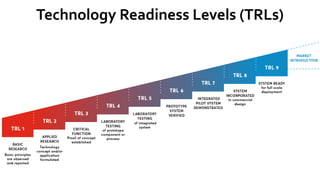
Technology Readiness Levels (TRLs)
1. Basic principles observed and reported.
2. Technology concept and/or application formulated.
3. Analytical and experimental critical function and/or characteristic proof of
concept.
4. Component and/or breadboard validation in laboratory environment.
5. Component and/or breadboard validation in relevant environment.
6.System/subsystem model or prototype demonstration in a relevant
environment.
7. System prototype demonstration in an operational environment.
8. Actual system completed and qualified through test and demonstration.
9.Actual system proven through successful long-term operations.
The value of technology increases as it matures!
• TRL 1-3 is basic research and is generally “marketed” to government agencies, major companies, and
philanthropic organizations that seek to advance the state of the art.
Ex: Sponsored research, “Science for hire”
• TRL 4-7 is technology demonstration and is “marketed” to early-adopters and strategic partners seeking
early market advantages.
Ex: Licensing agreements, sales of patent portfolio, joint venturing, pilot projects
• TRL 8-9 is technology application and product development and is marketed directly to end users.
Ex: Product sales and marketing, full-scale manufacturing & support
So …
How mature is your
technology right now?
And …
What is the commercial (!)
potential of your institution’s
technology “Portfolio”?
Create and maintain an “inventory” of your technologies!
Market
Potential
Technology Maturity
Weakening
Stable
Slow
Growth
Strong
Growth
Explosive
Growth
Idea Stage Improving Mature
Technology 1
Technology 2
Technology 3
Technology 4
Technology 5
Each will require a
different strategy to
commercialize!
TRL 1-3 TRL 4-6 TRL 7-9
There are a number of factors affecting value
Nature, form, and stage of development of the
technology
Perceived technical risk
Perceived commercial risk
Economic impact and useful economic life
Expected future advances in the field
Three Approaches toValuingTechnology
Cost
Market
Income
“Values” the technology on the basis of what it
cost to create it
Considers recent transactions involving transfer
of ownership of similar technologies
“Values” the technology as the “Present Worth”
of projected economic benefits
Valuing based on Cost
Advantages:
 Simple to do
 Easy for everyone to
understand
Disadvantages:
 Has little relationship to
potential benefits
 Rarely considers opportunity
costs
Valuing based on recent market activity
Advantages:
 Simple to do, if you can find the data …
 Easily understandable
Disadvantages:
 Hard to find comparable transactions
 Every technology is unique, difficult to
agree on comparisons
Valuing based on future earning
Advantages:
 Best captures the long-term value and
full range of risks and benefits
Disadvantages:
 Difficult to create and agree on the
financial model and associated
assumptions
 Highly subjective, based on anticipated
future revenues …
Other Considerations
Avoid doing too much sophisticated market
research:
New technologies often CREATE NEW markets…
Usually has some “irreducible uncertainty”
There are ALWAYS competitors!
It is worth doing the patent and literature searches to find
out who else is active!
Might also be potential partners & licensees!!!
Don’t assume your faculty have the expertise
needed to assess their own inventions!
Build a team of qualified staff and a network of external
reviewers
1.Does technology assessment really
matter? 
2.What does it mean to “assess” a
technology? 
3.Are there proven tools for doing so?
Very sophisticated analyses are possible … Are they necessary? Useful?
Technology Maturity
Market
Readiness
Early Adopters Beachheads
Early Movers Scale
Looking “Over the Horizon”
What isTechnology Forecasting?
•“Technology Forecasting” (TF) is a term describing
a number of methods to facilitate understanding of
the past, present, and (most importantly) the
future of a technology.
•Forecasts can inform and improve decisions about
investment, future research, product development,
and market entry.
Why ForecastTechnology?
• Anticipate emerging technological trends
• Measure the pace of technological advance
• Predict ultimate limits
• Establish R&D funding and licensing priorities
“One should expect that the expected can be prevented, but the unexpected should have been
expected.”
- NormAugustine (Augustine’s Law #45)
Technology Forecasting Methods
• Exploratory Methods (Scanning,TrendAnalysis, Expert Opinions)
• Normative Methods (Scenarios, RelevanceTrees, Cross-Impact
Analysis, Modeling/Simulation)
Current Planning
Process
Future
State #1 Future
State #2
Future
State #3
R&D Effort
Capability
The Logistic “S” Curve
• A simple, but effective, model of
technological growth:
M = Limit of growth
a = growth constant
t0 = time of half-growth
q(t) =
(M)
[ 1 + e -a(t-t0) ]
ElapsedTime (or R&D Spending)
Technological
Capability
M
t0
Applications of the S-Curve
• S-Curves have been shown to effectively model a wide variety of technologies
and systems:
• Aircraft speed and economy
• Computer speed and storage capability
• Automobile speed and fuel economy
• Satellite communications
• Nuclear energy efficiency
• Automotive fuel economy
• Renewable energy systems
• Artificial Intelligence & Machine Learning
• Space Launch Systems
Gartner
Hype Cycle
2020 Gartner
Hype Cycle for
Emerging
Technologies
Evolutionary
Niche
Revolutionary
Architectural
Four Classes
of Innovation
Two Questions…
To what extent does your innovation make other technologies obsolete?
Example: The automobile made the horse and buggy obsolete
To what extent will your innovation make current marketing & sales
channels obsolete?
Example: The people who sell automobiles are not the same people who sold horses and buggies
Automobiles were an “Architectural” Innovation
Other InnovationTypes
Evolutionary Innovations:
1TB hard drives DID NOT make 100 GB hard drives obsolete
The companies that sold 100 GB drives now also sell 1TB hard drives
Niche Innovations:
Solid state Flash Drives DID NOT make Hard Drives obsolete
The companies that sell Flash Drives do not sell Hard Drives
Revolutionary Innovations:
High Definition (digital)TV made analogTVs obsolete
The companies who sold analogTVs now sell digitalTVs
TheTransilience Map
Niche Architectural
Revolutionary
Evolutionary
Makes sales & marketing
channels obsolete
Makes older
technologies
obsolete
Automobiles
MP3 Music
Digital Cameras
Flash Drives
High DefinitionTV
High Capacity Hard Drives
Leaves older
technologies
viable
Retains existing sales &
marketing channels
1.Does technology assessment really
Matter? 
2.What does it mean to “assess” a
technology? 
3.Are there proven tools for doing so? 
Back-up Slides
Innovations are …
•Revolutionary: Satisfies a long-term need or
creates an entirely new industry
•Major Improvement: Significantly enhances
product superiority in an existing product,
process, or service
•Minor Improvement: Creates an incremental
improvement in an existing product, process, or
service
Typical License/Royalty Rates
0% 5% 10% 15%
Revolutionary
Major Improvement
Minor Improvement
Median
Average
Median
Average
Median
Average
Low to High Rates

Technology Asessment & Forecasting.pptx

  • 1.
    Today,Tomorrow, and Beyond:Technology Assessment & Forecasting Marty Kaszubowski Institute for Innovation & Entrepreneurship
  • 2.
    1.Does technology assessmentreally matter? 2.What does it mean to “assess” a technology? 3.Are there proven tools for doing so?
  • 3.
    Why bother? Your faculty,students, and staff are constantly finding ways to innovate and invent! The resulting “technology” has potential value to the university, the country, the world! It usually needs to be matured, and that costs money and time… “Assessing” the technology helps establish the value the technology might generate when it finally reaches commercial exploitation Whether you aim to license the technology to a company, or help a faculty member (or student!) start their own company, you need to know how much value remains in the underlying technology
  • 4.
    Typical Investment Criteria ManagementTeam •Full-Time Commitment • Integrity • Passion • Coach-ability • Creativity • Record of High Achievement Scalability • Markets with big buying power • Potential to dominate market • Large-scale production & delivery economics Proprietary Advantage • Unique technology with defensible IP • Difficult-to-replicate business model
  • 5.
    Technology Assessment (froma real “Due-Diligence Checklist”!)  What is the company's technological advantage?  How important are the features offered by the advanced technology to customers?  How easily can competitors copy or circumvent the technological advantage?  What stage of maturity is the technology: (a) Idea Stage; (b) Proof of Concept; (c) Prototypes Available; (d) Alpha Stage; (e) Beta Stage?  What outside agencies have shown support for the technology (federal government, state technology supporters, universities, etc.)? Why?  What outside resources can be drawn upon to advance the technology?  Have patents been issued or applied for? What do the patents cover that provide a sustainable competitive advantage?  Does the company have the means to defend their patents against infringements by competitors?  Have appropriate licenses been obtained for technology that is integral to the product or service, but which does not belong to the company? What are the terms (exclusive or non- exclusive, sunset clause, payment schedule?
  • 6.
    The most importantthing… TechnologyTransfer = Getting the technology out of the laboratory and into the real world!!!
  • 7.
    Six Paths tothe RealWorld 1. Enforcement Licensing: • Someone is ALREADY using your technology and you seek payment from them to avoid legal trouble 2. Opportunity Licensing: • You find someone who could use your technology to enhance their existing products, services, or processes (“Technology Push”) 3. Opportunistic Licensing: • Someone contacts you (!) and asks to obtain access to your technology (“Market Pull”)
  • 8.
    Six Paths tothe RealWorld 4. Divestiture Licensing: • You simply want to get rid of the technology and look for anyone who will take it 5. Partnering: • You think your institution can exploit the technology directly, but find someone who can bring additional resources (money, people, related technologies) to help 6. Startup(s): • A completely new business is formed based on your technology and your institution owns part of the new company
  • 9.
  • 10.
    1.Does technology assessmentreally matter?  2.What does it mean to “assess” a technology? 3.Are there proven tools for doing so?
  • 11.
    Technology Assessment Means… 1.Define what the technology is and what problems it can help solve 2. Establish the maturity of the technology and understand what more needs to be done before it can actually solve those problems! 3. Establish a value for the technology, e.g., what would someone pay (!) to gain access to it!
  • 12.
    TheTechnology Assessment Process 1.Define the technology being assessed and the “figures of merit” 2. Establish the current technical, cultural, market, political, regulatory, and economic context 3. Establish the future societal boundaries to limit the forecast(s) 4. Gather data … 5. Prepare quantitative and/or qualitative forecast(s) 6. Identify the impact of forecast(s) 7. Evaluate the impacts and suggest an approach forward
  • 13.
    A “Technology" isusually described in terms of … A bundle of patents Related technical trade secrets and proprietary technical know-how Proprietary hardware/software required to make full use of the technology
  • 14.
    To do aproper technology assessment you’ll need: Correct interpretations of patent claims and definition of what is unique and valuable. The time remaining to practice the unique patent claims. A “Concept Statement” for the product(s) you expect to develop. Assessments of the markets for the product(s) you envision. Financial models related to price, elasticity, demand, cost of manufacturing, costs-to-scale, etc.
  • 15.
    PLEASE … Doa patent search … TOO OFTEN we talk to an inventor or a Founder who hasn’t made even the simplest effort to do a patent search… http://Patents.Google.com is a great place to start … Caution: You need to be clever do to a good search – Don’t rely on the obvious keyword searches! I just invented the “Bucket!” I don’t see any patents for “Buckets!”
  • 16.
    Value is afunction of maturity and market potential Market Potential Technology Maturity Weakening Stable Slow Growth Strong Growth Explosive Growth Idea Stage Improving Mature IncreasingValue Increasing Value
  • 17.
  • 18.
    Technology Readiness Levels(TRLs) 1. Basic principles observed and reported. 2. Technology concept and/or application formulated. 3. Analytical and experimental critical function and/or characteristic proof of concept. 4. Component and/or breadboard validation in laboratory environment. 5. Component and/or breadboard validation in relevant environment. 6.System/subsystem model or prototype demonstration in a relevant environment. 7. System prototype demonstration in an operational environment. 8. Actual system completed and qualified through test and demonstration. 9.Actual system proven through successful long-term operations.
  • 19.
    The value oftechnology increases as it matures! • TRL 1-3 is basic research and is generally “marketed” to government agencies, major companies, and philanthropic organizations that seek to advance the state of the art. Ex: Sponsored research, “Science for hire” • TRL 4-7 is technology demonstration and is “marketed” to early-adopters and strategic partners seeking early market advantages. Ex: Licensing agreements, sales of patent portfolio, joint venturing, pilot projects • TRL 8-9 is technology application and product development and is marketed directly to end users. Ex: Product sales and marketing, full-scale manufacturing & support
  • 20.
    So … How matureis your technology right now?
  • 21.
    And … What isthe commercial (!) potential of your institution’s technology “Portfolio”?
  • 22.
    Create and maintainan “inventory” of your technologies! Market Potential Technology Maturity Weakening Stable Slow Growth Strong Growth Explosive Growth Idea Stage Improving Mature Technology 1 Technology 2 Technology 3 Technology 4 Technology 5 Each will require a different strategy to commercialize! TRL 1-3 TRL 4-6 TRL 7-9
  • 23.
    There are anumber of factors affecting value Nature, form, and stage of development of the technology Perceived technical risk Perceived commercial risk Economic impact and useful economic life Expected future advances in the field
  • 24.
    Three Approaches toValuingTechnology Cost Market Income “Values”the technology on the basis of what it cost to create it Considers recent transactions involving transfer of ownership of similar technologies “Values” the technology as the “Present Worth” of projected economic benefits
  • 25.
    Valuing based onCost Advantages:  Simple to do  Easy for everyone to understand Disadvantages:  Has little relationship to potential benefits  Rarely considers opportunity costs
  • 26.
    Valuing based onrecent market activity Advantages:  Simple to do, if you can find the data …  Easily understandable Disadvantages:  Hard to find comparable transactions  Every technology is unique, difficult to agree on comparisons
  • 27.
    Valuing based onfuture earning Advantages:  Best captures the long-term value and full range of risks and benefits Disadvantages:  Difficult to create and agree on the financial model and associated assumptions  Highly subjective, based on anticipated future revenues …
  • 28.
    Other Considerations Avoid doingtoo much sophisticated market research: New technologies often CREATE NEW markets… Usually has some “irreducible uncertainty” There are ALWAYS competitors! It is worth doing the patent and literature searches to find out who else is active! Might also be potential partners & licensees!!! Don’t assume your faculty have the expertise needed to assess their own inventions! Build a team of qualified staff and a network of external reviewers
  • 29.
    1.Does technology assessmentreally matter?  2.What does it mean to “assess” a technology?  3.Are there proven tools for doing so?
  • 30.
    Very sophisticated analysesare possible … Are they necessary? Useful? Technology Maturity Market Readiness Early Adopters Beachheads Early Movers Scale
  • 31.
  • 32.
    What isTechnology Forecasting? •“TechnologyForecasting” (TF) is a term describing a number of methods to facilitate understanding of the past, present, and (most importantly) the future of a technology. •Forecasts can inform and improve decisions about investment, future research, product development, and market entry.
  • 33.
    Why ForecastTechnology? • Anticipateemerging technological trends • Measure the pace of technological advance • Predict ultimate limits • Establish R&D funding and licensing priorities “One should expect that the expected can be prevented, but the unexpected should have been expected.” - NormAugustine (Augustine’s Law #45)
  • 34.
    Technology Forecasting Methods •Exploratory Methods (Scanning,TrendAnalysis, Expert Opinions) • Normative Methods (Scenarios, RelevanceTrees, Cross-Impact Analysis, Modeling/Simulation) Current Planning Process Future State #1 Future State #2 Future State #3 R&D Effort Capability
  • 35.
    The Logistic “S”Curve • A simple, but effective, model of technological growth: M = Limit of growth a = growth constant t0 = time of half-growth q(t) = (M) [ 1 + e -a(t-t0) ] ElapsedTime (or R&D Spending) Technological Capability M t0
  • 36.
    Applications of theS-Curve • S-Curves have been shown to effectively model a wide variety of technologies and systems: • Aircraft speed and economy • Computer speed and storage capability • Automobile speed and fuel economy • Satellite communications • Nuclear energy efficiency • Automotive fuel economy • Renewable energy systems • Artificial Intelligence & Machine Learning • Space Launch Systems
  • 37.
  • 38.
    2020 Gartner Hype Cyclefor Emerging Technologies
  • 41.
  • 42.
    Two Questions… To whatextent does your innovation make other technologies obsolete? Example: The automobile made the horse and buggy obsolete To what extent will your innovation make current marketing & sales channels obsolete? Example: The people who sell automobiles are not the same people who sold horses and buggies Automobiles were an “Architectural” Innovation
  • 43.
    Other InnovationTypes Evolutionary Innovations: 1TBhard drives DID NOT make 100 GB hard drives obsolete The companies that sold 100 GB drives now also sell 1TB hard drives Niche Innovations: Solid state Flash Drives DID NOT make Hard Drives obsolete The companies that sell Flash Drives do not sell Hard Drives Revolutionary Innovations: High Definition (digital)TV made analogTVs obsolete The companies who sold analogTVs now sell digitalTVs
  • 44.
    TheTransilience Map Niche Architectural Revolutionary Evolutionary Makessales & marketing channels obsolete Makes older technologies obsolete Automobiles MP3 Music Digital Cameras Flash Drives High DefinitionTV High Capacity Hard Drives Leaves older technologies viable Retains existing sales & marketing channels
  • 45.
    1.Does technology assessmentreally Matter?  2.What does it mean to “assess” a technology?  3.Are there proven tools for doing so? 
  • 47.
  • 48.
    Innovations are … •Revolutionary:Satisfies a long-term need or creates an entirely new industry •Major Improvement: Significantly enhances product superiority in an existing product, process, or service •Minor Improvement: Creates an incremental improvement in an existing product, process, or service
  • 49.
    Typical License/Royalty Rates 0%5% 10% 15% Revolutionary Major Improvement Minor Improvement Median Average Median Average Median Average Low to High Rates