EUBIC 
LEARNING CAMP 
May 15-17 2014, Finland
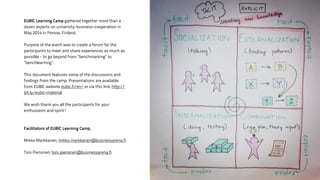
EUBIC Learning Camp gathered together more than a 
dozen experts on university-business-cooperation in 
May 2014 in Porvoo, Finland. 
! 
Purpose of the event was to create a forum for the 
participants to meet and share experiences as much as 
possible - to go beyond from ”benchmarking” to 
”benchlearning”. 
! 
This document features some of the discussions and 
findings from the camp. Presentations are available 
from EUBIC website eubic.fi/en/ or via this link: http:// 
bit.ly/eubic-material 
! 
We wish thank you all the participants for your 
enthusiasm and spirit! 
! 
! 
Facilitators of EUBIC Learning Camp, 
! 
Mikko Markkanen, mikko.markkanen@businessarena.fi 
! 
Toni Pienonen, toni.pienonen@businessarena.fi
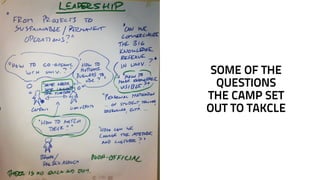
SOME OF THE 
QUESTIONS 
THE CAMP SET 
OUT TO TAKCLE
DISCUSSION AND 
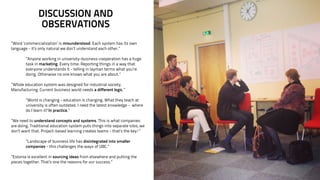
OBSERVATIONS 
”Word ’commercialization’ is misunderstood. Each system has its own 
language - it’s only natural we don’t understand each other.” 
! 
”Anyone working in university-business-cooperation has a huge 
task in marketing. Every time. Reporting things in a way that 
everyone understands it - telling in layman terms what you’re 
doing. Otherwise no one knows what you are about.” 
! 
”Whole education system was designed for industrial society. 
Manufacturing. Current business world needs a different logic.” 
! 
”World is changing - education is changing. What they teach at 
university is often outdated. I need the latest knowledge - where 
do I learn it? In practice.” 
! 
”We need to understand concepts and systems. This is what companies 
are doing. Traditional education system puts things into separate silos, we 
don’t want that. Project-based learning creates teams - that’s the key!” 
! 
”Landscape of business life has disintegrated into smaller 
companies - this challenges the ways of UBC.” 
! 
”Estonia is excellent in sourcing ideas from elsewhere and putting the 
pieces together. That’s one the reasons for our success.”
”If you do all services free of charge, for companies there’s less 
commitment and perceived benefits. Don’t do it!” 
! 
”TU Berlin: Strategic focus on responding to societal 
challenges in the university vision.” 
! 
”Steering groups should be held accountable for the results of 
the projects, like company boards.” 
! 
”Commercialization is often too much focused on 
personal idea. Especially in social sciences we need to 
solve complex challenges, that bring together 
multidisciplinary teams.” 
! 
”In Estonia there isn’t going back to old ways. Change is 
accepted. Such an environment drives things ahead - and we 
need to nurture it!” 
! 
”Universities should use students as door openers 
between university and business - more focus on the 
”after sales”, shared learning. Where is the customer 
relationship management of internships, projects and 
thesis work?” 
! 
”How do we increase the (temporary) people flow between 
universities and business, the role of universities in businesses’ 
strategy, and involve university representatives in strategic 
decision-making?”
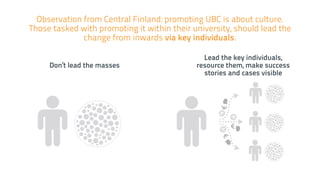
Observation from Central Finland: promoting UBC is about culture. 
Those tasked with promoting it within their university, should lead the 
change from inwards via key individuals. 
Don’t lead the masses 
Lead the key individuals, 
resource them, make success 
stories and cases visible
EXISTING MODELS AND SOLUTIONS 
THAT WERE PRESENTED / 
DISCUSSED ABOUT AT THE CAMP
(FINLAND) 
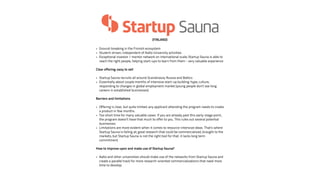
• Ground-breaking in the Finnish ecosystem 
• Student-driven, independent of Aalto University activities 
• Exceptional investor / mentor network on international scale; Startup Sauna is able to 
reach the right people, helping start-ups to learn from them - very valuable experience 
! 
Clear offering: easy to sell 
! 
• Startup Sauna recruits all around Scandinavia, Russia and Baltics 
• Essentially about couple months of intensive start-up building: hype, culture, 
responding to changes in global employment market (young people don’t see long 
careers in established businesses) 
! 
Barriers and limitations 
! 
• Offering is clear, but quite limited: any applicant attending the program needs to create 
a product in few months. 
• Too short time for many valuable cases. If you are already past this early-stage point, 
the program doesn’t have that much to offer to you. This rules out several potential 
businesses. 
• Limitations are more evident when it comes to resource-intensive ideas. That’s where 
Startup Sauna is failing at; good research that could be commercialized, brought to the 
markets, but Startup Sauna is not the right tool for that. it lacks long term 
commitment. 
! 
How to improve upon and make use of Startup Sauna? 
• Aalto and other universities should make use of the networks from Startup Sauna and 
create a parallel track for more research-oriented commercializations that need more 
time to develop.
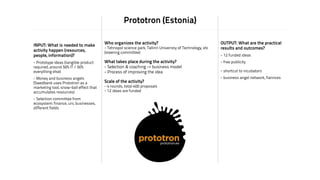
Prototron (Estonia) 
!INPUT: What is needed to make 
activity happen (resources, 
people, information)? ! 
! 
- Prototype ideas (tangible product 
required, around 50% IT / 50% 
everything else)! 
! 
- Money and business angels 
(Swedbank uses Prototron as a 
marketing tool, snow-ball effect that 
accumulates resources)! 
! 
- Selection committee from 
ecosystem: finance, uni, businesses, 
different fields 
Who organizes the activity?! 
- Tehnopol science park, Tallinn Univeristy of Technology, etc 
(steering committee)! 
!! 
What takes place during the activity?! 
- Selection & coaching -> business model! 
- Process of improving the idea! 
!! 
Scale of the activity?! 
- 4 rounds, total 400 proposals! 
- 12 ideas are funded 
OUTPUT: What are the practical 
results and outcomes? 
! 
- 12 funded ideas! 
! 
- free publicity! 
!! 
- shortcut to incubators! 
! 
- business angel network, fiannces
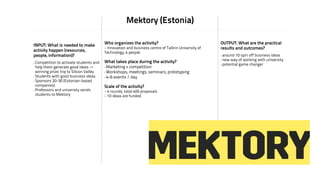
Mektory (Estonia) 
!INPUT: What is needed to make 
activity happen (resources, 
people, information)? ! 
! 
- Competition to activate students and 
help them generate good ideas -> 
winning prize: trip to Silicon Valley! 
- Students with good business ideas 
- Sponsors 20-30 (Estonian-based 
companies) 
- Professors and univeristy sends 
students to Mektory 
Who organizes the activity?! 
- Innovation and business centre of Tallinn University of 
Technology, 4 people! 
!! 
What takes place during the activity?! 
- Marketing + competition 
- Workshops, meetings, seminars, prototyping 
- 4-6 events / day! 
!! 
Scale of the activity?! 
- 4 rounds, total 400 proposals! 
- 10 ideas are funded 
OUTPUT: What are the practical 
results and outcomes? 
! 
- around 10 spin off business ideas 
- new way of working with university 
- potential game changer
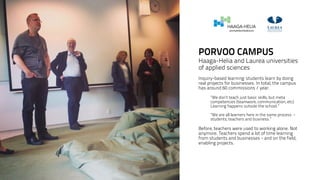
PORVOO CAMPUS 
Haaga-Helia and Laurea universities 
of applied sciences 
! 
Inquiry-based learning: students learn by doing 
real projects for businesses. In total, the campus 
has around 60 commissions / year. 
! 
”We don’t teach just basic skills, but meta 
competencies (teamwork, communication, etc). 
Learning happens outside the school.” 
! 
”We are all learners here in the same process - 
students, teachers and business.” 
Before, teachers were used to working alone. Not 
anymore. Teachers spend a lot of time learning 
from students and businesses - and on the field, 
enabling projects. 
! 
!
”innoSPICE is a standard based model for 
innovation, knowledge- and technology transfer. It 
is an evaluation procedure that can help 
knowledge-intense institutions generate more 
innovation while helping investors and research 
institutions optimize public funds to achieve 
economic added value.” 
! 
http://innospice.ning.com/
(Finland) 
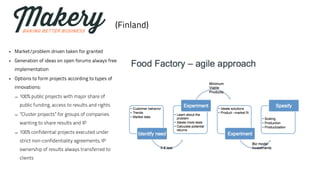
• Market/problem driven taken for granted 
• Generation of ideas on open forums always free 
implementation 
• Options to form projects according to types of 
innovations: 
– 100% public projects with major share of 
public funding, access to results and rights 
– ”Cluster projects” for groups of companies 
wanting to share results and IP 
– 100% confidential projects executed under 
strict non-confidentiality agreements, IP 
ownership of results always transferred to 
clients
NEW SOLUTIONS CREATED 
BY CAMP PARTICIPANTS
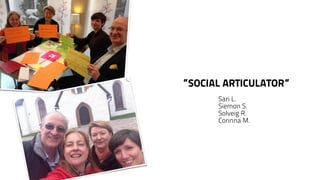
”SOCIAL ARTICULATOR” 
Sari L. 
Siemon S. 
Solveig R. 
Corinna M.
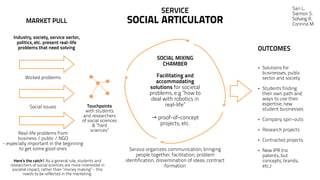
MARKET PULL 
Touchpoints 
with students 
and researchers 
of social sciences 
& ”hard 
sciences” 
SERVICE 
SOCIAL ARTICULATOR 
OUTCOMES 
! 
! 
• Solutions for 
businesses, public 
sector and society 
! 
• Students finding 
their own path and 
ways to use their 
expertise, new 
student businesses 
! 
• Company spin-outs 
! 
• Research projects 
! 
• Contracted projects 
! 
• New IPR (no 
patents, but 
concepts, brands, 
etc.) 
Industry, society, service sector, 
politics, etc. present real-life 
problems that need solving 
Wicked problems 
Social issues 
Real-life problems from 
business / public / NGO 
- especially important in the beginning 
to get some good ones 
SOCIAL MIXING 
CHAMBER 
! 
Facilitating and 
accommodating 
solutions for societal 
problems, e.g ”how to 
deal with robotics in 
real-life” 
! 
→ proof-of-concept 
projects, etc. 
Service organizes communication, bringing 
people together, facilitation, problem 
identification, dissemination of ideas, contract 
formation 
Here’s the catch! As a general rule, students and 
researchers of social sciences are more interested in 
societal impact, rather than ”money making” - this 
needs to be reflected in the marketing. 
Sari L. 
Siemon S. 
Solveig R. 
Corinna M.
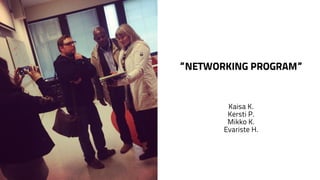
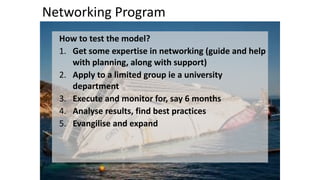
”NETWORKING PROGRAM” 
Kaisa K. 
Kersti P. 
Mikko K. 
Evariste H.
Networking 
Program 
Question: 
How 
many 
relevant 
business 
contacts 
does 
a 
resercher 
have? 
! 
Answer: 
X? 
! 
! 
…Not 
enough 
-­‐ 
it 
needs 
to 
be 
at 
least 
10X! 
! 
!
Networking 
Program 
How 
to 
get 
to 
10X? 
1. Measure 
no 
of 
contacts, 
evaluate 
relevance 
2. Set 
new 
targets 
individually, 
to 
the 
team, 
faculty 
etc. 
Define 
networking 
as 
KPI. 
3. Set 
individual 
plans 
to 
enhance 
networking 
and 
business 
engagement 
! 
Actions: 
Events, 
business 
conferences, 
workshops, 
business 
breakfasts, 
alumni 
engagemeint, 
mentorships, 
social 
media… 
What 
ever 
means 
needed 
to 
find 
meaningful 
contacts 
! 
!
Networking 
Program 
• Needs: 
– Need 
for 
new 
meaningful 
contacts 
and 
cooperation 
– Need 
to 
create 
value 
to 
society 
through 
economic 
activity 
– Practical 
applications 
through 
scientific 
knowledge 
• Benefits: 
– Better 
mutual 
understanding 
of 
business 
reality 
and 
the 
research 
world 
– Better 
utilisation 
of 
universities 
resources 
– Value 
co-­‐creation 
– Better 
understanding 
of 
the 
the 
”big 
picture” 
– Merging 
different 
working 
cultures 
• Scale 
– University 
wide, 
tailor 
made 
for 
different 
fields 
of 
research 
– All 
levels, 
management 
included 
• Barriers 
– Lack 
of 
time; 
Contradicting 
expectations; 
Lack 
of 
motivation 
and 
focus; 
Cultural 
differences; 
Attitude 
and 
resistance 
to 
change 
– 
people 
want 
to 
stay 
in 
their 
comfort 
zone
Networking 
Program 
How 
to 
test 
the 
model? 
1. Get 
some 
expertise 
in 
networking 
(guide 
and 
help 
with 
planning, 
along 
with 
support) 
2. Apply 
to 
a 
limited 
group 
ie 
a 
university 
department 
3. Execute 
and 
monitor 
for, 
say 
6 
months 
4. Analyse 
results, 
find 
best 
practices 
5. Evangilise 
and 
expand 
!
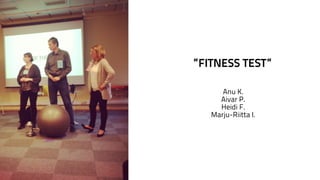
”FITNESS TEST” 
Anu K. 
Aivar P. 
Heidi F. 
Marju-Riitta I.
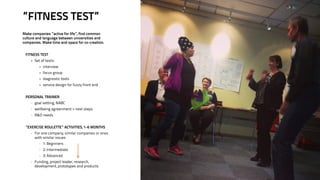
”FITNESS TEST” 
! 
Make companies ”active for life”, find common 
culture and language between universities and 
companies. Make time and space for co-creation. 
! 
FITNESS TEST 
• Set of tests: 
• interview 
• focus group 
• diagnostic tools 
• service design for fuzzy front end 
! 
PERSONAL TRAINER 
- goal setting, NABC 
- wellbeing agreenment = next steps 
- R&D needs 
! 
”EXERCISE ROULETTE” ACTIVITIES, 1-6 MONTHS 
- For one company, similar companies or ones 
with similar issues 
- 1: Beginners 
- 2: Intermediate 
- 3: Advanced 
- Funding, project leader, research, 
development, prototypes and products
WHAT NEXT?
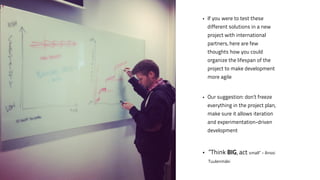
• If you were to test these 
different solutions in a new 
project with international 
partners, here are few 
thoughts how you could 
organize the lifespan of the 
project to make development 
more agile 
! 
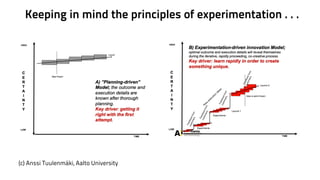
• Our suggestion: don’t freeze 
everything in the project plan, 
make sure it allows iteration 
and experimentation-driven 
development 
! 
• ”Think BIG, act small” - Anssi 
Tuulenmäki
Keeping in mind the principles of experimentation . . . 
(c) Anssi Tuulenmäki, Aalto University
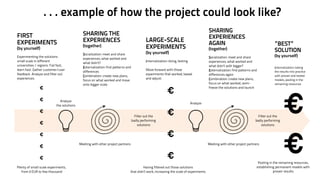
. . . example of how the project could look like? 
FIRST 
EXPERIMENTS 
(by yourself) 
! 
Experimenting the solutions 
small scale in different 
universities / regions. Fail fast, 
learn fast. Gather customer/user 
feedback. Analyze and filter out 
experiences. 
SHARING THE 
EXPERIENCES 
(together) 
! 
Socialization: meet and share 
experiences, what worked and 
what didn’t? 
Externalization: find patterns and 
differences 
Combination: create new plans, 
focus on what worked and move 
onto bigger scale 
€" 
! 
€" 
! 
€" 
! 
€" 
! 
€" 
! 
€" 
! 
€ 
LARGE-SCALE 
EXPERIMENTS 
(by yourself) 
! Internalization: doing, testing 
! 
Move forward with those 
experiments that worked, tweak 
and adjust. 
€" 
! 
€" 
! 
€" 
Meeting with other project partners Meeting with other project partners 
! 
€ 
SHARING 
EXPERIENCES 
AGAIN 
(together) 
! 
Socialization: meet and share 
experiences, what worked and 
what didn’t with bigger? 
Externalization: find patterns and 
differences again 
Combination: create new plans, 
focus on what worked, semi-freeze 
the solutions and launch 
”BEST” 
SOLUTION 
(by yourself) 
! 
Internalization: taking 
the results into practice 
with proven and tested 
models, pooling in the 
remaining resources 
€ 
Plenty of small scale experiments, 
from 0 EUR to few thousand 
Having filtered out those solutions 
that didn’t work, increasing the scale of experiments 
Analyze 
the solutions 
Filter out the 
badly performing 
solutions 
Analyze 
Filter out the 
badly performing 
solutions 
€ 
Pooling in the remaining resources, 
establishing permanent models with 
proven results
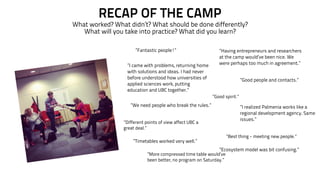
RECAP OF THE CAMP 
What worked? What didn’t? What should be done differently? 
What will you take into practice? What did you learn? 
”I came with problems, returning home 
with solutions and ideas. I had never 
before understood how universities of 
applied sciences work, putting 
education and UBC together.” 
”I realized Palmenia works like a 
regional development agency. Same 
issues.” 
”We need people who break the rules.” 
”Having entrepreneurs and researchers 
at the camp would’ve been nice. We 
were perhaps too much in agreement.” 
”Fantastic people!” 
”Good people and contacts.” 
”Timetables worked very well.” 
”Good spirit.” 
”Ecosystem model was bit confusing.” 
”Different points of view affect UBC a 
great deal.” 
”Best thing - meeting new people.” 
”More compressed time table would’ve 
been better, no program on Saturday.”
Documentation 
Toni Pienonen / Business Arena Oy 
0400 737 238, toni.pienonen@businessarena.fi

EUBIC Learning Camp documentation, May 2014

  • 1.
    EUBIC LEARNING CAMP May 15-17 2014, Finland
  • 2.
    EUBIC Learning Campgathered together more than a dozen experts on university-business-cooperation in May 2014 in Porvoo, Finland. ! Purpose of the event was to create a forum for the participants to meet and share experiences as much as possible - to go beyond from ”benchmarking” to ”benchlearning”. ! This document features some of the discussions and findings from the camp. Presentations are available from EUBIC website eubic.fi/en/ or via this link: http:// bit.ly/eubic-material ! We wish thank you all the participants for your enthusiasm and spirit! ! ! Facilitators of EUBIC Learning Camp, ! Mikko Markkanen, mikko.markkanen@businessarena.fi ! Toni Pienonen, toni.pienonen@businessarena.fi
  • 3.
    SOME OF THE QUESTIONS THE CAMP SET OUT TO TAKCLE
  • 4.
    DISCUSSION AND OBSERVATIONS ”Word ’commercialization’ is misunderstood. Each system has its own language - it’s only natural we don’t understand each other.” ! ”Anyone working in university-business-cooperation has a huge task in marketing. Every time. Reporting things in a way that everyone understands it - telling in layman terms what you’re doing. Otherwise no one knows what you are about.” ! ”Whole education system was designed for industrial society. Manufacturing. Current business world needs a different logic.” ! ”World is changing - education is changing. What they teach at university is often outdated. I need the latest knowledge - where do I learn it? In practice.” ! ”We need to understand concepts and systems. This is what companies are doing. Traditional education system puts things into separate silos, we don’t want that. Project-based learning creates teams - that’s the key!” ! ”Landscape of business life has disintegrated into smaller companies - this challenges the ways of UBC.” ! ”Estonia is excellent in sourcing ideas from elsewhere and putting the pieces together. That’s one the reasons for our success.”
  • 5.
    ”If you doall services free of charge, for companies there’s less commitment and perceived benefits. Don’t do it!” ! ”TU Berlin: Strategic focus on responding to societal challenges in the university vision.” ! ”Steering groups should be held accountable for the results of the projects, like company boards.” ! ”Commercialization is often too much focused on personal idea. Especially in social sciences we need to solve complex challenges, that bring together multidisciplinary teams.” ! ”In Estonia there isn’t going back to old ways. Change is accepted. Such an environment drives things ahead - and we need to nurture it!” ! ”Universities should use students as door openers between university and business - more focus on the ”after sales”, shared learning. Where is the customer relationship management of internships, projects and thesis work?” ! ”How do we increase the (temporary) people flow between universities and business, the role of universities in businesses’ strategy, and involve university representatives in strategic decision-making?”
  • 6.
    Observation from CentralFinland: promoting UBC is about culture. Those tasked with promoting it within their university, should lead the change from inwards via key individuals. Don’t lead the masses Lead the key individuals, resource them, make success stories and cases visible
  • 7.
    EXISTING MODELS ANDSOLUTIONS THAT WERE PRESENTED / DISCUSSED ABOUT AT THE CAMP
  • 8.
    (FINLAND) • Ground-breakingin the Finnish ecosystem • Student-driven, independent of Aalto University activities • Exceptional investor / mentor network on international scale; Startup Sauna is able to reach the right people, helping start-ups to learn from them - very valuable experience ! Clear offering: easy to sell ! • Startup Sauna recruits all around Scandinavia, Russia and Baltics • Essentially about couple months of intensive start-up building: hype, culture, responding to changes in global employment market (young people don’t see long careers in established businesses) ! Barriers and limitations ! • Offering is clear, but quite limited: any applicant attending the program needs to create a product in few months. • Too short time for many valuable cases. If you are already past this early-stage point, the program doesn’t have that much to offer to you. This rules out several potential businesses. • Limitations are more evident when it comes to resource-intensive ideas. That’s where Startup Sauna is failing at; good research that could be commercialized, brought to the markets, but Startup Sauna is not the right tool for that. it lacks long term commitment. ! How to improve upon and make use of Startup Sauna? • Aalto and other universities should make use of the networks from Startup Sauna and create a parallel track for more research-oriented commercializations that need more time to develop.
  • 9.
    Prototron (Estonia) !INPUT:What is needed to make activity happen (resources, people, information)? ! ! - Prototype ideas (tangible product required, around 50% IT / 50% everything else)! ! - Money and business angels (Swedbank uses Prototron as a marketing tool, snow-ball effect that accumulates resources)! ! - Selection committee from ecosystem: finance, uni, businesses, different fields Who organizes the activity?! - Tehnopol science park, Tallinn Univeristy of Technology, etc (steering committee)! !! What takes place during the activity?! - Selection & coaching -> business model! - Process of improving the idea! !! Scale of the activity?! - 4 rounds, total 400 proposals! - 12 ideas are funded OUTPUT: What are the practical results and outcomes? ! - 12 funded ideas! ! - free publicity! !! - shortcut to incubators! ! - business angel network, fiannces
  • 10.
    Mektory (Estonia) !INPUT:What is needed to make activity happen (resources, people, information)? ! ! - Competition to activate students and help them generate good ideas -> winning prize: trip to Silicon Valley! - Students with good business ideas - Sponsors 20-30 (Estonian-based companies) - Professors and univeristy sends students to Mektory Who organizes the activity?! - Innovation and business centre of Tallinn University of Technology, 4 people! !! What takes place during the activity?! - Marketing + competition - Workshops, meetings, seminars, prototyping - 4-6 events / day! !! Scale of the activity?! - 4 rounds, total 400 proposals! - 10 ideas are funded OUTPUT: What are the practical results and outcomes? ! - around 10 spin off business ideas - new way of working with university - potential game changer
  • 11.
    PORVOO CAMPUS Haaga-Heliaand Laurea universities of applied sciences ! Inquiry-based learning: students learn by doing real projects for businesses. In total, the campus has around 60 commissions / year. ! ”We don’t teach just basic skills, but meta competencies (teamwork, communication, etc). Learning happens outside the school.” ! ”We are all learners here in the same process - students, teachers and business.” Before, teachers were used to working alone. Not anymore. Teachers spend a lot of time learning from students and businesses - and on the field, enabling projects. ! !
  • 12.
    ”innoSPICE is astandard based model for innovation, knowledge- and technology transfer. It is an evaluation procedure that can help knowledge-intense institutions generate more innovation while helping investors and research institutions optimize public funds to achieve economic added value.” ! http://innospice.ning.com/
  • 13.
    (Finland) • Market/problemdriven taken for granted • Generation of ideas on open forums always free implementation • Options to form projects according to types of innovations: – 100% public projects with major share of public funding, access to results and rights – ”Cluster projects” for groups of companies wanting to share results and IP – 100% confidential projects executed under strict non-confidentiality agreements, IP ownership of results always transferred to clients
  • 14.
    NEW SOLUTIONS CREATED BY CAMP PARTICIPANTS
  • 15.
    ”SOCIAL ARTICULATOR” SariL. Siemon S. Solveig R. Corinna M.
  • 16.
    MARKET PULL Touchpoints with students and researchers of social sciences & ”hard sciences” SERVICE SOCIAL ARTICULATOR OUTCOMES ! ! • Solutions for businesses, public sector and society ! • Students finding their own path and ways to use their expertise, new student businesses ! • Company spin-outs ! • Research projects ! • Contracted projects ! • New IPR (no patents, but concepts, brands, etc.) Industry, society, service sector, politics, etc. present real-life problems that need solving Wicked problems Social issues Real-life problems from business / public / NGO - especially important in the beginning to get some good ones SOCIAL MIXING CHAMBER ! Facilitating and accommodating solutions for societal problems, e.g ”how to deal with robotics in real-life” ! → proof-of-concept projects, etc. Service organizes communication, bringing people together, facilitation, problem identification, dissemination of ideas, contract formation Here’s the catch! As a general rule, students and researchers of social sciences are more interested in societal impact, rather than ”money making” - this needs to be reflected in the marketing. Sari L. Siemon S. Solveig R. Corinna M.
  • 17.
    ”NETWORKING PROGRAM” KaisaK. Kersti P. Mikko K. Evariste H.
  • 18.
    Networking Program Question: How many relevant business contacts does a resercher have? ! Answer: X? ! ! …Not enough -­‐ it needs to be at least 10X! ! !
  • 19.
    Networking Program How to get to 10X? 1. Measure no of contacts, evaluate relevance 2. Set new targets individually, to the team, faculty etc. Define networking as KPI. 3. Set individual plans to enhance networking and business engagement ! Actions: Events, business conferences, workshops, business breakfasts, alumni engagemeint, mentorships, social media… What ever means needed to find meaningful contacts ! !
  • 20.
    Networking Program •Needs: – Need for new meaningful contacts and cooperation – Need to create value to society through economic activity – Practical applications through scientific knowledge • Benefits: – Better mutual understanding of business reality and the research world – Better utilisation of universities resources – Value co-­‐creation – Better understanding of the the ”big picture” – Merging different working cultures • Scale – University wide, tailor made for different fields of research – All levels, management included • Barriers – Lack of time; Contradicting expectations; Lack of motivation and focus; Cultural differences; Attitude and resistance to change – people want to stay in their comfort zone
  • 21.
    Networking Program How to test the model? 1. Get some expertise in networking (guide and help with planning, along with support) 2. Apply to a limited group ie a university department 3. Execute and monitor for, say 6 months 4. Analyse results, find best practices 5. Evangilise and expand !
  • 22.
    ”FITNESS TEST” AnuK. Aivar P. Heidi F. Marju-Riitta I.
  • 23.
    ”FITNESS TEST” ! Make companies ”active for life”, find common culture and language between universities and companies. Make time and space for co-creation. ! FITNESS TEST • Set of tests: • interview • focus group • diagnostic tools • service design for fuzzy front end ! PERSONAL TRAINER - goal setting, NABC - wellbeing agreenment = next steps - R&D needs ! ”EXERCISE ROULETTE” ACTIVITIES, 1-6 MONTHS - For one company, similar companies or ones with similar issues - 1: Beginners - 2: Intermediate - 3: Advanced - Funding, project leader, research, development, prototypes and products
  • 24.
  • 25.
    • If youwere to test these different solutions in a new project with international partners, here are few thoughts how you could organize the lifespan of the project to make development more agile ! • Our suggestion: don’t freeze everything in the project plan, make sure it allows iteration and experimentation-driven development ! • ”Think BIG, act small” - Anssi Tuulenmäki
  • 26.
    Keeping in mindthe principles of experimentation . . . (c) Anssi Tuulenmäki, Aalto University
  • 27.
    . . .example of how the project could look like? FIRST EXPERIMENTS (by yourself) ! Experimenting the solutions small scale in different universities / regions. Fail fast, learn fast. Gather customer/user feedback. Analyze and filter out experiences. SHARING THE EXPERIENCES (together) ! Socialization: meet and share experiences, what worked and what didn’t? Externalization: find patterns and differences Combination: create new plans, focus on what worked and move onto bigger scale €" ! €" ! €" ! €" ! €" ! €" ! € LARGE-SCALE EXPERIMENTS (by yourself) ! Internalization: doing, testing ! Move forward with those experiments that worked, tweak and adjust. €" ! €" ! €" Meeting with other project partners Meeting with other project partners ! € SHARING EXPERIENCES AGAIN (together) ! Socialization: meet and share experiences, what worked and what didn’t with bigger? Externalization: find patterns and differences again Combination: create new plans, focus on what worked, semi-freeze the solutions and launch ”BEST” SOLUTION (by yourself) ! Internalization: taking the results into practice with proven and tested models, pooling in the remaining resources € Plenty of small scale experiments, from 0 EUR to few thousand Having filtered out those solutions that didn’t work, increasing the scale of experiments Analyze the solutions Filter out the badly performing solutions Analyze Filter out the badly performing solutions € Pooling in the remaining resources, establishing permanent models with proven results
  • 28.
    RECAP OF THECAMP What worked? What didn’t? What should be done differently? What will you take into practice? What did you learn? ”I came with problems, returning home with solutions and ideas. I had never before understood how universities of applied sciences work, putting education and UBC together.” ”I realized Palmenia works like a regional development agency. Same issues.” ”We need people who break the rules.” ”Having entrepreneurs and researchers at the camp would’ve been nice. We were perhaps too much in agreement.” ”Fantastic people!” ”Good people and contacts.” ”Timetables worked very well.” ”Good spirit.” ”Ecosystem model was bit confusing.” ”Different points of view affect UBC a great deal.” ”Best thing - meeting new people.” ”More compressed time table would’ve been better, no program on Saturday.”
  • 29.
    Documentation Toni Pienonen/ Business Arena Oy 0400 737 238, toni.pienonen@businessarena.fi