Same Ecosystem,
Different Entrepreneurs
MEASURING THE VITALITY OF A DIVERSE ENTREPRENEURIAL
ECOSYSTEM
Entrepreneurial Ecosystem
[...] a set of interconnected entrepreneurial actors
(both potential and existing), entrepreneurial
organizations, institutions and entrepreneurial
processes which formally and informally coalesce to
connect, mediate and govern the performance within
the local entrepreneurial environment (OECD, 2014)
Research Questions
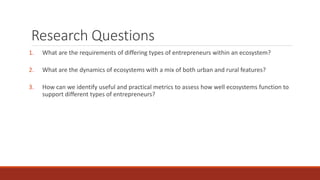
1. What are the requirements of differing types of entrepreneurs within an ecosystem?
2. What are the dynamics of ecosystems with a mix of both urban and rural features?
3. How can we identify useful and practical metrics to assess how well ecosystems function to
support different types of entrepreneurs?
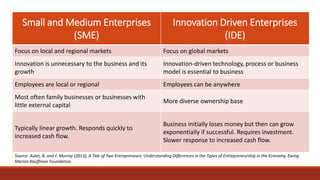
Small and Medium Enterprises
(SME)
Innovation Driven Enterprises
(IDE)
Focus on local and regional markets Focus on global markets
Innovation is unnecessary to the business and its
growth
Innovation-driven technology, process or business
model is essential to business
Employees are local or regional Employees can be anywhere
Most often family businesses or businesses with
little external capital
More diverse ownership base
Typically linear growth. Responds quickly to
increased cash flow.
Business initially loses money but then can grow
exponentially if successful. Requires investment.
Slower response to increased cash flow.
Source: Aulet, B. and F. Murray (2013), A Tale of Two Entrepreneurs: Understanding Differences in the Types of Entrepreneurship in the Economy, Ewing
Marion Kauffman Foundation.
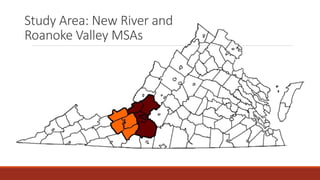
Study Area: New River and
Roanoke Valley MSAs
Methods
Interviews and Focus Groups with Entrepreneurs (17 respondents) and Intermediaries (27
respondents)
Entrepreneur Surveys (146 respondents; 84 complete entrepreneur responses)
Review of Secondary Metrics Data
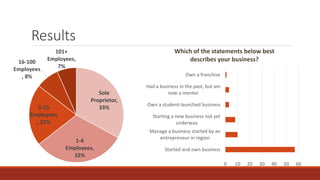
Results
Sole
Proprietor,
33%
1-4
Employees,
32%
5-15
Employees
, 21%
16-100
Employees
, 8%
101+
Employees,
7%
0 10 20 30 40 50 60
Started and own business
Manage a business started by an
entrepreneur in region
Starting a new business not yet
underway
Own a student-launched business
Had a business in the past, but am
now a mentor
Own a franchise
Which of the statements below best
describes your business?
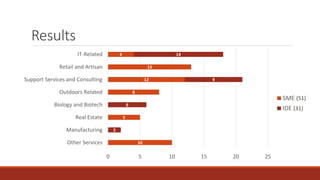
Results
10
5
8
12
13
4
2
6
9
14
0 5 10 15 20 25
Other Services
Manufacturing
Real Estate
Biology and Biotech
Outdoors Related
Support Services and Consulting
Retail and Artisan
IT-Related
SME
IDE
(51)
(31)
Results
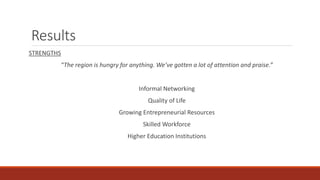
STRENGTHS
“The region is hungry for anything. We’ve gotten a lot of attention and praise.”
Informal Networking
Quality of Life
Growing Entrepreneurial Resources
Skilled Workforce
Higher Education Institutions
Results
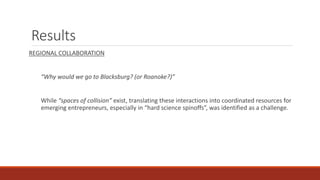
REGIONAL COLLABORATION
“Why would we go to Blacksburg? (or Roanoke?)”
While “spaces of collision” exist, translating these interactions into coordinated resources for
emerging entrepreneurs, especially in “hard science spinoffs”, was identified as a challenge.
Results
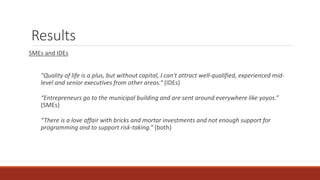
SMEs and IDEs
"Quality of life is a plus, but without capital, I can't attract well-qualified, experienced mid-
level and senior executives from other areas.“ (IDEs)
“Entrepreneurs go to the municipal building and are sent around everywhere like yoyos.”
(SMEs)
“There is a love affair with bricks and mortar investments and not enough support for
programming and to support risk-taking.” (both)
Results
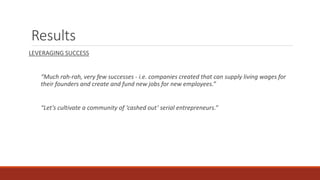
LEVERAGING SUCCESS
“Much rah-rah, very few successes - i.e. companies created that can supply living wages for
their founders and create and fund new jobs for new employees.”
“Let’s cultivate a community of ‘cashed out’ serial entrepreneurs.”
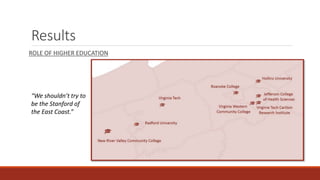
Results
ROLE OF HIGHER EDUCATION
“We shouldn’t try to
be the Stanford of
the East Coast.”
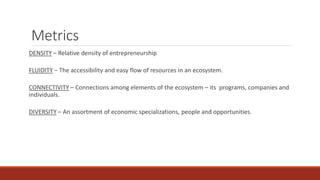
Metrics
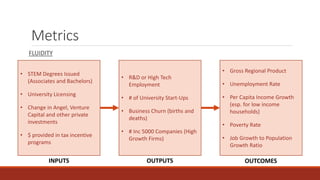
DENSITY – Relative density of entrepreneurship
FLUIDITY – The accessibility and easy flow of resources in an ecosystem.
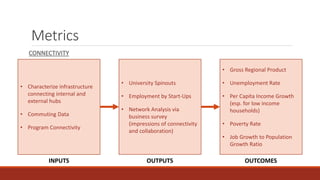
CONNECTIVITY – Connections among elements of the ecosystem – its programs, companies and
individuals.
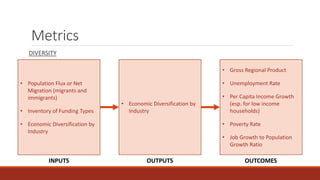
DIVERSITY – An assortment of economic specializations, people and opportunities.
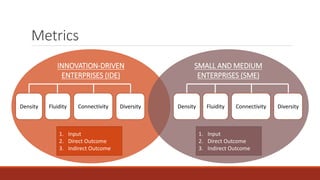
Metrics
INNOVATION-DRIVEN
ENTERPRISES (IDE)
SMALL AND MEDIUM
ENTERPRISES (SME)
Density Fluidity Connectivity Diversity
1. Input
2. Direct Outcome
3. Indirect Outcome
1. Input
2. Direct Outcome
3. Indirect Outcome
Density Fluidity Connectivity Diversity
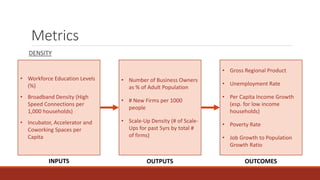
Metrics
DENSITY
• Workforce Education Levels
(%)
• Broadband Density (High
Speed Connections per
1,000 households)
• Incubator, Accelerator and
Coworking Spaces per
Capita
• Number of Business Owners
as % of Adult Population
• # New Firms per 1000
people
• Scale-Up Density (# of Scale-
Ups for past 5yrs by total #
of firms)
• Gross Regional Product
• Unemployment Rate
• Per Capita Income Growth
(esp. for low income
households)
• Poverty Rate
• Job Growth to Population
Growth Ratio
INPUTS OUTPUTS OUTCOMES
Metrics
FLUIDITY
• STEM Degrees Issued
(Associates and Bachelors)
• University Licensing
• Change in Angel, Venture
Capital and other private
investments
• $ provided in tax incentive
programs
• R&D or High Tech
Employment
• # of University Start-Ups
• Business Churn (births and
deaths)
• # Inc 5000 Companies (High
Growth Firms)
• Gross Regional Product
• Unemployment Rate
• Per Capita Income Growth
(esp. for low income
households)
• Poverty Rate
• Job Growth to Population
Growth Ratio
INPUTS OUTPUTS OUTCOMES
Metrics
CONNECTIVITY
• Characterize infrastructure
connecting internal and
external hubs
• Commuting Data
• Program Connectivity
• University Spinouts
• Employment by Start-Ups
• Network Analysis via
business survey
(impressions of connectivity
and collaboration)
• Gross Regional Product
• Unemployment Rate
• Per Capita Income Growth
(esp. for low income
households)
• Poverty Rate
• Job Growth to Population
Growth Ratio
INPUTS OUTPUTS OUTCOMES
Metrics
DIVERSITY
• Population Flux or Net
Migration (migrants and
immigrants)
• Inventory of Funding Types
• Economic Diversification by
Industry
• Economic Diversification by
Industry
• Gross Regional Product
• Unemployment Rate
• Per Capita Income Growth
(esp. for low income
households)
• Poverty Rate
• Job Growth to Population
Growth Ratio
INPUTS OUTPUTS OUTCOMES
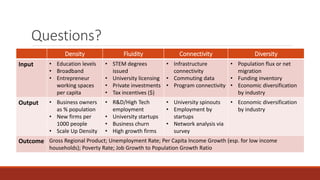
Questions?
Density Fluidity Connectivity Diversity
Input • Education levels
• Broadband
• Entrepreneur
working spaces
per capita
• STEM degrees
issued
• University licensing
• Private investments
• Tax incentives ($)
• Infrastructure
connectivity
• Commuting data
• Program connectivity
• Population flux or net
migration
• Funding inventory
• Economic diversification
by industry
Output • Business owners
as % population
• New firms per
1000 people
• Scale Up Density
• R&D/High Tech
employment
• University startups
• Business churn
• High growth firms
• University spinouts
• Employment by
startups
• Network analysis via
survey
• Economic diversification
by industry
Outcome Gross Regional Product; Unemployment Rate; Per Capita Income Growth (esp. for low income
households); Poverty Rate; Job Growth to Population Growth Ratio

UEDA Annual Summit 2016: Virginia Tech; Same Ecosystem, Different Entrepreneurs

  • 1.
    Same Ecosystem, Different Entrepreneurs MEASURINGTHE VITALITY OF A DIVERSE ENTREPRENEURIAL ECOSYSTEM
  • 2.
    Entrepreneurial Ecosystem [...] aset of interconnected entrepreneurial actors (both potential and existing), entrepreneurial organizations, institutions and entrepreneurial processes which formally and informally coalesce to connect, mediate and govern the performance within the local entrepreneurial environment (OECD, 2014)
  • 3.
    Research Questions 1. Whatare the requirements of differing types of entrepreneurs within an ecosystem? 2. What are the dynamics of ecosystems with a mix of both urban and rural features? 3. How can we identify useful and practical metrics to assess how well ecosystems function to support different types of entrepreneurs?
  • 4.
    Small and MediumEnterprises (SME) Innovation Driven Enterprises (IDE) Focus on local and regional markets Focus on global markets Innovation is unnecessary to the business and its growth Innovation-driven technology, process or business model is essential to business Employees are local or regional Employees can be anywhere Most often family businesses or businesses with little external capital More diverse ownership base Typically linear growth. Responds quickly to increased cash flow. Business initially loses money but then can grow exponentially if successful. Requires investment. Slower response to increased cash flow. Source: Aulet, B. and F. Murray (2013), A Tale of Two Entrepreneurs: Understanding Differences in the Types of Entrepreneurship in the Economy, Ewing Marion Kauffman Foundation.
  • 5.
    Study Area: NewRiver and Roanoke Valley MSAs
  • 6.
    Methods Interviews and FocusGroups with Entrepreneurs (17 respondents) and Intermediaries (27 respondents) Entrepreneur Surveys (146 respondents; 84 complete entrepreneur responses) Review of Secondary Metrics Data
  • 7.
    Results Sole Proprietor, 33% 1-4 Employees, 32% 5-15 Employees , 21% 16-100 Employees , 8% 101+ Employees, 7% 010 20 30 40 50 60 Started and own business Manage a business started by an entrepreneur in region Starting a new business not yet underway Own a student-launched business Had a business in the past, but am now a mentor Own a franchise Which of the statements below best describes your business?
  • 8.
    Results 10 5 8 12 13 4 2 6 9 14 0 5 1015 20 25 Other Services Manufacturing Real Estate Biology and Biotech Outdoors Related Support Services and Consulting Retail and Artisan IT-Related SME IDE (51) (31)
  • 9.
    Results STRENGTHS “The region ishungry for anything. We’ve gotten a lot of attention and praise.” Informal Networking Quality of Life Growing Entrepreneurial Resources Skilled Workforce Higher Education Institutions
  • 10.
    Results REGIONAL COLLABORATION “Why wouldwe go to Blacksburg? (or Roanoke?)” While “spaces of collision” exist, translating these interactions into coordinated resources for emerging entrepreneurs, especially in “hard science spinoffs”, was identified as a challenge.
  • 11.
    Results SMEs and IDEs "Qualityof life is a plus, but without capital, I can't attract well-qualified, experienced mid- level and senior executives from other areas.“ (IDEs) “Entrepreneurs go to the municipal building and are sent around everywhere like yoyos.” (SMEs) “There is a love affair with bricks and mortar investments and not enough support for programming and to support risk-taking.” (both)
  • 12.
    Results LEVERAGING SUCCESS “Much rah-rah,very few successes - i.e. companies created that can supply living wages for their founders and create and fund new jobs for new employees.” “Let’s cultivate a community of ‘cashed out’ serial entrepreneurs.”
  • 13.
    Results ROLE OF HIGHEREDUCATION “We shouldn’t try to be the Stanford of the East Coast.”
  • 14.
    Metrics DENSITY – Relativedensity of entrepreneurship FLUIDITY – The accessibility and easy flow of resources in an ecosystem. CONNECTIVITY – Connections among elements of the ecosystem – its programs, companies and individuals. DIVERSITY – An assortment of economic specializations, people and opportunities.
  • 15.
    Metrics INNOVATION-DRIVEN ENTERPRISES (IDE) SMALL ANDMEDIUM ENTERPRISES (SME) Density Fluidity Connectivity Diversity 1. Input 2. Direct Outcome 3. Indirect Outcome 1. Input 2. Direct Outcome 3. Indirect Outcome Density Fluidity Connectivity Diversity
  • 16.
    Metrics DENSITY • Workforce EducationLevels (%) • Broadband Density (High Speed Connections per 1,000 households) • Incubator, Accelerator and Coworking Spaces per Capita • Number of Business Owners as % of Adult Population • # New Firms per 1000 people • Scale-Up Density (# of Scale- Ups for past 5yrs by total # of firms) • Gross Regional Product • Unemployment Rate • Per Capita Income Growth (esp. for low income households) • Poverty Rate • Job Growth to Population Growth Ratio INPUTS OUTPUTS OUTCOMES
  • 17.
    Metrics FLUIDITY • STEM DegreesIssued (Associates and Bachelors) • University Licensing • Change in Angel, Venture Capital and other private investments • $ provided in tax incentive programs • R&D or High Tech Employment • # of University Start-Ups • Business Churn (births and deaths) • # Inc 5000 Companies (High Growth Firms) • Gross Regional Product • Unemployment Rate • Per Capita Income Growth (esp. for low income households) • Poverty Rate • Job Growth to Population Growth Ratio INPUTS OUTPUTS OUTCOMES
  • 18.
    Metrics CONNECTIVITY • Characterize infrastructure connectinginternal and external hubs • Commuting Data • Program Connectivity • University Spinouts • Employment by Start-Ups • Network Analysis via business survey (impressions of connectivity and collaboration) • Gross Regional Product • Unemployment Rate • Per Capita Income Growth (esp. for low income households) • Poverty Rate • Job Growth to Population Growth Ratio INPUTS OUTPUTS OUTCOMES
  • 19.
    Metrics DIVERSITY • Population Fluxor Net Migration (migrants and immigrants) • Inventory of Funding Types • Economic Diversification by Industry • Economic Diversification by Industry • Gross Regional Product • Unemployment Rate • Per Capita Income Growth (esp. for low income households) • Poverty Rate • Job Growth to Population Growth Ratio INPUTS OUTPUTS OUTCOMES
  • 20.
    Questions? Density Fluidity ConnectivityDiversity Input • Education levels • Broadband • Entrepreneur working spaces per capita • STEM degrees issued • University licensing • Private investments • Tax incentives ($) • Infrastructure connectivity • Commuting data • Program connectivity • Population flux or net migration • Funding inventory • Economic diversification by industry Output • Business owners as % population • New firms per 1000 people • Scale Up Density • R&D/High Tech employment • University startups • Business churn • High growth firms • University spinouts • Employment by startups • Network analysis via survey • Economic diversification by industry Outcome Gross Regional Product; Unemployment Rate; Per Capita Income Growth (esp. for low income households); Poverty Rate; Job Growth to Population Growth Ratio

Editor's Notes

  • #8 Respondents were predominantly White (90% of survey respondents)
  • #13 Supporting enterprise growth was seen as a challenge for both SMEs and IDEs