© 2018 PAREXEL INTERNATIONAL CORP.
LIFE OF A
BIOSIMILAR
PARTHA ROY, Ph.D.
Vice President, Technical
PAREXEL International
2018
© 2018 PAREXEL INTERNATIONAL CORP. / 2
WELCOME
• Overview of the 351(k) Pathway and FDA
Approvals
• Managing Post-Approval Challenges
− Manufacturing Changes
− Interchangeability
− Introducing innovation to Biosimilar
Product
− A recent example of Biosimilar Label
Curve-Outs
• Conclusions
AGENDA
© 2018 PAREXEL INTERNATIONAL CORP. / 3
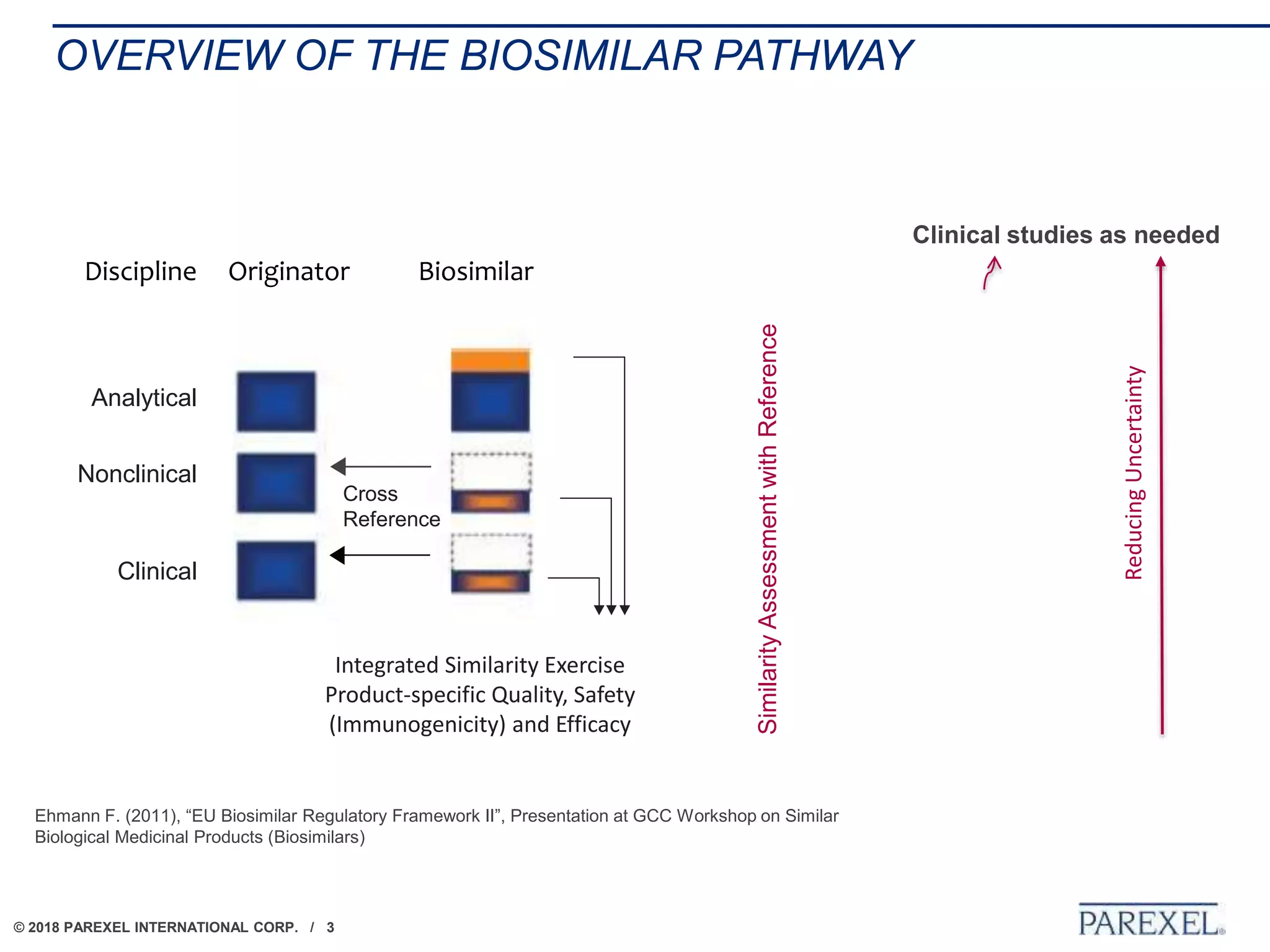
OVERVIEW OF THE BIOSIMILAR PATHWAY
Clinical studies as needed
SimilarityAssessmentwithReference
ReducingUncertainty
Discipline Originator Biosimilar
Integrated Similarity Exercise
Product-specific Quality, Safety
(Immunogenicity) and Efficacy
Cross
Reference
Ehmann F. (2011), “EU Biosimilar Regulatory Framework II”, Presentation at GCC Workshop on Similar
Biological Medicinal Products (Biosimilars)
Analytical
Nonclinical
Clinical
© 2018 PAREXEL INTERNATIONAL CORP. / 4
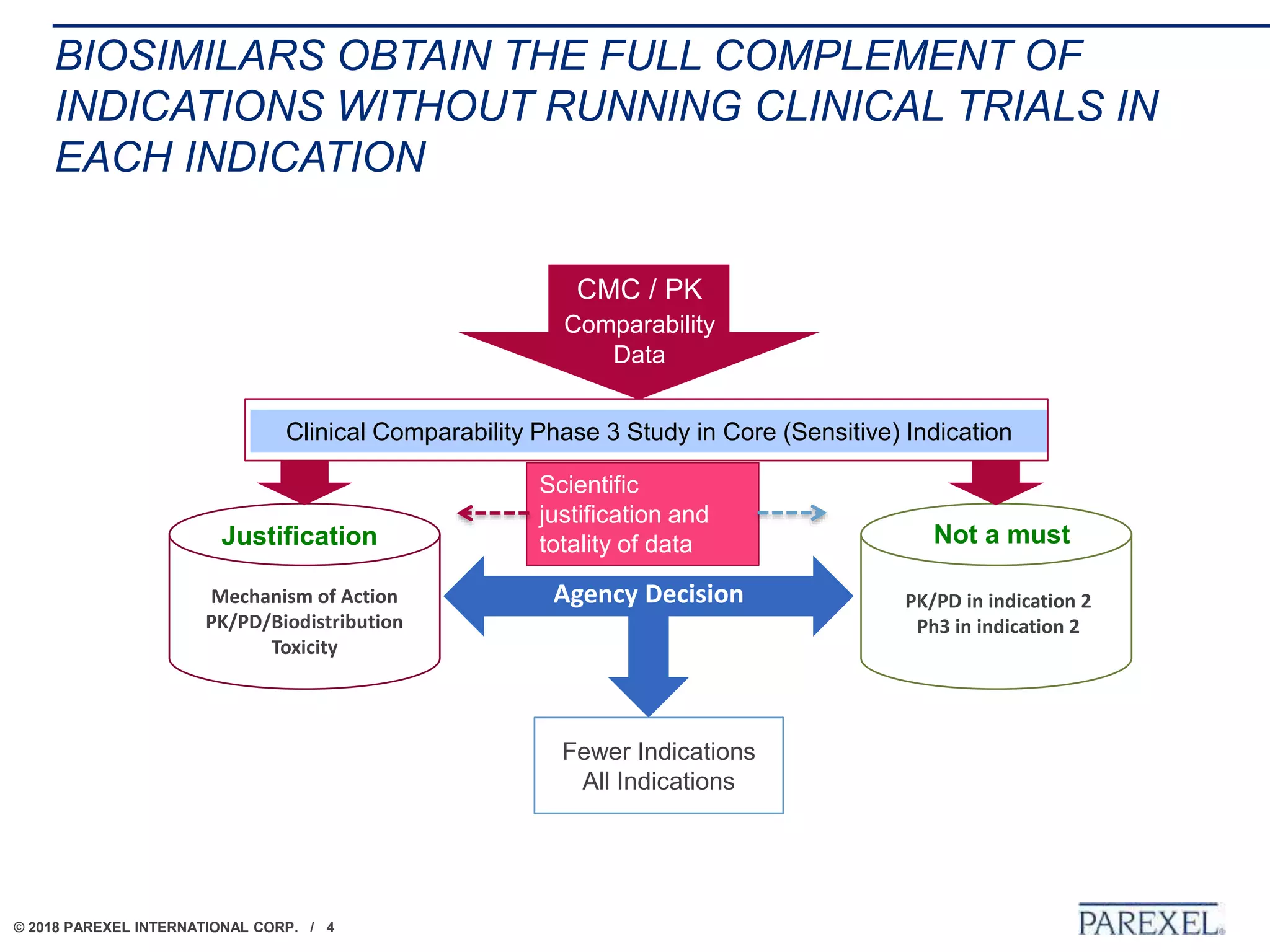
BIOSIMILARS OBTAIN THE FULL COMPLEMENT OF
INDICATIONS WITHOUT RUNNING CLINICAL TRIALS IN
EACH INDICATION
PK/PD in indication 2
Ph3 in indication 2
Mechanism of Action
PK/PD/Biodistribution
Toxicity
CMC / PK
Comparability
Data
Fewer Indications
All Indications
Clinical Comparability Phase 3 Study in Core (Sensitive) Indication
Agency Decision
Scientific
justification and
totality of data Not a mustJustification
© 2018 PAREXEL INTERNATIONAL CORP. / 5
FDA APPROVED BIOSIMILARS SO FAR
Drug Name Approval Date
Zarxio
(Filgrastim-sndz)
March 2015
Inflectra
(Infliximab-dyyb)
April 2016
Erelzi
(Etanercept-szzs)
August 2016
Amjevita
(Adalimumab -atta)
September 2016
Renflexis
(Infliximab-abda)
May 2017
Cyltezo
(Adalimumab-adbm)
August 2017
Mvasi
(Bevacizumab-awwb)
September 2017
Ogivri
(trastuzumab-dkst)
December 2017
© 2018 PAREXEL INTERNATIONAL CORP. / 6
TAIPEI, TAIWAN
POST APPROVAL
CHALLENGES
MANUFACTURING
CHANGES
© 2018 PAREXEL INTERNATIONAL CORP. / 7
POST-APPROVAL COMPARABILITY EXPECTATIONS
ACROSS JURISDICTIONS
Once approved, the biosimilar will have its own
lifecycle following ICHQ5E for comparability exercise
for any changes to manufacturing process. There is
no regulatory requirement for re-demonstration of
biosimilarity.
Once a Notice of Compliance (NOC) is issued for a
Subsequent Entry Biologic (SEB), it is considered to
be a stand-alone product and regulated accordingly. It
is not required to re-establish its similarity to its
reference biologic drug product.
No specific reference to biosimilar post-approval
comparability expectations in the guidance
documents.
© 2018 PAREXEL INTERNATIONAL CORP. / 8
CHALLENGES AND
UNCERTAINTIES REMAIN
WITH POST-APPROVAL
CHANGES OF A
BIOSIMILAR
• Reference product profile will
continue to change over time
even after biosimilar product
is approved
• Biosimilar process change
post-approval is inevitable
• Hence biosimilar process
can not be locked into a
particular process at the time
of approval, however, the
questions is:
How will you manage a process drift?
© 2018 PAREXEL INTERNATIONAL CORP. / 9
CHALLENGES AND UNCERTAINTIES REMAIN WITH
POST-APPROVAL CHANGES OF A BIOSIMILAR
• Comparability protocol supports post-approval manufacturing changes to ensure
that the quality attribute ranges remain consistent with those of the biosimilar’s
non-clinical and clinical experience including the analytical similarity that
supported approval in the first place
• Hallmark of a biosimilar development is paucity of nonclinical and clinical assessment
with heavy anchoring to the reference product
• Therefore, the reality is that biosimilar product is restricted to the reference product
quality range, manufacturing experience and clinical relevance.
• The need for and the extent of a comparability exercise depends on the potential
impact of the change(s) on the quality, safety and efficacy of the product, i.e. risk
assessment
• Categorization of change? Is there any need for further clinical assessment?
• Potential for quality drift in terms of impurity profile and/or better delivery /
presentation – can lead to a different, unintended target product profile
• How to deal with post-approval process changes for interchangeable biosimilars:
FDA Guidances are silent on this.
© 2018 PAREXEL INTERNATIONAL CORP. / 10
DUBLIN, IRELAND
POST-APPROVAL
CHALLENGES
INTERCHANGEABILITY
© 2018 PAREXEL INTERNATIONAL CORP. / 11
DEFINITIONS: SWITCHING, INTERCHANGEABILITY AND
AUTOMATIC SUBSTITUTION
Switching
− Decision to change therapy (when motivated by economic concerns, may be deemed
“non-medical switching”)
Interchangeability (note: definition may depend on jurisdiction)
− Health or regulatory authority designation that products are equivalent
− Primarily a US standard
− The EMA’s evaluation does not include recommendations on interchangeability
Substitution – Pharmacist Action
− When a pharmacist substitutes a certain prescribed product by another
equivalent product
− Qualified as “automatic” or “involuntary” substitution without prescribing physician’s
involvement
© 2018 PAREXEL INTERNATIONAL CORP. / 12
REGULATORS GENERALLY RECOGNIZE UNIQUE IMPACT THAT ALTERNATING
BIOLOGIC THERAPIES CAN HAVE ON PATIENTS
12©2015 NIBRT AbbVie | Biosimilars are not generics: Important considerations fueling the regulatory debate
US3
“Prior exposure to a therapeutic protein product or to
a structurally similar protein may lead to pre-existing
antibodies at baseline.
Canada1
“Repeated switches between
biosimilars and originator products may
increase immunogenicity with
potentially negative effects.”
WHO5
Generics “can be shown to be bioequivalent and may often be substituted for one another at the
point of dispensing. Because of their structural complexity, the complexity of their manufacturing
processes using living organisms, the greater difficulties in achieving consistency of manufactured
batches and the often complex long-term effects of their administration to a patient,
bioequivalence cannot be easily established for a product containing a biological substance. For
those reasons, many regulatory systems take a different approach between similar
biotherapeutics and generic chemical medicines.”
Japan4
“It is vital to assure the traceability
of adverse events during the
respective surveillance period,. . .
their substitution or combined
application should in principle be
avoided throughout the treatment
period.”
EMA2
“Patient-related factors, which might influence the
immune response to a therapeutic protein, include . . .
pre-existing antibodies (protein therapeutic -reactive
antibodies) due to previous exposure to the product or
products containing substances with structural
similarity”
© 2018 PAREXEL INTERNATIONAL CORP. / 13
SPECIFIC GUIDANCE ON INTERCHANGEABILITY OF
BIOSIMILARS VARIES
• U.S. remains sole regulatory agency that has explicitly additional standard for
interchangeability
• Biosimilar will be deemed interchangeable (and therefore eligible for automatic
substitution at the pharmacy) if the product:
- Is biosimilar to the reference product; and
- Can be expected to produce the same clinical result as the reference
product in any given patient; and
- For a biological product that is administered more than once to an individual,
the risk in terms of safety or diminished efficacy of alternating or switching
between use of the biological product and the reference product is not greater
than the risk of using the reference product without such alternation or switch.
• No interchangeability guidance or determinations to date
© 2018 PAREXEL INTERNATIONAL CORP. / 14
IN EUROPE, DECISIONS REGARDING INTERCHANGEABILITY AND SWITCHING
ARE LEFT TO MEMBER STATES AND APPROACHES VARY
14©2015 NIBRT AbbVie | Biosimilars are not generics: Important considerations fueling the regulatory debate
UK
Recommends that biologic
prescriptions be written by
brand name in order to
“ensure that automatic
substitution of a biosimilar
product does not occur
when the medicine is
dispensed by the
pharmacist.”2
Germany
“[A]ny decision needs to be based on
scientific data, in particular data supporting a
high degree of comparability of the biosimilar
and its originator product and the scientific
plausibility of all data referred to in the
discussion process.”3
Norway
Automatic substitution currently
not allowed; government
sponsored “NOR-SWITCH” study
is ongoing; may be used to
support automatic substitution in
the future.
Ireland
“It is not recommended that
patients switch back and
forth between a biosimilar
and reference medicine, as
at the current time the
availability of data on the
impact of this are limited.”1
1. Ireland Health Products Regulatory Agency, Guide to Biosimilars for Healthcare Professionals and Patients, 14 October 2015. , 2. MHRA, Drug Safety Update:
Biosimilar products (February 2008), https://www.gov.uk/drug-safety-update/biosimilar-products. , 3. Paul Ehrlich Institute's position on the interchangeability of
biosimilars.
© 2018 PAREXEL INTERNATIONAL CORP. / 15
AUSTRALIA BECAME FIRST MAJOR REGULATORY JURISDICTION TO
CONSIDER AUTOMATIC SUBSTITUTION FOR BIOSIMILARS
15©2015 NIBRT AbbVie | Biosimilars are not generics: Important considerations fueling the regulatory debate
• Australia’s Reimbursement Authority, Pharmaceutical Benefits Advisory
Committee (PBAC) has recommended that biosimilars are suitable for
substitution at the pharmacy level, otherwise known as “A flagging”.
• However, physicians would retain ability to keep patient on current therapy
(by indicating that substitution is not authorized), hence not a case of
automatic substitution but a pharmacy-level substitution by default
• PBAC will only consider “a-flagging if there is:
− Absence of data to suggest significant differences in clinical effectiveness or safety
compared with the originator
− Absence of identified populations where the risks of using the biosimilar are
disproportionately high
− Availability of data to support switching between the originator and the biosimilar
(one-way transitioning)
− Availability of data for treatment-naïve patients initiating on the biosimilar
− Whether the Therapeutic Goods Administration (TGA) has deemed a product to be
biosimilar with the originator biological.
© 2018 PAREXEL INTERNATIONAL CORP. / 16
TOKYO, JAPAN
POST-APPROVAL
CHALLENGES
INTRODUCING INNOVATION
TO BIOSIMILARS
© 2018 PAREXEL INTERNATIONAL CORP. / 17
BIOSIMILAR PRODUCT
INNOVATION POST-
APPROVAL:
INTRODUCTION OF A NEW
AUTOINJECTOR
• Will be reviewed under a
supplement for the approved
351(k) BLA application
• CDRH evaluation of the device
• Human Factors Study – use-related
hazards evaluation
• Design verification, controls and
performance
• PK bridging study in a range
of BWs
• In-use study in target
population may be needed
© 2018 PAREXEL INTERNATIONAL CORP. / 18
BIOSIMILAR PRODUCT INNOVATION POST-APPROVAL:
INTRODUCTION OF A NEW ROUTE OF ADMINISTRATION
As an example, seeking approval of a SC formulation (new route) when
the reference and the biosimilar are both IV products
• Development under BLA 351(a) pathway and not under a supplement to the
existing Biosimilar, 351(k) BLA
- Stand-alone application and must contain all required data and information necessary to
demonstrate the safety, purity, and potency of the proposed biological product for each of
its proposed indications.
- Expected to include full reports of investigations of safety, purity, and potency, and may
not rely on FDA’s finding of safety, purity, and potency for another approved biological
product or literature-based summaries to fulfill a requirement for licensure
• Need separate INDs for separate indications for which licensure is sought
• Cross-referencing clinical comparability data that supported a demonstration of
biosimilarity to the reference product from the existing 351(k) BLA would only be
considered, if adequately justified, as a comparison to an active control
© 2018 PAREXEL INTERNATIONAL CORP. / 19
BIOSIMILAR PRODUCT
INNOVATION POST-
APPROVAL:
INTRODUCTION OF A
NEW ROUTE OF
ADMINISTRATION
• A single Phase 3 may be justified based
on how much safety and efficacy data
from IV can be relied upon
• Strategically, better to target the
indication for which the core comparability
study was conducted as part of Biosimilar
approval
Get the dose and regimen right
• Phase 2 (PK/PD) study to explore
dose, safety and efficacy
• Study design considerations – non-
inferiority, cross-over, dose cohorts?
• Flat vs. BW (or BSA) - based dosing
• PK/PD modeling
• Safety/Tolerability: Hypersensitivity,
local cutaneous reactions and AESI
© 2018 PAREXEL INTERNATIONAL CORP. / 20
BOSTON, MASSACHUSETTS
POST-APPROVAL
CHALLENGES
BIOSIMILAR LABELS
© 2018 PAREXEL INTERNATIONAL CORP. / 21
FDA’S NEW NON-PROPRIETARY NAMING GUIDANCE
• Draft Guidance finalized on January 2017
• Both newly licensed as well as previously
licensed biological products
• Use of proper name: core name plus a
‘four lower case letter’ suffix
e.g. infliximab-dyyb
• Open questions:
- Random, meaningless suffix?
- Interchangeable products will share
same suffix as reference product?
• Two main justifications for distinguishable
non-proprietary names:
1. Prevent inadvertent substitution
2. Facilitating pharmacovigilance
© 2018 PAREXEL INTERNATIONAL CORP. / 22
BIOSIMILAR LABELLING CAN BE DIFFERENT FROM REFERENCE: AN
EXAMPLE OF LABEL CURVE-OUT
• FDA deleted two indications based on sponsor request driven by patent issues
• FDA felt that it is necessary to retain some safety data related to the deleted indications
• Deleted indication(s) referred to as “another indication” in the label
• Similar approach taken for Inflectra labeling w.r.t. orphan-protected pediatric UC
© 2018 PAREXEL INTERNATIONAL CORP. / 23
CONCLUDING
REMARKS • Many post-approval challenges
remain and need multi-disciplinary
collaborative solution
• Biosimilars product quality mimics
reference product for approval,
however, they become a stand-
alone product after approval
• FDA Guidance largely silent on
product quality expectations for an
interchangeable biosimilar through
its lifecycle
• The regulatory burden of post-
approval innovation for a biosimilar
is yet to be well defined
© 2018 PAREXEL INTERNATIONAL CORP. / 24
THANK YOU
© 2017 PAREXEL INTERNATIONAL CORP. / 24

Life of a Biosimilar

  • 1.
    © 2018 PAREXELINTERNATIONAL CORP. LIFE OF A BIOSIMILAR PARTHA ROY, Ph.D. Vice President, Technical PAREXEL International 2018
  • 2.
    © 2018 PAREXELINTERNATIONAL CORP. / 2 WELCOME • Overview of the 351(k) Pathway and FDA Approvals • Managing Post-Approval Challenges − Manufacturing Changes − Interchangeability − Introducing innovation to Biosimilar Product − A recent example of Biosimilar Label Curve-Outs • Conclusions AGENDA
  • 3.
    © 2018 PAREXELINTERNATIONAL CORP. / 3 OVERVIEW OF THE BIOSIMILAR PATHWAY Clinical studies as needed SimilarityAssessmentwithReference ReducingUncertainty Discipline Originator Biosimilar Integrated Similarity Exercise Product-specific Quality, Safety (Immunogenicity) and Efficacy Cross Reference Ehmann F. (2011), “EU Biosimilar Regulatory Framework II”, Presentation at GCC Workshop on Similar Biological Medicinal Products (Biosimilars) Analytical Nonclinical Clinical
  • 4.
    © 2018 PAREXELINTERNATIONAL CORP. / 4 BIOSIMILARS OBTAIN THE FULL COMPLEMENT OF INDICATIONS WITHOUT RUNNING CLINICAL TRIALS IN EACH INDICATION PK/PD in indication 2 Ph3 in indication 2 Mechanism of Action PK/PD/Biodistribution Toxicity CMC / PK Comparability Data Fewer Indications All Indications Clinical Comparability Phase 3 Study in Core (Sensitive) Indication Agency Decision Scientific justification and totality of data Not a mustJustification
  • 5.
    © 2018 PAREXELINTERNATIONAL CORP. / 5 FDA APPROVED BIOSIMILARS SO FAR Drug Name Approval Date Zarxio (Filgrastim-sndz) March 2015 Inflectra (Infliximab-dyyb) April 2016 Erelzi (Etanercept-szzs) August 2016 Amjevita (Adalimumab -atta) September 2016 Renflexis (Infliximab-abda) May 2017 Cyltezo (Adalimumab-adbm) August 2017 Mvasi (Bevacizumab-awwb) September 2017 Ogivri (trastuzumab-dkst) December 2017
  • 6.
    © 2018 PAREXELINTERNATIONAL CORP. / 6 TAIPEI, TAIWAN POST APPROVAL CHALLENGES MANUFACTURING CHANGES
  • 7.
    © 2018 PAREXELINTERNATIONAL CORP. / 7 POST-APPROVAL COMPARABILITY EXPECTATIONS ACROSS JURISDICTIONS Once approved, the biosimilar will have its own lifecycle following ICHQ5E for comparability exercise for any changes to manufacturing process. There is no regulatory requirement for re-demonstration of biosimilarity. Once a Notice of Compliance (NOC) is issued for a Subsequent Entry Biologic (SEB), it is considered to be a stand-alone product and regulated accordingly. It is not required to re-establish its similarity to its reference biologic drug product. No specific reference to biosimilar post-approval comparability expectations in the guidance documents.
  • 8.
    © 2018 PAREXELINTERNATIONAL CORP. / 8 CHALLENGES AND UNCERTAINTIES REMAIN WITH POST-APPROVAL CHANGES OF A BIOSIMILAR • Reference product profile will continue to change over time even after biosimilar product is approved • Biosimilar process change post-approval is inevitable • Hence biosimilar process can not be locked into a particular process at the time of approval, however, the questions is: How will you manage a process drift?
  • 9.
    © 2018 PAREXELINTERNATIONAL CORP. / 9 CHALLENGES AND UNCERTAINTIES REMAIN WITH POST-APPROVAL CHANGES OF A BIOSIMILAR • Comparability protocol supports post-approval manufacturing changes to ensure that the quality attribute ranges remain consistent with those of the biosimilar’s non-clinical and clinical experience including the analytical similarity that supported approval in the first place • Hallmark of a biosimilar development is paucity of nonclinical and clinical assessment with heavy anchoring to the reference product • Therefore, the reality is that biosimilar product is restricted to the reference product quality range, manufacturing experience and clinical relevance. • The need for and the extent of a comparability exercise depends on the potential impact of the change(s) on the quality, safety and efficacy of the product, i.e. risk assessment • Categorization of change? Is there any need for further clinical assessment? • Potential for quality drift in terms of impurity profile and/or better delivery / presentation – can lead to a different, unintended target product profile • How to deal with post-approval process changes for interchangeable biosimilars: FDA Guidances are silent on this.
  • 10.
    © 2018 PAREXELINTERNATIONAL CORP. / 10 DUBLIN, IRELAND POST-APPROVAL CHALLENGES INTERCHANGEABILITY
  • 11.
    © 2018 PAREXELINTERNATIONAL CORP. / 11 DEFINITIONS: SWITCHING, INTERCHANGEABILITY AND AUTOMATIC SUBSTITUTION Switching − Decision to change therapy (when motivated by economic concerns, may be deemed “non-medical switching”) Interchangeability (note: definition may depend on jurisdiction) − Health or regulatory authority designation that products are equivalent − Primarily a US standard − The EMA’s evaluation does not include recommendations on interchangeability Substitution – Pharmacist Action − When a pharmacist substitutes a certain prescribed product by another equivalent product − Qualified as “automatic” or “involuntary” substitution without prescribing physician’s involvement
  • 12.
    © 2018 PAREXELINTERNATIONAL CORP. / 12 REGULATORS GENERALLY RECOGNIZE UNIQUE IMPACT THAT ALTERNATING BIOLOGIC THERAPIES CAN HAVE ON PATIENTS 12©2015 NIBRT AbbVie | Biosimilars are not generics: Important considerations fueling the regulatory debate US3 “Prior exposure to a therapeutic protein product or to a structurally similar protein may lead to pre-existing antibodies at baseline. Canada1 “Repeated switches between biosimilars and originator products may increase immunogenicity with potentially negative effects.” WHO5 Generics “can be shown to be bioequivalent and may often be substituted for one another at the point of dispensing. Because of their structural complexity, the complexity of their manufacturing processes using living organisms, the greater difficulties in achieving consistency of manufactured batches and the often complex long-term effects of their administration to a patient, bioequivalence cannot be easily established for a product containing a biological substance. For those reasons, many regulatory systems take a different approach between similar biotherapeutics and generic chemical medicines.” Japan4 “It is vital to assure the traceability of adverse events during the respective surveillance period,. . . their substitution or combined application should in principle be avoided throughout the treatment period.” EMA2 “Patient-related factors, which might influence the immune response to a therapeutic protein, include . . . pre-existing antibodies (protein therapeutic -reactive antibodies) due to previous exposure to the product or products containing substances with structural similarity”
  • 13.
    © 2018 PAREXELINTERNATIONAL CORP. / 13 SPECIFIC GUIDANCE ON INTERCHANGEABILITY OF BIOSIMILARS VARIES • U.S. remains sole regulatory agency that has explicitly additional standard for interchangeability • Biosimilar will be deemed interchangeable (and therefore eligible for automatic substitution at the pharmacy) if the product: - Is biosimilar to the reference product; and - Can be expected to produce the same clinical result as the reference product in any given patient; and - For a biological product that is administered more than once to an individual, the risk in terms of safety or diminished efficacy of alternating or switching between use of the biological product and the reference product is not greater than the risk of using the reference product without such alternation or switch. • No interchangeability guidance or determinations to date
  • 14.
    © 2018 PAREXELINTERNATIONAL CORP. / 14 IN EUROPE, DECISIONS REGARDING INTERCHANGEABILITY AND SWITCHING ARE LEFT TO MEMBER STATES AND APPROACHES VARY 14©2015 NIBRT AbbVie | Biosimilars are not generics: Important considerations fueling the regulatory debate UK Recommends that biologic prescriptions be written by brand name in order to “ensure that automatic substitution of a biosimilar product does not occur when the medicine is dispensed by the pharmacist.”2 Germany “[A]ny decision needs to be based on scientific data, in particular data supporting a high degree of comparability of the biosimilar and its originator product and the scientific plausibility of all data referred to in the discussion process.”3 Norway Automatic substitution currently not allowed; government sponsored “NOR-SWITCH” study is ongoing; may be used to support automatic substitution in the future. Ireland “It is not recommended that patients switch back and forth between a biosimilar and reference medicine, as at the current time the availability of data on the impact of this are limited.”1 1. Ireland Health Products Regulatory Agency, Guide to Biosimilars for Healthcare Professionals and Patients, 14 October 2015. , 2. MHRA, Drug Safety Update: Biosimilar products (February 2008), https://www.gov.uk/drug-safety-update/biosimilar-products. , 3. Paul Ehrlich Institute's position on the interchangeability of biosimilars.
  • 15.
    © 2018 PAREXELINTERNATIONAL CORP. / 15 AUSTRALIA BECAME FIRST MAJOR REGULATORY JURISDICTION TO CONSIDER AUTOMATIC SUBSTITUTION FOR BIOSIMILARS 15©2015 NIBRT AbbVie | Biosimilars are not generics: Important considerations fueling the regulatory debate • Australia’s Reimbursement Authority, Pharmaceutical Benefits Advisory Committee (PBAC) has recommended that biosimilars are suitable for substitution at the pharmacy level, otherwise known as “A flagging”. • However, physicians would retain ability to keep patient on current therapy (by indicating that substitution is not authorized), hence not a case of automatic substitution but a pharmacy-level substitution by default • PBAC will only consider “a-flagging if there is: − Absence of data to suggest significant differences in clinical effectiveness or safety compared with the originator − Absence of identified populations where the risks of using the biosimilar are disproportionately high − Availability of data to support switching between the originator and the biosimilar (one-way transitioning) − Availability of data for treatment-naïve patients initiating on the biosimilar − Whether the Therapeutic Goods Administration (TGA) has deemed a product to be biosimilar with the originator biological.
  • 16.
    © 2018 PAREXELINTERNATIONAL CORP. / 16 TOKYO, JAPAN POST-APPROVAL CHALLENGES INTRODUCING INNOVATION TO BIOSIMILARS
  • 17.
    © 2018 PAREXELINTERNATIONAL CORP. / 17 BIOSIMILAR PRODUCT INNOVATION POST- APPROVAL: INTRODUCTION OF A NEW AUTOINJECTOR • Will be reviewed under a supplement for the approved 351(k) BLA application • CDRH evaluation of the device • Human Factors Study – use-related hazards evaluation • Design verification, controls and performance • PK bridging study in a range of BWs • In-use study in target population may be needed
  • 18.
    © 2018 PAREXELINTERNATIONAL CORP. / 18 BIOSIMILAR PRODUCT INNOVATION POST-APPROVAL: INTRODUCTION OF A NEW ROUTE OF ADMINISTRATION As an example, seeking approval of a SC formulation (new route) when the reference and the biosimilar are both IV products • Development under BLA 351(a) pathway and not under a supplement to the existing Biosimilar, 351(k) BLA - Stand-alone application and must contain all required data and information necessary to demonstrate the safety, purity, and potency of the proposed biological product for each of its proposed indications. - Expected to include full reports of investigations of safety, purity, and potency, and may not rely on FDA’s finding of safety, purity, and potency for another approved biological product or literature-based summaries to fulfill a requirement for licensure • Need separate INDs for separate indications for which licensure is sought • Cross-referencing clinical comparability data that supported a demonstration of biosimilarity to the reference product from the existing 351(k) BLA would only be considered, if adequately justified, as a comparison to an active control
  • 19.
    © 2018 PAREXELINTERNATIONAL CORP. / 19 BIOSIMILAR PRODUCT INNOVATION POST- APPROVAL: INTRODUCTION OF A NEW ROUTE OF ADMINISTRATION • A single Phase 3 may be justified based on how much safety and efficacy data from IV can be relied upon • Strategically, better to target the indication for which the core comparability study was conducted as part of Biosimilar approval Get the dose and regimen right • Phase 2 (PK/PD) study to explore dose, safety and efficacy • Study design considerations – non- inferiority, cross-over, dose cohorts? • Flat vs. BW (or BSA) - based dosing • PK/PD modeling • Safety/Tolerability: Hypersensitivity, local cutaneous reactions and AESI
  • 20.
    © 2018 PAREXELINTERNATIONAL CORP. / 20 BOSTON, MASSACHUSETTS POST-APPROVAL CHALLENGES BIOSIMILAR LABELS
  • 21.
    © 2018 PAREXELINTERNATIONAL CORP. / 21 FDA’S NEW NON-PROPRIETARY NAMING GUIDANCE • Draft Guidance finalized on January 2017 • Both newly licensed as well as previously licensed biological products • Use of proper name: core name plus a ‘four lower case letter’ suffix e.g. infliximab-dyyb • Open questions: - Random, meaningless suffix? - Interchangeable products will share same suffix as reference product? • Two main justifications for distinguishable non-proprietary names: 1. Prevent inadvertent substitution 2. Facilitating pharmacovigilance
  • 22.
    © 2018 PAREXELINTERNATIONAL CORP. / 22 BIOSIMILAR LABELLING CAN BE DIFFERENT FROM REFERENCE: AN EXAMPLE OF LABEL CURVE-OUT • FDA deleted two indications based on sponsor request driven by patent issues • FDA felt that it is necessary to retain some safety data related to the deleted indications • Deleted indication(s) referred to as “another indication” in the label • Similar approach taken for Inflectra labeling w.r.t. orphan-protected pediatric UC
  • 23.
    © 2018 PAREXELINTERNATIONAL CORP. / 23 CONCLUDING REMARKS • Many post-approval challenges remain and need multi-disciplinary collaborative solution • Biosimilars product quality mimics reference product for approval, however, they become a stand- alone product after approval • FDA Guidance largely silent on product quality expectations for an interchangeable biosimilar through its lifecycle • The regulatory burden of post- approval innovation for a biosimilar is yet to be well defined
  • 24.
    © 2018 PAREXELINTERNATIONAL CORP. / 24 THANK YOU © 2017 PAREXEL INTERNATIONAL CORP. / 24

Editor's Notes

  • #13 1. Scott, B. et al., “Biosimilar Monoclonal Antibodies: A Canadian Regulatory Perspective on the Assessment of Clinically Relevant Differences and Indication Extrapolation.” J Clin Pharmacol. 2015 Mar;55 Suppl 3:S123-32. 2. European Medicines Agency, Draft Guideline on Immunogenicity assessment of 6 biotechnology-derived therapeutic proteins, 24 September 2015, 1 EMEA/CHMP/BMWP/14327/2006 Rev. 1. 3. FDA, Guidance for Industry: Immunogenicity Assessment for Therapeutic Protein Products (August 2014). 4. PMDA, Guidelines for the Quality, Safety and Efficacy Assurance of Follow-on Biologics,” English Translation (PFSB/ELD No.0304007) by PhRMA. 5. World Health Organization, Guidelines of Evaluation of Similar Biotherapeutic Products (SBPs) (2009).
  • #15 1. Ireland Health Products Regulatory Agency, Guide to Biosimilars for Healthcare Professionals and Patients, 14 October 2015. 2. MHRA, Drug Safety Update: Biosimilar products (February 2008), https://www.gov.uk/drug-safety-update/biosimilar-products. 3. Paul Ehrlich Institute's position on the interchangeability of biosimilars.