Trends in Agile Testing Code Chef Talks 2009 Lisa Crispin With Material from Janet Gregory
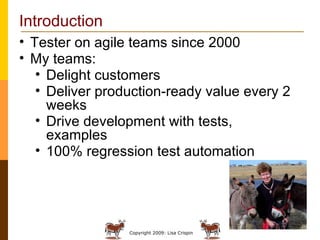
Introduction  Tester on agile teams since 2000 My teams: Delight customers Deliver production-ready value every 2 weeks Drive development with tests, examples 100% regression test automation
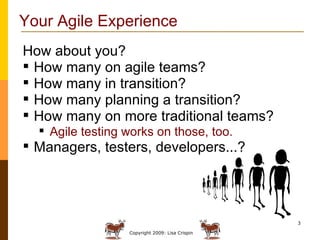
Your Agile Experience How about you? How many on agile teams? How many in transition? How many planning a transition? How many on more traditional teams? Agile testing works on those, too. Managers, testers, developers...?
Takeaways Transitions in testing How testing works on agile teams Agile testing tools and techniques What it means for us
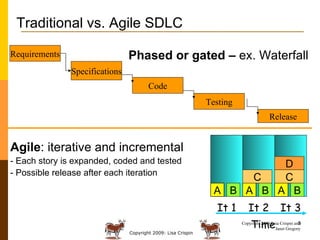
Traditional vs. Agile SDLC Phased or gated –  ex. Waterfall It 1 It 2 It 3 A B A B A B C C D Time Agile : iterative and incremental - Each story is expanded, coded and tested - Possible release after each iteration Requirements Specifications Code Testing Release Copyright 2009 Lisa Crispin and Janet Gregory
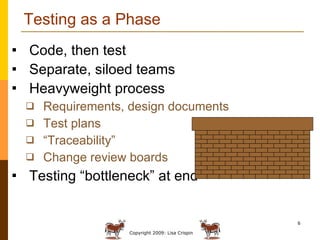
Testing as a Phase Code, then test Separate, siloed teams Heavyweight process Requirements, design documents Test plans “ Traceability” Change review boards Testing “bottleneck” at end
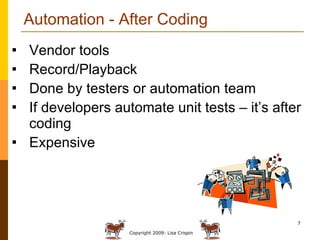
Automation - After Coding Vendor tools Record/Playback Done by testers or automation team If developers automate unit tests – it’s after coding Expensive
Exploratory Testing – “agile”  Simultaneous learning, test design, test execution [source: James Bach] Aka “Context-Driven” Critical thinking, no requirements doc needed Diverse ideas Rich resources Tools, data, people [source: Jon Hagar]
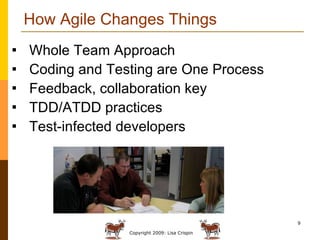
How Agile Changes Things Whole Team Approach Coding and Testing are One Process Feedback, collaboration key TDD/ATDD practices Test-infected developers
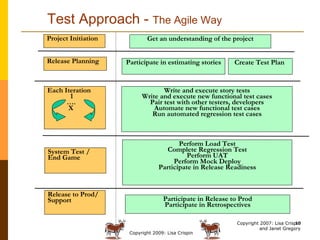
Test Approach -  The Agile Way Copyright 2007: Lisa Crispin and Janet Gregory Project Initiation Get an understanding of the project Participate in estimating stories  Create Test Plan  Release Planning Each Iteration 1  … . X Write and execute story tests Write and execute new functional test cases Pair test with other testers, developers Automate new functional test cases Run automated regression test cases Perform Load Test Complete Regression Test Perform UAT Perform Mock Deploy Participate in Release Readiness System Test / End Game Participate in Release to Prod Participate in Retrospectives Release to Prod/ Support
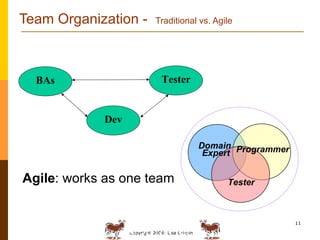
Team Organization -  Traditional vs. Agile Agile : works as one team Copyright 2007: Lisa Crispin and Janet Gregory Traditional : independent functional groups Dev BAs Tester Tester Programmer Domain   Expert
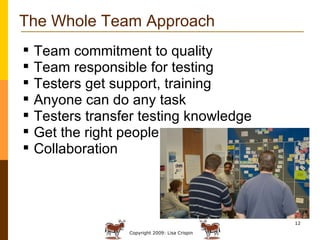
The Whole Team Approach Team commitment to quality Team responsible for testing Testers get support, training Anyone can do any task Testers transfer testing knowledge Get the right people Collaboration
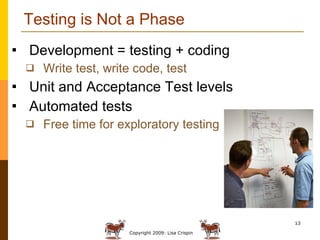
Testing is Not a Phase Development = testing + coding Write test, write code, test Unit and Acceptance Test levels Automated tests Free time for exploratory testing
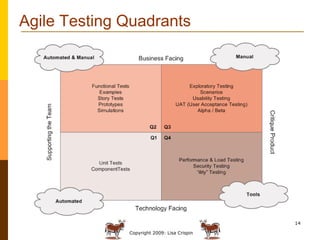
Agile Testing Quadrants
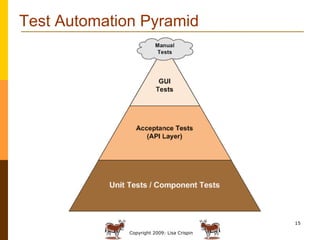
Test Automation Pyramid
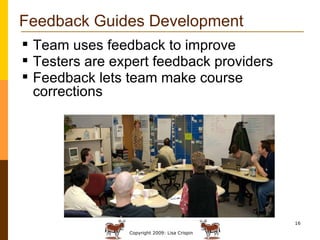
Feedback Guides Development Team uses feedback to improve Testers are expert feedback providers Feedback lets team make course corrections
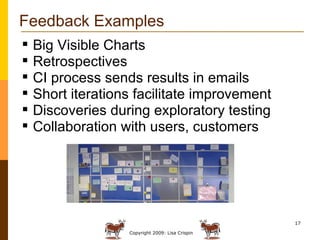
Feedback Examples Big Visible Charts Retrospectives CI process sends results in emails Short iterations facilitate improvement Discoveries during exploratory testing Collaboration with users, customers
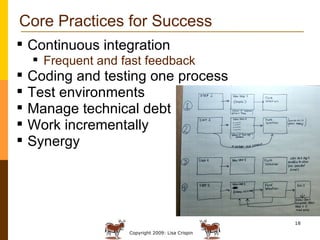
Core Practices for Success Continuous integration Frequent and fast feedback Coding and testing one process Test environments Manage technical debt Work incrementally Synergy
Where Is It Taking Us? Lines between roles blurred More focus on tests to drive coding Examples as requirements Find ways to control technical debt Tests pushed to lower levels Less end-to-end automation
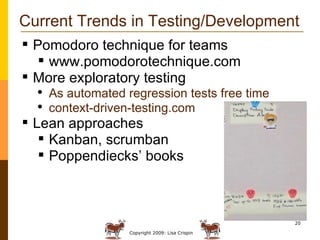
Current Trends in Testing/Development Pomodoro technique for teams www.pomodorotechnique.com More exploratory testing As automated regression tests free time context-driven-testing.com Lean approaches Kanban, scrumban Poppendiecks’ books
More Current Trends Continuous Integration is a given Mix and match frameworks/drivers More low-tech early prototyping More early collaboration Behavior-Driven Development (BDD)
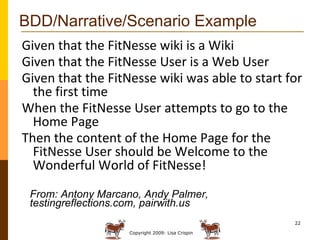
BDD/Narrative/Scenario Example Given that the FitNesse wiki is a Wiki Given that the FitNesse User is a Web User Given that the FitNesse wiki was able to start for the first time When the FitNesse User attempts to go to the Home Page Then the content of the Home Page for the FitNesse User should be Welcome to the Wonderful World of FitNesse! From: Antony Marcano, Andy Palmer, testingreflections.com, pairwith.us
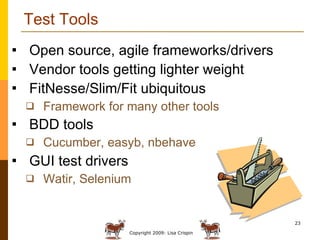
Test Tools Open source, agile frameworks/drivers Vendor tools getting lighter weight FitNesse/Slim/Fit ubiquitous Framework for many other tools BDD tools Cucumber, easyb, nbehave GUI test drivers Watir, Selenium
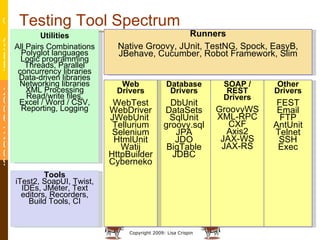
Testing Tool Spectrum Agile2009 -  © ASERT 2006-2009 Database Drivers DbUnit DataSets SqlUnit groovy.sql JPA JDO BigTable JDBC SOAP / REST Drivers GroovyWS XML-RPC CXF Axis2 JAX-WS JAX-RS Utilities All Pairs Combinations Polyglot languages Logic programming Threads, Parallel concurrency libraries Data-driven libraries Networking libraries XML Processing Read/write files, Excel / Word / CSV, Reporting, Logging Other Drivers FEST Email FTP AntUnit Telnet SSH Exec Tools iTest2, SoapUI, Twist, IDEs, JMeter, Text editors, Recorders, Build Tools, CI Web Drivers WebTest WebDriver JWebUnit  Tellurium Selenium HtmlUnit Watij HttpBuilder Cyberneko Runners Native Groovy, JUnit, TestNG, Spock, EasyB, JBehave, Cucumber, Robot Framework, Slim
Testing Techniques Team writes acceptance tests together Programmers and testers pair to automate tests ROI guides automation Testers do exploratory testing Customers participate Pair with customers for ET Frequent demos
Trends in Test Automation Record/Playback as “trainer”, debugger Test architecture/design critical Planning and tracking tools – online and low-tech Open source, agile tools explosion Plenty of good browser test drivers Other problems now being solved Scenario, Narrative style
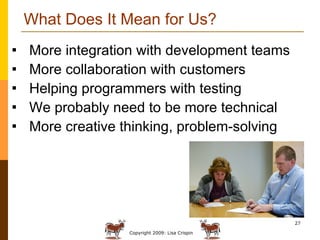
What Does It Mean for Us? More integration with development teams More collaboration with customers Helping programmers with testing We probably need to be more technical More creative thinking, problem-solving
Do Your Best Work Whole Team approach Collaborate with customers, developers Business examples, turned into tests Agile Testing Quadrants Test Automation Pyramid Exploratory testing
The Future is What You Make It Get out of your chair – go talk to programmers and customers Learn a new test framework or scripting language today - build your skills Lots of free resources, just takes time Bring testing problems to the whole team Benefit from multiple skill sets How can your expertise help the team?
Questions?
Some Agile Testing Resources lisacrispin.com janetgregory.ca exampler.com [email_address] testobsessed.com A ntonymarcano.com
Copyright 2008 Janet Gregory, DragonFire Bridging the Communication Gap Specification By Example and Acceptance Testing Gojko Adzic
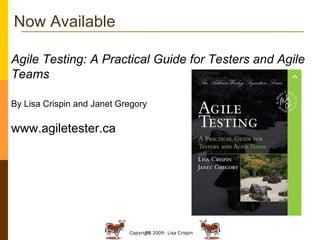
Now Available Agile Testing: A Practical Guide for Testers and Agile Teams By Lisa Crispin and Janet Gregory   www.agiletester.ca

Trends in Agile Testing by Lisa Crispin

  • 1.
    Trends in AgileTesting Code Chef Talks 2009 Lisa Crispin With Material from Janet Gregory
  • 2.
    Introduction Testeron agile teams since 2000 My teams: Delight customers Deliver production-ready value every 2 weeks Drive development with tests, examples 100% regression test automation
  • 3.
    Your Agile ExperienceHow about you? How many on agile teams? How many in transition? How many planning a transition? How many on more traditional teams? Agile testing works on those, too. Managers, testers, developers...?
  • 4.
    Takeaways Transitions intesting How testing works on agile teams Agile testing tools and techniques What it means for us
  • 5.
    Traditional vs. AgileSDLC Phased or gated – ex. Waterfall It 1 It 2 It 3 A B A B A B C C D Time Agile : iterative and incremental - Each story is expanded, coded and tested - Possible release after each iteration Requirements Specifications Code Testing Release Copyright 2009 Lisa Crispin and Janet Gregory
  • 6.
    Testing as aPhase Code, then test Separate, siloed teams Heavyweight process Requirements, design documents Test plans “ Traceability” Change review boards Testing “bottleneck” at end
  • 7.
    Automation - AfterCoding Vendor tools Record/Playback Done by testers or automation team If developers automate unit tests – it’s after coding Expensive
  • 8.
    Exploratory Testing –“agile” Simultaneous learning, test design, test execution [source: James Bach] Aka “Context-Driven” Critical thinking, no requirements doc needed Diverse ideas Rich resources Tools, data, people [source: Jon Hagar]
  • 9.
    How Agile ChangesThings Whole Team Approach Coding and Testing are One Process Feedback, collaboration key TDD/ATDD practices Test-infected developers
  • 10.
    Test Approach - The Agile Way Copyright 2007: Lisa Crispin and Janet Gregory Project Initiation Get an understanding of the project Participate in estimating stories Create Test Plan Release Planning Each Iteration 1 … . X Write and execute story tests Write and execute new functional test cases Pair test with other testers, developers Automate new functional test cases Run automated regression test cases Perform Load Test Complete Regression Test Perform UAT Perform Mock Deploy Participate in Release Readiness System Test / End Game Participate in Release to Prod Participate in Retrospectives Release to Prod/ Support
  • 11.
    Team Organization - Traditional vs. Agile Agile : works as one team Copyright 2007: Lisa Crispin and Janet Gregory Traditional : independent functional groups Dev BAs Tester Tester Programmer Domain Expert
  • 12.
    The Whole TeamApproach Team commitment to quality Team responsible for testing Testers get support, training Anyone can do any task Testers transfer testing knowledge Get the right people Collaboration
  • 13.
    Testing is Nota Phase Development = testing + coding Write test, write code, test Unit and Acceptance Test levels Automated tests Free time for exploratory testing
  • 14.
  • 15.
  • 16.
    Feedback Guides DevelopmentTeam uses feedback to improve Testers are expert feedback providers Feedback lets team make course corrections
  • 17.
    Feedback Examples BigVisible Charts Retrospectives CI process sends results in emails Short iterations facilitate improvement Discoveries during exploratory testing Collaboration with users, customers
  • 18.
    Core Practices forSuccess Continuous integration Frequent and fast feedback Coding and testing one process Test environments Manage technical debt Work incrementally Synergy
  • 19.
    Where Is ItTaking Us? Lines between roles blurred More focus on tests to drive coding Examples as requirements Find ways to control technical debt Tests pushed to lower levels Less end-to-end automation
  • 20.
    Current Trends inTesting/Development Pomodoro technique for teams www.pomodorotechnique.com More exploratory testing As automated regression tests free time context-driven-testing.com Lean approaches Kanban, scrumban Poppendiecks’ books
  • 21.
    More Current TrendsContinuous Integration is a given Mix and match frameworks/drivers More low-tech early prototyping More early collaboration Behavior-Driven Development (BDD)
  • 22.
    BDD/Narrative/Scenario Example Giventhat the FitNesse wiki is a Wiki Given that the FitNesse User is a Web User Given that the FitNesse wiki was able to start for the first time When the FitNesse User attempts to go to the Home Page Then the content of the Home Page for the FitNesse User should be Welcome to the Wonderful World of FitNesse! From: Antony Marcano, Andy Palmer, testingreflections.com, pairwith.us
  • 23.
    Test Tools Opensource, agile frameworks/drivers Vendor tools getting lighter weight FitNesse/Slim/Fit ubiquitous Framework for many other tools BDD tools Cucumber, easyb, nbehave GUI test drivers Watir, Selenium
  • 24.
    Testing Tool SpectrumAgile2009 - © ASERT 2006-2009 Database Drivers DbUnit DataSets SqlUnit groovy.sql JPA JDO BigTable JDBC SOAP / REST Drivers GroovyWS XML-RPC CXF Axis2 JAX-WS JAX-RS Utilities All Pairs Combinations Polyglot languages Logic programming Threads, Parallel concurrency libraries Data-driven libraries Networking libraries XML Processing Read/write files, Excel / Word / CSV, Reporting, Logging Other Drivers FEST Email FTP AntUnit Telnet SSH Exec Tools iTest2, SoapUI, Twist, IDEs, JMeter, Text editors, Recorders, Build Tools, CI Web Drivers WebTest WebDriver JWebUnit Tellurium Selenium HtmlUnit Watij HttpBuilder Cyberneko Runners Native Groovy, JUnit, TestNG, Spock, EasyB, JBehave, Cucumber, Robot Framework, Slim
  • 25.
    Testing Techniques Teamwrites acceptance tests together Programmers and testers pair to automate tests ROI guides automation Testers do exploratory testing Customers participate Pair with customers for ET Frequent demos
  • 26.
    Trends in TestAutomation Record/Playback as “trainer”, debugger Test architecture/design critical Planning and tracking tools – online and low-tech Open source, agile tools explosion Plenty of good browser test drivers Other problems now being solved Scenario, Narrative style
  • 27.
    What Does ItMean for Us? More integration with development teams More collaboration with customers Helping programmers with testing We probably need to be more technical More creative thinking, problem-solving
  • 28.
    Do Your BestWork Whole Team approach Collaborate with customers, developers Business examples, turned into tests Agile Testing Quadrants Test Automation Pyramid Exploratory testing
  • 29.
    The Future isWhat You Make It Get out of your chair – go talk to programmers and customers Learn a new test framework or scripting language today - build your skills Lots of free resources, just takes time Bring testing problems to the whole team Benefit from multiple skill sets How can your expertise help the team?
  • 30.
  • 31.
    Some Agile TestingResources lisacrispin.com janetgregory.ca exampler.com [email_address] testobsessed.com A ntonymarcano.com
  • 32.
    Copyright 2008 JanetGregory, DragonFire Bridging the Communication Gap Specification By Example and Acceptance Testing Gojko Adzic
  • 33.
    Now Available AgileTesting: A Practical Guide for Testers and Agile Teams By Lisa Crispin and Janet Gregory www.agiletester.ca

Editor's Notes

  • #6 When I talk about Agile, I will usually refer to XP or SCRUM because those are the 2 methodologies I am the most familiar with. When I talk about traditional methods, I mean phased or gated methodologies such as waterfall. Phased Approach - waterfall Coding occurs after requirements and specifications are complete Testing occurs after coding is complete Application not delivered until all phases are complete Some problems with waterfall: missing and out of date requirements gaps between what the customer is expecting and what is delivered Agile = Testing occurs on a feature by feature basis Each feature (or story) is delivered incrementally Business value is delivered on a regular basis