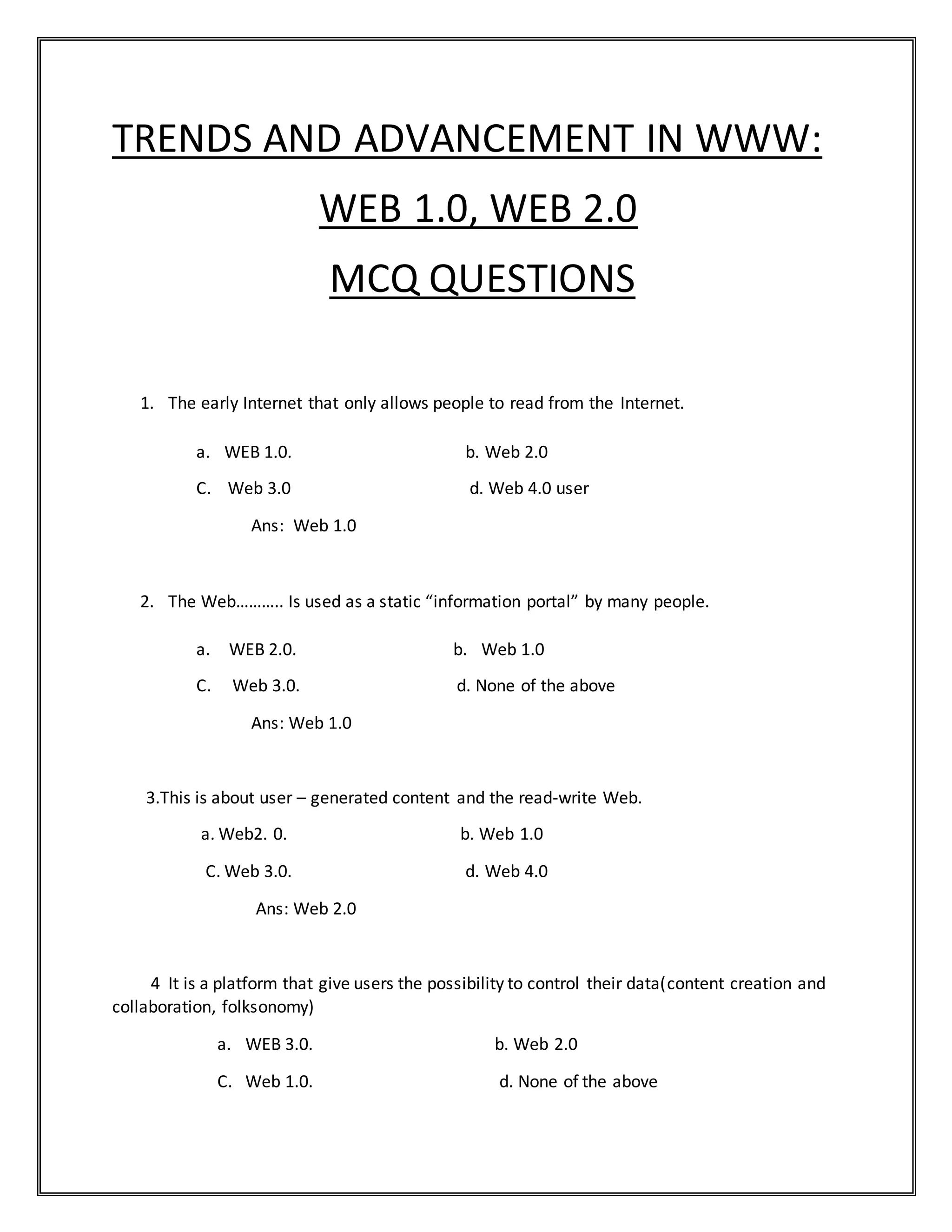
TRENDS AND ADVANCEMENT IN WWW:
WEB 1.0, WEB 2.0
MCQ QUESTIONS
1. The early Internet that only allows people to read from the Internet.
a. WEB 1.0. b. Web 2.0
C. Web 3.0 d. Web 4.0 user
Ans: Web 1.0
2. The Web……….. Is used as a static “information portal” by many people.
a. WEB 2.0. b. Web 1.0
C. Web 3.0. d. None of the above
Ans: Web 1.0
3.This is about user – generated content and the read-write Web.
a. Web2. 0. b. Web 1.0
C. Web 3.0. d. Web 4.0
Ans: Web 2.0
4 It is a platform that give users the possibility to control their data(content creation and
collaboration, folksonomy)
a. WEB 3.0. b. Web 2.0
C. Web 1.0. d. None of the above
Ans: Web 2.0
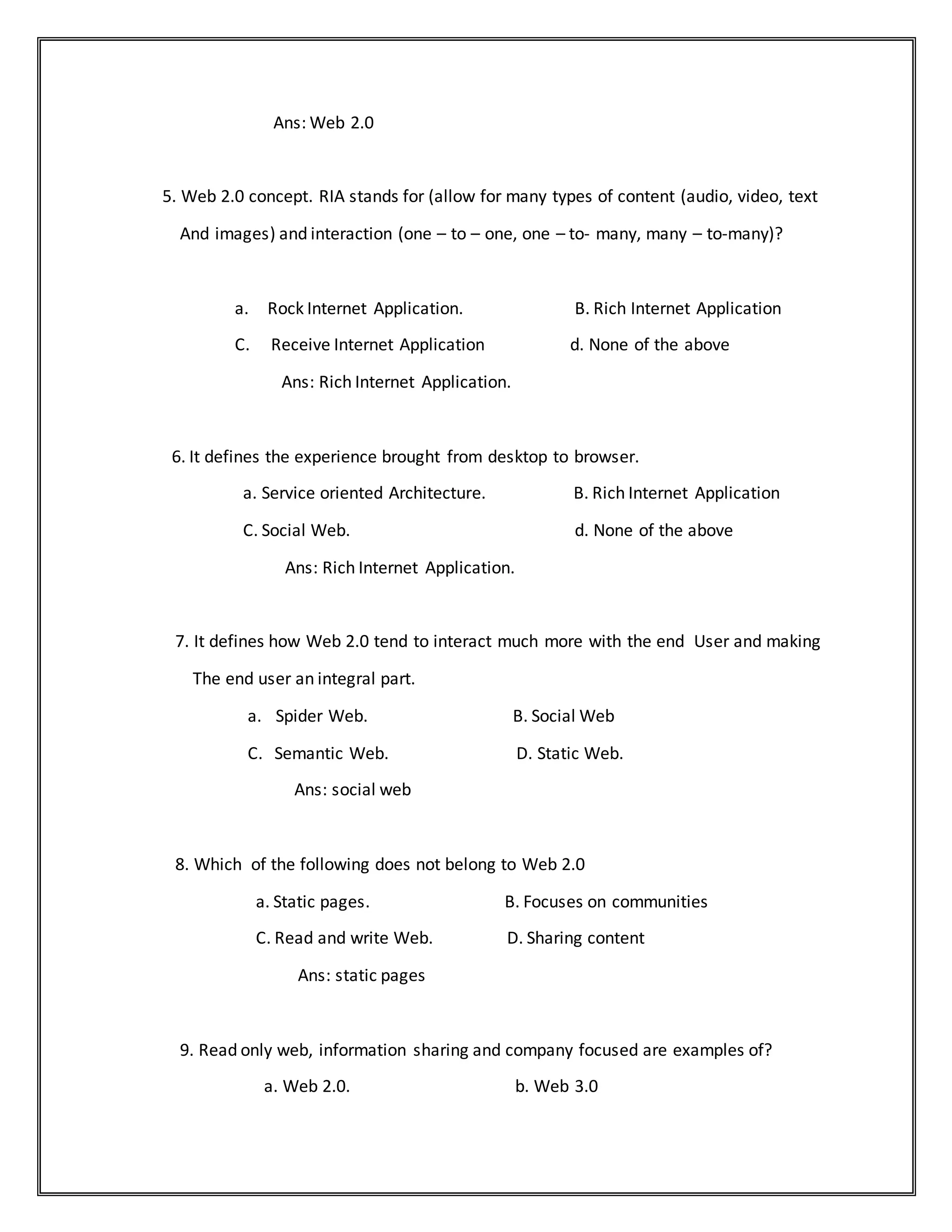
5. Web 2.0 concept. RIA stands for (allow for many types of content (audio, video, text
And images) and interaction (one – to – one, one – to- many, many – to-many)?
a. Rock Internet Application. B. Rich Internet Application
C. Receive Internet Application d. None of the above
Ans: Rich Internet Application.
6. It defines the experience brought from desktop to browser.
a. Service oriented Architecture. B. Rich Internet Application
C. Social Web. d. None of the above
Ans: Rich Internet Application.
7. It defines how Web 2.0 tend to interact much more with the end User and making
The end user an integral part.
a. Spider Web. B. Social Web
C. Semantic Web. D. Static Web.
Ans: social web
8. Which of the following does not belong to Web 2.0
a. Static pages. B. Focuses on communities
C. Read and write Web. D. Sharing content
Ans: static pages
9. Read only web, information sharing and company focused are examples of?
a. Web 2.0. b. Web 3.0
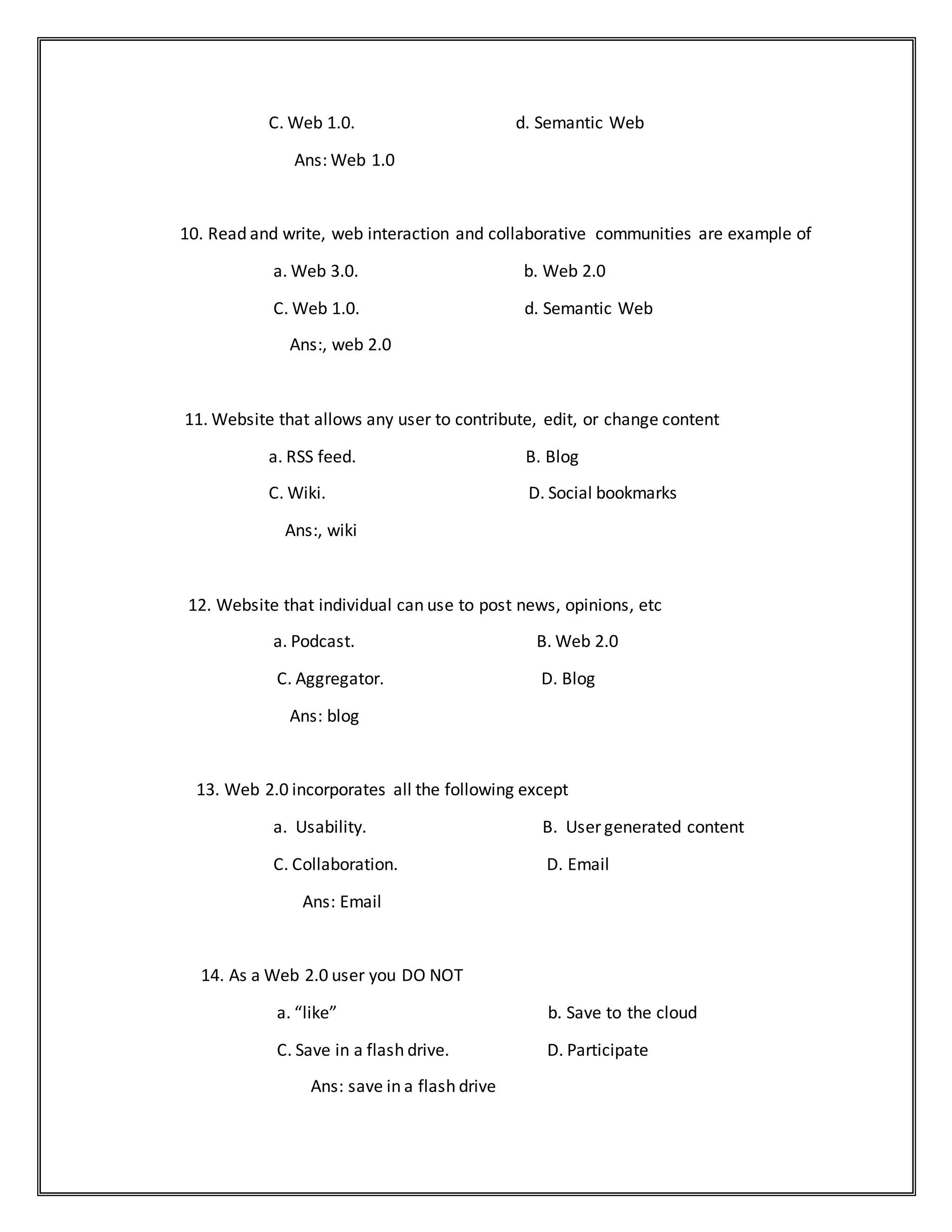
C. Web 1.0. d. Semantic Web
Ans: Web 1.0
10. Read and write, web interaction and collaborative communities are example of
a. Web 3.0. b. Web 2.0
C. Web 1.0. d. Semantic Web
Ans:, web 2.0
11. Website that allows any user to contribute, edit, or change content
a. RSS feed. B. Blog
C. Wiki. D. Social bookmarks
Ans:, wiki
12. Website that individual can use to post news, opinions, etc
a. Podcast. B. Web 2.0
C. Aggregator. D. Blog
Ans: blog
13. Web 2.0 incorporates all the following except
a. Usability. B. User generated content
C. Collaboration. D. Email
Ans: Email
14. As a Web 2.0 user you DO NOT
a. “like” b. Save to the cloud
C. Save in a flash drive. D. Participate
Ans: save in a flash drive
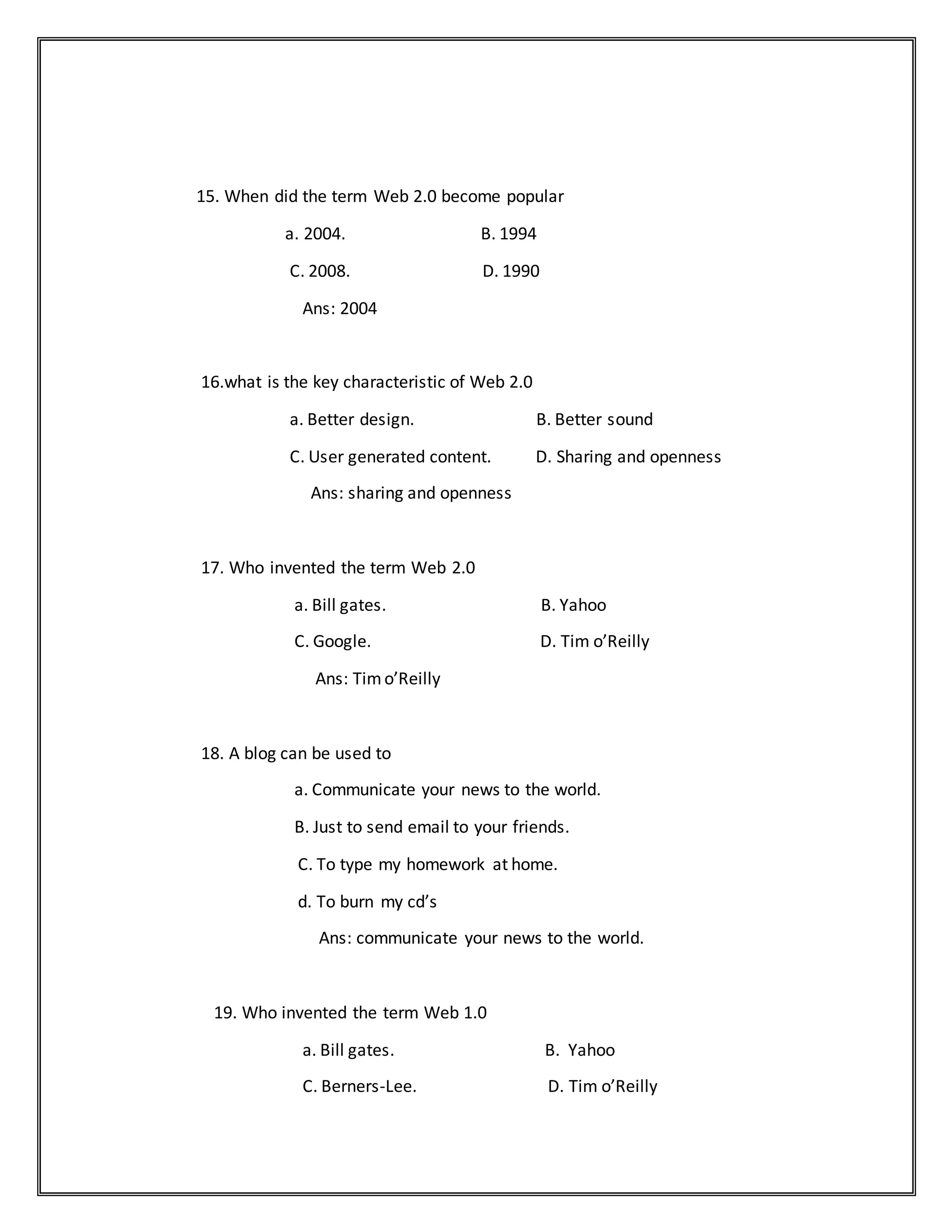
15. When did the term Web 2.0 become popular
a. 2004. B. 1994
C. 2008. D. 1990
Ans: 2004
16.what is the key characteristic of Web 2.0
a. Better design. B. Better sound
C. User generated content. D. Sharing and openness
Ans: sharing and openness
17. Who invented the term Web 2.0
a. Bill gates. B. Yahoo
C. Google. D. Tim o’Reilly
Ans: Timo’Reilly
18. A blog can be used to
a. Communicate your news to the world.
B. Just to send email to your friends.
C. To type my homework at home.
d. To burn my cd’s
Ans: communicate your news to the world.
19. Who invented the term Web 1.0
a. Bill gates. B. Yahoo
C. Berners-Lee. D. Tim o’Reilly
Ans: Berners-Lee.

Trends and advancement in www (web 1.0 and web2.0) mcq

  • 1.
    TRENDS AND ADVANCEMENTIN WWW: WEB 1.0, WEB 2.0 MCQ QUESTIONS 1. The early Internet that only allows people to read from the Internet. a. WEB 1.0. b. Web 2.0 C. Web 3.0 d. Web 4.0 user Ans: Web 1.0 2. The Web……….. Is used as a static “information portal” by many people. a. WEB 2.0. b. Web 1.0 C. Web 3.0. d. None of the above Ans: Web 1.0 3.This is about user – generated content and the read-write Web. a. Web2. 0. b. Web 1.0 C. Web 3.0. d. Web 4.0 Ans: Web 2.0 4 It is a platform that give users the possibility to control their data(content creation and collaboration, folksonomy) a. WEB 3.0. b. Web 2.0 C. Web 1.0. d. None of the above
  • 2.
    Ans: Web 2.0 5.Web 2.0 concept. RIA stands for (allow for many types of content (audio, video, text And images) and interaction (one – to – one, one – to- many, many – to-many)? a. Rock Internet Application. B. Rich Internet Application C. Receive Internet Application d. None of the above Ans: Rich Internet Application. 6. It defines the experience brought from desktop to browser. a. Service oriented Architecture. B. Rich Internet Application C. Social Web. d. None of the above Ans: Rich Internet Application. 7. It defines how Web 2.0 tend to interact much more with the end User and making The end user an integral part. a. Spider Web. B. Social Web C. Semantic Web. D. Static Web. Ans: social web 8. Which of the following does not belong to Web 2.0 a. Static pages. B. Focuses on communities C. Read and write Web. D. Sharing content Ans: static pages 9. Read only web, information sharing and company focused are examples of? a. Web 2.0. b. Web 3.0
  • 3.
    C. Web 1.0.d. Semantic Web Ans: Web 1.0 10. Read and write, web interaction and collaborative communities are example of a. Web 3.0. b. Web 2.0 C. Web 1.0. d. Semantic Web Ans:, web 2.0 11. Website that allows any user to contribute, edit, or change content a. RSS feed. B. Blog C. Wiki. D. Social bookmarks Ans:, wiki 12. Website that individual can use to post news, opinions, etc a. Podcast. B. Web 2.0 C. Aggregator. D. Blog Ans: blog 13. Web 2.0 incorporates all the following except a. Usability. B. User generated content C. Collaboration. D. Email Ans: Email 14. As a Web 2.0 user you DO NOT a. “like” b. Save to the cloud C. Save in a flash drive. D. Participate Ans: save in a flash drive
  • 4.
    15. When didthe term Web 2.0 become popular a. 2004. B. 1994 C. 2008. D. 1990 Ans: 2004 16.what is the key characteristic of Web 2.0 a. Better design. B. Better sound C. User generated content. D. Sharing and openness Ans: sharing and openness 17. Who invented the term Web 2.0 a. Bill gates. B. Yahoo C. Google. D. Tim o’Reilly Ans: Timo’Reilly 18. A blog can be used to a. Communicate your news to the world. B. Just to send email to your friends. C. To type my homework at home. d. To burn my cd’s Ans: communicate your news to the world. 19. Who invented the term Web 1.0 a. Bill gates. B. Yahoo C. Berners-Lee. D. Tim o’Reilly
  • 5.