Course Sponsor: Jay R. Smith Mfg. Co. 2781 Gunter Park Dr. E Montgomery, AL 36109 Ph: 334-277-8520 Fax: 334-272-7396 [email_address] www.jrsmith.com
Background, operation and design of trench drain system. Design advantages of trench drain system.
At the conclusion of this course, you will be able to: Describe the basic ideas of trench drainage system. List the benefits of trench drainage systems. Compare and contrast the differences between traditional trench drainage systems. Cite case studies and installation examples of trench drain systems. Describe how trench drainage systems can help reduce project costs.
Drainage is the process of carrying water AWAY from a specific place. The process of drainage has been around for many years. Trench drainage (floor trench) can be referred to as:  channel  drainage,  line  drainage,  trip  drainage and  slot  drainage. Trench drains are considered to be an open trench with removable grates. Slot drains are a slot in the pavement connected to underground drains and to not have removable grates. Generally a trench is regarded as the completed job in the ground. A channel is an individual modular piece which when added to others makes up the drainage system.
Reduce Ponding Reduce Slip Hazards Protect and Extend Life of Paved Surfaces Protect Property from Flood Damage Reduce Inconvenience to Public Users Reduce Hydroplaning Hazard to Vehicles on Roads
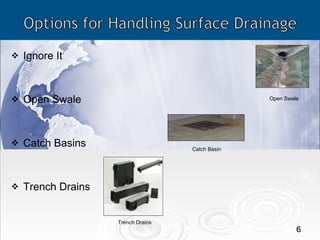
Ignore It Open Swale Catch Basins Trench Drains Open Swale Trench Drains Catch Basin
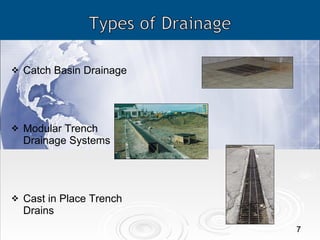
Catch Basin Drainage Modular Trench Drainage Systems Cast in Place Trench Drains
Uneven appearance. Complex, multiple grades to design and construct. Deeper excavation required due to pipe depths. Higher risk of ponding. Pipes prone to blockage and failure. Maintenance can be difficult and costly since piping is not accessible. Possible interference with other utilities, i.e. electrical, sewage, etc.
High labor cost. Time consuming due to on-site formwork. Hand-formed poured-in-place concrete trenches often are not uniform in the slope. Concrete absorbs water. Difficult to get a uniform slope.
Slower drainage due to wide trenches Debris and standing water result from slower flow and create unsanitary conditions Concrete is attacked my mild acids, caustics and saltwater Concrete patching is difficult and time consuming Grates often have to be ground or otherwise modified to fit and to keep from rocking
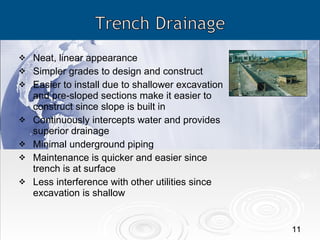
Neat, linear appearance Simpler grades to design and construct Easier to install due to shallower excavation and pre-sloped sections make it easier to construct since slope is built in Continuously intercepts water and provides superior drainage Minimal underground piping Maintenance is quicker and easier since trench is at surface Less interference with other utilities since excavation is shallow
Food Processing Facilities Animal Facilities Stadiums and Sporting Facilities Fire Stations Vehicle Maintenance Facilities Pools Airports Manufacturing Plants Lawn and Garden Centers Retail Stores Parking Lots
Rapid drainage. The drain bottom is shaped to increase velocity during low flow conditions and helps in self cleaning. Closed cell structure of polymers and negligible water absorption prevents collection of bacteria and stops gasoline and other pollutants from getting into the soil. Highly chemical resistant. Not eroded by cleaning agents in wash-down water in food processing plants. Easily maintained since smooth, radius channels don’t collect debris.
Hydraulic Performance  – the amount of liquid to be intercepted, collected and carried in a specific time period Traffic type and frequency Wheel size and type Static versus dynamic loading Loading  – what loads will the trench be subjected to Traffic type and frequency Wheel size and type Static versus dynamic loading
Durability – how the trench system performs over time Material choices and performance Chemical resistance Installation User Requirements  – project specific options Aesthetic – visual look requirements Safety – ADA (Americans with Disabilities Act) requirements, pedestrian requirements – ladies heels, slip resistant finish, etc. Security – ease of removal of grate
For an application that has 2” per hour of rainfall with a trench drain located across a paved area. The lot is level along the 130’ length and slopes to the center of the 65’ dimension. Existing conditions allow the outlet anywhere.  Step 1.  Determine the total volume flow rate. 130’ x 65’ = 8450 Sq. Ft. 2” per hour / 12” per foot = 0.167’ per hour 0.167’ per hour X 8450 Sq. Ft. = 1411 CFH (Cubic Feet per Hour) 1411 CFH  / 3600 Seconds per Hour = 0.39 CFS (Cubic Feet per Second) 0.39 CFS – Convert to GPM (Gallons per Minute)  = .39 * 7.48 * 60 = 175 GPM 175 GPM is the total volume flow rate required for the catchment area. 65’ 130’
Step 2.  Decide on correct layout. Since the trench exceeds 100 feet in length and we would rather not use extension walls, the catch basin will be placed in the center and slope each end to the catch basin.  65’  65’
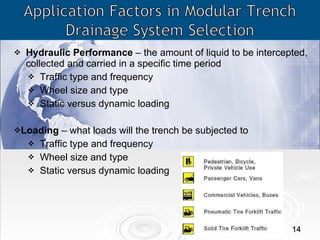
Extra Heavy Duty -  For use : Commercial solid tire traffic patterns, forklifts, and impacts from steel struts or metal wheels. Heavy Duty -  For use : Commercial pneumatic tire traffic patterns, forklifts, and tractor trailers Medium Duty –  For use:  Passenger cars and vans Light Duty -  For use : Pedestrian, wheel chair and bicycle traffic areas.
Features and Benefits Applications 1’ long non-sloping channels. Channel sections are bolted together. Channel sections available with flashing flange and flashing clamp. Channel sections can be provided with acid resistant coating when specified. Channel sections are appropriate for high temperature applications. Channel section grates can be provided with vandal proof screws when specified. Channel sections can be provided with caulk, threaded or no-hub outlets. Truck Loading Docks Parking Decks Above Grade Applications
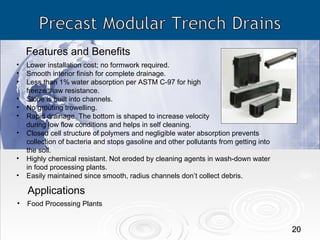
Features and Benefits Applications Lower installation cost; no formwork required. Smooth interior finish for complete drainage. Less than 1% water absorption per ASTM C-97 for high  freeze/thaw resistance. Slope is built into channels. No grouting trowelling. Rapid drainage. The bottom is shaped to increase velocity  during low flow conditions and helps in self cleaning. Closed cell structure of polymers and negligible water absorption prevents collection of bacteria and stops gasoline and other pollutants from getting into the soil. Highly chemical resistant. Not eroded by cleaning agents in wash-down water in food processing plants. Easily maintained since smooth, radius channels don’t collect debris. Food Processing Plants
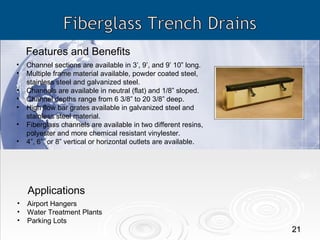
Features and Benefits Applications Channel sections are available in 3’, 9’, and 9’ 10” long. Multiple frame material available, powder coated steel, stainless steel and galvanized steel. Channels are available in neutral (flat) and 1/8” sloped. Channel depths range from 6 3/8” to 20 3/8” deep. High flow bar grates available in galvanized steel and stainless steel material. Fiberglass channels are available in two different resins, polyester and more chemical resistant vinylester. 4”, 6”, or 8” vertical or horizontal outlets are available.  Airport Hangers Water Treatment Plants Parking Lots
Features and Benefits Applications Available in two neutral depths and 20 interlocking, 0.6% pre-sloped channels. The shallowest channel is 13.06” and the deepest channel is 17.81”. Closing end caps and horizontal outlet caps provide for a complete drainage system. Strengthening ribs on the channel sides create a stronger and safer system capable of withstanding the considerable loading imposed by the turning action of heavy wheeled vehicles. Side profiling also provides anchoring to the surrounding concrete to prevent movement due to freeze-thaw cycles. Airports Warehouses Bus Depots Service Stations Military Bases Highways
Features and Benefits 1 Meter Channel Sections, 39.38” long and 6.38” wide. 4” Wide Throat with Bolting End Plates. 23 Modular Chanel Sections Made of 16 Gauge, type 304 Stainless Steel. 4 Neutral (flat) Channels and 15 Channels with .6% Build-in Slope. Channel Inverts Range from 3.75” to 7.50”. Regularly Furnished with Secure Light Duty Slotted Stainless Steel Grate. 4” No-Hub Vertical Outlet on Channel Sections 2,5,10 and 15. End Outlet Plates Available in 2”, 3”, and 4” No-Hub. Available with Flashing Flange and Flashing Collar. A variety of Stainless Steel Grates Available. Applications Bottling Plants Commercial Plants Food Handling (Restaurants and Cafeterias)
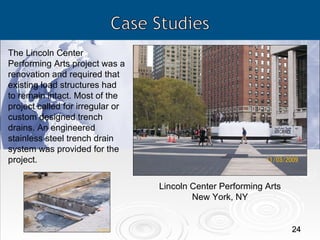
Lincoln Center Performing Arts New York, NY The Lincoln Center Performing Arts project was a renovation and required that existing load structures had to remain intact. Most of the project called for irregular or custom designed trench drains. An engineered stainless steel trench drain system was provided for the project.
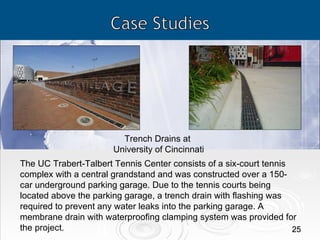
Trench Drains at  University of Cincinnati The UC Trabert-Talbert Tennis Center consists of a six-court tennis complex with a central grandstand and was constructed over a 150-car underground parking garage. Due to the tennis courts being located above the parking garage, a trench drain with flashing was required to prevent any water leaks into the parking garage. A membrane drain with waterproofing clamping system was provided for the project.
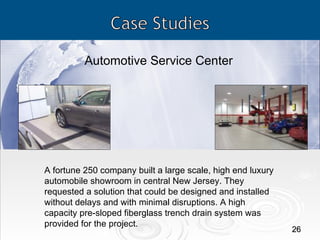
Automotive Service Center A fortune 250 company built a large scale, high end luxury automobile showroom in central New Jersey. They requested a solution that could be designed and installed without delays and with minimal disruptions. A high capacity pre-sloped fiberglass trench drain system was provided for the project.
By now you should be able to:  Describe the basic ideas of Trench Drains List the benefits of Trench Drains Compare and contrast the differences between traditional drainage and engineered trench drains Cite case studies and installation examples where a trench drain systems benefited the owner Describe how a trench drain system can help reduce project costs
Course Sponsor: Jay R. Smith Mfg. Co. 2781 Gunter Park Dr. E Montgomery, AL 36109 Ph: 334-277-8520 Fax: 334-272-7396 [email_address] www.jrsmith.com

Trench Drain Systems: Types, Benefits, Applications, and Overview

  • 1.
    Course Sponsor: JayR. Smith Mfg. Co. 2781 Gunter Park Dr. E Montgomery, AL 36109 Ph: 334-277-8520 Fax: 334-272-7396 [email_address] www.jrsmith.com
  • 2.
    Background, operation anddesign of trench drain system. Design advantages of trench drain system.
  • 3.
    At the conclusionof this course, you will be able to: Describe the basic ideas of trench drainage system. List the benefits of trench drainage systems. Compare and contrast the differences between traditional trench drainage systems. Cite case studies and installation examples of trench drain systems. Describe how trench drainage systems can help reduce project costs.
  • 4.
    Drainage is theprocess of carrying water AWAY from a specific place. The process of drainage has been around for many years. Trench drainage (floor trench) can be referred to as: channel drainage, line drainage, trip drainage and slot drainage. Trench drains are considered to be an open trench with removable grates. Slot drains are a slot in the pavement connected to underground drains and to not have removable grates. Generally a trench is regarded as the completed job in the ground. A channel is an individual modular piece which when added to others makes up the drainage system.
  • 5.
    Reduce Ponding ReduceSlip Hazards Protect and Extend Life of Paved Surfaces Protect Property from Flood Damage Reduce Inconvenience to Public Users Reduce Hydroplaning Hazard to Vehicles on Roads
  • 6.
    Ignore It OpenSwale Catch Basins Trench Drains Open Swale Trench Drains Catch Basin
  • 7.
    Catch Basin DrainageModular Trench Drainage Systems Cast in Place Trench Drains
  • 8.
    Uneven appearance. Complex,multiple grades to design and construct. Deeper excavation required due to pipe depths. Higher risk of ponding. Pipes prone to blockage and failure. Maintenance can be difficult and costly since piping is not accessible. Possible interference with other utilities, i.e. electrical, sewage, etc.
  • 9.
    High labor cost.Time consuming due to on-site formwork. Hand-formed poured-in-place concrete trenches often are not uniform in the slope. Concrete absorbs water. Difficult to get a uniform slope.
  • 10.
    Slower drainage dueto wide trenches Debris and standing water result from slower flow and create unsanitary conditions Concrete is attacked my mild acids, caustics and saltwater Concrete patching is difficult and time consuming Grates often have to be ground or otherwise modified to fit and to keep from rocking
  • 11.
    Neat, linear appearanceSimpler grades to design and construct Easier to install due to shallower excavation and pre-sloped sections make it easier to construct since slope is built in Continuously intercepts water and provides superior drainage Minimal underground piping Maintenance is quicker and easier since trench is at surface Less interference with other utilities since excavation is shallow
  • 12.
    Food Processing FacilitiesAnimal Facilities Stadiums and Sporting Facilities Fire Stations Vehicle Maintenance Facilities Pools Airports Manufacturing Plants Lawn and Garden Centers Retail Stores Parking Lots
  • 13.
    Rapid drainage. Thedrain bottom is shaped to increase velocity during low flow conditions and helps in self cleaning. Closed cell structure of polymers and negligible water absorption prevents collection of bacteria and stops gasoline and other pollutants from getting into the soil. Highly chemical resistant. Not eroded by cleaning agents in wash-down water in food processing plants. Easily maintained since smooth, radius channels don’t collect debris.
  • 14.
    Hydraulic Performance – the amount of liquid to be intercepted, collected and carried in a specific time period Traffic type and frequency Wheel size and type Static versus dynamic loading Loading – what loads will the trench be subjected to Traffic type and frequency Wheel size and type Static versus dynamic loading
  • 15.
    Durability – howthe trench system performs over time Material choices and performance Chemical resistance Installation User Requirements – project specific options Aesthetic – visual look requirements Safety – ADA (Americans with Disabilities Act) requirements, pedestrian requirements – ladies heels, slip resistant finish, etc. Security – ease of removal of grate
  • 16.
    For an applicationthat has 2” per hour of rainfall with a trench drain located across a paved area. The lot is level along the 130’ length and slopes to the center of the 65’ dimension. Existing conditions allow the outlet anywhere. Step 1. Determine the total volume flow rate. 130’ x 65’ = 8450 Sq. Ft. 2” per hour / 12” per foot = 0.167’ per hour 0.167’ per hour X 8450 Sq. Ft. = 1411 CFH (Cubic Feet per Hour) 1411 CFH / 3600 Seconds per Hour = 0.39 CFS (Cubic Feet per Second) 0.39 CFS – Convert to GPM (Gallons per Minute) = .39 * 7.48 * 60 = 175 GPM 175 GPM is the total volume flow rate required for the catchment area. 65’ 130’
  • 17.
    Step 2. Decide on correct layout. Since the trench exceeds 100 feet in length and we would rather not use extension walls, the catch basin will be placed in the center and slope each end to the catch basin. 65’ 65’
  • 18.
    Extra Heavy Duty- For use : Commercial solid tire traffic patterns, forklifts, and impacts from steel struts or metal wheels. Heavy Duty - For use : Commercial pneumatic tire traffic patterns, forklifts, and tractor trailers Medium Duty – For use: Passenger cars and vans Light Duty - For use : Pedestrian, wheel chair and bicycle traffic areas.
  • 19.
    Features and BenefitsApplications 1’ long non-sloping channels. Channel sections are bolted together. Channel sections available with flashing flange and flashing clamp. Channel sections can be provided with acid resistant coating when specified. Channel sections are appropriate for high temperature applications. Channel section grates can be provided with vandal proof screws when specified. Channel sections can be provided with caulk, threaded or no-hub outlets. Truck Loading Docks Parking Decks Above Grade Applications
  • 20.
    Features and BenefitsApplications Lower installation cost; no formwork required. Smooth interior finish for complete drainage. Less than 1% water absorption per ASTM C-97 for high freeze/thaw resistance. Slope is built into channels. No grouting trowelling. Rapid drainage. The bottom is shaped to increase velocity during low flow conditions and helps in self cleaning. Closed cell structure of polymers and negligible water absorption prevents collection of bacteria and stops gasoline and other pollutants from getting into the soil. Highly chemical resistant. Not eroded by cleaning agents in wash-down water in food processing plants. Easily maintained since smooth, radius channels don’t collect debris. Food Processing Plants
  • 21.
    Features and BenefitsApplications Channel sections are available in 3’, 9’, and 9’ 10” long. Multiple frame material available, powder coated steel, stainless steel and galvanized steel. Channels are available in neutral (flat) and 1/8” sloped. Channel depths range from 6 3/8” to 20 3/8” deep. High flow bar grates available in galvanized steel and stainless steel material. Fiberglass channels are available in two different resins, polyester and more chemical resistant vinylester. 4”, 6”, or 8” vertical or horizontal outlets are available. Airport Hangers Water Treatment Plants Parking Lots
  • 22.
    Features and BenefitsApplications Available in two neutral depths and 20 interlocking, 0.6% pre-sloped channels. The shallowest channel is 13.06” and the deepest channel is 17.81”. Closing end caps and horizontal outlet caps provide for a complete drainage system. Strengthening ribs on the channel sides create a stronger and safer system capable of withstanding the considerable loading imposed by the turning action of heavy wheeled vehicles. Side profiling also provides anchoring to the surrounding concrete to prevent movement due to freeze-thaw cycles. Airports Warehouses Bus Depots Service Stations Military Bases Highways
  • 23.
    Features and Benefits1 Meter Channel Sections, 39.38” long and 6.38” wide. 4” Wide Throat with Bolting End Plates. 23 Modular Chanel Sections Made of 16 Gauge, type 304 Stainless Steel. 4 Neutral (flat) Channels and 15 Channels with .6% Build-in Slope. Channel Inverts Range from 3.75” to 7.50”. Regularly Furnished with Secure Light Duty Slotted Stainless Steel Grate. 4” No-Hub Vertical Outlet on Channel Sections 2,5,10 and 15. End Outlet Plates Available in 2”, 3”, and 4” No-Hub. Available with Flashing Flange and Flashing Collar. A variety of Stainless Steel Grates Available. Applications Bottling Plants Commercial Plants Food Handling (Restaurants and Cafeterias)
  • 24.
    Lincoln Center PerformingArts New York, NY The Lincoln Center Performing Arts project was a renovation and required that existing load structures had to remain intact. Most of the project called for irregular or custom designed trench drains. An engineered stainless steel trench drain system was provided for the project.
  • 25.
    Trench Drains at University of Cincinnati The UC Trabert-Talbert Tennis Center consists of a six-court tennis complex with a central grandstand and was constructed over a 150-car underground parking garage. Due to the tennis courts being located above the parking garage, a trench drain with flashing was required to prevent any water leaks into the parking garage. A membrane drain with waterproofing clamping system was provided for the project.
  • 26.
    Automotive Service CenterA fortune 250 company built a large scale, high end luxury automobile showroom in central New Jersey. They requested a solution that could be designed and installed without delays and with minimal disruptions. A high capacity pre-sloped fiberglass trench drain system was provided for the project.
  • 27.
    By now youshould be able to: Describe the basic ideas of Trench Drains List the benefits of Trench Drains Compare and contrast the differences between traditional drainage and engineered trench drains Cite case studies and installation examples where a trench drain systems benefited the owner Describe how a trench drain system can help reduce project costs
  • 28.
    Course Sponsor: JayR. Smith Mfg. Co. 2781 Gunter Park Dr. E Montgomery, AL 36109 Ph: 334-277-8520 Fax: 334-272-7396 [email_address] www.jrsmith.com