
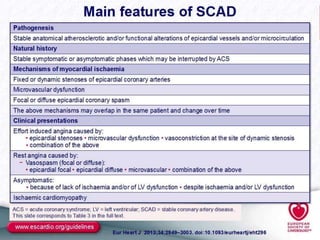


Stable Ischemic Heart Disease
Is This the Beginning of a New Era?
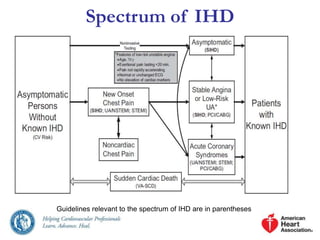
Spectrum of IHD
Guidelines relevant to the spectrum of IHD are in parentheses
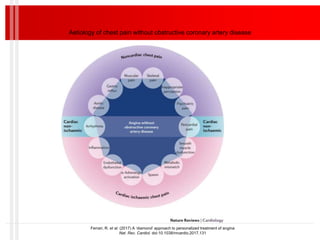
Aetiology of chest pain without obstructive coronary artery disease
Ferrari, R. et al. (2017) A ‘diamond’ approach to personalized treatment of angina
Nat. Rev. Cardiol. doi:10.1038/nrcardio.2017.131
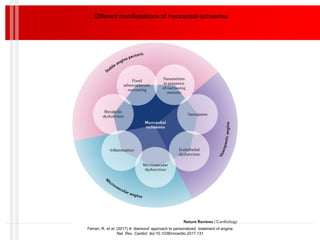
Different manifestations of myocardial ischaemia
Ferrari, R. et al. (2017) A ‘diamond’ approach to personalized treatment of angina
Nat. Rev. Cardiol. doi:10.1038/nrcardio.2017.131
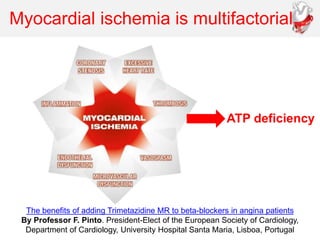
Myocardial ischemia is multifactorial
The benefits of adding Trimetazidine MR to beta-blockers in angina patients
By Professor F. Pinto. President-Elect of the European Society of Cardiology,
Department of Cardiology, University Hospital Santa Maria, Lisboa, Portugal
ATP deficiency
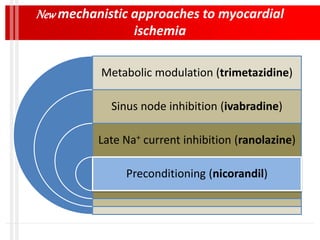
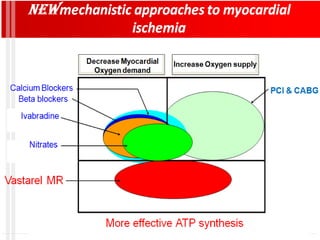
New mechanistic approaches to myocardial
ischemia
Metabolic modulation (trimetazidine)
Sinus node inhibition (ivabradine)
Late Na+ current inhibition (ranolazine)
Preconditioning (nicorandil)
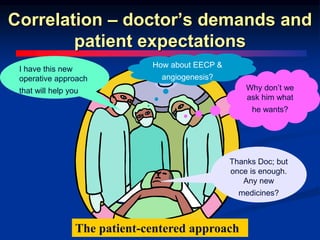
Correlation – doctor’s demands and
patient expectations
I have this new
operative approach
that will help you Why don’t we
ask him what
he wants?
How about EECP &
angiogenesis?
Thanks Doc; but
once is enough.
Any new
medicines?
The patient-centered approach
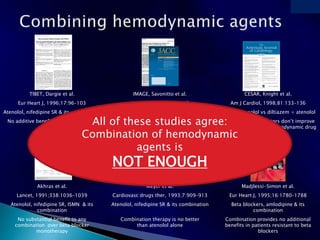
TIBET, Dargie et al. IMAGE, Savonitto et al. CESAR, Knight et al.
Eur Heart J, 1996;17:96–103 JACC, 1996;27:311–316 Am J Cardiol, 1998;81:133–136
Atenolol, nifedipine SR & its combination Metoprolol, nifedipine SR & its combination Amlo + atenolol vs diltiazem + atenolol
No additive benefit from combination purported benefit of 2 drugs is due to
addition of new drug in resistant patients
Exercise test parameters don’t improve
when adding second hemodynamic drug
Akhras et al. Meyer et al. Madjlessi-Simon et al.
Lancet, 1991;338:1036–1039 Cardiovasc drugs ther, 1993;7:909–913 Eur Heart J, 1995;16:1780–1788
Atenolol, nifedipine SR, ISMN & its
combination
Atenolol, nifedipine SR & its combination Beta blockers, amlodipine & its
combination
No substantial benefit to any
combination over beta blocker
monotherapy
Combination therapy is no better
than atenolol alone
Combination provides no additional
benefits in patients resistant to beta
blockers
All of these studies agree:
Combination of hemodynamic
agents is
NOT ENOUGH
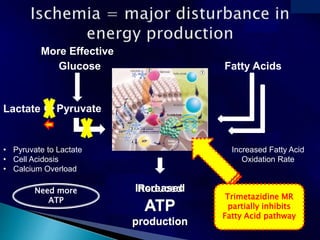
Glucose
Lactate Pyruvate
Fatty Acids
Reduced
ATP
production
• Pyruvate to Lactate
• Cell Acidosis
• Calcium Overload
Increased Fatty Acid
Oxidation Rate
Need more
ATP Trimetazidine MR
partially inhibits
Fatty Acid pathway
Increased
ATP
production
More Effective
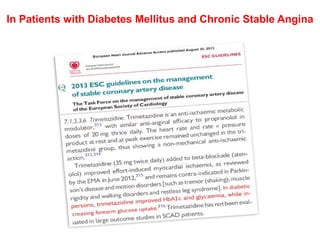
In Patients with Diabetes Mellitus and Chronic Stable Angina
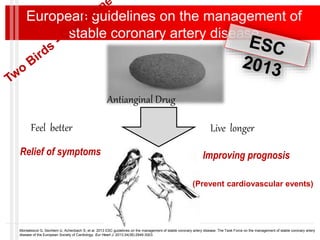
Antianginal Drug
Relief of symptoms Improving prognosis
(Prevent cardiovascular events)
Feel better Live longer
European guidelines on the management of
stable coronary artery disease
Montalescot G, Sechtem U, Achenbach S, et al. 2013 ESC guidelines on the management of stable coronary artery disease: The Task Force on the management of stable coronary artery
disease of the European Society of Cardiology. Eur Heart J. 2013;34(38):2949-3003.
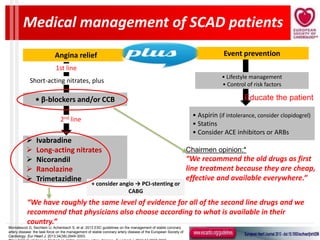
“We recommend the old drugs as first
line treatment because they are cheap,
effective and available everywhere.”
“We have roughly the same level of evidence for all of the second line drugs and we
recommend that physicians also choose according to what is available in their
country.”
Angina relief Event prevention
• β-blockers and/or CCB
 Ivabradine
 Long-acting nitrates
 Nicorandil
 Ranolazine
 Trimetazidine
• Lifestyle management
• Control of risk factors
• Aspirin (if intolerance, consider clopidogrel)
• Statins
• Consider ACE inhibitors or ARBs
+ consider angio → PCI-stenting or
CABG
Short-acting nitrates, plus
1st line
2nd line
Medical management of SCAD patients
Montalescot G, Sechtem U, Achenbach S, et al. 2013 ESC guidelines on the management of stable coronary
artery disease: the task force on the management of stable coronary artery disease of the European Society of
Cardiology. Eur Heart J. 2013;34(38):2949-3003.
Chairmen opinion:*
Educate the patient
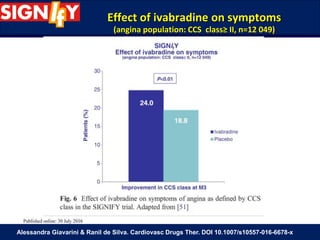
Alessandra Giavarini & Ranil de Silva. Cardiovasc Drugs Ther. DOI 10.1007/s10557-016-6678-x
Effect of ivabradine on symptoms
(angina population: CCS class≥ II, n=12 049)
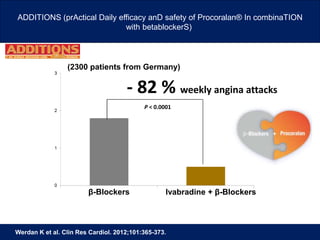
Werdan K et al. Clin Res Cardiol. 2012;101:365-373.
- 82 % weekly angina attacks
P < 0.0001
(2300 patients from Germany)
β-Blockers Ivabradine + β-Blockers
ADDITIONS (prActical Daily efficacy anD safety of Procoralan® In combinaTION
with betablockerS)
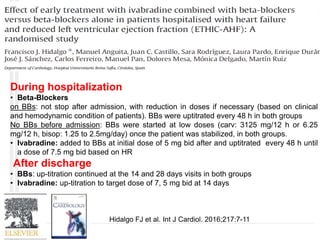
Hidalgo FJ et al. Int J Cardiol. 2016;217:7-11
During hospitalization
• Beta-Blockers
on BBs: not stop after admission, with reduction in doses if necessary (based on clinical
and hemodynamic condition of patients). BBs were uptitrated every 48 h in both groups
No BBs before admission: BBs were started at low doses (carv: 3125 mg/12 h or 6.25
mg/12 h, bisop: 1.25 to 2.5mg/day) once the patient was stabilized, in both groups.
• Ivabradine: added to BBs at initial dose of 5 mg bid after and uptitrated every 48 h until
a dose of 7.5 mg bid based on HR
After discharge
• BBs: up-titration continued at the 14 and 28 days visits in both groups
• Ivabradine: up-titration to target dose of 7, 5 mg bid at 14 days
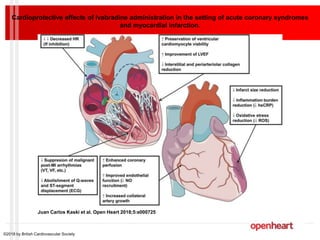
Cardioprotective effects of ivabradine administration in the setting of acute coronary syndromes
and myocardial infarction.
Juan Carlos Kaski et al. Open Heart 2018;5:e000725
©2018 by British Cardiovascular Society
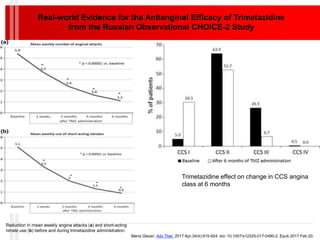
Reduction in mean weekly angina attacks (a) and short-acting
nitrate use (b) before and during trimetazidine administration.
Trimetazidine effect on change in CCS angina
class at 6 months
Real-world Evidence for the Antianginal Efficacy of Trimetazidine
from the Russian Observational CHOICE-2 Study
Maria Glezer; Adv Ther. 2017 Apr;34(4):915-924. doi: 10.1007/s12325-017-0490-2. Epub 2017 Feb 20.
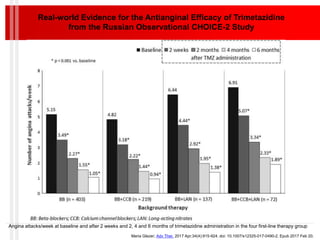
Angina attacks/week at baseline and after 2 weeks and 2, 4 and 6 months of trimetazidine administration in the four first-line therapy group
Real-world Evidence for the Antianginal Efficacy of Trimetazidine
from the Russian Observational CHOICE-2 Study
Maria Glezer; Adv Ther. 2017 Apr;34(4):915-924. doi: 10.1007/s12325-017-0490-2. Epub 2017 Feb 20.
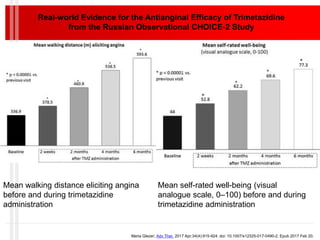
Mean walking distance eliciting angina
before and during trimetazidine
administration
Mean self-rated well-being (visual
analogue scale, 0–100) before and during
trimetazidine administration
Real-world Evidence for the Antianginal Efficacy of Trimetazidine
from the Russian Observational CHOICE-2 Study
Maria Glezer; Adv Ther. 2017 Apr;34(4):915-924. doi: 10.1007/s12325-017-0490-2. Epub 2017 Feb 20.
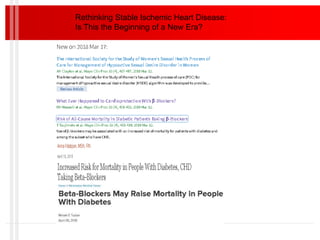
Rethinking Stable Ischemic Heart Disease:
Is This the Beginning of a New Era?
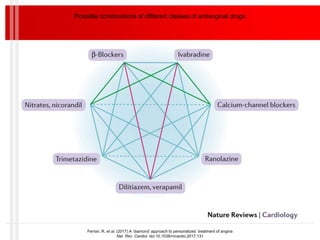
Possible combinations of different classes of antianginal drugs
Ferrari, R. et al. (2017) A ‘diamond’ approach to personalized treatment of angina
Nat. Rev. Cardiol. doi:10.1038/nrcardio.2017.131
Ferrari, R. et al. (2017) A ‘diamond’ approach to
personalized treatment of angina
Nat. Rev. Cardiol. doi:10.1038/nrcardio.2017.131
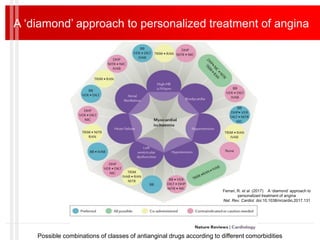
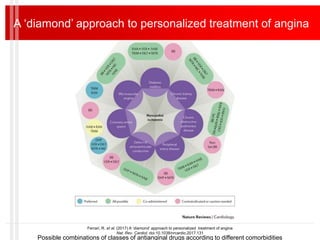
Possible combinations of classes of antianginal drugs according to different comorbidities
A ‘diamond’ approach to personalized treatment of angina
Possible combinations of classes of antianginal drugs according to different comorbidities
Ferrari, R. et al. (2017) A ‘diamond’ approach to personalized treatment of angina
Nat. Rev. Cardiol. doi:10.1038/nrcardio.2017.131
A ‘diamond’ approach to personalized treatment of angina
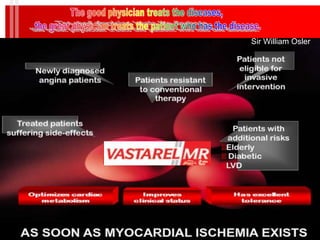
Sir William Osler
"People don't want to hear the truth
because they don't want their illusions destroyed."
- Friedrich Nietzsche
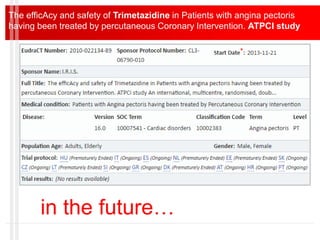
The efficAcy and safety of Trimetazidine in Patients with angina pectoris
having been treated by percutaneous Coronary Intervention. ATPCI study
in the future…
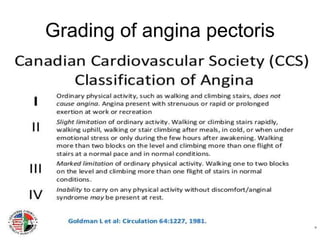
Grading of angina pectoris
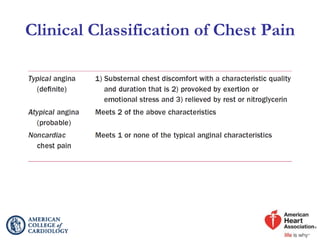
Clinical Classification of Chest Pain
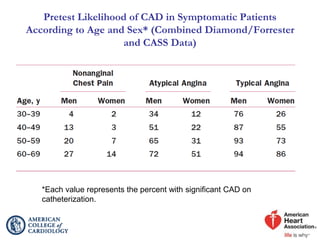
Pretest Likelihood of CAD in Symptomatic Patients
According to Age and Sex* (Combined Diamond/Forrester
and CASS Data)
*Each value represents the percent with significant CAD on
catheterization.
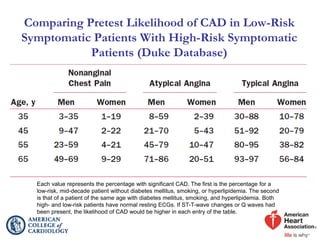
Comparing Pretest Likelihood of CAD in Low-Risk
Symptomatic Patients With High-Risk Symptomatic
Patients (Duke Database)
Each value represents the percentage with significant CAD. The first is the percentage for a
low-risk, mid-decade patient without diabetes mellitus, smoking, or hyperlipidemia. The second
is that of a patient of the same age with diabetes mellitus, smoking, and hyperlipidemia. Both
high- and low-risk patients have normal resting ECGs. If ST-T-wave changes or Q waves had
been present, the likelihood of CAD would be higher in each entry of the table.

SIHD 2018

  • 1.
    Stable Ischemic HeartDisease Is This the Beginning of a New Era?
  • 3.
    Spectrum of IHD Guidelinesrelevant to the spectrum of IHD are in parentheses
  • 4.
    Aetiology of chestpain without obstructive coronary artery disease Ferrari, R. et al. (2017) A ‘diamond’ approach to personalized treatment of angina Nat. Rev. Cardiol. doi:10.1038/nrcardio.2017.131
  • 5.
    Different manifestations ofmyocardial ischaemia Ferrari, R. et al. (2017) A ‘diamond’ approach to personalized treatment of angina Nat. Rev. Cardiol. doi:10.1038/nrcardio.2017.131
  • 6.
    Myocardial ischemia ismultifactorial The benefits of adding Trimetazidine MR to beta-blockers in angina patients By Professor F. Pinto. President-Elect of the European Society of Cardiology, Department of Cardiology, University Hospital Santa Maria, Lisboa, Portugal ATP deficiency
  • 7.
    New mechanistic approachesto myocardial ischemia Metabolic modulation (trimetazidine) Sinus node inhibition (ivabradine) Late Na+ current inhibition (ranolazine) Preconditioning (nicorandil)
  • 8.
    Correlation – doctor’sdemands and patient expectations I have this new operative approach that will help you Why don’t we ask him what he wants? How about EECP & angiogenesis? Thanks Doc; but once is enough. Any new medicines? The patient-centered approach
  • 9.
    TIBET, Dargie etal. IMAGE, Savonitto et al. CESAR, Knight et al. Eur Heart J, 1996;17:96–103 JACC, 1996;27:311–316 Am J Cardiol, 1998;81:133–136 Atenolol, nifedipine SR & its combination Metoprolol, nifedipine SR & its combination Amlo + atenolol vs diltiazem + atenolol No additive benefit from combination purported benefit of 2 drugs is due to addition of new drug in resistant patients Exercise test parameters don’t improve when adding second hemodynamic drug Akhras et al. Meyer et al. Madjlessi-Simon et al. Lancet, 1991;338:1036–1039 Cardiovasc drugs ther, 1993;7:909–913 Eur Heart J, 1995;16:1780–1788 Atenolol, nifedipine SR, ISMN & its combination Atenolol, nifedipine SR & its combination Beta blockers, amlodipine & its combination No substantial benefit to any combination over beta blocker monotherapy Combination therapy is no better than atenolol alone Combination provides no additional benefits in patients resistant to beta blockers All of these studies agree: Combination of hemodynamic agents is NOT ENOUGH
  • 10.
    Glucose Lactate Pyruvate Fatty Acids Reduced ATP production •Pyruvate to Lactate • Cell Acidosis • Calcium Overload Increased Fatty Acid Oxidation Rate Need more ATP Trimetazidine MR partially inhibits Fatty Acid pathway Increased ATP production More Effective
  • 11.
    In Patients withDiabetes Mellitus and Chronic Stable Angina
  • 12.
    Antianginal Drug Relief ofsymptoms Improving prognosis (Prevent cardiovascular events) Feel better Live longer European guidelines on the management of stable coronary artery disease Montalescot G, Sechtem U, Achenbach S, et al. 2013 ESC guidelines on the management of stable coronary artery disease: The Task Force on the management of stable coronary artery disease of the European Society of Cardiology. Eur Heart J. 2013;34(38):2949-3003.
  • 13.
    “We recommend theold drugs as first line treatment because they are cheap, effective and available everywhere.” “We have roughly the same level of evidence for all of the second line drugs and we recommend that physicians also choose according to what is available in their country.” Angina relief Event prevention • β-blockers and/or CCB  Ivabradine  Long-acting nitrates  Nicorandil  Ranolazine  Trimetazidine • Lifestyle management • Control of risk factors • Aspirin (if intolerance, consider clopidogrel) • Statins • Consider ACE inhibitors or ARBs + consider angio → PCI-stenting or CABG Short-acting nitrates, plus 1st line 2nd line Medical management of SCAD patients Montalescot G, Sechtem U, Achenbach S, et al. 2013 ESC guidelines on the management of stable coronary artery disease: the task force on the management of stable coronary artery disease of the European Society of Cardiology. Eur Heart J. 2013;34(38):2949-3003. Chairmen opinion:* Educate the patient
  • 14.
    Alessandra Giavarini &Ranil de Silva. Cardiovasc Drugs Ther. DOI 10.1007/s10557-016-6678-x Effect of ivabradine on symptoms (angina population: CCS class≥ II, n=12 049)
  • 15.
    Werdan K etal. Clin Res Cardiol. 2012;101:365-373. - 82 % weekly angina attacks P < 0.0001 (2300 patients from Germany) β-Blockers Ivabradine + β-Blockers ADDITIONS (prActical Daily efficacy anD safety of Procoralan® In combinaTION with betablockerS)
  • 16.
    Hidalgo FJ etal. Int J Cardiol. 2016;217:7-11 During hospitalization • Beta-Blockers on BBs: not stop after admission, with reduction in doses if necessary (based on clinical and hemodynamic condition of patients). BBs were uptitrated every 48 h in both groups No BBs before admission: BBs were started at low doses (carv: 3125 mg/12 h or 6.25 mg/12 h, bisop: 1.25 to 2.5mg/day) once the patient was stabilized, in both groups. • Ivabradine: added to BBs at initial dose of 5 mg bid after and uptitrated every 48 h until a dose of 7.5 mg bid based on HR After discharge • BBs: up-titration continued at the 14 and 28 days visits in both groups • Ivabradine: up-titration to target dose of 7, 5 mg bid at 14 days
  • 19.
    Cardioprotective effects ofivabradine administration in the setting of acute coronary syndromes and myocardial infarction. Juan Carlos Kaski et al. Open Heart 2018;5:e000725 ©2018 by British Cardiovascular Society
  • 20.
    Reduction in meanweekly angina attacks (a) and short-acting nitrate use (b) before and during trimetazidine administration. Trimetazidine effect on change in CCS angina class at 6 months Real-world Evidence for the Antianginal Efficacy of Trimetazidine from the Russian Observational CHOICE-2 Study Maria Glezer; Adv Ther. 2017 Apr;34(4):915-924. doi: 10.1007/s12325-017-0490-2. Epub 2017 Feb 20.
  • 21.
    Angina attacks/week atbaseline and after 2 weeks and 2, 4 and 6 months of trimetazidine administration in the four first-line therapy group Real-world Evidence for the Antianginal Efficacy of Trimetazidine from the Russian Observational CHOICE-2 Study Maria Glezer; Adv Ther. 2017 Apr;34(4):915-924. doi: 10.1007/s12325-017-0490-2. Epub 2017 Feb 20.
  • 22.
    Mean walking distanceeliciting angina before and during trimetazidine administration Mean self-rated well-being (visual analogue scale, 0–100) before and during trimetazidine administration Real-world Evidence for the Antianginal Efficacy of Trimetazidine from the Russian Observational CHOICE-2 Study Maria Glezer; Adv Ther. 2017 Apr;34(4):915-924. doi: 10.1007/s12325-017-0490-2. Epub 2017 Feb 20.
  • 23.
    Rethinking Stable IschemicHeart Disease: Is This the Beginning of a New Era?
  • 26.
    Possible combinations ofdifferent classes of antianginal drugs Ferrari, R. et al. (2017) A ‘diamond’ approach to personalized treatment of angina Nat. Rev. Cardiol. doi:10.1038/nrcardio.2017.131
  • 28.
    Ferrari, R. etal. (2017) A ‘diamond’ approach to personalized treatment of angina Nat. Rev. Cardiol. doi:10.1038/nrcardio.2017.131 Possible combinations of classes of antianginal drugs according to different comorbidities A ‘diamond’ approach to personalized treatment of angina
  • 29.
    Possible combinations ofclasses of antianginal drugs according to different comorbidities Ferrari, R. et al. (2017) A ‘diamond’ approach to personalized treatment of angina Nat. Rev. Cardiol. doi:10.1038/nrcardio.2017.131 A ‘diamond’ approach to personalized treatment of angina
  • 30.
  • 31.
    "People don't wantto hear the truth because they don't want their illusions destroyed." - Friedrich Nietzsche
  • 32.
    The efficAcy andsafety of Trimetazidine in Patients with angina pectoris having been treated by percutaneous Coronary Intervention. ATPCI study in the future…
  • 34.
  • 35.
  • 36.
    Pretest Likelihood ofCAD in Symptomatic Patients According to Age and Sex* (Combined Diamond/Forrester and CASS Data) *Each value represents the percent with significant CAD on catheterization.
  • 37.
    Comparing Pretest Likelihoodof CAD in Low-Risk Symptomatic Patients With High-Risk Symptomatic Patients (Duke Database) Each value represents the percentage with significant CAD. The first is the percentage for a low-risk, mid-decade patient without diabetes mellitus, smoking, or hyperlipidemia. The second is that of a patient of the same age with diabetes mellitus, smoking, and hyperlipidemia. Both high- and low-risk patients have normal resting ECGs. If ST-T-wave changes or Q waves had been present, the likelihood of CAD would be higher in each entry of the table.