INTRODUCTION TO TOUR
GUIDING
Subtopics
1. Meaning and definition
2. Main components of tour guiding
3. Terminologies Used In Tour Guiding
4. Understanding tour guide
5. Position of tour guide in tourism system
6. Types of tour guide
7. Roles of tour of guide
Meaning and definition of tour guiding
Tour guiding is the process of interpreting attractions to visitors, directing,
informing, instructing, and leading them in the visited places. Tour Guiding is
usually for a shorter length of time. It refers to the specific activity at a sight
or an attraction for a scheduled portion of time.
Tour guiding refers to an act that provides assistance, information,
interpretation to people on organized tours, individual clients, educational
establishments, at religious and historical sites, museums, and at venues of
other significant interest. It should be done by a person (normally) have a
recognized national or regional tourist guide qualification.
Main components of tour guiding
The ATTRACTION:
The VISITOR:
The GUIDE:
Terminologies Used In Tour Guiding
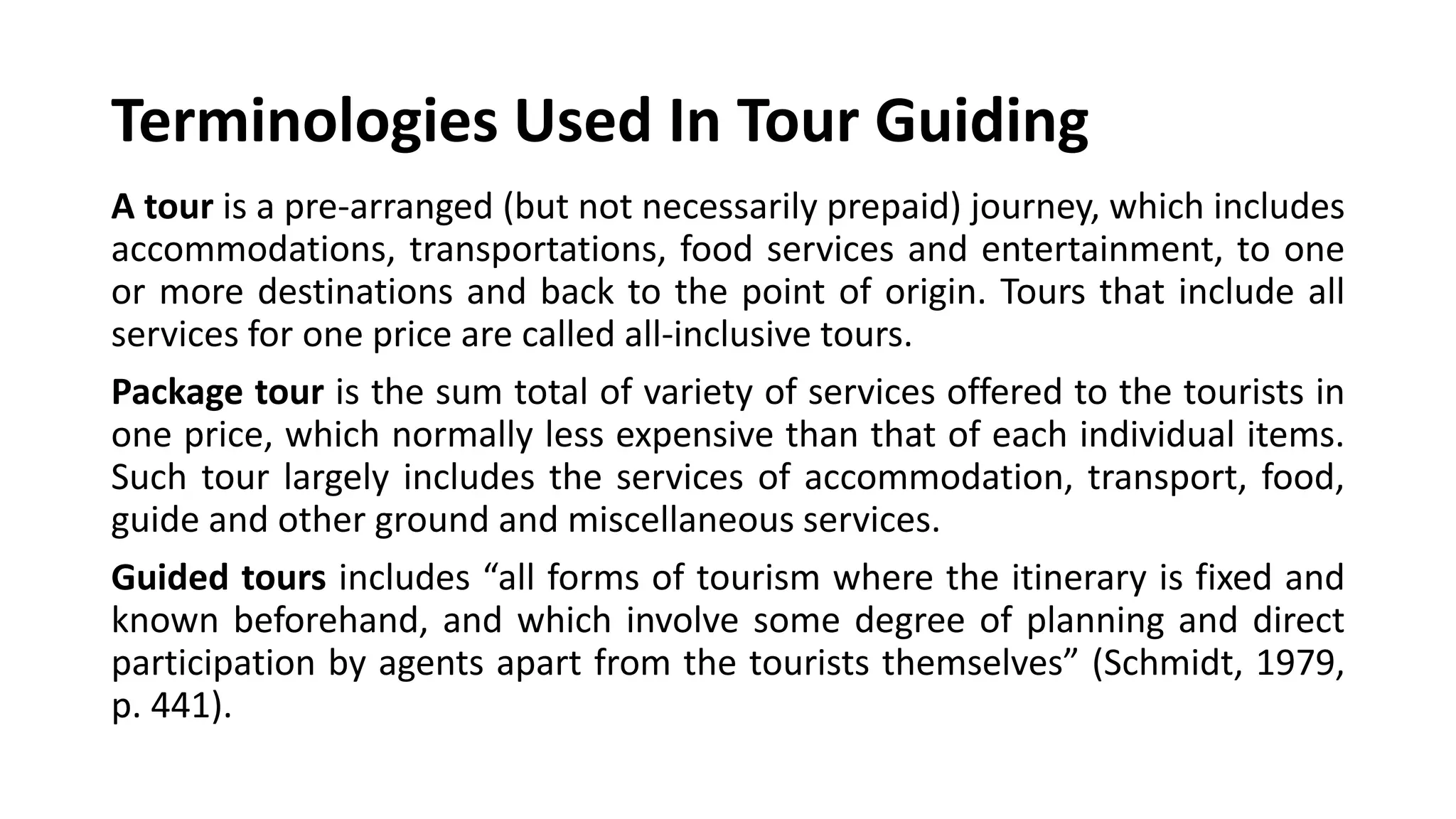
A tour is a pre-arranged (but not necessarily prepaid) journey, which includes
accommodations, transportations, food services and entertainment, to one
or more destinations and back to the point of origin. Tours that include all
services for one price are called all-inclusive tours.
Package tour is the sum total of variety of services offered to the tourists in
one price, which normally less expensive than that of each individual items.
Such tour largely includes the services of accommodation, transport, food,
guide and other ground and miscellaneous services.
Guided tours includes “all forms of tourism where the itinerary is fixed and
known beforehand, and which involve some degree of planning and direct
participation by agents apart from the tourists themselves” (Schmidt, 1979,
p. 441).
Terminologies Used In Tour Guiding
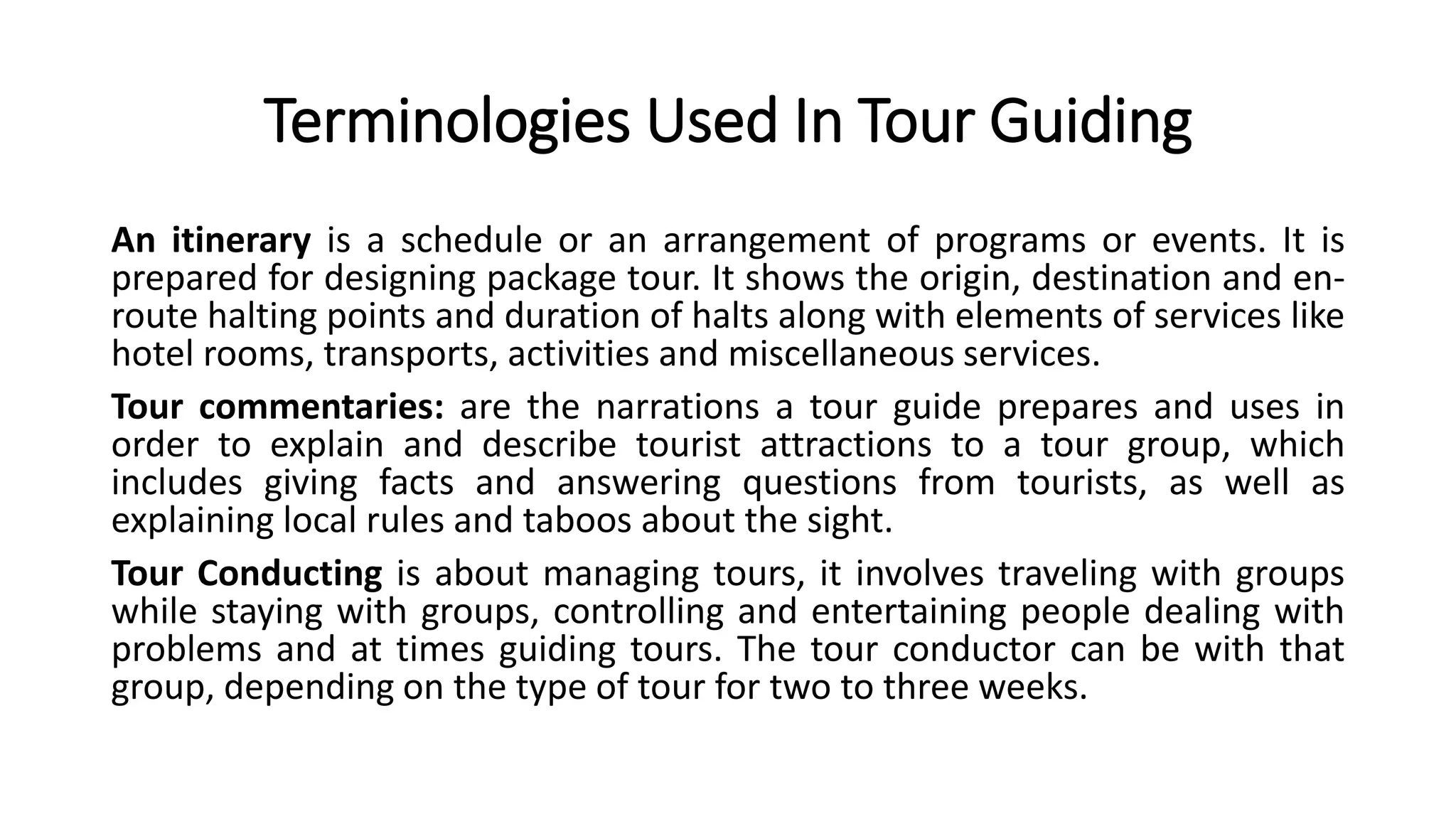
An itinerary is a schedule or an arrangement of programs or events. It is
prepared for designing package tour. It shows the origin, destination and en-
route halting points and duration of halts along with elements of services like
hotel rooms, transports, activities and miscellaneous services.
Tour commentaries: are the narrations a tour guide prepares and uses in
order to explain and describe tourist attractions to a tour group, which
includes giving facts and answering questions from tourists, as well as
explaining local rules and taboos about the sight.
Tour Conducting is about managing tours, it involves traveling with groups
while staying with groups, controlling and entertaining people dealing with
problems and at times guiding tours. The tour conductor can be with that
group, depending on the type of tour for two to three weeks.
Understanding tour guide
Meaning and definition of tour guide
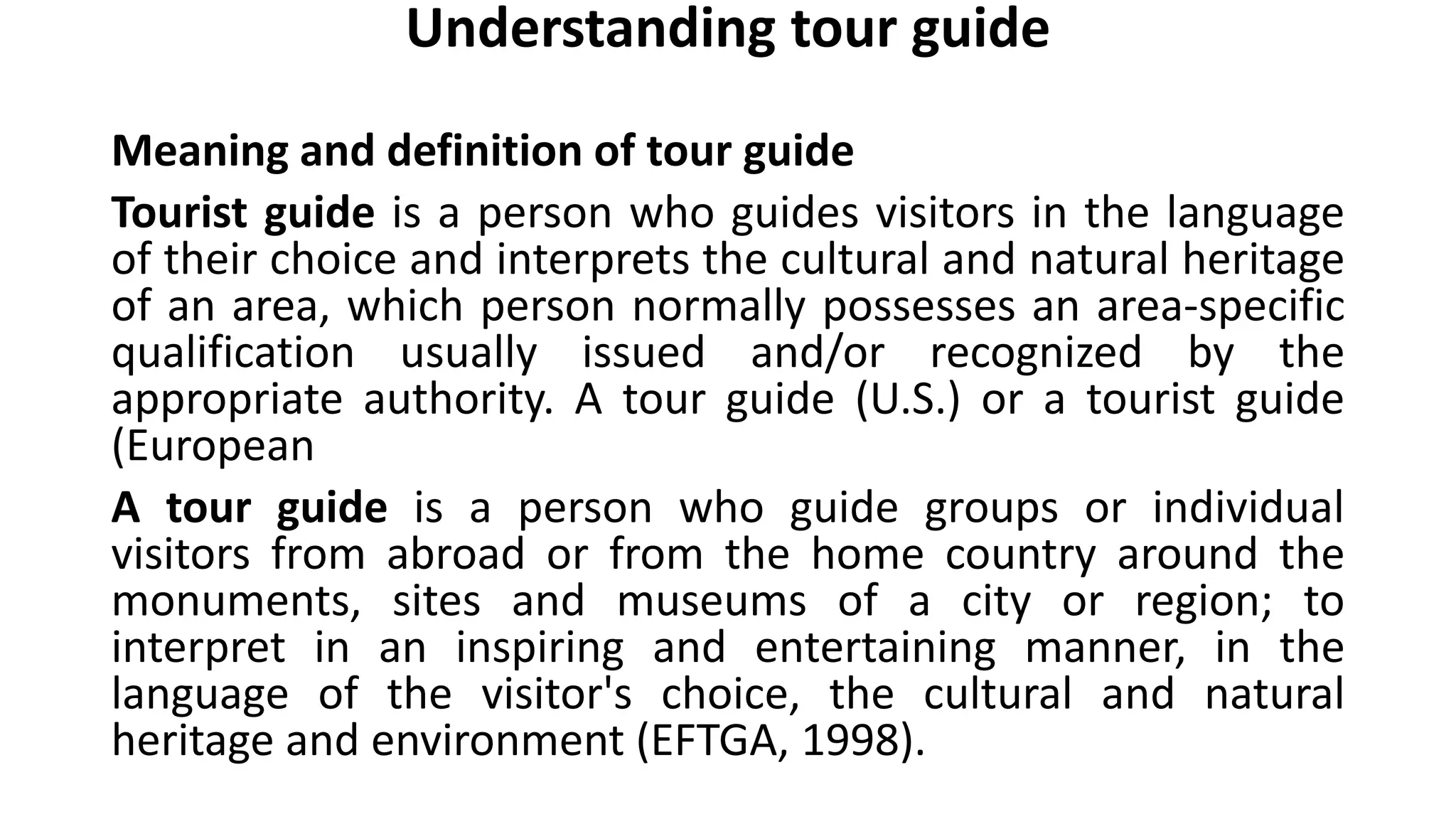
Tourist guide is a person who guides visitors in the language
of their choice and interprets the cultural and natural heritage
of an area, which person normally possesses an area-specific
qualification usually issued and/or recognized by the
appropriate authority. A tour guide (U.S.) or a tourist guide
(European
A tour guide is a person who guide groups or individual
visitors from abroad or from the home country around the
monuments, sites and museums of a city or region; to
interpret in an inspiring and entertaining manner, in the
language of the visitor's choice, the cultural and natural
heritage and environment (EFTGA, 1998).
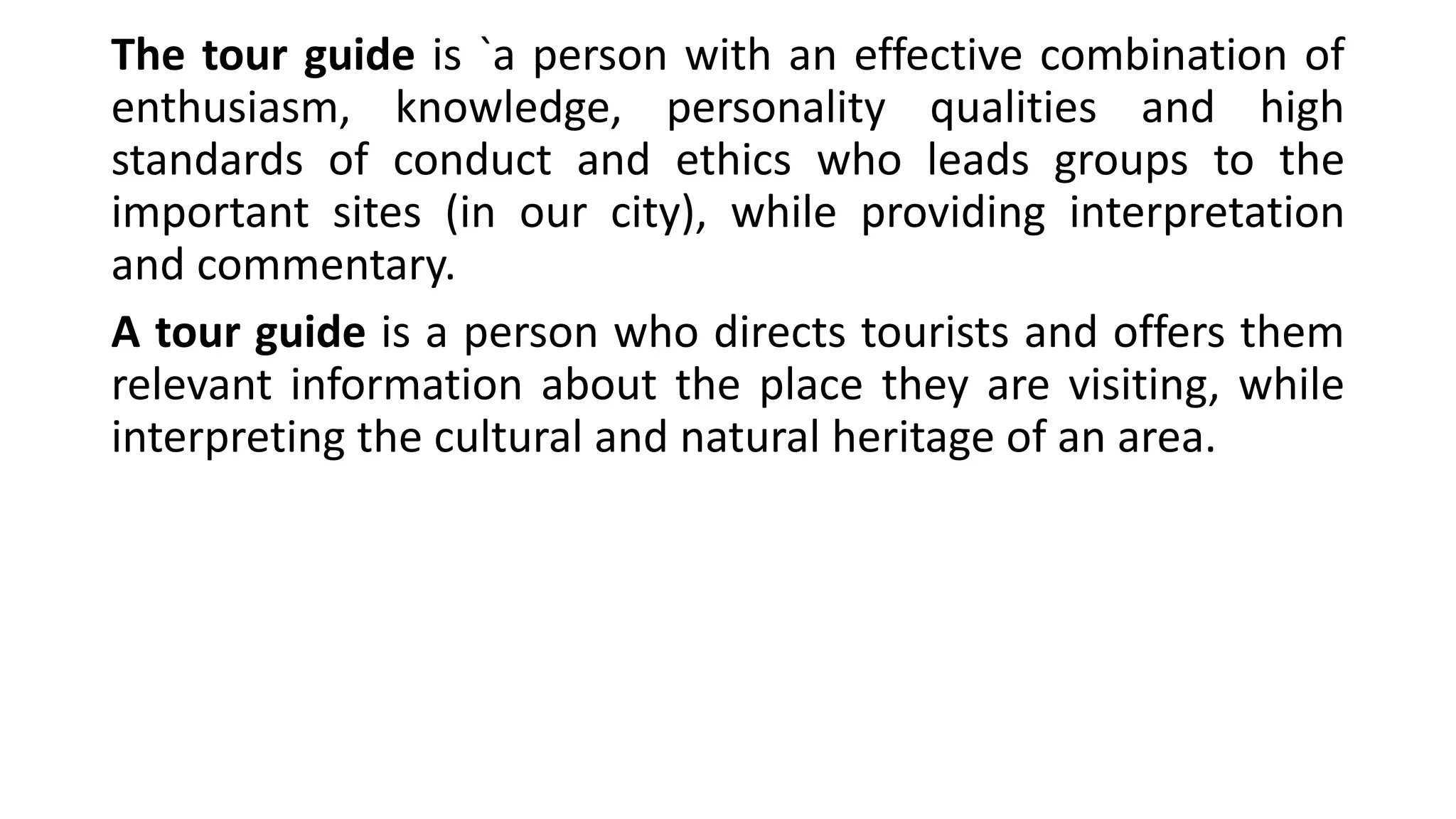
The tour guide is `a person with an effective combination of
enthusiasm, knowledge, personality qualities and high
standards of conduct and ethics who leads groups to the
important sites (in our city), while providing interpretation
and commentary.
A tour guide is a person who directs tourists and offers them
relevant information about the place they are visiting, while
interpreting the cultural and natural heritage of an area.
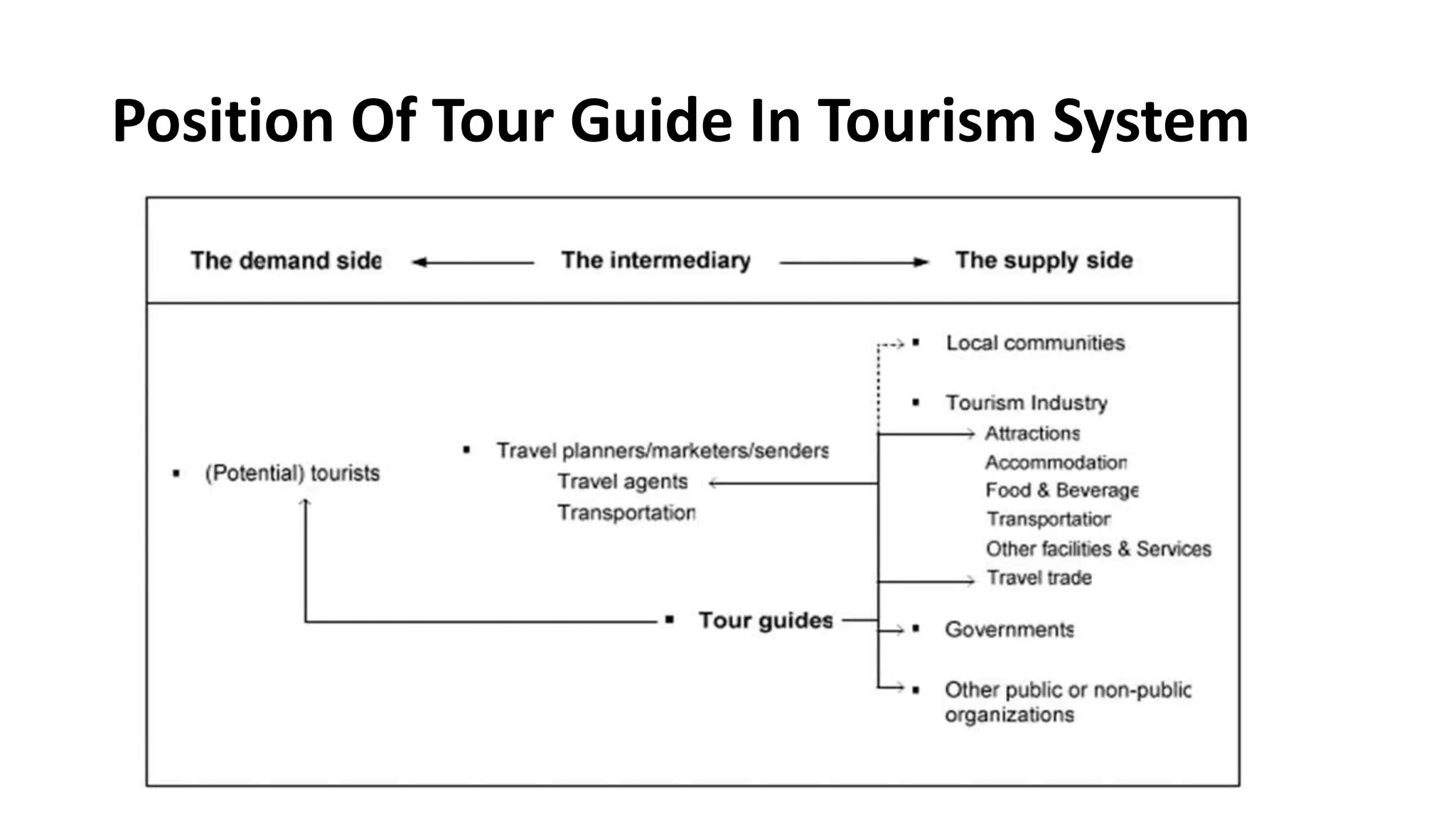
Position Of Tour Guide In Tourism System
Basically, a tourism system has three common parts:
The demand
The demand refers to the tourists
The supply
The supply side involves several stakeholders or players,
mainly including local communities, the tourism industry
government authorities and various other organizations. The
tourism industry is itself multi-dimensional and encompasses
at least six components: attractions, accommodation, food
and beverage, local transportation, other facilities and
services (e.g. places of entertainment and souvenir shops),
and the travel trade (i.e. travel operators, travel agents)
The linkage or intermediaries.
The intermediary component is composed of travel agents and
transportation companies (in both the guest community and the host
community) who function as travel planners and travel senders,
drawing up and arranging travel packages and transporting tourists
between origins and destinations.
Tour guides occupy a very special position in the system.
They are an essential part of the supply-side components. They can work for
all of the supply-side stakeholders, within all of the sectors of the tourism
industry.
Tour guides are generally considered to be service providers for visitors.
They are functioning as a bridge or a linkage between the demand and the
supply sides.
tour guides also form part of the intermediary component
Position Of Tour Guide In Tourism System
TYPES OF TOUR GUIDES
Free Lance – not permanently connected with any tour operator and paid
per trip.
Staff Guide – permanently connected with a tour operator, receives monthly
salary.
Local guide – a person competent enough to guide in a certain locality or
area.
Tour conductor/Escort/tour manager – person who accompanies a group of
tourists from the point of origin to the destination, and back to the origin.
Specialist – person who specializes in a certain field such as botany,
architecture, etc.
Linguist – person who speaks fluently two or more foreign languages.
Eco-Tour Guide- who perform the tour guide roles within ecological
classified areas, where nature. Flora and fauna and the local communities or
indigenous people are the main interest.
an ecotour guide is ‘someone employed on a paid or voluntary basis
who conducts paying or non-paying tourists around an area or site of
natural and/or cultural importance utilizing ecotourism and
interpretation principles’ (Black et al. 2000:3).
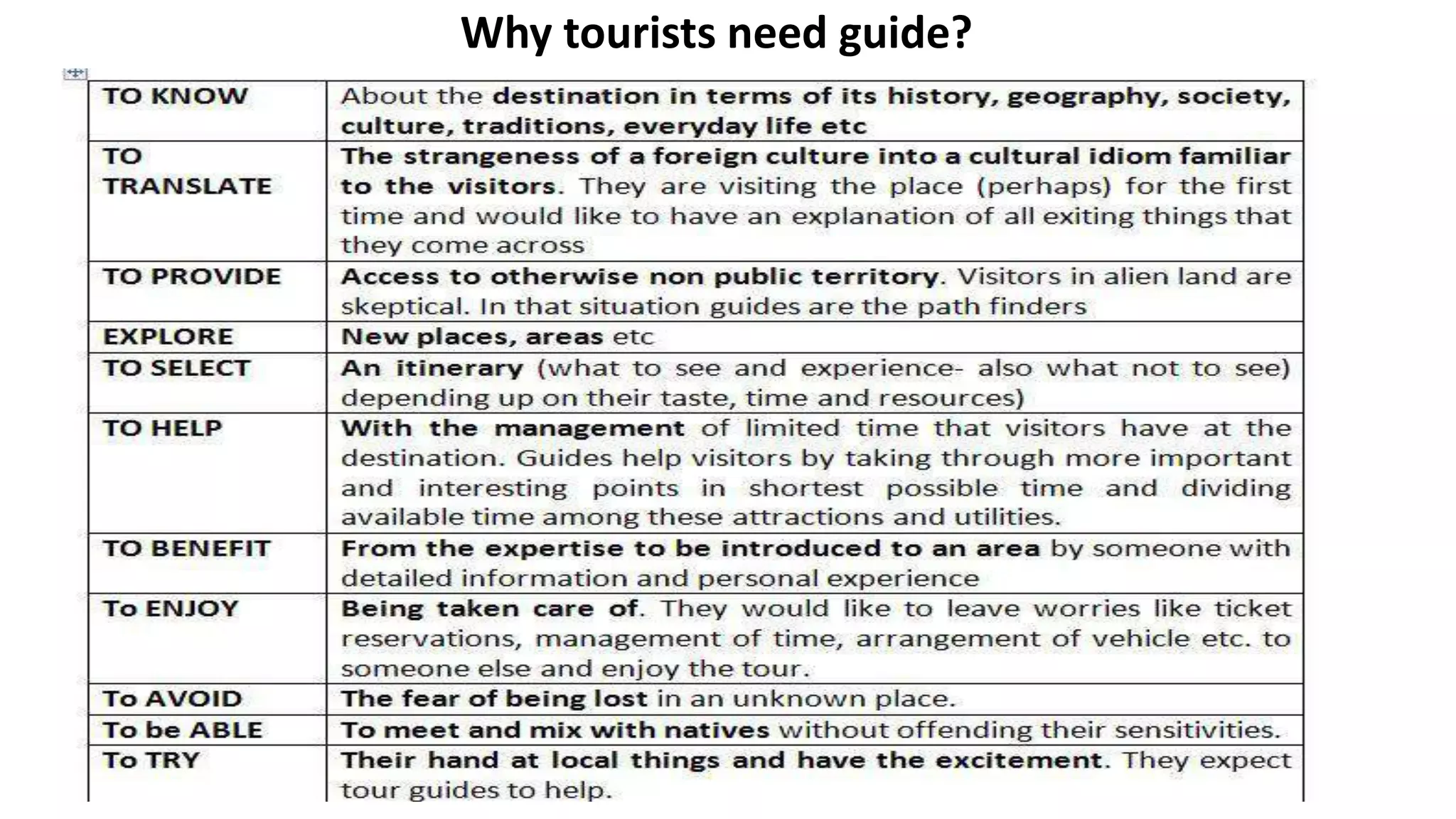
Why tourists need guide?
Qualities of an effective tour Guide/
Characteristics of good tour guides
Sensitivity- wide range of human understanding
Sympathetic person, ready to help visitors
Reliability (meeting deadlines, providing appropriate information, trustworthy
Knowledgeable person on attractions, destination and other issues of the country
and world
Effective and competent communicator, tour guides must have an ability to
communicate well. This includes articulation, eye contact, gestures, and a clear
pleasant speaking voice
Self-confidence- combining self-esteem with experience. This enable guides to
carry on their tasks effectively, to put people at ease and to help create enjoyable
experiences.
Proactive Nature- this means to initiate change and the willingness to assume
responsibility for initiating change.
Flexibility- ability to be adaptable and patient.
Authenticity- being genuine and honest.
A Pleasant, Professional Appearance- First impressions are often
lasting and are frequently based on one’s physical appearance.
Decisiveness- a guide must be able to make quick decisions.
Good Health- guiding requires great exertion.
Personal Integrity- a strong sense of ethics is essential to success.
Motivations for tour guiding a as profession
and career
factors that motivated the youth to take up tour guiding a as profession
and career. (1 mark each)
1. Alternative employment opportunity
2. Having skills and abilities
3. Government supports to the youth
4. Expanding social networking and relationship
5. personal experience as a traveler within a package tour
6. Learning needs and travel opportunity
7. The acquaintance and friends in the tourism industry
IMPORTANT SKILLS FOR TOUR GUIDE
Leadership skills
Customer cure skills
Health and safety skills
Marketing skills
Legal issues skills
Professionals and ethical standard skills
The use of job equipment
Interpretative guiding skills
Cross-cultural skills
knowledge of tourism products
Key Skills
Professional Tour Guides have a high level of general knowledge
Some have specialized site and destination expertise
Good communication and organizational skills
Providers of excellent customer service
Leadership and management skills
Qualified in first aid and occupational health and safety
Ecological and environmental awareness
Roles of tour guide
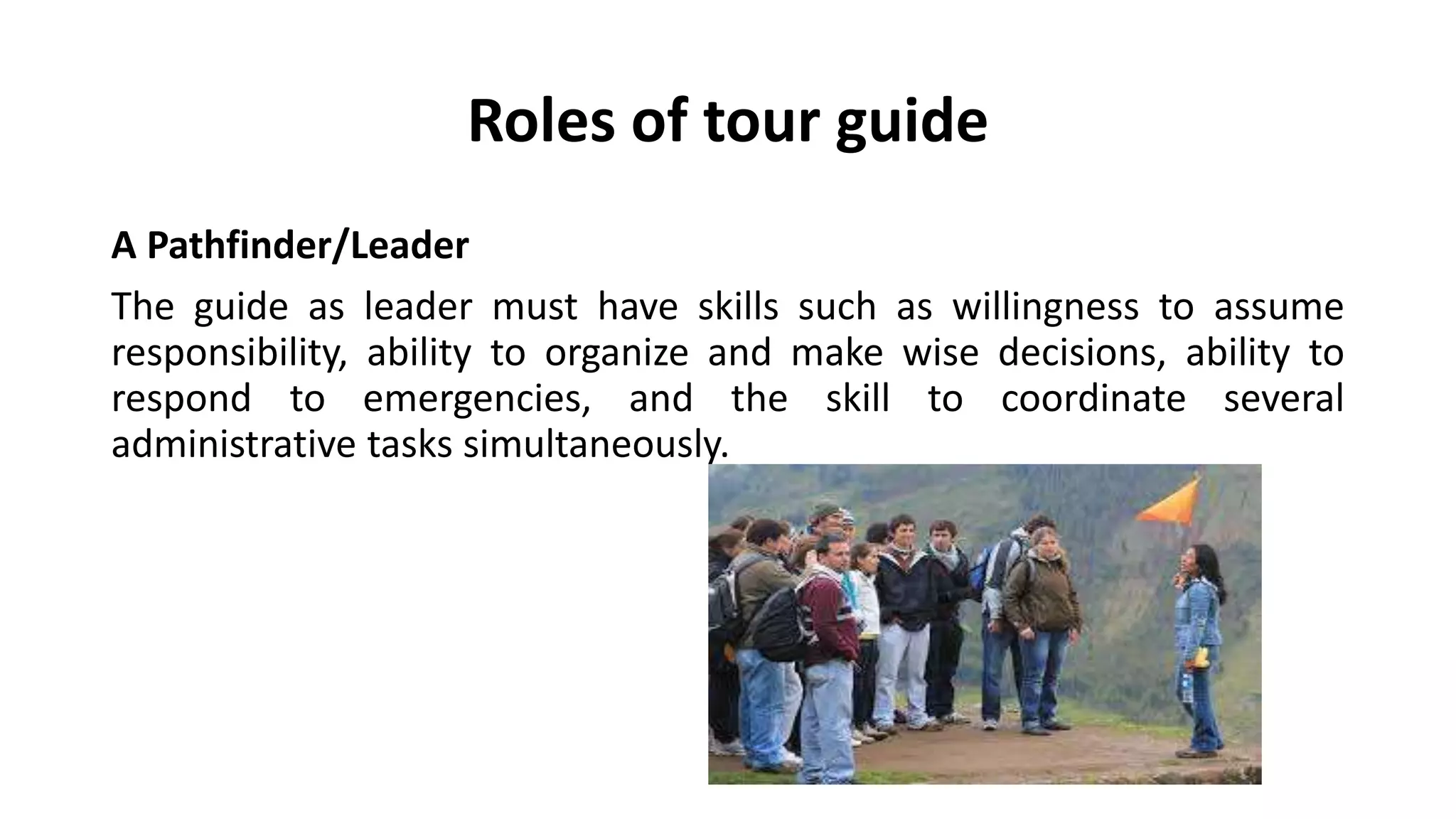
A Pathfinder/Leader
The guide as leader must have skills such as willingness to assume
responsibility, ability to organize and make wise decisions, ability to
respond to emergencies, and the skill to coordinate several
administrative tasks simultaneously.
Tour Guides As Sales Representatives
It is confirmed that tour guides becomes representatives of their
employees from the commencement of every tour and their
performance influences not only current visitors’ experiences but also
potential visitors’ intention to buy products because of effect due to
word-of-mouth.
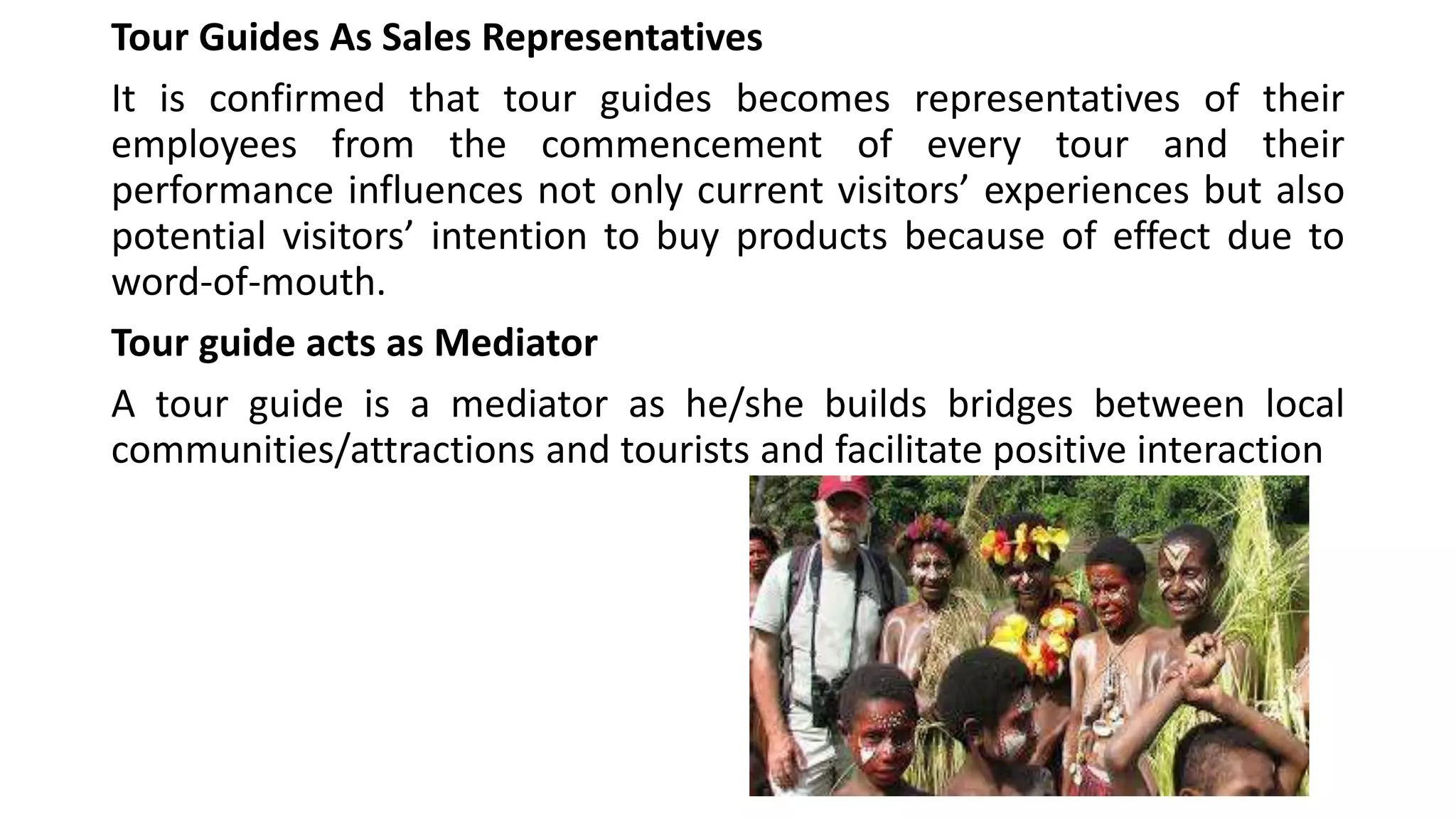
Tour guide acts as Mediator
A tour guide is a mediator as he/she builds bridges between local
communities/attractions and tourists and facilitate positive interaction
Tour guides act as ambassador
Tour guides act as ambassador since tour guides are the leading players
in enhancing the image and reputation of the destination. In
representing their locality, tour guides act on behalf of their country,
and hence, it is no surprise that they are commonly referred to as
“ambassadors”.
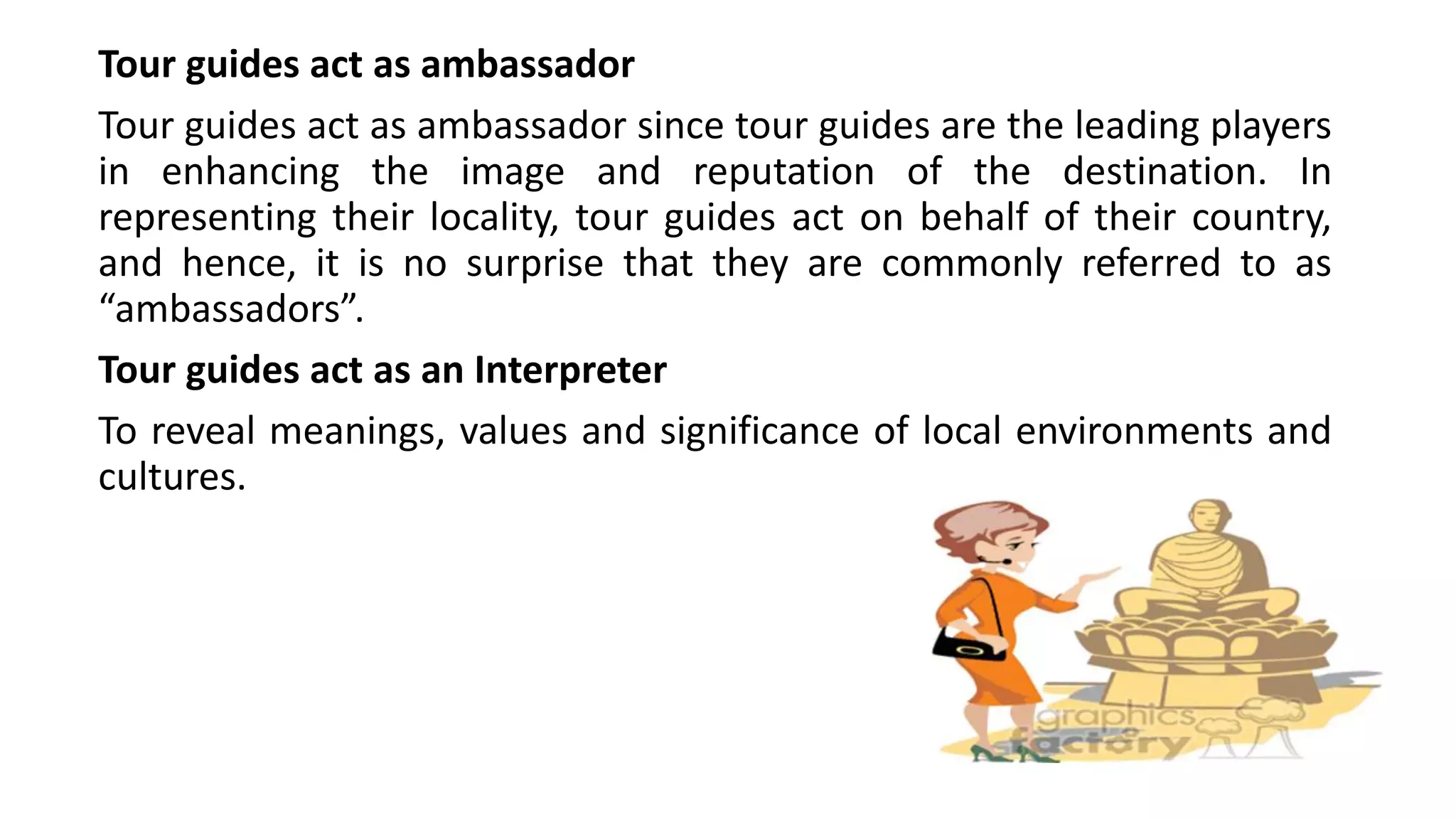
Tour guides act as an Interpreter
To reveal meanings, values and significance of local environments and
cultures.
Tour Guide Acts As Coordinator
Tour guide act as the link between the various suppliers and
coordinates the delivery of services from each. The supervision of
luggage van handlers-is coordinated by the tour guide and assisted by
the courier.
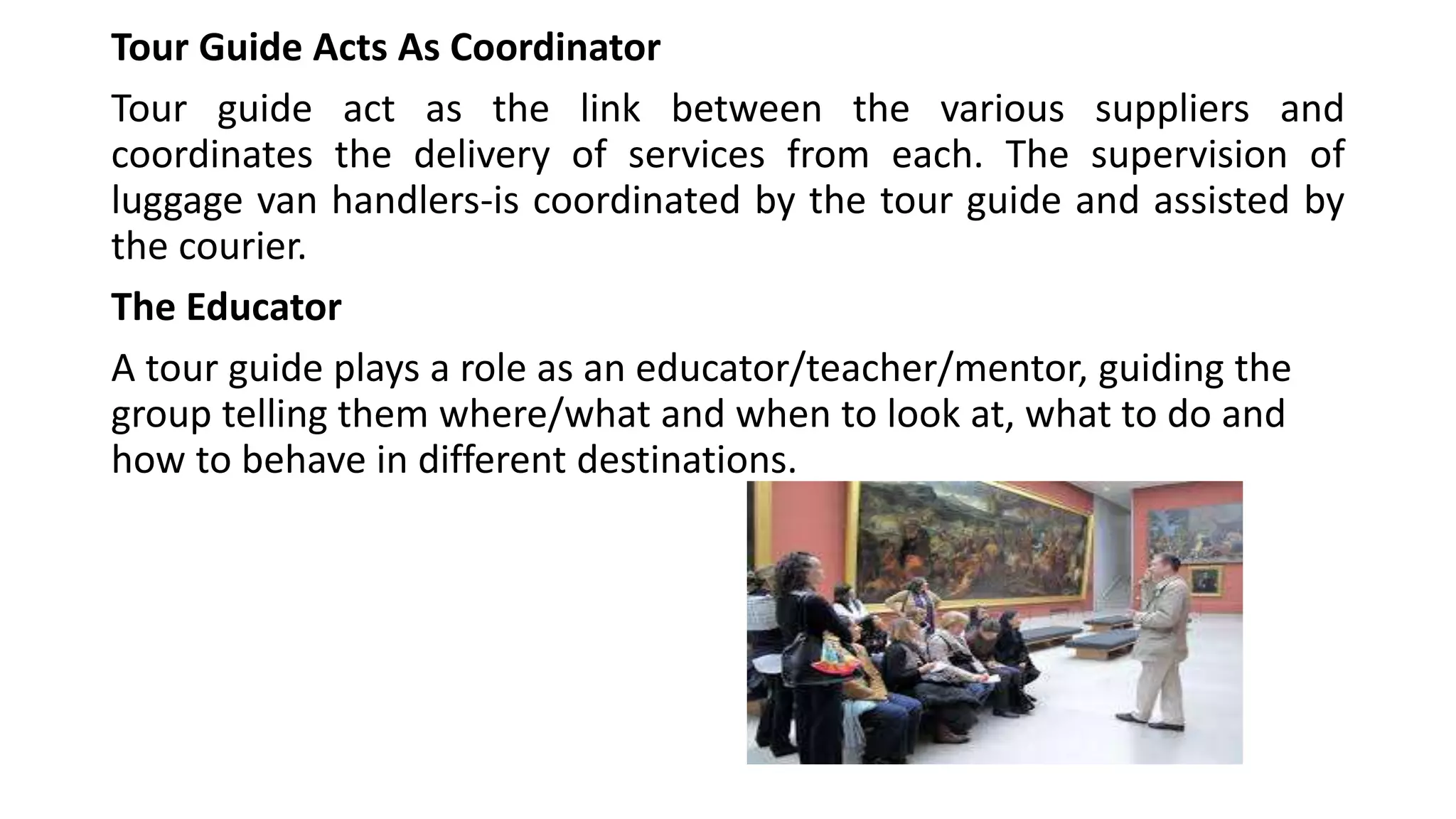
The Educator
A tour guide plays a role as an educator/teacher/mentor, guiding the
group telling them where/what and when to look at, what to do and
how to behave in different destinations.
Tools and technologies
Tour guides may use microphones, video cameras, maps, guide books
and display photos or diagrams in their work.
They may also use commentary notes that they write themselves and
memorize, as well as information handouts for visitors on their tour.
If they conduct long tours, they may also need to drive a bus or
coach and use equipment for cooking, navigation and setting up camp
sites.
 They are frequently required to wear a uniform or special clothing
that protects them from harsh weather conditions and assists them in
walking, trekking and other tour activities.
Problems of untrained tour guides
Many tour guides in the past as well as to day do not have any formal
education or training and learn through experience on the job. Highlight
problems and consequence associated with untrained tour guides.
1. Poor guiding performance/ services
2. Unethical guiding practices
3. Poor quality of visitor experience
4. Low visitors satisfaction
5. Lack of recognition, rewards and incentives
6. Negative publicity towards the guiding professional
7. Damage to destination image
CHALLENGES OF TOUR GUDING
PROFFESIONALISM
Literature reveals that like any other profession, tour guiding profession
is faced with a number of challenges that affect this field in one way or
the other.
The following are some of the challenges that tour guides face;
lack necessary skills and training to be tour guides
Lack of recognition and a poor image of profession.
Poor payments and low salaries of young tour guides
Absence of any monitoring of tour guide performance
Little support from government
Seasonality
CHALLENGES OF TOUR GUDING
PROFFESIONALISM
False criminal allegations are levelled against guides
Inability to meet expectations of a demanding tourist
Limited knowledge about tourism product/ destination
Poor competences in foreign language
Poor connectivity with other areas with tourism potential
Excessive competition from unauthorized tour guides. These un-
authorized guides are available for lower wages
Dependence on travel agents
Mechanisms To Improve Tour Guiding Service
Provision of Education and Training
To ensure that tour guides are professionally trained, there is need for
introducing a compulsory basic training to be taken by all practicing
and new entrant guides.
The introductory course for guides entering the field needs to comprise
some of the important issues such as local history, geography of
destination, local economy, customer care skills, health and safety
management and basic emergency aid.
Establishment of Tour Guides’ Association
Due to various challenges tour guides face, a good representation of
their grievances and complaints would help to channel their views and
opinions to relevant authorities such as government. Such being the
case, information of a national tour guides’ association to represent
interests of tour guides to government would be as essential remedial
action.
The association could also develop codes of ethics and conduct to be
followed by its members and this may help guides to accomplish their
expected roles and improve on their performance.
Certification and Licensing of Tour Guides
Tour guides are supposed to be registered, certified and given licenses
of performance. This approach could not only categorized and install
confidence in tour guides since they would be distinguished from
dubious guides, but also ensure minimum standards of professionalism
that would help improve service quality thereby enhancing both tour
guides’ and destination’s image.
Adoption Of A Code Of Conduct.
The formulation of a code of conduct and/or code of ethics is also
considered an effective measure in setting a standard for service
professionalism in tour guiding.
A code of conduct is a set of rules outlining the responsibilities of or
proper practices for an individual, a group, or an organization.
Training and code of conduct/ethics are important in shaping the
professional ethos and “habitus "of the guiding profession.
Formulating An Effective Monitoring And Evaluation System
The government should establish the strong institutions that will be
responsible in maintaining the service standard of the guiding
profession, An effective monitoring system can keep tourist
complaints at a low level.
Setting a standard for service professionalism

Introduction to tour guiding

  • 1.
  • 2.
    Subtopics 1. Meaning anddefinition 2. Main components of tour guiding 3. Terminologies Used In Tour Guiding 4. Understanding tour guide 5. Position of tour guide in tourism system 6. Types of tour guide 7. Roles of tour of guide
  • 3.
    Meaning and definitionof tour guiding Tour guiding is the process of interpreting attractions to visitors, directing, informing, instructing, and leading them in the visited places. Tour Guiding is usually for a shorter length of time. It refers to the specific activity at a sight or an attraction for a scheduled portion of time. Tour guiding refers to an act that provides assistance, information, interpretation to people on organized tours, individual clients, educational establishments, at religious and historical sites, museums, and at venues of other significant interest. It should be done by a person (normally) have a recognized national or regional tourist guide qualification.
  • 4.
    Main components oftour guiding The ATTRACTION: The VISITOR: The GUIDE:
  • 5.
    Terminologies Used InTour Guiding A tour is a pre-arranged (but not necessarily prepaid) journey, which includes accommodations, transportations, food services and entertainment, to one or more destinations and back to the point of origin. Tours that include all services for one price are called all-inclusive tours. Package tour is the sum total of variety of services offered to the tourists in one price, which normally less expensive than that of each individual items. Such tour largely includes the services of accommodation, transport, food, guide and other ground and miscellaneous services. Guided tours includes “all forms of tourism where the itinerary is fixed and known beforehand, and which involve some degree of planning and direct participation by agents apart from the tourists themselves” (Schmidt, 1979, p. 441).
  • 6.
    Terminologies Used InTour Guiding An itinerary is a schedule or an arrangement of programs or events. It is prepared for designing package tour. It shows the origin, destination and en- route halting points and duration of halts along with elements of services like hotel rooms, transports, activities and miscellaneous services. Tour commentaries: are the narrations a tour guide prepares and uses in order to explain and describe tourist attractions to a tour group, which includes giving facts and answering questions from tourists, as well as explaining local rules and taboos about the sight. Tour Conducting is about managing tours, it involves traveling with groups while staying with groups, controlling and entertaining people dealing with problems and at times guiding tours. The tour conductor can be with that group, depending on the type of tour for two to three weeks.
  • 7.
    Understanding tour guide Meaningand definition of tour guide Tourist guide is a person who guides visitors in the language of their choice and interprets the cultural and natural heritage of an area, which person normally possesses an area-specific qualification usually issued and/or recognized by the appropriate authority. A tour guide (U.S.) or a tourist guide (European A tour guide is a person who guide groups or individual visitors from abroad or from the home country around the monuments, sites and museums of a city or region; to interpret in an inspiring and entertaining manner, in the language of the visitor's choice, the cultural and natural heritage and environment (EFTGA, 1998).
  • 8.
    The tour guideis `a person with an effective combination of enthusiasm, knowledge, personality qualities and high standards of conduct and ethics who leads groups to the important sites (in our city), while providing interpretation and commentary. A tour guide is a person who directs tourists and offers them relevant information about the place they are visiting, while interpreting the cultural and natural heritage of an area.
  • 9.
    Position Of TourGuide In Tourism System Basically, a tourism system has three common parts: The demand The demand refers to the tourists The supply The supply side involves several stakeholders or players, mainly including local communities, the tourism industry government authorities and various other organizations. The tourism industry is itself multi-dimensional and encompasses at least six components: attractions, accommodation, food and beverage, local transportation, other facilities and services (e.g. places of entertainment and souvenir shops), and the travel trade (i.e. travel operators, travel agents)
  • 10.
    The linkage orintermediaries. The intermediary component is composed of travel agents and transportation companies (in both the guest community and the host community) who function as travel planners and travel senders, drawing up and arranging travel packages and transporting tourists between origins and destinations.
  • 11.
    Tour guides occupya very special position in the system. They are an essential part of the supply-side components. They can work for all of the supply-side stakeholders, within all of the sectors of the tourism industry. Tour guides are generally considered to be service providers for visitors. They are functioning as a bridge or a linkage between the demand and the supply sides. tour guides also form part of the intermediary component
  • 12.
    Position Of TourGuide In Tourism System
  • 13.
    TYPES OF TOURGUIDES Free Lance – not permanently connected with any tour operator and paid per trip. Staff Guide – permanently connected with a tour operator, receives monthly salary. Local guide – a person competent enough to guide in a certain locality or area. Tour conductor/Escort/tour manager – person who accompanies a group of tourists from the point of origin to the destination, and back to the origin. Specialist – person who specializes in a certain field such as botany, architecture, etc. Linguist – person who speaks fluently two or more foreign languages. Eco-Tour Guide- who perform the tour guide roles within ecological classified areas, where nature. Flora and fauna and the local communities or indigenous people are the main interest.
  • 14.
    an ecotour guideis ‘someone employed on a paid or voluntary basis who conducts paying or non-paying tourists around an area or site of natural and/or cultural importance utilizing ecotourism and interpretation principles’ (Black et al. 2000:3).
  • 15.
  • 16.
    Qualities of aneffective tour Guide/ Characteristics of good tour guides Sensitivity- wide range of human understanding Sympathetic person, ready to help visitors Reliability (meeting deadlines, providing appropriate information, trustworthy Knowledgeable person on attractions, destination and other issues of the country and world Effective and competent communicator, tour guides must have an ability to communicate well. This includes articulation, eye contact, gestures, and a clear pleasant speaking voice Self-confidence- combining self-esteem with experience. This enable guides to carry on their tasks effectively, to put people at ease and to help create enjoyable experiences. Proactive Nature- this means to initiate change and the willingness to assume responsibility for initiating change.
  • 17.
    Flexibility- ability tobe adaptable and patient. Authenticity- being genuine and honest. A Pleasant, Professional Appearance- First impressions are often lasting and are frequently based on one’s physical appearance. Decisiveness- a guide must be able to make quick decisions. Good Health- guiding requires great exertion. Personal Integrity- a strong sense of ethics is essential to success.
  • 18.
    Motivations for tourguiding a as profession and career factors that motivated the youth to take up tour guiding a as profession and career. (1 mark each) 1. Alternative employment opportunity 2. Having skills and abilities 3. Government supports to the youth 4. Expanding social networking and relationship 5. personal experience as a traveler within a package tour 6. Learning needs and travel opportunity 7. The acquaintance and friends in the tourism industry
  • 19.
    IMPORTANT SKILLS FORTOUR GUIDE Leadership skills Customer cure skills Health and safety skills Marketing skills Legal issues skills Professionals and ethical standard skills The use of job equipment Interpretative guiding skills Cross-cultural skills knowledge of tourism products
  • 20.
    Key Skills Professional TourGuides have a high level of general knowledge Some have specialized site and destination expertise Good communication and organizational skills Providers of excellent customer service Leadership and management skills Qualified in first aid and occupational health and safety Ecological and environmental awareness
  • 21.
    Roles of tourguide A Pathfinder/Leader The guide as leader must have skills such as willingness to assume responsibility, ability to organize and make wise decisions, ability to respond to emergencies, and the skill to coordinate several administrative tasks simultaneously.
  • 22.
    Tour Guides AsSales Representatives It is confirmed that tour guides becomes representatives of their employees from the commencement of every tour and their performance influences not only current visitors’ experiences but also potential visitors’ intention to buy products because of effect due to word-of-mouth. Tour guide acts as Mediator A tour guide is a mediator as he/she builds bridges between local communities/attractions and tourists and facilitate positive interaction
  • 23.
    Tour guides actas ambassador Tour guides act as ambassador since tour guides are the leading players in enhancing the image and reputation of the destination. In representing their locality, tour guides act on behalf of their country, and hence, it is no surprise that they are commonly referred to as “ambassadors”. Tour guides act as an Interpreter To reveal meanings, values and significance of local environments and cultures.
  • 24.
    Tour Guide ActsAs Coordinator Tour guide act as the link between the various suppliers and coordinates the delivery of services from each. The supervision of luggage van handlers-is coordinated by the tour guide and assisted by the courier. The Educator A tour guide plays a role as an educator/teacher/mentor, guiding the group telling them where/what and when to look at, what to do and how to behave in different destinations.
  • 25.
    Tools and technologies Tourguides may use microphones, video cameras, maps, guide books and display photos or diagrams in their work. They may also use commentary notes that they write themselves and memorize, as well as information handouts for visitors on their tour. If they conduct long tours, they may also need to drive a bus or coach and use equipment for cooking, navigation and setting up camp sites.  They are frequently required to wear a uniform or special clothing that protects them from harsh weather conditions and assists them in walking, trekking and other tour activities.
  • 26.
    Problems of untrainedtour guides Many tour guides in the past as well as to day do not have any formal education or training and learn through experience on the job. Highlight problems and consequence associated with untrained tour guides. 1. Poor guiding performance/ services 2. Unethical guiding practices 3. Poor quality of visitor experience 4. Low visitors satisfaction 5. Lack of recognition, rewards and incentives 6. Negative publicity towards the guiding professional 7. Damage to destination image
  • 27.
    CHALLENGES OF TOURGUDING PROFFESIONALISM Literature reveals that like any other profession, tour guiding profession is faced with a number of challenges that affect this field in one way or the other. The following are some of the challenges that tour guides face; lack necessary skills and training to be tour guides Lack of recognition and a poor image of profession. Poor payments and low salaries of young tour guides Absence of any monitoring of tour guide performance Little support from government Seasonality
  • 28.
    CHALLENGES OF TOURGUDING PROFFESIONALISM False criminal allegations are levelled against guides Inability to meet expectations of a demanding tourist Limited knowledge about tourism product/ destination Poor competences in foreign language Poor connectivity with other areas with tourism potential Excessive competition from unauthorized tour guides. These un- authorized guides are available for lower wages Dependence on travel agents
  • 29.
    Mechanisms To ImproveTour Guiding Service Provision of Education and Training To ensure that tour guides are professionally trained, there is need for introducing a compulsory basic training to be taken by all practicing and new entrant guides. The introductory course for guides entering the field needs to comprise some of the important issues such as local history, geography of destination, local economy, customer care skills, health and safety management and basic emergency aid.
  • 30.
    Establishment of TourGuides’ Association Due to various challenges tour guides face, a good representation of their grievances and complaints would help to channel their views and opinions to relevant authorities such as government. Such being the case, information of a national tour guides’ association to represent interests of tour guides to government would be as essential remedial action. The association could also develop codes of ethics and conduct to be followed by its members and this may help guides to accomplish their expected roles and improve on their performance.
  • 31.
    Certification and Licensingof Tour Guides Tour guides are supposed to be registered, certified and given licenses of performance. This approach could not only categorized and install confidence in tour guides since they would be distinguished from dubious guides, but also ensure minimum standards of professionalism that would help improve service quality thereby enhancing both tour guides’ and destination’s image.
  • 32.
    Adoption Of ACode Of Conduct. The formulation of a code of conduct and/or code of ethics is also considered an effective measure in setting a standard for service professionalism in tour guiding. A code of conduct is a set of rules outlining the responsibilities of or proper practices for an individual, a group, or an organization. Training and code of conduct/ethics are important in shaping the professional ethos and “habitus "of the guiding profession.
  • 33.
    Formulating An EffectiveMonitoring And Evaluation System The government should establish the strong institutions that will be responsible in maintaining the service standard of the guiding profession, An effective monitoring system can keep tourist complaints at a low level. Setting a standard for service professionalism