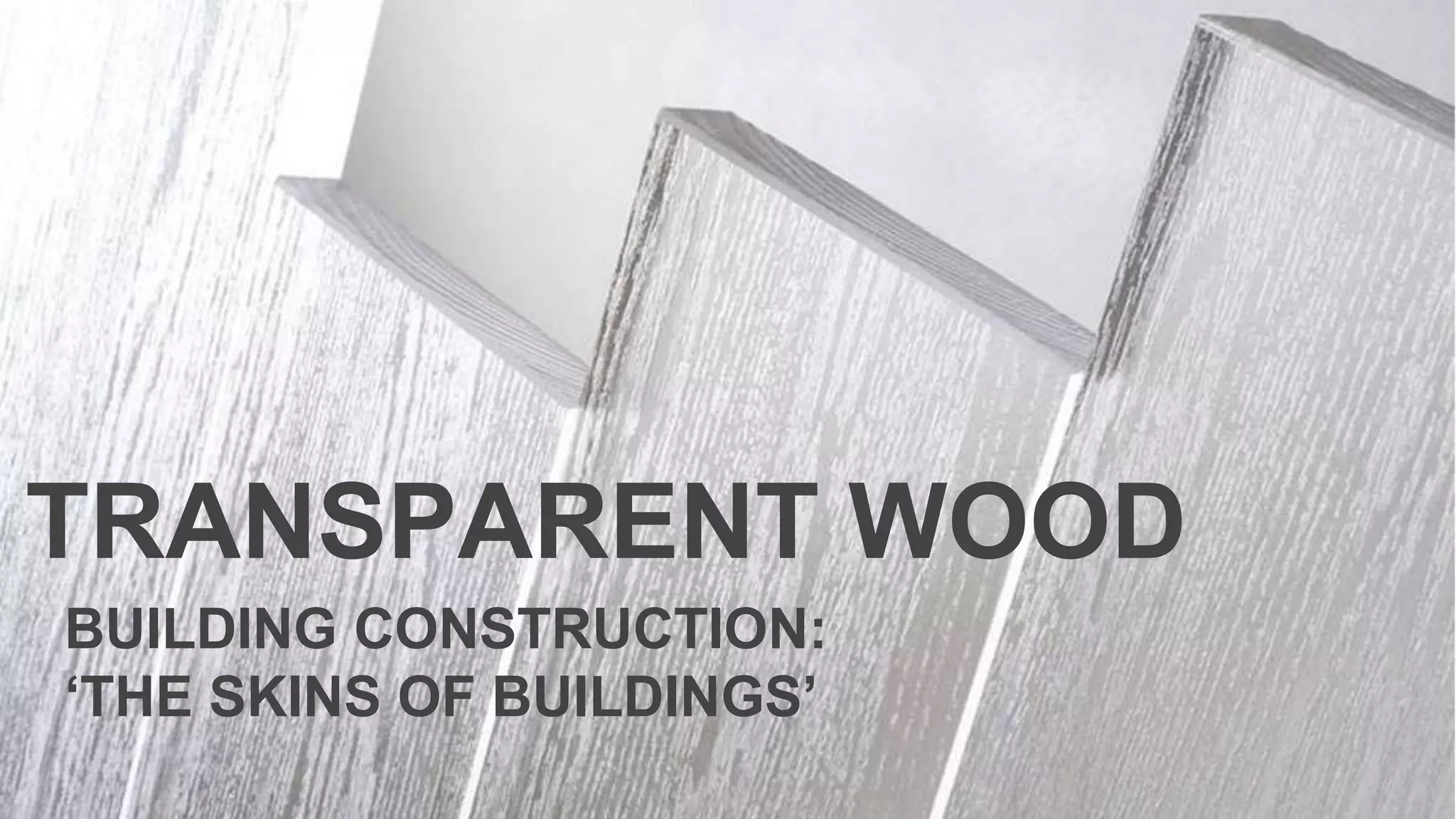
TRANSPARENT WOOD
BUILDING CONSTRUCTION:
‘THE SKINS OF BUILDINGS’
INTRODUCTION
Wood is by far the most used, bio-based material in
buildings.
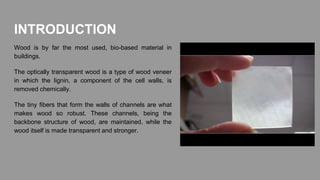
The optically transparent wood is a type of wood veneer
in which the lignin, a component of the cell walls, is
removed chemically.
The tiny fibers that form the walls of channels are what
makes wood so robust. These channels, being the
backbone structure of wood, are maintained, while the
wood itself is made transparent and stronger.
PRODUCTION PROCESS
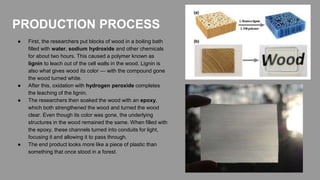
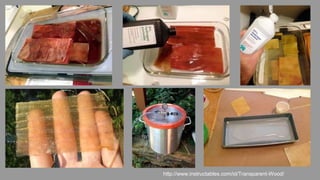
● First, the researchers put blocks of wood in a boiling bath
filled with water, sodium hydroxide and other chemicals
for about two hours. This caused a polymer known as
lignin to leach out of the cell walls in the wood. Lignin is
also what gives wood its color — with the compound gone
the wood turned white.
● After this, oxidation with hydrogen peroxide completes
the leaching of the lignin.
● The researchers then soaked the wood with an epoxy,
which both strengthened the wood and turned the wood
clear. Even though its color was gone, the underlying
structures in the wood remained the same. When filled with
the epoxy, these channels turned into conduits for light,
focusing it and allowing it to pass through.
● The end product looks more like a piece of plastic than
something that once stood in a forest.
http://www.instructables.com/id/Transparent-Wood/
PHYSICAL PROPERTIES
● Transparent- It transmits 85% light. It isn't crystal clear, but hazy. In addition to affording a
measure of privacy to people inside buildings made of transparent wood, the haziness means
the material traps some light.
● Wood has lower thermal conductivity which would help to keep a building at more consistent
temperature and make it easier to reach higher energy efficiency.
● Shatterproof
● Biodegradable
● Stronger than glass and plastic
● Energy efficient
● Low density
● Fire retardant property: During a fire,
fire-retardant chemicals begin to react
when temperatures reach a point slightly
below the point where wood will ignite.
Nonu-flammable gases and water vapour
are formed and released at a slow steady
rate thereby insulating the wood fibres
from temperatures that would cause them
to burn.
ADVANTAGES
● Transparent wood is shatterproof.
● It is significantly more biodegradable than
glass or plastic.
● It is stronger than glass and plastic.
● It achieves a 85% transmittance rate for light.
● It has excellent mechanical properties,
including strength, toughness, low density
and low thermal conductivity.
● Economic and suitable for mass production in
the future.
● It could reduce a building's net energy
consumption not only by reducing the need
for artificial lighting but also by generating
electricity.
LIMITATIONS
● Currently, the researchers can only treat
wood chunks that are up to about four
inches to a side.
● They are currently limited to about a
centimeter in thickness, although they
have made clear wood that is as thin as a
sheet of paper as well.
ENVIRONMENTAL EFFECTS
● The researchers say widespread use of their "transparent"
wood could slash energy costs by reducing the need for
artificial lighting inside homes and other buildings.
● At a time when residences account for 27% of global
energy consumption and 17% of carbon dioxide emissions,
transparent wood can allow homeowners to take major and
meaningful steps to shrink their negative environmental
impact.
● In a world where modern urban architecture relies heavily on the use of glass and steel, replacing
these materials with transparent, biodegradable wood could revolutionize design concepts -- as well
as reduce heating costs and help to lower fuel consumption.
CAR WINDSCREENS: Since the durability of
this material is better than glass and also, since
it is considered to not shatter on impact,
replacing glass windscreens with this material
seems logical
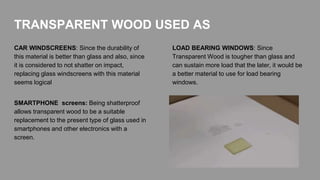
LOAD BEARING WINDOWS: Since
Transparent Wood is tougher than glass and
can sustain more load that the later, it would be
a better material to use for load bearing
windows.
TRANSPARENT WOOD USED AS
SMARTPHONE screens: Being shatterproof
allows transparent wood to be a suitable
replacement to the present type of glass used in
smartphones and other electronics with a
screen.
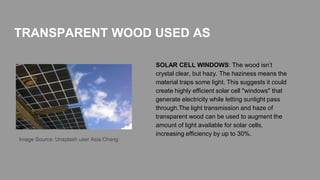
SOLAR CELL WINDOWS: The wood isn’t
crystal clear, but hazy. The haziness means the
material traps some light. This suggests it could
create highly efficient solar cell "windows" that
generate electricity while letting sunlight pass
through.The light transmission and haze of
transparent wood can be used to augment the
amount of light available for solar cells,
increasing efficiency by up to 30%.
TRANSPARENT WOOD USED AS
Image Source: Unsplash user Asia Chang
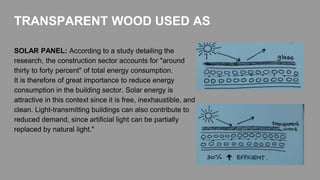
SOLAR PANEL: According to a study detailing the
research, the construction sector accounts for "around
thirty to forty percent" of total energy consumption.
It is therefore of great importance to reduce energy
consumption in the building sector. Solar energy is
attractive in this context since it is free, inexhaustible, and
clean. Light-transmitting buildings can also contribute to
reduced demand, since artificial light can be partially
replaced by natural light."
TRANSPARENT WOOD USED AS
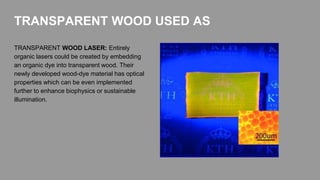
TRANSPARENT WOOD LASER: Entirely
organic lasers could be created by embedding
an organic dye into transparent wood. Their
newly developed wood-dye material has optical
properties which can be even implemented
further to enhance biophysics or sustainable
illumination.
TRANSPARENT WOOD USED AS
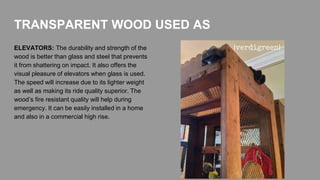
ELEVATORS: The durability and strength of the
wood is better than glass and steel that prevents
it from shattering on impact. It also offers the
visual pleasure of elevators when glass is used.
The speed will increase due to its lighter weight
as well as making its ride quality superior. The
wood’s fire resistant quality will help during
emergency. It can be easily installed in a home
and also in a commercial high rise.
TRANSPARENT WOOD USED AS
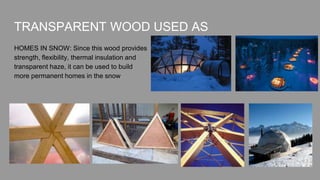
HOMES IN SNOW: Since this wood provides
strength, flexibility, thermal insulation and
transparent haze, it can be used to build
more permanent homes in the snow
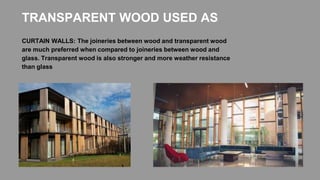
CURTAIN WALLS: The joineries between wood and transparent wood
are much preferred when compared to joineries between wood and
glass. Transparent wood is also stronger and more weather resistance
than glass
TRANSPARENT WOOD USED AS
SOURCES
● Courtesy: University of Maryland
● http://blogs.discovermagazine.com/d-brief/2016/05/16/transparent-wood-is-a-surprisingly-versatile-
material/#.WzOXXivhWEc
● https://www.wired.co.uk/article/transparent-wood-building-walls-solar-cells
● https://www.sciencedaily.com/releases/2016/03/160330085735.htm
● https://www.futuresplatform.com/blog/transparent-wood
● https://www.natureworldnews.com/articles/22960/20160526/scientists-create-transparent-wood-find-
out-uses.htm
● http://www.instructables.com/id/Transparent-Wood/
● https://www.google.co.in/amp/s/m.huffpost.com/us/entry/us_56fd3c14e4b0daf53aeee8e6/amp
● https://blog.allplan.com/en/transparent-wood

Transparent Wood

  • 1.
  • 2.
    INTRODUCTION Wood is byfar the most used, bio-based material in buildings. The optically transparent wood is a type of wood veneer in which the lignin, a component of the cell walls, is removed chemically. The tiny fibers that form the walls of channels are what makes wood so robust. These channels, being the backbone structure of wood, are maintained, while the wood itself is made transparent and stronger.
  • 3.
    PRODUCTION PROCESS ● First,the researchers put blocks of wood in a boiling bath filled with water, sodium hydroxide and other chemicals for about two hours. This caused a polymer known as lignin to leach out of the cell walls in the wood. Lignin is also what gives wood its color — with the compound gone the wood turned white. ● After this, oxidation with hydrogen peroxide completes the leaching of the lignin. ● The researchers then soaked the wood with an epoxy, which both strengthened the wood and turned the wood clear. Even though its color was gone, the underlying structures in the wood remained the same. When filled with the epoxy, these channels turned into conduits for light, focusing it and allowing it to pass through. ● The end product looks more like a piece of plastic than something that once stood in a forest.
  • 4.
  • 5.
    PHYSICAL PROPERTIES ● Transparent-It transmits 85% light. It isn't crystal clear, but hazy. In addition to affording a measure of privacy to people inside buildings made of transparent wood, the haziness means the material traps some light. ● Wood has lower thermal conductivity which would help to keep a building at more consistent temperature and make it easier to reach higher energy efficiency. ● Shatterproof ● Biodegradable ● Stronger than glass and plastic ● Energy efficient ● Low density ● Fire retardant property: During a fire, fire-retardant chemicals begin to react when temperatures reach a point slightly below the point where wood will ignite. Nonu-flammable gases and water vapour are formed and released at a slow steady rate thereby insulating the wood fibres from temperatures that would cause them to burn.
  • 6.
    ADVANTAGES ● Transparent woodis shatterproof. ● It is significantly more biodegradable than glass or plastic. ● It is stronger than glass and plastic. ● It achieves a 85% transmittance rate for light. ● It has excellent mechanical properties, including strength, toughness, low density and low thermal conductivity. ● Economic and suitable for mass production in the future. ● It could reduce a building's net energy consumption not only by reducing the need for artificial lighting but also by generating electricity. LIMITATIONS ● Currently, the researchers can only treat wood chunks that are up to about four inches to a side. ● They are currently limited to about a centimeter in thickness, although they have made clear wood that is as thin as a sheet of paper as well.
  • 7.
    ENVIRONMENTAL EFFECTS ● Theresearchers say widespread use of their "transparent" wood could slash energy costs by reducing the need for artificial lighting inside homes and other buildings. ● At a time when residences account for 27% of global energy consumption and 17% of carbon dioxide emissions, transparent wood can allow homeowners to take major and meaningful steps to shrink their negative environmental impact. ● In a world where modern urban architecture relies heavily on the use of glass and steel, replacing these materials with transparent, biodegradable wood could revolutionize design concepts -- as well as reduce heating costs and help to lower fuel consumption.
  • 8.
    CAR WINDSCREENS: Sincethe durability of this material is better than glass and also, since it is considered to not shatter on impact, replacing glass windscreens with this material seems logical LOAD BEARING WINDOWS: Since Transparent Wood is tougher than glass and can sustain more load that the later, it would be a better material to use for load bearing windows. TRANSPARENT WOOD USED AS SMARTPHONE screens: Being shatterproof allows transparent wood to be a suitable replacement to the present type of glass used in smartphones and other electronics with a screen.
  • 9.
    SOLAR CELL WINDOWS:The wood isn’t crystal clear, but hazy. The haziness means the material traps some light. This suggests it could create highly efficient solar cell "windows" that generate electricity while letting sunlight pass through.The light transmission and haze of transparent wood can be used to augment the amount of light available for solar cells, increasing efficiency by up to 30%. TRANSPARENT WOOD USED AS Image Source: Unsplash user Asia Chang
  • 10.
    SOLAR PANEL: Accordingto a study detailing the research, the construction sector accounts for "around thirty to forty percent" of total energy consumption. It is therefore of great importance to reduce energy consumption in the building sector. Solar energy is attractive in this context since it is free, inexhaustible, and clean. Light-transmitting buildings can also contribute to reduced demand, since artificial light can be partially replaced by natural light." TRANSPARENT WOOD USED AS
  • 11.
    TRANSPARENT WOOD LASER:Entirely organic lasers could be created by embedding an organic dye into transparent wood. Their newly developed wood-dye material has optical properties which can be even implemented further to enhance biophysics or sustainable illumination. TRANSPARENT WOOD USED AS
  • 12.
    ELEVATORS: The durabilityand strength of the wood is better than glass and steel that prevents it from shattering on impact. It also offers the visual pleasure of elevators when glass is used. The speed will increase due to its lighter weight as well as making its ride quality superior. The wood’s fire resistant quality will help during emergency. It can be easily installed in a home and also in a commercial high rise. TRANSPARENT WOOD USED AS
  • 13.
    TRANSPARENT WOOD USEDAS HOMES IN SNOW: Since this wood provides strength, flexibility, thermal insulation and transparent haze, it can be used to build more permanent homes in the snow
  • 14.
    CURTAIN WALLS: Thejoineries between wood and transparent wood are much preferred when compared to joineries between wood and glass. Transparent wood is also stronger and more weather resistance than glass TRANSPARENT WOOD USED AS
  • 15.
    SOURCES ● Courtesy: Universityof Maryland ● http://blogs.discovermagazine.com/d-brief/2016/05/16/transparent-wood-is-a-surprisingly-versatile- material/#.WzOXXivhWEc ● https://www.wired.co.uk/article/transparent-wood-building-walls-solar-cells ● https://www.sciencedaily.com/releases/2016/03/160330085735.htm ● https://www.futuresplatform.com/blog/transparent-wood ● https://www.natureworldnews.com/articles/22960/20160526/scientists-create-transparent-wood-find- out-uses.htm ● http://www.instructables.com/id/Transparent-Wood/ ● https://www.google.co.in/amp/s/m.huffpost.com/us/entry/us_56fd3c14e4b0daf53aeee8e6/amp ● https://blog.allplan.com/en/transparent-wood