18fap2ar015
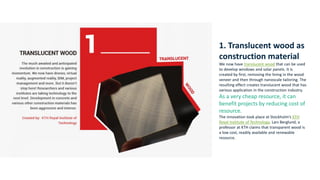
1. Translucent wood as
construction material
We now have translucent wood that can be used
to develop windows and solar panels. It is
created by first, removing the lining in the wood
veneer and then through nanoscale tailoring. The
resulting effect creates translucent wood that has
various application in the construction industry.
As a very cheap resource, it can
benefit projects by reducing cost of
resource.
The innovation took place at Stockholm’s KTH
Royal Institute of Technology. Lars Berglund, a
professor at KTH claims that transparent wood is
a low cost, readily available and renewable
resource.
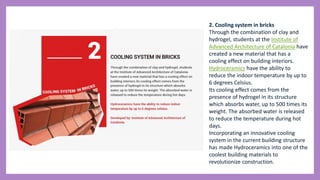
2. Cooling system in bricks
Through the combination of clay and
hydrogel, students at the Institute of
Advanced Architecture of Catalonia have
created a new material that has a
cooling effect on building interiors.
Hydroceramics have the ability to
reduce the indoor temperature by up to
6 degrees Celsius.
Its cooling effect comes from the
presence of hydrogel in its structure
which absorbs water, up to 500 times its
weight. The absorbed water is released
to reduce the temperature during hot
days.
Incorporating an innovative cooling
system in the current building structure
has made Hydroceramics into one of the
coolest building materials to
revolutionize construction.
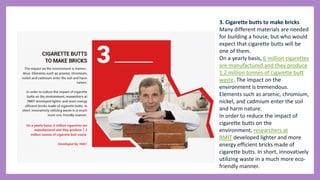
3. Cigarette butts to make bricks
Many different materials are needed
for building a house, but who would
expect that cigarette butts will be
one of them.
On a yearly basis, 6 million cigarettes
are manufactured and they produce
1.2 million tonnes of cigarette butt
waste. The impact on the
environment is tremendous.
Elements such as arsenic, chromium,
nickel, and cadmium enter the soil
and harm nature.
In order to reduce the impact of
cigarette butts on the
environment, researchers at
RMIT developed lighter and more
energy efficient bricks made of
cigarette butts. In short, innovatively
utilizing waste in a much more eco-
friendly manner.
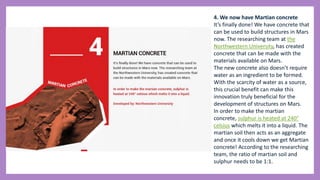
4. We now have Martian concrete
It’s finally done! We have concrete that
can be used to build structures in Mars
now. The researching team at the
Northwestern University, has created
concrete that can be made with the
materials available on Mars.
The new concrete also doesn’t require
water as an ingredient to be formed.
With the scarcity of water as a source,
this crucial benefit can make this
innovation truly beneficial for the
development of structures on Mars.
In order to make the martian
concrete, sulphur is heated at 240°
celsius which melts it into a liquid. The
martian soil then acts as an aggregate
and once it cools down we get Martian
concrete! According to the researching
team, the ratio of martian soil and
sulphur needs to be 1:1.
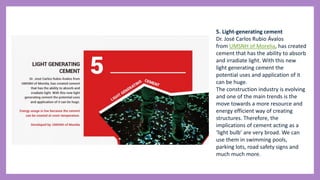
5. Light-generating cement
Dr. José Carlos Rubio Ávalos
from UMSNH of Morelia, has created
cement that has the ability to absorb
and irradiate light. With this new
light generating cement the
potential uses and application of it
can be huge.
The construction industry is evolving
and one of the main trends is the
move towards a more resource and
energy efficient way of creating
structures. Therefore, the
implications of cement acting as a
‘light bulb’ are very broad. We can
use them in swimming pools,
parking lots, road safety signs and
much much more.
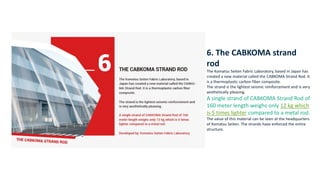
6. The CABKOMA strand
rod
The Komatsu Seiten Fabric Laboratory, based in Japan has
created a new material called the CABKOMA Strand Rod. It
is a thermoplastic carbon fiber composite.
The strand is the lightest seismic reinforcement and is very
aesthetically pleasing.
A single strand of CABKOMA Strand Rod of
160 meter length weighs only 12 kg which
is 5 times lighter compared to a metal rod.
The value of this material can be seen at the headquarters
of Komatsu Seiten. The strands have enforced the entire
structure.
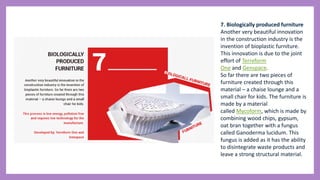
7. Biologically produced furniture
Another very beautiful innovation
in the construction industry is the
invention of bioplastic furniture.
This innovation is due to the joint
effort of Terreform
One and Genspace.
So far there are two pieces of
furniture created through this
material – a chaise lounge and a
small chair for kids. The furniture is
made by a material
called Mycoform, which is made by
combining wood chips, gypsum,
oat bran together with a fungus
called Ganoderma lucidum. This
fungus is added as it has the ability
to disintegrate waste products and
leave a strong structural material.
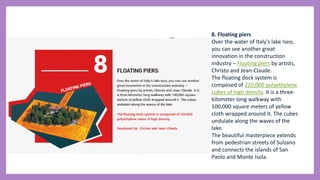
8. Floating piers
Over the water of Italy’s lake Iseo,
you can see another great
innovation in the construction
industry – Floating piers by artists,
Christo and Jean-Claude.
The floating dock system is
composed of 220,000 polyethylene
cubes of high density. It is a three-
kilometer long walkway with
100,000 square meters of yellow
cloth wrapped around it. The cubes
undulate along the waves of the
lake.
The beautiful masterpiece extends
from pedestrian streets of Sulzano
and connects the islands of San
Paolo and Monte Isola.
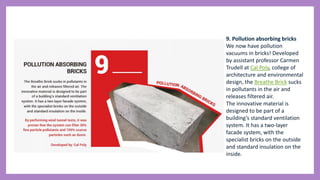
9. Pollution absorbing bricks
We now have pollution
vacuums in bricks! Developed
by assistant professor Carmen
Trudell at Cal Poly, college of
architecture and environmental
design, the Breathe Brick sucks
in pollutants in the air and
releases filtered air.
The innovative material is
designed to be part of a
building’s standard ventilation
system. It has a two-layer
facade system, with the
specialist bricks on the outside
and standard insulation on the
inside.
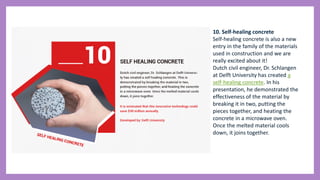
10. Self-healing concrete
Self-healing concrete is also a new
entry in the family of the materials
used in construction and we are
really excited about it!
Dutch civil engineer, Dr. Schlangen
at Delft University has created a
self-healing concrete. In his
presentation, he demonstrated the
effectiveness of the material by
breaking it in two, putting the
pieces together, and heating the
concrete in a microwave oven.
Once the melted material cools
down, it joins together.
A3

A3

  • 1.
  • 2.
    1. Translucent woodas construction material We now have translucent wood that can be used to develop windows and solar panels. It is created by first, removing the lining in the wood veneer and then through nanoscale tailoring. The resulting effect creates translucent wood that has various application in the construction industry. As a very cheap resource, it can benefit projects by reducing cost of resource. The innovation took place at Stockholm’s KTH Royal Institute of Technology. Lars Berglund, a professor at KTH claims that transparent wood is a low cost, readily available and renewable resource.
  • 3.
    2. Cooling systemin bricks Through the combination of clay and hydrogel, students at the Institute of Advanced Architecture of Catalonia have created a new material that has a cooling effect on building interiors. Hydroceramics have the ability to reduce the indoor temperature by up to 6 degrees Celsius. Its cooling effect comes from the presence of hydrogel in its structure which absorbs water, up to 500 times its weight. The absorbed water is released to reduce the temperature during hot days. Incorporating an innovative cooling system in the current building structure has made Hydroceramics into one of the coolest building materials to revolutionize construction.
  • 4.
    3. Cigarette buttsto make bricks Many different materials are needed for building a house, but who would expect that cigarette butts will be one of them. On a yearly basis, 6 million cigarettes are manufactured and they produce 1.2 million tonnes of cigarette butt waste. The impact on the environment is tremendous. Elements such as arsenic, chromium, nickel, and cadmium enter the soil and harm nature. In order to reduce the impact of cigarette butts on the environment, researchers at RMIT developed lighter and more energy efficient bricks made of cigarette butts. In short, innovatively utilizing waste in a much more eco- friendly manner.
  • 5.
    4. We nowhave Martian concrete It’s finally done! We have concrete that can be used to build structures in Mars now. The researching team at the Northwestern University, has created concrete that can be made with the materials available on Mars. The new concrete also doesn’t require water as an ingredient to be formed. With the scarcity of water as a source, this crucial benefit can make this innovation truly beneficial for the development of structures on Mars. In order to make the martian concrete, sulphur is heated at 240° celsius which melts it into a liquid. The martian soil then acts as an aggregate and once it cools down we get Martian concrete! According to the researching team, the ratio of martian soil and sulphur needs to be 1:1.
  • 6.
    5. Light-generating cement Dr.José Carlos Rubio Ávalos from UMSNH of Morelia, has created cement that has the ability to absorb and irradiate light. With this new light generating cement the potential uses and application of it can be huge. The construction industry is evolving and one of the main trends is the move towards a more resource and energy efficient way of creating structures. Therefore, the implications of cement acting as a ‘light bulb’ are very broad. We can use them in swimming pools, parking lots, road safety signs and much much more.
  • 7.
    6. The CABKOMAstrand rod The Komatsu Seiten Fabric Laboratory, based in Japan has created a new material called the CABKOMA Strand Rod. It is a thermoplastic carbon fiber composite. The strand is the lightest seismic reinforcement and is very aesthetically pleasing. A single strand of CABKOMA Strand Rod of 160 meter length weighs only 12 kg which is 5 times lighter compared to a metal rod. The value of this material can be seen at the headquarters of Komatsu Seiten. The strands have enforced the entire structure.
  • 8.
    7. Biologically producedfurniture Another very beautiful innovation in the construction industry is the invention of bioplastic furniture. This innovation is due to the joint effort of Terreform One and Genspace. So far there are two pieces of furniture created through this material – a chaise lounge and a small chair for kids. The furniture is made by a material called Mycoform, which is made by combining wood chips, gypsum, oat bran together with a fungus called Ganoderma lucidum. This fungus is added as it has the ability to disintegrate waste products and leave a strong structural material.
  • 9.
    8. Floating piers Overthe water of Italy’s lake Iseo, you can see another great innovation in the construction industry – Floating piers by artists, Christo and Jean-Claude. The floating dock system is composed of 220,000 polyethylene cubes of high density. It is a three- kilometer long walkway with 100,000 square meters of yellow cloth wrapped around it. The cubes undulate along the waves of the lake. The beautiful masterpiece extends from pedestrian streets of Sulzano and connects the islands of San Paolo and Monte Isola.
  • 10.
    9. Pollution absorbingbricks We now have pollution vacuums in bricks! Developed by assistant professor Carmen Trudell at Cal Poly, college of architecture and environmental design, the Breathe Brick sucks in pollutants in the air and releases filtered air. The innovative material is designed to be part of a building’s standard ventilation system. It has a two-layer facade system, with the specialist bricks on the outside and standard insulation on the inside.
  • 11.
    10. Self-healing concrete Self-healingconcrete is also a new entry in the family of the materials used in construction and we are really excited about it! Dutch civil engineer, Dr. Schlangen at Delft University has created a self-healing concrete. In his presentation, he demonstrated the effectiveness of the material by breaking it in two, putting the pieces together, and heating the concrete in a microwave oven. Once the melted material cools down, it joins together.