See discussions, stats, and author profiles for this publication at: https://www.researchgate.net/publication/295813699
TRANSMISSION TECHNIQUES
Presentation · February 2016
DOI: 10.13140/RG.2.1.3533.8005
CITATIONS
0
READS
1,068
2 authors:
Some of the authors of this publication are also working on these related projects:
Fast Rule-line Removal using Integral Images and Support Vector Machines View project
Incorporating Appearance and Edge Features for Vehicle Detection in the Blind-spot Area View project
Ayat Zaki Hindi
Aalborg University
9 PUBLICATIONS   16 CITATIONS   
SEE PROFILE
Nizar Zarka
Higher Institute for Applied Sciences and Technology
73 PUBLICATIONS   119 CITATIONS   
SEE PROFILE
All content following this page was uploaded by Nizar Zarka on 24 February 2016.
The user has requested enhancement of the downloaded file.
TRANSMISSION
TECHNIQUES
Ayat Zaki Hindi
Supervisor: Dr. Nizar Zarka
1
Higher Institute for Applied Sciences and Technology
Telecommunication Department
Fifth year 2015-2016
Ayat Zaki Hindi & Dr. Nizar Zarka 2/24/2016
CONTENT
 Introduction to Transmission
 Transmission Technologies
 PDH
 SDH
 ATM
2
Ayat Zaki Hindi & Dr. Nizar Zarka 2/24/2016
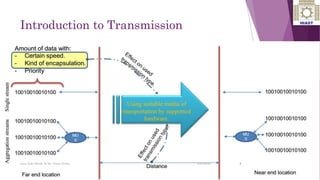
Introduction to Transmission
 Transmission: It means transport amount of data
with kind of encapsulation from location to another
location using a suitable media of transportation by
supported hardware.
3
Ayat Zaki Hindi & Dr. Nizar Zarka 2/24/2016
Introduction to Transmission
4
Ayat Zaki Hindi & Dr. Nizar Zarka 2/24/2016
Transmission Technologies
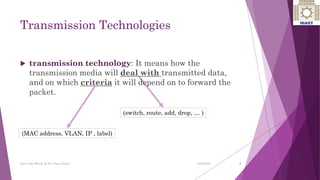
 transmission technology: It means how the
transmission media will deal with transmitted data,
and on which criteria it will depend on to forward the
packet.
(switch, route, add, drop, … )
(MAC address, VLAN, IP , label)
5
Ayat Zaki Hindi & Dr. Nizar Zarka 2/24/2016
Transmission Technologies
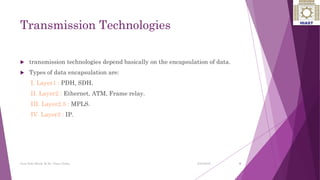
 transmission technologies depend basically on the encapsulation of data.
 Types of data encapsulation are:
I. Layer1 : PDH, SDH.
II. Layer2 : Ethernet, ATM, Frame relay.
III. Layer2.5 : MPLS.
IV. Layer3 : IP.
6
Ayat Zaki Hindi & Dr. Nizar Zarka 2/24/2016
Transmission Technologies
Plesio-Chronous digital hierarchy (PDH)
 The term Plesio-chronous is derived from Greek plēsios, meaning
near, and chronous meaning time.
 It refers to the fact that PDH networks run in a state where
different parts of the network are nearly, but not quite perfectly
synchronized.
 which means work at same data rate with slight difference.
7
Ayat Zaki Hindi & Dr. Nizar Zarka 2/24/2016
Transmission Technologies – PDH
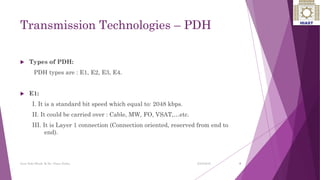
 Types of PDH:
PDH types are : E1, E2, E3, E4.
 E1:
I. It is a standard bit speed which equal to: 2048 kbps.
II. It could be carried over : Cable, MW, FO, VSAT,…etc.
III. It is Layer 1 connection (Connection oriented, reserved from end to
end).
8
Ayat Zaki Hindi & Dr. Nizar Zarka 2/24/2016
Transmission Technologies – PDH
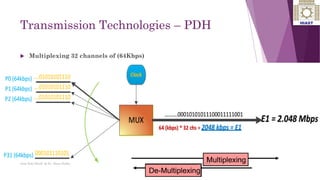
 Multiplexing 32 channels of (64Kbps)
9
Ayat Zaki Hindi & Dr. Nizar Zarka 2/24/2016
Transmission Technologies – PDH
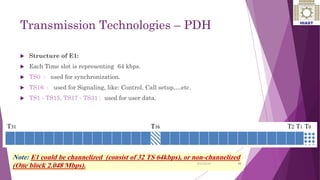
 Structure of E1:
 Each Time slot is representing 64 kbps.
 TS0 : used for synchronization.
 TS16 : used for Signaling, like: Control, Call setup,…etc.
 TS1 - TS15, TS17 - TS31 : used for user data.
10
Ayat Zaki Hindi & Dr. Nizar Zarka 2/24/2016
Transmission Technologies – PDH
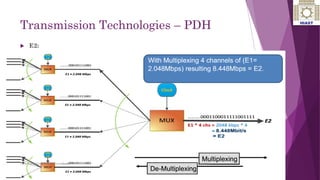
 E2:
11
Ayat Zaki Hindi & Dr. Nizar Zarka 2/24/2016
Transmission Technologies – PDH
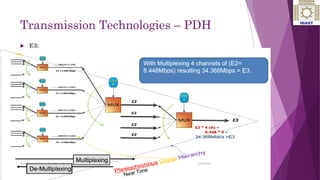
 E3:
12
Ayat Zaki Hindi & Dr. Nizar Zarka 2/24/2016
Transmission Technologies – PDH
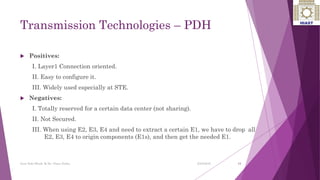
 Positives:
I. Layer1 Connection oriented.
II. Easy to configure it.
III. Widely used especially at STE.
 Negatives:
I. Totally reserved for a certain data center (not sharing).
II. Not Secured.
III. When using E2, E3, E4 and need to extract a certain E1, we have to drop all
E2, E3, E4 to origin components (E1s), and then get the needed E1.
13
Ayat Zaki Hindi & Dr. Nizar Zarka 2/24/2016
Transmission Technologies
Synchronous Digital Hierarchy (SDH)
 It is a standardized transport protocol defined by ETSI that
transfer multiple digital bit streams (many different services)
synchronously over physical media like optical fiber or
electrical interface cables, Microwave,...
 This protocol was developed to replace the (PDH) system.
 The system works on a one Global Master Clock.
 Types of SDH: STM-1, STM-4, STM-16, STM-64.
(Synchronous Transport Module)
14
Ayat Zaki Hindi & Dr. Nizar Zarka 2/24/2016
Transmission Technologies – SDH
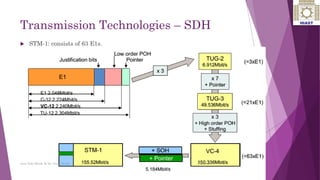
 STM-1: consists of 63 E1s.
15
Ayat Zaki Hindi & Dr. Nizar Zarka 2/24/2016
Transmission Technologies – SDH
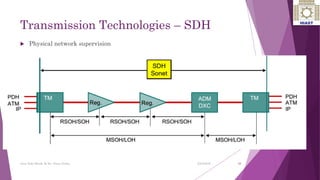
 Physical network supervision
16
Ayat Zaki Hindi & Dr. Nizar Zarka 2/24/2016
Transmission Technologies – SDH
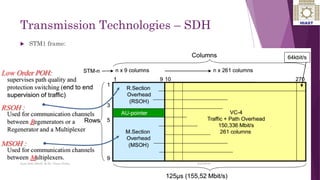
 STM1 frame:
17
Ayat Zaki Hindi & Dr. Nizar Zarka 2/24/2016
Transmission Technologies – SDH
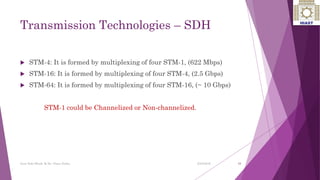
 STM-4: It is formed by multiplexing of four STM-1, (622 Mbps)
 STM-16: It is formed by multiplexing of four STM-4, (2.5 Gbps)
 STM-64: It is formed by multiplexing of four STM-16, (~ 10 Gbps)
STM-1 could be Channelized or Non-channelized.
18
Ayat Zaki Hindi & Dr. Nizar Zarka 2/24/2016
Transmission Technologies – SDH
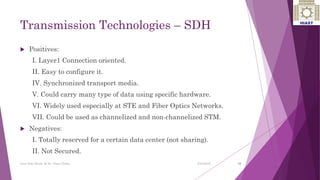
 Positives:
I. Layer1 Connection oriented.
II. Easy to configure it.
IV. Synchronized transport media.
V. Could carry many type of data using specific hardware.
VI. Widely used especially at STE and Fiber Optics Networks.
VII. Could be used as channelized and non-channelized STM.
 Negatives:
I. Totally reserved for a certain data center (not sharing).
II. Not Secured.
19
Ayat Zaki Hindi & Dr. Nizar Zarka 2/24/2016
Transmission Technologies
Asynchronous Transfer Mode (ATM)
 It is a switching technique that uses asynchronous time-division
multiplexing.
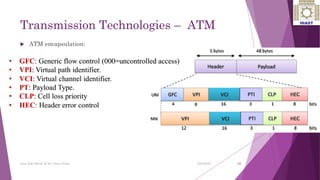
 It encodes data into small, fixed-sized cells (53 bytes = 48 payload +
5 header). Payload carrying different types of traffic.
 This differs from networks such as the Internet or Ethernet LANs
that use variable sized packets or frames.
20
Ayat Zaki Hindi & Dr. Nizar Zarka 2/24/2016
Transmission Technologies – ATM
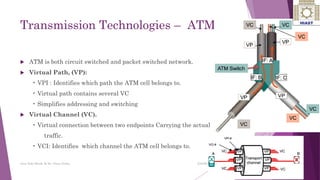
 ATM is both circuit switched and packet switched network.
 Virtual Path, (VP):
• VPI : Identifies which path the ATM cell belongs to.
• Virtual path contains several VC
• Simplifies addressing and switching
 Virtual Channel (VC).
• Virtual connection between two endpoints Carrying the actual
traffic.
• VCI: Identifies which channel the ATM cell belongs to.
21
Ayat Zaki Hindi & Dr. Nizar Zarka 2/24/2016
Transmission Technologies – ATM
 ATM encapsulation:
22
Ayat Zaki Hindi & Dr. Nizar Zarka 2/24/2016
Transmission Technologies – ATM
 Positives:
I. Connection oriented.
II. Easy to configure it.
IV. Circuit switched and packet switched networking.
V. Could carry many type of data using specific hardware.
 Negatives:
I. Path is reserved (not sharing).
II. Not Secured.
23
Ayat Zaki Hindi & Dr. Nizar Zarka 2/24/2016
24
Ayat Zaki Hindi & Dr. Nizar Zarka 2/24/2016
View publication stats

Transmissiontechniques

  • 1.
    See discussions, stats,and author profiles for this publication at: https://www.researchgate.net/publication/295813699 TRANSMISSION TECHNIQUES Presentation · February 2016 DOI: 10.13140/RG.2.1.3533.8005 CITATIONS 0 READS 1,068 2 authors: Some of the authors of this publication are also working on these related projects: Fast Rule-line Removal using Integral Images and Support Vector Machines View project Incorporating Appearance and Edge Features for Vehicle Detection in the Blind-spot Area View project Ayat Zaki Hindi Aalborg University 9 PUBLICATIONS   16 CITATIONS    SEE PROFILE Nizar Zarka Higher Institute for Applied Sciences and Technology 73 PUBLICATIONS   119 CITATIONS    SEE PROFILE All content following this page was uploaded by Nizar Zarka on 24 February 2016. The user has requested enhancement of the downloaded file.
  • 2.
    TRANSMISSION TECHNIQUES Ayat Zaki Hindi Supervisor:Dr. Nizar Zarka 1 Higher Institute for Applied Sciences and Technology Telecommunication Department Fifth year 2015-2016 Ayat Zaki Hindi & Dr. Nizar Zarka 2/24/2016
  • 3.
    CONTENT  Introduction toTransmission  Transmission Technologies  PDH  SDH  ATM 2 Ayat Zaki Hindi & Dr. Nizar Zarka 2/24/2016
  • 4.
    Introduction to Transmission Transmission: It means transport amount of data with kind of encapsulation from location to another location using a suitable media of transportation by supported hardware. 3 Ayat Zaki Hindi & Dr. Nizar Zarka 2/24/2016
  • 5.
    Introduction to Transmission 4 AyatZaki Hindi & Dr. Nizar Zarka 2/24/2016
  • 6.
    Transmission Technologies  transmissiontechnology: It means how the transmission media will deal with transmitted data, and on which criteria it will depend on to forward the packet. (switch, route, add, drop, … ) (MAC address, VLAN, IP , label) 5 Ayat Zaki Hindi & Dr. Nizar Zarka 2/24/2016
  • 7.
    Transmission Technologies  transmissiontechnologies depend basically on the encapsulation of data.  Types of data encapsulation are: I. Layer1 : PDH, SDH. II. Layer2 : Ethernet, ATM, Frame relay. III. Layer2.5 : MPLS. IV. Layer3 : IP. 6 Ayat Zaki Hindi & Dr. Nizar Zarka 2/24/2016
  • 8.
    Transmission Technologies Plesio-Chronous digitalhierarchy (PDH)  The term Plesio-chronous is derived from Greek plēsios, meaning near, and chronous meaning time.  It refers to the fact that PDH networks run in a state where different parts of the network are nearly, but not quite perfectly synchronized.  which means work at same data rate with slight difference. 7 Ayat Zaki Hindi & Dr. Nizar Zarka 2/24/2016
  • 9.
    Transmission Technologies –PDH  Types of PDH: PDH types are : E1, E2, E3, E4.  E1: I. It is a standard bit speed which equal to: 2048 kbps. II. It could be carried over : Cable, MW, FO, VSAT,…etc. III. It is Layer 1 connection (Connection oriented, reserved from end to end). 8 Ayat Zaki Hindi & Dr. Nizar Zarka 2/24/2016
  • 10.
    Transmission Technologies –PDH  Multiplexing 32 channels of (64Kbps) 9 Ayat Zaki Hindi & Dr. Nizar Zarka 2/24/2016
  • 11.
    Transmission Technologies –PDH  Structure of E1:  Each Time slot is representing 64 kbps.  TS0 : used for synchronization.  TS16 : used for Signaling, like: Control, Call setup,…etc.  TS1 - TS15, TS17 - TS31 : used for user data. 10 Ayat Zaki Hindi & Dr. Nizar Zarka 2/24/2016
  • 12.
    Transmission Technologies –PDH  E2: 11 Ayat Zaki Hindi & Dr. Nizar Zarka 2/24/2016
  • 13.
    Transmission Technologies –PDH  E3: 12 Ayat Zaki Hindi & Dr. Nizar Zarka 2/24/2016
  • 14.
    Transmission Technologies –PDH  Positives: I. Layer1 Connection oriented. II. Easy to configure it. III. Widely used especially at STE.  Negatives: I. Totally reserved for a certain data center (not sharing). II. Not Secured. III. When using E2, E3, E4 and need to extract a certain E1, we have to drop all E2, E3, E4 to origin components (E1s), and then get the needed E1. 13 Ayat Zaki Hindi & Dr. Nizar Zarka 2/24/2016
  • 15.
    Transmission Technologies Synchronous DigitalHierarchy (SDH)  It is a standardized transport protocol defined by ETSI that transfer multiple digital bit streams (many different services) synchronously over physical media like optical fiber or electrical interface cables, Microwave,...  This protocol was developed to replace the (PDH) system.  The system works on a one Global Master Clock.  Types of SDH: STM-1, STM-4, STM-16, STM-64. (Synchronous Transport Module) 14 Ayat Zaki Hindi & Dr. Nizar Zarka 2/24/2016
  • 16.
    Transmission Technologies –SDH  STM-1: consists of 63 E1s. 15 Ayat Zaki Hindi & Dr. Nizar Zarka 2/24/2016
  • 17.
    Transmission Technologies –SDH  Physical network supervision 16 Ayat Zaki Hindi & Dr. Nizar Zarka 2/24/2016
  • 18.
    Transmission Technologies –SDH  STM1 frame: 17 Ayat Zaki Hindi & Dr. Nizar Zarka 2/24/2016
  • 19.
    Transmission Technologies –SDH  STM-4: It is formed by multiplexing of four STM-1, (622 Mbps)  STM-16: It is formed by multiplexing of four STM-4, (2.5 Gbps)  STM-64: It is formed by multiplexing of four STM-16, (~ 10 Gbps) STM-1 could be Channelized or Non-channelized. 18 Ayat Zaki Hindi & Dr. Nizar Zarka 2/24/2016
  • 20.
    Transmission Technologies –SDH  Positives: I. Layer1 Connection oriented. II. Easy to configure it. IV. Synchronized transport media. V. Could carry many type of data using specific hardware. VI. Widely used especially at STE and Fiber Optics Networks. VII. Could be used as channelized and non-channelized STM.  Negatives: I. Totally reserved for a certain data center (not sharing). II. Not Secured. 19 Ayat Zaki Hindi & Dr. Nizar Zarka 2/24/2016
  • 21.
    Transmission Technologies Asynchronous TransferMode (ATM)  It is a switching technique that uses asynchronous time-division multiplexing.  It encodes data into small, fixed-sized cells (53 bytes = 48 payload + 5 header). Payload carrying different types of traffic.  This differs from networks such as the Internet or Ethernet LANs that use variable sized packets or frames. 20 Ayat Zaki Hindi & Dr. Nizar Zarka 2/24/2016
  • 22.
    Transmission Technologies –ATM  ATM is both circuit switched and packet switched network.  Virtual Path, (VP): • VPI : Identifies which path the ATM cell belongs to. • Virtual path contains several VC • Simplifies addressing and switching  Virtual Channel (VC). • Virtual connection between two endpoints Carrying the actual traffic. • VCI: Identifies which channel the ATM cell belongs to. 21 Ayat Zaki Hindi & Dr. Nizar Zarka 2/24/2016
  • 23.
    Transmission Technologies –ATM  ATM encapsulation: 22 Ayat Zaki Hindi & Dr. Nizar Zarka 2/24/2016
  • 24.
    Transmission Technologies –ATM  Positives: I. Connection oriented. II. Easy to configure it. IV. Circuit switched and packet switched networking. V. Could carry many type of data using specific hardware.  Negatives: I. Path is reserved (not sharing). II. Not Secured. 23 Ayat Zaki Hindi & Dr. Nizar Zarka 2/24/2016
  • 25.
    24 Ayat Zaki Hindi& Dr. Nizar Zarka 2/24/2016 View publication stats View publication stats