A FRAMEWORK FOR ACTION 
WASH Sustainability 3-Part Webinar Series 
September 27, 2014
RESOLUTION OF PROBLEMS WITH WATER SYSTEMS: GUIDELINES FOR IMPLEMENTING ORGANIZATIONS 
September 17, 2014 
Susan Davis, Improve International
What is resolution? 
Resolution is the process of addressing problems identified through post- implementation monitoring and/or evaluation. 
Assumes that implementing organizations are responsible for responding when they find water systems they have built are non- functional or need major repair.
The case for resolution 
•Water is a human right. 
•To save lives and change lives, implementing organizations need to focus on the provision of good water services forever. 
•Failed and abandoned water systems are a massive waste of investment – not only on the part of the donors, but also on the part of the community. Failed systems make poor people poorer. 
•Many problems with water services are attributed to poor implementation.
Guidelines: for your consideration 
The definition of guideline is a general rule, principle, or piece of advice. 
Synonyms include: recommendation, suggestion, or advice.
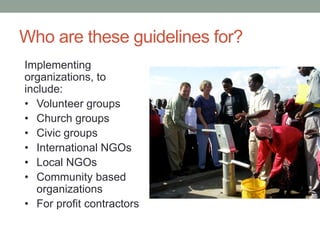
Who are these guidelines for? 
Implementing organizations, to include: 
•Volunteer groups 
•Church groups 
•Civic groups 
•International NGOs 
•Local NGOs 
•Community based organizations 
•For profit contractors
Wait, shouldn’t governments be responsible? 
•Resolution activities should be a bridge to sustained, locally-led services. 
•Goal is for governments to lead the way in ensuring water services for everyone in their countries. 
•These guidelines and approaches are intended to move implementing organizations toward that common goal.
Where did these guidelines come from? 
•Difficult to determine root causes vs. symptoms, but repetitiveness of the problems across the globe suggests that there are common ways we can respond. 
•Based on common failures and recommendations from interviews, a literature review, and the Resolution Workshop Feb 2014
Overall guidelines 
•First, do no harm. Understand and address root causes of problems instead of just repairing infrastructure 
•Change measurements of success 
•Be accountable to water users
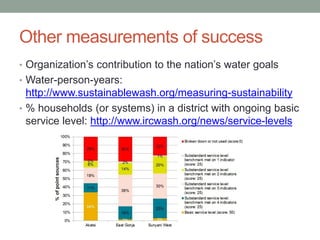
Other measurements of success 
•Organization’s contribution to the nation’s water goals 
•Water-person-years: http://www.sustainablewash.org/measuring-sustainability 
•% households (or systems) in a district with ongoing basic service level: http://www.ircwash.org/news/service-levels
Implementation guidelines 
•Shift from implementation and rehabilitation to facilitation, such as capacity building for supporting service providers 
•Collaboratively define and agree on roles and responsibilities in ensuring ongoing services 
•Improve monitoring to rapidly and accurately identify areas for resolution 
•Donors should show increased flexibility in funding to support such efforts
Implementation – practical approaches 
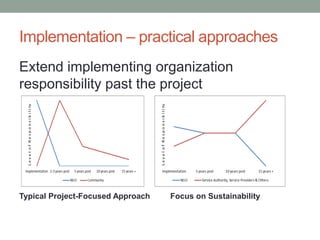
Extend implementing organization responsibility past the project 
Typical Project-Focused Approach Focus on Sustainability
Institutional guidelines 
•Engage local governments and work within national frameworks 
•Collaboratively define and agree on roles and responsibilities in ensuring ongoing services
Institutional – practical approaches 
•Advocate to governments 
•Help strengthen local governments 
•Facilitate post-construction support of rural community water committees 
•Stimulate local private sector to deliver services or support service delivery 
•Set up agreements with communities and service providers on roles 
•Enable accountability of service providers 
•Organize isolated community water committees into networks
Environmental guideline 
Understand and plan water services based on users’ multiple needs and sources of water, seasonal availability of water and water resource management needs
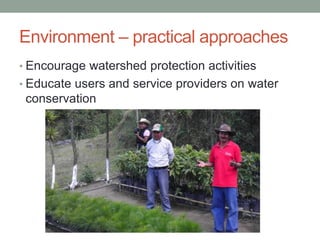
Environment – practical approaches 
•Encourage watershed protection activities 
•Educate users and service providers on water conservation
Financial guideline 
Water services are not free - all stakeholders must understand lifecycle costs and agree on who will pay for which costs
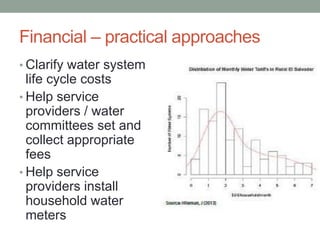
Financial – practical approaches 
•Clarify water system life cycle costs 
•Help service providers / water committees set and collect appropriate fees 
•Help service providers install household water meters
Social guideline 
Implementing organizations should make their exit strategy and timeline explicit while planning resolution activities with local stakeholders
Social – practical approaches 
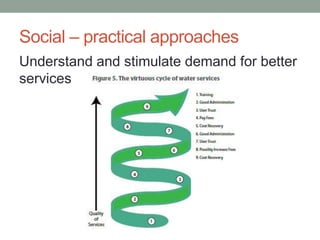
Understand and stimulate demand for better services
Technical guideline 
Implementing organizations should engage local governments and work within national frameworks
Technical – practical approaches 
Engage local governments and work within national frameworks
Technical – practical approaches 
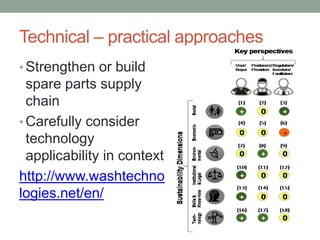
•Strengthen or build spare parts supply chain 
•Carefully consider technology applicability in context 
http://www.washtechnologies.net/en/
QUESTIONS?
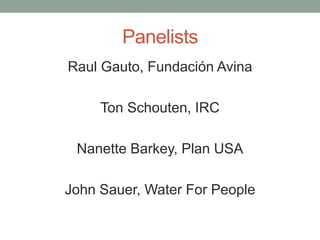
Panelists 
Raul Gauto, Fundación Avina 
Ton Schouten, IRC 
Nanette Barkey, Plan USA 
John Sauer, Water For People
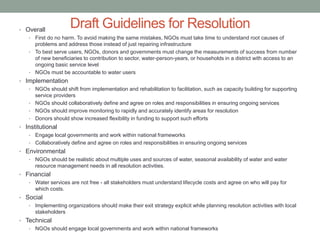
Draft Guidelines for Resolution 
•Overall 
•First do no harm. To avoid making the same mistakes, NGOs must take time to understand root causes of problems and address those instead of just repairing infrastructure 
•To best serve users, NGOs, donors and governments must change the measurements of success from number of new beneficiaries to contribution to sector, water-person-years, or households in a district with access to an ongoing basic service level 
•NGOs must be accountable to water users 
•Implementation 
•NGOs should shift from implementation and rehabilitation to facilitation, such as capacity building for supporting service providers 
•NGOs should collaboratively define and agree on roles and responsibilities in ensuring ongoing services 
•NGOs should improve monitoring to rapidly and accurately identify areas for resolution 
•Donors should show increased flexibility in funding to support such efforts 
•Institutional 
•Engage local governments and work within national frameworks 
•Collaboratively define and agree on roles and responsibilities in ensuring ongoing services 
•Environmental 
•NGOs should be realistic about multiple uses and sources of water, seasonal availability of water and water resource management needs in all resolution activities. 
•Financial 
•Water services are not free - all stakeholders must understand lifecycle costs and agree on who will pay for which costs. 
•Social 
•Implementing organizations should make their exit strategy explicit while planning resolution activities with local stakeholders 
•Technical 
•NGOs should engage local governments and work within national frameworks
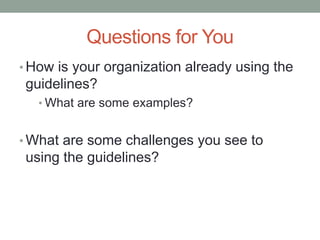
Questions for You 
•How is your organization already using the guidelines? 
•What are some examples? 
•What are some challenges you see to using the guidelines?
Continue the Conversation 
WASH Sustainability Webinar Series archives 
http://sustainablewash.org/initiatives/wash- sustainability-webinar-series
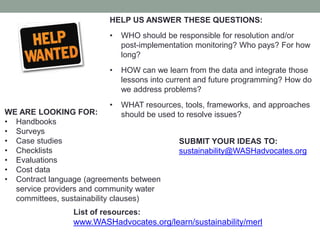
HELP US ANSWER THESE QUESTIONS: 
•WHO should be responsible for resolution and/or post-implementation monitoring? Who pays? For how long? 
•HOW can we learn from the data and integrate those lessons into current and future programming? How do we address problems? 
•WHAT resources, tools, frameworks, and approaches should be used to resolve issues? 
WE ARE LOOKING FOR: 
•Handbooks 
•Surveys 
•Case studies 
•Checklists 
•Evaluations 
•Cost data 
•Contract language (agreements between service providers and community water committees, sustainability clauses) 
SUBMIT YOUR IDEAS TO: 
sustainability@WASHadvocates.org 
List of resources: www.WASHadvocates.org/learn/sustainability/merl

A Framework for Action

  • 1.
    A FRAMEWORK FORACTION WASH Sustainability 3-Part Webinar Series September 27, 2014
  • 2.
    RESOLUTION OF PROBLEMSWITH WATER SYSTEMS: GUIDELINES FOR IMPLEMENTING ORGANIZATIONS September 17, 2014 Susan Davis, Improve International
  • 3.
    What is resolution? Resolution is the process of addressing problems identified through post- implementation monitoring and/or evaluation. Assumes that implementing organizations are responsible for responding when they find water systems they have built are non- functional or need major repair.
  • 4.
    The case forresolution •Water is a human right. •To save lives and change lives, implementing organizations need to focus on the provision of good water services forever. •Failed and abandoned water systems are a massive waste of investment – not only on the part of the donors, but also on the part of the community. Failed systems make poor people poorer. •Many problems with water services are attributed to poor implementation.
  • 5.
    Guidelines: for yourconsideration The definition of guideline is a general rule, principle, or piece of advice. Synonyms include: recommendation, suggestion, or advice.
  • 6.
    Who are theseguidelines for? Implementing organizations, to include: •Volunteer groups •Church groups •Civic groups •International NGOs •Local NGOs •Community based organizations •For profit contractors
  • 7.
    Wait, shouldn’t governmentsbe responsible? •Resolution activities should be a bridge to sustained, locally-led services. •Goal is for governments to lead the way in ensuring water services for everyone in their countries. •These guidelines and approaches are intended to move implementing organizations toward that common goal.
  • 8.
    Where did theseguidelines come from? •Difficult to determine root causes vs. symptoms, but repetitiveness of the problems across the globe suggests that there are common ways we can respond. •Based on common failures and recommendations from interviews, a literature review, and the Resolution Workshop Feb 2014
  • 9.
    Overall guidelines •First,do no harm. Understand and address root causes of problems instead of just repairing infrastructure •Change measurements of success •Be accountable to water users
  • 10.
    Other measurements ofsuccess •Organization’s contribution to the nation’s water goals •Water-person-years: http://www.sustainablewash.org/measuring-sustainability •% households (or systems) in a district with ongoing basic service level: http://www.ircwash.org/news/service-levels
  • 11.
    Implementation guidelines •Shiftfrom implementation and rehabilitation to facilitation, such as capacity building for supporting service providers •Collaboratively define and agree on roles and responsibilities in ensuring ongoing services •Improve monitoring to rapidly and accurately identify areas for resolution •Donors should show increased flexibility in funding to support such efforts
  • 12.
    Implementation – practicalapproaches Extend implementing organization responsibility past the project Typical Project-Focused Approach Focus on Sustainability
  • 13.
    Institutional guidelines •Engagelocal governments and work within national frameworks •Collaboratively define and agree on roles and responsibilities in ensuring ongoing services
  • 14.
    Institutional – practicalapproaches •Advocate to governments •Help strengthen local governments •Facilitate post-construction support of rural community water committees •Stimulate local private sector to deliver services or support service delivery •Set up agreements with communities and service providers on roles •Enable accountability of service providers •Organize isolated community water committees into networks
  • 15.
    Environmental guideline Understandand plan water services based on users’ multiple needs and sources of water, seasonal availability of water and water resource management needs
  • 16.
    Environment – practicalapproaches •Encourage watershed protection activities •Educate users and service providers on water conservation
  • 17.
    Financial guideline Waterservices are not free - all stakeholders must understand lifecycle costs and agree on who will pay for which costs
  • 18.
    Financial – practicalapproaches •Clarify water system life cycle costs •Help service providers / water committees set and collect appropriate fees •Help service providers install household water meters
  • 19.
    Social guideline Implementingorganizations should make their exit strategy and timeline explicit while planning resolution activities with local stakeholders
  • 20.
    Social – practicalapproaches Understand and stimulate demand for better services
  • 21.
    Technical guideline Implementingorganizations should engage local governments and work within national frameworks
  • 22.
    Technical – practicalapproaches Engage local governments and work within national frameworks
  • 23.
    Technical – practicalapproaches •Strengthen or build spare parts supply chain •Carefully consider technology applicability in context http://www.washtechnologies.net/en/
  • 24.
  • 25.
    Panelists Raul Gauto,Fundación Avina Ton Schouten, IRC Nanette Barkey, Plan USA John Sauer, Water For People
  • 26.
    Draft Guidelines forResolution •Overall •First do no harm. To avoid making the same mistakes, NGOs must take time to understand root causes of problems and address those instead of just repairing infrastructure •To best serve users, NGOs, donors and governments must change the measurements of success from number of new beneficiaries to contribution to sector, water-person-years, or households in a district with access to an ongoing basic service level •NGOs must be accountable to water users •Implementation •NGOs should shift from implementation and rehabilitation to facilitation, such as capacity building for supporting service providers •NGOs should collaboratively define and agree on roles and responsibilities in ensuring ongoing services •NGOs should improve monitoring to rapidly and accurately identify areas for resolution •Donors should show increased flexibility in funding to support such efforts •Institutional •Engage local governments and work within national frameworks •Collaboratively define and agree on roles and responsibilities in ensuring ongoing services •Environmental •NGOs should be realistic about multiple uses and sources of water, seasonal availability of water and water resource management needs in all resolution activities. •Financial •Water services are not free - all stakeholders must understand lifecycle costs and agree on who will pay for which costs. •Social •Implementing organizations should make their exit strategy explicit while planning resolution activities with local stakeholders •Technical •NGOs should engage local governments and work within national frameworks
  • 27.
    Questions for You •How is your organization already using the guidelines? •What are some examples? •What are some challenges you see to using the guidelines?
  • 28.
    Continue the Conversation WASH Sustainability Webinar Series archives http://sustainablewash.org/initiatives/wash- sustainability-webinar-series
  • 29.
    HELP US ANSWERTHESE QUESTIONS: •WHO should be responsible for resolution and/or post-implementation monitoring? Who pays? For how long? •HOW can we learn from the data and integrate those lessons into current and future programming? How do we address problems? •WHAT resources, tools, frameworks, and approaches should be used to resolve issues? WE ARE LOOKING FOR: •Handbooks •Surveys •Case studies •Checklists •Evaluations •Cost data •Contract language (agreements between service providers and community water committees, sustainability clauses) SUBMIT YOUR IDEAS TO: sustainability@WASHadvocates.org List of resources: www.WASHadvocates.org/learn/sustainability/merl