Translating Flowchart algorithm to
Pseudocode Format and vice versa
Today’s lesson
Lesson Objectives
By the end of this lesson, a student will be able to:
❏ Define and explain the concepts of algorithms,
pseudocode, and flowcharts.
❏ Importance of Using Pseudocode
❏ Differentiate between pseudocode and flowcharts.
❏ Prepare pseudocode for a simple program.
❏ Create a basic flowchart representation of an algorithm.
❏ Differences between pseudocode and actual code
The Concepts of Algorithms
❏ An algorithm is a step-by-step set of instructions
designed to solve a specific problem or perform a
particular task.
❏ It's a well-defined sequence of operations that
transforms input data into desired output.
❏ Algorithms serve as a blueprint for creating computer
programs and are used in various fields to solve complex
problems efficiently.
The Concepts of Pseudocode
❏ Pseudocode is a high-level description of an algorithm
that combines natural language and programming
language-like constructs.
❏ It's used to outline the logic of a program without getting
into the specifics of a particular programming language.
Pseudocode focuses on expressing the algorithm's
steps in a human-readable manner.
The Concepts of Flowcharts
❏ A flowchart is a graphical representation of an algorithm
or a process.
❏ It uses different shapes and arrows to depict the
sequence of steps and decisions in a logical order.
❏ Flowcharts help in visually understanding the flow of
control, conditions, and actions within an algorithm or
program.
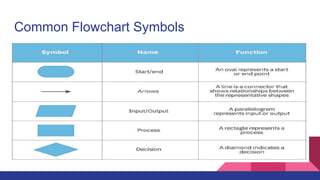
Common Flowchart Symbols
Importance of Using Pseudocode
❏ Clarity: Pseudocode helps in planning and organizing
thoughts before coding, making it easier to visualize the
algorithm's logic and flow.
❏ Language-Independent: Pseudocode is not tied to a
specific programming language, allowing programmers
to focus on the algorithm's design without worrying
about syntax.
Cont…
❏ Simplicity: Writing in pseudocode enables developers
to focus on the algorithm's core logic rather than getting
bogged down by the details of a programming
language.
Differences Between Pseudocode and Flowcharts.
Flexibility
Pseudocode allows for more detailed descriptions and
explanations of logic. BUT Flowcharts are more visual and
may be better for illustrating complex flows.
Usage
Pseudocode is often used in programming courses and
planning stages. WHEREAS Flowcharts are commonly
used in documentation and presentations.
Cont…
Format
Pseudocode is primarily text-based, using a mixture of
human-readable language and programming-like
constructs. WHILE Flowcharts use graphical symbols
connected by arrows to depict the algorithm's flow.
Sample Pseudocode for Adding Two Numbers
1. Start
2. Input firstNumber
3. Input secondNumber
4. Set sum = firstNumber + secondNumber
5. Display sum
6. End
Sample Flowchart Representation of Adding Two
Numbers
Start
Input firstNumber,
secondNumber
sum=firstNumber +
secondNumber
Display sum
End
Differences Between Pseudocode and Actual
Code
❏ Syntax: Pseudocode uses natural language and abstract
programming constructs, while actual code follows the
specific syntax rules of a programming language.
❏ Level of Detail: Pseudocode focuses on high-level logic
and concepts, whereas actual code includes specific
details like data types, variables, and syntax rules.
❏ Execution: Pseudocode is not executable, while actual
code is compiled or interpreted by a computer to produce
the desired output.
Assignment
Research and provide examples of real-world applications
where understanding algorithms and using pseudocode
can be beneficial.(e.g. How to withdraw cash from ATM)

Translating Flowchart algorithm to Pseudocode Format and vice versa.pptx

  • 1.
    Translating Flowchart algorithmto Pseudocode Format and vice versa Today’s lesson
  • 2.
    Lesson Objectives By theend of this lesson, a student will be able to: ❏ Define and explain the concepts of algorithms, pseudocode, and flowcharts. ❏ Importance of Using Pseudocode ❏ Differentiate between pseudocode and flowcharts. ❏ Prepare pseudocode for a simple program. ❏ Create a basic flowchart representation of an algorithm. ❏ Differences between pseudocode and actual code
  • 3.
    The Concepts ofAlgorithms ❏ An algorithm is a step-by-step set of instructions designed to solve a specific problem or perform a particular task. ❏ It's a well-defined sequence of operations that transforms input data into desired output. ❏ Algorithms serve as a blueprint for creating computer programs and are used in various fields to solve complex problems efficiently.
  • 4.
    The Concepts ofPseudocode ❏ Pseudocode is a high-level description of an algorithm that combines natural language and programming language-like constructs. ❏ It's used to outline the logic of a program without getting into the specifics of a particular programming language. Pseudocode focuses on expressing the algorithm's steps in a human-readable manner.
  • 5.
    The Concepts ofFlowcharts ❏ A flowchart is a graphical representation of an algorithm or a process. ❏ It uses different shapes and arrows to depict the sequence of steps and decisions in a logical order. ❏ Flowcharts help in visually understanding the flow of control, conditions, and actions within an algorithm or program.
  • 6.
  • 7.
    Importance of UsingPseudocode ❏ Clarity: Pseudocode helps in planning and organizing thoughts before coding, making it easier to visualize the algorithm's logic and flow. ❏ Language-Independent: Pseudocode is not tied to a specific programming language, allowing programmers to focus on the algorithm's design without worrying about syntax.
  • 8.
    Cont… ❏ Simplicity: Writingin pseudocode enables developers to focus on the algorithm's core logic rather than getting bogged down by the details of a programming language.
  • 9.
    Differences Between Pseudocodeand Flowcharts. Flexibility Pseudocode allows for more detailed descriptions and explanations of logic. BUT Flowcharts are more visual and may be better for illustrating complex flows. Usage Pseudocode is often used in programming courses and planning stages. WHEREAS Flowcharts are commonly used in documentation and presentations.
  • 10.
    Cont… Format Pseudocode is primarilytext-based, using a mixture of human-readable language and programming-like constructs. WHILE Flowcharts use graphical symbols connected by arrows to depict the algorithm's flow.
  • 11.
    Sample Pseudocode forAdding Two Numbers 1. Start 2. Input firstNumber 3. Input secondNumber 4. Set sum = firstNumber + secondNumber 5. Display sum 6. End
  • 12.
    Sample Flowchart Representationof Adding Two Numbers Start Input firstNumber, secondNumber sum=firstNumber + secondNumber Display sum End
  • 13.
    Differences Between Pseudocodeand Actual Code ❏ Syntax: Pseudocode uses natural language and abstract programming constructs, while actual code follows the specific syntax rules of a programming language. ❏ Level of Detail: Pseudocode focuses on high-level logic and concepts, whereas actual code includes specific details like data types, variables, and syntax rules. ❏ Execution: Pseudocode is not executable, while actual code is compiled or interpreted by a computer to produce the desired output.
  • 14.
    Assignment Research and provideexamples of real-world applications where understanding algorithms and using pseudocode can be beneficial.(e.g. How to withdraw cash from ATM)

Editor's Notes

  • #15 How to withdraw MOMO wallet so you can do that by just using the acronyms and it's indicative of lent