Programming
Index Which is the programming?
Programs and algorithms
Programming languages Trend programming languages Types of programs
Which is the programming? In computer science, programming is a process which is written (in a programming language), is tested, purified and remains the source code of a computer program. Within information technology, computer programs are the elements that make up the software, which is the set of instructions that run the hardware of a computer to perform a certain task. Therefore, programming is one of the major areas within computer science.
Programs and Algorithms An algorithm is a sequence of unambiguous, finite and ordered instructions to be followed to solve a problem. Usually implements a program (translated to a programming language specific) algorithm. Note that the instruction sequence itself (execution) which must be finite, not the number of steps taken.  The programs are usually divided into smaller parts (modules) so that the algorithmic complexity of each of the parties is less than the full program, which helps the development of the program.  According to Niklaus Wirth, a program consists of algorithms and data structure.  Various techniques have been proposed program whose goal is to improve the process of creating and maintaining software. Among them are the following:
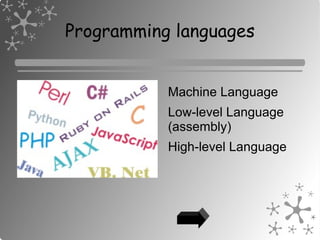
Programming languages Machine Language
Low-level Language (assembly)
High-level Language
Machine Language Microprogrammes circuits are digital, which means working with only two  voltage levels. These levels, abstraction, are symbolized with zero 0 and a 1,  so the machine language uses only those signs. This allows the use of the theories of Boolean algebra and the binary system in the design of such circuits and their programming. Claude Elwood Shannon, in his Analysis of Relay and Switching Circuits, and their experiences in switching networks, laying the groundwork for the implementation of Boolean algebra to switching networks.
Low-level Language The low-level languages are programming languages that are close to the operation of a computer. The lowest level of language par excellence is the machine code. This was followed by the assembly language, as when programming in assembler is working with the memory registers of the computer directly. Key high-level language: Ada, ALGOL, Basic, C++, C #, Clipper, COBOL, Fortran, Foxpro or Visual Foxpro, Java, Terms, Logo, PHP (PHP Hypertext Preprocessor), PL / SQL, RPG and Matlab.
High-level Language Programming languages high-level feature to express algorithms in a way appropriate to the human cognitive ability, rather than executing the capacity of the machines. In the first high-level language that the limitation was aimed at a specific area and its installation required a predefined syntax. Are classified as procedural languages. Another limitation of the high-level language is that it requires some programming skills to perform the logical sequence of instructions. The very high level languages were created so that users could solve this common problem of a data processing easier and faster. For this reason, in the late 1950s came a new kind of programming language that avoids these drawbacks at the expense of giving a little on the benefits. These languages are called "third generation" or "high level", as opposed to "low" or "close to the machine."
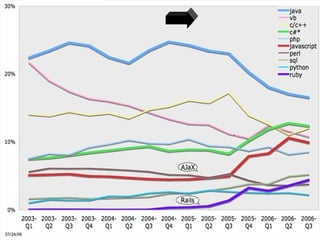
Trend of programming Languages The growth of Ruby and Javascript, due to the growth of Web 2.0 applications is a fact. This is causing a gradual decline of Java and C / C + +. As can be seen from the graph the introduction of Rails is the start of an upward trend of Ruby .
Trend of programming languages
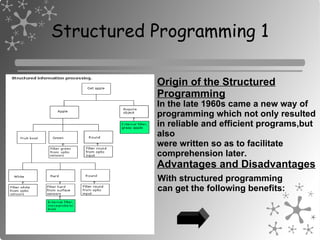
Types of Programs Structured programming  Origins  of the estructured programming
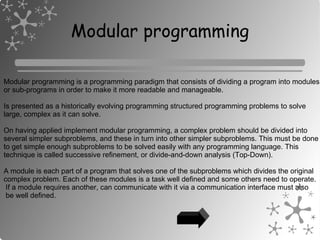
Advantages and Disadvantages of structured programming Modular programming
Object-oriented programming (OOP)
Declarative programming

Programming

  • 1.
  • 2.
    Index Which isthe programming?
  • 3.
  • 4.
    Programming languages Trendprogramming languages Types of programs
  • 5.
    Which is theprogramming? In computer science, programming is a process which is written (in a programming language), is tested, purified and remains the source code of a computer program. Within information technology, computer programs are the elements that make up the software, which is the set of instructions that run the hardware of a computer to perform a certain task. Therefore, programming is one of the major areas within computer science.
  • 6.
    Programs and AlgorithmsAn algorithm is a sequence of unambiguous, finite and ordered instructions to be followed to solve a problem. Usually implements a program (translated to a programming language specific) algorithm. Note that the instruction sequence itself (execution) which must be finite, not the number of steps taken. The programs are usually divided into smaller parts (modules) so that the algorithmic complexity of each of the parties is less than the full program, which helps the development of the program. According to Niklaus Wirth, a program consists of algorithms and data structure. Various techniques have been proposed program whose goal is to improve the process of creating and maintaining software. Among them are the following:
  • 7.
  • 8.
  • 9.
  • 10.
    Machine Language Microprogrammescircuits are digital, which means working with only two voltage levels. These levels, abstraction, are symbolized with zero 0 and a 1, so the machine language uses only those signs. This allows the use of the theories of Boolean algebra and the binary system in the design of such circuits and their programming. Claude Elwood Shannon, in his Analysis of Relay and Switching Circuits, and their experiences in switching networks, laying the groundwork for the implementation of Boolean algebra to switching networks.
  • 11.
    Low-level Language Thelow-level languages are programming languages that are close to the operation of a computer. The lowest level of language par excellence is the machine code. This was followed by the assembly language, as when programming in assembler is working with the memory registers of the computer directly. Key high-level language: Ada, ALGOL, Basic, C++, C #, Clipper, COBOL, Fortran, Foxpro or Visual Foxpro, Java, Terms, Logo, PHP (PHP Hypertext Preprocessor), PL / SQL, RPG and Matlab.
  • 12.
    High-level Language Programminglanguages high-level feature to express algorithms in a way appropriate to the human cognitive ability, rather than executing the capacity of the machines. In the first high-level language that the limitation was aimed at a specific area and its installation required a predefined syntax. Are classified as procedural languages. Another limitation of the high-level language is that it requires some programming skills to perform the logical sequence of instructions. The very high level languages were created so that users could solve this common problem of a data processing easier and faster. For this reason, in the late 1950s came a new kind of programming language that avoids these drawbacks at the expense of giving a little on the benefits. These languages are called "third generation" or "high level", as opposed to "low" or "close to the machine."
  • 13.
    Trend of programmingLanguages The growth of Ruby and Javascript, due to the growth of Web 2.0 applications is a fact. This is causing a gradual decline of Java and C / C + +. As can be seen from the graph the introduction of Rails is the start of an upward trend of Ruby .
  • 14.
  • 15.
    Types of ProgramsStructured programming Origins of the estructured programming
  • 16.
    Advantages and Disadvantagesof structured programming Modular programming
  • 17.
  • 18.