Python
www.scodenetwork.com
Contact no.- 9990211148, 9990211149
What is Python ?
Python is a general purpose, dynamic, high level and interpreted programming
language. It supports Object Oriented programming approach to develop
applications.
Python supports multiple programming pattern, including object oriented,
imperative and functional or procedural programming styles.
Python is not intended to work on special area such as web programming.That is
why it is known as multipurpose because it can be used with web, enterprise, 3D
CAD etc.
We don't need to use data types to declare variable because it is dynamically
typed so we can write a=10 to assign an integer value in an integer variable.
Python makes the development and debugging fast because there is no
compilation step included in python development and edit-test-debug cycle is
very fast.
www.scodenetwork.com
Contact no.- 9990211148, 9990211149
CompilerVs Interpreter
Compiler Interpreter
Scans the entire program and translates it as
a whole into machine code.
Translates program one statement at a time.
It takes large amount of time to analyze the
source code but the overall execution time is
comparatively faster.
It takes less amount of time to analyze the
source code but the overall execution time is
slower.
Generates intermediate object code which
further requires linking, hence requires more
memory.
No intermediate object code is generated,
hence are memory efficient.
It generates the error message only after
scanning the whole program. Hence
debugging is comparatively hard.
Continues translating the program until the
first error is met, in which case it stops. Hence
debugging is easy.
www.scodenetwork.com
Contact no.- 9990211148, 9990211149
Python History
• The implementation of Python was started in the December 1989 by GuidoVan Rossum at CWI in
Netherland.
• In February 1991, van Rossum published the code (labeled version 0.9.0) to alt. sources.
• In 1994, Python 1.0 was released with new features like: lambda, map, filter, and reduce.
• Python 2.0 added new features like: list comprehensions, garbage collection system.
• On December 3, 2008, Python 3.0 (also called "Py3K") was released. It was designed to rectify
fundamental flaw of the language.
ABC language & Modula-3
www.scodenetwork.com
Contact no.- 9990211148, 9990211149
Python Features
• Easy to Learn and Use
• Expressive Language
• Interpreted Language
• Cross-platform Language
• Free and Open Source
• Object-Oriented Language
• GUI Programming Support
• Large Standard Library
www.scodenetwork.com
Contact no.- 9990211148, 9990211149
• DynamicallyTyped
• Embedded
Flavors of Python:
1.CPython: It is the standard flavor of Python. It can be used to work
with C lanugageApplications
2. Jython or JPython: It is for JavaApplications. It can run on JVM
3. IronPython: It is for C#.Net platform
4.PyPy:The main advantage of PyPy is performance will be improved
because JIT compiler is available inside PVM.
5.RubyPython For Ruby Platforms
6. AnacondaPython It is specially designed for handling large volume of data
processing.
Python Applications
• Web Applications
• Desktop GUIApplications
• Software Development
• Scientific and Numeric
• BusinessApplications
• Console BasedApplication
• Audio orVideo based Applications
• 3D CADApplications
• Applications for Images
• EnterpriseApplications
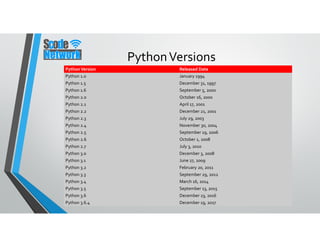
PythonVersions
PythonVersion Released Date
Python 1.0 January 1994
Python 1.5 December 31, 1997
Python 1.6 September 5, 2000
Python 2.0 October 16, 2000
Python 2.1 April 17, 2001
Python 2.2 December 21, 2001
Python 2.3 July 29, 2003
Python 2.4 November 30, 2004
Python 2.5 September 19, 2006
Python 2.6 October 1, 2008
Python 2.7 July 3, 2010
Python 3.0 December 3, 2008
Python 3.1 June 27, 2009
Python 3.2 February 20, 2011
Python 3.3 September 29, 2012
Python 3.4 March 16, 2014
Python 3.5 September 13, 2015
Python 3.6 December 23, 2016
Python 3.6.4 December 19, 2017
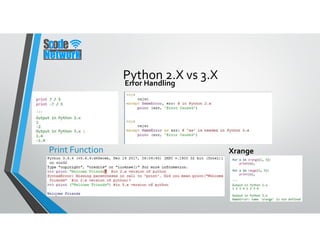
Python 2.X vs 3.X
Division operator
Print Function Xrange
Error Handling
Python Identifiers
A Python identifier is a name used to identify a variable, function, class, module, or other
object.An identifier starts with a letter A to Z or a to z, or an underscore (_) followed by zero
or more letters, underscores and digits (0 to 9). Python does not allow punctuation
characters such as @, $, and % within identifiers. Python is a case sensitive programming
language.Thus, Car and car are two different identifiers in Python.
Here are naming conventions for Python identifiers:
• Class names start with an uppercase letter.All other identifiers start with a
lowercase letter.
• Starting an identifier with a single leading underscore indicates that the
identifier is private.
• Starting an identifier with two leading underscores indicates a strongly private
identifier.
• If the identifier also ends with two trailing underscores, the identifier is a
language-defined special name.
Identifiers
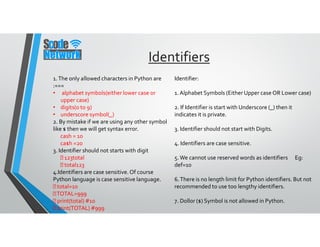
1.The only allowed characters in Python are
:===
• alphabet symbols(either lower case or
upper case)
• digits(0 to 9)
• underscore symbol(_)
2. By mistake if we are using any other symbol
like $ then we will get syntax error.
cash = 10
ca$h =20
3. Identifier should not starts with digit
 123total
 total123
4.Identifiers are case sensitive.Of course
Python language is case sensitive language.
 total=10
TOTAL=999
 print(total) #10
 print(TOTAL) #999
Identifier:
1. Alphabet Symbols (Either Upper case OR Lower case)
2. If Identifier is start with Underscore (_) then it
indicates it is private.
3. Identifier should not start with Digits.
4. Identifiers are case sensitive.
5.We cannot use reserved words as identifiers Eg:
def=10
6.There is no length limit for Python identifiers. But not
recommended to use too lengthy identifiers.
7. Dollor ($) Symbol is not allowed in Python.
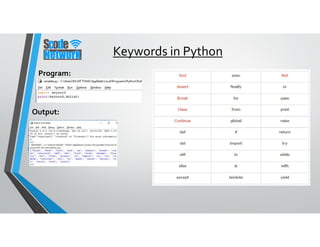
Keywords in Python
Program:
Output:
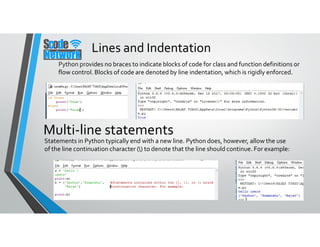
Lines and Indentation
Python provides no braces to indicate blocks of code for class and function definitions or
flow control. Blocks of code are denoted by line indentation, which is rigidly enforced.
Multi-line statements
Statements in Python typically end with a new line. Python does, however, allow the use
of the line continuation character () to denote that the line should continue. For example:
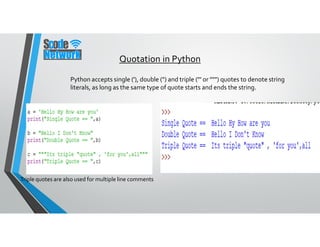
Quotation in Python
Python accepts single ('), double (") and triple (''' or """) quotes to denote string
literals, as long as the same type of quote starts and ends the string.
Triple quotes are also used for multiple line comments

python course ppt pdf

  • 1.
  • 2.
    What is Python? Python is a general purpose, dynamic, high level and interpreted programming language. It supports Object Oriented programming approach to develop applications. Python supports multiple programming pattern, including object oriented, imperative and functional or procedural programming styles. Python is not intended to work on special area such as web programming.That is why it is known as multipurpose because it can be used with web, enterprise, 3D CAD etc. We don't need to use data types to declare variable because it is dynamically typed so we can write a=10 to assign an integer value in an integer variable. Python makes the development and debugging fast because there is no compilation step included in python development and edit-test-debug cycle is very fast.
  • 3.
  • 4.
    CompilerVs Interpreter Compiler Interpreter Scansthe entire program and translates it as a whole into machine code. Translates program one statement at a time. It takes large amount of time to analyze the source code but the overall execution time is comparatively faster. It takes less amount of time to analyze the source code but the overall execution time is slower. Generates intermediate object code which further requires linking, hence requires more memory. No intermediate object code is generated, hence are memory efficient. It generates the error message only after scanning the whole program. Hence debugging is comparatively hard. Continues translating the program until the first error is met, in which case it stops. Hence debugging is easy. www.scodenetwork.com Contact no.- 9990211148, 9990211149
  • 5.
    Python History • Theimplementation of Python was started in the December 1989 by GuidoVan Rossum at CWI in Netherland. • In February 1991, van Rossum published the code (labeled version 0.9.0) to alt. sources. • In 1994, Python 1.0 was released with new features like: lambda, map, filter, and reduce. • Python 2.0 added new features like: list comprehensions, garbage collection system. • On December 3, 2008, Python 3.0 (also called "Py3K") was released. It was designed to rectify fundamental flaw of the language. ABC language & Modula-3 www.scodenetwork.com Contact no.- 9990211148, 9990211149
  • 6.
    Python Features • Easyto Learn and Use • Expressive Language • Interpreted Language • Cross-platform Language • Free and Open Source • Object-Oriented Language • GUI Programming Support • Large Standard Library www.scodenetwork.com Contact no.- 9990211148, 9990211149
  • 7.
    • DynamicallyTyped • Embedded Flavorsof Python: 1.CPython: It is the standard flavor of Python. It can be used to work with C lanugageApplications 2. Jython or JPython: It is for JavaApplications. It can run on JVM 3. IronPython: It is for C#.Net platform 4.PyPy:The main advantage of PyPy is performance will be improved because JIT compiler is available inside PVM. 5.RubyPython For Ruby Platforms 6. AnacondaPython It is specially designed for handling large volume of data processing.
  • 8.
    Python Applications • WebApplications • Desktop GUIApplications • Software Development • Scientific and Numeric • BusinessApplications • Console BasedApplication • Audio orVideo based Applications • 3D CADApplications • Applications for Images • EnterpriseApplications
  • 9.
    PythonVersions PythonVersion Released Date Python1.0 January 1994 Python 1.5 December 31, 1997 Python 1.6 September 5, 2000 Python 2.0 October 16, 2000 Python 2.1 April 17, 2001 Python 2.2 December 21, 2001 Python 2.3 July 29, 2003 Python 2.4 November 30, 2004 Python 2.5 September 19, 2006 Python 2.6 October 1, 2008 Python 2.7 July 3, 2010 Python 3.0 December 3, 2008 Python 3.1 June 27, 2009 Python 3.2 February 20, 2011 Python 3.3 September 29, 2012 Python 3.4 March 16, 2014 Python 3.5 September 13, 2015 Python 3.6 December 23, 2016 Python 3.6.4 December 19, 2017
  • 10.
    Python 2.X vs3.X Division operator Print Function Xrange Error Handling
  • 11.
    Python Identifiers A Pythonidentifier is a name used to identify a variable, function, class, module, or other object.An identifier starts with a letter A to Z or a to z, or an underscore (_) followed by zero or more letters, underscores and digits (0 to 9). Python does not allow punctuation characters such as @, $, and % within identifiers. Python is a case sensitive programming language.Thus, Car and car are two different identifiers in Python. Here are naming conventions for Python identifiers: • Class names start with an uppercase letter.All other identifiers start with a lowercase letter. • Starting an identifier with a single leading underscore indicates that the identifier is private. • Starting an identifier with two leading underscores indicates a strongly private identifier. • If the identifier also ends with two trailing underscores, the identifier is a language-defined special name.
  • 12.
    Identifiers 1.The only allowedcharacters in Python are :=== • alphabet symbols(either lower case or upper case) • digits(0 to 9) • underscore symbol(_) 2. By mistake if we are using any other symbol like $ then we will get syntax error. cash = 10 ca$h =20 3. Identifier should not starts with digit  123total  total123 4.Identifiers are case sensitive.Of course Python language is case sensitive language.  total=10 TOTAL=999  print(total) #10  print(TOTAL) #999 Identifier: 1. Alphabet Symbols (Either Upper case OR Lower case) 2. If Identifier is start with Underscore (_) then it indicates it is private. 3. Identifier should not start with Digits. 4. Identifiers are case sensitive. 5.We cannot use reserved words as identifiers Eg: def=10 6.There is no length limit for Python identifiers. But not recommended to use too lengthy identifiers. 7. Dollor ($) Symbol is not allowed in Python.
  • 13.
  • 14.
    Lines and Indentation Pythonprovides no braces to indicate blocks of code for class and function definitions or flow control. Blocks of code are denoted by line indentation, which is rigidly enforced. Multi-line statements Statements in Python typically end with a new line. Python does, however, allow the use of the line continuation character () to denote that the line should continue. For example:
  • 15.
    Quotation in Python Pythonaccepts single ('), double (") and triple (''' or """) quotes to denote string literals, as long as the same type of quote starts and ends the string. Triple quotes are also used for multiple line comments