Transitions into HE 
Supporting Student Study Skills Development at Distance 
Sam Nolan 
Eleanor Loughlin 
Malcolm Murray 
Elaine Tan
To Cover 
• The Idea 
• Where it comes from 
• The Project 
• Where we are at 
• Contributing to the Project
The Idea
The Idea 
“At the heart of successful retention and success is a 
strong sense of belonging in HE for all students. This is 
most effectively nurtured through mainstream activities 
that all students participate in.” 
Student belonging is achieved through: 
• Supportive peer relations 
• Meaningful interaction between staff and students 
• Developing knowledge, confidence and identity as successful 
HE learners 
• An HE experience relevant to students’ interests and future 
goals 
Findings of 2012 HEA Study into Student Retention
Aim 
• This project will develop an innovative e-learning 
course to support all incoming first years before they 
start at Durham University. The course is designed to 
help students develop study skills and to successfully 
make the transition into higher education. This pan- 
University initiative includes collaborators from all 
faculties, together with support services, DSU and 
colleges.
Objectives 
• The objectives of this project are: 
• To develop a small private online course (SPOC) for 
incoming undergraduates. This will run through September 
and focus on the skills required to make the transition into 
higher education. It will be developed in partnership with 
current students, to allow us to identify the areas which 
students struggle with and develop innovative engaging 
solutions at the appropriate level,
Objectives 
• The objectives of this project are: 
• To exploit existing distance learning tools such as DUO, 
video streaming and web-conferencing to create an online 
community of learners prior to their arrival at Durham, 
• To evaluate the impact of these web-based resource upon 
students’ learning, 
• To disseminate this work both within the University and at a 
national level.
Where it Comes From ?
Project Evolution 
• Many Universities across the UK are developing online 
courses to support students making the transition into 
HE. 
• At Durham, we started on a pilot project based in the 
Foundation Centre with a series of student interviews 
and focus groups.
Focus Group With New Students 
• Every student (local and international) wanted more 
contact pre-arrival 
• They wanted: 
• More information about their classes 
• Reading materials 
• Logistical information about Durham 
• Looked at good practice elsewhere, e.g. earlier DUBBU 
meetings: 
• “Opening Doors Early to Academic Integrity – aiding the transition 
to and managing expectations of academic practice at University”, 
J Thompson (Geography) & J Jurowska (LTT), Durham, 2012 
• “Delivering Transition Support Through the VLE”, S Davis (LTT), 
York, 2011
What do Students Get 
• All Students: 
• Website http://www.dur.ac.uk/foundation.welcome 
• Discussion Board 
• Access to Video Interviews with Former Students 
• Access to Live & Recorded Webchats 
• Information on Induction and TB1 Timetables 
• Introductory Videos from all their TB1 Modules 
• Short Video & Audio Preparatory Lectures 
• Quizzes 
• Access to other learning tools (e.g. Virtual Experiments)
Qualitative Feedback 
• In depth focus groups revealed the students often felt 
isolated over the summer prior to starting with us. As 
one put it: 
• “You’ve accepted an offer, but then it all goes quiet. 
You just want to get started, but you hear nothing and 
all the time you’re worried about whether you’ve made 
the right choice. This website was a godsend, it let you 
see your tutors, let you talk to your fellow students 
and with the weekly webchats, made you feel part of 
something.”
Qualitative Feedback 
• Increasing student confidence was also evident during 
the induction week, with students generally aware of 
where they needed to be, and more engaged with the 
activities that were taking place. As a staff member put 
it: 
• “They often come bounding over and say, I know 
you’ll be teaching me, as I’ve seen you on the online 
videos. That initial confidence has really increased, 
and it allows us to start an effective dialogue around 
learning earlier.”
This Project: Transitions into HE 
University Wide – Study Skills Focussed
Project Outputs 
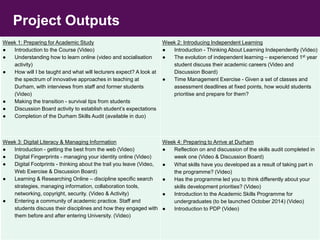
Week 1: Preparing for Academic Study 
● Introduction to the Course (Video) 
● Understanding how to learn online (video and socialisation 
activity) 
● How will I be taught and what will lecturers expect? A look at 
the spectrum of innovative approaches in teaching at 
Durham, with interviews from staff and former students 
(Video) 
● Making the transition - survival tips from students 
● Discussion Board activity to establish student’s expectations 
● Completion of the Durham Skills Audit (available in duo) 
Week 2: Introducing Independent Learning 
● Introduction - Thinking About Learning Independently (Video) 
● The evolution of independent learning – experienced 1st year 
student discuss their academic careers (Video and 
Discussion Board) 
● Time Management Exercise - Given a set of classes and 
assessment deadlines at fixed points, how would students 
prioritise and prepare for them? 
Week 3: Digital Literacy & Managing Information 
● Introduction - getting the best from the web (Video) 
● Digital Fingerprints - managing your identity online (Video) 
● Digital Footprints - thinking about the trail you leave (Video, 
Web Exercise & Discussion Board) 
● Learning & Researching Online – discipline specific search 
strategies, managing information, collaboration tools, 
networking, copyright, security. (Video & Activity) 
● Entering a community of academic practice. Staff and 
students discuss their disciplines and how they engaged with 
them before and after entering University. (Video) 
Week 4: Preparing to Arrive at Durham 
● Reflection on and discussion of the skills audit completed in 
week one (Video & Discussion Board) 
● What skills have you developed as a result of taking part in 
the programme? (Video) 
● Has the programme led you to think differently about your 
skills development priorities? (Video) 
● Introduction to the Academic Skills Programme for 
undergraduates (to be launched October 2014) (Video) 
● Introduction to PDP (Video)
Project Outputs 
Week 1: Preparing for Academic Study 
● Introduction to the Course (Video) 
● Understanding how to learn online (video and socialisation 
activity) 
● How will I be taught and what will lecturers expect? A look at 
the spectrum of innovative approaches in teaching at 
Durham, with interviews from staff and former students 
(Video) 
● Making the transition - survival tips from students 
● Discussion Board activity to establish student’s expectations 
● Completion of the Durham Skills Audit (available in duo) 
Week 2: Introducing Independent Learning 
● Introduction - Thinking About Learning Independently (Video) 
● The evolution of independent learning – experienced 1st year 
student discuss their academic careers (Video and 
Discussion Board) 
● Time Management Exercise - Given a set of classes and 
assessment deadlines at fixed points, how would students 
prioritise and prepare for them? 
Week 3: Digital Literacy & Managing Information 
● Introduction - getting the best from the web (Video) 
● Digital Fingerprints - managing your identity online (Video) 
● Digital Footprints - thinking about the trail you leave (Video, 
Web Exercise & Discussion Board) 
● Learning & Researching Online – discipline specific search 
strategies, managing information, collaboration tools, 
networking, copyright, security. (Video & Activity) 
● Entering a community of academic practice. Staff and 
students discuss their disciplines and how they engaged with 
them before and after entering University. (Video) 
Week 4: Preparing to Arrive at Durham 
● Reflection on and discussion of the skills audit completed in 
week one (Video & Discussion Board) 
● What skills have you developed as a result of taking part in 
the programme? (Video) 
● Has the programme led you to think differently about your 
skills development priorities? (Video) 
● Introduction to the Academic Skills Programme for 
undergraduates (to be launched October 2014) (Video) 
● Introduction to PDP (Video) 
Year One
Week 1 – Summer Development 2014 
• Introduction to the Course (Video) 
• Understanding how to learn online (video and 
socialisation activity) 
• How will I be taught and what will lecturers expect? A 
look at the spectrum of innovative approaches in 
teaching at Durham, with interviews from staff and 
former students (Video) 
• Making the transition - survival tips from students 
• Discussion Board activity to establish student’s 
expectations 
• Completion of the Durham Skills Audit (available in 
duo)
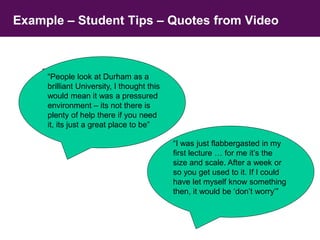
Example – Student Tips – Quotes from Video 
“People look at Durham as a 
brilliant University, I thought this 
would mean it was a pressured 
environment – its not there is 
plenty of help there if you need 
it, its just a great place to be” 
“People look at Durham as a 
brilliant University, I thought this 
would mean it was a pressured 
environment – its not there is 
plenty of help there if you need 
it, its just a great place to be” 
“I was just flabbergasted in my 
first lecture … for me it’s the 
size and scale. After a week or 
so you get used to it. If I could 
have let myself know something 
then, it would be ‘don’t worry’”
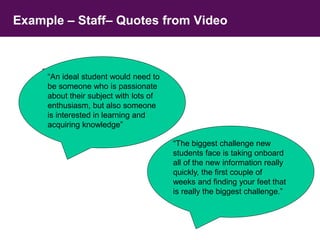
Example – Staff– Quotes from Video 
“People look at Durham as a 
brilliant University, I thought this 
would mean it was a pressured 
environment – its not there is 
plenty of help there if you need 
it, its just a great place to be” 
“An ideal student would need to 
be someone who is passionate 
about their subject with lots of 
enthusiasm, but also someone 
is interested in learning and 
acquiring knowledge” 
“The biggest challenge new 
students face is taking onboard 
all of the new information really 
quickly, the first couple of 
weeks and finding your feet that 
is really the biggest challenge.”
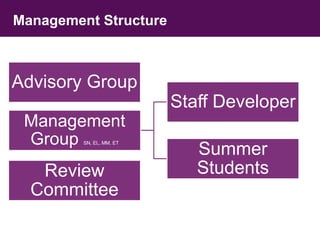
Management Structure 
Advisory Group 
Management 
Group SN, EL, MM, ET 
Staff Developer 
Summer 
Review Students 
Committee
Review Committee 
• Student Evaluating Consultants: 
• We will employ a review committee of 6 students per faculty 
to evaluate the produced materials. 
• These students will meet once in the Michaelmas and 
Epiphany Terms. 
• In reviewing the materials students will make 
recommendations and suggest improvements as 
appropriate.
Advisory Group 
• Their role to : 
• Offer on advice and guidance on developed materials 
• Provide volunteers for taking part in filming and interviews 
• Offer previously developed materials for inclusion for their 
students. 
• They will meet: 
• October 14 – Consider materials produced 
• January 15 – Consider feedback from review panel 
• June 15 – Consider materials produced 
• October/November 15 – Consider feedback from review panel 
• ?
Conclusion 
• The Idea 
• Where it comes from 
• The Purpose of Today 
• The Advisory Group

Transitions into HE - Project Overview

  • 1.
    Transitions into HE Supporting Student Study Skills Development at Distance Sam Nolan Eleanor Loughlin Malcolm Murray Elaine Tan
  • 2.
    To Cover •The Idea • Where it comes from • The Project • Where we are at • Contributing to the Project
  • 3.
  • 4.
    The Idea “Atthe heart of successful retention and success is a strong sense of belonging in HE for all students. This is most effectively nurtured through mainstream activities that all students participate in.” Student belonging is achieved through: • Supportive peer relations • Meaningful interaction between staff and students • Developing knowledge, confidence and identity as successful HE learners • An HE experience relevant to students’ interests and future goals Findings of 2012 HEA Study into Student Retention
  • 5.
    Aim • Thisproject will develop an innovative e-learning course to support all incoming first years before they start at Durham University. The course is designed to help students develop study skills and to successfully make the transition into higher education. This pan- University initiative includes collaborators from all faculties, together with support services, DSU and colleges.
  • 6.
    Objectives • Theobjectives of this project are: • To develop a small private online course (SPOC) for incoming undergraduates. This will run through September and focus on the skills required to make the transition into higher education. It will be developed in partnership with current students, to allow us to identify the areas which students struggle with and develop innovative engaging solutions at the appropriate level,
  • 7.
    Objectives • Theobjectives of this project are: • To exploit existing distance learning tools such as DUO, video streaming and web-conferencing to create an online community of learners prior to their arrival at Durham, • To evaluate the impact of these web-based resource upon students’ learning, • To disseminate this work both within the University and at a national level.
  • 8.
  • 9.
    Project Evolution •Many Universities across the UK are developing online courses to support students making the transition into HE. • At Durham, we started on a pilot project based in the Foundation Centre with a series of student interviews and focus groups.
  • 10.
    Focus Group WithNew Students • Every student (local and international) wanted more contact pre-arrival • They wanted: • More information about their classes • Reading materials • Logistical information about Durham • Looked at good practice elsewhere, e.g. earlier DUBBU meetings: • “Opening Doors Early to Academic Integrity – aiding the transition to and managing expectations of academic practice at University”, J Thompson (Geography) & J Jurowska (LTT), Durham, 2012 • “Delivering Transition Support Through the VLE”, S Davis (LTT), York, 2011
  • 11.
    What do StudentsGet • All Students: • Website http://www.dur.ac.uk/foundation.welcome • Discussion Board • Access to Video Interviews with Former Students • Access to Live & Recorded Webchats • Information on Induction and TB1 Timetables • Introductory Videos from all their TB1 Modules • Short Video & Audio Preparatory Lectures • Quizzes • Access to other learning tools (e.g. Virtual Experiments)
  • 12.
    Qualitative Feedback •In depth focus groups revealed the students often felt isolated over the summer prior to starting with us. As one put it: • “You’ve accepted an offer, but then it all goes quiet. You just want to get started, but you hear nothing and all the time you’re worried about whether you’ve made the right choice. This website was a godsend, it let you see your tutors, let you talk to your fellow students and with the weekly webchats, made you feel part of something.”
  • 13.
    Qualitative Feedback •Increasing student confidence was also evident during the induction week, with students generally aware of where they needed to be, and more engaged with the activities that were taking place. As a staff member put it: • “They often come bounding over and say, I know you’ll be teaching me, as I’ve seen you on the online videos. That initial confidence has really increased, and it allows us to start an effective dialogue around learning earlier.”
  • 14.
    This Project: Transitionsinto HE University Wide – Study Skills Focussed
  • 15.
    Project Outputs Week1: Preparing for Academic Study ● Introduction to the Course (Video) ● Understanding how to learn online (video and socialisation activity) ● How will I be taught and what will lecturers expect? A look at the spectrum of innovative approaches in teaching at Durham, with interviews from staff and former students (Video) ● Making the transition - survival tips from students ● Discussion Board activity to establish student’s expectations ● Completion of the Durham Skills Audit (available in duo) Week 2: Introducing Independent Learning ● Introduction - Thinking About Learning Independently (Video) ● The evolution of independent learning – experienced 1st year student discuss their academic careers (Video and Discussion Board) ● Time Management Exercise - Given a set of classes and assessment deadlines at fixed points, how would students prioritise and prepare for them? Week 3: Digital Literacy & Managing Information ● Introduction - getting the best from the web (Video) ● Digital Fingerprints - managing your identity online (Video) ● Digital Footprints - thinking about the trail you leave (Video, Web Exercise & Discussion Board) ● Learning & Researching Online – discipline specific search strategies, managing information, collaboration tools, networking, copyright, security. (Video & Activity) ● Entering a community of academic practice. Staff and students discuss their disciplines and how they engaged with them before and after entering University. (Video) Week 4: Preparing to Arrive at Durham ● Reflection on and discussion of the skills audit completed in week one (Video & Discussion Board) ● What skills have you developed as a result of taking part in the programme? (Video) ● Has the programme led you to think differently about your skills development priorities? (Video) ● Introduction to the Academic Skills Programme for undergraduates (to be launched October 2014) (Video) ● Introduction to PDP (Video)
  • 16.
    Project Outputs Week1: Preparing for Academic Study ● Introduction to the Course (Video) ● Understanding how to learn online (video and socialisation activity) ● How will I be taught and what will lecturers expect? A look at the spectrum of innovative approaches in teaching at Durham, with interviews from staff and former students (Video) ● Making the transition - survival tips from students ● Discussion Board activity to establish student’s expectations ● Completion of the Durham Skills Audit (available in duo) Week 2: Introducing Independent Learning ● Introduction - Thinking About Learning Independently (Video) ● The evolution of independent learning – experienced 1st year student discuss their academic careers (Video and Discussion Board) ● Time Management Exercise - Given a set of classes and assessment deadlines at fixed points, how would students prioritise and prepare for them? Week 3: Digital Literacy & Managing Information ● Introduction - getting the best from the web (Video) ● Digital Fingerprints - managing your identity online (Video) ● Digital Footprints - thinking about the trail you leave (Video, Web Exercise & Discussion Board) ● Learning & Researching Online – discipline specific search strategies, managing information, collaboration tools, networking, copyright, security. (Video & Activity) ● Entering a community of academic practice. Staff and students discuss their disciplines and how they engaged with them before and after entering University. (Video) Week 4: Preparing to Arrive at Durham ● Reflection on and discussion of the skills audit completed in week one (Video & Discussion Board) ● What skills have you developed as a result of taking part in the programme? (Video) ● Has the programme led you to think differently about your skills development priorities? (Video) ● Introduction to the Academic Skills Programme for undergraduates (to be launched October 2014) (Video) ● Introduction to PDP (Video) Year One
  • 17.
    Week 1 –Summer Development 2014 • Introduction to the Course (Video) • Understanding how to learn online (video and socialisation activity) • How will I be taught and what will lecturers expect? A look at the spectrum of innovative approaches in teaching at Durham, with interviews from staff and former students (Video) • Making the transition - survival tips from students • Discussion Board activity to establish student’s expectations • Completion of the Durham Skills Audit (available in duo)
  • 18.
    Example – StudentTips – Quotes from Video “People look at Durham as a brilliant University, I thought this would mean it was a pressured environment – its not there is plenty of help there if you need it, its just a great place to be” “People look at Durham as a brilliant University, I thought this would mean it was a pressured environment – its not there is plenty of help there if you need it, its just a great place to be” “I was just flabbergasted in my first lecture … for me it’s the size and scale. After a week or so you get used to it. If I could have let myself know something then, it would be ‘don’t worry’”
  • 19.
    Example – Staff–Quotes from Video “People look at Durham as a brilliant University, I thought this would mean it was a pressured environment – its not there is plenty of help there if you need it, its just a great place to be” “An ideal student would need to be someone who is passionate about their subject with lots of enthusiasm, but also someone is interested in learning and acquiring knowledge” “The biggest challenge new students face is taking onboard all of the new information really quickly, the first couple of weeks and finding your feet that is really the biggest challenge.”
  • 20.
    Management Structure AdvisoryGroup Management Group SN, EL, MM, ET Staff Developer Summer Review Students Committee
  • 21.
    Review Committee •Student Evaluating Consultants: • We will employ a review committee of 6 students per faculty to evaluate the produced materials. • These students will meet once in the Michaelmas and Epiphany Terms. • In reviewing the materials students will make recommendations and suggest improvements as appropriate.
  • 22.
    Advisory Group •Their role to : • Offer on advice and guidance on developed materials • Provide volunteers for taking part in filming and interviews • Offer previously developed materials for inclusion for their students. • They will meet: • October 14 – Consider materials produced • January 15 – Consider feedback from review panel • June 15 – Consider materials produced • October/November 15 – Consider feedback from review panel • ?
  • 23.
    Conclusion • TheIdea • Where it comes from • The Purpose of Today • The Advisory Group