Spinning Plates:
Working on Student Summer
Projects
Sam Nolan (@samjnolan)
Sarah Learmonth
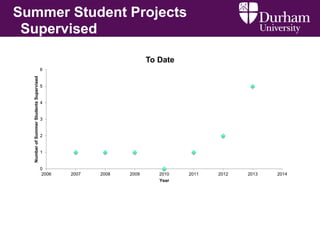
Summer Student Projects
Supervised
0
1
2
3
4
5
6
2006 2007 2008 2009 2010 2011 2012 2013 2014
NumberofSummerStudentsSupervised
Year
To Date
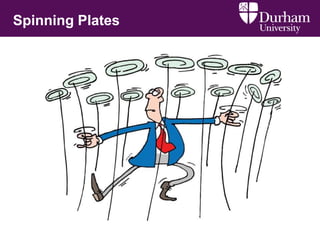
Spinning Plates
To Cover
• Project 1: Screen Experiments (FC, Chemistry & Physics)
• Project 2: Pre-Arrival (FC)
• Project 3: Transitions into HE (all Uni)
• Challenges & Opportunities
• Conclusion
• None of this would be possible without:
• Students: Andres del Castillo Dubuc, Sarah Learmonth, Fran
Weetman, Katherine Hurst, Jason Hutsby, Dan Maxwell,
Matthew Shipton
• Staff: Simon Rees, Lowry McComb, Marek Szablewski, Ifan
Hughes, Matt Jones, Antje Kohnle, Litka Milian, Steve Leech,
Megan Bruce, Eleanor Loughlin, Malcolm Murray, Elaine Tan
• Funding from the University Centre for Academic and
Researcher Development (CARD)
Interactive Screen Experiments
Enhancing laboratory learning
Plate 1: Screen Experiments
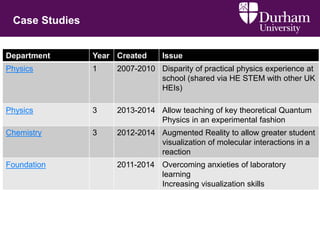
Case Studies
Department Year Created Issue
Physics 1 2007-2010 Disparity of practical physics experience at
school (shared via HE STEM with other UK
HEIs)
Physics 3 2013-2014 Allow teaching of key theoretical Quantum
Physics in an experimental fashion
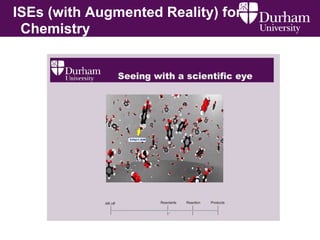
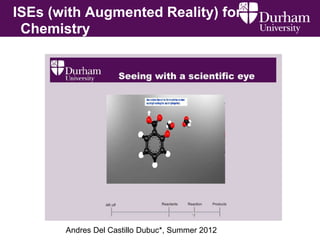
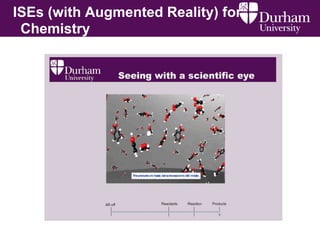
Chemistry 3 2012-2014 Augmented Reality to allow greater student
visualization of molecular interactions in a
reaction
Foundation 2011-2014 Overcoming anxieties of laboratory
learning
Increasing visualization skills
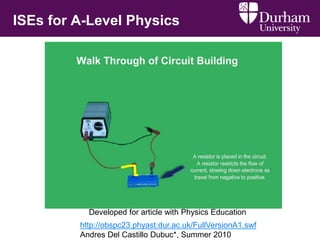
ISEs for A-Level Physics
Developed for article with Physics Education
http://obspc23.phyast.dur.ac.uk/FullVersionA1.swf
Andres Del Castillo Dubuc*, Summer 2010
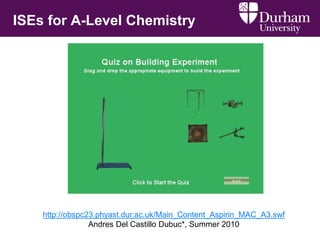
ISEs for A-Level Chemistry
http://obspc23.phyast.dur.ac.uk/Main_Content_Aspirin_MAC_A3.swf
Andres Del Castillo Dubuc*, Summer 2010
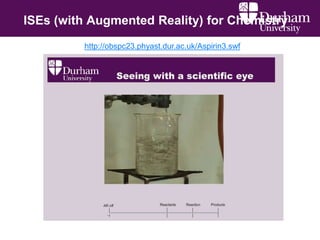
ISEs (with Augmented Reality) for Chemistry
http://obspc23.phyast.dur.ac.uk/Aspirin3.swf
ISEs (with Augmented Reality) for
Chemistry
ISEs (with Augmented Reality) for
Chemistry
Andres Del Castillo Dubuc*, Summer 2012
ISEs (with Augmented Reality) for
Chemistry
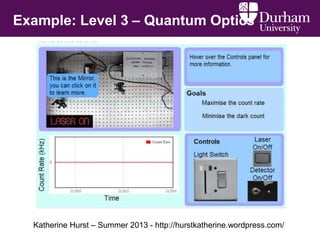
Example: Level 3 – Quantum Optics
Katherine Hurst – Summer 2013 - http://hurstkatherine.wordpress.com/
Student Thoughts
End of module questionnaires (Level 1)
• ‘The interactive screen experiments (ISEs) provided as
preparatory tasks for some of the Full Experiments
helped my understanding of the experiment.’
• Of the 191 responses 131 students agreed or strongly
agreed.
Focus groups (Foundation)
• 'I used the experiment as soon as you sent it out,
before the class, after the class and when I was writing
the report. I haven’t done practicals in Brazil and really
appreciated this.’
• 'I wish we could have had more of these sent out
earlier to give us something to do over the summer.'
Foundation Centre: Pre-Arrival
Enhancing Student Learning from Day One
Plate 2
The Idea
“At the heart of successful retention and success is a
strong sense of belonging in HE for all students. This is
most effectively nurtured through mainstream activities
that all students participate in.”
Student belonging is achieved through:
• Supportive peer relations
• Meaningful interaction between staff and students
• Developing knowledge, confidence and identity as successful
HE learners
• An HE experience relevant to students’ interests and future
goals
Findings of 2012 HEA Study into Student Retention
Focus Group With New Students
• Every student (local and international) wanted more
contact pre-arrival
• They wanted:
• More information about their classes
• Reading materials
• Logistical information about Durham
• Looked at good practice elsewhere, e.g. earlier DUBBU
meetings:
• “Opening Doors Early to Academic Integrity – aiding the transition
to and managing expectations of academic practice at University”,
J Thompson (Geography) & J Jurowska (LTT), Durham, 2012
• “Delivering Transition Support Through the VLE”, S Davis (LTT),
York, 2011
Student Employees
• 2012 Stephen Brayson*
• 2013 Fran Weetman, Jason Hutsby*
What do Students Get
• All Students:
• Website http://www.dur.ac.uk/foundation.welcome
• Discussion Board
• Access to Video Interviews with Former Students
• Access to Live & Recorded Webchats
• Information on Induction and TB1 Timetables
• Introductory Videos from all their TB1 Modules
• Short Video & Audio Preparatory Lectures
• Quizzes
• Access to other learning tools (e.g. Virtual Experiments)
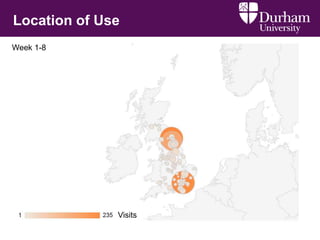
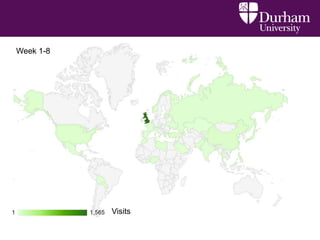
Visits
Week 1-8
Location of Use
Visits
Week 1-8
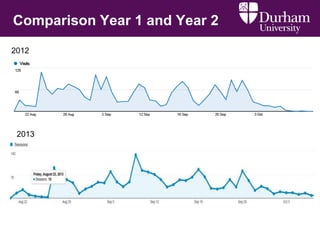
Comparison Year 1 and Year 2
2012
2013
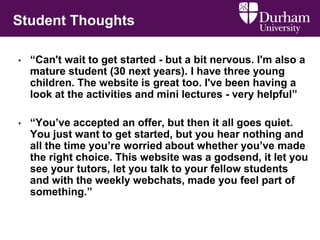
Student Thoughts
• “Can't wait to get started - but a bit nervous. I'm also a
mature student (30 next years). I have three young
children. The website is great too. I've been having a
look at the activities and mini lectures - very helpful”
• “You’ve accepted an offer, but then it all goes quiet.
You just want to get started, but you hear nothing and
all the time you’re worried about whether you’ve made
the right choice. This website was a godsend, it let you
see your tutors, let you talk to your fellow students
and with the weekly webchats, made you feel part of
something.”
Transitions into Higher Education
Plate 3
Enhancing Students First Steps into HE
Aim
• This project will develop an innovative e-learning
course to support all incoming first years before they
start at Durham University. The course is designed to
help students develop study skills and to successfully
make the transition into higher education. This pan-
University initiative includes collaborators from all
faculties, together with support services, DSU and
colleges.
Objectives
• The objectives of this project are:
• To develop a small private online course (SPOC) for
incoming undergraduates. This will run through September
and focus on the skills required to make the transition into
higher education. It will be developed in partnership with
current students, to allow us to identify the areas which
students struggle with and develop innovative engaging
solutions at the appropriate level,
Objectives
• The objectives of this project are:
• To exploit existing distance learning tools such as DUO,
video streaming and web-conferencing to create an online
community of learners prior to their arrival at Durham,
• To evaluate the impact of these web-based resource upon
students’ learning,
• To disseminate this work both within the University and at a
national level.
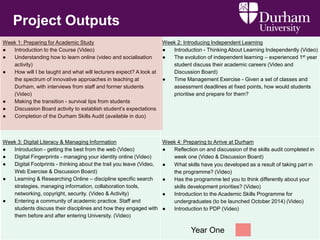
Project Outputs
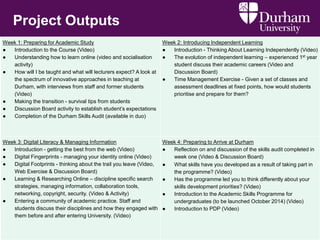
Week 1: Preparing for Academic Study
● Introduction to the Course (Video)
● Understanding how to learn online (video and socialisation
activity)
● How will I be taught and what will lecturers expect? A look at
the spectrum of innovative approaches in teaching at
Durham, with interviews from staff and former students
(Video)
● Making the transition - survival tips from students
● Discussion Board activity to establish student’s expectations
● Completion of the Durham Skills Audit (available in duo)
Week 2: Introducing Independent Learning
● Introduction - Thinking About Learning Independently (Video)
● The evolution of independent learning – experienced 1st year
student discuss their academic careers (Video and
Discussion Board)
● Time Management Exercise - Given a set of classes and
assessment deadlines at fixed points, how would students
prioritise and prepare for them?
Week 3: Digital Literacy & Managing Information
● Introduction - getting the best from the web (Video)
● Digital Fingerprints - managing your identity online (Video)
● Digital Footprints - thinking about the trail you leave (Video,
Web Exercise & Discussion Board)
● Learning & Researching Online – discipline specific search
strategies, managing information, collaboration tools,
networking, copyright, security. (Video & Activity)
● Entering a community of academic practice. Staff and
students discuss their disciplines and how they engaged with
them before and after entering University. (Video)
Week 4: Preparing to Arrive at Durham
● Reflection on and discussion of the skills audit completed in
week one (Video & Discussion Board)
● What skills have you developed as a result of taking part in
the programme? (Video)
● Has the programme led you to think differently about your
skills development priorities? (Video)
● Introduction to the Academic Skills Programme for
undergraduates (to be launched October 2014) (Video)
● Introduction to PDP (Video)
Project Outputs
Week 1: Preparing for Academic Study
● Introduction to the Course (Video)
● Understanding how to learn online (video and socialisation
activity)
● How will I be taught and what will lecturers expect? A look at
the spectrum of innovative approaches in teaching at
Durham, with interviews from staff and former students
(Video)
● Making the transition - survival tips from students
● Discussion Board activity to establish student’s expectations
● Completion of the Durham Skills Audit (available in duo)
Week 2: Introducing Independent Learning
● Introduction - Thinking About Learning Independently (Video)
● The evolution of independent learning – experienced 1st year
student discuss their academic careers (Video and
Discussion Board)
● Time Management Exercise - Given a set of classes and
assessment deadlines at fixed points, how would students
prioritise and prepare for them?
Week 3: Digital Literacy & Managing Information
● Introduction - getting the best from the web (Video)
● Digital Fingerprints - managing your identity online (Video)
● Digital Footprints - thinking about the trail you leave (Video,
Web Exercise & Discussion Board)
● Learning & Researching Online – discipline specific search
strategies, managing information, collaboration tools,
networking, copyright, security. (Video & Activity)
● Entering a community of academic practice. Staff and
students discuss their disciplines and how they engaged with
them before and after entering University. (Video)
Week 4: Preparing to Arrive at Durham
● Reflection on and discussion of the skills audit completed in
week one (Video & Discussion Board)
● What skills have you developed as a result of taking part in
the programme? (Video)
● Has the programme led you to think differently about your
skills development priorities? (Video)
● Introduction to the Academic Skills Programme for
undergraduates (to be launched October 2014) (Video)
● Introduction to PDP (Video)
Year One
Week 1 – Current Development
• Introduction to the Course (Video)
• Understanding how to learn online (video and
socialisation activity)
• How will I be taught and what will lecturers expect? A
look at the spectrum of innovative approaches in
teaching at Durham, with interviews from staff and
former students (Video)
• Making the transition - survival tips from students
• Discussion Board activity to establish student’s
expectations
• Completion of the Durham Skills Audit (available in
duo)
• Introduction to the Course (Video)
• Understanding how to learn online (video and
socialisation activity)
• How will I be taught and what will lecturers expect? A
look at the spectrum of innovative approaches in
teaching at Durham, with interviews from staff and
former students (Video)
• Making the transition - survival tips from students
• Discussion Board activity to establish student’s
expectations
• Completion of the Durham Skills Audit (available in
duo)
Week 1 – Current Development
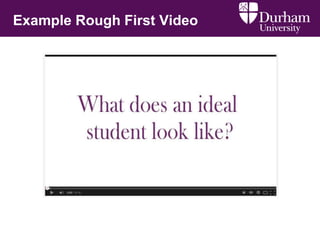
Example Rough First Video
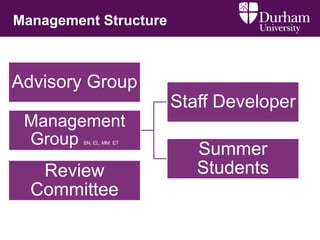
Management Structure
Advisory Group
Management
Group SN, EL, MM, ET
Staff Developer
Summer
StudentsReview
Committee
Review Committee
• Student Evaluating Consultants:
• We will employ a review committee of 6 students per faculty
to evaluate the produced materials.
• These students will meet once in the Michaelmas and
Epiphany Terms.
• In reviewing the materials students will make
recommendations and suggest improvements as
appropriate.
The Student’s Perspective
The Role and Responsibilities
My role within the project:
• Student Developer
What does the role entail?
• Administration
• Assisting in filming and editing
• Producing content for the website/blog
What Have I Gained?
• Practical skills
• Financial gain
• Enhanced postgraduate applications
• Enhanced CV
• Increased networks
• Personal satisfaction
Challenges & Opportunities
Opportunities
• Helping Students Succeed
• Developing eLearning Resources to support your
teaching
• Dissemination:
• Teaching Tools used both within Durham, in local schools
and nationally at HE Level
• Practioner Journal Papers
• Contributed Talks
• Invited Talks
• Membership of National Bodies
Challenges
• Time and Location
• Finding the Right Student
• Need not be the most able, sometimes it’s the one who you
think will gain the most from the experience.
• Giving Opportunities and Working as Partners
• Setting goals and timescales
Conclusion
• Summer projects are:
• Great for enhancing student skill set
• Great for producing learning resources
• Great because the best way to improve your classes is for
you and the people who’ve just been through it to innovate a
new approach together.
• Fun !
• This Summer
• More Screen Experiments
• More Augmented Reality
• More Pre-Arrival Development FC
• Transitions into HE

Plate Spinning DURRBU

  • 1.
    Spinning Plates: Working onStudent Summer Projects Sam Nolan (@samjnolan) Sarah Learmonth
  • 2.
    Summer Student Projects Supervised 0 1 2 3 4 5 6 20062007 2008 2009 2010 2011 2012 2013 2014 NumberofSummerStudentsSupervised Year To Date
  • 3.
  • 4.
    To Cover • Project1: Screen Experiments (FC, Chemistry & Physics) • Project 2: Pre-Arrival (FC) • Project 3: Transitions into HE (all Uni) • Challenges & Opportunities • Conclusion • None of this would be possible without: • Students: Andres del Castillo Dubuc, Sarah Learmonth, Fran Weetman, Katherine Hurst, Jason Hutsby, Dan Maxwell, Matthew Shipton • Staff: Simon Rees, Lowry McComb, Marek Szablewski, Ifan Hughes, Matt Jones, Antje Kohnle, Litka Milian, Steve Leech, Megan Bruce, Eleanor Loughlin, Malcolm Murray, Elaine Tan • Funding from the University Centre for Academic and Researcher Development (CARD)
  • 5.
    Interactive Screen Experiments Enhancinglaboratory learning Plate 1: Screen Experiments
  • 6.
    Case Studies Department YearCreated Issue Physics 1 2007-2010 Disparity of practical physics experience at school (shared via HE STEM with other UK HEIs) Physics 3 2013-2014 Allow teaching of key theoretical Quantum Physics in an experimental fashion Chemistry 3 2012-2014 Augmented Reality to allow greater student visualization of molecular interactions in a reaction Foundation 2011-2014 Overcoming anxieties of laboratory learning Increasing visualization skills
  • 7.
    ISEs for A-LevelPhysics Developed for article with Physics Education http://obspc23.phyast.dur.ac.uk/FullVersionA1.swf Andres Del Castillo Dubuc*, Summer 2010
  • 8.
    ISEs for A-LevelChemistry http://obspc23.phyast.dur.ac.uk/Main_Content_Aspirin_MAC_A3.swf Andres Del Castillo Dubuc*, Summer 2010
  • 9.
    ISEs (with AugmentedReality) for Chemistry http://obspc23.phyast.dur.ac.uk/Aspirin3.swf
  • 10.
    ISEs (with AugmentedReality) for Chemistry
  • 11.
    ISEs (with AugmentedReality) for Chemistry Andres Del Castillo Dubuc*, Summer 2012
  • 12.
    ISEs (with AugmentedReality) for Chemistry
  • 13.
    Example: Level 3– Quantum Optics Katherine Hurst – Summer 2013 - http://hurstkatherine.wordpress.com/
  • 14.
    Student Thoughts End ofmodule questionnaires (Level 1) • ‘The interactive screen experiments (ISEs) provided as preparatory tasks for some of the Full Experiments helped my understanding of the experiment.’ • Of the 191 responses 131 students agreed or strongly agreed. Focus groups (Foundation) • 'I used the experiment as soon as you sent it out, before the class, after the class and when I was writing the report. I haven’t done practicals in Brazil and really appreciated this.’ • 'I wish we could have had more of these sent out earlier to give us something to do over the summer.'
  • 15.
    Foundation Centre: Pre-Arrival EnhancingStudent Learning from Day One Plate 2
  • 16.
    The Idea “At theheart of successful retention and success is a strong sense of belonging in HE for all students. This is most effectively nurtured through mainstream activities that all students participate in.” Student belonging is achieved through: • Supportive peer relations • Meaningful interaction between staff and students • Developing knowledge, confidence and identity as successful HE learners • An HE experience relevant to students’ interests and future goals Findings of 2012 HEA Study into Student Retention
  • 17.
    Focus Group WithNew Students • Every student (local and international) wanted more contact pre-arrival • They wanted: • More information about their classes • Reading materials • Logistical information about Durham • Looked at good practice elsewhere, e.g. earlier DUBBU meetings: • “Opening Doors Early to Academic Integrity – aiding the transition to and managing expectations of academic practice at University”, J Thompson (Geography) & J Jurowska (LTT), Durham, 2012 • “Delivering Transition Support Through the VLE”, S Davis (LTT), York, 2011
  • 18.
    Student Employees • 2012Stephen Brayson* • 2013 Fran Weetman, Jason Hutsby*
  • 19.
    What do StudentsGet • All Students: • Website http://www.dur.ac.uk/foundation.welcome • Discussion Board • Access to Video Interviews with Former Students • Access to Live & Recorded Webchats • Information on Induction and TB1 Timetables • Introductory Videos from all their TB1 Modules • Short Video & Audio Preparatory Lectures • Quizzes • Access to other learning tools (e.g. Virtual Experiments)
  • 20.
  • 21.
  • 22.
    Comparison Year 1and Year 2 2012 2013
  • 23.
    Student Thoughts • “Can'twait to get started - but a bit nervous. I'm also a mature student (30 next years). I have three young children. The website is great too. I've been having a look at the activities and mini lectures - very helpful” • “You’ve accepted an offer, but then it all goes quiet. You just want to get started, but you hear nothing and all the time you’re worried about whether you’ve made the right choice. This website was a godsend, it let you see your tutors, let you talk to your fellow students and with the weekly webchats, made you feel part of something.”
  • 24.
    Transitions into HigherEducation Plate 3 Enhancing Students First Steps into HE
  • 25.
    Aim • This projectwill develop an innovative e-learning course to support all incoming first years before they start at Durham University. The course is designed to help students develop study skills and to successfully make the transition into higher education. This pan- University initiative includes collaborators from all faculties, together with support services, DSU and colleges.
  • 26.
    Objectives • The objectivesof this project are: • To develop a small private online course (SPOC) for incoming undergraduates. This will run through September and focus on the skills required to make the transition into higher education. It will be developed in partnership with current students, to allow us to identify the areas which students struggle with and develop innovative engaging solutions at the appropriate level,
  • 27.
    Objectives • The objectivesof this project are: • To exploit existing distance learning tools such as DUO, video streaming and web-conferencing to create an online community of learners prior to their arrival at Durham, • To evaluate the impact of these web-based resource upon students’ learning, • To disseminate this work both within the University and at a national level.
  • 28.
    Project Outputs Week 1:Preparing for Academic Study ● Introduction to the Course (Video) ● Understanding how to learn online (video and socialisation activity) ● How will I be taught and what will lecturers expect? A look at the spectrum of innovative approaches in teaching at Durham, with interviews from staff and former students (Video) ● Making the transition - survival tips from students ● Discussion Board activity to establish student’s expectations ● Completion of the Durham Skills Audit (available in duo) Week 2: Introducing Independent Learning ● Introduction - Thinking About Learning Independently (Video) ● The evolution of independent learning – experienced 1st year student discuss their academic careers (Video and Discussion Board) ● Time Management Exercise - Given a set of classes and assessment deadlines at fixed points, how would students prioritise and prepare for them? Week 3: Digital Literacy & Managing Information ● Introduction - getting the best from the web (Video) ● Digital Fingerprints - managing your identity online (Video) ● Digital Footprints - thinking about the trail you leave (Video, Web Exercise & Discussion Board) ● Learning & Researching Online – discipline specific search strategies, managing information, collaboration tools, networking, copyright, security. (Video & Activity) ● Entering a community of academic practice. Staff and students discuss their disciplines and how they engaged with them before and after entering University. (Video) Week 4: Preparing to Arrive at Durham ● Reflection on and discussion of the skills audit completed in week one (Video & Discussion Board) ● What skills have you developed as a result of taking part in the programme? (Video) ● Has the programme led you to think differently about your skills development priorities? (Video) ● Introduction to the Academic Skills Programme for undergraduates (to be launched October 2014) (Video) ● Introduction to PDP (Video)
  • 29.
    Project Outputs Week 1:Preparing for Academic Study ● Introduction to the Course (Video) ● Understanding how to learn online (video and socialisation activity) ● How will I be taught and what will lecturers expect? A look at the spectrum of innovative approaches in teaching at Durham, with interviews from staff and former students (Video) ● Making the transition - survival tips from students ● Discussion Board activity to establish student’s expectations ● Completion of the Durham Skills Audit (available in duo) Week 2: Introducing Independent Learning ● Introduction - Thinking About Learning Independently (Video) ● The evolution of independent learning – experienced 1st year student discuss their academic careers (Video and Discussion Board) ● Time Management Exercise - Given a set of classes and assessment deadlines at fixed points, how would students prioritise and prepare for them? Week 3: Digital Literacy & Managing Information ● Introduction - getting the best from the web (Video) ● Digital Fingerprints - managing your identity online (Video) ● Digital Footprints - thinking about the trail you leave (Video, Web Exercise & Discussion Board) ● Learning & Researching Online – discipline specific search strategies, managing information, collaboration tools, networking, copyright, security. (Video & Activity) ● Entering a community of academic practice. Staff and students discuss their disciplines and how they engaged with them before and after entering University. (Video) Week 4: Preparing to Arrive at Durham ● Reflection on and discussion of the skills audit completed in week one (Video & Discussion Board) ● What skills have you developed as a result of taking part in the programme? (Video) ● Has the programme led you to think differently about your skills development priorities? (Video) ● Introduction to the Academic Skills Programme for undergraduates (to be launched October 2014) (Video) ● Introduction to PDP (Video) Year One
  • 30.
    Week 1 –Current Development • Introduction to the Course (Video) • Understanding how to learn online (video and socialisation activity) • How will I be taught and what will lecturers expect? A look at the spectrum of innovative approaches in teaching at Durham, with interviews from staff and former students (Video) • Making the transition - survival tips from students • Discussion Board activity to establish student’s expectations • Completion of the Durham Skills Audit (available in duo)
  • 31.
    • Introduction tothe Course (Video) • Understanding how to learn online (video and socialisation activity) • How will I be taught and what will lecturers expect? A look at the spectrum of innovative approaches in teaching at Durham, with interviews from staff and former students (Video) • Making the transition - survival tips from students • Discussion Board activity to establish student’s expectations • Completion of the Durham Skills Audit (available in duo) Week 1 – Current Development
  • 32.
  • 33.
    Management Structure Advisory Group Management GroupSN, EL, MM, ET Staff Developer Summer StudentsReview Committee
  • 34.
    Review Committee • StudentEvaluating Consultants: • We will employ a review committee of 6 students per faculty to evaluate the produced materials. • These students will meet once in the Michaelmas and Epiphany Terms. • In reviewing the materials students will make recommendations and suggest improvements as appropriate.
  • 35.
  • 36.
    The Role andResponsibilities My role within the project: • Student Developer What does the role entail? • Administration • Assisting in filming and editing • Producing content for the website/blog
  • 37.
    What Have IGained? • Practical skills • Financial gain • Enhanced postgraduate applications • Enhanced CV • Increased networks • Personal satisfaction
  • 38.
  • 39.
    Opportunities • Helping StudentsSucceed • Developing eLearning Resources to support your teaching • Dissemination: • Teaching Tools used both within Durham, in local schools and nationally at HE Level • Practioner Journal Papers • Contributed Talks • Invited Talks • Membership of National Bodies
  • 40.
    Challenges • Time andLocation • Finding the Right Student • Need not be the most able, sometimes it’s the one who you think will gain the most from the experience. • Giving Opportunities and Working as Partners • Setting goals and timescales
  • 41.
    Conclusion • Summer projectsare: • Great for enhancing student skill set • Great for producing learning resources • Great because the best way to improve your classes is for you and the people who’ve just been through it to innovate a new approach together. • Fun ! • This Summer • More Screen Experiments • More Augmented Reality • More Pre-Arrival Development FC • Transitions into HE