Transforming Technology Transfer and Recipe Management From Spreadsheets to Standardized Practices Paul Wlodarczyk, VP Solutions Consulting, JustSystems DocTrain Life Sciences 24 June 2008
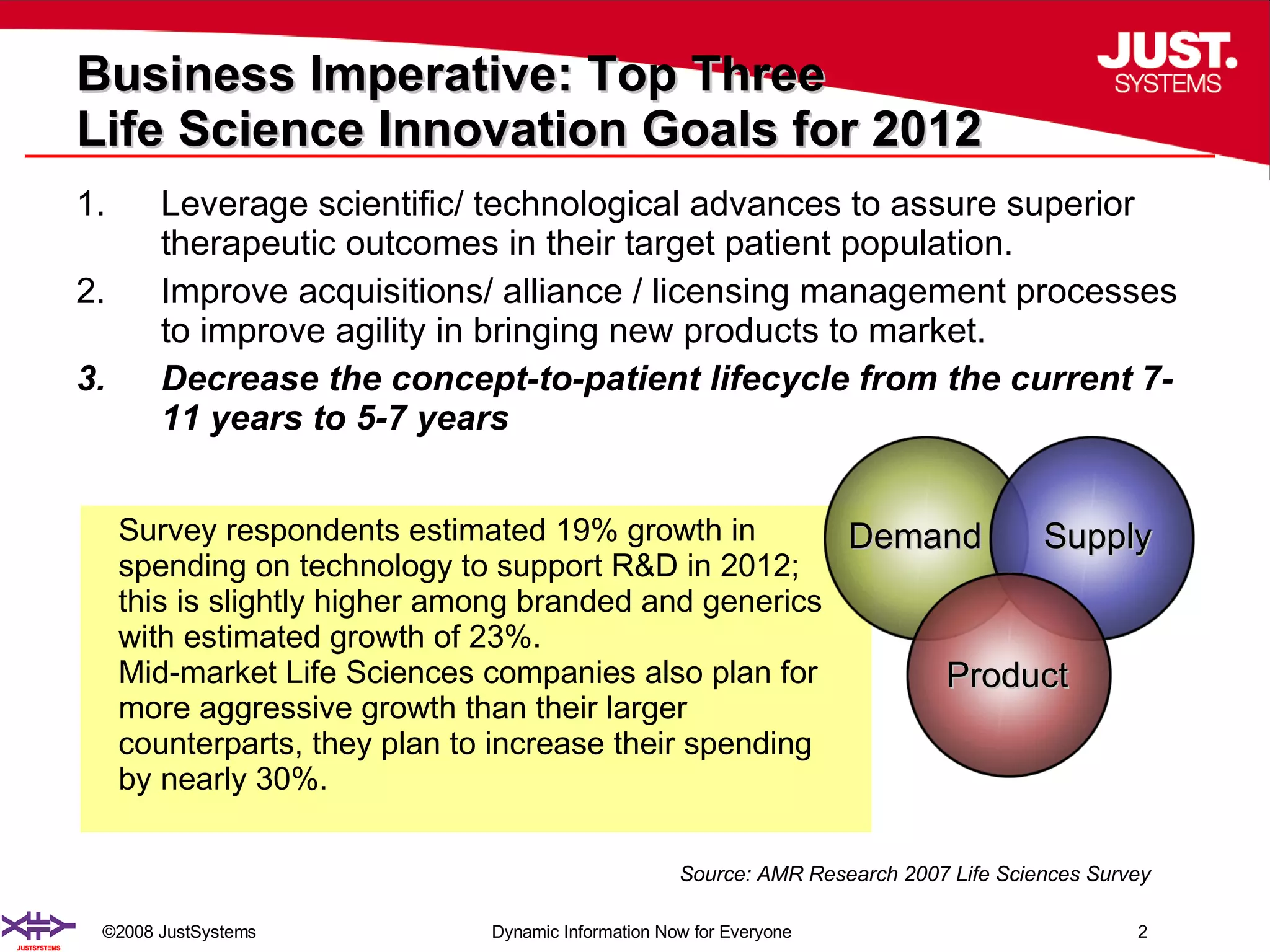
Business Imperative: Top Three Life Science Innovation Goals for 2012  Leverage scientific/ technological advances to assure superior therapeutic outcomes in their target patient population. Improve acquisitions/ alliance / licensing management processes to improve agility in bringing new products to market. Decrease the concept-to-patient lifecycle from the current 7-11 years to 5-7 years Survey respondents estimated 19% growth in spending on technology to support R&D in 2012;  this is slightly higher among branded and generics with estimated growth of 23%.  Mid-market Life Sciences companies also plan for more aggressive growth than their larger counterparts, they plan to increase their spending by nearly 30%. Source: AMR Research 2007 Life Sciences Survey Product Demand Supply
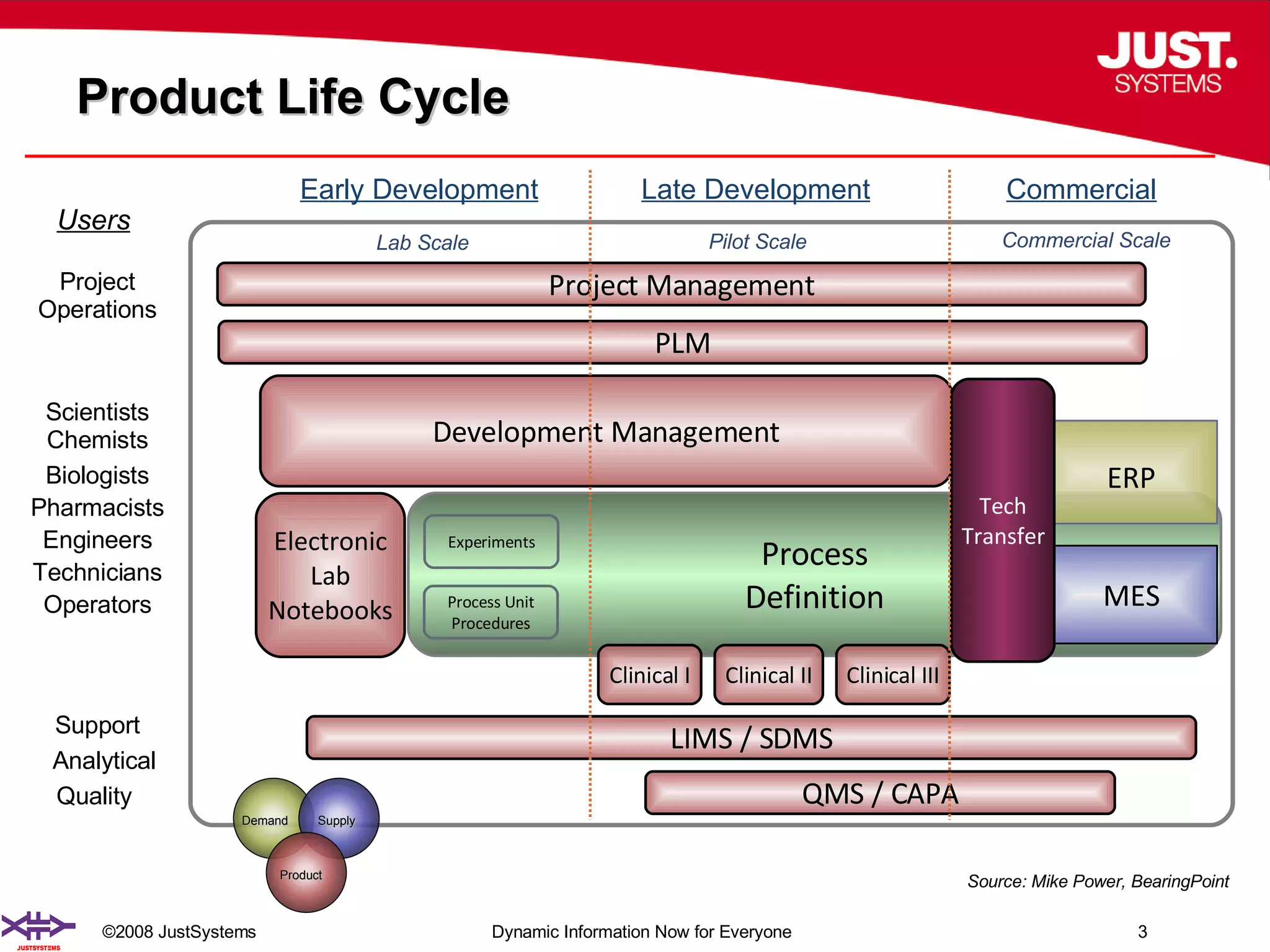
Product Life Cycle Process Definition Pilot Scale Early Development Late Development Project Management LIMS / SDMS QMS / CAPA Lab Scale Electronic Lab Notebooks Users Project Operations Scientists Chemists Biologists Pharmacists Engineers Technicians Operators Support Analytical Quality  MES ERP PLM Development Management Tech Transfer Clinical I Clinical II Clinical III Commercial Experiments Process Unit Procedures Commercial Scale Source: Mike Power, BearingPoint Product Demand Supply
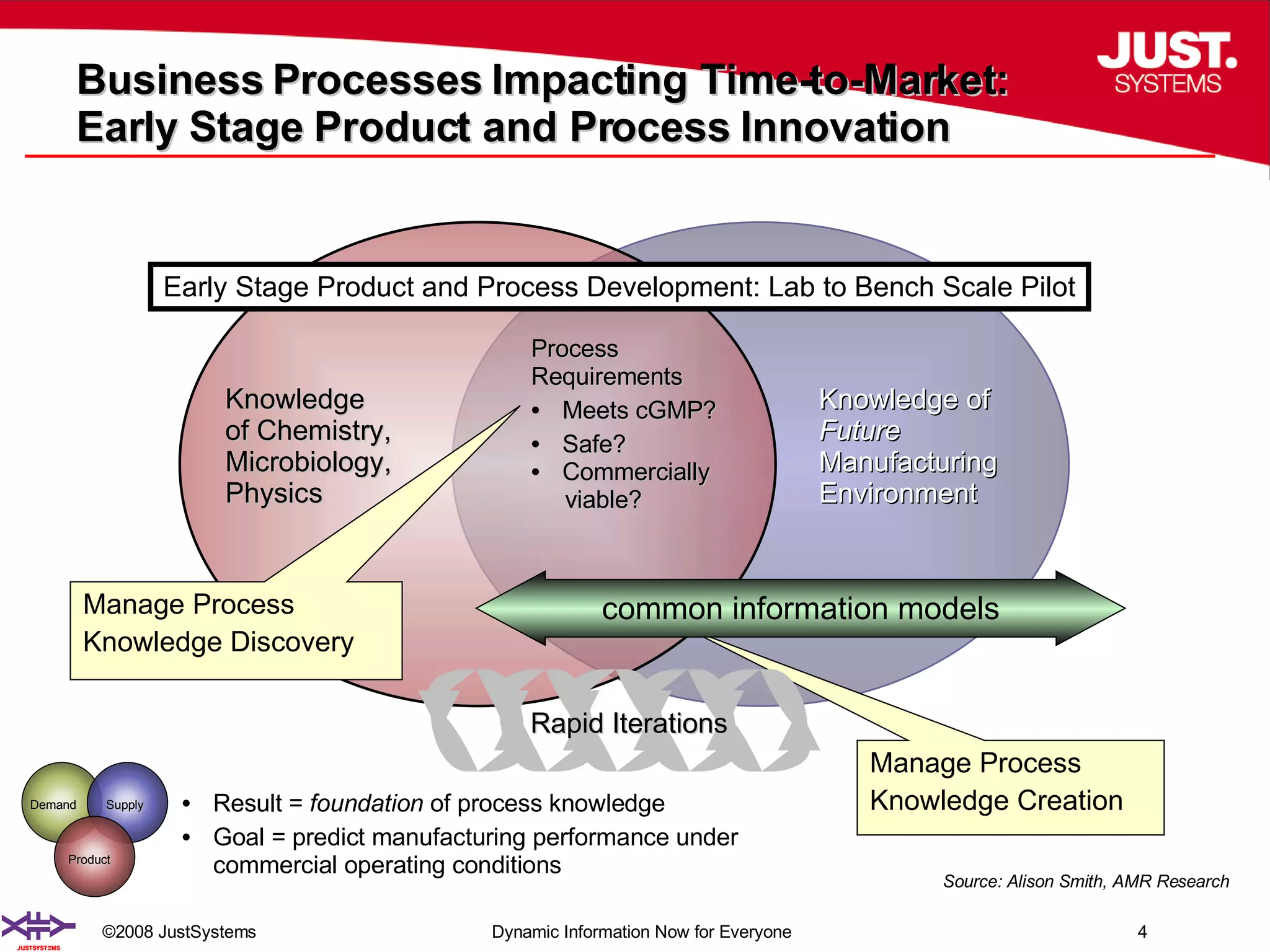
Business Processes Impacting Time-to-Market: Early Stage Product and Process Innovation  Knowledge of  Future   Manufacturing  Environment Result =  foundation  of process knowledge Goal = predict manufacturing performance under commercial operating conditions Manage Process Knowledge Creation Knowledge  of Chemistry, Microbiology, Physics Process Requirements Meets cGMP? Safe? Commercially viable? common information models Manage Process Knowledge Discovery Early Stage Product and Process Development: Lab to Bench Scale Pilot Source: Alison Smith, AMR Research Rapid Iterations Product Demand Supply
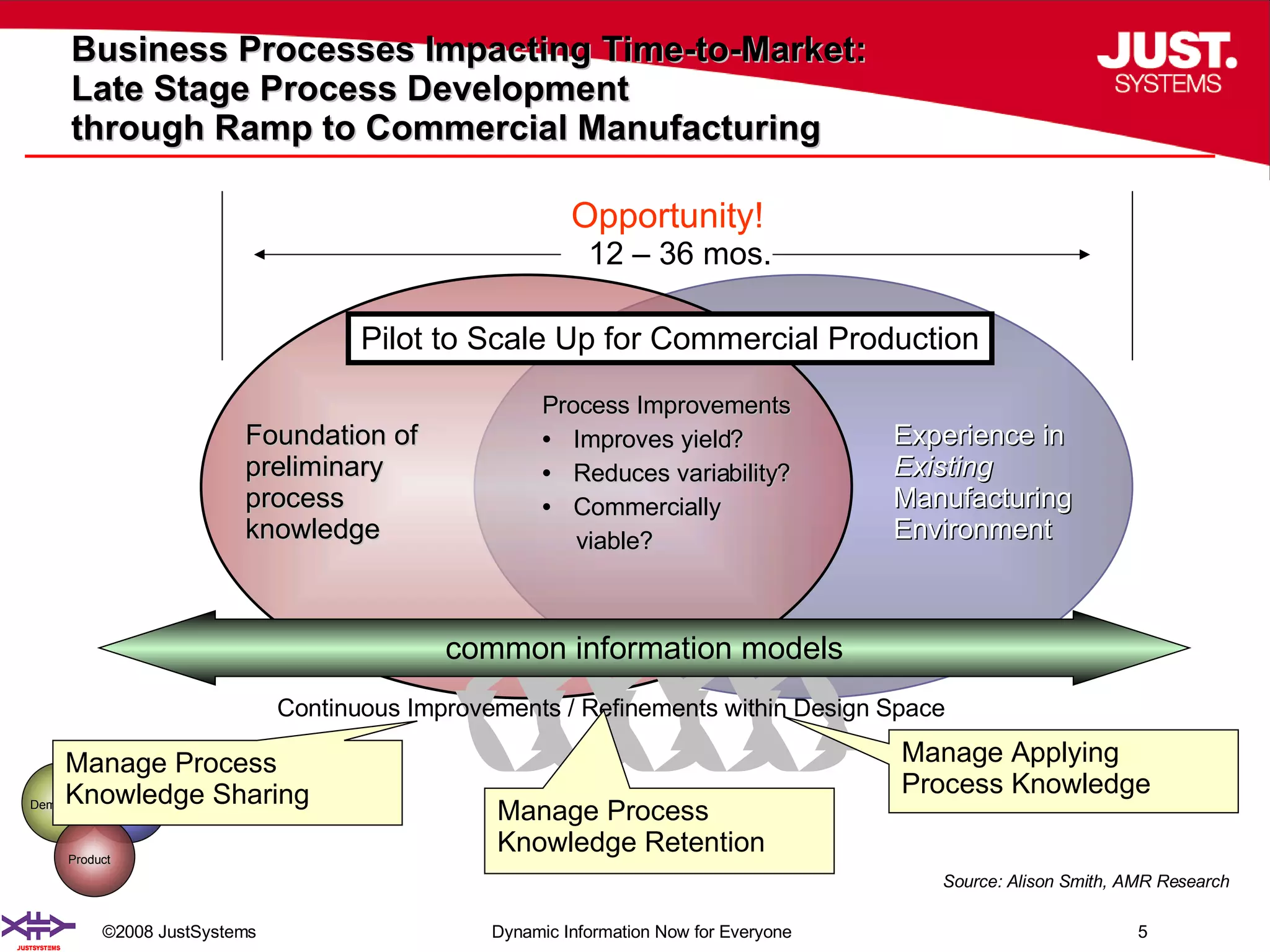
Business Processes Impacting Time-to-Market:  Late Stage Process Development  through Ramp to Commercial Manufacturing Foundation of preliminary process knowledge Experience in  Existing Manufacturing  Environment Process Improvements Improves yield? Reduces variability? Commercially  viable? Pilot to Scale Up for Commercial Production Continuous Improvements / Refinements within Design Space 12 – 36 mos. common information models Manage Process Knowledge Sharing Manage Process Knowledge Retention Manage Applying Process Knowledge Opportunity! Source: Alison Smith, AMR Research Product Demand Supply
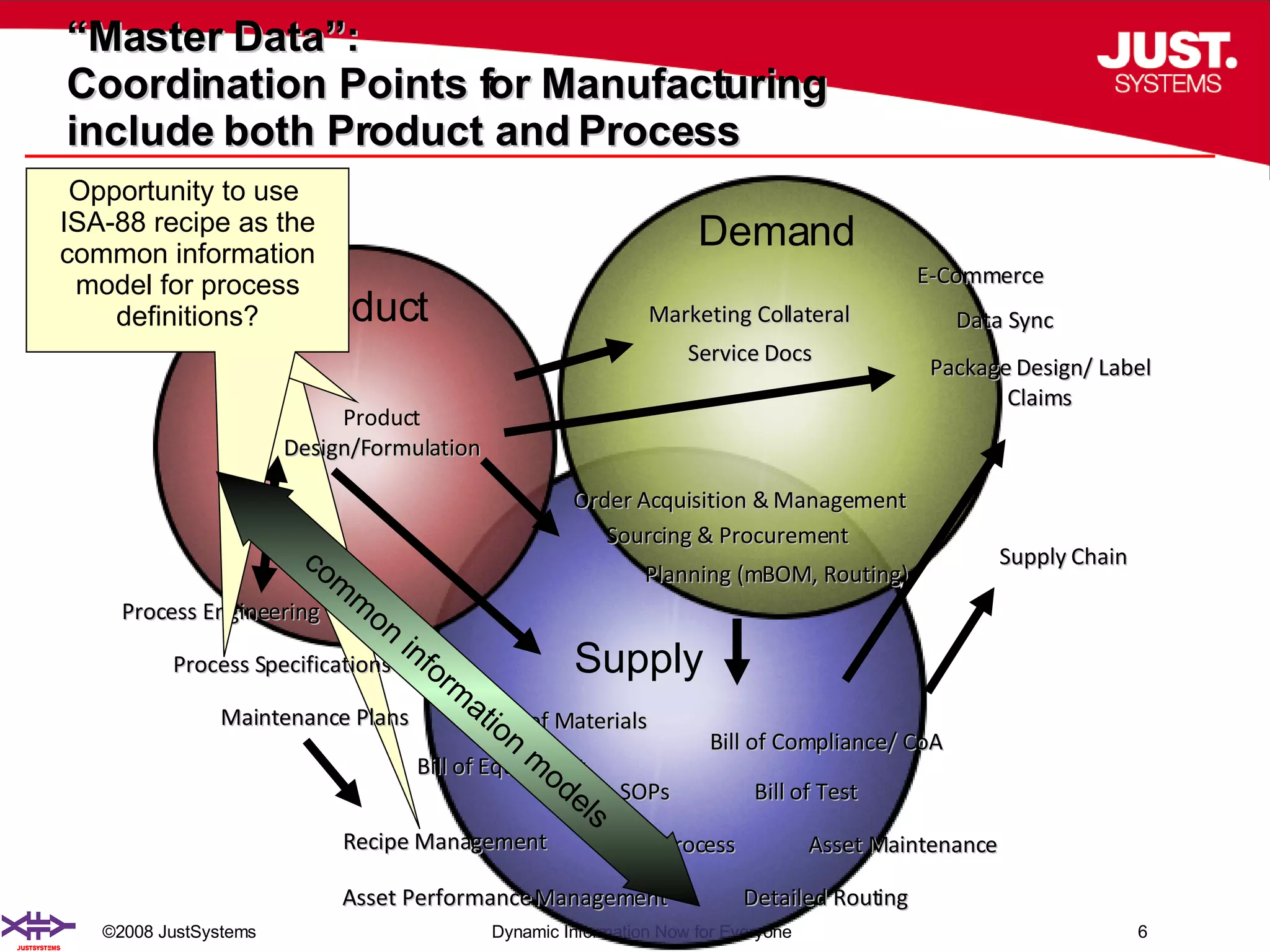
“ Master Data”:  Coordination Points for Manufacturing include both Product and Process  Opportunity to use  ISA-88 recipe as the common information model for process definitions? Supply Demand Product  Design/Formulation Marketing Collateral Service Docs Data Sync E-Commerce Order Acquisition & Management Supply Chain Planning (mBOM, Routing) Sourcing & Procurement Product Package Design/ Label Claims Recipe Management Detailed Routing Bill of Equipment Bill of Process Bill of Compliance/ CoA Bill of Test Asset Maintenance Bill of Materials Process Specifications Process Engineering Maintenance Plans SOPs Asset Performance Management Opportunity to use  ISA-88 recipe as the common information model for process definitions? Opportunity to use  ISA-88 recipe as the common information model for process definitions? common information models
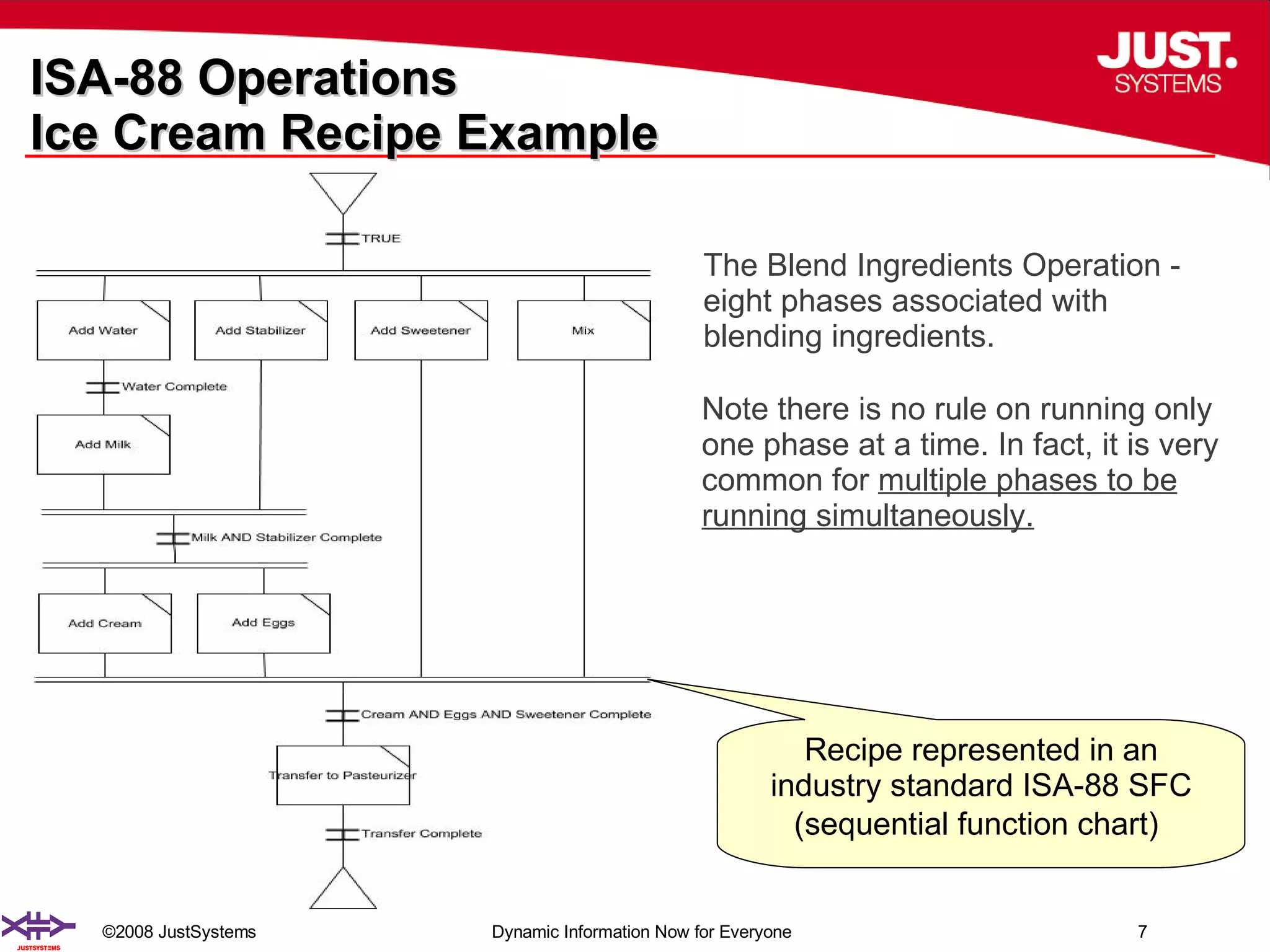
ISA-88 Operations Ice Cream Recipe Example The Blend Ingredients Operation  -  eight phases associated with blending ingredients. Note there is no rule on running only one phase at a time. In fact, it is very common for  multiple phases to be running simultaneously. Recipe represented in an industry standard ISA-88 SFC (sequential function chart)
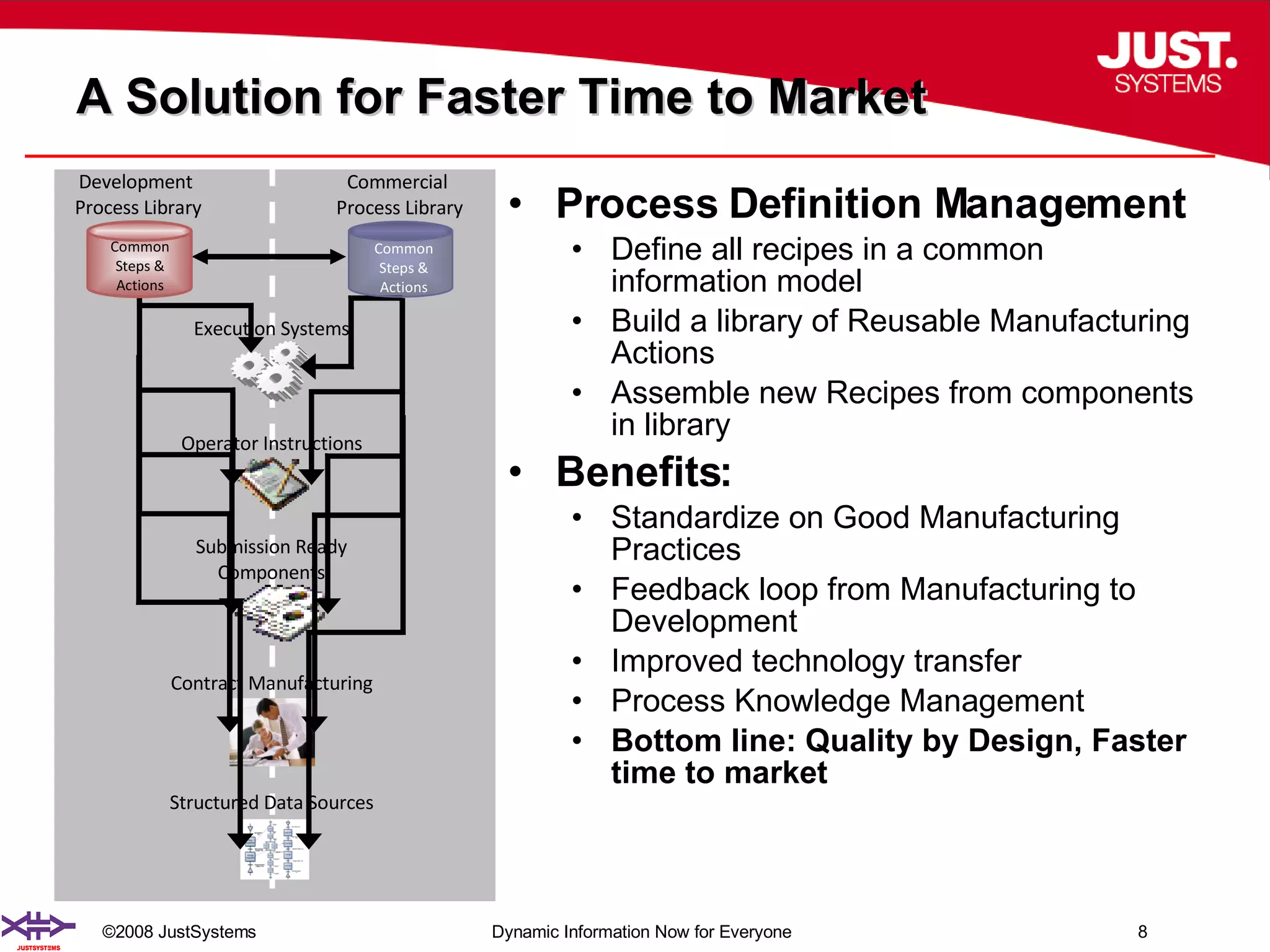
A Solution for Faster Time to Market Process Definition Management Define all recipes in a common information model Build a library of Reusable Manufacturing Actions Assemble new Recipes from components in library Benefits: Standardize on Good Manufacturing Practices Feedback loop from Manufacturing to Development Improved technology transfer Process Knowledge Management  Bottom line: Quality by Design, Faster time to market Development  Process Library Execution Systems Operator Instructions Submission Ready Components Contract Manufacturing Structured Data Sources Common Steps & Actions Common Steps & Actions Commercial  Process Library
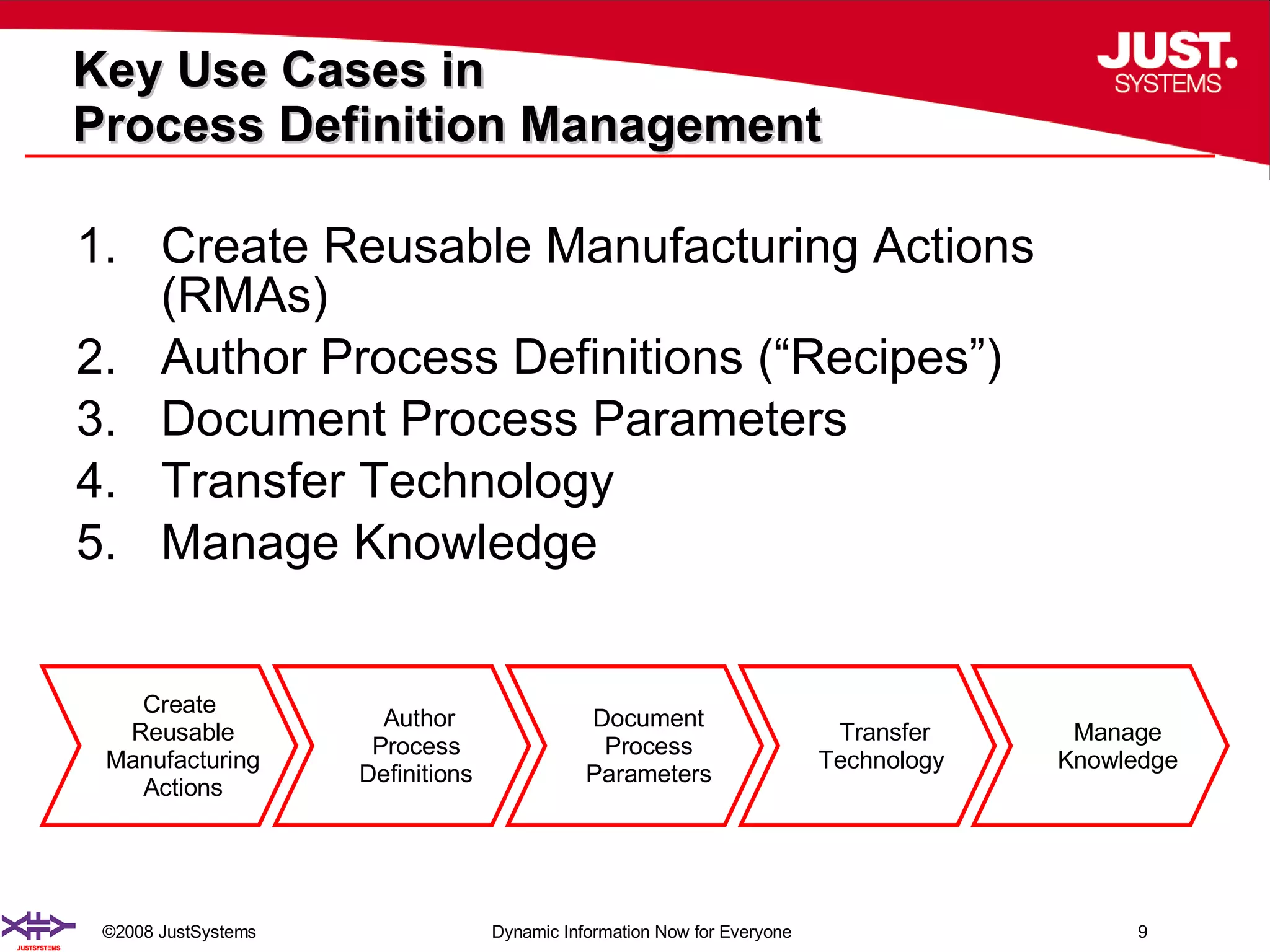
Key Use Cases in  Process Definition Management  Create Reusable Manufacturing Actions (RMAs) Author Process Definitions (“Recipes”) Document Process Parameters Transfer Technology  Manage Knowledge  Create  Reusable Manufacturing   Actions Author  Process Definitions Document  Process Parameters Transfer Technology Manage Knowledge
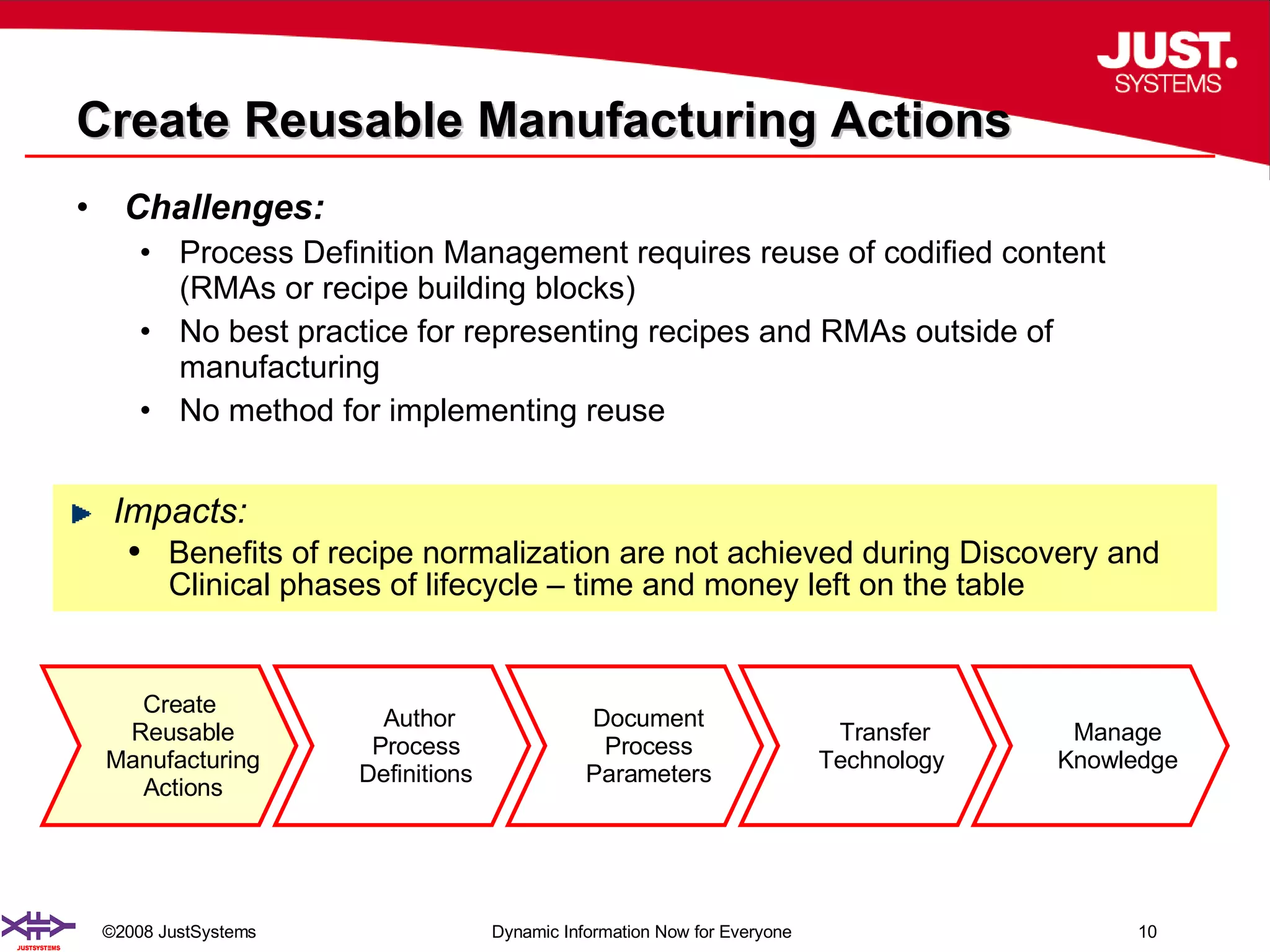
Create Reusable Manufacturing Actions Challenges: Process Definition Management requires reuse of codified content (RMAs or recipe building blocks) No best practice for representing recipes and RMAs outside of manufacturing No method for implementing reuse Impacts: Benefits of recipe normalization are not achieved during Discovery and Clinical phases of lifecycle – time and money left on the table Create  Reusable Manufacturing   Actions Author  Process Definitions Document  Process Parameters Transfer Technology Manage Knowledge
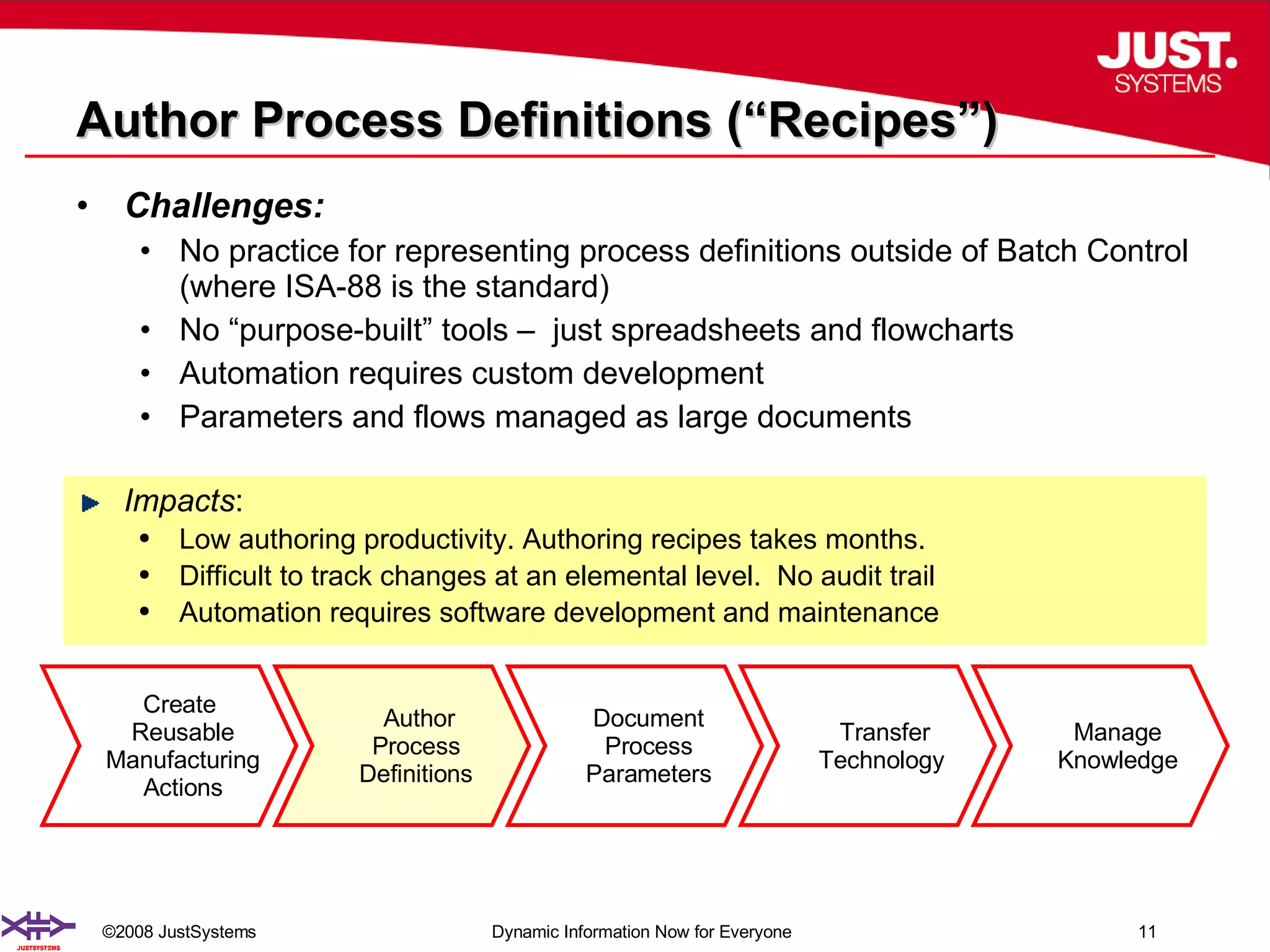
Author Process Definitions (“Recipes”) Challenges: No practice for representing process definitions outside of Batch Control (where ISA-88 is the standard) No “purpose-built” tools –  just spreadsheets and flowcharts Automation requires custom development Parameters and flows managed as large documents Impacts :  Low authoring productivity. Authoring recipes takes months. Difficult to track changes at an elemental level.  No audit trail Automation requires software development and maintenance Create  Reusable Manufacturing   Actions Author  Process Definitions Document  Process Parameters Transfer Technology Manage Knowledge
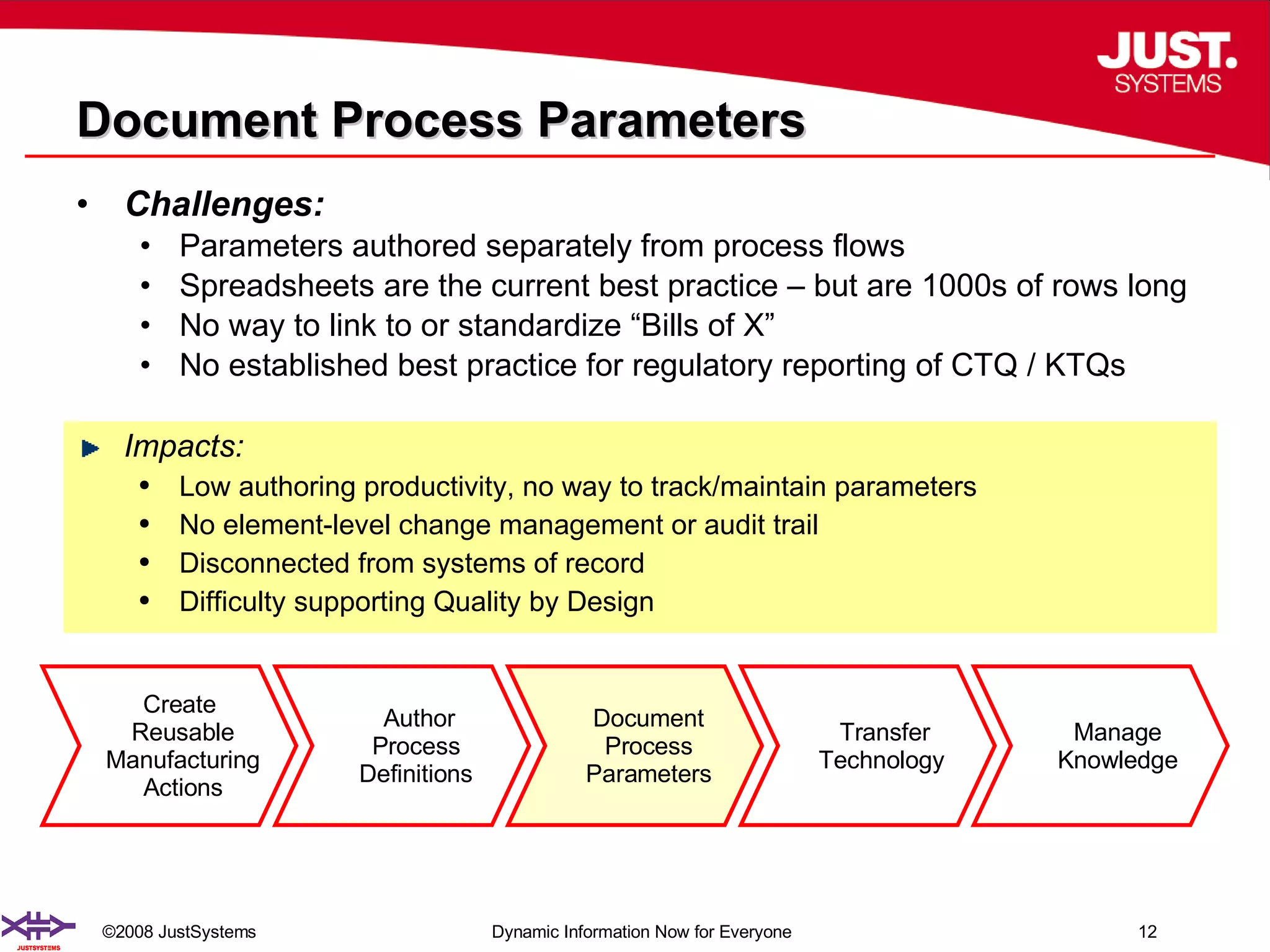
Document Process Parameters Challenges: Parameters authored separately from process flows  Spreadsheets are the current best practice – but are 1000s of rows long No way to link to or standardize “Bills of X” No established best practice for regulatory reporting of CTQ / KTQs Impacts: Low authoring productivity, no way to track/maintain parameters  No element-level change management or audit trail Disconnected from systems of record Difficulty supporting Quality by Design  Create  Reusable Manufacturing   Actions Author  Process Definitions Document  Process Parameters Transfer Technology Manage Knowledge
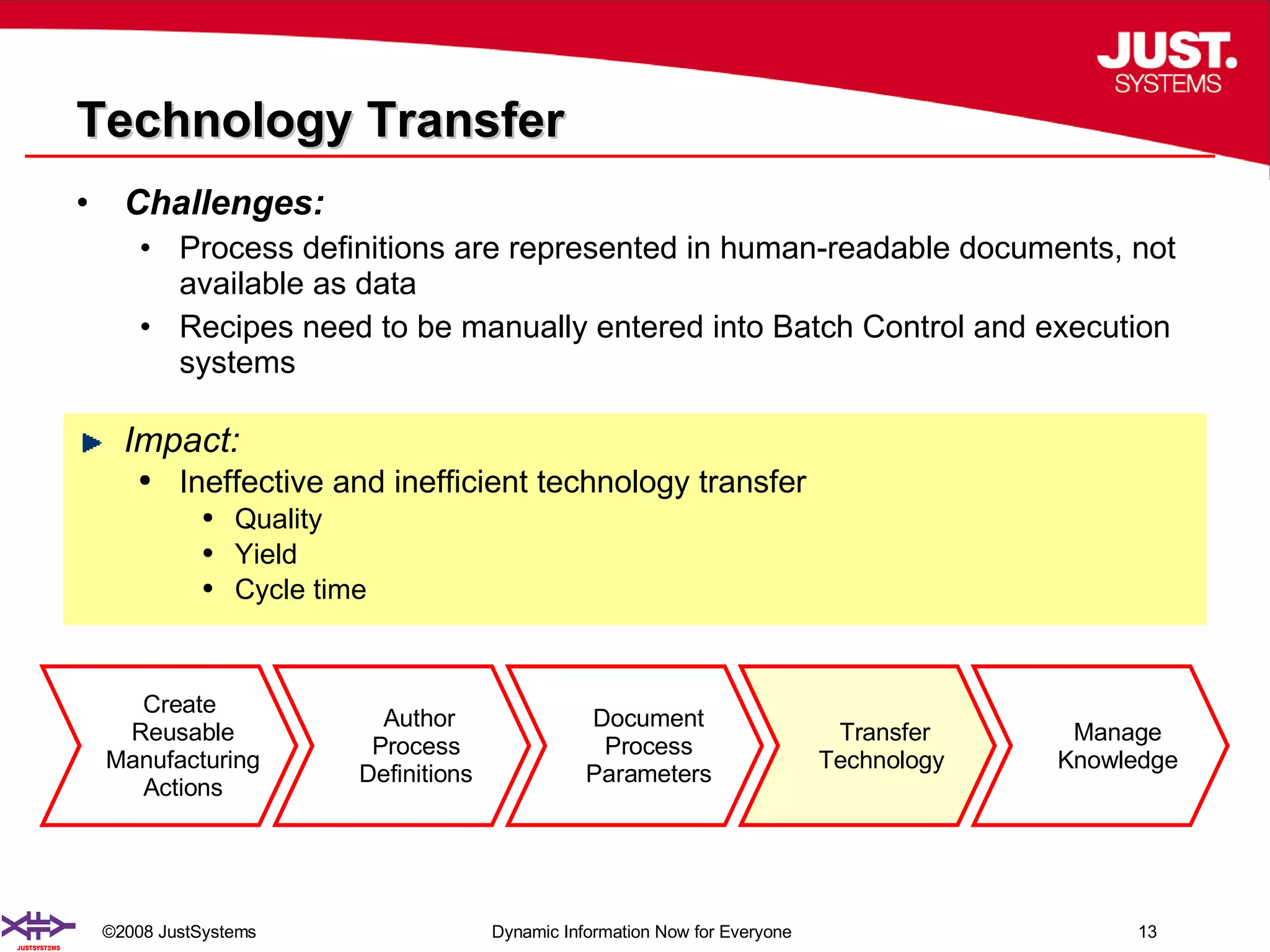
Technology Transfer Challenges: Process definitions are represented in human-readable documents, not available as data  Recipes need to be manually entered into Batch Control and execution systems Impact: Ineffective and inefficient technology transfer Quality Yield Cycle time Create  Reusable Manufacturing   Actions Author  Process Definitions Document  Process Parameters Transfer Technology Manage Knowledge
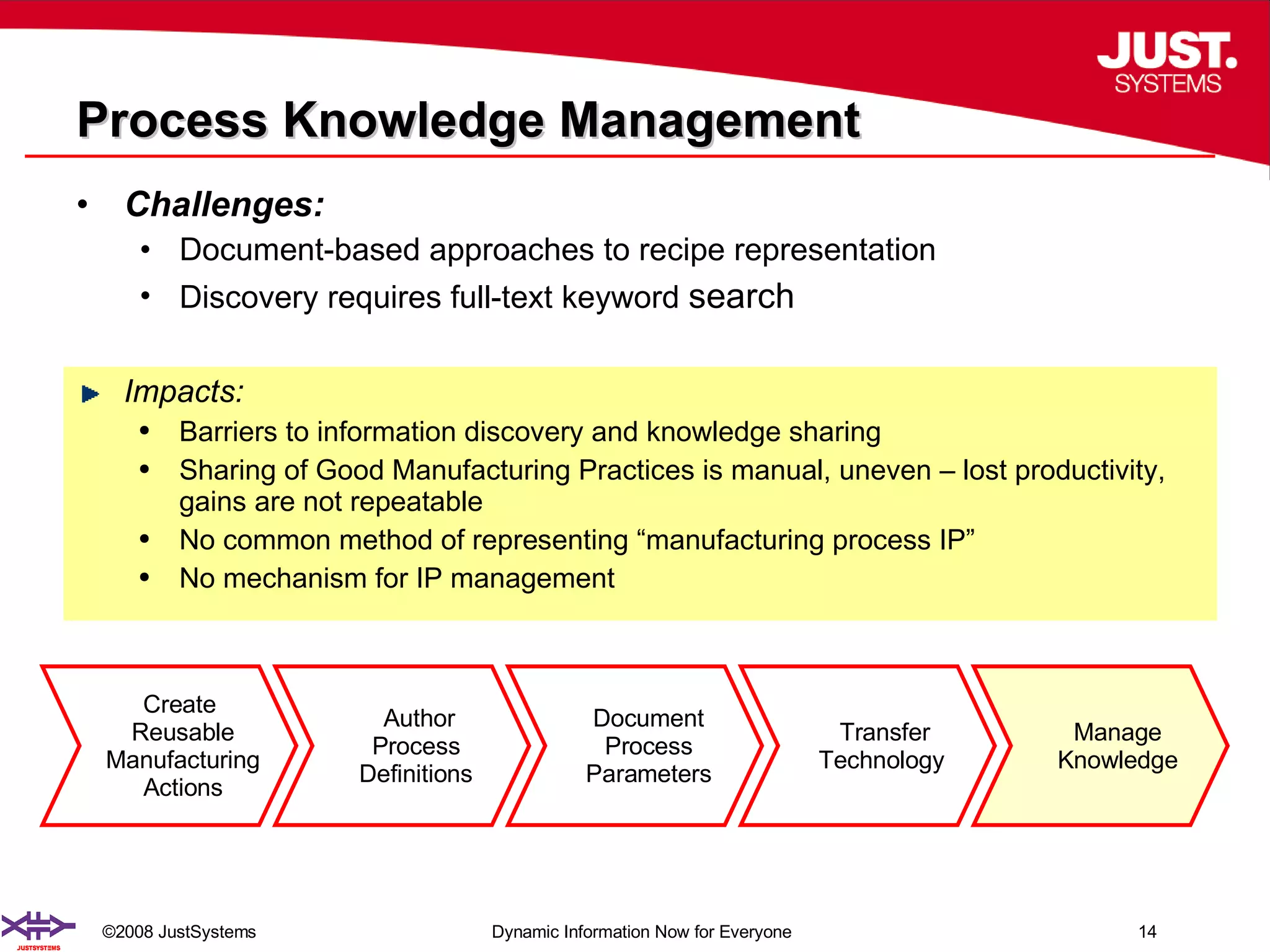
Process Knowledge Management Challenges: Document-based approaches to recipe representation Discovery requires full-text keyword  search Impacts: Barriers to information discovery and knowledge sharing Sharing of Good Manufacturing Practices is manual, uneven – lost productivity, gains are not repeatable No common method of representing “manufacturing process IP” No mechanism for IP management Create  Reusable Manufacturing   Actions Author  Process Definitions Document  Process Parameters Transfer Technology Manage Knowledge
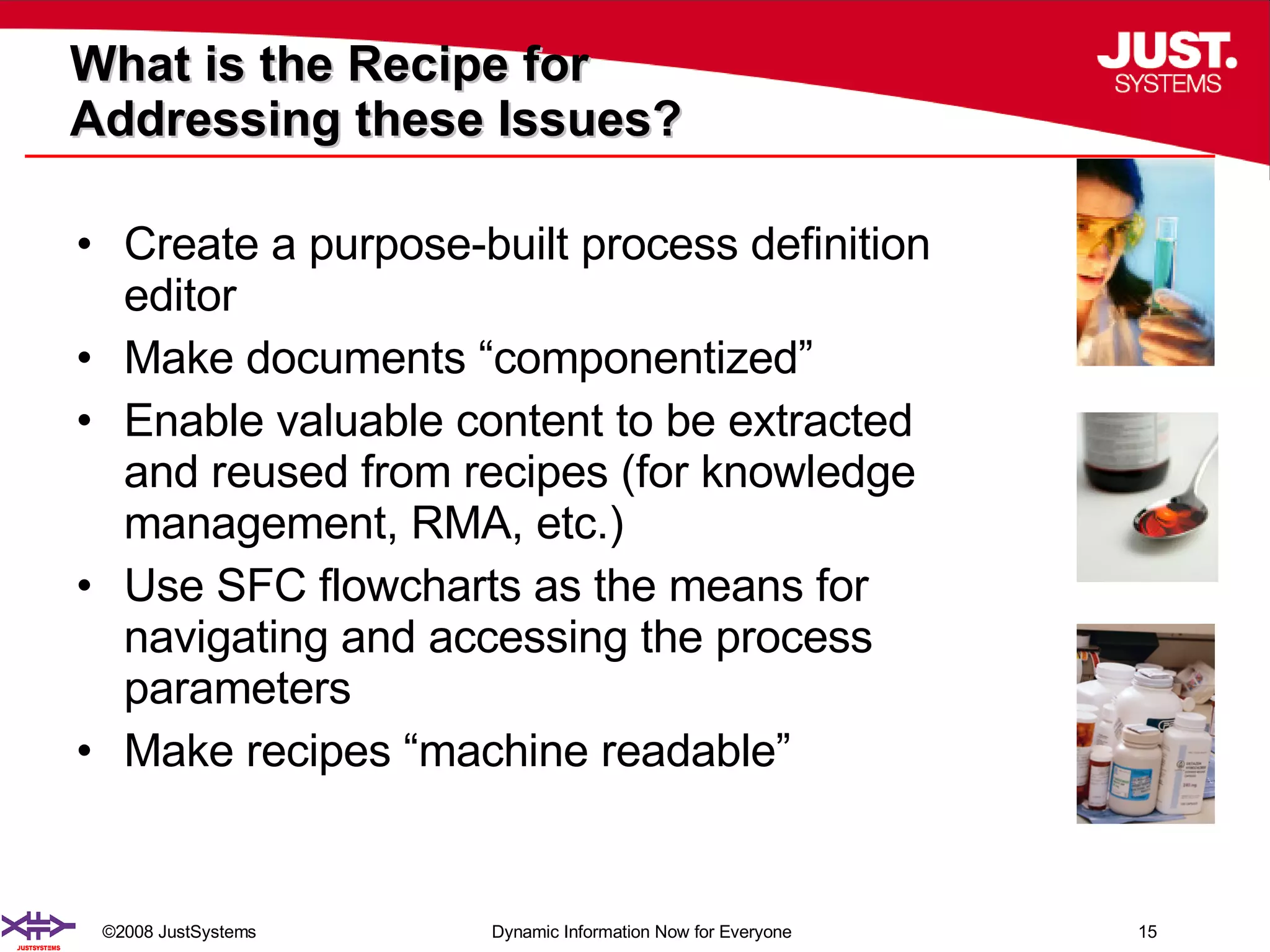
What is the Recipe for  Addressing these Issues? Create a purpose-built process definition editor  Make documents “componentized” Enable valuable content to be extracted and reused from recipes (for knowledge management, RMA, etc.) Use SFC flowcharts as the means for navigating and accessing the process parameters Make recipes “machine readable”
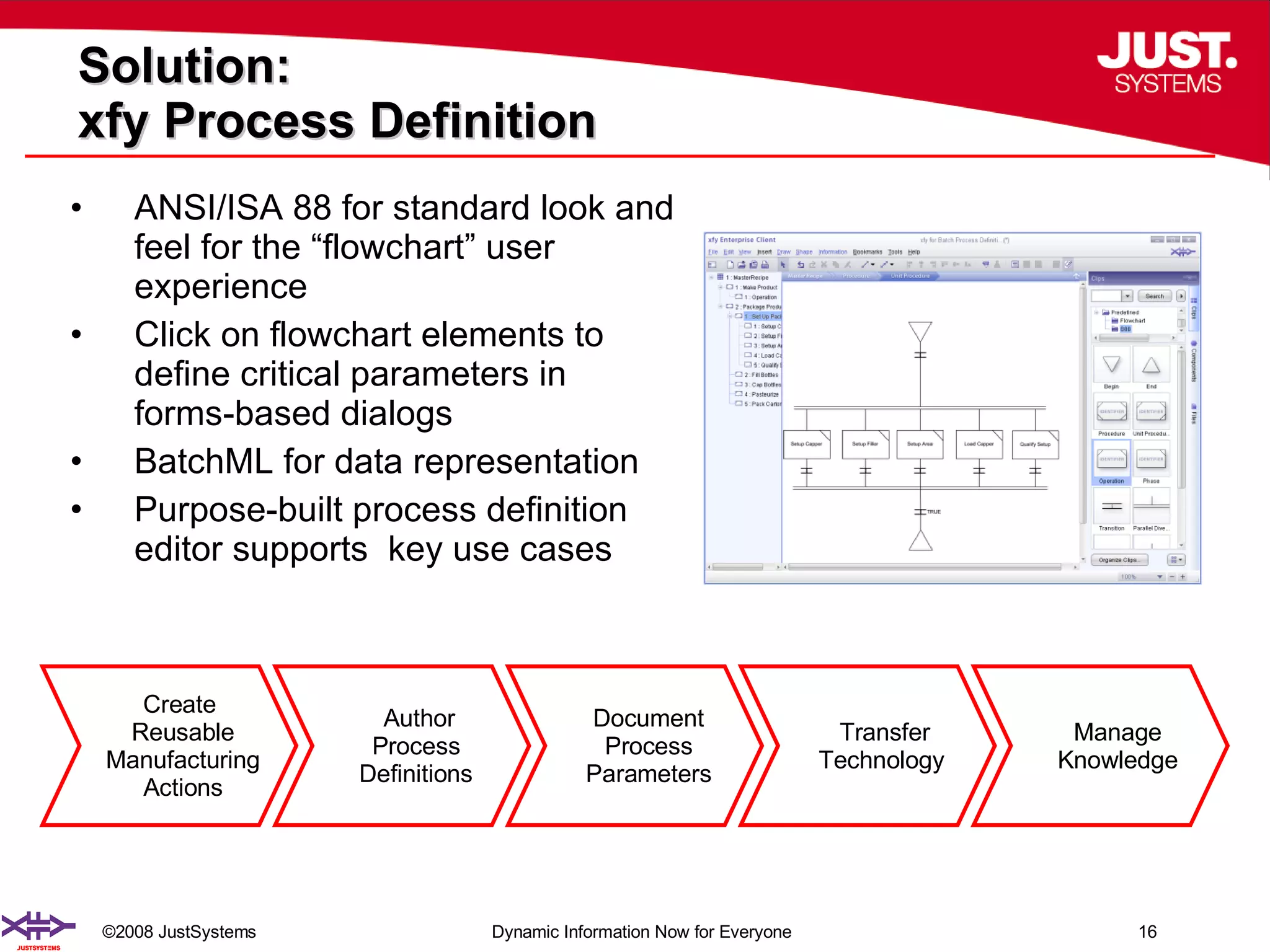
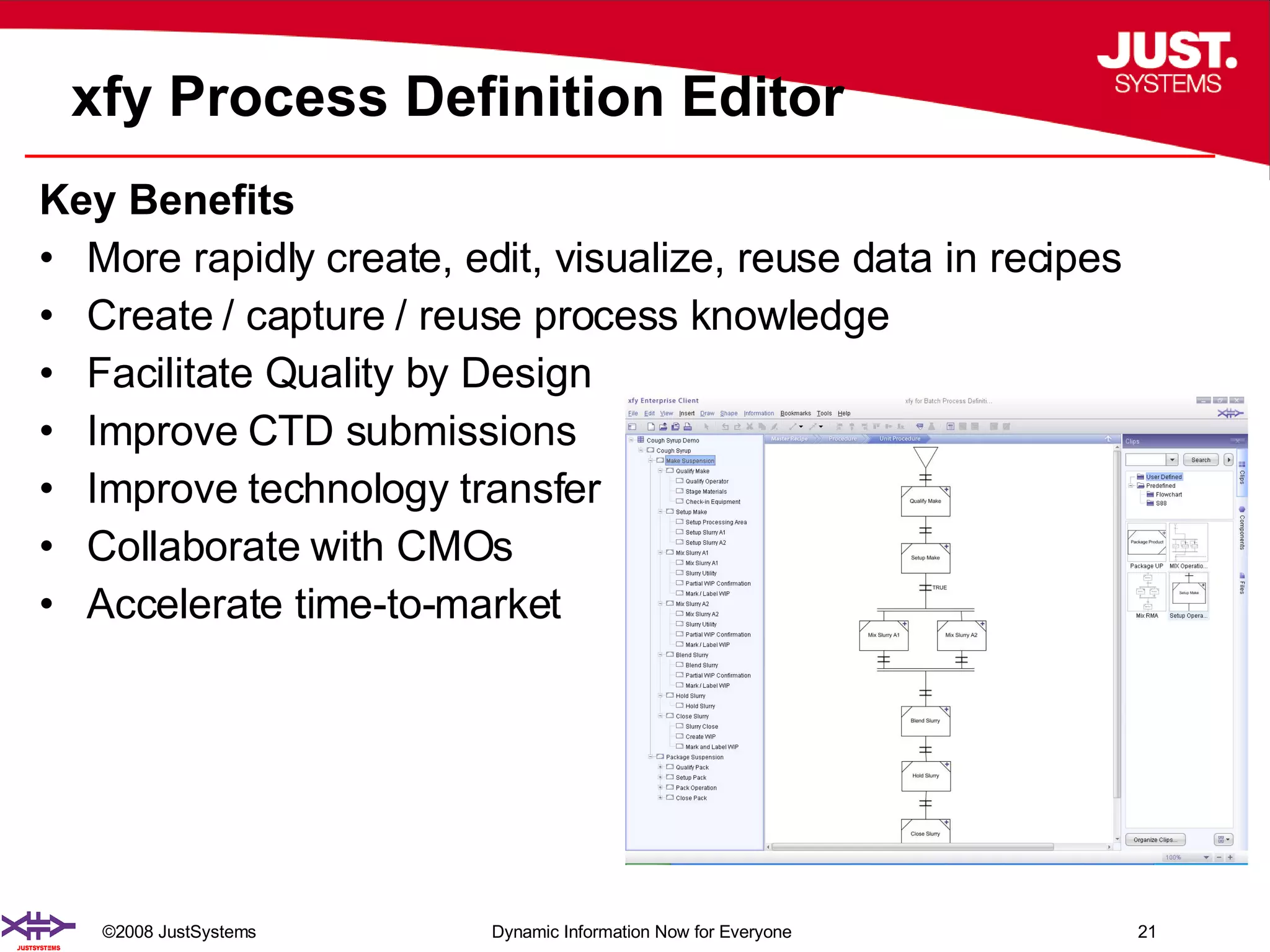
Solution:  xfy Process Definition ANSI/ISA 88 for standard look and feel for the “flowchart” user experience Click on flowchart elements to  define critical parameters in  forms-based dialogs BatchML for data representation Purpose-built process definition editor supports  key use cases Create  Reusable Manufacturing   Actions Author  Process Definitions Document  Process Parameters Transfer Technology Manage Knowledge
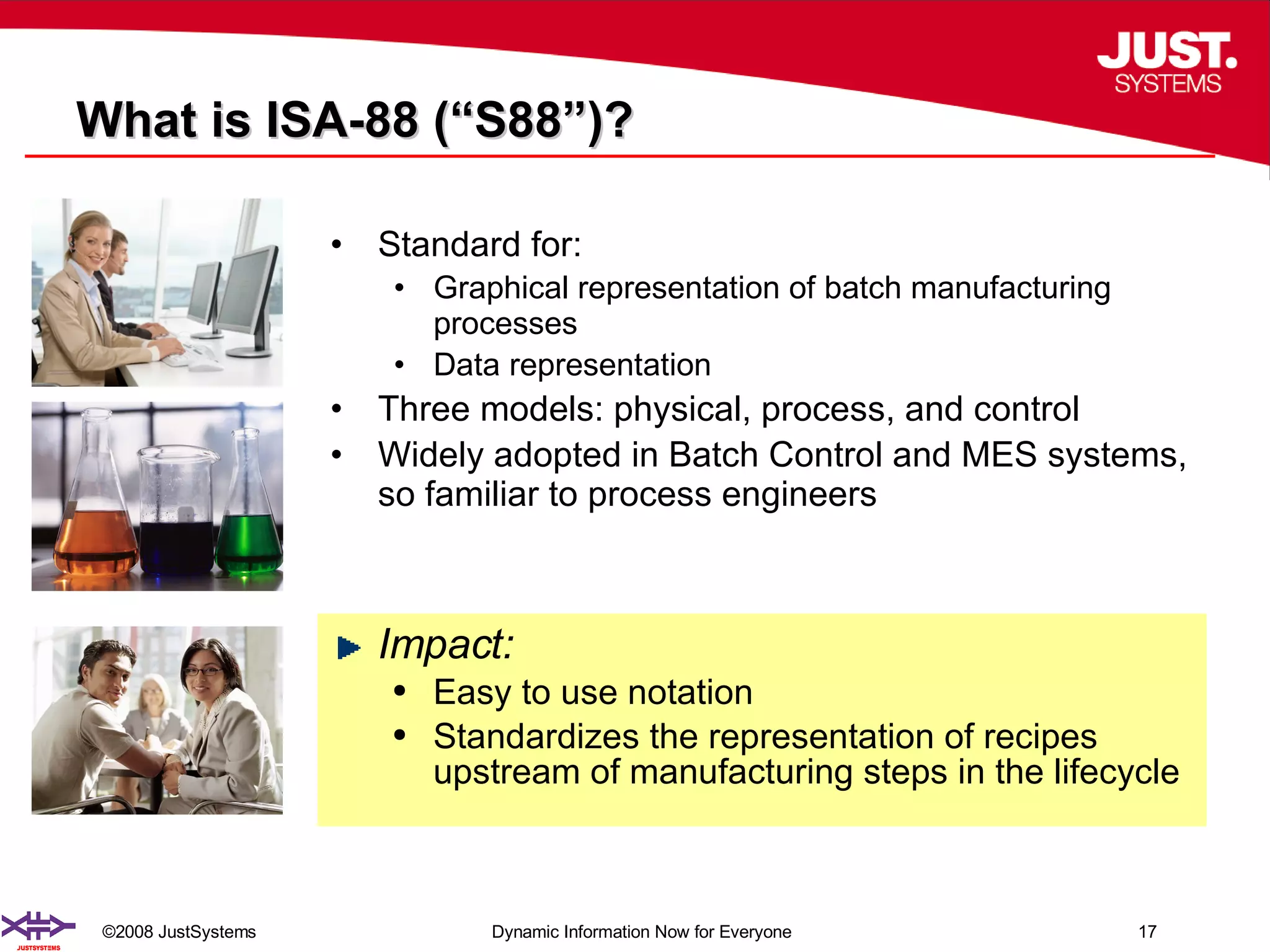
What is ISA-88 (“S88”)? Standard for: Graphical representation of batch manufacturing processes Data representation Three models: physical, process, and control Widely adopted in Batch Control and MES systems, so familiar to process engineers Impact: Easy to use notation Standardizes the representation of recipes upstream of manufacturing steps in the lifecycle
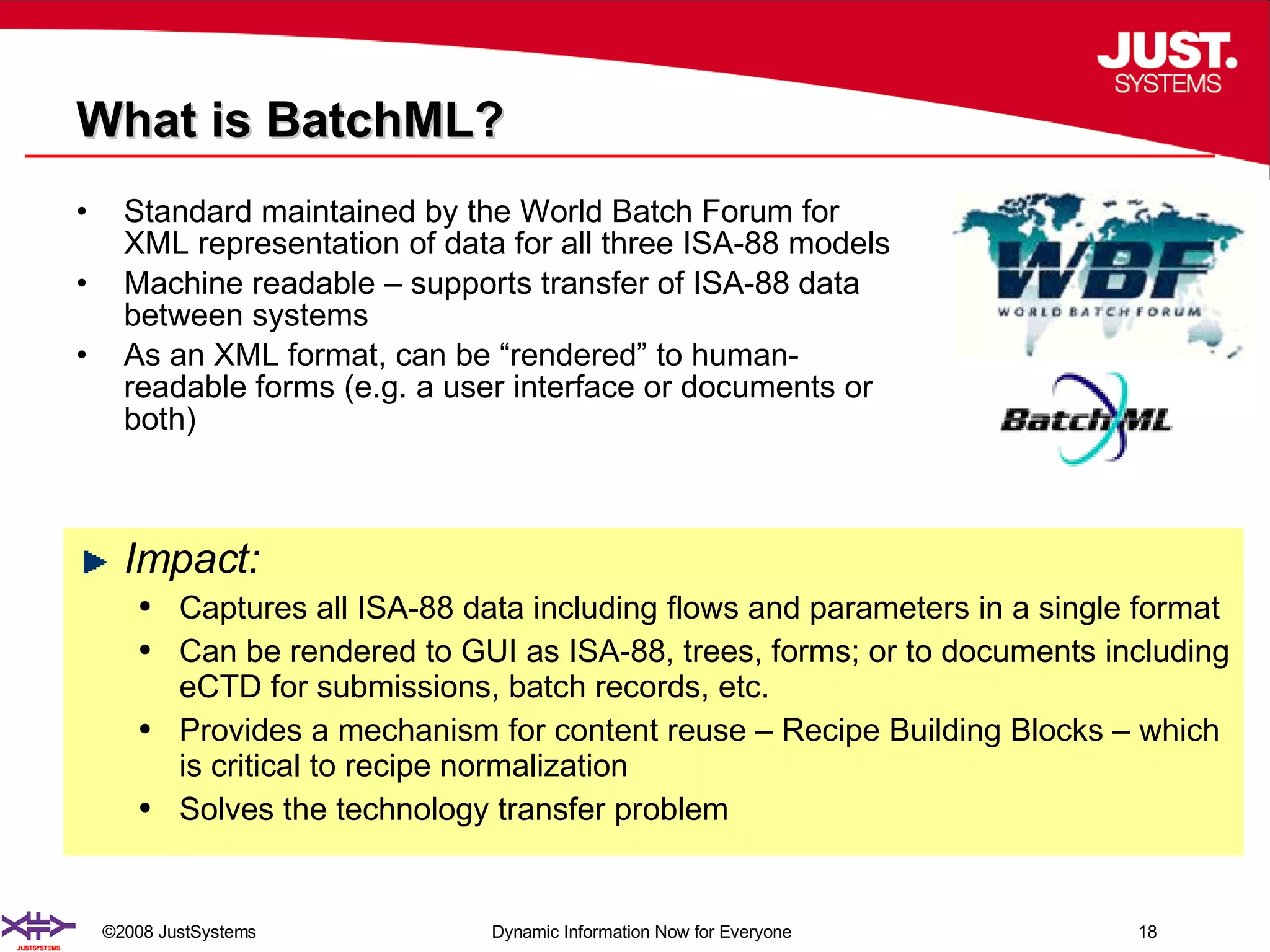
What is BatchML? Standard maintained by the World Batch Forum for XML representation of data for all three ISA-88 models Machine readable – supports transfer of ISA-88 data between systems  As an XML format, can be “rendered” to human-readable forms (e.g. a user interface or documents or both) Impact: Captures all ISA-88 data including flows and parameters in a single format Can be rendered to GUI as ISA-88, trees, forms; or to documents including eCTD for submissions, batch records, etc.  Provides a mechanism for content reuse – Recipe Building Blocks – which is critical to recipe normalization Solves the technology transfer problem
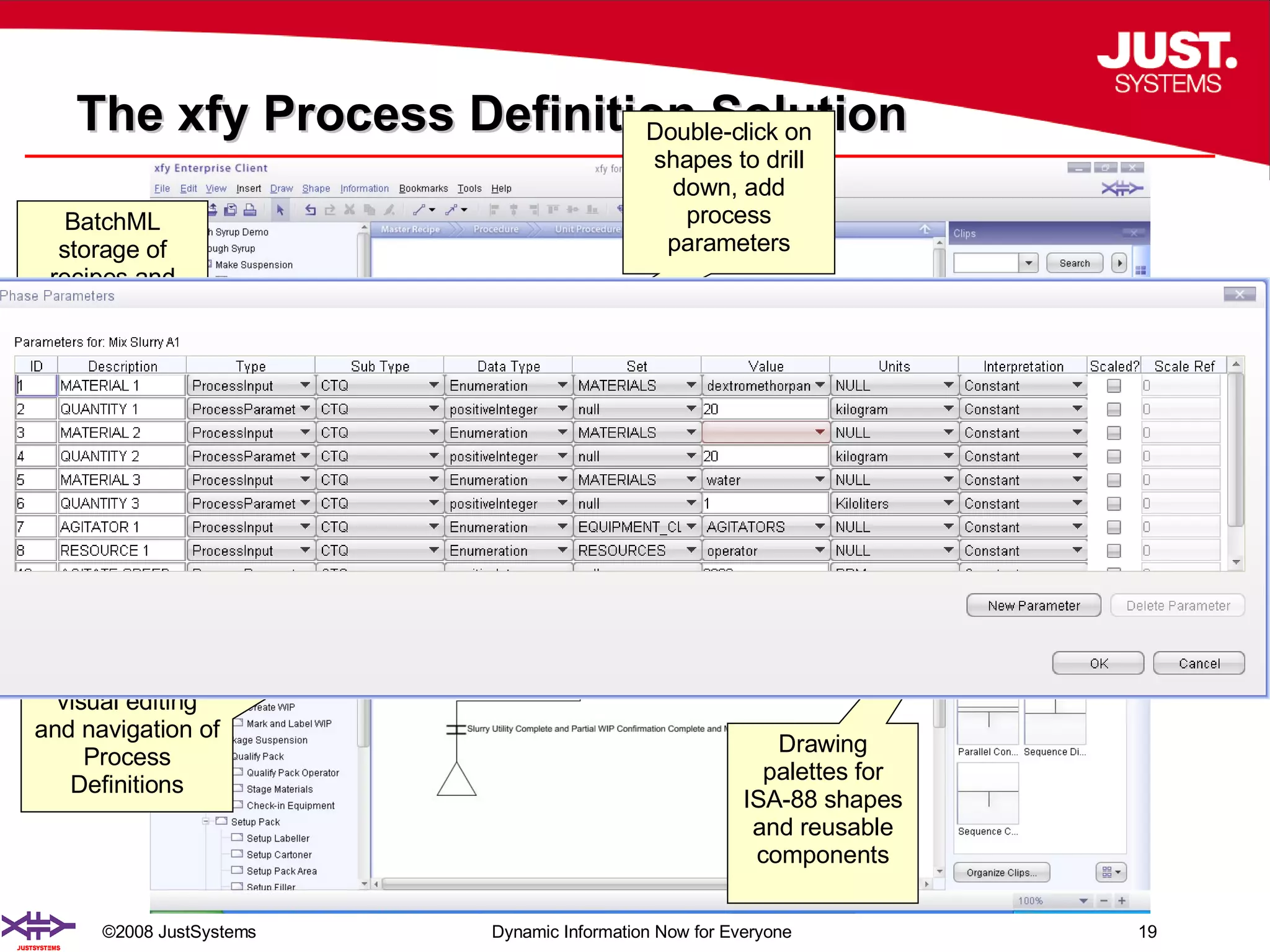
The xfy Process Definition Solution BatchML storage of recipes and recipe building blocks ISA-88 Editor for visual editing and navigation of Process Definitions Drawing palettes for ISA-88 shapes and reusable components Double-click on shapes to drill down, add process parameters
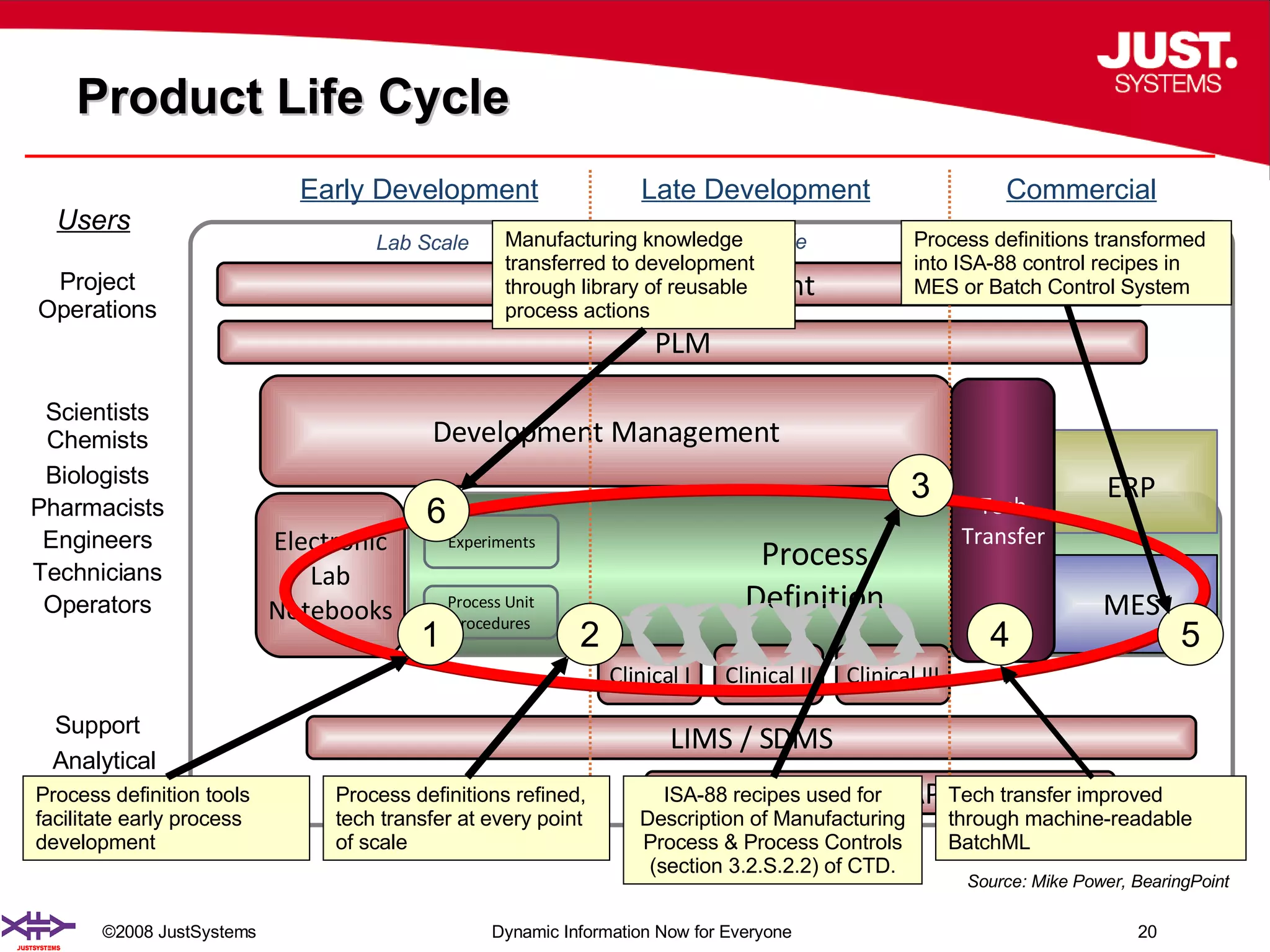
Product Life Cycle Process Definition Pilot Scale Early Development Late Development Project Management LIMS / SDMS QMS / CAPA Lab Scale Electronic Lab Notebooks Users Project Operations Scientists Chemists Biologists Pharmacists Engineers Technicians Operators Support Analytical Quality  MES ERP PLM Development Management Tech Transfer Clinical I Clinical II Clinical III Commercial Experiments Process Unit Procedures Commercial Scale Source: Mike Power, BearingPoint Process definition tools facilitate early process development 1 Process definitions refined, tech transfer at every point of scale 2 4 Tech transfer improved through machine-readable BatchML Process definitions transformed into ISA-88 control recipes in MES or Batch Control System 5 Manufacturing knowledge transferred to development through library of reusable process actions 6 ISA-88 recipes used for Description of Manufacturing Process & Process Controls (section 3.2.S.2.2) of CTD. 3
xfy Proce s s Definition Editor Key Benefits More rapidly create, edit, visualize, reuse data in recipes Create / capture / reuse process knowledge  Facilitate Quality by Design Improve CTD submissions Improve technology transfer Collaborate with CMOs Accelerate time-to-market
Global Presence 1,000 employees, FY ‘07 revenues of $110M HQ in Japan, offices in North America (NJ, Vancouver) and Europe (London) Our Experience Established in 1979 Market leader with over 2,500 customers Our Expertise Global provider of desktop productivity, information management, consumer & enterprise software  Framework for XML-based content creation, integration, visualization and delivery Our  Financial Strength Established and growing company JustSystems 2,500 Customers, Marquee Brands
For more information Visit our website: http:// na.justsystems.com/lifesciences   Email us: [email_address] Call us: (866) 793-1542

Transforming Technology Transfer and Recipe Management: From Spreadsheets to Standardized Practices

  • 1.
    Transforming Technology Transferand Recipe Management From Spreadsheets to Standardized Practices Paul Wlodarczyk, VP Solutions Consulting, JustSystems DocTrain Life Sciences 24 June 2008
  • 2.
    Business Imperative: TopThree Life Science Innovation Goals for 2012 Leverage scientific/ technological advances to assure superior therapeutic outcomes in their target patient population. Improve acquisitions/ alliance / licensing management processes to improve agility in bringing new products to market. Decrease the concept-to-patient lifecycle from the current 7-11 years to 5-7 years Survey respondents estimated 19% growth in spending on technology to support R&D in 2012; this is slightly higher among branded and generics with estimated growth of 23%. Mid-market Life Sciences companies also plan for more aggressive growth than their larger counterparts, they plan to increase their spending by nearly 30%. Source: AMR Research 2007 Life Sciences Survey Product Demand Supply
  • 3.
    Product Life CycleProcess Definition Pilot Scale Early Development Late Development Project Management LIMS / SDMS QMS / CAPA Lab Scale Electronic Lab Notebooks Users Project Operations Scientists Chemists Biologists Pharmacists Engineers Technicians Operators Support Analytical Quality MES ERP PLM Development Management Tech Transfer Clinical I Clinical II Clinical III Commercial Experiments Process Unit Procedures Commercial Scale Source: Mike Power, BearingPoint Product Demand Supply
  • 4.
    Business Processes ImpactingTime-to-Market: Early Stage Product and Process Innovation Knowledge of Future Manufacturing Environment Result = foundation of process knowledge Goal = predict manufacturing performance under commercial operating conditions Manage Process Knowledge Creation Knowledge of Chemistry, Microbiology, Physics Process Requirements Meets cGMP? Safe? Commercially viable? common information models Manage Process Knowledge Discovery Early Stage Product and Process Development: Lab to Bench Scale Pilot Source: Alison Smith, AMR Research Rapid Iterations Product Demand Supply
  • 5.
    Business Processes ImpactingTime-to-Market: Late Stage Process Development through Ramp to Commercial Manufacturing Foundation of preliminary process knowledge Experience in Existing Manufacturing Environment Process Improvements Improves yield? Reduces variability? Commercially viable? Pilot to Scale Up for Commercial Production Continuous Improvements / Refinements within Design Space 12 – 36 mos. common information models Manage Process Knowledge Sharing Manage Process Knowledge Retention Manage Applying Process Knowledge Opportunity! Source: Alison Smith, AMR Research Product Demand Supply
  • 6.
    “ Master Data”: Coordination Points for Manufacturing include both Product and Process Opportunity to use ISA-88 recipe as the common information model for process definitions? Supply Demand Product Design/Formulation Marketing Collateral Service Docs Data Sync E-Commerce Order Acquisition & Management Supply Chain Planning (mBOM, Routing) Sourcing & Procurement Product Package Design/ Label Claims Recipe Management Detailed Routing Bill of Equipment Bill of Process Bill of Compliance/ CoA Bill of Test Asset Maintenance Bill of Materials Process Specifications Process Engineering Maintenance Plans SOPs Asset Performance Management Opportunity to use ISA-88 recipe as the common information model for process definitions? Opportunity to use ISA-88 recipe as the common information model for process definitions? common information models
  • 7.
    ISA-88 Operations IceCream Recipe Example The Blend Ingredients Operation - eight phases associated with blending ingredients. Note there is no rule on running only one phase at a time. In fact, it is very common for multiple phases to be running simultaneously. Recipe represented in an industry standard ISA-88 SFC (sequential function chart)
  • 8.
    A Solution forFaster Time to Market Process Definition Management Define all recipes in a common information model Build a library of Reusable Manufacturing Actions Assemble new Recipes from components in library Benefits: Standardize on Good Manufacturing Practices Feedback loop from Manufacturing to Development Improved technology transfer Process Knowledge Management Bottom line: Quality by Design, Faster time to market Development Process Library Execution Systems Operator Instructions Submission Ready Components Contract Manufacturing Structured Data Sources Common Steps & Actions Common Steps & Actions Commercial Process Library
  • 9.
    Key Use Casesin Process Definition Management Create Reusable Manufacturing Actions (RMAs) Author Process Definitions (“Recipes”) Document Process Parameters Transfer Technology Manage Knowledge Create Reusable Manufacturing Actions Author Process Definitions Document Process Parameters Transfer Technology Manage Knowledge
  • 10.
    Create Reusable ManufacturingActions Challenges: Process Definition Management requires reuse of codified content (RMAs or recipe building blocks) No best practice for representing recipes and RMAs outside of manufacturing No method for implementing reuse Impacts: Benefits of recipe normalization are not achieved during Discovery and Clinical phases of lifecycle – time and money left on the table Create Reusable Manufacturing Actions Author Process Definitions Document Process Parameters Transfer Technology Manage Knowledge
  • 11.
    Author Process Definitions(“Recipes”) Challenges: No practice for representing process definitions outside of Batch Control (where ISA-88 is the standard) No “purpose-built” tools – just spreadsheets and flowcharts Automation requires custom development Parameters and flows managed as large documents Impacts : Low authoring productivity. Authoring recipes takes months. Difficult to track changes at an elemental level. No audit trail Automation requires software development and maintenance Create Reusable Manufacturing Actions Author Process Definitions Document Process Parameters Transfer Technology Manage Knowledge
  • 12.
    Document Process ParametersChallenges: Parameters authored separately from process flows Spreadsheets are the current best practice – but are 1000s of rows long No way to link to or standardize “Bills of X” No established best practice for regulatory reporting of CTQ / KTQs Impacts: Low authoring productivity, no way to track/maintain parameters No element-level change management or audit trail Disconnected from systems of record Difficulty supporting Quality by Design Create Reusable Manufacturing Actions Author Process Definitions Document Process Parameters Transfer Technology Manage Knowledge
  • 13.
    Technology Transfer Challenges:Process definitions are represented in human-readable documents, not available as data Recipes need to be manually entered into Batch Control and execution systems Impact: Ineffective and inefficient technology transfer Quality Yield Cycle time Create Reusable Manufacturing Actions Author Process Definitions Document Process Parameters Transfer Technology Manage Knowledge
  • 14.
    Process Knowledge ManagementChallenges: Document-based approaches to recipe representation Discovery requires full-text keyword search Impacts: Barriers to information discovery and knowledge sharing Sharing of Good Manufacturing Practices is manual, uneven – lost productivity, gains are not repeatable No common method of representing “manufacturing process IP” No mechanism for IP management Create Reusable Manufacturing Actions Author Process Definitions Document Process Parameters Transfer Technology Manage Knowledge
  • 15.
    What is theRecipe for Addressing these Issues? Create a purpose-built process definition editor Make documents “componentized” Enable valuable content to be extracted and reused from recipes (for knowledge management, RMA, etc.) Use SFC flowcharts as the means for navigating and accessing the process parameters Make recipes “machine readable”
  • 16.
    Solution: xfyProcess Definition ANSI/ISA 88 for standard look and feel for the “flowchart” user experience Click on flowchart elements to define critical parameters in forms-based dialogs BatchML for data representation Purpose-built process definition editor supports key use cases Create Reusable Manufacturing Actions Author Process Definitions Document Process Parameters Transfer Technology Manage Knowledge
  • 17.
    What is ISA-88(“S88”)? Standard for: Graphical representation of batch manufacturing processes Data representation Three models: physical, process, and control Widely adopted in Batch Control and MES systems, so familiar to process engineers Impact: Easy to use notation Standardizes the representation of recipes upstream of manufacturing steps in the lifecycle
  • 18.
    What is BatchML?Standard maintained by the World Batch Forum for XML representation of data for all three ISA-88 models Machine readable – supports transfer of ISA-88 data between systems As an XML format, can be “rendered” to human-readable forms (e.g. a user interface or documents or both) Impact: Captures all ISA-88 data including flows and parameters in a single format Can be rendered to GUI as ISA-88, trees, forms; or to documents including eCTD for submissions, batch records, etc. Provides a mechanism for content reuse – Recipe Building Blocks – which is critical to recipe normalization Solves the technology transfer problem
  • 19.
    The xfy ProcessDefinition Solution BatchML storage of recipes and recipe building blocks ISA-88 Editor for visual editing and navigation of Process Definitions Drawing palettes for ISA-88 shapes and reusable components Double-click on shapes to drill down, add process parameters
  • 20.
    Product Life CycleProcess Definition Pilot Scale Early Development Late Development Project Management LIMS / SDMS QMS / CAPA Lab Scale Electronic Lab Notebooks Users Project Operations Scientists Chemists Biologists Pharmacists Engineers Technicians Operators Support Analytical Quality MES ERP PLM Development Management Tech Transfer Clinical I Clinical II Clinical III Commercial Experiments Process Unit Procedures Commercial Scale Source: Mike Power, BearingPoint Process definition tools facilitate early process development 1 Process definitions refined, tech transfer at every point of scale 2 4 Tech transfer improved through machine-readable BatchML Process definitions transformed into ISA-88 control recipes in MES or Batch Control System 5 Manufacturing knowledge transferred to development through library of reusable process actions 6 ISA-88 recipes used for Description of Manufacturing Process & Process Controls (section 3.2.S.2.2) of CTD. 3
  • 21.
    xfy Proce ss Definition Editor Key Benefits More rapidly create, edit, visualize, reuse data in recipes Create / capture / reuse process knowledge Facilitate Quality by Design Improve CTD submissions Improve technology transfer Collaborate with CMOs Accelerate time-to-market
  • 22.
    Global Presence 1,000employees, FY ‘07 revenues of $110M HQ in Japan, offices in North America (NJ, Vancouver) and Europe (London) Our Experience Established in 1979 Market leader with over 2,500 customers Our Expertise Global provider of desktop productivity, information management, consumer & enterprise software Framework for XML-based content creation, integration, visualization and delivery Our Financial Strength Established and growing company JustSystems 2,500 Customers, Marquee Brands
  • 23.
    For more informationVisit our website: http:// na.justsystems.com/lifesciences Email us: [email_address] Call us: (866) 793-1542