ARUN KUMAR JAIN
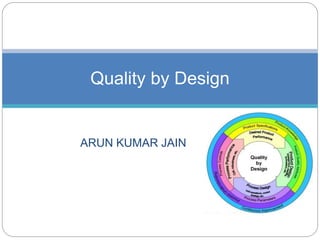
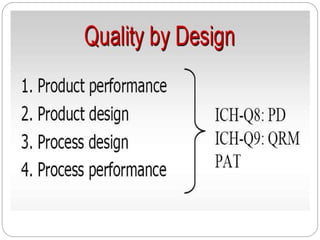
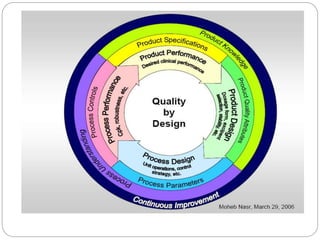
Quality by Design
Overview
 Interpretations of Quality
 QbD-Juran
 QbD-Definition
 ICH Q8-10
 Paradigm Shift
 QbD Attributes
 Challenges
 Tools
 Design Space
 QbD –Pharmaceutical Development
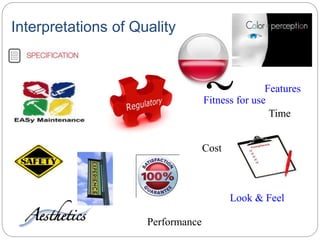
Interpretations of Quality
Time
Cost
Fitness for use
Performance
Features
Look & Feel
Joseph M Juran- QbD
 Quality by Design (QbD) is a concept first
outlined by quality expert Joseph M. Juran
 Joseph Moses Juran (December 24, 1904 – February
28, 2008) was a Romanian-born American engineer and
management consultant
 The word "quality" as having two meanings:
 Features that create customer satisfaction
 The reliability of those features.
 Failures in features create dissatisfactions, so removing
failures is the purpose of quality improvement, while
creating features is the purpose of quality by design
Definition of QbD
The pharmaceutical Quality by Design
(QbD) is a systematic approach to
development
that begins with
predefined objectives
and
emphasizes product and process
understanding
and
process control, based on sound science
and
quality risk management
6
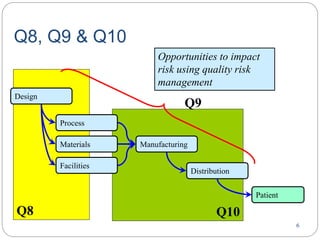
Q10Q8
Q8, Q9 & Q10
Process
Materials
Design
Manufacturing
Distribution
Patient
Facilities
Opportunities to impact
risk using quality risk
management
Q9
Pharmaceutical Development - Q8(R2)
 Describes science and risk-based approaches for
pharmaceutical product and manufacturing
process development
 Introduced concepts of design space and flexible
regulatory approaches
 Introduced concepts of Quality by Design (QbD)
and provided examples of QbD development
approaches and design space
© ICH, November 2010
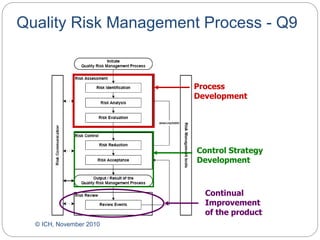
Quality Risk Management Process - Q9
Process
Development
Control Strategy
Development
Continual
Improvement
of the product
Q10-Pharmaceutical Quality System
The product lifecycle includes the following
Technical activities for new and existing products:
Pharmaceutical Development:
Drug substance development;
Formulation development (including container/closure system);
Manufacture of investigational products;
Delivery system development (where relevant);
Manufacturing process development and scale-up;
Analytical method development.
Technology Transfer:
New product transfers during Development through Manufacturing;
Transfers within or between manufacturing and testing sites for
marketed products.
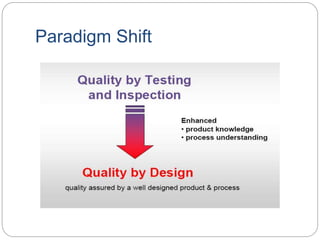
Paradigm Shift
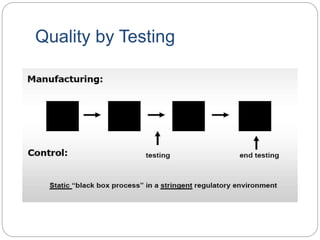
Quality by Testing
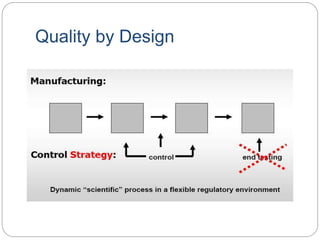
Quality by Design
“Quality can not be tested into
products;
it has to be built in
by design”
From
‘blind compliance’ to
‘science and risk based
compliance’
Ajaz Hussain, FDA
The Paradigm Change
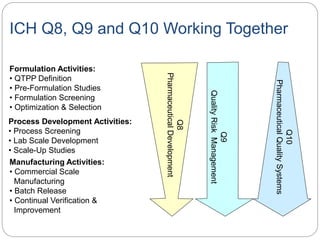
ICH Q8, Q9 and Q10 Working Together
Formulation Activities:
• QTPP Definition
• Pre-Formulation Studies
• Formulation Screening
• Optimization & Selection
Process Development Activities:
• Process Screening
• Lab Scale Development
• Scale-Up Studies
Manufacturing Activities:
• Commercial Scale
Manufacturing
• Batch Release
• Continual Verification &
Improvement
Q8
PharmaceuticalDevelopment
Q9
QualityRiskManagement
Q10
PharmaceuticalQualitySystems
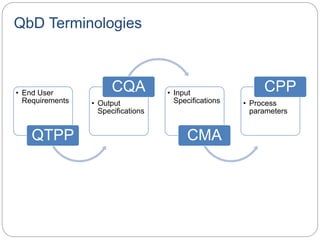
• End User
Requirements
QTPP
• Output
Specifications
CQA • Input
Specifications
CMA
• Process
parameters
CPP
QbD Terminologies
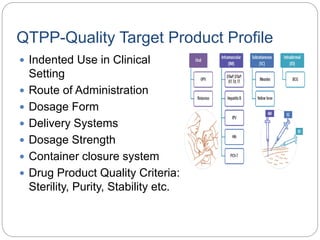
QTPP-Quality Target Product Profile
 Indented Use in Clinical
Setting
 Route of Administration
 Dosage Form
 Delivery Systems
 Dosage Strength
 Container closure system
 Drug Product Quality Criteria:
Sterility, Purity, Stability etc.
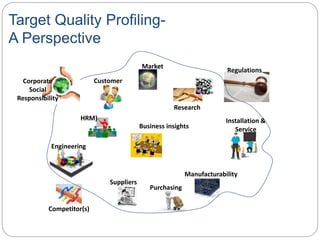
Target Quality Profiling-
A Perspective
Customer
Market
Regulations
Research
Engineering
Business insights
Manufacturability
Installation &
Service
Purchasing
Suppliers
Competitor(s)
Corporate
Social
Responsibility
HRM)
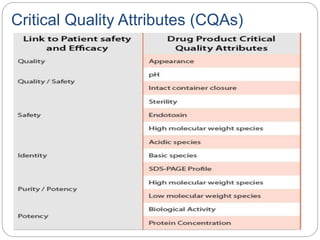
Critical Quality Attributes (CQAs)
Critical Material Attributes (CMAs)
 Input Material Quality Attributes
 Raw material Quality
 Examples: Water Content/LOD, Assay, Impurities,
Colour Value
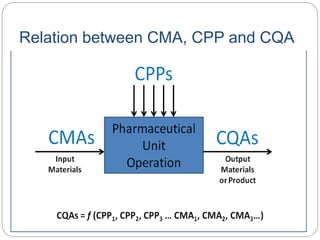
Relation between CMA, CPP and CQA
Process
(or Process Step)
Design
Space
Monitoring of
Parameters
or Attributes
Process Controls/PAT
Input
Process
Parameters
Input
Materials
Product
(or Intermediate)
Product
Variability
Reduced
Product
Variability
Process
Variability
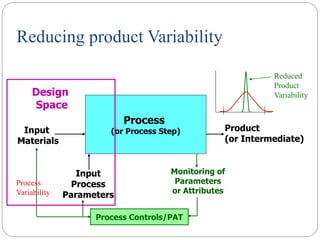
Reducing product Variability
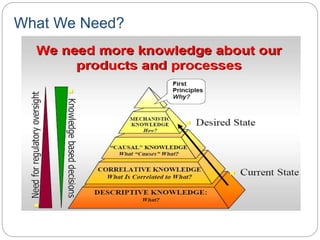
What We Need?
Key
in the Future of
Manufacturing
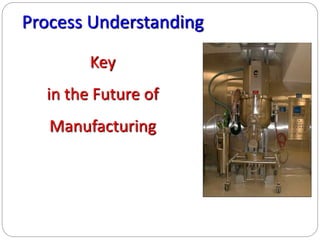
Process Understanding
A Process is well understood when…
 all critical sources of variability are identified and
explained;
 variability is managed by the process; and,
 product quality attributes can be accurately and
reliably predicted over the design space …
http://www.fda.gov/cder/guidance/6419fnl.ht
m
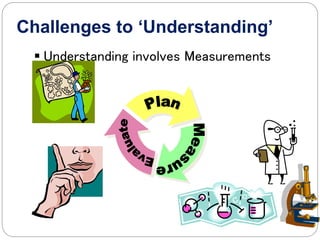
Challenges to ‘Understanding’
 Understanding involves Measurements
Challenges to Analytical Science
The need for increased
Process understanding is
a massive Boost for
Analytical Science
Fritz Erni
Challenges to Analytical Science
adequate Tools?
Product Development Tools
 Computer-aided drafting software
 Solid modeling software
 Finite element analysis software
 Parametric analysis software
 Rapid prototyping techniques
 Design for manufacture and assembly techniques
 Failure mode and effect analysis
Production Tools
 Computer-aided Manufacturing
 Computer numerical controlled tools
 Continuous process improvement
 Just-in-time production
 Virtual manufacturing software
 Agile manufacturing
Statistical Tools
 Design of Experiments
 Statistical Process Control
Other Considerations
 Training is a must
 Requires money and time
 Using the tools increases employee retention and
satisfaction
PAT: Process Understanding
 Improved Process Knowledge to Identify and Remove
Sources of Variability
 Identify Critical to Quality parameters
 Process understanding as input to Risk Management
 Control what is critical
34
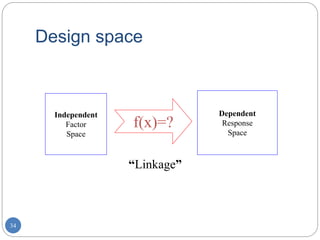
Design space
Independent
Factor
Space
Dependent
Response
Space
f(x)=?
“Linkage”
DOE and Design Space
 DOE is a tool to develop the design space.
 The outcome of the DOE
 Identifies the model correlations between CPPs/CMAs and CQAs
 Helps in establishing the boundaries of the design space.
 DOE can be used for Scale-up activities.
 DOE can be used as tool for confirming the design space at
manufacturing scale.
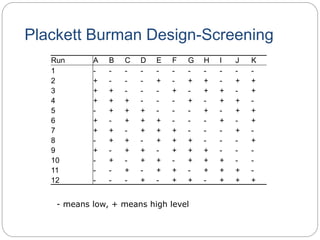
Plackett Burman Design-Screening
Run A B C D E F G H I J K
1 - - - - - - - - - - -
2 + - - - + - + + - + +
3 + + - - - + - + + - +
4 + + + - - - + - + + -
5 - + + + - - - + - + +
6 + - + + + - - - + - +
7 + + - + + + - - - + -
8 - + + - + + + - - - +
9 + - + + - + + + - - -
10 - + - + + - + + + - -
11 - - + - + + - + + + -
12 - - - + - + + - + + +
- means low, + means high level
37
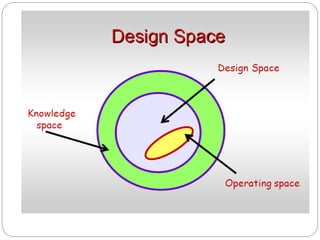
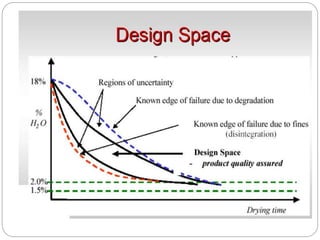
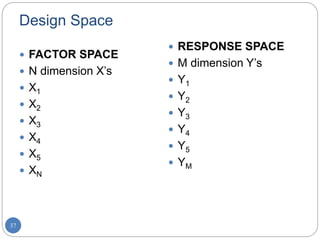
Design Space
 FACTOR SPACE
 N dimension X’s
 X1
 X2
 X3
 X4
 X5
 XN
 RESPONSE SPACE
 M dimension Y’s
 Y1
 Y2
 Y3
 Y4
 Y5
 YM
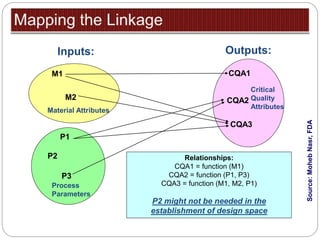
Inputs: Outputs:
P1
P2
P3
M1
M2
CQA1
CQA2
CQA3
Relationships:
CQA1 = function (M1)
CQA2 = function (P1, P3)
CQA3 = function (M1, M2, P1)
P2 might not be needed in the
establishment of design space
Process
Parameters
Material Attributes
Critical
Quality
Attributes
Source:MohebNasr,FDA
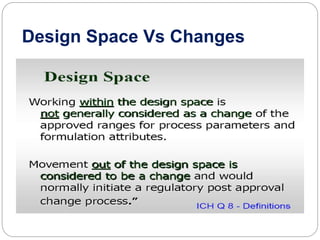
Design Space Vs Changes
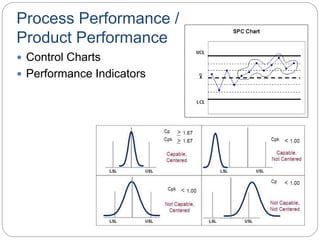
Process Performance /
Product Performance
 Control Charts
 Performance Indicators
Q & QA design
Q & QA design
Q & QA design

Q & QA design

  • 1.
  • 2.
    Overview  Interpretations ofQuality  QbD-Juran  QbD-Definition  ICH Q8-10  Paradigm Shift  QbD Attributes  Challenges  Tools  Design Space  QbD –Pharmaceutical Development
  • 3.
    Interpretations of Quality Time Cost Fitnessfor use Performance Features Look & Feel
  • 4.
    Joseph M Juran-QbD  Quality by Design (QbD) is a concept first outlined by quality expert Joseph M. Juran  Joseph Moses Juran (December 24, 1904 – February 28, 2008) was a Romanian-born American engineer and management consultant  The word "quality" as having two meanings:  Features that create customer satisfaction  The reliability of those features.  Failures in features create dissatisfactions, so removing failures is the purpose of quality improvement, while creating features is the purpose of quality by design
  • 5.
    Definition of QbD Thepharmaceutical Quality by Design (QbD) is a systematic approach to development that begins with predefined objectives and emphasizes product and process understanding and process control, based on sound science and quality risk management
  • 6.
    6 Q10Q8 Q8, Q9 &Q10 Process Materials Design Manufacturing Distribution Patient Facilities Opportunities to impact risk using quality risk management Q9
  • 7.
    Pharmaceutical Development -Q8(R2)  Describes science and risk-based approaches for pharmaceutical product and manufacturing process development  Introduced concepts of design space and flexible regulatory approaches  Introduced concepts of Quality by Design (QbD) and provided examples of QbD development approaches and design space
  • 8.
    © ICH, November2010 Quality Risk Management Process - Q9 Process Development Control Strategy Development Continual Improvement of the product
  • 9.
    Q10-Pharmaceutical Quality System Theproduct lifecycle includes the following Technical activities for new and existing products: Pharmaceutical Development: Drug substance development; Formulation development (including container/closure system); Manufacture of investigational products; Delivery system development (where relevant); Manufacturing process development and scale-up; Analytical method development. Technology Transfer: New product transfers during Development through Manufacturing; Transfers within or between manufacturing and testing sites for marketed products.
  • 10.
  • 11.
  • 12.
  • 13.
    “Quality can notbe tested into products; it has to be built in by design”
  • 14.
    From ‘blind compliance’ to ‘scienceand risk based compliance’ Ajaz Hussain, FDA The Paradigm Change
  • 15.
    ICH Q8, Q9and Q10 Working Together Formulation Activities: • QTPP Definition • Pre-Formulation Studies • Formulation Screening • Optimization & Selection Process Development Activities: • Process Screening • Lab Scale Development • Scale-Up Studies Manufacturing Activities: • Commercial Scale Manufacturing • Batch Release • Continual Verification & Improvement Q8 PharmaceuticalDevelopment Q9 QualityRiskManagement Q10 PharmaceuticalQualitySystems
  • 16.
    • End User Requirements QTPP •Output Specifications CQA • Input Specifications CMA • Process parameters CPP QbD Terminologies
  • 17.
    QTPP-Quality Target ProductProfile  Indented Use in Clinical Setting  Route of Administration  Dosage Form  Delivery Systems  Dosage Strength  Container closure system  Drug Product Quality Criteria: Sterility, Purity, Stability etc.
  • 18.
    Target Quality Profiling- APerspective Customer Market Regulations Research Engineering Business insights Manufacturability Installation & Service Purchasing Suppliers Competitor(s) Corporate Social Responsibility HRM)
  • 19.
  • 20.
    Critical Material Attributes(CMAs)  Input Material Quality Attributes  Raw material Quality  Examples: Water Content/LOD, Assay, Impurities, Colour Value
  • 21.
  • 22.
    Process (or Process Step) Design Space Monitoringof Parameters or Attributes Process Controls/PAT Input Process Parameters Input Materials Product (or Intermediate) Product Variability Reduced Product Variability Process Variability Reducing product Variability
  • 23.
  • 24.
    Key in the Futureof Manufacturing Process Understanding
  • 25.
    A Process iswell understood when…  all critical sources of variability are identified and explained;  variability is managed by the process; and,  product quality attributes can be accurately and reliably predicted over the design space … http://www.fda.gov/cder/guidance/6419fnl.ht m
  • 26.
    Challenges to ‘Understanding’ Understanding involves Measurements
  • 27.
    Challenges to AnalyticalScience The need for increased Process understanding is a massive Boost for Analytical Science
  • 28.
    Fritz Erni Challenges toAnalytical Science adequate Tools?
  • 29.
    Product Development Tools Computer-aided drafting software  Solid modeling software  Finite element analysis software  Parametric analysis software  Rapid prototyping techniques  Design for manufacture and assembly techniques  Failure mode and effect analysis
  • 30.
    Production Tools  Computer-aidedManufacturing  Computer numerical controlled tools  Continuous process improvement  Just-in-time production  Virtual manufacturing software  Agile manufacturing
  • 31.
    Statistical Tools  Designof Experiments  Statistical Process Control
  • 32.
    Other Considerations  Trainingis a must  Requires money and time  Using the tools increases employee retention and satisfaction
  • 33.
    PAT: Process Understanding Improved Process Knowledge to Identify and Remove Sources of Variability  Identify Critical to Quality parameters  Process understanding as input to Risk Management  Control what is critical
  • 34.
  • 35.
    DOE and DesignSpace  DOE is a tool to develop the design space.  The outcome of the DOE  Identifies the model correlations between CPPs/CMAs and CQAs  Helps in establishing the boundaries of the design space.  DOE can be used for Scale-up activities.  DOE can be used as tool for confirming the design space at manufacturing scale.
  • 36.
    Plackett Burman Design-Screening RunA B C D E F G H I J K 1 - - - - - - - - - - - 2 + - - - + - + + - + + 3 + + - - - + - + + - + 4 + + + - - - + - + + - 5 - + + + - - - + - + + 6 + - + + + - - - + - + 7 + + - + + + - - - + - 8 - + + - + + + - - - + 9 + - + + - + + + - - - 10 - + - + + - + + + - - 11 - - + - + + - + + + - 12 - - - + - + + - + + + - means low, + means high level
  • 37.
    37 Design Space  FACTORSPACE  N dimension X’s  X1  X2  X3  X4  X5  XN  RESPONSE SPACE  M dimension Y’s  Y1  Y2  Y3  Y4  Y5  YM
  • 38.
    Inputs: Outputs: P1 P2 P3 M1 M2 CQA1 CQA2 CQA3 Relationships: CQA1 =function (M1) CQA2 = function (P1, P3) CQA3 = function (M1, M2, P1) P2 might not be needed in the establishment of design space Process Parameters Material Attributes Critical Quality Attributes Source:MohebNasr,FDA
  • 40.
  • 43.
    Process Performance / ProductPerformance  Control Charts  Performance Indicators