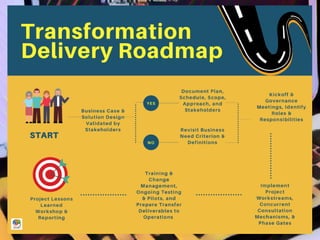
Transformation Delivery Framework
Drafted by Travis Barker MPA GCPM
VISION AND
STRATEGY
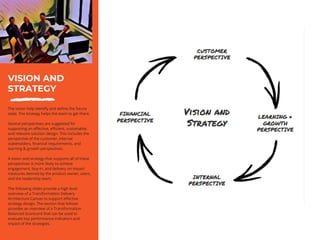
The vision help identify and define the future
state. The strategy helps the team to get there.
Several perspectives are suggested for
supporting an effective, efficient, sustainable,
and relevant solution design. This includes the
perspective of the customer, internal
stakeholders, financial requirements, and
learning & growth perspectives.
A vision and strategy that supports all of these
perspectives is more likely to achieve
engagement, buy-in, and delivery on impact
measures desired by the product owner, users,
and the leadership team.
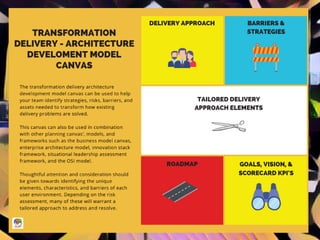
The following slides provide a high level
overview of a Transformation Delivery
Architecture Canvas to support effective
strategy design. The section that follows
provides an overview of a Transformation
Balanced Scorecard that can be used to
evaluate key performance indicators and
impact of the strategies.
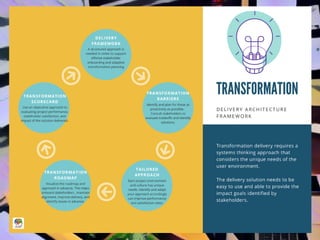
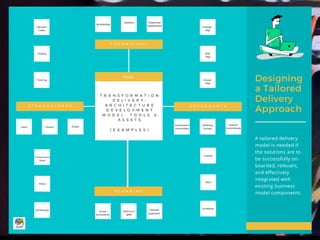
Transformation Delivery Architecture Canvas
CREATE A SHARED IT
VISION
Shared set of goals and
principles for department and
enterprise teams to share and
work towards together.
These are aligned with the
college plan and supports
involvement across the college
as a result of facilitated and
engagement processes.
Governance & Compliance
Enterprise Architecture
CyberSecurity
Project Management
Change Management
On Premise-Services
Products & Services
Support
Development
Infrastructure
Strengthen department and team's
understanding of the enterprise
structure and responsibilities between
groups.This will emphasiize:
IMPROVE COLLABORATION
BETWEEN TEAMS
Future Focused Training
People Centred Change
Management
Recruitment & Retention
INVEST IN PEOPLE
Future investments in ERP platform
and related systems
Organizational readiness
Implementation planning
Realizing the value of previous ERP
investments
Business process improvement
initiatives
Transition to sustainment
Establish technology raodmap
Ensure project solutions align with
technology strategy
Manage change requests and fixes
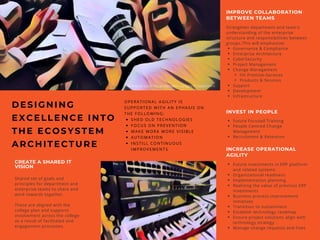
INCREASE OPERATIONAL
AGILITY
DESIGNING
EXCELLENCE INTO
THE ECOSYSTEM
ARCHITECTURE
SHED OLD TECHNOLOGIES
FOCUS ON PREVENTION
MAKE WORK MORE VISIBLE
AUTOMATION
INSTILL CONTINUOUS
IMPROVEMENTS
OPERATIONAL AGILITY IS
SUPPORTED WITH AN EPHASIS ON
THE FOLLOWING:
Reference: Justin Yau presentation, Langara IT Department
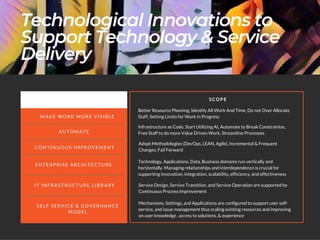
MAKE WORK MORE VISIBLE
AUTOMATE
CONTINUOUS IMPROVEMENT
ENTERPRISE ARCHITECTURE
IT INFRASTRUCTURE LIBRARY
SCOPE
SELF SERVICE & GOVERNANCE
MODEL
Better Resource Planning, Identify All Work And Time, Do not Over Allocate
Staff, Setting Limits for Work in Progress
Infrastructure as Code, Start Utilizing AI, Automate to Break Constraintss,
Free Staff to do more Value Driven Work, Streamline Processes
Adopt Methodologies (DevOps, LEAN, Agile), Incremental & Frequent
Changes, Fail Forward
Technological Innovations to
Support Technology & Service
Delivery
Technology, Applications, Data, Business domains run vertically and
horizontally. Managing relationships and interdependence is crucial for
supporting innovation, integration, scalability, efficiency, and effectiveness
Service Design, Service Transition, and Service Operation are supported by
Continuous Process Improvement
Mechanisms, Settings, and Applications are configured to support user self-
service, and issue management thus scaling existing resources and improving
on user knowledge , access to solutions, & experience
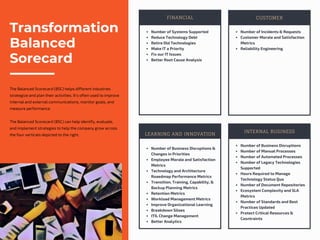
Transformation Balanced Scorecard
Transformation
Balanced
Sorecard
The Balanced Scorecard (BSC) helps different industries
strategize and plan their activities. It's often used to improve
internal and external communications, monitor goals, and
measure performance.
The Balanced Scorecard (BSC) can help identify, evaluate,
and implement strategies to help the company grow across
the four verticals depicted to the right.
CUSTOMER
Number of Incidents & Requests
Customer Morale and Satisfaction
Metrics
Reliability Engineering
FINANCIAL
Number of Systems Supported
Reduce Technology Debt
Retire Old Technologies
Make IT a Priority
Fix our IT Issues
Better Root Cause Analysis
LEARNING AND INNOVATION
Number of Business Disruptions &
Changes in Priorities
Employee Morale and Satisfaction
Metrics
Technology and Architecture
Roaedmap Performance Metrics
Transition, Training, Capability, &
Backup Planning Metrics
Retention Metrics
Workload Management Metrics
Improve Organizational Learning
Breakdown Siloes
ITIL Change Management
Better Analytics
INTERNAL BUSINESS
Number of Business Disruptions
Number of Manual Processes
Number of Automated Processes
Number of Legacy Technologies
Supported
Hours Required to Manage
Technology Status Quo
Number of Document Repositories
Ecosystem Complexity and SLA
Metrics
Number of Standards and Best
Practices Updated
Protect Critical Resources &
Cosntraints
Implementation Roadmap
Transformation Delivery Framework - Innovate Vancouver.pdf

Transformation Delivery Framework - Innovate Vancouver.pdf

  • 1.
  • 2.
    VISION AND STRATEGY The visionhelp identify and define the future state. The strategy helps the team to get there. Several perspectives are suggested for supporting an effective, efficient, sustainable, and relevant solution design. This includes the perspective of the customer, internal stakeholders, financial requirements, and learning & growth perspectives. A vision and strategy that supports all of these perspectives is more likely to achieve engagement, buy-in, and delivery on impact measures desired by the product owner, users, and the leadership team. The following slides provide a high level overview of a Transformation Delivery Architecture Canvas to support effective strategy design. The section that follows provides an overview of a Transformation Balanced Scorecard that can be used to evaluate key performance indicators and impact of the strategies.
  • 3.
  • 4.
    CREATE A SHAREDIT VISION Shared set of goals and principles for department and enterprise teams to share and work towards together. These are aligned with the college plan and supports involvement across the college as a result of facilitated and engagement processes. Governance & Compliance Enterprise Architecture CyberSecurity Project Management Change Management On Premise-Services Products & Services Support Development Infrastructure Strengthen department and team's understanding of the enterprise structure and responsibilities between groups.This will emphasiize: IMPROVE COLLABORATION BETWEEN TEAMS Future Focused Training People Centred Change Management Recruitment & Retention INVEST IN PEOPLE Future investments in ERP platform and related systems Organizational readiness Implementation planning Realizing the value of previous ERP investments Business process improvement initiatives Transition to sustainment Establish technology raodmap Ensure project solutions align with technology strategy Manage change requests and fixes INCREASE OPERATIONAL AGILITY DESIGNING EXCELLENCE INTO THE ECOSYSTEM ARCHITECTURE SHED OLD TECHNOLOGIES FOCUS ON PREVENTION MAKE WORK MORE VISIBLE AUTOMATION INSTILL CONTINUOUS IMPROVEMENTS OPERATIONAL AGILITY IS SUPPORTED WITH AN EPHASIS ON THE FOLLOWING: Reference: Justin Yau presentation, Langara IT Department
  • 6.
    MAKE WORK MOREVISIBLE AUTOMATE CONTINUOUS IMPROVEMENT ENTERPRISE ARCHITECTURE IT INFRASTRUCTURE LIBRARY SCOPE SELF SERVICE & GOVERNANCE MODEL Better Resource Planning, Identify All Work And Time, Do not Over Allocate Staff, Setting Limits for Work in Progress Infrastructure as Code, Start Utilizing AI, Automate to Break Constraintss, Free Staff to do more Value Driven Work, Streamline Processes Adopt Methodologies (DevOps, LEAN, Agile), Incremental & Frequent Changes, Fail Forward Technological Innovations to Support Technology & Service Delivery Technology, Applications, Data, Business domains run vertically and horizontally. Managing relationships and interdependence is crucial for supporting innovation, integration, scalability, efficiency, and effectiveness Service Design, Service Transition, and Service Operation are supported by Continuous Process Improvement Mechanisms, Settings, and Applications are configured to support user self- service, and issue management thus scaling existing resources and improving on user knowledge , access to solutions, & experience
  • 8.
  • 9.
    Transformation Balanced Sorecard The Balanced Scorecard(BSC) helps different industries strategize and plan their activities. It's often used to improve internal and external communications, monitor goals, and measure performance. The Balanced Scorecard (BSC) can help identify, evaluate, and implement strategies to help the company grow across the four verticals depicted to the right. CUSTOMER Number of Incidents & Requests Customer Morale and Satisfaction Metrics Reliability Engineering FINANCIAL Number of Systems Supported Reduce Technology Debt Retire Old Technologies Make IT a Priority Fix our IT Issues Better Root Cause Analysis LEARNING AND INNOVATION Number of Business Disruptions & Changes in Priorities Employee Morale and Satisfaction Metrics Technology and Architecture Roaedmap Performance Metrics Transition, Training, Capability, & Backup Planning Metrics Retention Metrics Workload Management Metrics Improve Organizational Learning Breakdown Siloes ITIL Change Management Better Analytics INTERNAL BUSINESS Number of Business Disruptions Number of Manual Processes Number of Automated Processes Number of Legacy Technologies Supported Hours Required to Manage Technology Status Quo Number of Document Repositories Ecosystem Complexity and SLA Metrics Number of Standards and Best Practices Updated Protect Critical Resources & Cosntraints
  • 10.