This document discusses transfer and separation in the workplace. It defines transfer as shifting an employee between jobs without changing responsibilities or pay. Transfers can be for organizational needs, employee requests, better utilization, versatility, workforce adjustment, relief, or conflict reduction. Separation is when an employee leaves the organization. Common types of separation include resignation, dismissal, death, suspension, retrenchment, and layoff.
DEFINITION
According to Dale Yoder,A transfer
involves the shifting of an employee from
one job to another without special
reference to changing responsibility or
compensation.Transfer may involve
promotion,demotion or no change in
status and responsibility.
3.
Purpose of Transfer
•To meet the organisational requirements.
•To meet Employees’ Requests.
•To Ensure Better Utilisation of the
Employees.
•To Make the Employees More Versatile.
•To Adjust the Workforce.
4.
PURPOSE OF TRANSFER
•ToProvide Relief to the Employee.
•To Reduce Conflicts and incompatibilities.
•To penalize the Employees.
•To Maintain a Tenure System.
•To Accommodate Family Related Issues.
5.
PURPOSE OF TRANSFER
1.Tomeet the organisational
requirements:
Organisational changes may demand the shift in job
assignments with a view to place the right men on the right
job.
2.To meet employees requests:
Sometimes,transfer is done at the request of the employer
himself.Employee may need transfer in order to satisfy
6.
PURPOSE OF TRANSFER
3.Toensure better utilisation of the
employees:
An employee may be transferred because the
management feels that he is not performing satisfactorily
and adequately.
4.To make the employees more
7.
PURPOSE OF TRANSFER
5.Toadjust the workforce:
Workforce may be transferred from a plant where there is less
work to a plant where there is more work.
6.To provide relief to the employees:
Transfer may be made to give relief to employees who are
overburdened or doing harzardous jobs for long periods.
Beak monolpy.
Unsatisfactory for an employees heath can be transfer.
8.
PURPOSE OF TRANSFER
7.Toreduce conflicts and in
compatibilities:
When employees find it to difficult to get along with colleagues
in a particular section or department,they could be shifted to
another place to reduce conflicts.
8.To penalise the employees:
Transfer may be effected as disciplinary measures to shift
employees indulging in undesirable activities to remote,far flung
9.
PURPOSE OF TRANSFER
9.Tomaintain a tenure system:
Employees has a fixed tenure system.They shifted from
one place to the another so that they will increase
experience and skills which is beneficial for the
organisation.
10.To accommodate family related
issues:
Family related issues cause transfers, specially among
10.
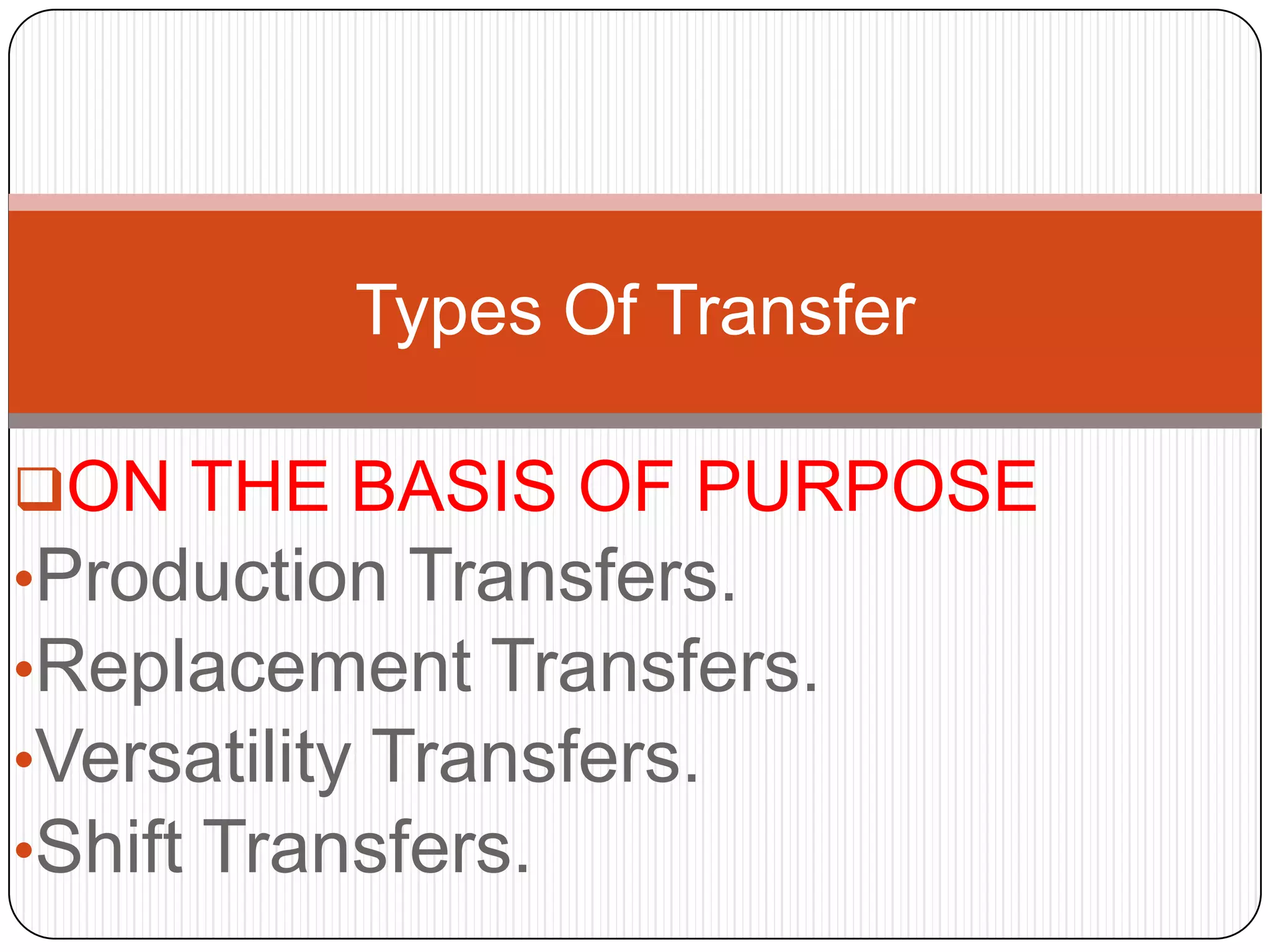
Types Of Transfer
ONTHE BASIS OF PURPOSE
•Production Transfers.
•Replacement Transfers.
•Versatility Transfers.
•Shift Transfers.
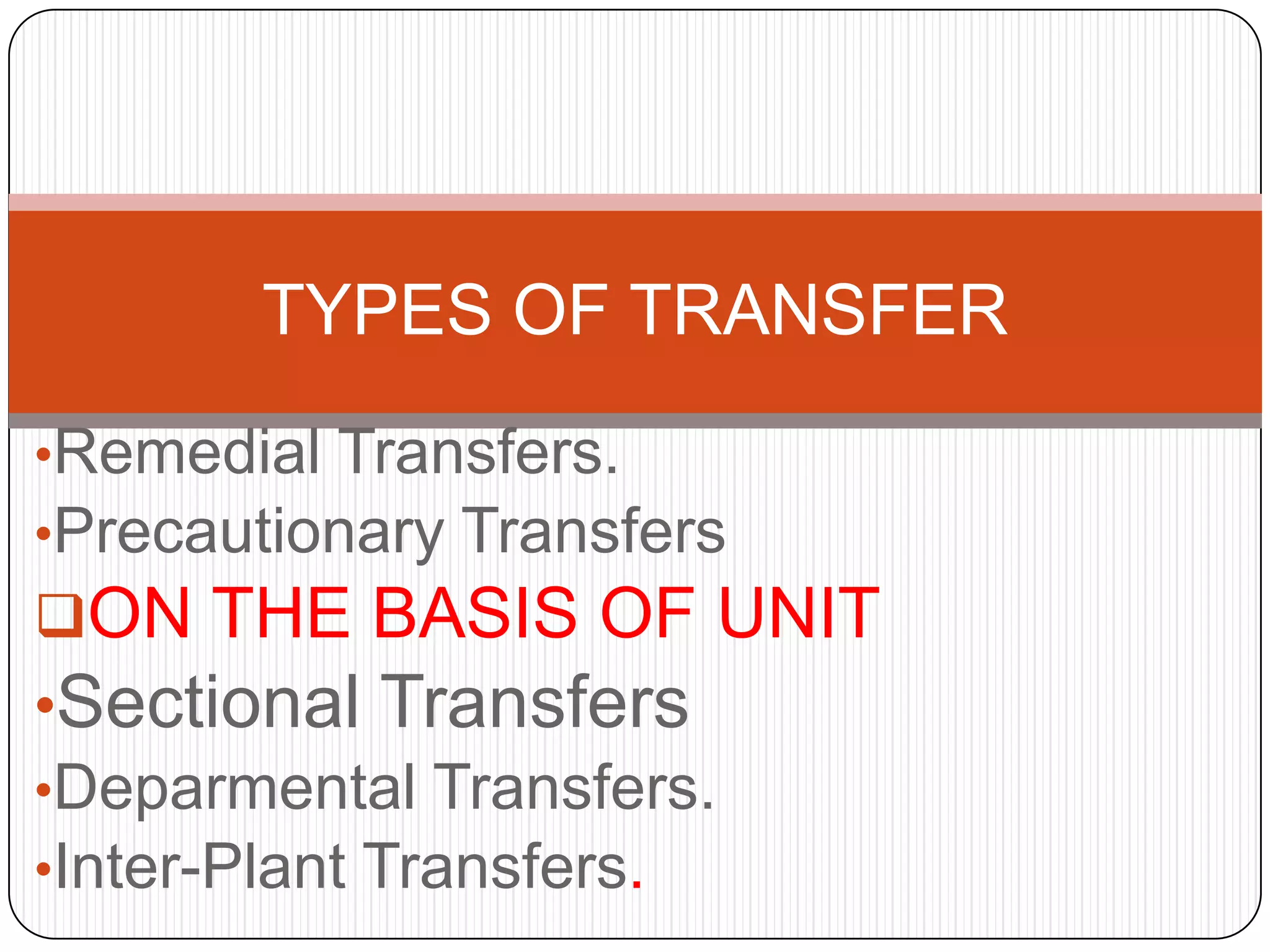
11.
TYPES OF TRANSFER
•RemedialTransfers.
•Precautionary Transfers
ON THE BASIS OF UNIT
•Sectional Transfers
•Deparmental Transfers.
•Inter-Plant Transfers.
12.
TYPES OF TRAANSFER
1.Productiontransfers:
A shortage or surplus of the workforce is common in
different departments in a plant or several plants in an
organisation. Surplus employees in a department have to
be laid off, unless they are transferred to another
department. Transfers effected to avoid such inevitable lay
offs are called production transfers.
13.
TYPES OF TRANSFER
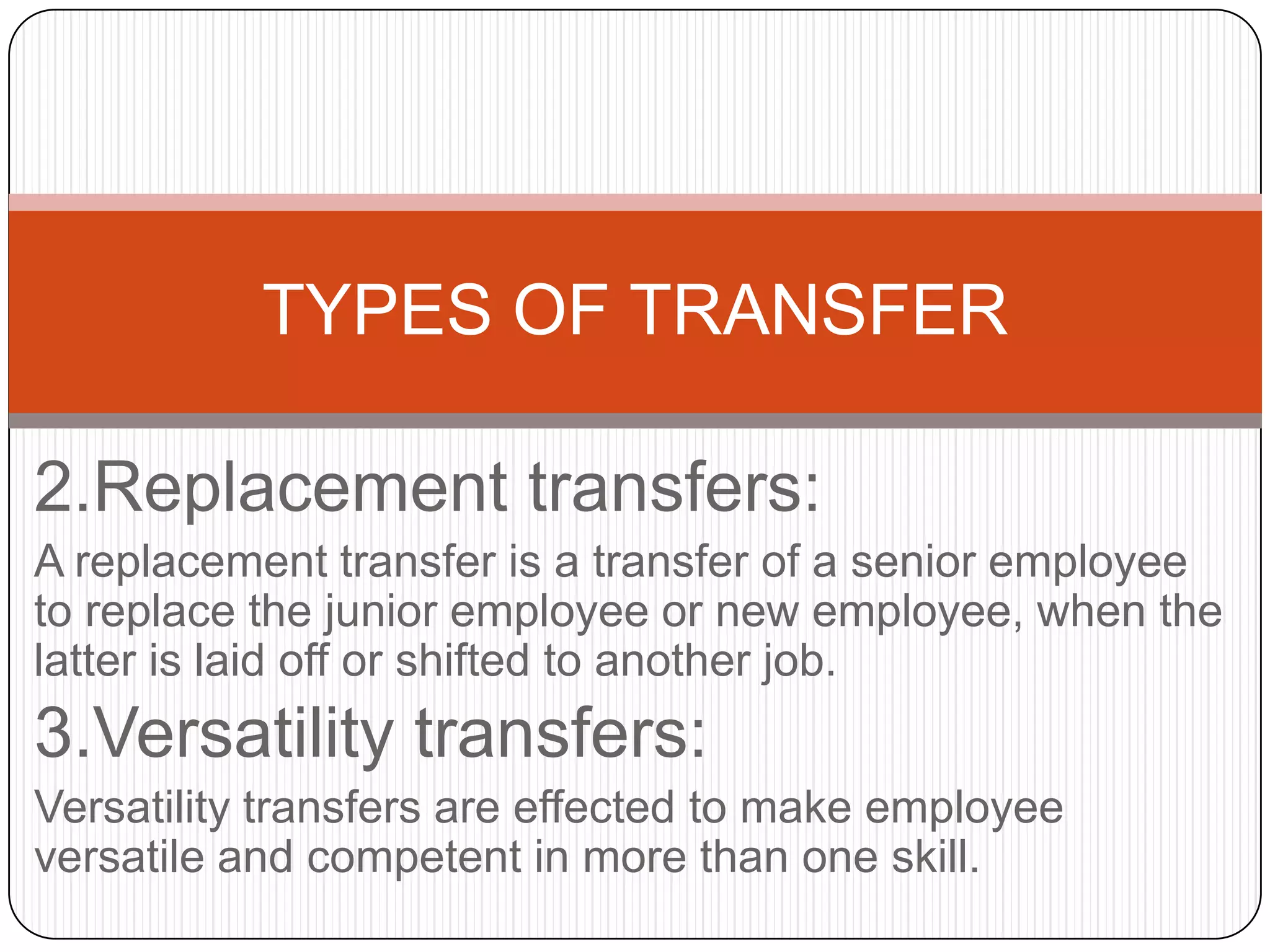
2.Replacementtransfers:
A replacement transfer is a transfer of a senior employee
to replace the junior employee or new employee, when the
latter is laid off or shifted to another job.
3.Versatility transfers:
Versatility transfers are effected to make employee
versatile and competent in more than one skill.
14.
TYPES OF TRANSFER
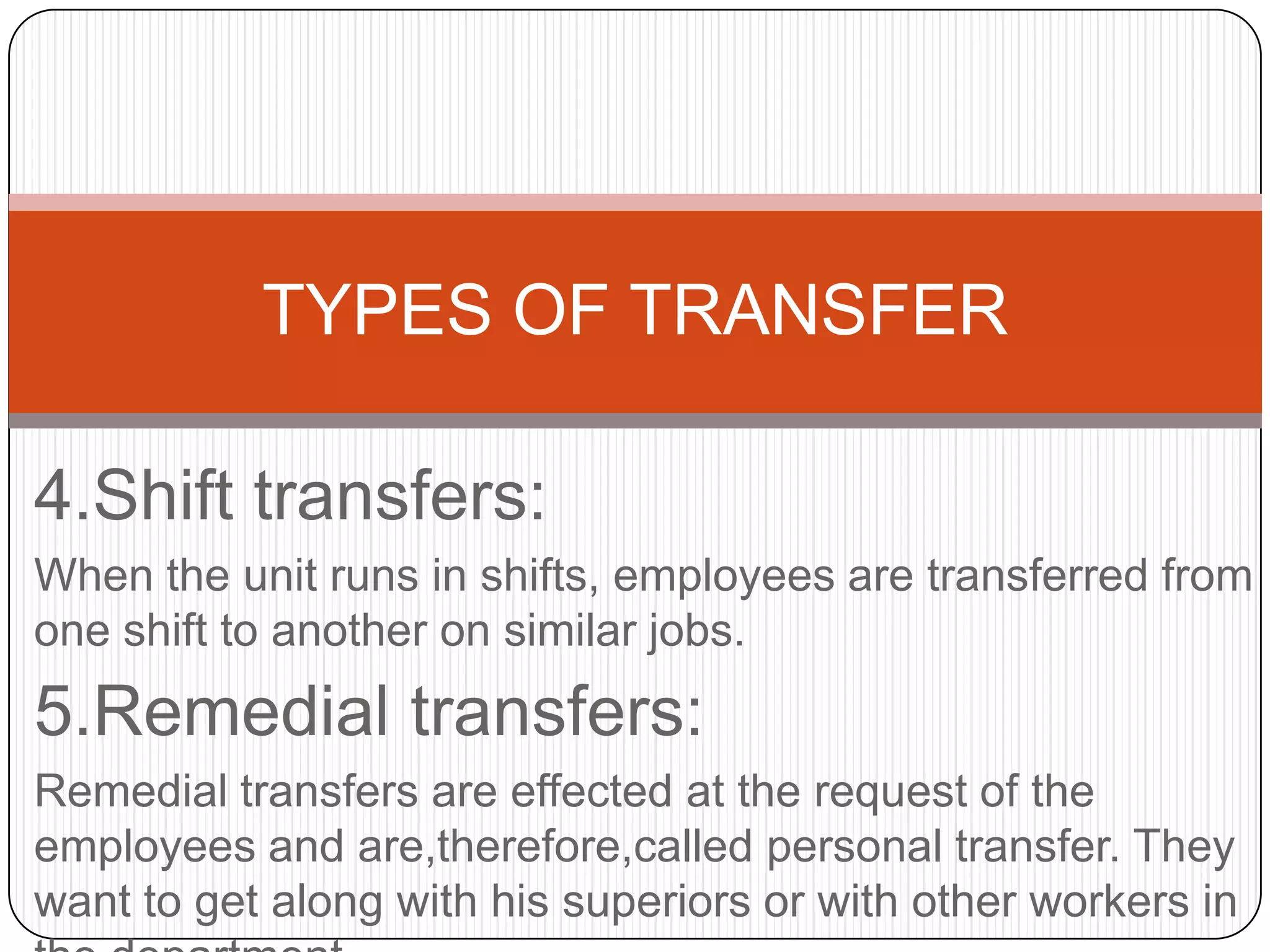
4.Shifttransfers:
When the unit runs in shifts, employees are transferred from
one shift to another on similar jobs.
5.Remedial transfers:
Remedial transfers are effected at the request of the
employees and are,therefore,called personal transfer. They
want to get along with his superiors or with other workers in
15.
TYPES OF TRANSFER
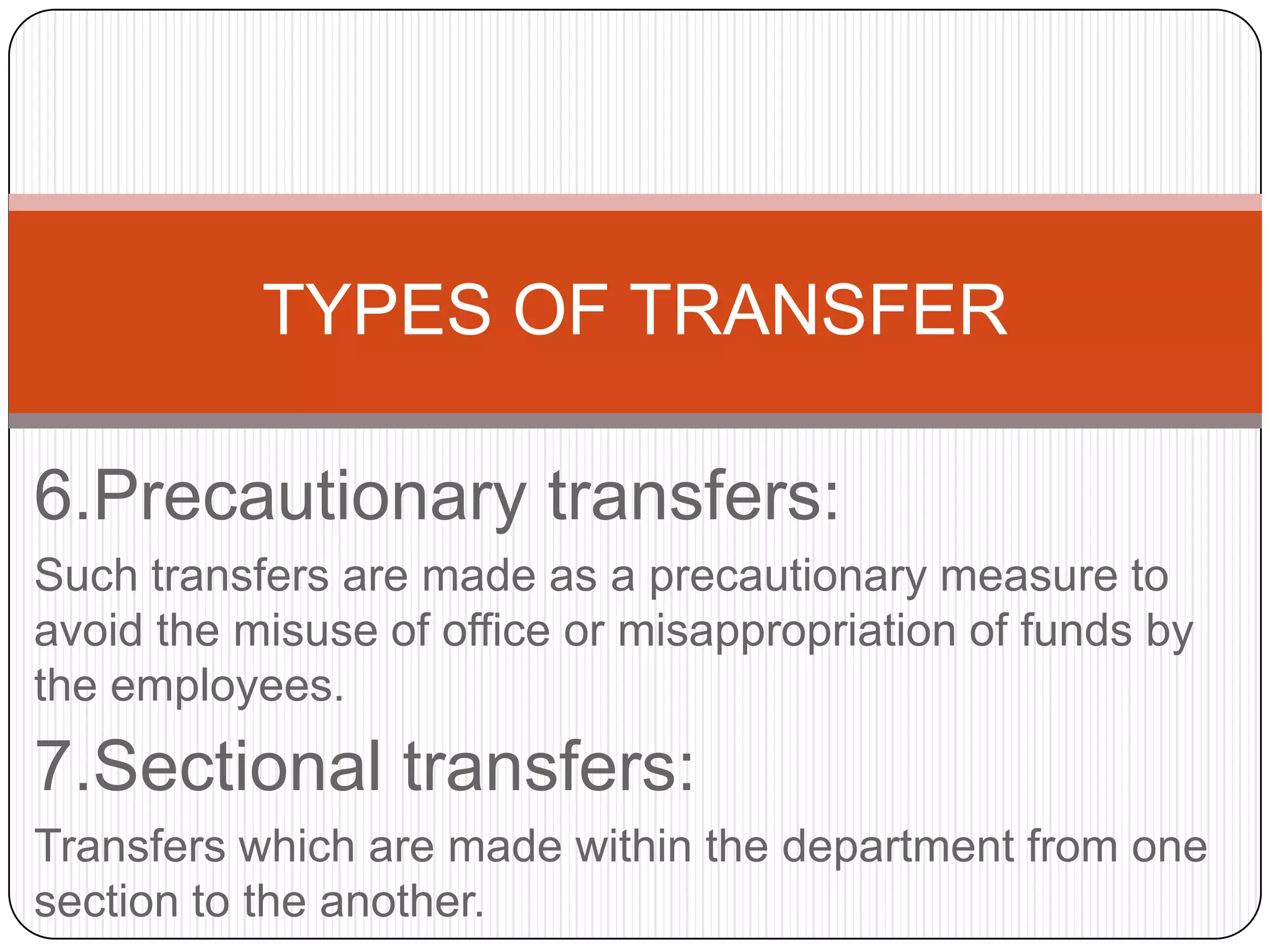
6.Precautionarytransfers:
Such transfers are made as a precautionary measure to
avoid the misuse of office or misappropriation of funds by
the employees.
7.Sectional transfers:
Transfers which are made within the department from one
section to the another.
16.
TYPES OF TRANSFER
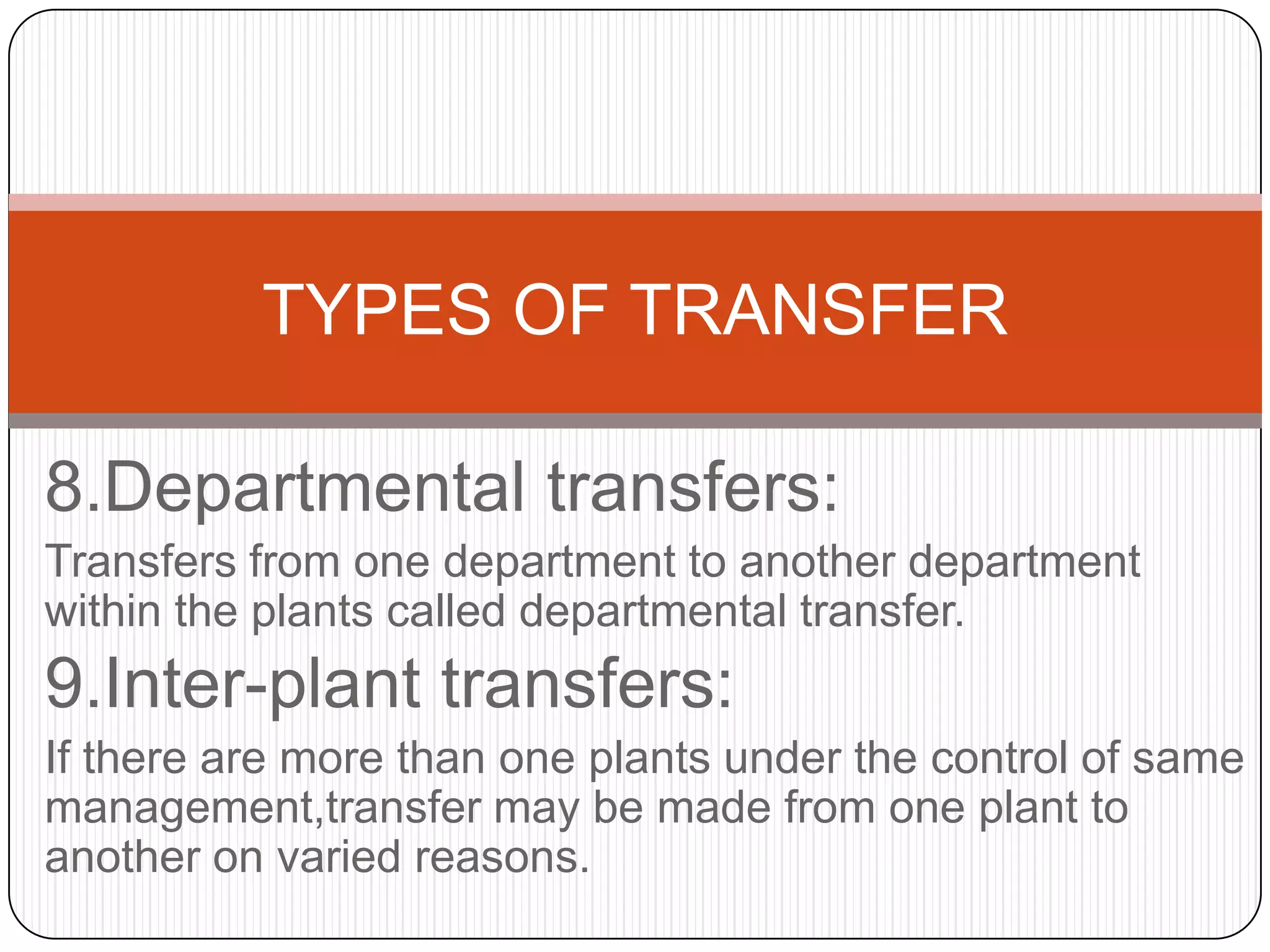
8.Departmentaltransfers:
Transfers from one department to another department
within the plants called departmental transfer.
9.Inter-plant transfers:
If there are more than one plants under the control of same
management,transfer may be made from one plant to
another on varied reasons.
17.
TRANSFER POLICY
The managementmust frame a policy on
transfers and apply it to all the transfers
instead of treating each case on its merit.
Such a policy must be based on the
following principles.
18.
TRANSFER POLICY
•Transfer policymust be in writing and be
made known to all the employees of the
organization.
•Transfers should be clearly defined as
temporary or permanent.
•The policy should specify the region or
unit of the organization within which
transfers will be administrated.
DEFINITION
•In the wordsof keith Davis,Separation
is a decision that the individual and the
organisation should part.Separations
can be taken the following forms:
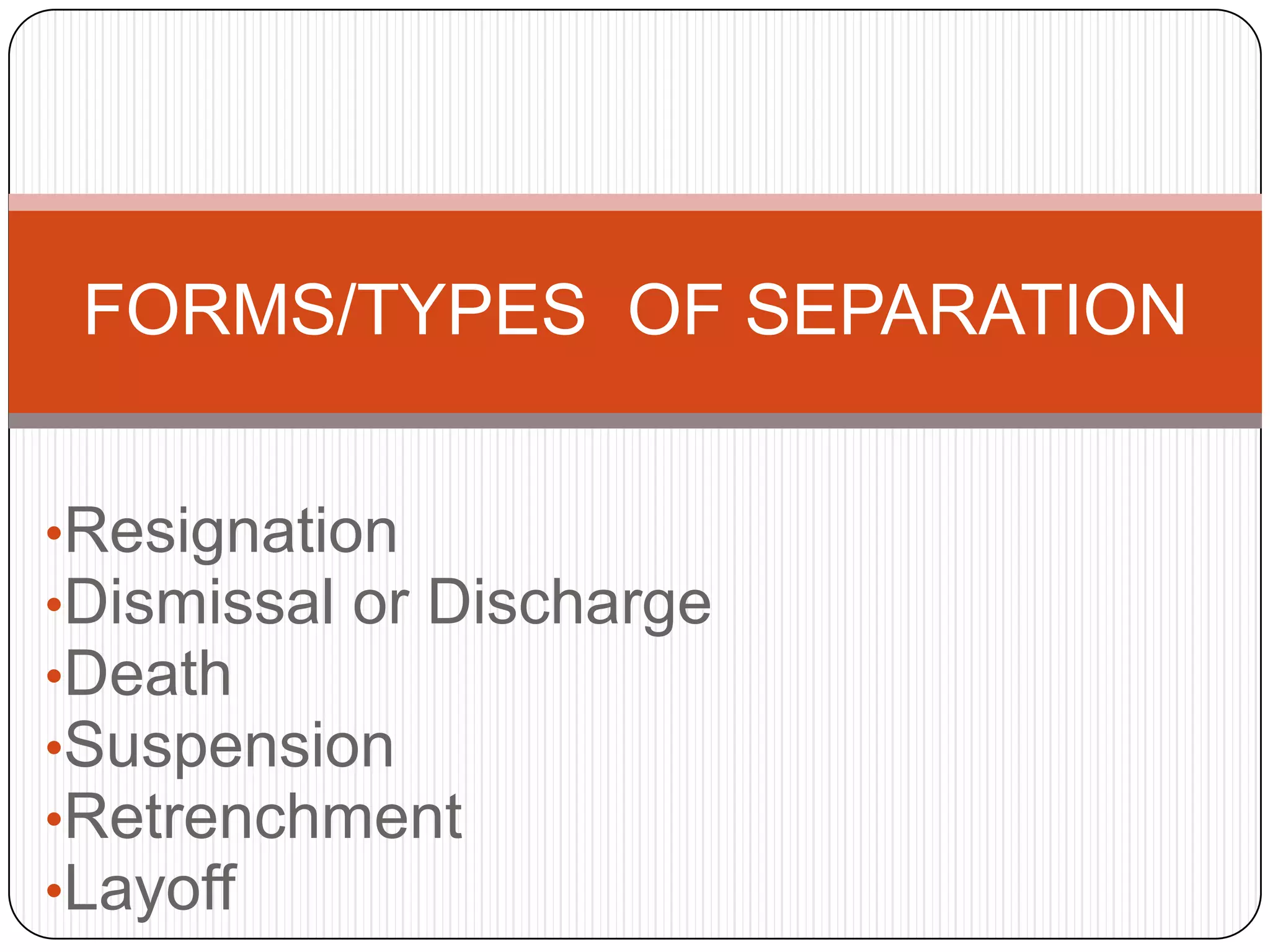
FORMS/TYPES OF SEPARATION
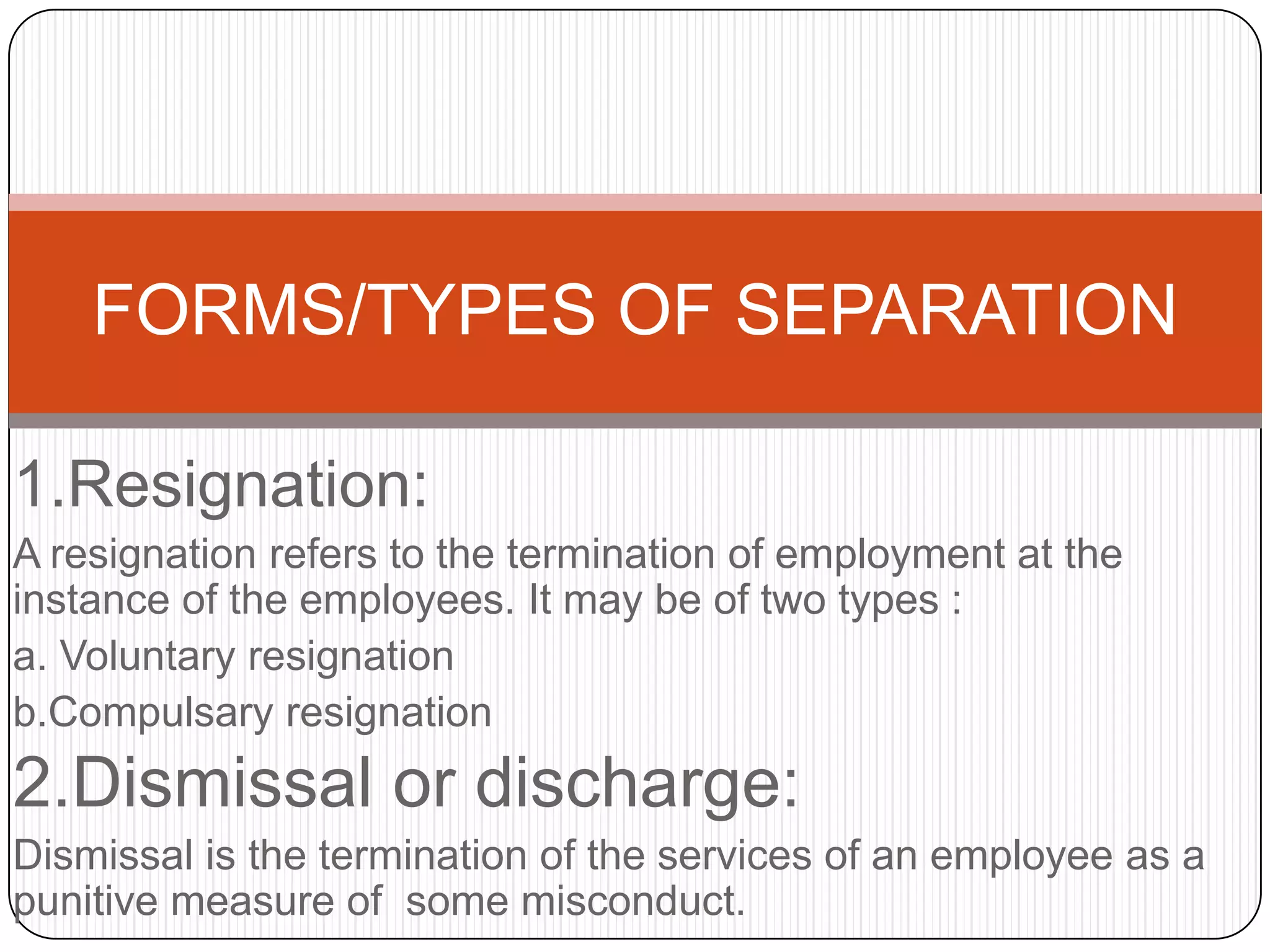
1.Resignation:
Aresignation refers to the termination of employment at the
instance of the employees. It may be of two types :
a. Voluntary resignation
b.Compulsary resignation
2.Dismissal or discharge:
Dismissal is the termination of the services of an employee as a
punitive measure of some misconduct.
23.
FORMS/TYPES OF SEPARATION
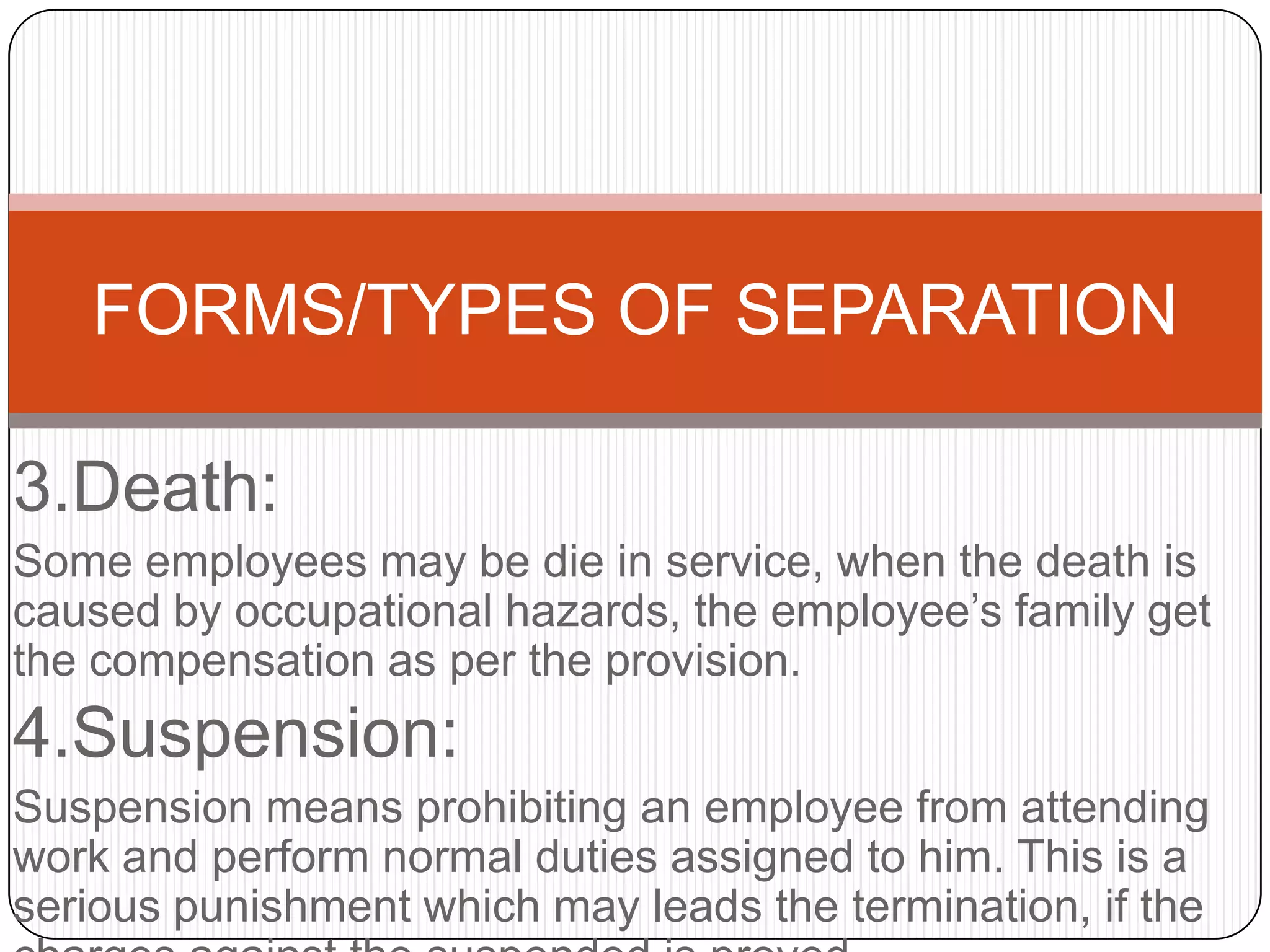
3.Death:
Someemployees may be die in service, when the death is
caused by occupational hazards, the employee’s family get
the compensation as per the provision.
4.Suspension:
Suspension means prohibiting an employee from attending
work and perform normal duties assigned to him. This is a
serious punishment which may leads the termination, if the
24.
FORMS/TYPES OF SEPARATION
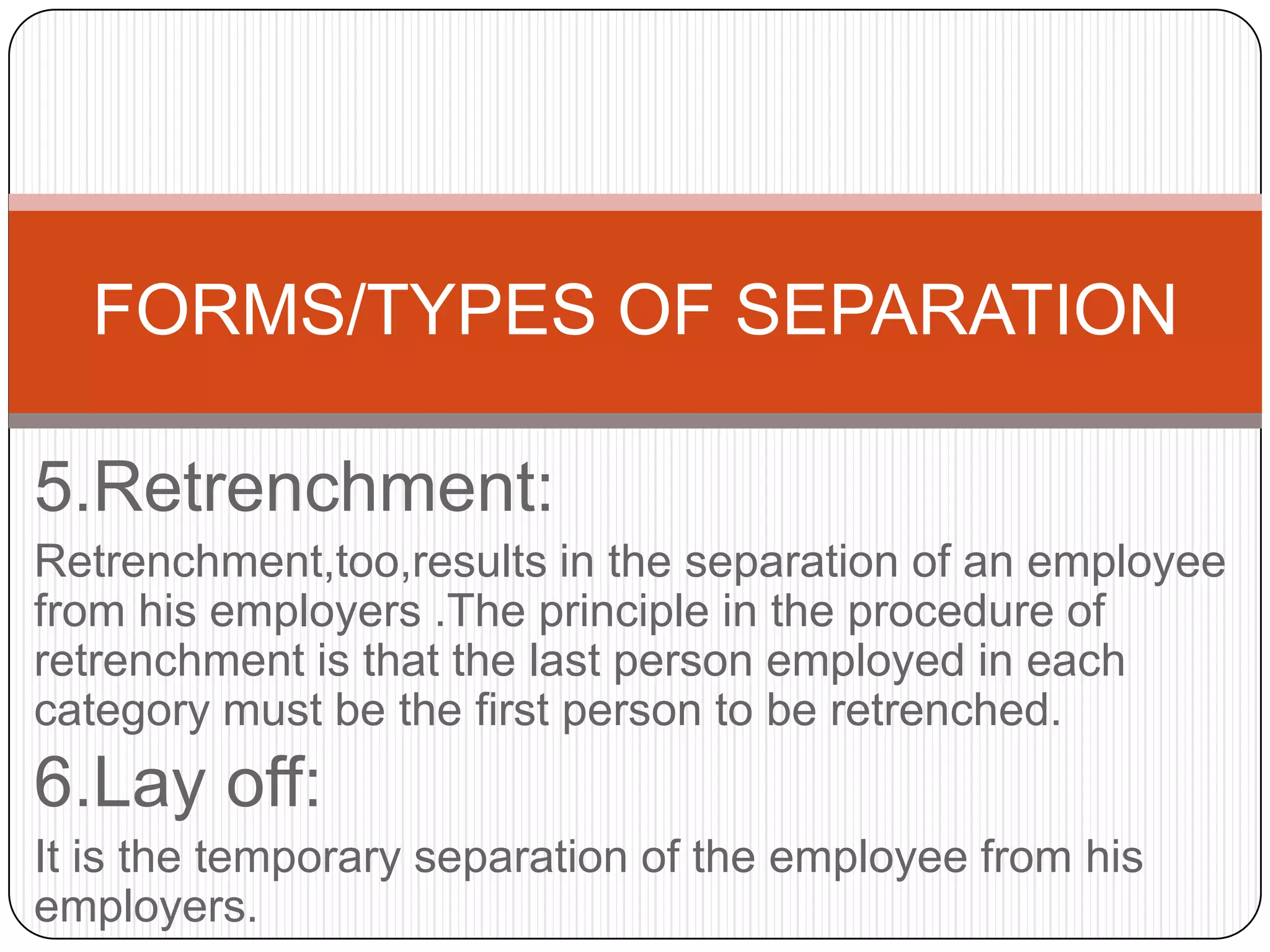
5.Retrenchment:
Retrenchment,too,resultsin the separation of an employee
from his employers .The principle in the procedure of
retrenchment is that the last person employed in each
category must be the first person to be retrenched.
6.Lay off:
It is the temporary separation of the employee from his
employers.