Human Resource Management
Chapter Eight
Promotions, Transfers and Separations
By: Estifanos Getnet (MBA)
7/21/2022 1
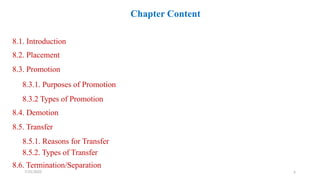
Chapter Content
8.1.
8.2.
8.3.
Introduction
Placement
Promotion
8.3.1. Purposes of Promotion
8.3.2 Types of Promotion
8.4. Demotion
8.5. Transfer
8.5.1. Reasons for Transfer
8.5.2. Types of Transfer
8.6. Termination/Separation
7/21/2022 2
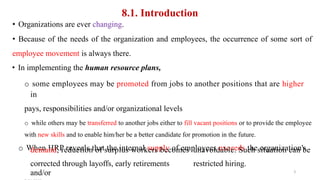
8.1. Introduction
• Organizations are ever changing.
• Because of the needs of the organization and employees, the occurrence of some sort of
employee movement is always there.
• In implementing the human resource plans,
o some employees may be promoted from jobs to another positions that are higher
in
pays, responsibilities and/or organizational levels
o while others may be transferred to another jobs either to fill vacant positions or to provide the employee
with new skills and to enable him/her be a better candidate for promotion in the future.
o When HRP reveals that the internal supply of employees exceeds the organization's
demand, reduction of surplus workers becomes
corrected through layoffs, early retirements
and/or
unavoidable. Such situation can be
restricted hiring.
3
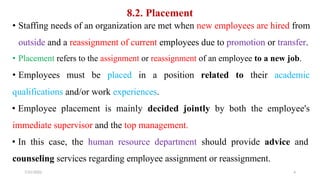
8.2. Placement
• Staffing needs of an organization are met when new employees are hired from
outside and a reassignment of current employees due to promotion or transfer.
• Placement refers to the assignment or reassignment of an employee to a new job.
• Employees must be placed in a position related to their academic
qualifications and/or work experiences.
• Employee placement is mainly decided jointly by both the employee's
immediate supervisor and the top management.
• In this case, the human resource department should provide advice and
counseling services regarding employee assignment or reassignment.
7/21/2022 4
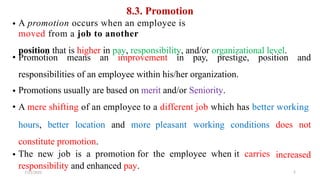
8.3. Promotion
A promotion occurs when an employee is
moved from a job to another
position that is higher in pay, responsibility, and/or organizational level.
•
• Promotion means an improvement in pay, prestige, position and
responsibilities of an employee within his/her organization.
Promotions usually are based on merit and/or Seniority.
A mere shifting of an employee to a different job which has better working
•
•
hours, better location and more pleasant working conditions does not
constitute promotion.
The new job is a promotion for the employee when it carries
responsibility and enhanced pay.
7/21/2022
• increased
5
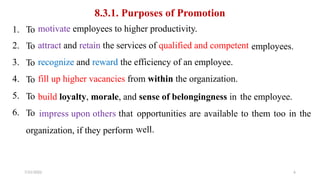
8.3.1. Purposes of Promotion
motivate employees to higher productivity.
attract and retain the services of qualified and competent
recognize and reward the efficiency of an employee.
fill up higher vacancies from within the organization.
1.
2.
3.
4.
5.
6.
To
To
To
To
To
To
employees.
build loyalty, morale, and sense of belongingness in the employee.
impress upon others that opportunities
well.
are available to them too in the
organization, if they perform
7/21/2022 6
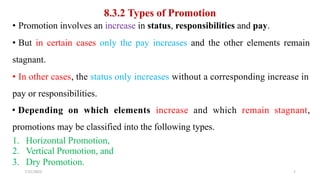
8.3.2 Types of Promotion
• Promotion involves an increase in status, responsibilities and pay.
• But in certain cases only the pay increases and the other elements remain
stagnant.
• In other cases, the status only increases without a corresponding increase in
pay or responsibilities.
• Depending on which elements increase and which remain stagnant,
promotions may be classified into the following types.
1.
2.
3.
Horizontal Promotion,
Vertical Promotion, and
Dry Promotion.
7/21/2022 7
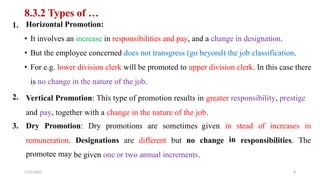
8.3.2 Types of …
Horizontal Promotion:
• It involves an increase in responsibilities and pay, and a change in designation.
• But the employee concerned does not transgress (go beyond) the job classification.
• For e.g. lower division clerk will be promoted to upper division clerk. In this case there
is no change in the nature of the job.
Vertical Promotion: This type of promotion results in greater responsibility, prestige
and pay, together with a change in the nature of the job.
1.
2.
3. Dry Promotion: Dry promotions are sometimes given in
in
stead of increases in
remuneration.
promotee may
Designations are different but no change responsibilities. The
be given one or two annual increments.
7/21/2022 8
8.4. Demotion
• Demotions refer to the downward
movement of an employee to a position
that is lower in responsibility, status, and perhaps lower pay.
• Demotions may occur due to:
odiscipline;
opoor performance, or
oinappropriate behavior such as absenteeism.
• It can be used as an alternative to firing an employee because
7/21/2022
of inefficiency.
9
8.5. Transfer
• Transfers refer to reassignment of an
employee from one job to another
position with similar status, equal pay and/or responsibility.
• A transfer involves a change in the job (accompanied by a change in the place of the
job) of an employee without a change in responsibilities or remuneration.
• It differs from a promotion in that the former involves a significant increase in
responsibility, status, and income but all these
later.
• Another difference is that transfers are regular
are infrequent, if not irregular.
7/21/2022
elements are stagnant in the
and frequent, but promotions
10
8.5.1. Reasons for Transfer
• The reasons for transfers vary from organization to
individual to individual within an organization.
organization, and from
• Broadly speaking, the following are the reasons for transfer:
to another department
1. Workers are transferred from the surplus department
or plant where there is a shortage of staff.
2. Removal of the incompatibilities between
between one worker and another worker.
Correction of faulty initial placement of an
the worker and his/her boss and
3.
4.
employee.
A change in the interests and capacity of an individual, necessitating his/her
transfer to a different job.
7/21/2022 11
8.5.1. Reasons …
Decline in productivity of an employee overtime b/c of the monotony of
his/her job. To break this monotony, the employee needs to be transferred.
The climate may be unsatisfactory for an employee‟s health. The
employee may request a transfer to a different place where his or her health
will not be affected by its climate.
Family related issues cause transfers, especially among female employees.
5.
6.
7.
When they got married,
and this fact necessitates
the female employees want to join their husbands
transfers or resignations.
7/21/2022 12
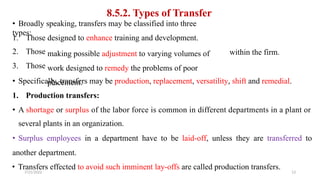
8.5.2. Types of Transfer
• Broadly speaking, transfers may be classified into three
types:
1.
2.
3.
Those
Those
Those
designed to enhance training and development.
making possible adjustment to varying volumes of
work designed to remedy the problems of poor
placement.
within the firm.
• Specifically, transfers may be production, replacement, versatility, shift and remedial.
1. Production transfers:
• A shortage or surplus of the labor force is common in different departments in a plant or
several plants in an organization.
• Surplus employees in a department have to be laid-off, unless they are transferred to
another department.
• Transfers effected to avoid such imminent lay-offs are called production transfers.
7/21/2022 13
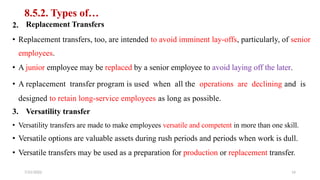
8.5.2. Types of…
Replacement Transfers
2.
• Replacement transfers, too, are intended to avoid imminent lay-offs, particularly, of senior
employees.
• A junior employee may be replaced by a senior employee to avoid laying off the later.
• A replacement transfer program is used when all the operations are declining and is
designed to retain long-service employees as long as possible.
3. Versatility transfer
• Versatility transfers are made to make employees versatile and competent in more than one skill.
• Versatile options are valuable assets during rush periods and periods when work is dull.
• Versatile transfers may be used as a preparation for production or replacement transfer.
7/21/2022 14
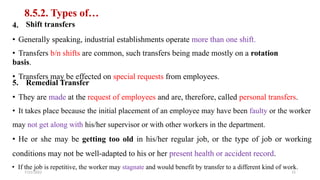
8.5.2. Types of…
Shift transfers
4.
• Generally speaking, industrial establishments operate more than one shift.
• Transfers b/n shifts are common, such transfers being made mostly on a rotation
basis.
• Transfers may be effected on special requests from employees.
5. Remedial Transfer
• They are made at the request of employees and are, therefore, called personal transfers.
• It takes place because the initial placement of an employee may have been faulty or the worker
may not get along with his/her supervisor or with other workers in the department.
• He or she may be getting too old in his/her regular job, or the type of job or working
conditions may not be well-adapted to his or her present health or accident record.
• If the job is repetitive, the worker may stagnate and would benefit by transfer to a different kind of work.
7/21/2022 15
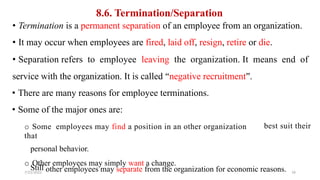
8.6. Termination/Separation
• Termination is a permanent separation of an employee from an organization.
• It may occur when employees are fired, laid off, resign, retire or die.
• Separation refers to employee leaving the organization. It means end of
service with the organization. It is called “negative recruitment”.
• There are many reasons for employee terminations.
• Some of the major ones are:
o Some employees may find a position in an other organization
that
personal behavior.
o Other employees may simply want a change.
best suit their
Still
7/21/2022
other employees may separate from the organization for economic reasons. 16
8.6. Termination/Separation…
• Separation is sometimes called Employee Exit.
• Employee Exit simply means separation from the organization. It may take
the form of:
oretirement, either compulsory
oresignation,
odismissal,
olay-off or retrenchment.
or voluntary,
• There are many causes of separation/employee exit.
• Broadly these causes can be classified under the following
and Non avoidable causes/unavoidable causes.
7/21/2022
headings: Avoidable causes
17
8.6. Termination/Separation…
Non avoidable causes/unavoidable causes:
• Employee‟s preferences or incompetence or poor health could be
considered as unavoidable causes.
• Such clear-cut demarcation is not possible in the case of avoidable causes.
Avoidable causes:
1.
2.
• Avoidable causes can be due to personal reasons like:
o incompatibility with peers or superiors,
o lack of interest or aptitude of the given job,
o
perceived
o change
of
o change
of
fears about one‟s own career prospects,
technology,
product mix,
o production volume,
o poor working conditions,
etc… 18
8.6. Termination/Separation…
 Types of separation:
1. Lay-offs
• A lay-off is a temporary separation of the employee from his/her employer at
the instance of the latter without any prejudice to the former.
• In other words, it refers to separation of employees for an indefinite period
due to reasons much beyond the control of employer.
• It is intended to reduce financial burden of organization.
• It may be for a definite period on the expiry of which
recalled by the employer for duty.
7/21/2022
the employee will be
19
8.6. Termination/Separation…
• It may be caused by one of the following reasons:
1.
2.
3.
Shortage of raw materials;
Accumulation of stocks;
Breakdown of machinery and for any other reason.
• As the employees are laid off at the instance of the employer, they have to be
paid compensation for the period they are laid off.
• The basis for the lay-off may be merit or seniority.
oIf merit is the basis, employees with unsatisfactory performance are laid of first.
oIf seniority is used as the basis of lay off, then
shortest period of service will be first laid off and
retained as long as conditions permit.
7/21/2022
the employees with the
the older employees are
20
8.6. Termination/Separation…
• The basis for recalling the employees as soon as the lay-off is lifted needs to
be made clear.
• Naturally key employees must be the first to be recalled.
• Top management has to decide who are to be lay –off and recalled.
• The following principles could be used in relation to these issues.
oThe “last in first out (LIFO)” principle is used for lay-off, and
oThe „last out first in (LOFI)‟ principle is used when they are
reemployed.
recalled and
7/21/2022 21
8.6. Termination/Separation…
2. Resignations
• It refers to the termination of employment at the instance of the employee.
• This is a manner of separation taken up by the employee.
• An employee resigns when:
oHe/she secures a better job elsewhere, or
oAn employee suffers form ill health, and
oFor other reasons.
• The administration of separation caused by
resignation is very simple because
the employee himself/herself is responsible
for it.
7/21/2022 22
8.6. Termination/Separation…
1. Voluntary resignation: the employee seeks separation from the
organization due to reasons of personal nature like lack
opportunities, chances of better employment elsewhere,
reasons of dissatisfaction of job etc.
of promotional
health reasons,
2. Induced resignation: It implies avoiding termination on grounds of
discipline. Meaning the individual may be induced or persuaded to leave
due to any other serious charges brought against him/her, and the
of
proceedings
service.
7/21/2022
of which might result in conviction and termination
23
8.6. Termination/Separation…
3. Dismissal or discharge
• Dismissal is the termination of services as a punishment for some major
offences done by the employee.
• Such punishment is awarded through a judicial or quasi-judicial process in
which ample opportunity is given to the employee who has been accused to
defend himself/herself, call witnesses in defending his/her case,
• The following reasons lead to the dismissal of an employee:
o Excessive absenteeism;
o Serious misconduct;
o False statement of qualification at the time of employment and
o Theft of company‟s property.
etc.
7/21/2022 24
8.6. Termination/Separation…
4. Suspension
• It is a practice to suspend an employee, when any serious charge is brought against
him/her, during the period of investigation.
These are done mostly for the purpose of preventing the employee from tampering with
the documents or influence the witness by making use of his opportunity and power.
During the suspension period, he is paid a reduced amount of salary, which is called
“subsistence allowance”.
Depending on the results of the enquiry, at the end, he is either re-established if found “not
guilty” or discharged or dismissed if found “guilty” of charges.
If he is re-established, the areas of pay and allowances during period of suspension are
paid to him and his service seniority is restored.
•
•
•
•
7/21/2022 25
8.6. Termination/Separation…
5. Retrenchment
• It refers to the termination of the services of employees because of:
othe replacement of labour by machines, or
ohigh-rise of cost of production and increasing losses etc.
othe closure of a department due to lack of demand for the products of it.
• In other words, it is the termination of the services of an employee,
permanently due to any reason, which is economical but not discipline.
• On retrenchment, employee is entitled for some compensation.
• The general principle for retrenchment is “last in first out (LIFO)”.
7/21/2022 26
8.6. Termination/Separation…
• Retrenchment d/t from lay-off and dismissal.
1. In lay-off, the employee continues to be in the employment of the
organization and is sure to be recalled after the end of the period of lay-off.
• But in retrenchment the employee is sent home for good.
An employee is dismissed because of his or her own fault.
• But, retrenchment is forced on both the employer and the employees.
• Moreover, retrenchment involves the termination of the services of
several employees.
• But dismissal generally involves the termination of the service of one
2.
or two employees.
7/21/2022 27
8.6. Termination/Separation…
6. Retirement
• Here there are two ways in which retirement can take place. Compulsory retirement
schemes and Voluntary Retirement Scheme (VRS)
1) Compulsory retirement schemes:
• This type of separation method applies to persons working in an organization who have
reached a particular age.
• Currently most employers fix their compulsory retirement ages at between 60 and 65.
2) Voluntary Retirement Scheme (VRS):
• It is sending home surplus labor for good, not strictly by retrenchment, but by a novel
scheme called the VRS, also known as the Golden Hand Shake Plan.
• Handsome compensations are paid to those workers who opt to leave.
7/21/2022 28
The End
7/21/2022 29

HRM-Chap-9 Promotion Transfer Separation

  • 1.
    Human Resource Management ChapterEight Promotions, Transfers and Separations By: Estifanos Getnet (MBA) 7/21/2022 1
  • 2.
    Chapter Content 8.1. 8.2. 8.3. Introduction Placement Promotion 8.3.1. Purposesof Promotion 8.3.2 Types of Promotion 8.4. Demotion 8.5. Transfer 8.5.1. Reasons for Transfer 8.5.2. Types of Transfer 8.6. Termination/Separation 7/21/2022 2
  • 3.
    8.1. Introduction • Organizationsare ever changing. • Because of the needs of the organization and employees, the occurrence of some sort of employee movement is always there. • In implementing the human resource plans, o some employees may be promoted from jobs to another positions that are higher in pays, responsibilities and/or organizational levels o while others may be transferred to another jobs either to fill vacant positions or to provide the employee with new skills and to enable him/her be a better candidate for promotion in the future. o When HRP reveals that the internal supply of employees exceeds the organization's demand, reduction of surplus workers becomes corrected through layoffs, early retirements and/or unavoidable. Such situation can be restricted hiring. 3
  • 4.
    8.2. Placement • Staffingneeds of an organization are met when new employees are hired from outside and a reassignment of current employees due to promotion or transfer. • Placement refers to the assignment or reassignment of an employee to a new job. • Employees must be placed in a position related to their academic qualifications and/or work experiences. • Employee placement is mainly decided jointly by both the employee's immediate supervisor and the top management. • In this case, the human resource department should provide advice and counseling services regarding employee assignment or reassignment. 7/21/2022 4
  • 5.
    8.3. Promotion A promotionoccurs when an employee is moved from a job to another position that is higher in pay, responsibility, and/or organizational level. • • Promotion means an improvement in pay, prestige, position and responsibilities of an employee within his/her organization. Promotions usually are based on merit and/or Seniority. A mere shifting of an employee to a different job which has better working • • hours, better location and more pleasant working conditions does not constitute promotion. The new job is a promotion for the employee when it carries responsibility and enhanced pay. 7/21/2022 • increased 5
  • 6.
    8.3.1. Purposes ofPromotion motivate employees to higher productivity. attract and retain the services of qualified and competent recognize and reward the efficiency of an employee. fill up higher vacancies from within the organization. 1. 2. 3. 4. 5. 6. To To To To To To employees. build loyalty, morale, and sense of belongingness in the employee. impress upon others that opportunities well. are available to them too in the organization, if they perform 7/21/2022 6
  • 7.
    8.3.2 Types ofPromotion • Promotion involves an increase in status, responsibilities and pay. • But in certain cases only the pay increases and the other elements remain stagnant. • In other cases, the status only increases without a corresponding increase in pay or responsibilities. • Depending on which elements increase and which remain stagnant, promotions may be classified into the following types. 1. 2. 3. Horizontal Promotion, Vertical Promotion, and Dry Promotion. 7/21/2022 7
  • 8.
    8.3.2 Types of… Horizontal Promotion: • It involves an increase in responsibilities and pay, and a change in designation. • But the employee concerned does not transgress (go beyond) the job classification. • For e.g. lower division clerk will be promoted to upper division clerk. In this case there is no change in the nature of the job. Vertical Promotion: This type of promotion results in greater responsibility, prestige and pay, together with a change in the nature of the job. 1. 2. 3. Dry Promotion: Dry promotions are sometimes given in in stead of increases in remuneration. promotee may Designations are different but no change responsibilities. The be given one or two annual increments. 7/21/2022 8
  • 9.
    8.4. Demotion • Demotionsrefer to the downward movement of an employee to a position that is lower in responsibility, status, and perhaps lower pay. • Demotions may occur due to: odiscipline; opoor performance, or oinappropriate behavior such as absenteeism. • It can be used as an alternative to firing an employee because 7/21/2022 of inefficiency. 9
  • 10.
    8.5. Transfer • Transfersrefer to reassignment of an employee from one job to another position with similar status, equal pay and/or responsibility. • A transfer involves a change in the job (accompanied by a change in the place of the job) of an employee without a change in responsibilities or remuneration. • It differs from a promotion in that the former involves a significant increase in responsibility, status, and income but all these later. • Another difference is that transfers are regular are infrequent, if not irregular. 7/21/2022 elements are stagnant in the and frequent, but promotions 10
  • 11.
    8.5.1. Reasons forTransfer • The reasons for transfers vary from organization to individual to individual within an organization. organization, and from • Broadly speaking, the following are the reasons for transfer: to another department 1. Workers are transferred from the surplus department or plant where there is a shortage of staff. 2. Removal of the incompatibilities between between one worker and another worker. Correction of faulty initial placement of an the worker and his/her boss and 3. 4. employee. A change in the interests and capacity of an individual, necessitating his/her transfer to a different job. 7/21/2022 11
  • 12.
    8.5.1. Reasons … Declinein productivity of an employee overtime b/c of the monotony of his/her job. To break this monotony, the employee needs to be transferred. The climate may be unsatisfactory for an employee‟s health. The employee may request a transfer to a different place where his or her health will not be affected by its climate. Family related issues cause transfers, especially among female employees. 5. 6. 7. When they got married, and this fact necessitates the female employees want to join their husbands transfers or resignations. 7/21/2022 12
  • 13.
    8.5.2. Types ofTransfer • Broadly speaking, transfers may be classified into three types: 1. 2. 3. Those Those Those designed to enhance training and development. making possible adjustment to varying volumes of work designed to remedy the problems of poor placement. within the firm. • Specifically, transfers may be production, replacement, versatility, shift and remedial. 1. Production transfers: • A shortage or surplus of the labor force is common in different departments in a plant or several plants in an organization. • Surplus employees in a department have to be laid-off, unless they are transferred to another department. • Transfers effected to avoid such imminent lay-offs are called production transfers. 7/21/2022 13
  • 14.
    8.5.2. Types of… ReplacementTransfers 2. • Replacement transfers, too, are intended to avoid imminent lay-offs, particularly, of senior employees. • A junior employee may be replaced by a senior employee to avoid laying off the later. • A replacement transfer program is used when all the operations are declining and is designed to retain long-service employees as long as possible. 3. Versatility transfer • Versatility transfers are made to make employees versatile and competent in more than one skill. • Versatile options are valuable assets during rush periods and periods when work is dull. • Versatile transfers may be used as a preparation for production or replacement transfer. 7/21/2022 14
  • 15.
    8.5.2. Types of… Shifttransfers 4. • Generally speaking, industrial establishments operate more than one shift. • Transfers b/n shifts are common, such transfers being made mostly on a rotation basis. • Transfers may be effected on special requests from employees. 5. Remedial Transfer • They are made at the request of employees and are, therefore, called personal transfers. • It takes place because the initial placement of an employee may have been faulty or the worker may not get along with his/her supervisor or with other workers in the department. • He or she may be getting too old in his/her regular job, or the type of job or working conditions may not be well-adapted to his or her present health or accident record. • If the job is repetitive, the worker may stagnate and would benefit by transfer to a different kind of work. 7/21/2022 15
  • 16.
    8.6. Termination/Separation • Terminationis a permanent separation of an employee from an organization. • It may occur when employees are fired, laid off, resign, retire or die. • Separation refers to employee leaving the organization. It means end of service with the organization. It is called “negative recruitment”. • There are many reasons for employee terminations. • Some of the major ones are: o Some employees may find a position in an other organization that personal behavior. o Other employees may simply want a change. best suit their Still 7/21/2022 other employees may separate from the organization for economic reasons. 16
  • 17.
    8.6. Termination/Separation… • Separationis sometimes called Employee Exit. • Employee Exit simply means separation from the organization. It may take the form of: oretirement, either compulsory oresignation, odismissal, olay-off or retrenchment. or voluntary, • There are many causes of separation/employee exit. • Broadly these causes can be classified under the following and Non avoidable causes/unavoidable causes. 7/21/2022 headings: Avoidable causes 17
  • 18.
    8.6. Termination/Separation… Non avoidablecauses/unavoidable causes: • Employee‟s preferences or incompetence or poor health could be considered as unavoidable causes. • Such clear-cut demarcation is not possible in the case of avoidable causes. Avoidable causes: 1. 2. • Avoidable causes can be due to personal reasons like: o incompatibility with peers or superiors, o lack of interest or aptitude of the given job, o perceived o change of o change of fears about one‟s own career prospects, technology, product mix, o production volume, o poor working conditions, etc… 18
  • 19.
    8.6. Termination/Separation…  Typesof separation: 1. Lay-offs • A lay-off is a temporary separation of the employee from his/her employer at the instance of the latter without any prejudice to the former. • In other words, it refers to separation of employees for an indefinite period due to reasons much beyond the control of employer. • It is intended to reduce financial burden of organization. • It may be for a definite period on the expiry of which recalled by the employer for duty. 7/21/2022 the employee will be 19
  • 20.
    8.6. Termination/Separation… • Itmay be caused by one of the following reasons: 1. 2. 3. Shortage of raw materials; Accumulation of stocks; Breakdown of machinery and for any other reason. • As the employees are laid off at the instance of the employer, they have to be paid compensation for the period they are laid off. • The basis for the lay-off may be merit or seniority. oIf merit is the basis, employees with unsatisfactory performance are laid of first. oIf seniority is used as the basis of lay off, then shortest period of service will be first laid off and retained as long as conditions permit. 7/21/2022 the employees with the the older employees are 20
  • 21.
    8.6. Termination/Separation… • Thebasis for recalling the employees as soon as the lay-off is lifted needs to be made clear. • Naturally key employees must be the first to be recalled. • Top management has to decide who are to be lay –off and recalled. • The following principles could be used in relation to these issues. oThe “last in first out (LIFO)” principle is used for lay-off, and oThe „last out first in (LOFI)‟ principle is used when they are reemployed. recalled and 7/21/2022 21
  • 22.
    8.6. Termination/Separation… 2. Resignations •It refers to the termination of employment at the instance of the employee. • This is a manner of separation taken up by the employee. • An employee resigns when: oHe/she secures a better job elsewhere, or oAn employee suffers form ill health, and oFor other reasons. • The administration of separation caused by resignation is very simple because the employee himself/herself is responsible for it. 7/21/2022 22
  • 23.
    8.6. Termination/Separation… 1. Voluntaryresignation: the employee seeks separation from the organization due to reasons of personal nature like lack opportunities, chances of better employment elsewhere, reasons of dissatisfaction of job etc. of promotional health reasons, 2. Induced resignation: It implies avoiding termination on grounds of discipline. Meaning the individual may be induced or persuaded to leave due to any other serious charges brought against him/her, and the of proceedings service. 7/21/2022 of which might result in conviction and termination 23
  • 24.
    8.6. Termination/Separation… 3. Dismissalor discharge • Dismissal is the termination of services as a punishment for some major offences done by the employee. • Such punishment is awarded through a judicial or quasi-judicial process in which ample opportunity is given to the employee who has been accused to defend himself/herself, call witnesses in defending his/her case, • The following reasons lead to the dismissal of an employee: o Excessive absenteeism; o Serious misconduct; o False statement of qualification at the time of employment and o Theft of company‟s property. etc. 7/21/2022 24
  • 25.
    8.6. Termination/Separation… 4. Suspension •It is a practice to suspend an employee, when any serious charge is brought against him/her, during the period of investigation. These are done mostly for the purpose of preventing the employee from tampering with the documents or influence the witness by making use of his opportunity and power. During the suspension period, he is paid a reduced amount of salary, which is called “subsistence allowance”. Depending on the results of the enquiry, at the end, he is either re-established if found “not guilty” or discharged or dismissed if found “guilty” of charges. If he is re-established, the areas of pay and allowances during period of suspension are paid to him and his service seniority is restored. • • • • 7/21/2022 25
  • 26.
    8.6. Termination/Separation… 5. Retrenchment •It refers to the termination of the services of employees because of: othe replacement of labour by machines, or ohigh-rise of cost of production and increasing losses etc. othe closure of a department due to lack of demand for the products of it. • In other words, it is the termination of the services of an employee, permanently due to any reason, which is economical but not discipline. • On retrenchment, employee is entitled for some compensation. • The general principle for retrenchment is “last in first out (LIFO)”. 7/21/2022 26
  • 27.
    8.6. Termination/Separation… • Retrenchmentd/t from lay-off and dismissal. 1. In lay-off, the employee continues to be in the employment of the organization and is sure to be recalled after the end of the period of lay-off. • But in retrenchment the employee is sent home for good. An employee is dismissed because of his or her own fault. • But, retrenchment is forced on both the employer and the employees. • Moreover, retrenchment involves the termination of the services of several employees. • But dismissal generally involves the termination of the service of one 2. or two employees. 7/21/2022 27
  • 28.
    8.6. Termination/Separation… 6. Retirement •Here there are two ways in which retirement can take place. Compulsory retirement schemes and Voluntary Retirement Scheme (VRS) 1) Compulsory retirement schemes: • This type of separation method applies to persons working in an organization who have reached a particular age. • Currently most employers fix their compulsory retirement ages at between 60 and 65. 2) Voluntary Retirement Scheme (VRS): • It is sending home surplus labor for good, not strictly by retrenchment, but by a novel scheme called the VRS, also known as the Golden Hand Shake Plan. • Handsome compensations are paid to those workers who opt to leave. 7/21/2022 28
  • 29.