TMS - TranscranialMagnetic Stimulation for Chronic PainRafael Higashi, MDDepartment of Neurology- Clínica HigashiRio de Janeiro - Brazilwww.estimulacaoneurologica.com.br
Department of Neurology Marcilio Dias Navy Hospital – Rio de Janeiro - Brazil
Transcranial Magnetic Stimulation Laboratory
Aldini. Frankenstein, Mary Wollstonecraft Shelley (1797-1851)Luigi Rolando (1773-1831), pioneered in cerebral electrical stimulation (1809) in vivo animals Rolando or central fissureExperiments: stimulation of nerves and muscles by Luigi Galvani in 1786 - voltaic
 Basic PrinciplesI(t)/ImaxTempo-msVoltage until 3kVCurrents (discharge of capacitor)- 4-8kA Energy reserve 500J500 J /100 S Magnetic fieldEletrical current  in the cerebral  cortex  eletrical currentMainUnitBobbin
Basic PrinciplesMagnetic field generate Current induction TMS bobbin
Eletrical Current Induction in The Cerebral  Cortex  Frequency
 Intensity
 Location of the stimulusDependent Effect of Estimulation Frequency Frequency  =  less or  =  1 Hz – inibitionFrequency = more  or  = 1 Hz – facilitation placebo – no  difference in cerebral activity 1 Hz – decreasing in cerebral activityFrequency   rTMS20  Hz –increasing in cerebral activityDifference (%)  evocado potential in  the  motor cortex pré/pósrTMS
EMTLocal effect, distant effect or both?
Behavior and Motor Effects in Distant Areas TMSMotor  improvement stimulating contralateral  motor areaA Sham-Controlled Trial of a 5-Day Course of Repetitive Transcranial Magnetic Stimulation of the Unaffected Hemisphere in Stroke PatientsFelipe Fregni et al. Stroke. 2006;37:2115-2122.Harvard Center for Non-Invasive Brain Stimulation, Beth Israel Deaconess Medical Center, Harvard Medical School, BostonUniversity of Sao Paulo, Sao Paulo, Brazil
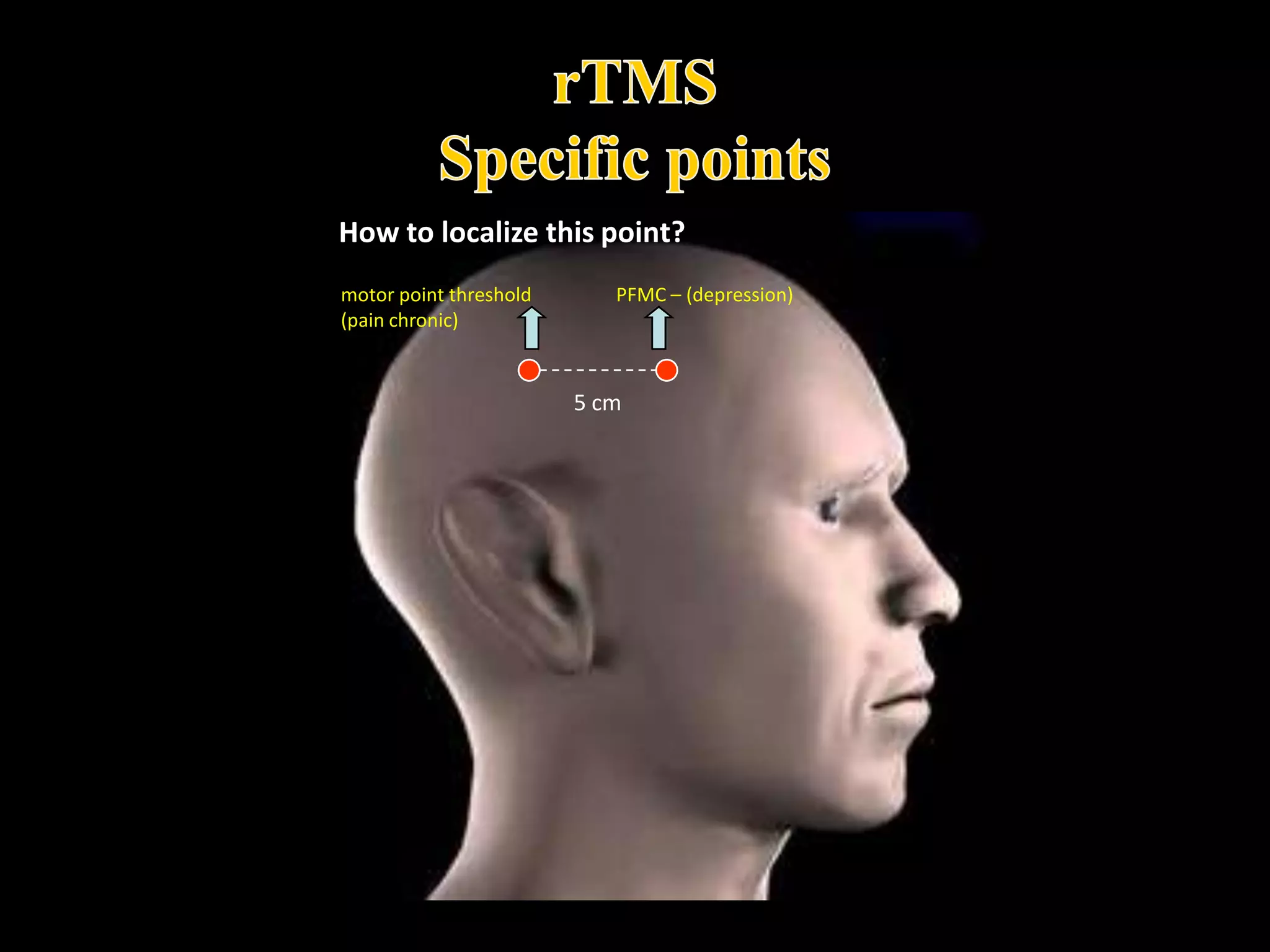
rTMSSpecific points How to localize this point?PFMC – (depression)motor point threshold(pain chronic)5 cm
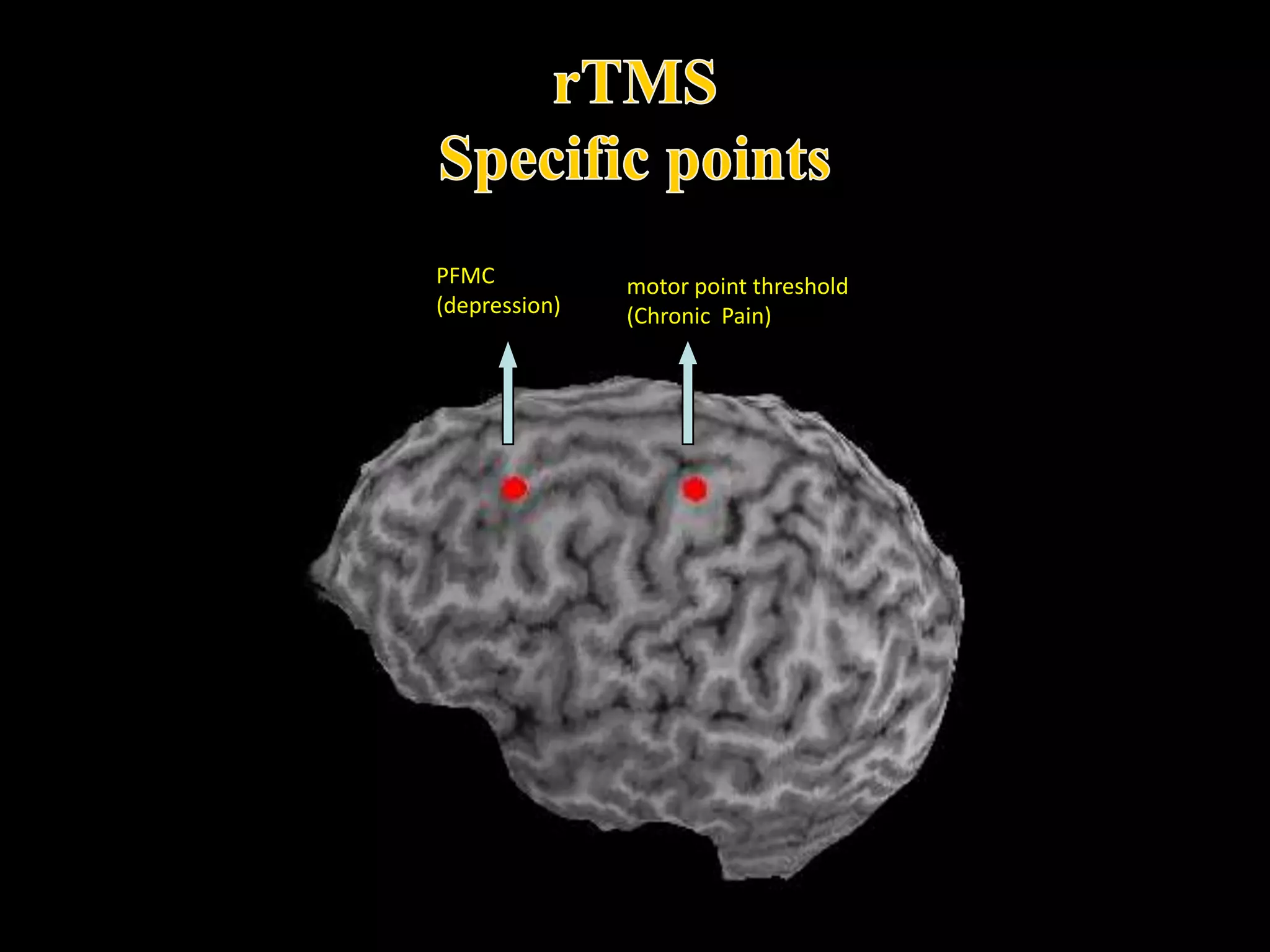
rTMSSpecific pointsPFMC  (depression)motor point threshold(Chronic  Pain)
A review of the safety of repetitive transcranial magnetic stimulation as a clinical treatment for depressionRisk of seizure (0.1–0.6%) comparable with antidepressant therapy
 hearing loss  (earplugs)
 Mild headache ( 28% of subjects experienced headache x 16% sham )
 Psychiatric complications: hypomanic (transient)International Journal of Neuropsychopharmacology (2008), 11, 131–147. Colleen K. Loo et al. School of Psychiatry, University of New South Wales, Sydney, Australia
Mechanism of  Action Neurotransmittor release Long-term potentiation –  increasing receptorsGenetic induction Effects  (long term):Synaptic Connection Improvement Ions induction and others substances locally rTMSimmediate effectCerebral cortexCerebral cortex
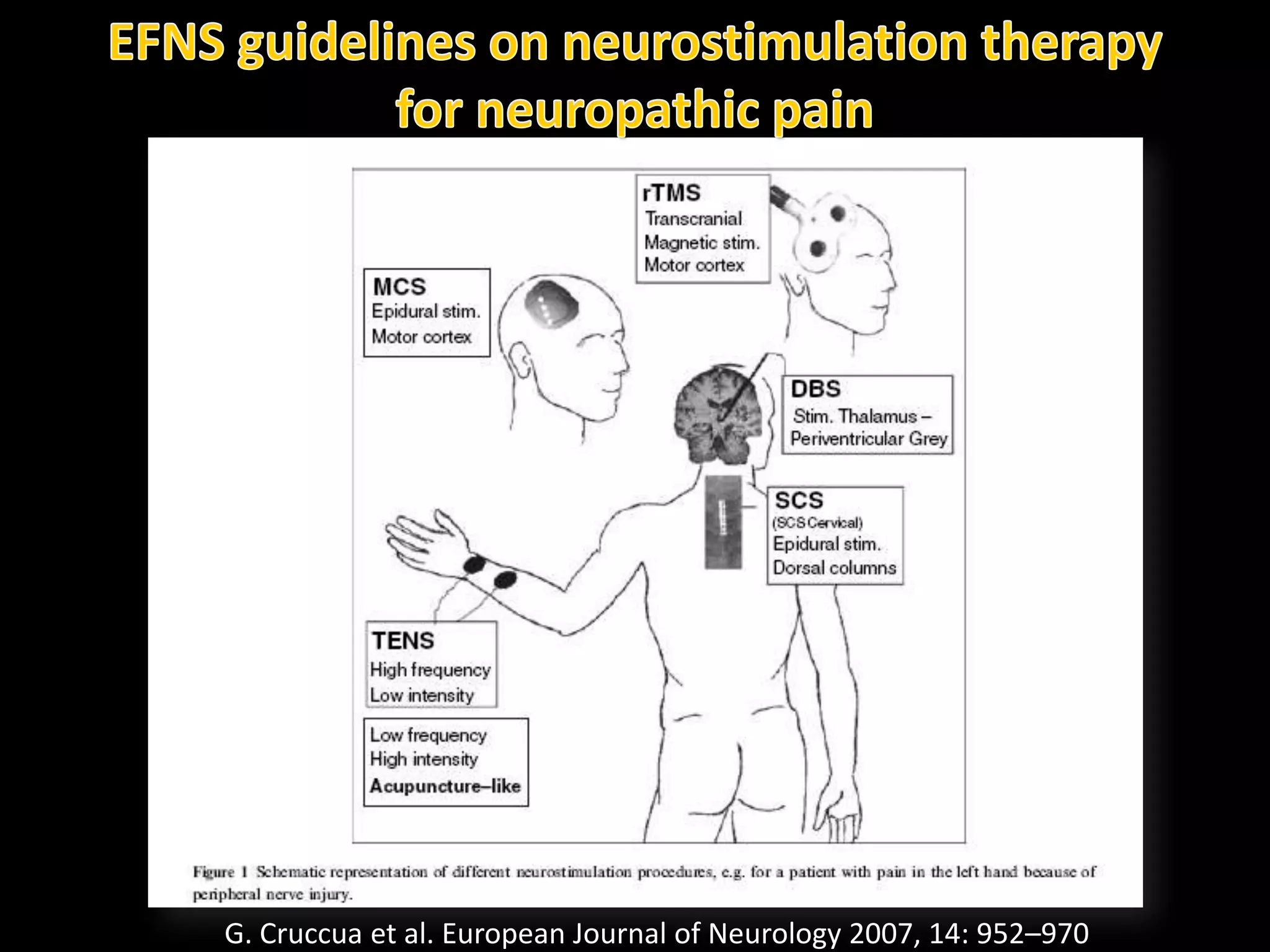
Use of Repetitive Transcranial Magnetic Stimulation in chronic pain relief MCS with surgically implanted epidural in  the early 1990s with significant analgesic effects  Tsubokawa et al. Act neurochir.,52, 137-139 (1991).In the later 1990s rTMS was introduced for clinical research. Lefauchaer at all. Eletroencefalogr. Clin. Neurophysiol. 107, 92(1998).At present, 20 studies (case reports, open or controlled trials have assessed the efficacy of rTMS.  Lefaucher et al. Expert Rev. Neurotherapeutics 8 (5), 799-808 (2008).
Postoperative coronal cranial radiograph showing the 4-pole epidural electrode over the convexity of the right motor cortex.Using  PET , regional changes incerebral blood flow  in 10 patients undergoing motor cortex stimulation for pain controlShowing regions with significant  CBF increases during motor cortex stimulation. Note the absence of any significant CBF change in the right motor or somatosensory cortices directly underlying the stimulator G. Larreat al, Pain 83 (1999) 259±273. Functional Neurology Unit, Claude Bernard University, Lyon, France
Five patients underwent MCS in which functional imaging guidance was used. Trial periods of stimulation successfully reduced pain in three of the five patients who then underwent permanent internal placement of the system. At a mean 6-month follow up, these patients reported an average reduction in pain of 55% on a visual analog scale.Left: Photograph showing the permanent electrode sutured to the dura. Right: Lateral radiograph demonstrating the craniotomy and final electrode placement.ALON Y. MOGILNER at all. Neurosurg Focus 11 (3):Article 4, 2001.Department of Neurosurgery, New York Medical College, Valhalla, end Department of Neurosurgery, Cleveland Clinic Foundation, Cleveland, Ohio
Postoperative Left Prefrontal rTMS Reduces Patient controlled Analgesia Use Jeffrey J. Borckardt at all Anesthesiology 2006; 105:557–62. Medical University of South CarolinaPhoto of  TMS motor threshold assessment in the postanesthesia care unit. Dr. Weinstein (left) supports the patient’s right wrist to allow free movement of thumb and fingers. Dr. Borckardt (middle) positions the coil over the motor cortex and locates the area corresponding with abductor pollicisbrevis (APB). Neil Shelly (right) runs the Parameter Estimation by Sequential Testing and adjusts the TMS machine output to the specified levels until the amount of TMS output is determined that is necessary to cause visible thumb movement 50% of the time
Postoperative Left Prefrontal rTMS Reduces Patient controlled Analgesia Use  Jeffrey J. Borckardt et all. Anesthesiology 2006; 105:557–62. Department of Psychiatry andBehavioral Sciences, Medical University of South CarolinaMethods: Twenty gastric bypass surgery patients were randomly assigned to receive 20 min of either active or sham immediately after surgery. PCA pump use was trackedResults: Active rTMS was associated with a 40% reduction in total morphine use compared with sham during the 44 h after surgery. The effect seemed to be most prominent during the first 24 h after cortical stimulation delivery. No effects were observed for r TMS on mood ratingsConclusions: A single session of postoperative prefrontal rTMS was associated with a reduction in PCA pump use in gastric bypass surgery patients. This is important because the risks associated with postoperative morphine use are high, especially among obese patients who frequently have obstructive sleep apnea, right ventricular dysfunction, and pulmonary hypertension. These preliminary findings suggest a potential new noninvasive method for managing postoperative morphine use.
Motor cortex rTMS restores defective intracortical inhibition in chronic neuropathic pain.                                                J.P. Lefaucheur et al.  NEUROLOGY 2006;67:1568–1574. Departments of Physiology  and Neurosurgery , Hopital Henri Mondor, Assistance Publique - Hopitaux de Paris, Faculte de Médecine de Créteil, France.Effects of unilateral repetitive transcranial magnetic stimulation of the motor cortex on chronic widespread pain in fibromyalgia.                                                                                                                               A. Passard et al. Brain (2007), 130, 2661-2670. Universite Versailles-Saint-Quentin, Versailles, FranceSomatotopic organization of the analgesic effects of motor cortex rTMS in neuropathic pain.                                     J.P. Lefaucheur at al. NEUROLOGY 2006;67:1998–2004. Departments of Physiology  and Neurosurgery , Hopital Henri Mondor, Assistance Publique - Hopitaux de Paris, Faculte de Médecine de Créteil, France
Expert reviews 2007Recent advances in the treatment of chronic pain with non-invasive brain stimulation techniquesFelipe Fregni, Steven Freedman, Alvaro Pascual-LeoneLancet Neurol 2007; 6: 188–91  Center for Non-invasive Brain - Harvard Medical School, BostonConclusionsnew and rapidly developing field
optimistic that, in the future, rTMS might become new therapeutic options for patients with chronic pain.
New studies investigating other parameters as well as compare the effects of drugsExpert reviews 2008The use of repetitive transcranial magnetic stimulation in pain reliefJean Pascal Lefaucher Expert Rev. Neurotherapeutics 8 (5), 799-808 (2008) - Hospital Henri MondorConclusionsMotor cortex rTMS applied focally (figure of eight) at high rate (5-20Hz) for at least 1000 pulses  relieves neuropathic pain significantly compared with sham

Transcranial Magnetic Stimulation ( TMS) for Chronic Pain

  • 1.
    TMS - TranscranialMagneticStimulation for Chronic PainRafael Higashi, MDDepartment of Neurology- Clínica HigashiRio de Janeiro - Brazilwww.estimulacaoneurologica.com.br
  • 2.
    Department of NeurologyMarcilio Dias Navy Hospital – Rio de Janeiro - Brazil
  • 3.
  • 4.
    Aldini. Frankenstein, MaryWollstonecraft Shelley (1797-1851)Luigi Rolando (1773-1831), pioneered in cerebral electrical stimulation (1809) in vivo animals Rolando or central fissureExperiments: stimulation of nerves and muscles by Luigi Galvani in 1786 - voltaic
  • 5.
    Basic PrinciplesI(t)/ImaxTempo-msVoltageuntil 3kVCurrents (discharge of capacitor)- 4-8kA Energy reserve 500J500 J /100 S Magnetic fieldEletrical current in the cerebral cortex eletrical currentMainUnitBobbin
  • 6.
    Basic PrinciplesMagnetic fieldgenerate Current induction TMS bobbin
  • 7.
    Eletrical Current Inductionin The Cerebral Cortex Frequency
  • 8.
  • 9.
    Location ofthe stimulusDependent Effect of Estimulation Frequency Frequency = less or = 1 Hz – inibitionFrequency = more or = 1 Hz – facilitation placebo – no difference in cerebral activity 1 Hz – decreasing in cerebral activityFrequency rTMS20 Hz –increasing in cerebral activityDifference (%) evocado potential in the motor cortex pré/pósrTMS
  • 10.
  • 11.
    Behavior and MotorEffects in Distant Areas TMSMotor improvement stimulating contralateral motor areaA Sham-Controlled Trial of a 5-Day Course of Repetitive Transcranial Magnetic Stimulation of the Unaffected Hemisphere in Stroke PatientsFelipe Fregni et al. Stroke. 2006;37:2115-2122.Harvard Center for Non-Invasive Brain Stimulation, Beth Israel Deaconess Medical Center, Harvard Medical School, BostonUniversity of Sao Paulo, Sao Paulo, Brazil
  • 12.
    rTMSSpecific points Howto localize this point?PFMC – (depression)motor point threshold(pain chronic)5 cm
  • 13.
    rTMSSpecific pointsPFMC (depression)motor point threshold(Chronic Pain)
  • 14.
    A review ofthe safety of repetitive transcranial magnetic stimulation as a clinical treatment for depressionRisk of seizure (0.1–0.6%) comparable with antidepressant therapy
  • 15.
    hearing loss (earplugs)
  • 16.
    Mild headache( 28% of subjects experienced headache x 16% sham )
  • 17.
    Psychiatric complications:hypomanic (transient)International Journal of Neuropsychopharmacology (2008), 11, 131–147. Colleen K. Loo et al. School of Psychiatry, University of New South Wales, Sydney, Australia
  • 18.
    Mechanism of Action Neurotransmittor release Long-term potentiation – increasing receptorsGenetic induction Effects (long term):Synaptic Connection Improvement Ions induction and others substances locally rTMSimmediate effectCerebral cortexCerebral cortex
  • 19.
    Use of RepetitiveTranscranial Magnetic Stimulation in chronic pain relief MCS with surgically implanted epidural in the early 1990s with significant analgesic effects Tsubokawa et al. Act neurochir.,52, 137-139 (1991).In the later 1990s rTMS was introduced for clinical research. Lefauchaer at all. Eletroencefalogr. Clin. Neurophysiol. 107, 92(1998).At present, 20 studies (case reports, open or controlled trials have assessed the efficacy of rTMS. Lefaucher et al. Expert Rev. Neurotherapeutics 8 (5), 799-808 (2008).
  • 20.
    Postoperative coronal cranialradiograph showing the 4-pole epidural electrode over the convexity of the right motor cortex.Using PET , regional changes incerebral blood flow in 10 patients undergoing motor cortex stimulation for pain controlShowing regions with significant CBF increases during motor cortex stimulation. Note the absence of any significant CBF change in the right motor or somatosensory cortices directly underlying the stimulator G. Larreat al, Pain 83 (1999) 259±273. Functional Neurology Unit, Claude Bernard University, Lyon, France
  • 21.
    Five patients underwentMCS in which functional imaging guidance was used. Trial periods of stimulation successfully reduced pain in three of the five patients who then underwent permanent internal placement of the system. At a mean 6-month follow up, these patients reported an average reduction in pain of 55% on a visual analog scale.Left: Photograph showing the permanent electrode sutured to the dura. Right: Lateral radiograph demonstrating the craniotomy and final electrode placement.ALON Y. MOGILNER at all. Neurosurg Focus 11 (3):Article 4, 2001.Department of Neurosurgery, New York Medical College, Valhalla, end Department of Neurosurgery, Cleveland Clinic Foundation, Cleveland, Ohio
  • 22.
    Postoperative Left PrefrontalrTMS Reduces Patient controlled Analgesia Use Jeffrey J. Borckardt at all Anesthesiology 2006; 105:557–62. Medical University of South CarolinaPhoto of TMS motor threshold assessment in the postanesthesia care unit. Dr. Weinstein (left) supports the patient’s right wrist to allow free movement of thumb and fingers. Dr. Borckardt (middle) positions the coil over the motor cortex and locates the area corresponding with abductor pollicisbrevis (APB). Neil Shelly (right) runs the Parameter Estimation by Sequential Testing and adjusts the TMS machine output to the specified levels until the amount of TMS output is determined that is necessary to cause visible thumb movement 50% of the time
  • 23.
    Postoperative Left PrefrontalrTMS Reduces Patient controlled Analgesia Use Jeffrey J. Borckardt et all. Anesthesiology 2006; 105:557–62. Department of Psychiatry andBehavioral Sciences, Medical University of South CarolinaMethods: Twenty gastric bypass surgery patients were randomly assigned to receive 20 min of either active or sham immediately after surgery. PCA pump use was trackedResults: Active rTMS was associated with a 40% reduction in total morphine use compared with sham during the 44 h after surgery. The effect seemed to be most prominent during the first 24 h after cortical stimulation delivery. No effects were observed for r TMS on mood ratingsConclusions: A single session of postoperative prefrontal rTMS was associated with a reduction in PCA pump use in gastric bypass surgery patients. This is important because the risks associated with postoperative morphine use are high, especially among obese patients who frequently have obstructive sleep apnea, right ventricular dysfunction, and pulmonary hypertension. These preliminary findings suggest a potential new noninvasive method for managing postoperative morphine use.
  • 24.
    Motor cortex rTMSrestores defective intracortical inhibition in chronic neuropathic pain. J.P. Lefaucheur et al. NEUROLOGY 2006;67:1568–1574. Departments of Physiology and Neurosurgery , Hopital Henri Mondor, Assistance Publique - Hopitaux de Paris, Faculte de Médecine de Créteil, France.Effects of unilateral repetitive transcranial magnetic stimulation of the motor cortex on chronic widespread pain in fibromyalgia. A. Passard et al. Brain (2007), 130, 2661-2670. Universite Versailles-Saint-Quentin, Versailles, FranceSomatotopic organization of the analgesic effects of motor cortex rTMS in neuropathic pain. J.P. Lefaucheur at al. NEUROLOGY 2006;67:1998–2004. Departments of Physiology and Neurosurgery , Hopital Henri Mondor, Assistance Publique - Hopitaux de Paris, Faculte de Médecine de Créteil, France
  • 25.
    Expert reviews 2007Recentadvances in the treatment of chronic pain with non-invasive brain stimulation techniquesFelipe Fregni, Steven Freedman, Alvaro Pascual-LeoneLancet Neurol 2007; 6: 188–91 Center for Non-invasive Brain - Harvard Medical School, BostonConclusionsnew and rapidly developing field
  • 26.
    optimistic that, inthe future, rTMS might become new therapeutic options for patients with chronic pain.
  • 27.
    New studies investigatingother parameters as well as compare the effects of drugsExpert reviews 2008The use of repetitive transcranial magnetic stimulation in pain reliefJean Pascal Lefaucher Expert Rev. Neurotherapeutics 8 (5), 799-808 (2008) - Hospital Henri MondorConclusionsMotor cortex rTMS applied focally (figure of eight) at high rate (5-20Hz) for at least 1000 pulses relieves neuropathic pain significantly compared with sham
  • 28.
    Repeated dailyrTMS prolong the effects
  • 29.
    More efficientwhen applied in an area adjacent to the cortical representation of the painful zone
  • 30.
    Positive responsecould predict a positive outcome of surgically implanted epidural electrodesEFNS guidelines on neurostimulation therapy for neuropathic painG. Cruccua et al. European Journal of Neurology 2007, 14: 952–970
  • 31.
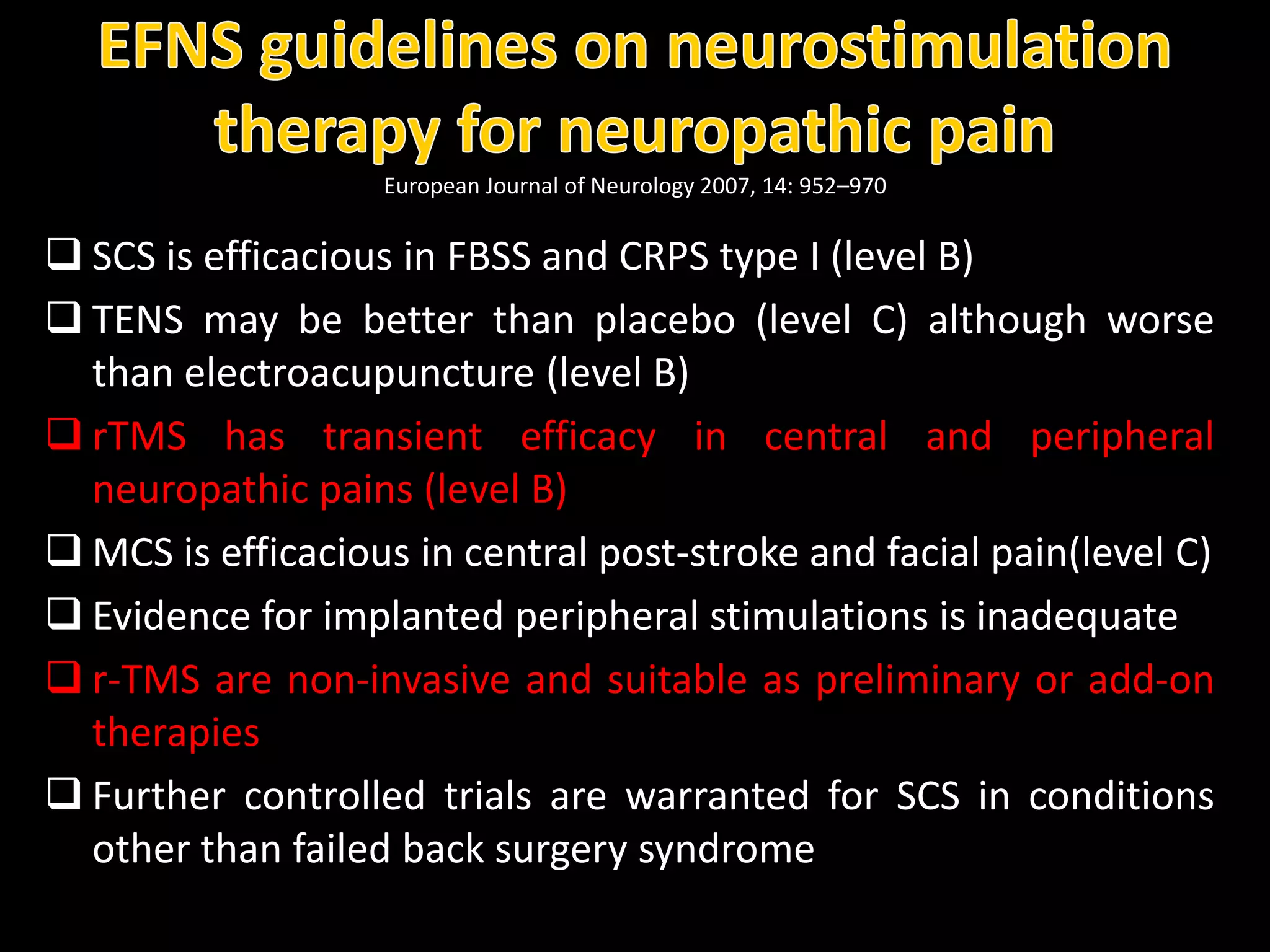
    EFNS guidelines onneurostimulation therapy for neuropathic pain European Journal of Neurology 2007, 14: 952–970SCS is efficacious in FBSS and CRPS type I (level B)
  • 32.
    TENS may bebetter than placebo (level C) although worse than electroacupuncture (level B)
  • 33.
    rTMS has transientefficacy in central and peripheral neuropathic pains (level B)
  • 34.
    MCS is efficaciousin central post-stroke and facial pain(level C)
  • 35.
    Evidence for implantedperipheral stimulations is inadequate
  • 36.
    r-TMS are non-invasiveand suitable as preliminary or add-on therapies
  • 37.
    Further controlled trialsare warranted for SCS in conditions other than failed back surgery syndrome Rio de Janeiro, Brazil (morning)
  • 38.
    Rio de Janeiro,Brazil (night)
  • 39.