Transaction
Management
Transactio
n
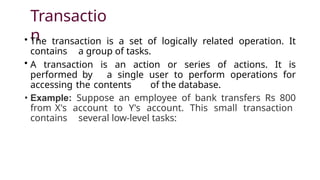
• The transaction is a set of logically related operation. It
contains a group of tasks.
• A transaction is an action or series of actions. It is
performed by a single user to perform operations for
accessing the contents of the database.
• Example: Suppose an employee of bank transfers Rs 800
from X's account to Y's account. This small transaction
contains several low-level tasks:
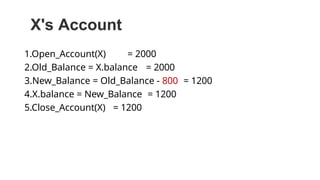
X's Account
1.Open_Account(X) = 2000
2.Old_Balance = X.balance = 2000
3.New_Balance = Old_Balance - 800 = 1200
4.X.balance = New_Balance = 1200
5.Close_Account(X) = 1200
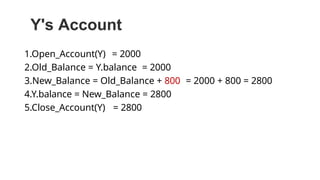
Y's Account
1.Open_Account(Y) = 2000
2.Old_Balance = Y.balance = 2000
3.New_Balance = Old_Balance + 800 = 2000 + 800 = 2800
4.Y.balance = New_Balance = 2800
5.Close_Account(Y) = 2800
Operations of Transaction:
• Read(X): Read operation is used to read the value of X from
the database and stores it in a buffer in main memory.
• Write(X): Write operationis used to write the value back to
the database from the buffer.
• Let's take an example to debit transaction from an account
which consists of following operations:
1.1. R(X); X = 4000
2.2. X = X - 500; 4000 – 500 = 3500
3.3. W(X); = 3500
• Let's assume the value of X before starting of the
transaction is 4000.
• The first operation reads X's value from database and
stores it in a buffer.
• The second operation will decrease the value of X by 500.
So buffer will contain 3500.
• The third operation will write the buffer's value to the
database. So X's final value will be 3500.
• But it may be possible that because of the failure of
hardware, software or power, etc. that transaction may fail
before finished all the operations in the set.
• For example: If in the above transaction, the debit
transaction fails after executing operation 2 then X's
value will remain 4000 in the database which is not
acceptable by the bank.
To solve this problem, we have two important operations:
• Commit: It is used to save the work done permanently.
• Rollback: It is used to undo the work done.
Transaction
property
The transaction has four properties. These are used
to maintain consistency in a database, before and
after the transaction.
Property of Transaction: ACID Properties
1. Atomicity
2. Consistency
3. Isolation
4. Durability
Atomicit
y
• It states that all operations of the transaction take place at
once if not, the transaction is aborted.
• There is no midway, i.e., the transaction cannot occur
partially. Each transaction is treated as one unit and
either run to completion or is not executed at all.
• Atomicity involves the following two operations:
• Abort: If a transaction aborts then all the changes made are
not visible.
• Commit: If a transaction commits then all the changes
made are visible.
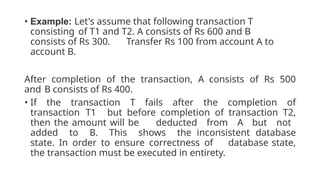
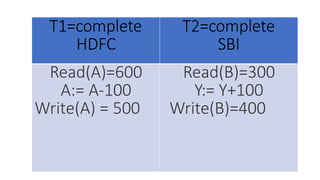
• Example: Let's assume that following transaction T
consisting of T1 and T2. A consists of Rs 600 and B
consists of Rs 300. Transfer Rs 100 from account A to
account B.
After completion of the transaction, A consists of Rs 500
and B consists of Rs 400.
• If the transaction T fails after the completion of
transaction T1 but before completion of transaction T2,
then the amount will be deducted from A but not
added to B. This shows the inconsistent database
state. In order to ensure correctness of database state,
the transaction must be executed in entirety.
T1=complete
HDFC
T2=complete
SBI
Read(A)=600
A:= A-100
Write(A) = 500
Read(B)=300
Y:= Y+100
Write(B)=400
Consistenc
y
• The integrity constraints are maintained so that the
database is consistent before and after the transaction.
• The execution of a transaction will leave a database in either
its prior stable state or a new stable state.
• The consistent property of database states that
every transaction sees a consistent database instance.
• The transaction is used to transformthe database from
one consistent state to another consistent state.
For example: The total amountmust be maintainedbefore
or after the transaction.
1.Total before T occurs = 600+300=900
2.Total after T occurs= 500+400=900
Therefore, the database is consistent. In the case when T1
is completed but T2 fails, then inconsistency will occur.
Isolation
• It shows that the data which is used at the time of execution
of a transaction cannot be used by the second transaction
until the first one is completed.
• In isolation, if the transaction T1 is being executed and
using the data item X, then that data item can't be
accessed by any other transaction T2 until the
transaction T1 ends.
• The concurrency control subsystem of the DBMS enforced
the isolation property.
Durability
• The durability property is used to indicate the
performance of the database's consistent state. It states
that the transaction made the permanent changes.
• They cannot be lost by the erroneous operation of a
faulty transaction or by the system failure. When a
transaction is completed, then the database reaches a
state known as the consistent state. That consistent
state cannot be lost, even in the event of a system's
failure.
• The recovery subsystem of the DBMS has the responsibility
of Durability property.
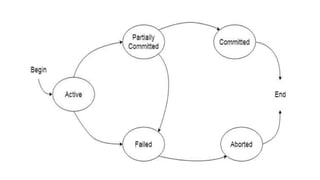
States of Transaction
• In a database, the transactioncan be in one of the
following states -
Active state
•The active state is the first state of
every transaction. In this state, the
transaction is being executed.
•For example: Insertion or deletion
or updating a record is done here. But
all the records are still not saved to the
database.
Partially committed
• In the partially committedstate, a transaction executes its
final operation, but the data is still not saved to the
database.
• In the total mark calculation example, a final display of the
total marks step is executed in this state.
Committed
• A transaction is said to be in a committed state if it executes
all its operations successfully. In this state, all the effects
are now permanently saved on the database system.
Failed state
• If any of the checks made by the database recovery
system fails, then the transaction is said to be in the
failed state.
• In the example of total mark calculation, if the database is
not able to fire a query to fetch the marks, then the
transaction will fail to execute.
Aborte
d
• If any of the checks fail and the transaction has reached a
failed state then the database recovery system will
make sure that the database is in its previous consistent
state. If not then it will abort or roll back the
transaction to bring the database into a consistent state.
• If the transaction fails in the middle of the transaction
then before executing the transaction, all the executed
transactions are rolled back to its consistent state.
• After aborting the transaction, the database recovery
module will select one of the two operations:
1.Re-start the transaction
2.Kill the transaction
Schedul
e
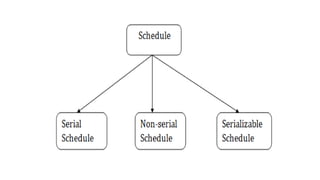
• A series of operation from one transaction to
another transaction is known as schedule. It is used to
preserve the order of the operation in each of the
individual transaction.
Serial
Schedule
• The serial schedule is a type of schedule where one
transaction is
executed completely before starting another transaction. In the
serial
schedule, when the first transaction completes its cycle, then
the next transaction is executed.
• For example: Suppose there are two transactions T1 and T2
which
have some operations.If it has no interleavingof operations,
then there are the following two possible outcomes:
1. Execute all the operations of T1 which was followed by all
the operations of T2.
2. Execute all the operations of T1 which was followed by all
the operations of T2.
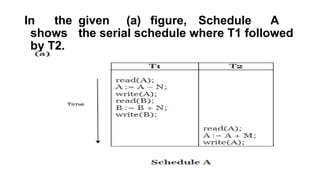
• In the given (a) figure, Schedule A shows the serial schedule
where T1 followed by T2.
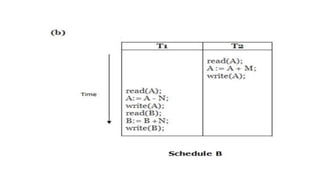
• In the given (b) figure, Schedule B shows the serial schedule
In the given (a) figure, Schedule A
shows the serial schedule where T1 followed
by T2.
Non-serial Schedule
• If interleaving of operations is allowed, then there will be
non- serial schedule.
• It contains many possible orders in which the system
can execute the individual operations of the
transactions.
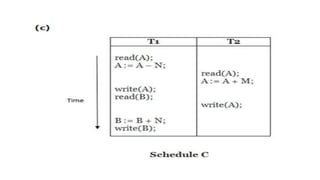
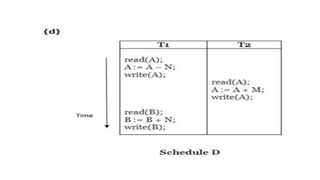
• In the given figure (c) and (d), Schedule C and Schedule D
are the non-serial schedules. It has interleaving of
operations.
Serializable schedule
• The serializability of schedules is used to find non-
serial schedules that allow the transaction to
execute concurrently without interfering with one another.
• It identifies which schedules are correct when executions of
the transaction have interleaving of their operations.
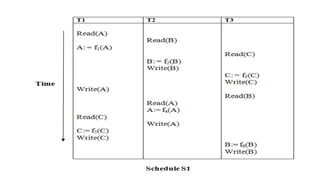
• A non-serial schedule will be serializable if its result is equal
to the result of its transactions executed serially.
transactionprocessing-220423112118 (1).pptx

transactionprocessing-220423112118 (1).pptx

  • 1.
  • 2.
    Transactio n • The transactionis a set of logically related operation. It contains a group of tasks. • A transaction is an action or series of actions. It is performed by a single user to perform operations for accessing the contents of the database. • Example: Suppose an employee of bank transfers Rs 800 from X's account to Y's account. This small transaction contains several low-level tasks:
  • 3.
    X's Account 1.Open_Account(X) =2000 2.Old_Balance = X.balance = 2000 3.New_Balance = Old_Balance - 800 = 1200 4.X.balance = New_Balance = 1200 5.Close_Account(X) = 1200
  • 4.
    Y's Account 1.Open_Account(Y) =2000 2.Old_Balance = Y.balance = 2000 3.New_Balance = Old_Balance + 800 = 2000 + 800 = 2800 4.Y.balance = New_Balance = 2800 5.Close_Account(Y) = 2800
  • 5.
    Operations of Transaction: •Read(X): Read operation is used to read the value of X from the database and stores it in a buffer in main memory. • Write(X): Write operationis used to write the value back to the database from the buffer. • Let's take an example to debit transaction from an account which consists of following operations: 1.1. R(X); X = 4000 2.2. X = X - 500; 4000 – 500 = 3500 3.3. W(X); = 3500
  • 6.
    • Let's assumethe value of X before starting of the transaction is 4000. • The first operation reads X's value from database and stores it in a buffer. • The second operation will decrease the value of X by 500. So buffer will contain 3500. • The third operation will write the buffer's value to the database. So X's final value will be 3500. • But it may be possible that because of the failure of hardware, software or power, etc. that transaction may fail before finished all the operations in the set.
  • 7.
    • For example:If in the above transaction, the debit transaction fails after executing operation 2 then X's value will remain 4000 in the database which is not acceptable by the bank. To solve this problem, we have two important operations: • Commit: It is used to save the work done permanently. • Rollback: It is used to undo the work done.
  • 8.
    Transaction property The transaction hasfour properties. These are used to maintain consistency in a database, before and after the transaction. Property of Transaction: ACID Properties 1. Atomicity 2. Consistency 3. Isolation 4. Durability
  • 9.
    Atomicit y • It statesthat all operations of the transaction take place at once if not, the transaction is aborted. • There is no midway, i.e., the transaction cannot occur partially. Each transaction is treated as one unit and either run to completion or is not executed at all. • Atomicity involves the following two operations: • Abort: If a transaction aborts then all the changes made are not visible. • Commit: If a transaction commits then all the changes made are visible.
  • 10.
    • Example: Let'sassume that following transaction T consisting of T1 and T2. A consists of Rs 600 and B consists of Rs 300. Transfer Rs 100 from account A to account B. After completion of the transaction, A consists of Rs 500 and B consists of Rs 400. • If the transaction T fails after the completion of transaction T1 but before completion of transaction T2, then the amount will be deducted from A but not added to B. This shows the inconsistent database state. In order to ensure correctness of database state, the transaction must be executed in entirety.
  • 11.
  • 12.
    Consistenc y • The integrityconstraints are maintained so that the database is consistent before and after the transaction. • The execution of a transaction will leave a database in either its prior stable state or a new stable state. • The consistent property of database states that every transaction sees a consistent database instance. • The transaction is used to transformthe database from one consistent state to another consistent state.
  • 13.
    For example: Thetotal amountmust be maintainedbefore or after the transaction. 1.Total before T occurs = 600+300=900 2.Total after T occurs= 500+400=900 Therefore, the database is consistent. In the case when T1 is completed but T2 fails, then inconsistency will occur.
  • 14.
    Isolation • It showsthat the data which is used at the time of execution of a transaction cannot be used by the second transaction until the first one is completed. • In isolation, if the transaction T1 is being executed and using the data item X, then that data item can't be accessed by any other transaction T2 until the transaction T1 ends. • The concurrency control subsystem of the DBMS enforced the isolation property.
  • 15.
    Durability • The durabilityproperty is used to indicate the performance of the database's consistent state. It states that the transaction made the permanent changes. • They cannot be lost by the erroneous operation of a faulty transaction or by the system failure. When a transaction is completed, then the database reaches a state known as the consistent state. That consistent state cannot be lost, even in the event of a system's failure. • The recovery subsystem of the DBMS has the responsibility of Durability property.
  • 16.
    States of Transaction •In a database, the transactioncan be in one of the following states -
  • 18.
    Active state •The activestate is the first state of every transaction. In this state, the transaction is being executed. •For example: Insertion or deletion or updating a record is done here. But all the records are still not saved to the database.
  • 19.
    Partially committed • Inthe partially committedstate, a transaction executes its final operation, but the data is still not saved to the database. • In the total mark calculation example, a final display of the total marks step is executed in this state.
  • 20.
    Committed • A transactionis said to be in a committed state if it executes all its operations successfully. In this state, all the effects are now permanently saved on the database system.
  • 21.
    Failed state • Ifany of the checks made by the database recovery system fails, then the transaction is said to be in the failed state. • In the example of total mark calculation, if the database is not able to fire a query to fetch the marks, then the transaction will fail to execute.
  • 22.
    Aborte d • If anyof the checks fail and the transaction has reached a failed state then the database recovery system will make sure that the database is in its previous consistent state. If not then it will abort or roll back the transaction to bring the database into a consistent state. • If the transaction fails in the middle of the transaction then before executing the transaction, all the executed transactions are rolled back to its consistent state. • After aborting the transaction, the database recovery module will select one of the two operations: 1.Re-start the transaction 2.Kill the transaction
  • 23.
    Schedul e • A seriesof operation from one transaction to another transaction is known as schedule. It is used to preserve the order of the operation in each of the individual transaction.
  • 25.
    Serial Schedule • The serialschedule is a type of schedule where one transaction is executed completely before starting another transaction. In the serial schedule, when the first transaction completes its cycle, then the next transaction is executed. • For example: Suppose there are two transactions T1 and T2 which have some operations.If it has no interleavingof operations, then there are the following two possible outcomes: 1. Execute all the operations of T1 which was followed by all the operations of T2. 2. Execute all the operations of T1 which was followed by all the operations of T2. • In the given (a) figure, Schedule A shows the serial schedule where T1 followed by T2. • In the given (b) figure, Schedule B shows the serial schedule
  • 26.
    In the given(a) figure, Schedule A shows the serial schedule where T1 followed by T2.
  • 28.
    Non-serial Schedule • Ifinterleaving of operations is allowed, then there will be non- serial schedule. • It contains many possible orders in which the system can execute the individual operations of the transactions. • In the given figure (c) and (d), Schedule C and Schedule D are the non-serial schedules. It has interleaving of operations.
  • 29.
    Serializable schedule • Theserializability of schedules is used to find non- serial schedules that allow the transaction to execute concurrently without interfering with one another. • It identifies which schedules are correct when executions of the transaction have interleaving of their operations. • A non-serial schedule will be serializable if its result is equal to the result of its transactions executed serially.