TRACCS: Trajectory-Aware Coordinated Urban
Crowd-Sourcing
Cen Chen and Shih-Fen Cheng and Aldy Gunawan and Archan Misra
School of Information Systems Singapore Management University
Koustuv Dasgupta and Deepthi Chander
Xerox Research Centre India
Presentater: Xinyang Li
2/13/2015
What is the problem to be analyzed?
Large-scale mobile crowd-tasking
A large pool of citizen crowd-
workers are used to perform a
variety of location-specific
urban logistics tasks.
Why should we care about and what we can
learn from?
● Revenue
○ To maximize the total payoff from all assigned tasks for workers.
● Cost
○ Reduce the detour (from the expected path) that a worker will
experience to complete assigned tasks.
We can learn about the optimization method to balance the revenue and cost.
A quick view of paper
● Method
o Decentralized → Centralized
o Instantaneous timestamp →
Wider time horizon (location
point V.S. location trajectory)
o Optimization Problem
● Contribution
o Capture diverse optimization
objects precisely
o Handle city-scale tasks
Comparation
Compare with
centralized algorithm
● Increase revenue of
assigned tasks >
20% by increasing
the task completion
ratio.
Comparation
Compare with
centralized algorithm
● Reduce the average
detour overhead by
> 60%
Comparation
Compare with decentralized
algorithm
● The task completion ratio of
decentralized is significantly
lower than Greedy+ILS
Model Details
Notations:
● N is set of all nodes. Nt is task node.
● M is set of all workers(agents).
● ti,j is traveling time from i to j.
● st is reward.
● Rm is the set of routine nodes of agent m.
● pi
m is itended visit sequence of Rm.
Model Details
Greedy Construction Heuristic
The main goal of Greedy is to let
every agent carry high-value tasks as
much as possible.
Model Details
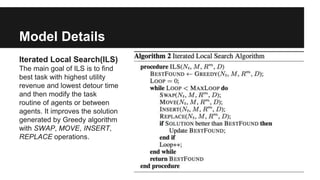
Iterated Local Search(ILS)
The main goal of ILS is to find
best task with highest utility
revenue and lowest detour time
and then modify the task
routine of agents or between
agents. It improves the solution
generated by Greedy algorithm
with SWAP, MOVE, INSERT,
REPLACE operations.
Main Results
Conclusions
● Greedy+ILS heuristic is able to assign over 85-90% of the total tasks with
detours threshold no higher than 10%.
● Centrally-coordinated heuristics significantly outperform the present
Myopic approach of independent, achieving 20% or higher task
assignment rates, and reducing the average detour overhead by 60% or
higher.
©Xinyang Li University at Buffalo
Appreaciate
your attendance
Happy Valentine’s Day and Chinese New Year

TRACCS presentation

  • 1.
    TRACCS: Trajectory-Aware CoordinatedUrban Crowd-Sourcing Cen Chen and Shih-Fen Cheng and Aldy Gunawan and Archan Misra School of Information Systems Singapore Management University Koustuv Dasgupta and Deepthi Chander Xerox Research Centre India Presentater: Xinyang Li 2/13/2015
  • 2.
    What is theproblem to be analyzed? Large-scale mobile crowd-tasking A large pool of citizen crowd- workers are used to perform a variety of location-specific urban logistics tasks.
  • 3.
    Why should wecare about and what we can learn from? ● Revenue ○ To maximize the total payoff from all assigned tasks for workers. ● Cost ○ Reduce the detour (from the expected path) that a worker will experience to complete assigned tasks. We can learn about the optimization method to balance the revenue and cost.
  • 4.
    A quick viewof paper ● Method o Decentralized → Centralized o Instantaneous timestamp → Wider time horizon (location point V.S. location trajectory) o Optimization Problem ● Contribution o Capture diverse optimization objects precisely o Handle city-scale tasks
  • 5.
    Comparation Compare with centralized algorithm ●Increase revenue of assigned tasks > 20% by increasing the task completion ratio.
  • 6.
    Comparation Compare with centralized algorithm ●Reduce the average detour overhead by > 60%
  • 7.
    Comparation Compare with decentralized algorithm ●The task completion ratio of decentralized is significantly lower than Greedy+ILS
  • 8.
    Model Details Notations: ● Nis set of all nodes. Nt is task node. ● M is set of all workers(agents). ● ti,j is traveling time from i to j. ● st is reward. ● Rm is the set of routine nodes of agent m. ● pi m is itended visit sequence of Rm.
  • 9.
    Model Details Greedy ConstructionHeuristic The main goal of Greedy is to let every agent carry high-value tasks as much as possible.
  • 10.
    Model Details Iterated LocalSearch(ILS) The main goal of ILS is to find best task with highest utility revenue and lowest detour time and then modify the task routine of agents or between agents. It improves the solution generated by Greedy algorithm with SWAP, MOVE, INSERT, REPLACE operations.
  • 11.
  • 12.
    Conclusions ● Greedy+ILS heuristicis able to assign over 85-90% of the total tasks with detours threshold no higher than 10%. ● Centrally-coordinated heuristics significantly outperform the present Myopic approach of independent, achieving 20% or higher task assignment rates, and reducing the average detour overhead by 60% or higher.
  • 13.
    ©Xinyang Li Universityat Buffalo Appreaciate your attendance Happy Valentine’s Day and Chinese New Year

Editor's Notes

  • #5 Decentralized: A crowd-tasking platform usually provides each worker a set of available tasks close to the worker’s current location; and each worker then independently chooses which tasks she wants to accept the perform. Centralized: The crowd-tasking platform assigns a sequence of tasks to each worker, taking into account their expected location trajectory over a wider time horizon. Optimization Problem: so-called heuristic method, but kind of greedy algorithm, that’s why they call it Greedy-ILS. This is computationally-efficient via simulations with realistic topologies and commuting patterns. Different movement patterns can impose different types of detour constraints. And they present 2 different integer linear problem model, they are detour-with-rejoin and detour-without-retrace, to capture these diversity precisely. City-scale tasks, 1000 workers and 2000 tasks in 2 seconds.
  • #10 The remaining detour time is caculated by total time of predicted route times threshold.
  • #13 But not perfect, algorithm has to be enhanced to deal with not only addtional constraints but also more walk trajectory. But it obviously give us a idea to centrally-coordinated assign tasks not independently.