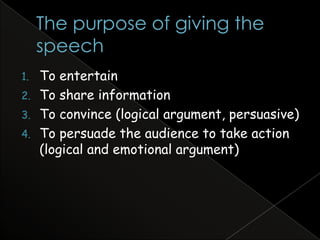
1. To entertain
2. To share information
3. To convince (logical argument, persuasive)
4. To persuade the audience to take action
   (logical and emotional argument)
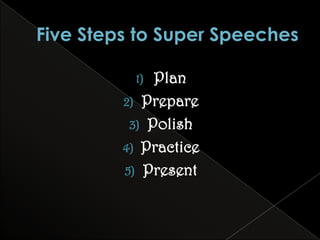
1)  Plan
2) Prepare
 3) Polish
4) Practice
5) Present
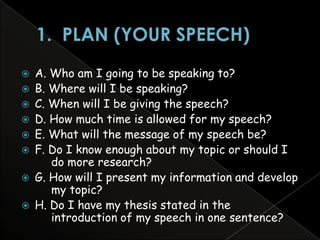
   A. Who am I going to be speaking to?
   B. Where will I be speaking?
   C. When will I be giving the speech?
   D. How much time is allowed for my speech?
   E. What will the message of my speech be?
   F. Do I know enough about my topic or should I
       do more research?
   G. How will I present my information and develop
       my topic?
   H. Do I have my thesis stated in the
       introduction of my speech in one sentence?
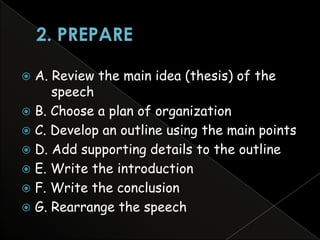
 A. Review the main idea (thesis) of the
     speech
 B. Choose a plan of organization
 C. Develop an outline using the main points
 D. Add supporting details to the outline
 E. Write the introduction
 F. Write the conclusion
 G. Rearrange the speech
 A. Time your speech
 B. Add connecting words (transitions)
 C. Review and improve your vocabulary:
 D. Prepare your outline for the teacher
 E. Prepare notecards for practicing and
     presenting
 A. Everyone must practice
 B. Decide what style you will use to
     present
 C. Set goals for each session
 D. Practice in many ways
 E. Be patient
 A. Attitude
 B. Dress for success
 C. Project confidence
 D. Prepare your materials ahead of time
 E. Use all of the skills of speaking
 F. Finish with confidence
There are no "bad" topics, but there are
     inappropriate or poorly developed ones. At
     this stage you should focus on choosing
     topic:
1.    that you have some knowledge about, or
      wish to gain knowledge about.
2.     that you care about
3.     that is appropriate for the audience and
      the setting
Training speech

Training speech

  • 2.
    1. To entertain 2.To share information 3. To convince (logical argument, persuasive) 4. To persuade the audience to take action (logical and emotional argument)
  • 3.
    1) Plan 2)Prepare 3) Polish 4) Practice 5) Present
  • 4.
    A. Who am I going to be speaking to?  B. Where will I be speaking?  C. When will I be giving the speech?  D. How much time is allowed for my speech?  E. What will the message of my speech be?  F. Do I know enough about my topic or should I do more research?  G. How will I present my information and develop my topic?  H. Do I have my thesis stated in the introduction of my speech in one sentence?
  • 5.
     A. Reviewthe main idea (thesis) of the speech  B. Choose a plan of organization  C. Develop an outline using the main points  D. Add supporting details to the outline  E. Write the introduction  F. Write the conclusion  G. Rearrange the speech
  • 6.
     A. Timeyour speech  B. Add connecting words (transitions)  C. Review and improve your vocabulary:  D. Prepare your outline for the teacher  E. Prepare notecards for practicing and presenting
  • 7.
     A. Everyonemust practice  B. Decide what style you will use to present  C. Set goals for each session  D. Practice in many ways  E. Be patient
  • 8.
     A. Attitude B. Dress for success  C. Project confidence  D. Prepare your materials ahead of time  E. Use all of the skills of speaking  F. Finish with confidence
  • 9.
    There are no"bad" topics, but there are inappropriate or poorly developed ones. At this stage you should focus on choosing topic: 1. that you have some knowledge about, or wish to gain knowledge about. 2. that you care about 3. that is appropriate for the audience and the setting