

HumanResource Management
Muhammad Abdullah
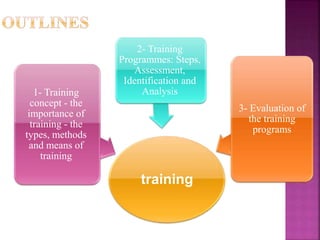
training
1- Training
concept - the
importance of
training - the
types, methods
and means of
training
2- Training
Programmes: Steps,
Assessment,
Identification and
Analysis
3- Evaluation of
the training
programs
 The main objective
Explains the role of training in raising the efficiency of
the performance of employees in the organization.
 The secondary objective
Clarification of the best modern available training
methods and types and their importance for the sake of
increasing of production and productivity.
 The main objective
Explains the role of training in raising the efficiency of
the performance of employees in the organization.
 The secondary objective
Clarification of the best modern available training
methods and types and their importance for the sake of
increasing of production and productivity.
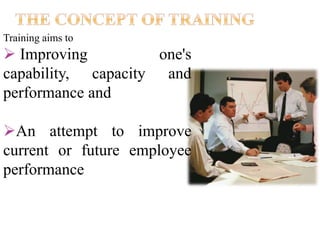
Training aims to
 Improving one's
capability, capacity and
performance and
An attempt to improve
current or future employee
performance
 Training is activity of teaching employees
particular skill, type of behavior or specifically
how to do a particular job more effectively and
efficiently.
 Training is planned process that modifies
attitude, knowledge, skills and behavior
through learning experiences to achieve
effective performance in activity or range of
activities.
McNamara (2001) lists the following as general benefits
from employee training:
 increased job satisfaction and morale
 increased motivation
 increased efficiencies in processes, resulting in financial
gain
 increased capacity to adopt new technologies and
methods
 increased innovation in strategies and products
 reduced employee turnover
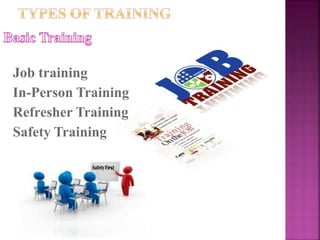
Job training
In-Person Training
Refresher Training
Safety Training
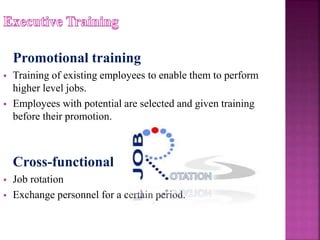
Promotional training
 Training of existing employees to enable them to perform
higher level jobs.
 Employees with potential are selected and given training
before their promotion.
Cross-functional
 Job rotation
 Exchange personnel for a certain period.
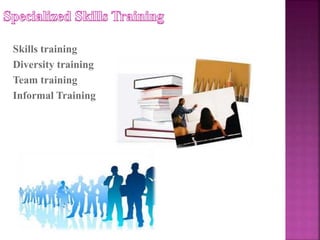
Skills training
Diversity training
Team training
Informal Training
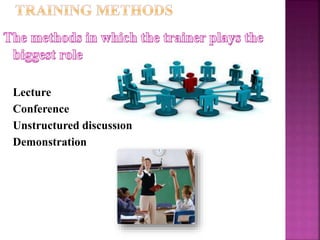
Lecture
Conference
Unstructured discussion
Demonstration
Brain storming
Open classroom
Workshop
Case study
Job rotation
Field trip
Group discussion
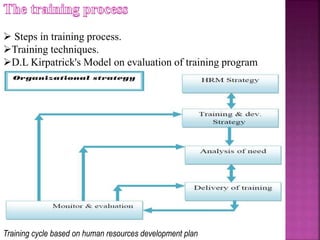
 Steps in training process.
Training techniques.
D.L Kirpatrick's Model on evaluation of training program
Training cycle based on human resources development plan

Training & Development

  • 1.
  • 2.
    training 1- Training concept -the importance of training - the types, methods and means of training 2- Training Programmes: Steps, Assessment, Identification and Analysis 3- Evaluation of the training programs
  • 3.
     The mainobjective Explains the role of training in raising the efficiency of the performance of employees in the organization.  The secondary objective Clarification of the best modern available training methods and types and their importance for the sake of increasing of production and productivity.  The main objective Explains the role of training in raising the efficiency of the performance of employees in the organization.  The secondary objective Clarification of the best modern available training methods and types and their importance for the sake of increasing of production and productivity.
  • 4.
    Training aims to Improving one's capability, capacity and performance and An attempt to improve current or future employee performance
  • 5.
     Training isactivity of teaching employees particular skill, type of behavior or specifically how to do a particular job more effectively and efficiently.  Training is planned process that modifies attitude, knowledge, skills and behavior through learning experiences to achieve effective performance in activity or range of activities.
  • 6.
    McNamara (2001) liststhe following as general benefits from employee training:  increased job satisfaction and morale  increased motivation  increased efficiencies in processes, resulting in financial gain  increased capacity to adopt new technologies and methods  increased innovation in strategies and products  reduced employee turnover
  • 7.
  • 8.
    Promotional training  Trainingof existing employees to enable them to perform higher level jobs.  Employees with potential are selected and given training before their promotion. Cross-functional  Job rotation  Exchange personnel for a certain period.
  • 9.
    Skills training Diversity training Teamtraining Informal Training
  • 10.
  • 11.
  • 12.
    Case study Job rotation Fieldtrip Group discussion
  • 13.
     Steps intraining process. Training techniques. D.L Kirpatrick's Model on evaluation of training program Training cycle based on human resources development plan