WELCOME TO
MELCHORA AQUINO HIGH
SCHOOL
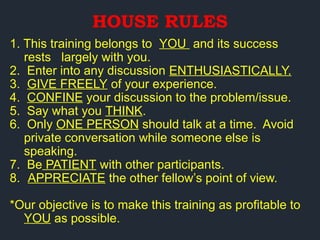
1. This training belongs to YOU and its success
rests largely with you.
2. Enter into any discussion ENTHUSIASTICALLY.
3. GIVE FREELY of your experience.
4. CONFINE your discussion to the problem/issue.
5. Say what you THINK.
6. Only ONE PERSON should talk at a time. Avoid
private conversation while someone else is
speaking.
7. Be PATIENT with other participants.
8. APPRECIATE the other fellow’s point of view.
*Our objective is to make this training as profitable to
YOU as possible.
HOUSE RULES
PRE-ASSESSMENT TOOL
QUALIFICATION
FOOD AND BEVERAGE
SERVICES NC II
TOURISM - SECTOR
FOOD AND BEVERAGE
SERVICES NC II
- is a technical-vocational program that trains
students on the preparation of food plans
and meals for restaurants, hotels, canteens,
banquets and functions, and basically any
establishment that serves food to a large
number of people.
FOOD AND BEVERAGE
SERVICES NCII
BASIC COMPETENCIES
- PARTICIPATE IN WORKPLACE COMMUNICATION
- WORK IN TEAM ENVIRONMENT
- PRACTICE CAREER PROFESSIONALISM
- PRACTICE OCCUPATIONAL HEALTH AND SAFETY
PROCEDURES
COMMON COMPETENCIES
- DEVELOP AND UPDATED INDUSTRY KNOWLEDGE
- OBSERVE WORKPLACE HYGEINE PROCEDURES
- PERFORM COMPUTER OPERATIONS
- PERFORM WORKPLACE SAFETY PRACTICES
- PROVIDE EFFECTIVE CUSTOMER SERVICE
FOOD AND BEVERAGE
SERVICES NCII
CORE COMPETENCIES
- PREPARE THE DINING ROOM/RESTAURANT AREA
FOR SERVICE
- WELCOME GUESTS AND TAKE FOOD AND
BEVERAGE ORDERS
- PROMOTE FOOD AND BEVERAGE PRODUCTS
- PROVIDE FOOD AND BEVERAGE SERVICES TO
GUESTS
- PROVIDE ROOM SERVICE
- RECEIVE AND HANDLE GUESTS CONCERNS
WHAT IS THE PURPOSE
OF YOUR TRAINING?
WHAT KIND OF
TRAINING?
What is Competency?
It is the possession and application of
knowledge, skills, attitudes and values to
perform activities to the standard expected
in the workplace.
Competency-Based
Training (CBT)
CBT is a training delivery approach
that focuses on the competency
development of the learner as a result of
the training.
Competency-Based Training…
1. emphasizes most on what the learner
can actually do;
2. focuses on outcomes rather than the
learning process within specified time;
3. is concerned with the attainment and
application of knowledge, skills and
attitude to a specific level of
competency.
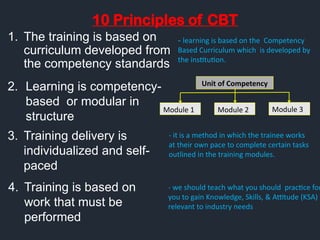
10 Principles of CBT
1. The training is based on
curriculum developed from
the competency standards
4. Training is based on
work that must be
performed
2. Learning is competency-
based or modular in
structure
Module 1 Module 2 Module 3
Unit of Competency
3. Training delivery is
individualized and self-
paced
- learning is based on the Competency
Based Curriculum which is developed by
the institution.
- it is a method in which the trainee works
at their own pace to complete certain tasks
outlined in the training modules.
- we should teach what you should practice for
you to gain Knowledge, Skills, & Attitude (KSA)
relevant to industry needs
5. Training materials are directly related to the
competency standards and the curriculum
6. Assessment of learners is based in the collection of
evidences of work performance based on industry or
organizational required standards
7. Training is based both on and off the job components
8. The system allows Recognition of Prior Learning
(RPL)
9. The system allows for learners to enter and exit
programs at different times and levels and to receive
award for competencies attained at any point.
10.Approved training programs are nationally accredited
WHO ADMINISTER THIS
TRAINING?
Role of the CBT Trainer
1. Act as a team member
2. Stimulates student’s motivation
3. Manages learning: a consultant rather than a provider of
information; a facilitator of the learning
4. Evaluates student achievement
5. Diagnose and solves learning problems
6. Assist each student in designing a personalized plan of study
7. Assist learners to obtain individualized rewards
Role of Trainee
As a trainee, you may:
1) Select what you want to learn, when you want to learn it,
within reason
2) Learn at your own rate within program guidelines. You may
speed up, slow down, stop or even repeat a task
3) Request to receive credit for what you already know
though pre-testing or review of a task list completed at
another training site
4) Choose how you want to learn-individually, one-to-one
basis, in small groups, in large groups, or with audio-
visuals
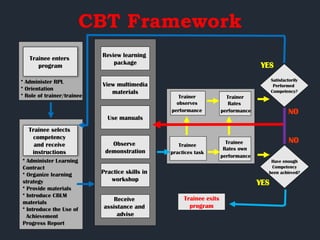
CBT Framework
Have enough
Competency
been achieved?
YES
YES
Trainee exits
program
Trainer
observes
performance
Trainee
practices task
Trainee
Rates own
performance
Trainer
Rates
performance
Trainee enters
program
• Administer RPL
• Orientation
• Role of trainer/trainee
Trainee selects
competency
and receive
instructions
• Administer Learning
Contract
• Organize learning
strategy
• Provide materials
• Introduce CBLM
materials
• Introduce the Use of
Achievement
Progress Report
Review learning
package
View multimedia
materials
Use manuals
Observe
demonstration
Practice skills in
workshop
Receive
assistance and
advise
Satisfactorily
Performed
Competency?
NO
NO
Competency-Based
Learning Material (CBLM)
A well-designed and carefully
developed learning materials that give
trainees detailed instructions to guide
them through the learning process.
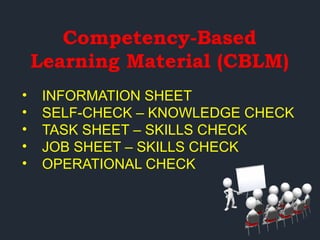
Competency-Based
Learning Material (CBLM)
• INFORMATION SHEET
• SELF-CHECK – KNOWLEDGE CHECK
• TASK SHEET – SKILLS CHECK
• JOB SHEET – SKILLS CHECK
• OPERATIONAL CHECK
HOW ARE WE GOING
TO TRACK YOUR
PROGRESS?
Tracking progress
• Training Activity Matrix – it is used to schedule
and monitor the use of the facilities and resources
needed by each trainees, it serve as a guide in
scheduling trainees in every training session
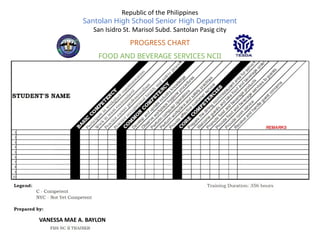
• Progress Chart – monitors student’s progress
through each competencies and learning outcomes
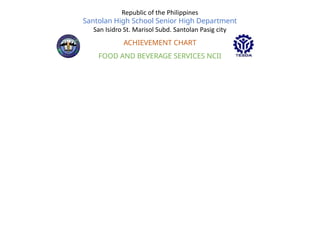
• Achievement Chart – monitors student’s progress
through required activities and tasks in the CBLM
Republic of the Philippines
Santolan High School Senior High Department
San Isidro St. Marisol Subd. Santolan Pasig city
ACHIEVEMENT CHART
FOOD AND BEVERAGE SERVICES NCII
Republic of the Philippines
Santolan High School Senior High Department
San Isidro St. Marisol Subd. Santolan Pasig city
PROGRESS CHART
FOOD AND BEVERAGE SERVICES NCII
VANESSA MAE A. BAYLON
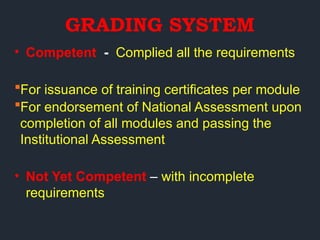
GRADING SYSTEM
• Competent - Complied all the requirements
For issuance of training certificates per module
For endorsement of National Assessment upon
completion of all modules and passing the
Institutional Assessment
• Not Yet Competent – with incomplete
requirements
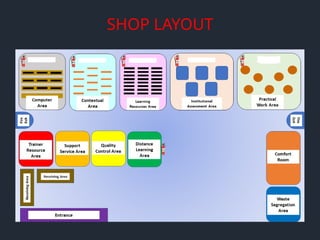
SHOP LAYOUT
QUALIFICATION
FOOD AND BEVERAGE
SERVICES NC II
TOURISM - SECTOR
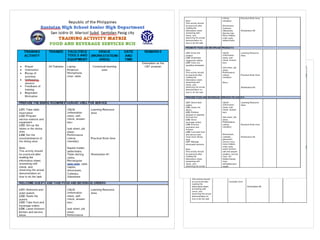
Unit of Competency #2 (TRS512388)
WELCOME GUESTS AND TAKE FOOD
AND BEVERAGE ORDERS
Learning Outcomes:
LO1 – Welcome and greet guests
LO2 – Seat the guests
LO3 – Take food and beverage orders
LO4 – Liaise between kitchen and service
areas
NOW IT’S TIME FOR DEMONSTRATION!
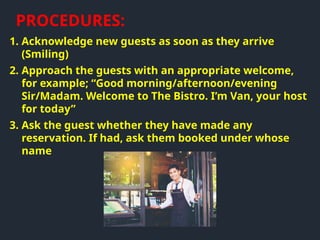
1. Acknowledge new guests as soon as they arrive
(Smiling)
2. Approach the guests with an appropriate welcome,
for example; “Good morning/afternoon/evening
Sir/Madam. Welcome to The Bistro. I’m Van, your host
for today”
3. Ask the guest whether they have made any
reservation. If had, ask them booked under whose
name
PROCEDURES:
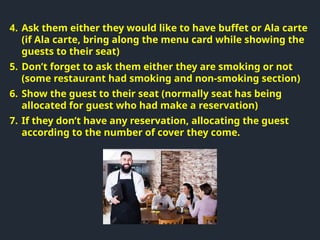
4. Ask them either they would like to have buffet or Ala carte
(if Ala carte, bring along the menu card while showing the
guests to their seat)
5. Don’t forget to ask them either they are smoking or not
(some restaurant had smoking and non-smoking section)
6. Show the guest to their seat (normally seat has being
allocated for guest who had make a reservation)
7. If they don’t have any reservation, allocating the guest
according to the number of cover they come.
NOW IT’S YOUR TIME TO DEMONSTRATE!
NOW IT’S TIME TO KNOW IF WE
LEARN THE CORES..
• YOU WILL NOW UNDERGO AN
EXAM CALLED “INSTITUTIONAL
ASSESSMENT”
- IT’S AN EVALUATION TO KNOW IF
YOU ARE READY TO TAKE THE “FOOD
AND BEVERAGE SERVICES NCII
EXAMINATION”
INSTITUTIONAL ASSESSMENT
METHODS
• Written Exams
• Demonstration
• Observation with Oral Questioning

Trainers Methodology Powerpoint Presentation

  • 1.
  • 3.
    1. This trainingbelongs to YOU and its success rests largely with you. 2. Enter into any discussion ENTHUSIASTICALLY. 3. GIVE FREELY of your experience. 4. CONFINE your discussion to the problem/issue. 5. Say what you THINK. 6. Only ONE PERSON should talk at a time. Avoid private conversation while someone else is speaking. 7. Be PATIENT with other participants. 8. APPRECIATE the other fellow’s point of view. *Our objective is to make this training as profitable to YOU as possible. HOUSE RULES
  • 4.
  • 5.
  • 6.
    FOOD AND BEVERAGE SERVICESNC II - is a technical-vocational program that trains students on the preparation of food plans and meals for restaurants, hotels, canteens, banquets and functions, and basically any establishment that serves food to a large number of people.
  • 7.
    FOOD AND BEVERAGE SERVICESNCII BASIC COMPETENCIES - PARTICIPATE IN WORKPLACE COMMUNICATION - WORK IN TEAM ENVIRONMENT - PRACTICE CAREER PROFESSIONALISM - PRACTICE OCCUPATIONAL HEALTH AND SAFETY PROCEDURES COMMON COMPETENCIES - DEVELOP AND UPDATED INDUSTRY KNOWLEDGE - OBSERVE WORKPLACE HYGEINE PROCEDURES - PERFORM COMPUTER OPERATIONS - PERFORM WORKPLACE SAFETY PRACTICES - PROVIDE EFFECTIVE CUSTOMER SERVICE
  • 8.
    FOOD AND BEVERAGE SERVICESNCII CORE COMPETENCIES - PREPARE THE DINING ROOM/RESTAURANT AREA FOR SERVICE - WELCOME GUESTS AND TAKE FOOD AND BEVERAGE ORDERS - PROMOTE FOOD AND BEVERAGE PRODUCTS - PROVIDE FOOD AND BEVERAGE SERVICES TO GUESTS - PROVIDE ROOM SERVICE - RECEIVE AND HANDLE GUESTS CONCERNS
  • 9.
    WHAT IS THEPURPOSE OF YOUR TRAINING?
  • 10.
  • 11.
    What is Competency? Itis the possession and application of knowledge, skills, attitudes and values to perform activities to the standard expected in the workplace.
  • 12.
    Competency-Based Training (CBT) CBT isa training delivery approach that focuses on the competency development of the learner as a result of the training.
  • 13.
    Competency-Based Training… 1. emphasizesmost on what the learner can actually do; 2. focuses on outcomes rather than the learning process within specified time; 3. is concerned with the attainment and application of knowledge, skills and attitude to a specific level of competency.
  • 14.
    10 Principles ofCBT 1. The training is based on curriculum developed from the competency standards 4. Training is based on work that must be performed 2. Learning is competency- based or modular in structure Module 1 Module 2 Module 3 Unit of Competency 3. Training delivery is individualized and self- paced - learning is based on the Competency Based Curriculum which is developed by the institution. - it is a method in which the trainee works at their own pace to complete certain tasks outlined in the training modules. - we should teach what you should practice for you to gain Knowledge, Skills, & Attitude (KSA) relevant to industry needs
  • 15.
    5. Training materialsare directly related to the competency standards and the curriculum 6. Assessment of learners is based in the collection of evidences of work performance based on industry or organizational required standards 7. Training is based both on and off the job components 8. The system allows Recognition of Prior Learning (RPL) 9. The system allows for learners to enter and exit programs at different times and levels and to receive award for competencies attained at any point. 10.Approved training programs are nationally accredited
  • 16.
  • 17.
    Role of theCBT Trainer 1. Act as a team member 2. Stimulates student’s motivation 3. Manages learning: a consultant rather than a provider of information; a facilitator of the learning 4. Evaluates student achievement 5. Diagnose and solves learning problems 6. Assist each student in designing a personalized plan of study 7. Assist learners to obtain individualized rewards
  • 18.
    Role of Trainee Asa trainee, you may: 1) Select what you want to learn, when you want to learn it, within reason 2) Learn at your own rate within program guidelines. You may speed up, slow down, stop or even repeat a task 3) Request to receive credit for what you already know though pre-testing or review of a task list completed at another training site 4) Choose how you want to learn-individually, one-to-one basis, in small groups, in large groups, or with audio- visuals
  • 19.
    CBT Framework Have enough Competency beenachieved? YES YES Trainee exits program Trainer observes performance Trainee practices task Trainee Rates own performance Trainer Rates performance Trainee enters program • Administer RPL • Orientation • Role of trainer/trainee Trainee selects competency and receive instructions • Administer Learning Contract • Organize learning strategy • Provide materials • Introduce CBLM materials • Introduce the Use of Achievement Progress Report Review learning package View multimedia materials Use manuals Observe demonstration Practice skills in workshop Receive assistance and advise Satisfactorily Performed Competency? NO NO
  • 20.
    Competency-Based Learning Material (CBLM) Awell-designed and carefully developed learning materials that give trainees detailed instructions to guide them through the learning process.
  • 21.
    Competency-Based Learning Material (CBLM) •INFORMATION SHEET • SELF-CHECK – KNOWLEDGE CHECK • TASK SHEET – SKILLS CHECK • JOB SHEET – SKILLS CHECK • OPERATIONAL CHECK
  • 22.
    HOW ARE WEGOING TO TRACK YOUR PROGRESS?
  • 23.
    Tracking progress • TrainingActivity Matrix – it is used to schedule and monitor the use of the facilities and resources needed by each trainees, it serve as a guide in scheduling trainees in every training session • Progress Chart – monitors student’s progress through each competencies and learning outcomes • Achievement Chart – monitors student’s progress through required activities and tasks in the CBLM
  • 25.
    Republic of thePhilippines Santolan High School Senior High Department San Isidro St. Marisol Subd. Santolan Pasig city ACHIEVEMENT CHART FOOD AND BEVERAGE SERVICES NCII
  • 26.
    Republic of thePhilippines Santolan High School Senior High Department San Isidro St. Marisol Subd. Santolan Pasig city PROGRESS CHART FOOD AND BEVERAGE SERVICES NCII VANESSA MAE A. BAYLON
  • 27.
    GRADING SYSTEM • Competent- Complied all the requirements For issuance of training certificates per module For endorsement of National Assessment upon completion of all modules and passing the Institutional Assessment • Not Yet Competent – with incomplete requirements
  • 28.
  • 30.
  • 31.
    Unit of Competency#2 (TRS512388) WELCOME GUESTS AND TAKE FOOD AND BEVERAGE ORDERS Learning Outcomes: LO1 – Welcome and greet guests LO2 – Seat the guests LO3 – Take food and beverage orders LO4 – Liaise between kitchen and service areas
  • 32.
    NOW IT’S TIMEFOR DEMONSTRATION!
  • 33.
    1. Acknowledge newguests as soon as they arrive (Smiling) 2. Approach the guests with an appropriate welcome, for example; “Good morning/afternoon/evening Sir/Madam. Welcome to The Bistro. I’m Van, your host for today” 3. Ask the guest whether they have made any reservation. If had, ask them booked under whose name PROCEDURES:
  • 34.
    4. Ask themeither they would like to have buffet or Ala carte (if Ala carte, bring along the menu card while showing the guests to their seat) 5. Don’t forget to ask them either they are smoking or not (some restaurant had smoking and non-smoking section) 6. Show the guest to their seat (normally seat has being allocated for guest who had make a reservation) 7. If they don’t have any reservation, allocating the guest according to the number of cover they come.
  • 35.
    NOW IT’S YOURTIME TO DEMONSTRATE!
  • 36.
    NOW IT’S TIMETO KNOW IF WE LEARN THE CORES.. • YOU WILL NOW UNDERGO AN EXAM CALLED “INSTITUTIONAL ASSESSMENT” - IT’S AN EVALUATION TO KNOW IF YOU ARE READY TO TAKE THE “FOOD AND BEVERAGE SERVICES NCII EXAMINATION”
  • 37.
    INSTITUTIONAL ASSESSMENT METHODS • WrittenExams • Demonstration • Observation with Oral Questioning