TAKE FOOD
AND
BEVERAGE
ORDERS
LESSON 3
OBJECTIVES:
Take orders completely in accordance with established standard
procedure.
Note special requests and requirements accurately
Repeat orders to the guest and confirm items.
WHAT IS A MENU /ˈMENYO͞ O/?
A menu is a list of dishes that
are available for sale in a food
service outlet or that can be served
at a meal. In French, menu means ‘in
minute detail’ and in English, it is
also termed as ‘bill of fare’. The term
menu first used in 1541.
[Tabluh doht]
/a.laˈkaʁt/
DIFFERENCE BETWEEN A LA CARTE AND TABLE
D'HÔTE
A la Carte Table D'hôtel
Food is kept in a semi-prepared form and takes time to
serve.
Food is kept in fully prepared form and can be served
immediately.
Food items are individually serves and guests pay for
what they order.
The menu is collectively priced and the customer has to
pay for the full menu whether he consumes a certain dish
or not.
There is a vast choice. The menu is elaborate. There is a limited choice. The menu is comparatively
small.
Silver is laid according to the dishes ordered. Silver for the whole menu is laid in advance as the menu
is known in advance.
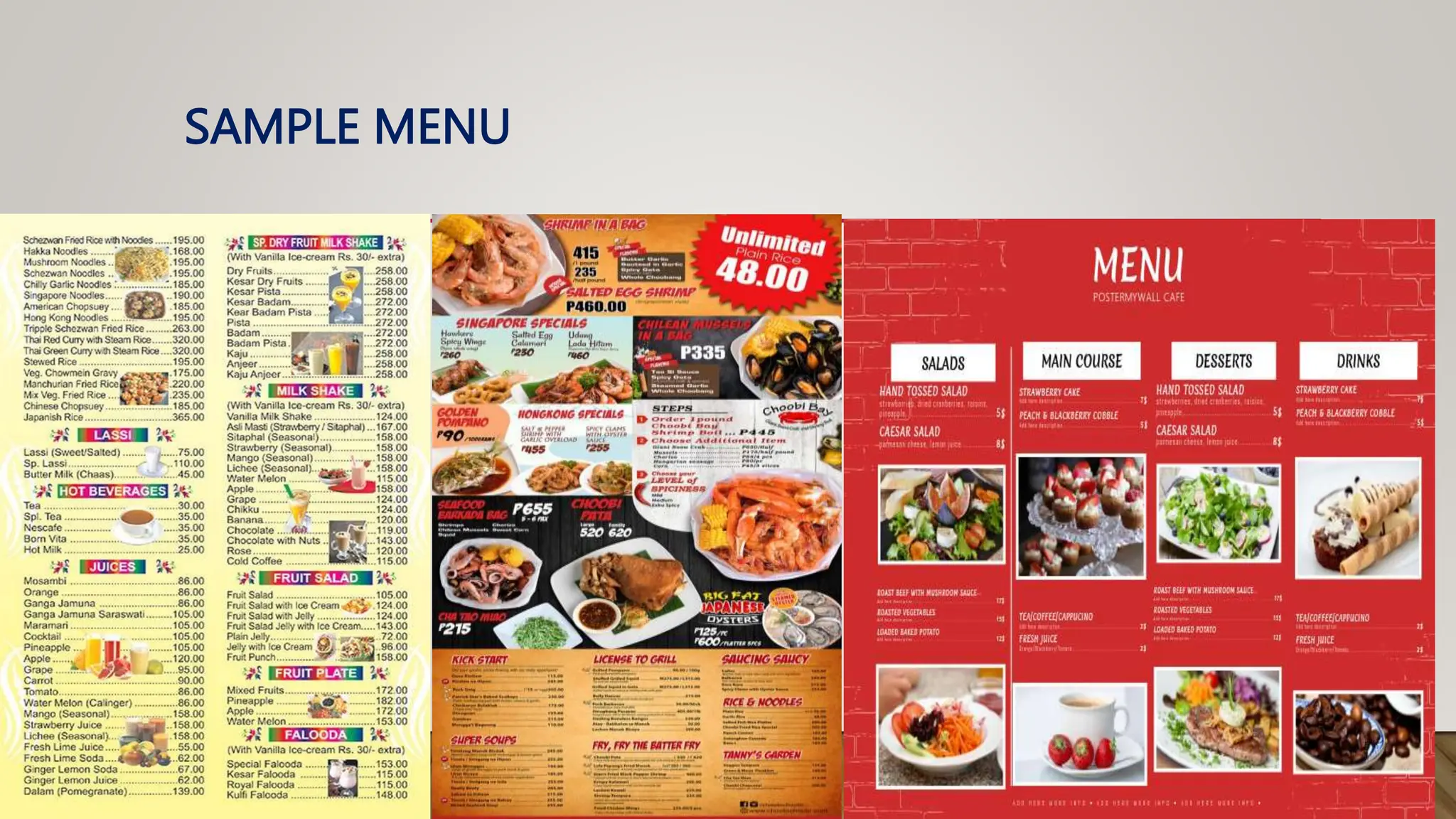
SAMPLE MENU
OTHER TYPES OF MENU
• Static menu- pre-determined menu that does not change everyday.
• Du Jour Menu (Dy zhoor) or Daily Menu- this menu changes daily and focused on seasonal ingredients.
• Cycle Menu- is a set of dishes or menu items that is different for each day during a cycle and repeats.
• Breakfast Menu- is fairly standardized. Offers a choice of juices, cereals, eggs and breakfast meats.
• Lunch Menu- is composed mostly of light meals and often informal meals.
• Dinner Menu- is more elaborate as guests have more time and leisure for eating.
• California Menu- features item that are traditionally available for breakfast, lunch and dinner offered
throughout the day.
• Children’s menu- typically has burgers, fried chicken, hotdogs, sandwiches, French fries, noodles, ice cream
and soft drinks.
• Dessert Menu- offers pastries
• Tourist Menu- is posted on the board outside a restaurant, usually with an attractive headline price,
primarily designed to attract tourist.
MENU PRESENTATION
• Make sure menus are clean, presentable and up-to-date.
• Present the menu when the guest are already comfortably and
properly seated.
• Never put the menus on the table where the guest have to pick
them up.
• In presenting menu, one can say, “May I present to you our menu”.
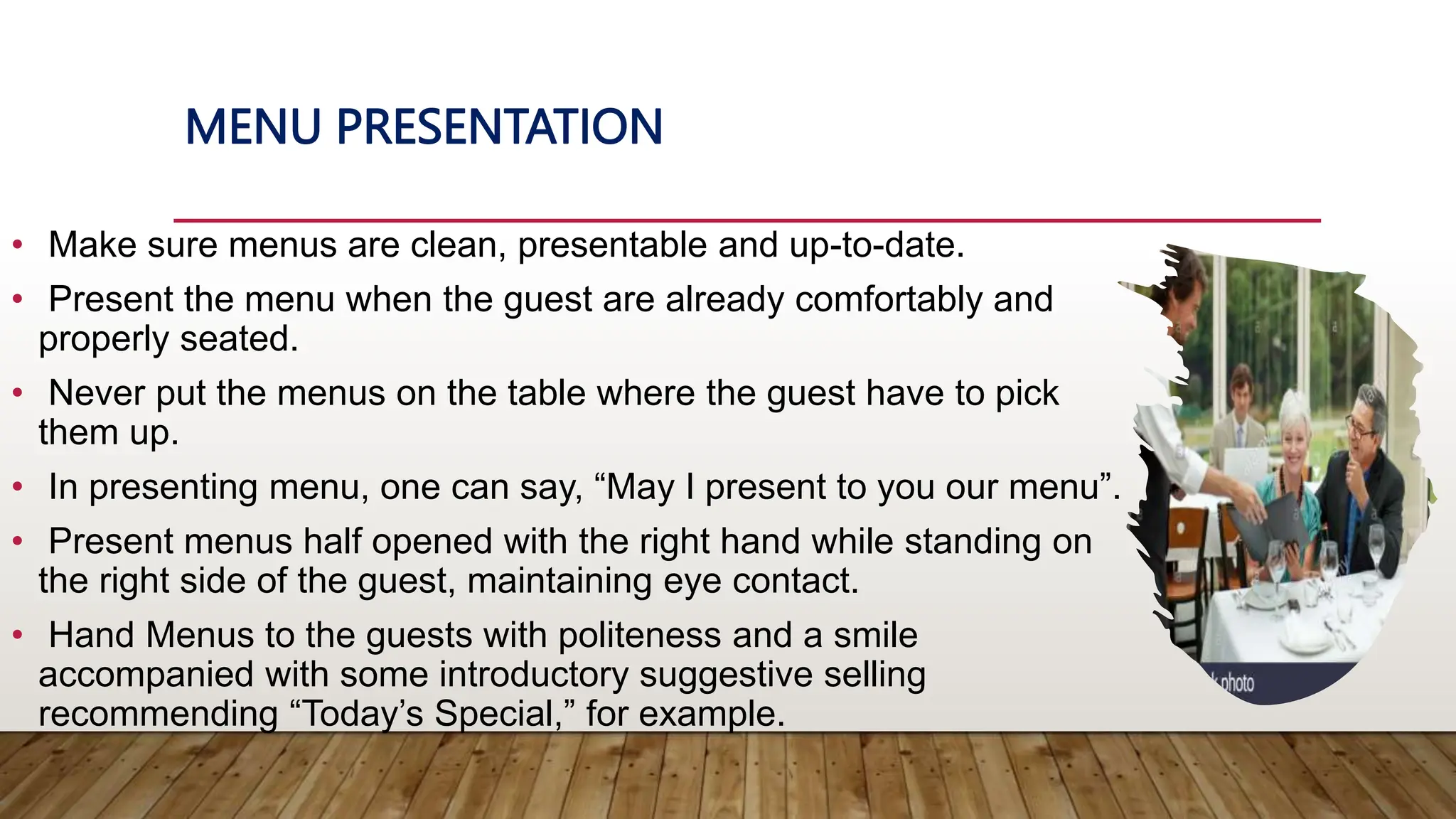
• Present menus half opened with the right hand while standing on
the right side of the guest, maintaining eye contact.
• Hand Menus to the guests with politeness and a smile
accompanied with some introductory suggestive selling
recommending “Today’s Special,” for example.
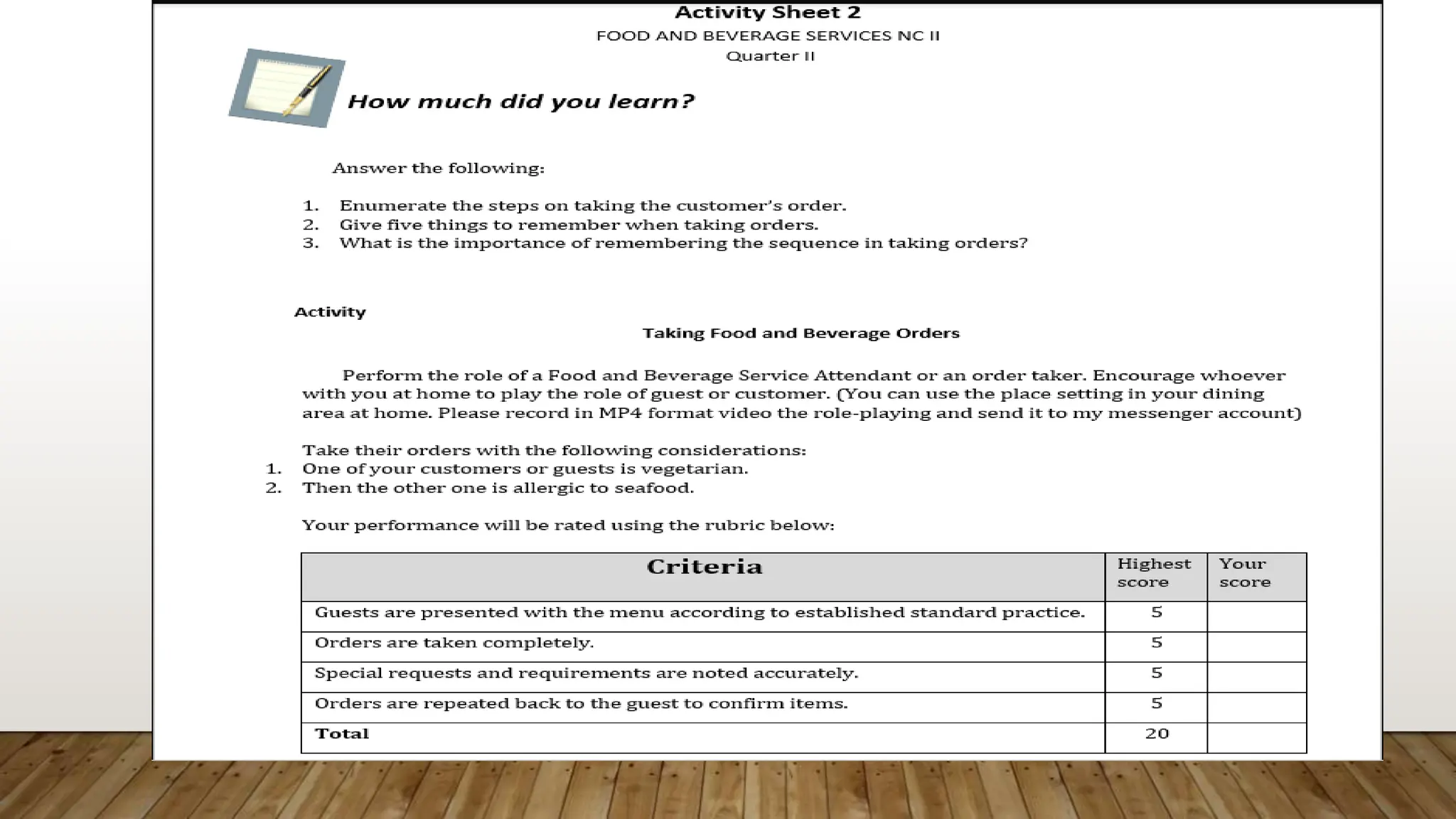
TAKING FOOD ORDERS
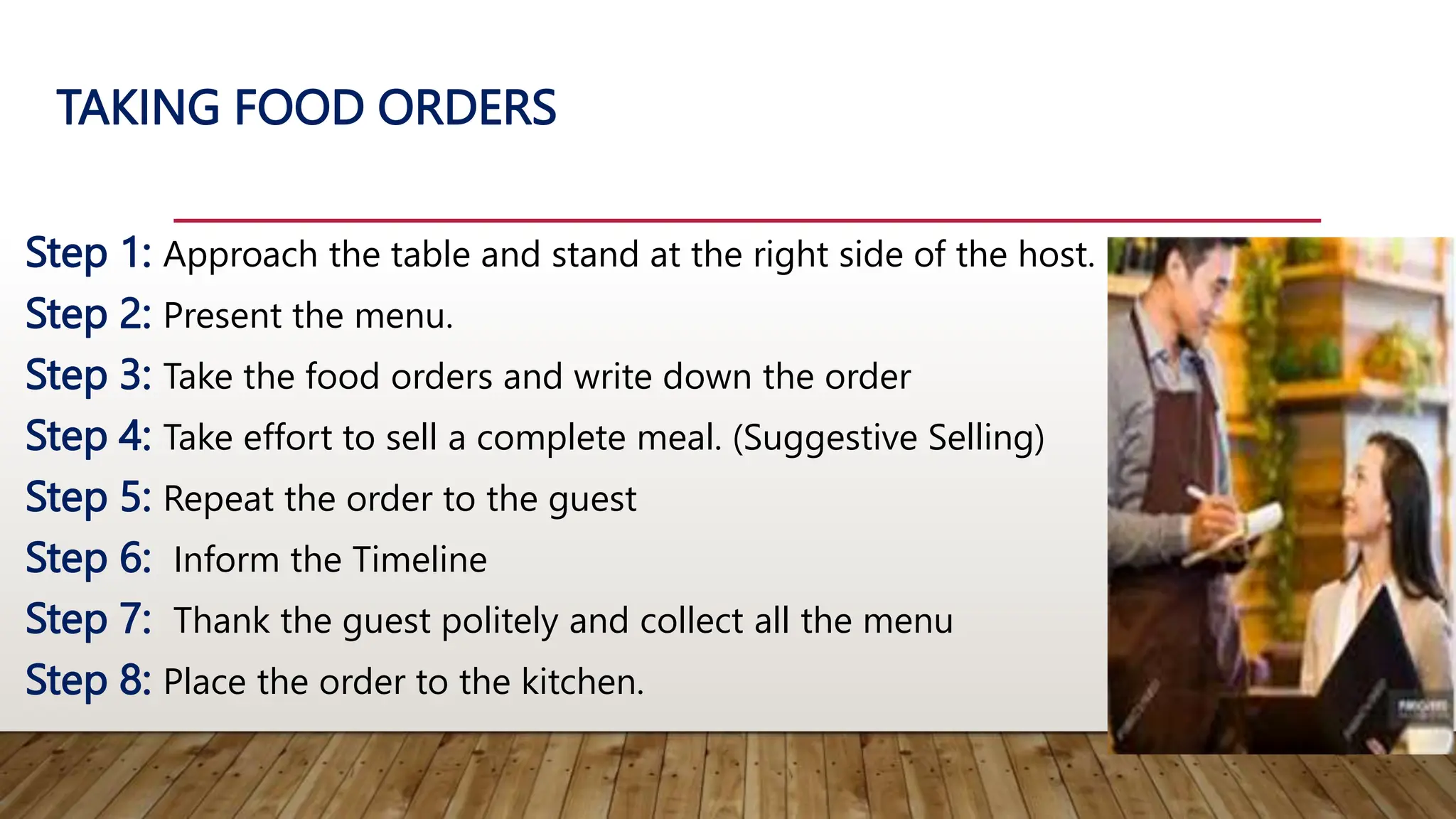
Step 1: Approach the table and stand at the right side of the host.
Step 2: Present the menu.
Step 3: Take the food orders and write down the order
Step 4: Take effort to sell a complete meal. (Suggestive Selling)
Step 5: Repeat the order to the guest
Step 6: Inform the Timeline
Step 7: Thank the guest politely and collect all the menu
Step 8: Place the order to the kitchen.
IMPORTANT THINGS TO REMEMBER WHEN TAKING
ORDERS
• Always have a sharp pencil or pen and order slip ready.
• Approach the guest after you have given them the time to look at the menu.
• Stand erect to the left of the guest with the order slip supported in the palm of your hand and ball pen ready.
• Always jot down orders with other instructions.
• Incorporate suggestive selling techniques throughout the order-taking process.
• Give attention to orders with special requests.
• Record proper sequence of serving starting with the appetizer, soup, salad, main course, dessert and coffee.
• If the guest is in hurry and seeks your assistance, suggest to him some “ready to serve” food items rather than “cooked to
order” items.
• Identify your guest or customer before you apply the suggestive selling.
• Use appropriate and uniform abbreviations in your restaurant as directed by house policy.
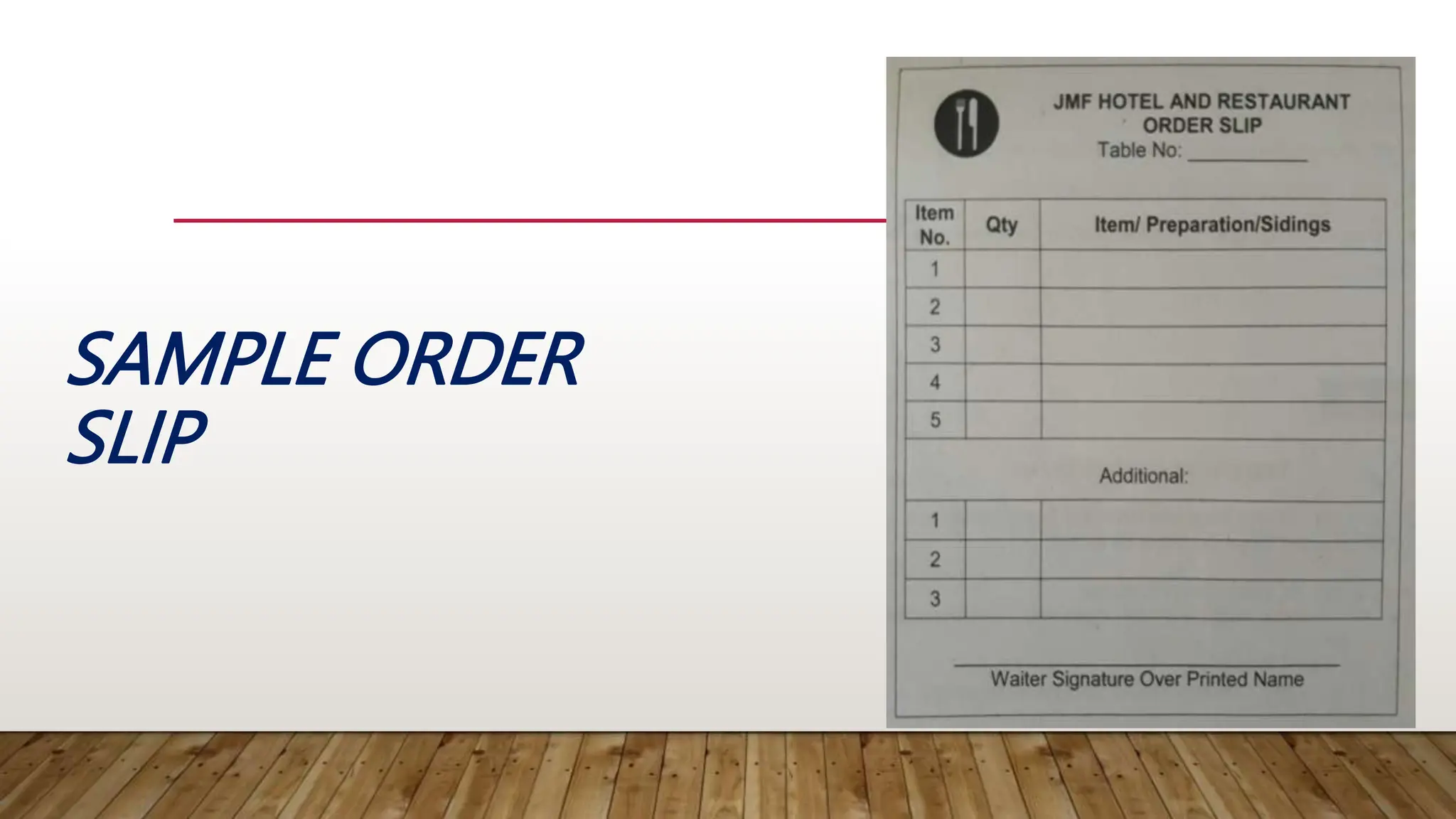
SAMPLE ORDER
SLIP
Thank you
ANSWER THE FOLLOWING QUESTIONS:
• What is menu?
• Give 5 important things to remember when taking orders.
• Enumerate the 8 steps in taking food orders.
• Give 5 important things to remember in presenting the menu.
• What are the 2 types of menu? Please define each type.

Take Food and Beverage Orders Module 4.pptx

  • 1.
  • 2.
    OBJECTIVES: Take orders completelyin accordance with established standard procedure. Note special requests and requirements accurately Repeat orders to the guest and confirm items.
  • 3.
    WHAT IS AMENU /ˈMENYO͞ O/? A menu is a list of dishes that are available for sale in a food service outlet or that can be served at a meal. In French, menu means ‘in minute detail’ and in English, it is also termed as ‘bill of fare’. The term menu first used in 1541.
  • 4.
  • 5.
    DIFFERENCE BETWEEN ALA CARTE AND TABLE D'HÔTE A la Carte Table D'hôtel Food is kept in a semi-prepared form and takes time to serve. Food is kept in fully prepared form and can be served immediately. Food items are individually serves and guests pay for what they order. The menu is collectively priced and the customer has to pay for the full menu whether he consumes a certain dish or not. There is a vast choice. The menu is elaborate. There is a limited choice. The menu is comparatively small. Silver is laid according to the dishes ordered. Silver for the whole menu is laid in advance as the menu is known in advance.
  • 6.
  • 7.
    OTHER TYPES OFMENU • Static menu- pre-determined menu that does not change everyday. • Du Jour Menu (Dy zhoor) or Daily Menu- this menu changes daily and focused on seasonal ingredients. • Cycle Menu- is a set of dishes or menu items that is different for each day during a cycle and repeats. • Breakfast Menu- is fairly standardized. Offers a choice of juices, cereals, eggs and breakfast meats. • Lunch Menu- is composed mostly of light meals and often informal meals. • Dinner Menu- is more elaborate as guests have more time and leisure for eating. • California Menu- features item that are traditionally available for breakfast, lunch and dinner offered throughout the day. • Children’s menu- typically has burgers, fried chicken, hotdogs, sandwiches, French fries, noodles, ice cream and soft drinks. • Dessert Menu- offers pastries • Tourist Menu- is posted on the board outside a restaurant, usually with an attractive headline price, primarily designed to attract tourist.
  • 8.
    MENU PRESENTATION • Makesure menus are clean, presentable and up-to-date. • Present the menu when the guest are already comfortably and properly seated. • Never put the menus on the table where the guest have to pick them up. • In presenting menu, one can say, “May I present to you our menu”. • Present menus half opened with the right hand while standing on the right side of the guest, maintaining eye contact. • Hand Menus to the guests with politeness and a smile accompanied with some introductory suggestive selling recommending “Today’s Special,” for example.
  • 9.
    TAKING FOOD ORDERS Step1: Approach the table and stand at the right side of the host. Step 2: Present the menu. Step 3: Take the food orders and write down the order Step 4: Take effort to sell a complete meal. (Suggestive Selling) Step 5: Repeat the order to the guest Step 6: Inform the Timeline Step 7: Thank the guest politely and collect all the menu Step 8: Place the order to the kitchen.
  • 10.
    IMPORTANT THINGS TOREMEMBER WHEN TAKING ORDERS • Always have a sharp pencil or pen and order slip ready. • Approach the guest after you have given them the time to look at the menu. • Stand erect to the left of the guest with the order slip supported in the palm of your hand and ball pen ready. • Always jot down orders with other instructions. • Incorporate suggestive selling techniques throughout the order-taking process. • Give attention to orders with special requests. • Record proper sequence of serving starting with the appetizer, soup, salad, main course, dessert and coffee. • If the guest is in hurry and seeks your assistance, suggest to him some “ready to serve” food items rather than “cooked to order” items. • Identify your guest or customer before you apply the suggestive selling. • Use appropriate and uniform abbreviations in your restaurant as directed by house policy.
  • 11.
  • 12.
  • 14.
    ANSWER THE FOLLOWINGQUESTIONS: • What is menu? • Give 5 important things to remember when taking orders. • Enumerate the 8 steps in taking food orders. • Give 5 important things to remember in presenting the menu. • What are the 2 types of menu? Please define each type.