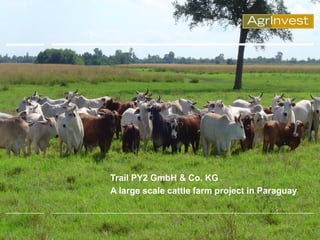
Trail PY2 GmbH & Co. KG
A large scale cattle farm project in Paraguay
Investment overview

 Acquired 38.818 hectares in West Paraguay (Chaco) for US$ 172/hectare
 Goal: Develop a large scale cattle farm with about 14.000 cattle units
 Total capital investment:       about US$ 30 million
 Secured private equity:         US$ 14 million
 Capital needs:                  about US$ 16 million
 Issuer (Andres Cramer) participation 30% at all times
      •   current participation US$ 6 million
   Undisclosed reserves:
     • The current market situations suggests an increase of our land value of 35% since
         the acquisition of the land in November 2010
     • The investor participates with 100% in these undisclosed reserves

   Total Return:                 276% after PY Tax (excl. agio)
   Minimum participation:        US$ 1 million plus agio
   Planned Exit:                 December 31st 2021

                                                                                           2
Content

 Investments
       •   in Agriculture
       •   in Livestock
       •   in Latin America
       •   in Paraguay
       •   in the Chaco
 Location of the farm & project description
 Risks & Opportunities
 Risk assessment
 Management team in Germany & Paraguay
 Principles & success factors of our farm management
 Our service
 Current projects
 Investment structure in Germany
 Sensitivities
 Tax structure
 Frequently Asked Questions
 In the press
 Short film about the project

                                                        3
Agriculture Investments

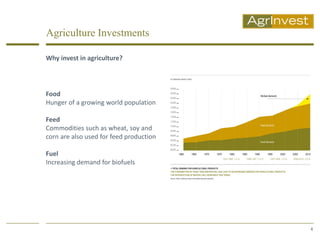
Why invest in agriculture?


Food
Hunger of a growing world population

Feed
Commodities such as wheat, soy and
corn are also used for feed production

Fuel
Increasing demand for biofuels


                                         4
Agriculture Investments

The growing demand for agricultural products is
accompanied by limited supply as arable land
cannot be reproduced. The fact that arable land is
being destroyed by urbanization, erosion and
salinization further increases scarcity


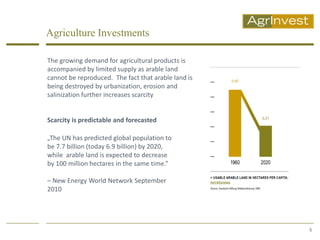
Scarcity is predictable and forecasted

„The UN has predicted global population to
be 7.7 billion (today 6.9 billion) by 2020,
while arable land is expected to decrease
by 100 million hectares in the same time.”

– New Energy World Network September
2010


                                                     5
Livestock Investments

Livestock investments hold a great opportunity, since:

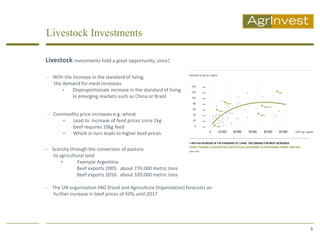
 With the increase in the standard of living,
    the demand for meat increases
        •  Disproportionate increase in the standard of living
           in emerging markets such as China or Brazil


 Commodity price increases e.g. wheat
     •  Lead to increase of feed prices since 1kg
             beef requires 10kg feed
        •    Which in turn leads to higher beef prices

 Scarcity through the conversion of pasture
   to agricultural land
       •       Example Argentina:
              Beef exports 2005: about 770.000 metric tons
              Beef exports 2010: about 320.000 metric tons

   The UN organization FAO (Food and Agriculture Organization) forecasts an
    further increase in beef prices of 50% until 2017


                                                                               6
Investing in Latin America

Latin America‘s success factors:

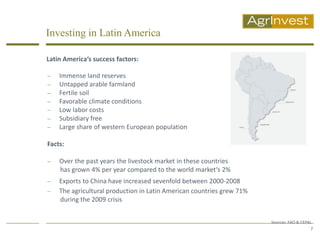
   Immense land reserves
   Untapped arable farmland
   Fertile soil
   Favorable climate conditions
   Low labor costs
   Subsidiary free
   Large share of western European population

Facts:

   Over the past years the livestock market in these countries
    has grown 4% per year compared to the world market‘s 2%
   Exports to China have increased sevenfold between 2000-2008
   The agricultural production in Latin American countries grew 71%
    during the 2009 crisis


                                                                       Sources: FAO & CEPAL
                                                                                          7
Investing in Paraguay

Market environment*

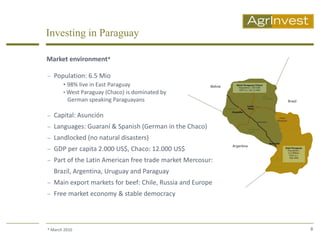
 Population: 6.5 Mio
     • 98% live in East Paraguay
     • West Paraguay (Chaco) is dominated by
       German speaking Paraguayans

 Capital: Asunción
 Languages: Guaraní & Spanish (German in the Chaco)
 Landlocked (no natural disasters)
 GDP per capita 2.000 US$, Chaco: 12.000 US$
 Part of the Latin American free trade market Mercosur:
   Brazil, Argentina, Uruguay and Paraguay
 Main export markets for beef: Chile, Russia and Europe
 Free market economy & stable democracy


* March 2010                                               8
Investing in Paraguay

Paraguay´s international reputation
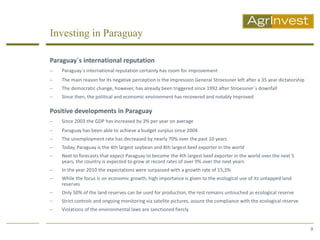
   Paraguay´s international reputation certainly has room for improvement
   The main reason for its negative perception is the impression General Stroessner left after a 35 year dictatorship
   The democratic change, however, has already been triggered since 1992 after Stroessner´s downfall
   Since then, the political and economic environment has recovered and notably improved

Positive developments in Paraguay
   Since 2003 the GDP has increased by 3% per year on average
   Paraguay has been able to achieve a budget surplus since 2004
   The unemployment rate has decreased by nearly 70% over the past 10 years
   Today, Paraguay is the 4th largest soybean and 8th largest beef exporter in the world
   Next to forecasts that expect Paraguay to become the 4th largest beef exporter in the world over the next 5
    years, the country is expected to grow at record rates of over 9% over the next years
   In the year 2010 the expectations were surpassed with a growth rate of 15,3%
   While the focus is on economic growth, high importance is given to the ecological use of its untapped land
    reserves
   Only 50% of the land reserves can be used for production, the rest remains untouched as ecological reserve
   Strict controls and ongoing monitoring via satelite pictures, assure the compliance with the ecological reserve
   Violations of the environmental laws are sanctioned fiercly


                                                                                                                         9
Investing in Paraguay

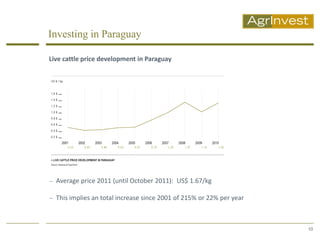
Live cattle price development in Paraguay


 Average price 2011 (until October 2011): US$ 1.67/kg

 This implies an total increase since 2001 of 215% or 22% per year


                                                                      10
Investing in Paraguay

Current advantages over other Latin American countries
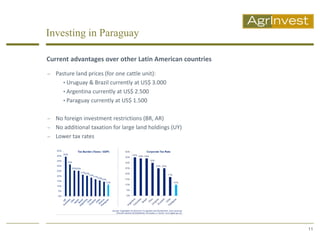
   Pasture land prices (for one cattle unit):
       • Uruguay & Brazil currently at US$ 3.000
       • Argentina currently at US$ 2.500
       • Paraguay currently at US$ 1.500


 No foreign investment restrictions (BR, AR)
 No additional taxation for large land holdings (UY)
 Lower tax rates


                                                         11
Investing in Paraguay

Current advantages over other Latin American countries


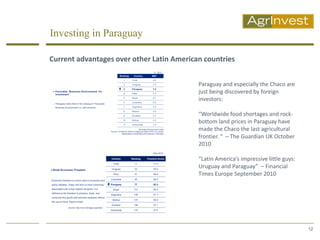
                                           Paraguay and especially the Chaco are
                                           just being discovered by foreign
                                           investors:

                                           “Worldwide food shortages and rock-
                                           bottom land prices in Paraguay have
                                           made the Chaco the last agricultural
                                           frontier. “ – The Guardian UK October
                                           2010

                                           “Latin America’s impressive little guys:
                                           Uruguay and Paraguay” – Financial
                                           Times Europe September 2010


                                                                                      12
Investing in the Chaco

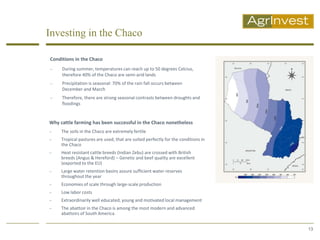
Conditions in the Chaco
    During summer, temperatures can reach up to 50 degrees Celcius,
     therefore 40% of the Chaco are semi-arid lands
    Precipitation is seasonal: 70% of the rain fall occurs between
     December and March
    Therefore, there are strong seasonal contrasts between droughts and
     floodings


Why cattle farming has been successful in the Chaco nonetheless
    The soils in the Chaco are extremely fertile
    Tropical pastures are used, that are suited perfectly for the conditions in
     the Chaco
    Heat resistant cattle breeds (Indian Zebu) are crossed with British
     breeds (Angus & Hereford) – Genetic and beef quality are excellent
     (exported to the EU)
    Large water retention basins assure sufficient water reserves
     throughout the year
    Economies of scale through large-scale production
    Low labor costs
    Extraordinarily well educated, young and motivated local management
    The abattoir in the Chaco is among the most modern and advanced
     abattoirs of South America


                                                                                   13
Investing in the Chaco

The potential of the Chaco

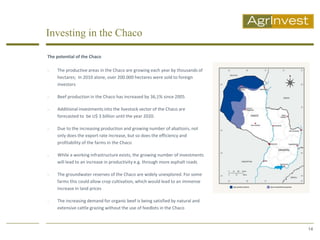
   The productive areas in the Chaco are growing each year by thousands of
    hectares; In 2010 alone, over 200.000 hectares were sold to foreign
    investors

   Beef production in the Chaco has increased by 36,1% since 2005

   Additional investments into the livestock sector of the Chaco are
    forecasted to be U$ 3 billion until the year 2020.

   Due to the increasing production and growing number of abattoirs, not
    only does the export rate increase, but so does the efficiency and
    profitability of the farms in the Chaco

   While a working infrastructure exists, the growing number of investments
    will lead to an increase in productivity e.g. through more asphalt roads

   The groundwater reserves of the Chaco are widely unexplored. For some
    farms this could allow crop cultivation, which would lead to an immense
    increase in land prices

   The increasing demand for organic beef is being satisfied by natural and
    extensive cattle grazing without the use of feedlots in the Chaco


                                                                               14
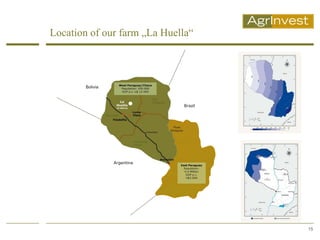
Location of our farm „La Huella“


                                   15
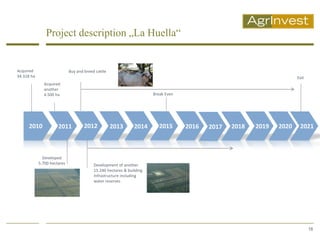
Project description „La Huella“


Acquired                     Buy and breed cattle
34.318 ha                                                                                                              Exit
              Acquired
              another
              4.500 ha                                                 Break Even


     2010             2011           2012           2013       2014       2015      2016   2017   2018   2019   2020    2021


              Developed
            5.700 hectares                Development of another
                                          15.240 hectares & building
                                          Infrastructure including
                                          water reserves


                                                                                                                              16
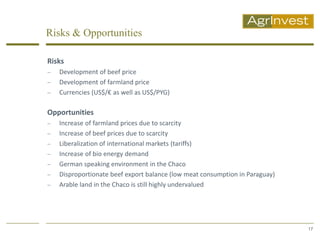
Risks & Opportunities

Risks
   Development of beef price
   Development of farmland price
   Currencies (US$/€ as well as US$/PYG)

Opportunities
   Increase of farmland prices due to scarcity
   Increase of beef prices due to scarcity
   Liberalization of international markets (tariffs)
   Increase of bio energy demand
   German speaking environment in the Chaco
   Disproportionate beef export balance (low meat consumption in Paraguay)
   Arable land in the Chaco is still highly undervalued


                                                                              17
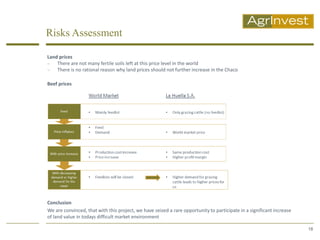
Risks Assessment

Land prices
   There are not many fertile soils left at this price level in the world
   There is no rational reason why land prices should not further increase in the Chaco

Beef prices


Conclusion
We are convinced, that with this project, we have seized a rare opportunity to participate in a significant increase
of land value in todays difficult market environment

                                                                                                                       18
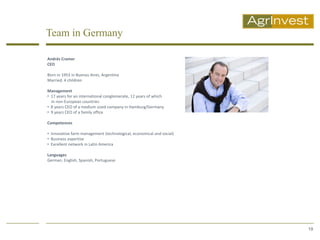
Team in Germany

Andrés Cramer
CEO

Born in 1953 in Buenos Aires, Argentina
Married, 4 children

Management
• 17 years for an international conglomerate, 12 years of which
  in non-European countries
• 8 years CEO of a medium sized company in Hamburg/Germany
• 9 years CEO of a family office

Competences

• Innovative farm management (technological, economical and social)
• Business expertise
• Excellent network in Latin America

Languages
German, English, Spanish, Portuguese


                                                                      19
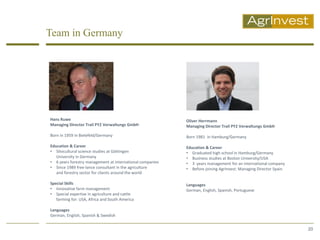
Team in Germany


Hans Ruwe                                                  Oliver Herrmann
Managing Director Trail PY2 Verwaltungs GmbH               Managing Director Trail PY2 Verwaltungs GmbH

Born in 1959 in Bielefeld/Germany                          Born 1981 in Hamburg/Germany

Education & Career                                         Education & Career
• Silvicultural science studies at Göttingen               • Graduated high school in Hamburg/Germany
   University in Germany                                   • Business studies at Boston University/USA
• 6 years forestry management at international companies   • 3 years management for an international company
• Since 1989 free-lance consultant in the agriculture      • Before joining AgrInvest: Managing Director Spain
   and forestry sector for clients around the world

Special Skills                                             Languages
• Innovative farm management                               German, English, Spanish, Portuguese
• Special expertise in agriculture and cattle
   farming for: USA, Africa and South America

Languages
German, English, Spanish & Swedish


                                                                                                                 20
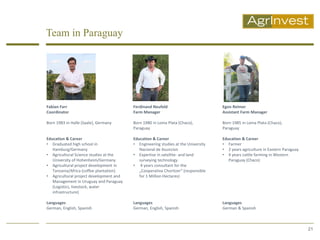
Team in Paraguay


Fabian Farr                              Ferdinand Neufeld                         Egon Reimer
Coordinator                              Farm Manager                              Assistant Farm Manager

Born 1983 in Halle (Saale), Germany      Born 1980 in Loma Plata (Chaco),          Born 1985 in Loma Plata (Chaco),
                                         Paraguay                                  Paraguay

Education & Career                       Education & Career                        Education & Career
• Graduated high school in               • Engineering studies at the University   • Farmer
   Hamburg/Germany                          Nacional de Asuncion                   • 2 years agriculture in Eastern Paraguay
• Agricultural Science studies at the    • Expertise in satellite- and land        • 4 years cattle farming in Western
   University of Hohenheim/Germany          surveying technology                      Paraguay (Chaco)
• Agricultural project development in    • 4 years consultant for the
   Tanzania/Africa (coffee plantation)      „Cooperativa Choritzer“ (responsible
• Agricultural project development and      for 1 Million Hectares)
   Management in Uruguay and Paraguay
   (Logistics, livestock, water
   infrastructure)

Languages                                Languages                                 Languages
German, English, Spanish                 German, English, Spanish                  German & Spanish


                                                                                                                               21
Principles & Success Factors

Law compliance
The strict compliance with Paraguayan law is a fundamental requirement for a sustainable and successful farm

Rights of indigenous tribes
All rights of indigenous tribes are treated with the utmost respect and supported by the company

Employee rights
The company has the goal to be among the best employers in the region and supports employee needs beyond
the required framework of law

Control of environmental impact
The farm shall serve as example for an ecological and innovative operation. Regular controls are carried out in
order to measure the impact on the environment. Furthermore, relevant environmental studies shall be
performed by scientific institutes

Regular controls and evaluation of operative goals
The managment commits itself to regularly evaluate and improve the operation as well as to set operative
goals above the standard.

Maintainig a high standard in all aspects
The farm will be managed according to West European standards


                                                                                                                  22
Our Service

Operations
     Build entire farm & fields
     Farm management


Project management
      Due diligence
      Business plan
      Controlling, auditing, tax & law
      Follow-up and control of goals
      Investor relations
      Preparation /execution of sales process


                                                 23
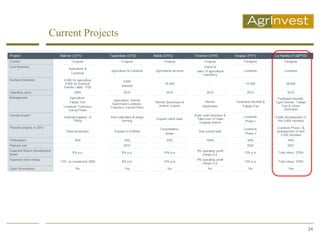
Current Projects


                   24
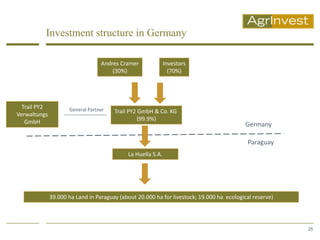
Investment structure in Germany

                                  Andres Cramer               Investors
                                      (30%)                     (70%)


  Trail PY2          General Partner
Verwaltungs                            Trail PY2 GmbH & Co. KG
   GmbH                                          (99.9%)
                                                                                           Germany

                                                                                           Paraguay
                                             La Huella S.A.


              39.000 ha Land in Paraguay (about 20.000 ha for livestock; 19.000 ha ecological reserve)


                                                                                                         25
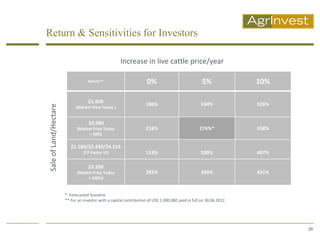
Return & Sensitivities for Investors

                                                      Increase in live cattle price/year

                                    Return**                         0%                             5%               10%

                                    $1.600                          186%                            244%             326%
Sale of Land/Hectare


                             (Market Price Today )


                                    $2.080
                             (Market Price Today                    218%                           276%*             358%
                                   + 30%)

                          $1.100/$2.430/$4.214
                                 (CF Factor 15)                     153%                            299%             497%

                                    $3.200
                             (Market Price Today                    292%                            349%             431%
                                  + 100%)


                       * Forecasted Scenario
                       ** For an investor with a capital contribution of US$ 1.000.000 paid in full on 30.06.2012.


                                                                                                                            26
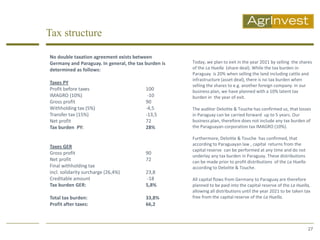
Tax structure

No double taxation agreement exists between
Germany and Paraguay. In general, the tax burden is   Today, we plan to exit in the year 2021 by selling the shares
determined as follows:                                of the La Huella (share deal). While the tax burden in
                                                      Paraguay is 20% when selling the land including cattle and
                                                      infrastructure (asset deal), there is no tax burden when
Taxes PY
                                                      selling the shares to e.g. another foreign company. In our
Profit before taxes                       100         business plan, we have planned with a 10% latent tax
IMAGRO (10%)                               -10        burden in the year of exit.
Gross profit                              90
Withholding tax (5%)                      -4,5        The auditor Deloitte & Touche has confirmed us, that losses
Transfer tax (15%)                        -13,5       in Paraguay can be carried forward up to 5 years. Our
Net profit                                72          business plan, therefore does not include any tax burden of
Tax burden PY:                            28%         the Paraguayan corporation tax IMAGRO (10%).

                                                      Furthermore, Deloitte & Touche has confirmed, that
                                                      according to Paraguayan law , capital returns from the
Taxes GER
                                                      capital reserve can be performed at any time and do not
Gross profit                              90
                                                      underlay any tax burden in Paraguay. These distributions
Net profit                                72          can be made prior to profit distributions of the La Huella
Final withholding tax                                 according to Deloitte & Touche.
incl. solidarity surcharge (26,4%)        23,8
Creditable amount                         -18         All capital flows from Germany to Paraguay are therefore
Tax burden GER:                           5,8%        planned to be paid into the capital reserve of the La Huella,
                                                      allowing all distributions until the year 2021 to be taken tax
Total tax burden:                         33,8%       free from the capital reserve of the La Huella.
Profit after taxes:                       66,2


                                                                                                                   27
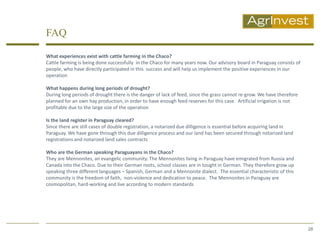
FAQ

What experiences exist with cattle farming in the Chaco?
Cattle farming is being done successfully in the Chaco for many years now. Our advisory board in Paraguay consists of
people, who have directly participated in this success and will help us implement the positive experiences in our
operation

What happens during long periods of drought?
During long periods of drought there is the danger of lack of feed, since the grass cannot re-grow. We have therefore
planned for an own hay production, in order to have enough feed reserves for this case. Artificial irrigation is not
profitable due to the large size of the operation

Is the land register in Paraguay cleared?
Since there are still cases of double registration, a notarized due dilligence is essential before acquiring land in
Paraguay. We have gone through this due dilligence process and our land has been secured through notarized land
registrations and notarized land sales contracts

Who are the German speaking Paraguayans in the Chaco?
They are Mennonites, an evangelic community. The Mennonites living in Paraguay have emigrated from Russia and
Canada into the Chaco. Due to their German roots, school classes are in tought in German. They therefore grow up
speaking three different languages – Spanish, German and a Mennonite dialect. The essential characteristic of this
community is the freedom of faith, non-violence and dedication to peace. The Mennonites in Paraguay are
cosmopolitan, hard-working and live according to modern standards


                                                                                                                        28
FAQ

Where is the catch? Why is the land in the Chaco so cheap?
There are different reasons:
 The increasing conversion from pasture to land for crop production has lead to a scarcity of pastures. Therefore,
  land that prior seemed unattractive for production is now getting attention for use as pasture.
 The Chaco seemed unattrative for many years, due to its high temperatures, seasonal precipitation and missing
  infrastructure
 Only the Mennonites have worked on the development of the region and succeeded in converting the land to
  productive and profitable surfaces for cattle farming
 Nonetheless, cattle farming is capital intensive in the Chaco due to the cost of building large water and feed
  reserves. Capital, which most Paraguayans lack. Therefore, the region relies on foreign direct investments
 Foreign investors are only now discovering the Chaco, since a working infrastructrure exists and a successful
  concept for livestock operations has been implemented
 In comparision to international price levels, the land is still cheap. It has, however, already increased in value by
  about 500% over the past years.
 Please refer to page 13 „The potential of the Chaco“ for why we believe, that land prices will continue to rise in the
  Chaco and have yet to make their biggest leap in terms of value


                                                                                                                           29
In the Press

Reuters: „South America tops farmland investors' wish-list”
Private equity and fund managers at a farm investing conference in Geneva named South America a top place to buy,
lease and manage agricultural lands for profit…Brazil, Paraguay and Uruguay are all attractive destinations and
Argentina is under review following the death of former President Nestor Kirchner…


World Bank Online: “Latin America’s growth expected to reach 5-6% in 2010”
Latin America’s semiannual economic report also reveals that the region’s recovery is ahead of the rich nation’s and
compares well with the Asian Tigers’ expected growth of over 7 percent. All in all, the crisis in Latin America &
Caribbean (LAC) was short lived, as compared to other parts of the globe, thanks in part to solid macroeconomic and
fiscal frameworks set in place well before the crisis struck. Individually, Brazil, Peru and Argentina lead the pack with
7.5 percent projected growth while Uruguay and Paraguay are expected to largely surpass the regional average…


Financial Times Europe: “Latin America’s impressive little guys: Uruguay and Paraguay”
Paraguay’s economy is on fire - set to grow at around 9 per cent this year, a 30-year-high…


The Banker (Financial Times Group): „Paraguay ups its game”
Paraguay's vast amounts of fertile and inexpensive land have been exploited in a very low-intensive way, and
therefore hold great potential for the agriculture sector…


                                                                                                                            30
Short movie: Project „La Huella“


                                   31

TRAIL PY2_PrivatePlacement

  • 1.
    Trail PY2 GmbH& Co. KG A large scale cattle farm project in Paraguay
  • 2.
    Investment overview  Acquired38.818 hectares in West Paraguay (Chaco) for US$ 172/hectare  Goal: Develop a large scale cattle farm with about 14.000 cattle units  Total capital investment: about US$ 30 million  Secured private equity: US$ 14 million  Capital needs: about US$ 16 million  Issuer (Andres Cramer) participation 30% at all times • current participation US$ 6 million  Undisclosed reserves: • The current market situations suggests an increase of our land value of 35% since the acquisition of the land in November 2010 • The investor participates with 100% in these undisclosed reserves  Total Return: 276% after PY Tax (excl. agio)  Minimum participation: US$ 1 million plus agio  Planned Exit: December 31st 2021 2
  • 3.
    Content  Investments • in Agriculture • in Livestock • in Latin America • in Paraguay • in the Chaco  Location of the farm & project description  Risks & Opportunities  Risk assessment  Management team in Germany & Paraguay  Principles & success factors of our farm management  Our service  Current projects  Investment structure in Germany  Sensitivities  Tax structure  Frequently Asked Questions  In the press  Short film about the project 3
  • 4.
    Agriculture Investments Why investin agriculture? Food Hunger of a growing world population Feed Commodities such as wheat, soy and corn are also used for feed production Fuel Increasing demand for biofuels 4
  • 5.
    Agriculture Investments The growingdemand for agricultural products is accompanied by limited supply as arable land cannot be reproduced. The fact that arable land is being destroyed by urbanization, erosion and salinization further increases scarcity Scarcity is predictable and forecasted „The UN has predicted global population to be 7.7 billion (today 6.9 billion) by 2020, while arable land is expected to decrease by 100 million hectares in the same time.” – New Energy World Network September 2010 5
  • 6.
    Livestock Investments Livestock investmentshold a great opportunity, since:  With the increase in the standard of living, the demand for meat increases • Disproportionate increase in the standard of living in emerging markets such as China or Brazil  Commodity price increases e.g. wheat • Lead to increase of feed prices since 1kg beef requires 10kg feed • Which in turn leads to higher beef prices  Scarcity through the conversion of pasture to agricultural land • Example Argentina: Beef exports 2005: about 770.000 metric tons Beef exports 2010: about 320.000 metric tons  The UN organization FAO (Food and Agriculture Organization) forecasts an further increase in beef prices of 50% until 2017 6
  • 7.
    Investing in LatinAmerica Latin America‘s success factors:  Immense land reserves  Untapped arable farmland  Fertile soil  Favorable climate conditions  Low labor costs  Subsidiary free  Large share of western European population Facts:  Over the past years the livestock market in these countries has grown 4% per year compared to the world market‘s 2%  Exports to China have increased sevenfold between 2000-2008  The agricultural production in Latin American countries grew 71% during the 2009 crisis Sources: FAO & CEPAL 7
  • 8.
    Investing in Paraguay Marketenvironment*  Population: 6.5 Mio • 98% live in East Paraguay • West Paraguay (Chaco) is dominated by German speaking Paraguayans  Capital: Asunción  Languages: Guaraní & Spanish (German in the Chaco)  Landlocked (no natural disasters)  GDP per capita 2.000 US$, Chaco: 12.000 US$  Part of the Latin American free trade market Mercosur: Brazil, Argentina, Uruguay and Paraguay  Main export markets for beef: Chile, Russia and Europe  Free market economy & stable democracy * March 2010 8
  • 9.
    Investing in Paraguay Paraguay´sinternational reputation  Paraguay´s international reputation certainly has room for improvement  The main reason for its negative perception is the impression General Stroessner left after a 35 year dictatorship  The democratic change, however, has already been triggered since 1992 after Stroessner´s downfall  Since then, the political and economic environment has recovered and notably improved Positive developments in Paraguay  Since 2003 the GDP has increased by 3% per year on average  Paraguay has been able to achieve a budget surplus since 2004  The unemployment rate has decreased by nearly 70% over the past 10 years  Today, Paraguay is the 4th largest soybean and 8th largest beef exporter in the world  Next to forecasts that expect Paraguay to become the 4th largest beef exporter in the world over the next 5 years, the country is expected to grow at record rates of over 9% over the next years  In the year 2010 the expectations were surpassed with a growth rate of 15,3%  While the focus is on economic growth, high importance is given to the ecological use of its untapped land reserves  Only 50% of the land reserves can be used for production, the rest remains untouched as ecological reserve  Strict controls and ongoing monitoring via satelite pictures, assure the compliance with the ecological reserve  Violations of the environmental laws are sanctioned fiercly 9
  • 10.
    Investing in Paraguay Livecattle price development in Paraguay  Average price 2011 (until October 2011): US$ 1.67/kg  This implies an total increase since 2001 of 215% or 22% per year 10
  • 11.
    Investing in Paraguay Currentadvantages over other Latin American countries  Pasture land prices (for one cattle unit): • Uruguay & Brazil currently at US$ 3.000 • Argentina currently at US$ 2.500 • Paraguay currently at US$ 1.500  No foreign investment restrictions (BR, AR)  No additional taxation for large land holdings (UY)  Lower tax rates 11
  • 12.
    Investing in Paraguay Currentadvantages over other Latin American countries Paraguay and especially the Chaco are just being discovered by foreign investors: “Worldwide food shortages and rock- bottom land prices in Paraguay have made the Chaco the last agricultural frontier. “ – The Guardian UK October 2010 “Latin America’s impressive little guys: Uruguay and Paraguay” – Financial Times Europe September 2010 12
  • 13.
    Investing in theChaco Conditions in the Chaco  During summer, temperatures can reach up to 50 degrees Celcius, therefore 40% of the Chaco are semi-arid lands  Precipitation is seasonal: 70% of the rain fall occurs between December and March  Therefore, there are strong seasonal contrasts between droughts and floodings Why cattle farming has been successful in the Chaco nonetheless  The soils in the Chaco are extremely fertile  Tropical pastures are used, that are suited perfectly for the conditions in the Chaco  Heat resistant cattle breeds (Indian Zebu) are crossed with British breeds (Angus & Hereford) – Genetic and beef quality are excellent (exported to the EU)  Large water retention basins assure sufficient water reserves throughout the year  Economies of scale through large-scale production  Low labor costs  Extraordinarily well educated, young and motivated local management  The abattoir in the Chaco is among the most modern and advanced abattoirs of South America 13
  • 14.
    Investing in theChaco The potential of the Chaco  The productive areas in the Chaco are growing each year by thousands of hectares; In 2010 alone, over 200.000 hectares were sold to foreign investors  Beef production in the Chaco has increased by 36,1% since 2005  Additional investments into the livestock sector of the Chaco are forecasted to be U$ 3 billion until the year 2020.  Due to the increasing production and growing number of abattoirs, not only does the export rate increase, but so does the efficiency and profitability of the farms in the Chaco  While a working infrastructure exists, the growing number of investments will lead to an increase in productivity e.g. through more asphalt roads  The groundwater reserves of the Chaco are widely unexplored. For some farms this could allow crop cultivation, which would lead to an immense increase in land prices  The increasing demand for organic beef is being satisfied by natural and extensive cattle grazing without the use of feedlots in the Chaco 14
  • 15.
    Location of ourfarm „La Huella“ 15
  • 16.
    Project description „LaHuella“ Acquired Buy and breed cattle 34.318 ha Exit Acquired another 4.500 ha Break Even 2010 2011 2012 2013 2014 2015 2016 2017 2018 2019 2020 2021 Developed 5.700 hectares Development of another 15.240 hectares & building Infrastructure including water reserves 16
  • 17.
    Risks & Opportunities Risks  Development of beef price  Development of farmland price  Currencies (US$/€ as well as US$/PYG) Opportunities  Increase of farmland prices due to scarcity  Increase of beef prices due to scarcity  Liberalization of international markets (tariffs)  Increase of bio energy demand  German speaking environment in the Chaco  Disproportionate beef export balance (low meat consumption in Paraguay)  Arable land in the Chaco is still highly undervalued 17
  • 18.
    Risks Assessment Land prices  There are not many fertile soils left at this price level in the world  There is no rational reason why land prices should not further increase in the Chaco Beef prices Conclusion We are convinced, that with this project, we have seized a rare opportunity to participate in a significant increase of land value in todays difficult market environment 18
  • 19.
    Team in Germany AndrésCramer CEO Born in 1953 in Buenos Aires, Argentina Married, 4 children Management • 17 years for an international conglomerate, 12 years of which in non-European countries • 8 years CEO of a medium sized company in Hamburg/Germany • 9 years CEO of a family office Competences • Innovative farm management (technological, economical and social) • Business expertise • Excellent network in Latin America Languages German, English, Spanish, Portuguese 19
  • 20.
    Team in Germany HansRuwe Oliver Herrmann Managing Director Trail PY2 Verwaltungs GmbH Managing Director Trail PY2 Verwaltungs GmbH Born in 1959 in Bielefeld/Germany Born 1981 in Hamburg/Germany Education & Career Education & Career • Silvicultural science studies at Göttingen • Graduated high school in Hamburg/Germany University in Germany • Business studies at Boston University/USA • 6 years forestry management at international companies • 3 years management for an international company • Since 1989 free-lance consultant in the agriculture • Before joining AgrInvest: Managing Director Spain and forestry sector for clients around the world Special Skills Languages • Innovative farm management German, English, Spanish, Portuguese • Special expertise in agriculture and cattle farming for: USA, Africa and South America Languages German, English, Spanish & Swedish 20
  • 21.
    Team in Paraguay FabianFarr Ferdinand Neufeld Egon Reimer Coordinator Farm Manager Assistant Farm Manager Born 1983 in Halle (Saale), Germany Born 1980 in Loma Plata (Chaco), Born 1985 in Loma Plata (Chaco), Paraguay Paraguay Education & Career Education & Career Education & Career • Graduated high school in • Engineering studies at the University • Farmer Hamburg/Germany Nacional de Asuncion • 2 years agriculture in Eastern Paraguay • Agricultural Science studies at the • Expertise in satellite- and land • 4 years cattle farming in Western University of Hohenheim/Germany surveying technology Paraguay (Chaco) • Agricultural project development in • 4 years consultant for the Tanzania/Africa (coffee plantation) „Cooperativa Choritzer“ (responsible • Agricultural project development and for 1 Million Hectares) Management in Uruguay and Paraguay (Logistics, livestock, water infrastructure) Languages Languages Languages German, English, Spanish German, English, Spanish German & Spanish 21
  • 22.
    Principles & SuccessFactors Law compliance The strict compliance with Paraguayan law is a fundamental requirement for a sustainable and successful farm Rights of indigenous tribes All rights of indigenous tribes are treated with the utmost respect and supported by the company Employee rights The company has the goal to be among the best employers in the region and supports employee needs beyond the required framework of law Control of environmental impact The farm shall serve as example for an ecological and innovative operation. Regular controls are carried out in order to measure the impact on the environment. Furthermore, relevant environmental studies shall be performed by scientific institutes Regular controls and evaluation of operative goals The managment commits itself to regularly evaluate and improve the operation as well as to set operative goals above the standard. Maintainig a high standard in all aspects The farm will be managed according to West European standards 22
  • 23.
    Our Service Operations  Build entire farm & fields  Farm management Project management  Due diligence  Business plan  Controlling, auditing, tax & law  Follow-up and control of goals  Investor relations  Preparation /execution of sales process 23
  • 24.
  • 25.
    Investment structure inGermany Andres Cramer Investors (30%) (70%) Trail PY2 General Partner Verwaltungs Trail PY2 GmbH & Co. KG GmbH (99.9%) Germany Paraguay La Huella S.A. 39.000 ha Land in Paraguay (about 20.000 ha for livestock; 19.000 ha ecological reserve) 25
  • 26.
    Return & Sensitivitiesfor Investors Increase in live cattle price/year Return** 0% 5% 10% $1.600 186% 244% 326% Sale of Land/Hectare (Market Price Today ) $2.080 (Market Price Today 218% 276%* 358% + 30%) $1.100/$2.430/$4.214 (CF Factor 15) 153% 299% 497% $3.200 (Market Price Today 292% 349% 431% + 100%) * Forecasted Scenario ** For an investor with a capital contribution of US$ 1.000.000 paid in full on 30.06.2012. 26
  • 27.
    Tax structure No doubletaxation agreement exists between Germany and Paraguay. In general, the tax burden is Today, we plan to exit in the year 2021 by selling the shares determined as follows: of the La Huella (share deal). While the tax burden in Paraguay is 20% when selling the land including cattle and infrastructure (asset deal), there is no tax burden when Taxes PY selling the shares to e.g. another foreign company. In our Profit before taxes 100 business plan, we have planned with a 10% latent tax IMAGRO (10%) -10 burden in the year of exit. Gross profit 90 Withholding tax (5%) -4,5 The auditor Deloitte & Touche has confirmed us, that losses Transfer tax (15%) -13,5 in Paraguay can be carried forward up to 5 years. Our Net profit 72 business plan, therefore does not include any tax burden of Tax burden PY: 28% the Paraguayan corporation tax IMAGRO (10%). Furthermore, Deloitte & Touche has confirmed, that according to Paraguayan law , capital returns from the Taxes GER capital reserve can be performed at any time and do not Gross profit 90 underlay any tax burden in Paraguay. These distributions Net profit 72 can be made prior to profit distributions of the La Huella Final withholding tax according to Deloitte & Touche. incl. solidarity surcharge (26,4%) 23,8 Creditable amount -18 All capital flows from Germany to Paraguay are therefore Tax burden GER: 5,8% planned to be paid into the capital reserve of the La Huella, allowing all distributions until the year 2021 to be taken tax Total tax burden: 33,8% free from the capital reserve of the La Huella. Profit after taxes: 66,2 27
  • 28.
    FAQ What experiences existwith cattle farming in the Chaco? Cattle farming is being done successfully in the Chaco for many years now. Our advisory board in Paraguay consists of people, who have directly participated in this success and will help us implement the positive experiences in our operation What happens during long periods of drought? During long periods of drought there is the danger of lack of feed, since the grass cannot re-grow. We have therefore planned for an own hay production, in order to have enough feed reserves for this case. Artificial irrigation is not profitable due to the large size of the operation Is the land register in Paraguay cleared? Since there are still cases of double registration, a notarized due dilligence is essential before acquiring land in Paraguay. We have gone through this due dilligence process and our land has been secured through notarized land registrations and notarized land sales contracts Who are the German speaking Paraguayans in the Chaco? They are Mennonites, an evangelic community. The Mennonites living in Paraguay have emigrated from Russia and Canada into the Chaco. Due to their German roots, school classes are in tought in German. They therefore grow up speaking three different languages – Spanish, German and a Mennonite dialect. The essential characteristic of this community is the freedom of faith, non-violence and dedication to peace. The Mennonites in Paraguay are cosmopolitan, hard-working and live according to modern standards 28
  • 29.
    FAQ Where is thecatch? Why is the land in the Chaco so cheap? There are different reasons:  The increasing conversion from pasture to land for crop production has lead to a scarcity of pastures. Therefore, land that prior seemed unattractive for production is now getting attention for use as pasture.  The Chaco seemed unattrative for many years, due to its high temperatures, seasonal precipitation and missing infrastructure  Only the Mennonites have worked on the development of the region and succeeded in converting the land to productive and profitable surfaces for cattle farming  Nonetheless, cattle farming is capital intensive in the Chaco due to the cost of building large water and feed reserves. Capital, which most Paraguayans lack. Therefore, the region relies on foreign direct investments  Foreign investors are only now discovering the Chaco, since a working infrastructrure exists and a successful concept for livestock operations has been implemented  In comparision to international price levels, the land is still cheap. It has, however, already increased in value by about 500% over the past years.  Please refer to page 13 „The potential of the Chaco“ for why we believe, that land prices will continue to rise in the Chaco and have yet to make their biggest leap in terms of value 29
  • 30.
    In the Press Reuters:„South America tops farmland investors' wish-list” Private equity and fund managers at a farm investing conference in Geneva named South America a top place to buy, lease and manage agricultural lands for profit…Brazil, Paraguay and Uruguay are all attractive destinations and Argentina is under review following the death of former President Nestor Kirchner… World Bank Online: “Latin America’s growth expected to reach 5-6% in 2010” Latin America’s semiannual economic report also reveals that the region’s recovery is ahead of the rich nation’s and compares well with the Asian Tigers’ expected growth of over 7 percent. All in all, the crisis in Latin America & Caribbean (LAC) was short lived, as compared to other parts of the globe, thanks in part to solid macroeconomic and fiscal frameworks set in place well before the crisis struck. Individually, Brazil, Peru and Argentina lead the pack with 7.5 percent projected growth while Uruguay and Paraguay are expected to largely surpass the regional average… Financial Times Europe: “Latin America’s impressive little guys: Uruguay and Paraguay” Paraguay’s economy is on fire - set to grow at around 9 per cent this year, a 30-year-high… The Banker (Financial Times Group): „Paraguay ups its game” Paraguay's vast amounts of fertile and inexpensive land have been exploited in a very low-intensive way, and therefore hold great potential for the agriculture sector… 30
  • 31.
    Short movie: Project„La Huella“ 31