TRADITIONAL LITERATURE By: Jarne’ Steptoe & Kristy Campbell
WHAT IS TRADITIONAL LITERATURE?  The terms "folk/fairy tales" are interchangeable.  They are called "folk" because they are part of the oral tradition handed down from generation to generation by the folk.  The term "fairy" denotes the presence of magic, characters like dwarfs, leprechauns, and the like.
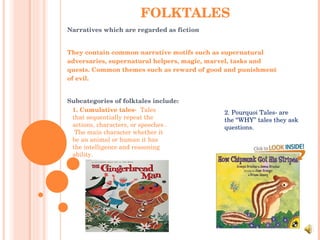
FOLKTALES Narratives which are regarded as fiction They contain common narrative motifs such as supernatural adversaries, supernatural helpers, magic, marvel, tasks and quests. Common themes such as reward of good and punishment of evil.  Subcategories of folktales include: 1. Cumulative tales-  Tales that sequentially repeat the actions, characters, or speeches .  The main character whether it be an animal or human it has the intelligence and reasoning ability.  2. Pourquoi Tales- are the “WHY” tales they ask questions.
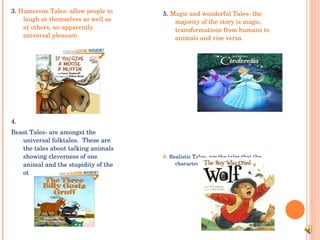
3.  Humorous Tales- allow people to laugh at themselves as well as at others, an apparently universal pleasure. 4.  Beast Tales- are amongst the universal folktales.  These are the tales about talking animals showing cleverness of one animal and the stupidity of the other. 5.  Magic and wonderful Tales- the majority of the story is magic, transformations from humans to animals and vise versa.  6.  Realistic Tales- are the tales that the characters could actually exist.
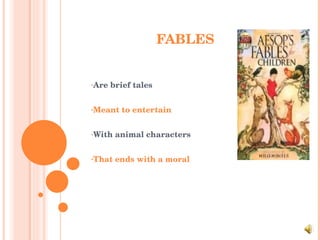
FABLES Are brief tales Meant to entertain With animal characters That ends with a moral
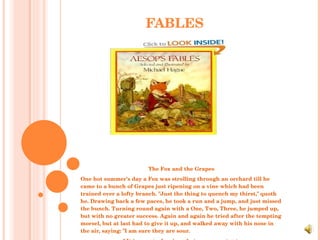
FABLES The Fox and the Grapes One hot summer's day a Fox was strolling through an orchard till he came to a bunch of Grapes just ripening on a vine which had been trained over a lofty branch. "Just the thing to quench my thirst," quoth he. Drawing back a few paces, he took a run and a jump, and just missed the bunch. Turning round again with a One, Two, Three, he jumped up, but with no greater success. Again and again he tried after the tempting morsel, but at last had to give it up, and walked away with his nose in the air, saying: "I am sure they are sour. " It is easy to despise what you cannot get.
MYTH A Legendary story, usually circled around a hero or event, that has no explanation as to how it happened. It usually is related to some sort of phenomenon
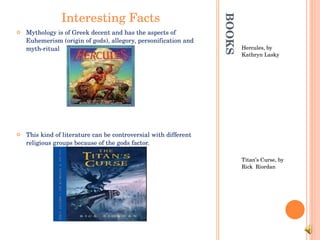
BOOKS Interesting Facts Mythology is of Greek decent and has the aspects of Euhemerism (origin of gods), allegory, personification and myth-ritual This kind of literature can be controversial with different religious groups because of the gods factor.  Hercules, by  Kathryn Lasky Titan’s Curse, by  Rick  Riordan
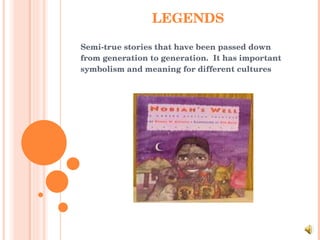
LEGENDS Semi-true stories that have been passed down from generation to generation.  It has important symbolism and meaning for different cultures
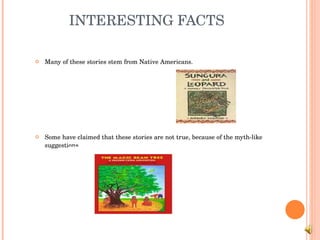
INTERESTING FACTS Many of these stories stem from Native Americans. Some have claimed that these stories are not true, because of the myth-like suggestions.
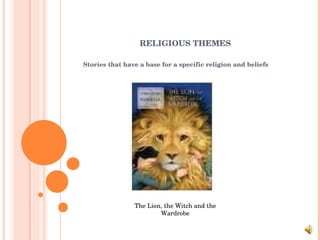
RELIGIOUS THEMES Stories that have a base for a specific religion and beliefs The Lion, the Witch and the Wardrobe
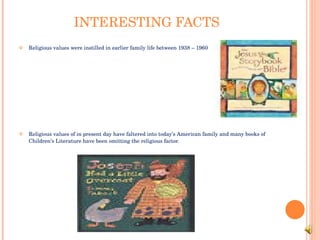
INTERESTING FACTS Religious values were instilled in earlier family life between 1938 – 1960 Religious values of in present day have faltered into today’s American family and many books of Children’s Literature have been omitting the religious factor.
REFERENCE Norton, Donna & Norton, Saundra (2011).  Through the eyes of a child: An introduction to children's literature  (8th ed.). Upper Saddle River, NJ: Merrill Prentice Hall, ISBN 0-137-02875X  (n.d.). Retrieved September 1, 2010, from Books: http://www.amazon.com/Childrens-Books/b/ref=bhp_bb0309A_childr2?ie=UTF8&node=4&pf_rd_m=ATVPDKIKX0DER&pf_rd_s=browse&pf_rd_r=1MRZ89YFQ1PFDY2B0HS9&pf_rd_t=101&pf_rd_p=1273387142&pf_rd_i=283155 Smith, C. L. (n.d.).  Cythian Leitich Smith . Retrieved from http://www.cynthialeitichsmith.com/lit_resources/diversity/multicultural/multi_background.html  

Traditional literature

  • 1.
    TRADITIONAL LITERATURE By:Jarne’ Steptoe & Kristy Campbell
  • 2.
    WHAT IS TRADITIONALLITERATURE? The terms "folk/fairy tales" are interchangeable.  They are called "folk" because they are part of the oral tradition handed down from generation to generation by the folk.  The term "fairy" denotes the presence of magic, characters like dwarfs, leprechauns, and the like.
  • 3.
    FOLKTALES Narratives whichare regarded as fiction They contain common narrative motifs such as supernatural adversaries, supernatural helpers, magic, marvel, tasks and quests. Common themes such as reward of good and punishment of evil. Subcategories of folktales include: 1. Cumulative tales- Tales that sequentially repeat the actions, characters, or speeches . The main character whether it be an animal or human it has the intelligence and reasoning ability. 2. Pourquoi Tales- are the “WHY” tales they ask questions.
  • 4.
    3. HumorousTales- allow people to laugh at themselves as well as at others, an apparently universal pleasure. 4. Beast Tales- are amongst the universal folktales. These are the tales about talking animals showing cleverness of one animal and the stupidity of the other. 5. Magic and wonderful Tales- the majority of the story is magic, transformations from humans to animals and vise versa. 6. Realistic Tales- are the tales that the characters could actually exist.
  • 5.
    FABLES Are brieftales Meant to entertain With animal characters That ends with a moral
  • 6.
    FABLES The Foxand the Grapes One hot summer's day a Fox was strolling through an orchard till he came to a bunch of Grapes just ripening on a vine which had been trained over a lofty branch. "Just the thing to quench my thirst," quoth he. Drawing back a few paces, he took a run and a jump, and just missed the bunch. Turning round again with a One, Two, Three, he jumped up, but with no greater success. Again and again he tried after the tempting morsel, but at last had to give it up, and walked away with his nose in the air, saying: "I am sure they are sour. " It is easy to despise what you cannot get.
  • 7.
    MYTH A Legendarystory, usually circled around a hero or event, that has no explanation as to how it happened. It usually is related to some sort of phenomenon
  • 8.
    BOOKS Interesting FactsMythology is of Greek decent and has the aspects of Euhemerism (origin of gods), allegory, personification and myth-ritual This kind of literature can be controversial with different religious groups because of the gods factor. Hercules, by Kathryn Lasky Titan’s Curse, by Rick Riordan
  • 9.
    LEGENDS Semi-true storiesthat have been passed down from generation to generation. It has important symbolism and meaning for different cultures
  • 10.
    INTERESTING FACTS Manyof these stories stem from Native Americans. Some have claimed that these stories are not true, because of the myth-like suggestions.
  • 11.
    RELIGIOUS THEMES Storiesthat have a base for a specific religion and beliefs The Lion, the Witch and the Wardrobe
  • 12.
    INTERESTING FACTS Religiousvalues were instilled in earlier family life between 1938 – 1960 Religious values of in present day have faltered into today’s American family and many books of Children’s Literature have been omitting the religious factor.
  • 13.
    REFERENCE Norton, Donna& Norton, Saundra (2011). Through the eyes of a child: An introduction to children's literature (8th ed.). Upper Saddle River, NJ: Merrill Prentice Hall, ISBN 0-137-02875X (n.d.). Retrieved September 1, 2010, from Books: http://www.amazon.com/Childrens-Books/b/ref=bhp_bb0309A_childr2?ie=UTF8&node=4&pf_rd_m=ATVPDKIKX0DER&pf_rd_s=browse&pf_rd_r=1MRZ89YFQ1PFDY2B0HS9&pf_rd_t=101&pf_rd_p=1273387142&pf_rd_i=283155 Smith, C. L. (n.d.). Cythian Leitich Smith . Retrieved from http://www.cynthialeitichsmith.com/lit_resources/diversity/multicultural/multi_background.html  

Editor's Notes

  • #4 May or may not have happened and they are not taken serious