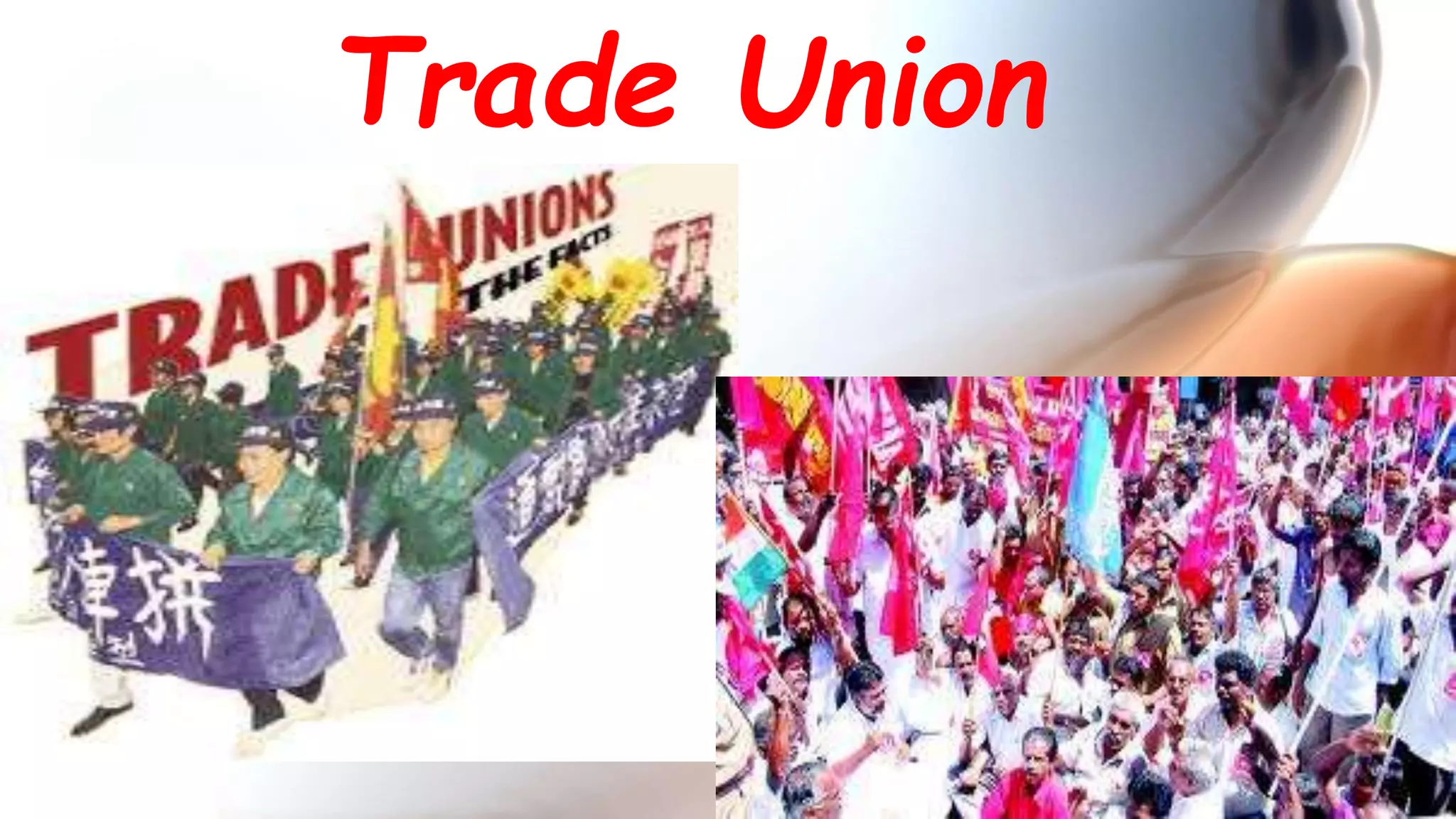
Trade Union
Trade unions are associations of workers or organization formed together by
labor, workers or employees to achieve their demands for better conditions
at their work atmosphere.
• Formed to protect and promote the interests of their members
• Primary function is to protect the interests of workers against discrimination
and unfair labor practices
Meaning Trade union
• Representation (Workers’ Interests)
• Negotiation (Collective Bargaining)
• Voice in decisions (Lay off, Retrenchment) affecting workers
• Member Service (Education, Training, Welfare, Discounts, Loans)
Objectives
Definition
-Trade Union is an organization of workers who have banded together to
achieve common goals such as protecting the integrity of its trade, achieving
higher pay, increasing the number of employees an employer hires, and better
working conditions.
-A group of employees in a particular sector, whose aim is to negotiate with
employees over pay, job security, working hours, etc. using the collective
power of the members.
-The most common purpose of these associations or unions is "maintaining or
improving the conditions of their employment".
4
why do workers join unions
Greater Bargaining Power
The individual employee possesses very little bargaining power as
compared to that of his employer. If he is not satisfied with the wage and other
conditions of employment, he can leave the job
Minimize Discrimination
He decisions regarding pay, work, transfer, promotion, etc. are highly
subjective in nature. The personal relationships existing between the
supervisor and each of his subordinates may influence the management.
Sense of Security
The employees may join the unions because of their belief that it is an
effective way to secure adequate protection from various types of hazards and
income insecurity such as accident, injury, illness, unemployment, etc.
Sense of Participation
The employees can participate in management of matters affecting their
interests only if they join trade unions. They can influence the decisions that are
taken as a result of collective bargaining between the union and the
management.
Sense of Belongingness
Those who are members of a union feel that they gain respect in the eyes of
their fellow workers. They can also discuss their problem with’ the trade union
leaders.
why do workers join
unions(Cont.)
Platform for self-expression
The desire for self-expression is a fundamental human drive for most people. the
workers also want the management to listen to them. A trade union provides such a
forum where the feelings, ideas and opinions of the workers could be discussed.
Betterment of relationships
Another reason for employees joining unions is that employees feel that unions can
fulfill the important need for adequate machinery for proper maintenance of employer-
employee relations. Unions help in betterment of industrial relations among
management and workers by solving the problems peacefully.
why do workers join unions (Cont.)
Classification based on ideology
a. Revolutionary Unions: Believe in destruction of existing social/economic
order and creation of a new one. They want shift in power and authority and
use of force - Left Unions.
b. Reformist or Welfare Unions: Work for changes and reforms within
existing socio-political framework of society - European Model.
c. Uplift Unions: Advocate extensive reforms well beyond the area of working
condition i.e., change in taxation system, elimination of poverty etc.
Classification of Trade Unions
Another common explanation of unions based on trades or crafts is that
between so called blue-collar workers and white-collar workers.
Unions representing workers employed on the production floor, or
outdoor trades such as in construction work, are called blue-collar unions.
Similarly, those employees in shops and offices and who are not in
management grades and perform clerical and allied functions are called white-
collar workers.
In addition, trade unions may be categorised on the basis of the industry
in which they are employed. Examples of these are workers engaged in
agriculture of forestry: hence agricultural labour unions or forest worker
unions.
Classification of Trade Unions (Cont.)
Classification based on agreement
a. Closed Shop: Where management and union agree that the union would have
sole responsibility and authority for the recruitment of workers, it is called a
Closed Shop agreement. The worker joins the union to become an employee of
the shop.
b. Union Shop: Where there is an agreement that all new recruits must join the
union within a fixed period after employment it is called a union shop.
Classification of Trade Unions
(Cont.)
Classification based on agreement (Cont.)
c. Preferential Shop: When a Union member is given preference in filling a
vacancy, such an agreement is called Preferential Shop.
d. Maintenance Shop: In this type of arrangement no compulsory membership in
the union before or after recruitment exists. However, if the employee chooses to
become a member after recruitment, his membership remains compulsory right
throughout his tenure of employment with that particular employer. This is called
a maintenance of membership shop or maintenance shop.
Classification of Trade Unions (Cont.)
Classification based on agreement (Cont.)
e. Agency Shop: In terms of the agreement between management and the
union a non union member has to pay the union a sum equivalent to a
member’s subscription in order to continue employment with the employer.
This is called an agency shop.
f. Open Shop: Membership in a union is in no way compulsory or compulsory
either before or after recruitment. In such organisations, sometimes there is
no union at all. This is least desirable form for unions.
Classification of Trade Unions (Cont.)
Theories of Trade Unions
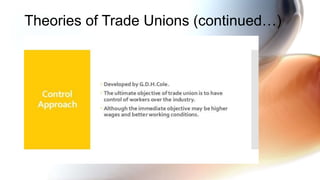
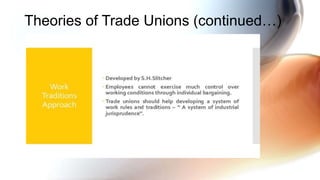
Theories of Trade Unions (continued…)
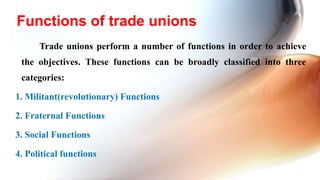
Trade unions perform a number of functions in order to achieve
the objectives. These functions can be broadly classified into three
categories:
1. Militant(revolutionary) Functions
2. Fraternal Functions
3. Social Functions
4. Political functions
Functions of trade unions
When the unions fail to accomplish their aims by the method of
collective bargaining and negotiations, they adopt an approach and put up a fight
with the management in the form of go-slow tactics, strike, boycott, gherao’s, etc.
Hence, these functions of the trade unions are known as militant or fighting
functions. Thus, the militant functions of trade unions can be summed up as:
• To achieve higher wages and better working conditions
• To raise the status of workers as a part of industry
• To protect labors against victimization and injustice
Militant Functions
They take up welfare measures for improving the morale of workers and generate
self confidence among them. They also arrange for legal assistance to its members, if
necessary. Besides, these, they undertake many welfare measures for their members, e.g.,
education of children, library, reading-rooms, in-door and out-door games, and Some
trade unions even undertake publication of some magazine or journal.
• To take up welfare measures for improving the morale of workers
• To generate self confidence among workers
• To encourage sincerity and discipline among workers
• To provide opportunities for promotion and growth
• To protect women workers against discrimination
Fraternal Functions
Besides the main economic functions consisting basically of organising unions and
improving their terms and conditions of employment to enable workers to meet their
physical needs, some unions have now started undertaking and organising welfare
activities and also providing variety of services to their members and sometimes to the
community of which they are a part, which may be grouped under following heads:
1) Welfare activities improve the quality of work life ,cooperative credit societies,
cooperative stores, cultural programmes, banking and medical facilities and training
for women
Social Functions
2) Education: awareness in the environment around them, enhancement of their knowledge
particularly in regard to issues that concern them, their statutory and other rights and
responsibilities, workers’ participation in management.
3) scheme, and procedure for redressing their grievances. Some central union
organizations are also assisting the Government in implementing the Workers’ Education
Scheme.
4) Publication of periodicals, news letters or magazines for establishing communication
with their members, making the latter aware of union policy and stand on certain principal
issues and personnel matters concerning members, such as births, deaths, marriages,
promotion and achievements
5) Research: Of late, this is gaining importance and is intended mainly to provide
updated information to union negotiators at the bargaining table. Such research
is to be more practical than academic, concerning problems relating to day-today
affairs of the union and its activities and union and management relations.
Political functions:
These functions include affiliating the union with a political party, helping the
political party in enrolling members, collecting donations, seeking the help of
political parties during the periods of strikes and lockouts.
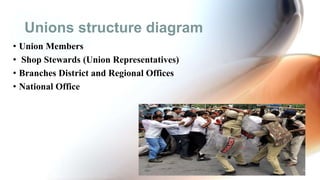
Unions structure diagram
• Union Members
• Shop Stewards (Union Representatives)
• Branches District and Regional Offices
• National Office
Trade unions are democratic organizations which are accountable to their members
for their policies and actions. Unions are normally modeled on the following structure:
• Members - people who pay a subscription to belong to a union
• Shop stewards - sometimes called union representatives - who are elected by
members of the union to represent them to management
• Branches - which support union members in different organizations locally. There is
usually a branch secretary who is elected by local members
 District and/or regional offices - these are usually staffed by full time
union officials. These are people who are paid to offer advice and
support to union members locally
 A national office - the union's headquarters which offers support to
union members and negotiates or campaigns for improvements to their
working conditions. At the top of the organization there is usually a
General Secretary and a National Executive Committee, elected by the
union's members.
Contd………
History of Trade Unions
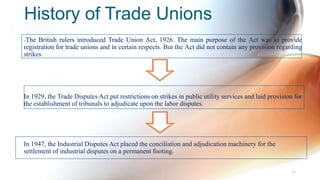
-The British rulers introduced Trade Union Act, 1926. The main purpose of the Act was to provide
registration for trade unions and in certain respects. But the Act did not contain any provision regarding
strikes.
In 1929, the Trade Disputes Act put restrictions on strikes in public utility services and laid provision for
the establishment of tribunals to adjudicate upon the labor disputes.
In 1947, the Industrial Disputes Act placed the conciliation and adjudication machinery for the
settlement of industrial disputes on a permanent footing.
31
History of Trade Unions
The Pakistan Period (1947-71)
-The East Pakistan Trade Unions Act, 1965 was enacted repealing the
Trade Unions Act, 1926.
-The Labor Disputes Act, 1965 was enacted.
-Industrial Relations Ordinance, 1969 was enacted integrating the above
two Acts.
32
Bangladesh Period (1971-onwards)
-Government of Bangladesh declared a labor policy in 1972. The right to strike and
collective bargaining in the nationalized industries was prohibited for six months by
Presidential order no. 55 in May 1972.
-In 1973, the right to strike and lockout, as granted by IRO, 1969 was withdrawn.
-In 1974 Act completely suspended the democratic rights of workers by prohibiting trade
union activities such as strikes, lock-outs, collective bargaining.
-The military regime of 1975 imposed restrictions on the rights of collective bargaining.
-The Industrial Relations (Amendment) Ordinance, 1977 liberalized the Rights of Freedom
of Association
-The Labor Policy of 1980 restored the right to freedom of association to a considerable
extent
-In 1982 the military regime banned trade union activities, strikes, and right of freedom of
association.
33
-Full trade union activities were restored by the democratic government in
1991.
-In 2006, an updated, consolidated and unified version of labor laws was
enacted.
-During the Emergency in 2007-2008 that lasted for 23 months, trade unions
and collective bargaining were prohibited and the determination of collective
bargaining agent could not be made.
-However, full trade union activities were restored by the democratic
government in 2009.
34
Trade union movement started in Bangladesh early 19th century when modern industrial concept
entered into the sub-continent
The Bangladesh constitution provides for freedom of association; in order to register
- Unions must at least 30% of the workers representation of an enterprise
- Must obtain authorization from the government
- The Registrar may also cancel the registration with Labor Court approval
In general, only current employees can be union members, which mean that the loss of a job also
leads to the loss of union membership
The trade unions are very strong in Bangladesh, although only 3.5 percent of the workforce is
unionized, but most of the unions are limited to the public sector or state-controlled enterprises.
The private sector is less unionized and trade unions are practically banned from the Export
Processing Zones (EPZ), as the EPZ is exempted from certain labor laws.
About 1.8 million of the country's workers belong to unions, out of a total workforce of approximately
58 million.
Most of the federations are financially weak and don't have in-house development programmes for the
activists. Education level of the workers are not in a satisfactory level. Offices are not equipped with
modern communication system.
TRADE UNION SITUATION IN BANGLADESH
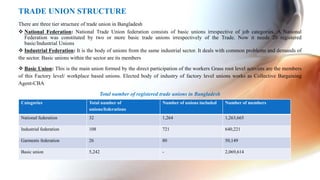
There are three tier structure of trade union in Bangladesh
 National Federation: National Trade Union federation consists of basic unions irrespective of job categories. A National
Federation was constituted by two or more basic trade unions irrespectively of the Trade. Now it needs 20 registered
basic/Industrial Unions
 Industrial Federation: It is the body of unions from the same industrial sector. It deals with common problems and demands of
the sector. Basic unions within the sector are its members
 Basic Union: This is the main union formed by the direct participation of the workers Grass root level activists are the members
of this Factory level/ workplace based unions. Elected body of industry of factory level unions works as Collective Bargaining
Agent-CBA
Total number of registered trade unions in Bangladesh
TRADE UNION STRUCTURE
Categories Total number of
unions/federations
Number of unions included Number of members
National federation 32 1,264 1,263,665
Industrial federation 108 721 640,221
Garments federation 26 80 50,149
Basic union 5,242 - 2,069,614
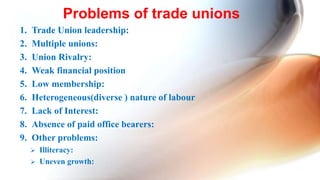
1. Trade Union leadership:
2. Multiple unions:
3. Union Rivalry:
4. Weak financial position
5. Low membership:
6. Heterogeneous(diverse ) nature of labour
7. Lack of Interest:
8. Absence of paid office bearers:
9. Other problems:
 Illiteracy:
 Uneven growth:
Problems of trade unions
Negative impacts
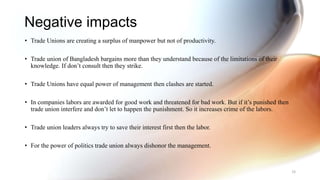
• Trade Unions are creating a surplus of manpower but not of productivity.
• Trade union of Bangladesh bargains more than they understand because of the limitations of their
knowledge. If don’t consult then they strike.
• Trade Unions have equal power of management then clashes are started.
• In companies labors are awarded for good work and threatened for bad work. But if it’s punished then
trade union interfere and don’t let to happen the punishment. So it increases crime of the labors.
• Trade union leaders always try to save their interest first then the labor.
• For the power of politics trade union always dishonor the management.
38
Positive impacts
• Trade union plays a major role in creating ideal working conditions.
• Trade union always helps management to create better policies for workers.
• Trade unions negotiate for the standard wage and benefits with the management.
• Trade union helps the management to increases the productivity as well as the profit.
• Political influence’s existence makes the trade union not to interfere in management
decisions.
• Trade union is hugely helping the management to produce more and implementing
management tactics.
39

Trade Union.ppt

  • 1.
  • 2.
    Trade unions areassociations of workers or organization formed together by labor, workers or employees to achieve their demands for better conditions at their work atmosphere. • Formed to protect and promote the interests of their members • Primary function is to protect the interests of workers against discrimination and unfair labor practices Meaning Trade union
  • 3.
    • Representation (Workers’Interests) • Negotiation (Collective Bargaining) • Voice in decisions (Lay off, Retrenchment) affecting workers • Member Service (Education, Training, Welfare, Discounts, Loans) Objectives
  • 4.
    Definition -Trade Union isan organization of workers who have banded together to achieve common goals such as protecting the integrity of its trade, achieving higher pay, increasing the number of employees an employer hires, and better working conditions. -A group of employees in a particular sector, whose aim is to negotiate with employees over pay, job security, working hours, etc. using the collective power of the members. -The most common purpose of these associations or unions is "maintaining or improving the conditions of their employment". 4
  • 5.
    why do workersjoin unions Greater Bargaining Power The individual employee possesses very little bargaining power as compared to that of his employer. If he is not satisfied with the wage and other conditions of employment, he can leave the job Minimize Discrimination He decisions regarding pay, work, transfer, promotion, etc. are highly subjective in nature. The personal relationships existing between the supervisor and each of his subordinates may influence the management. Sense of Security The employees may join the unions because of their belief that it is an effective way to secure adequate protection from various types of hazards and income insecurity such as accident, injury, illness, unemployment, etc.
  • 6.
    Sense of Participation Theemployees can participate in management of matters affecting their interests only if they join trade unions. They can influence the decisions that are taken as a result of collective bargaining between the union and the management. Sense of Belongingness Those who are members of a union feel that they gain respect in the eyes of their fellow workers. They can also discuss their problem with’ the trade union leaders. why do workers join unions(Cont.)
  • 7.
    Platform for self-expression Thedesire for self-expression is a fundamental human drive for most people. the workers also want the management to listen to them. A trade union provides such a forum where the feelings, ideas and opinions of the workers could be discussed. Betterment of relationships Another reason for employees joining unions is that employees feel that unions can fulfill the important need for adequate machinery for proper maintenance of employer- employee relations. Unions help in betterment of industrial relations among management and workers by solving the problems peacefully. why do workers join unions (Cont.)
  • 8.
    Classification based onideology a. Revolutionary Unions: Believe in destruction of existing social/economic order and creation of a new one. They want shift in power and authority and use of force - Left Unions. b. Reformist or Welfare Unions: Work for changes and reforms within existing socio-political framework of society - European Model. c. Uplift Unions: Advocate extensive reforms well beyond the area of working condition i.e., change in taxation system, elimination of poverty etc. Classification of Trade Unions
  • 9.
    Another common explanationof unions based on trades or crafts is that between so called blue-collar workers and white-collar workers. Unions representing workers employed on the production floor, or outdoor trades such as in construction work, are called blue-collar unions. Similarly, those employees in shops and offices and who are not in management grades and perform clerical and allied functions are called white- collar workers. In addition, trade unions may be categorised on the basis of the industry in which they are employed. Examples of these are workers engaged in agriculture of forestry: hence agricultural labour unions or forest worker unions. Classification of Trade Unions (Cont.)
  • 10.
    Classification based onagreement a. Closed Shop: Where management and union agree that the union would have sole responsibility and authority for the recruitment of workers, it is called a Closed Shop agreement. The worker joins the union to become an employee of the shop. b. Union Shop: Where there is an agreement that all new recruits must join the union within a fixed period after employment it is called a union shop. Classification of Trade Unions (Cont.)
  • 11.
    Classification based onagreement (Cont.) c. Preferential Shop: When a Union member is given preference in filling a vacancy, such an agreement is called Preferential Shop. d. Maintenance Shop: In this type of arrangement no compulsory membership in the union before or after recruitment exists. However, if the employee chooses to become a member after recruitment, his membership remains compulsory right throughout his tenure of employment with that particular employer. This is called a maintenance of membership shop or maintenance shop. Classification of Trade Unions (Cont.)
  • 12.
    Classification based onagreement (Cont.) e. Agency Shop: In terms of the agreement between management and the union a non union member has to pay the union a sum equivalent to a member’s subscription in order to continue employment with the employer. This is called an agency shop. f. Open Shop: Membership in a union is in no way compulsory or compulsory either before or after recruitment. In such organisations, sometimes there is no union at all. This is least desirable form for unions. Classification of Trade Unions (Cont.)
  • 13.
  • 14.
    Theories of TradeUnions (continued…)
  • 15.
    Theories of TradeUnions (continued…)
  • 16.
    Theories of TradeUnions (continued…)
  • 17.
    Theories of TradeUnions (continued…)
  • 18.
    Theories of TradeUnions (continued…)
  • 19.
    Theories of TradeUnions (continued…)
  • 20.
    Theories of TradeUnions (continued…)
  • 21.
    Theories of TradeUnions (continued…)
  • 22.
    Trade unions performa number of functions in order to achieve the objectives. These functions can be broadly classified into three categories: 1. Militant(revolutionary) Functions 2. Fraternal Functions 3. Social Functions 4. Political functions Functions of trade unions
  • 23.
    When the unionsfail to accomplish their aims by the method of collective bargaining and negotiations, they adopt an approach and put up a fight with the management in the form of go-slow tactics, strike, boycott, gherao’s, etc. Hence, these functions of the trade unions are known as militant or fighting functions. Thus, the militant functions of trade unions can be summed up as: • To achieve higher wages and better working conditions • To raise the status of workers as a part of industry • To protect labors against victimization and injustice Militant Functions
  • 24.
    They take upwelfare measures for improving the morale of workers and generate self confidence among them. They also arrange for legal assistance to its members, if necessary. Besides, these, they undertake many welfare measures for their members, e.g., education of children, library, reading-rooms, in-door and out-door games, and Some trade unions even undertake publication of some magazine or journal. • To take up welfare measures for improving the morale of workers • To generate self confidence among workers • To encourage sincerity and discipline among workers • To provide opportunities for promotion and growth • To protect women workers against discrimination Fraternal Functions
  • 25.
    Besides the maineconomic functions consisting basically of organising unions and improving their terms and conditions of employment to enable workers to meet their physical needs, some unions have now started undertaking and organising welfare activities and also providing variety of services to their members and sometimes to the community of which they are a part, which may be grouped under following heads: 1) Welfare activities improve the quality of work life ,cooperative credit societies, cooperative stores, cultural programmes, banking and medical facilities and training for women Social Functions
  • 26.
    2) Education: awarenessin the environment around them, enhancement of their knowledge particularly in regard to issues that concern them, their statutory and other rights and responsibilities, workers’ participation in management. 3) scheme, and procedure for redressing their grievances. Some central union organizations are also assisting the Government in implementing the Workers’ Education Scheme. 4) Publication of periodicals, news letters or magazines for establishing communication with their members, making the latter aware of union policy and stand on certain principal issues and personnel matters concerning members, such as births, deaths, marriages, promotion and achievements
  • 27.
    5) Research: Oflate, this is gaining importance and is intended mainly to provide updated information to union negotiators at the bargaining table. Such research is to be more practical than academic, concerning problems relating to day-today affairs of the union and its activities and union and management relations. Political functions: These functions include affiliating the union with a political party, helping the political party in enrolling members, collecting donations, seeking the help of political parties during the periods of strikes and lockouts.
  • 28.
    Unions structure diagram •Union Members • Shop Stewards (Union Representatives) • Branches District and Regional Offices • National Office
  • 29.
    Trade unions aredemocratic organizations which are accountable to their members for their policies and actions. Unions are normally modeled on the following structure: • Members - people who pay a subscription to belong to a union • Shop stewards - sometimes called union representatives - who are elected by members of the union to represent them to management • Branches - which support union members in different organizations locally. There is usually a branch secretary who is elected by local members
  • 30.
     District and/orregional offices - these are usually staffed by full time union officials. These are people who are paid to offer advice and support to union members locally  A national office - the union's headquarters which offers support to union members and negotiates or campaigns for improvements to their working conditions. At the top of the organization there is usually a General Secretary and a National Executive Committee, elected by the union's members. Contd………
  • 31.
    History of TradeUnions -The British rulers introduced Trade Union Act, 1926. The main purpose of the Act was to provide registration for trade unions and in certain respects. But the Act did not contain any provision regarding strikes. In 1929, the Trade Disputes Act put restrictions on strikes in public utility services and laid provision for the establishment of tribunals to adjudicate upon the labor disputes. In 1947, the Industrial Disputes Act placed the conciliation and adjudication machinery for the settlement of industrial disputes on a permanent footing. 31
  • 32.
    History of TradeUnions The Pakistan Period (1947-71) -The East Pakistan Trade Unions Act, 1965 was enacted repealing the Trade Unions Act, 1926. -The Labor Disputes Act, 1965 was enacted. -Industrial Relations Ordinance, 1969 was enacted integrating the above two Acts. 32
  • 33.
    Bangladesh Period (1971-onwards) -Governmentof Bangladesh declared a labor policy in 1972. The right to strike and collective bargaining in the nationalized industries was prohibited for six months by Presidential order no. 55 in May 1972. -In 1973, the right to strike and lockout, as granted by IRO, 1969 was withdrawn. -In 1974 Act completely suspended the democratic rights of workers by prohibiting trade union activities such as strikes, lock-outs, collective bargaining. -The military regime of 1975 imposed restrictions on the rights of collective bargaining. -The Industrial Relations (Amendment) Ordinance, 1977 liberalized the Rights of Freedom of Association -The Labor Policy of 1980 restored the right to freedom of association to a considerable extent -In 1982 the military regime banned trade union activities, strikes, and right of freedom of association. 33
  • 34.
    -Full trade unionactivities were restored by the democratic government in 1991. -In 2006, an updated, consolidated and unified version of labor laws was enacted. -During the Emergency in 2007-2008 that lasted for 23 months, trade unions and collective bargaining were prohibited and the determination of collective bargaining agent could not be made. -However, full trade union activities were restored by the democratic government in 2009. 34
  • 35.
    Trade union movementstarted in Bangladesh early 19th century when modern industrial concept entered into the sub-continent The Bangladesh constitution provides for freedom of association; in order to register - Unions must at least 30% of the workers representation of an enterprise - Must obtain authorization from the government - The Registrar may also cancel the registration with Labor Court approval In general, only current employees can be union members, which mean that the loss of a job also leads to the loss of union membership The trade unions are very strong in Bangladesh, although only 3.5 percent of the workforce is unionized, but most of the unions are limited to the public sector or state-controlled enterprises. The private sector is less unionized and trade unions are practically banned from the Export Processing Zones (EPZ), as the EPZ is exempted from certain labor laws. About 1.8 million of the country's workers belong to unions, out of a total workforce of approximately 58 million. Most of the federations are financially weak and don't have in-house development programmes for the activists. Education level of the workers are not in a satisfactory level. Offices are not equipped with modern communication system. TRADE UNION SITUATION IN BANGLADESH
  • 36.
    There are threetier structure of trade union in Bangladesh  National Federation: National Trade Union federation consists of basic unions irrespective of job categories. A National Federation was constituted by two or more basic trade unions irrespectively of the Trade. Now it needs 20 registered basic/Industrial Unions  Industrial Federation: It is the body of unions from the same industrial sector. It deals with common problems and demands of the sector. Basic unions within the sector are its members  Basic Union: This is the main union formed by the direct participation of the workers Grass root level activists are the members of this Factory level/ workplace based unions. Elected body of industry of factory level unions works as Collective Bargaining Agent-CBA Total number of registered trade unions in Bangladesh TRADE UNION STRUCTURE Categories Total number of unions/federations Number of unions included Number of members National federation 32 1,264 1,263,665 Industrial federation 108 721 640,221 Garments federation 26 80 50,149 Basic union 5,242 - 2,069,614
  • 37.
    1. Trade Unionleadership: 2. Multiple unions: 3. Union Rivalry: 4. Weak financial position 5. Low membership: 6. Heterogeneous(diverse ) nature of labour 7. Lack of Interest: 8. Absence of paid office bearers: 9. Other problems:  Illiteracy:  Uneven growth: Problems of trade unions
  • 38.
    Negative impacts • TradeUnions are creating a surplus of manpower but not of productivity. • Trade union of Bangladesh bargains more than they understand because of the limitations of their knowledge. If don’t consult then they strike. • Trade Unions have equal power of management then clashes are started. • In companies labors are awarded for good work and threatened for bad work. But if it’s punished then trade union interfere and don’t let to happen the punishment. So it increases crime of the labors. • Trade union leaders always try to save their interest first then the labor. • For the power of politics trade union always dishonor the management. 38
  • 39.
    Positive impacts • Tradeunion plays a major role in creating ideal working conditions. • Trade union always helps management to create better policies for workers. • Trade unions negotiate for the standard wage and benefits with the management. • Trade union helps the management to increases the productivity as well as the profit. • Political influence’s existence makes the trade union not to interfere in management decisions. • Trade union is hugely helping the management to produce more and implementing management tactics. 39