Qualitative English Work
The path taken by
women in the job
market and in politics
School: Pensi Icaraí II
Class: 205 ‐ Tarde
Teacher: Emanuelle Diniz
Students :
Julia Ballard
Igor Sansão
Beatriz Muniz
Hugo Cavalcanti
Paulo Victor
Felipe Klayn
1
Goals:
• Analyze the process of insertion of women in the
job market and in politics.
• Discuss and show the difficulties faced by
women seeking gender equality in the job
market and in politics.
• Show the differences between women and men
in the job market.
2
Beginning in the job market
In the period extending from the late eighteenth to
the early nineteenth century, there was a marked
definition of the feminine and masculine tasks. For
the woman, it was the role of being a good wife, a
good mother, and caring for the house.
Already the man was responsible for heavy work, he
was always involved in political and economic
affairs
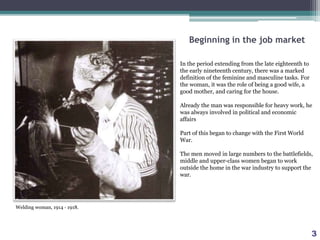
Part of this began to change with the First World
War.
The men moved in large numbers to the battlefields,
middle and upper-class women began to work
outside the home in the war industry to support the
war.
Welding woman, 1914 ‐ 1918.
3
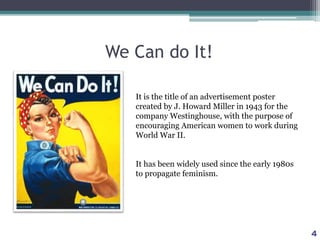
We Can do It!
It is the title of an advertisement poster
created by J. Howard Miller in 1943 for the
company Westinghouse, with the purpose of
encouraging American women to work during
World War II.
It has been widely used since the early 1980s
to propagate feminism.
4
The beginning in politics
Although only men participated in politics,
women discussed their opinions with other
women and participated, always present in the
stands open to the public.
"The beginning of the change was in March 1792
where the French activist, Pauline Leon, A
petition signed by 300 women, claiming the
right to organize in National Guard. And of
course, the revolutionaries did not allow such an
organization.
In spite of the failure, the French Revolution
changed the feminine condition, from that
moment on, the question about the role and the
rights of the woman is changed. Through this
period the women realized that they did not
have to be submissive to men. They gained
rights over marital status and divorce and
established the same rights of parental authority
for both father and mother.
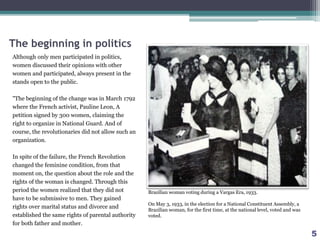
Brazilian woman voting during a Vargas Era, 1933.
On May 3, 1933, in the election for a National Constituent Assembly, a
Brazilian woman, for the first time, at the national level, voted and was
voted.
5
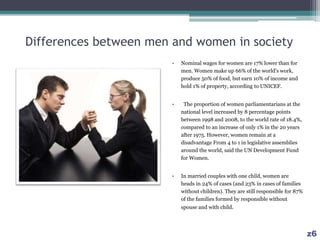
Differences between men and women in society
• Nominal wages for women are 17% lower than for
men. Women make up 66% of the world's work,
produce 50% of food, but earn 10% of income and
hold 1% of property, according to UNICEF.
• The proportion of women parliamentarians at the
national level increased by 8 percentage points
between 1998 and 2008, to the world rate of 18.4%,
compared to an increase of only 1% in the 20 years
after 1975. However, women remain at a
disadvantage From 4 to 1 in legislative assemblies
around the world, said the UN Development Fund
for Women.
• In married couples with one child, women are
heads in 24% of cases (and 23% in cases of families
without children). They are still responsible for 87%
of the families formed by responsible without
spouse and with child.
z6
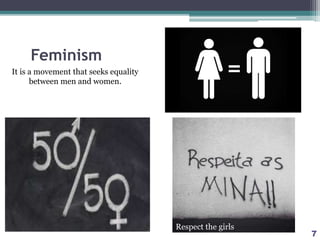
Feminism
It is a movement that seeks equality
between men and women.
7
Respect the girls
Types of Feminism:
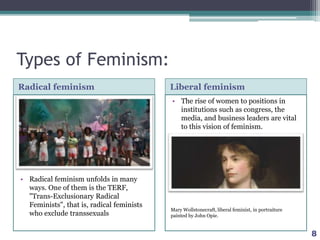
Radical feminism Liberal feminism
• Radical feminism unfolds in many
ways. One of them is the TERF,
"Trans-Exclusionary Radical
Feminists", that is, radical feminists
who exclude transsexuals
• The rise of women to positions in
institutions such as congress, the
media, and business leaders are vital
to this vision of feminism.
8
Mary Wollstonecraft, liberal feminist, in portraiture
painted by John Opie.
Types of Feminism:
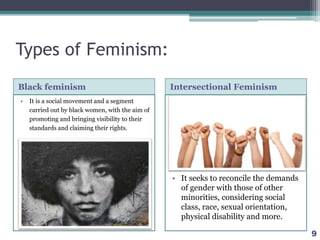
Black feminism Intersectional Feminism
• It is a social movement and a segment
carried out by black women, with the aim of
promoting and bringing visibility to their
standards and claiming their rights.
• It seeks to reconcile the demands
of gender with those of other
minorities, considering social
class, race, sexual orientation,
physical disability and more.
9
Conclusão:
10

Trabalho qualitativado de inglês ingles1

  • 1.
    Qualitative English Work Thepath taken by women in the job market and in politics School: Pensi Icaraí II Class: 205 ‐ Tarde Teacher: Emanuelle Diniz Students : Julia Ballard Igor Sansão Beatriz Muniz Hugo Cavalcanti Paulo Victor Felipe Klayn 1
  • 2.
    Goals: • Analyze theprocess of insertion of women in the job market and in politics. • Discuss and show the difficulties faced by women seeking gender equality in the job market and in politics. • Show the differences between women and men in the job market. 2
  • 3.
    Beginning in thejob market In the period extending from the late eighteenth to the early nineteenth century, there was a marked definition of the feminine and masculine tasks. For the woman, it was the role of being a good wife, a good mother, and caring for the house. Already the man was responsible for heavy work, he was always involved in political and economic affairs Part of this began to change with the First World War. The men moved in large numbers to the battlefields, middle and upper-class women began to work outside the home in the war industry to support the war. Welding woman, 1914 ‐ 1918. 3
  • 4.
    We Can doIt! It is the title of an advertisement poster created by J. Howard Miller in 1943 for the company Westinghouse, with the purpose of encouraging American women to work during World War II. It has been widely used since the early 1980s to propagate feminism. 4
  • 5.
    The beginning inpolitics Although only men participated in politics, women discussed their opinions with other women and participated, always present in the stands open to the public. "The beginning of the change was in March 1792 where the French activist, Pauline Leon, A petition signed by 300 women, claiming the right to organize in National Guard. And of course, the revolutionaries did not allow such an organization. In spite of the failure, the French Revolution changed the feminine condition, from that moment on, the question about the role and the rights of the woman is changed. Through this period the women realized that they did not have to be submissive to men. They gained rights over marital status and divorce and established the same rights of parental authority for both father and mother. Brazilian woman voting during a Vargas Era, 1933. On May 3, 1933, in the election for a National Constituent Assembly, a Brazilian woman, for the first time, at the national level, voted and was voted. 5
  • 6.
    Differences between menand women in society • Nominal wages for women are 17% lower than for men. Women make up 66% of the world's work, produce 50% of food, but earn 10% of income and hold 1% of property, according to UNICEF. • The proportion of women parliamentarians at the national level increased by 8 percentage points between 1998 and 2008, to the world rate of 18.4%, compared to an increase of only 1% in the 20 years after 1975. However, women remain at a disadvantage From 4 to 1 in legislative assemblies around the world, said the UN Development Fund for Women. • In married couples with one child, women are heads in 24% of cases (and 23% in cases of families without children). They are still responsible for 87% of the families formed by responsible without spouse and with child. z6
  • 7.
    Feminism It is amovement that seeks equality between men and women. 7 Respect the girls
  • 8.
    Types of Feminism: Radicalfeminism Liberal feminism • Radical feminism unfolds in many ways. One of them is the TERF, "Trans-Exclusionary Radical Feminists", that is, radical feminists who exclude transsexuals • The rise of women to positions in institutions such as congress, the media, and business leaders are vital to this vision of feminism. 8 Mary Wollstonecraft, liberal feminist, in portraiture painted by John Opie.
  • 9.
    Types of Feminism: Blackfeminism Intersectional Feminism • It is a social movement and a segment carried out by black women, with the aim of promoting and bringing visibility to their standards and claiming their rights. • It seeks to reconcile the demands of gender with those of other minorities, considering social class, race, sexual orientation, physical disability and more. 9
  • 10.