TRAINING
REGULATIONS
ELECTRONIC PRODUCTS
ASSEMBLY AND SERVICING NC II
ELECTRONICS SECTOR
TECHNICAL EDUCATION AND SKILLS DEVELOPMENT AUTHORITY
East Service Road, South Superhighway, Taguig City, Metro Manila
TABLE OF CONTENTS
ELECTRONICS SECTOR
ELECTRONIC PRODUCTS ASSEMBLY AND SERVICING
NATIONAL CERTIFICATE LEVEL II
Page No.
SECTION 1 ELECTRONIC PRODUCTS ASSEMBLY
AND SERVICING NC II
QUALIFICATION
1
SECTION 2 COMPETENCY STANDARDS 2 - 54
2.1 Basic Competencies 2 - 14
2.2 Common Competencies 15 - 37
2.3 Core Competencies 38 - 54
SECTION 3 TRAINING STANDARDS 55 - 61
3.1 Curriculum Design 55 - 58
3.2 Training Delivery 59
3.3 Trainee Entry Requirements 60
3.4 List of Tools, Equipment and Materials 60
3.5 Training Facilities 62
3.6 Trainer's Qualifications 62
3.7 Institutional Assessment 62
SECTION 4
ASSESSMENT AND CERTIFICATION
ARRANGEMENTS
63
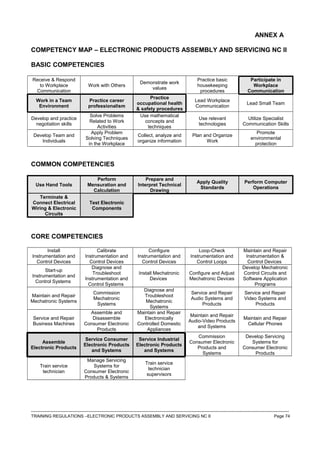
COMPETENCY MAP 64
DEFINITION OF TERMS 65 - 69
ACKNOWLEDGEMENT 70- 72
3
TRAINING REGULATIONS FOR
ELECTRONIC PRODUCTS ASSEMBLY AND SERVICING NC II
Section 1 ELECTRONIC PRODUCTS ASSEMBLY AND SERVICING NC II
QUALIFICATION
The ELECTRONIC PRODUCTS ASSEMBLY AND SERVICING NC II Qualification
consists of competencies that a person must possess to assemble electronic products,
prepare printed circuit boards (PCB) modules and to install and service consumer and
industrial electronic products and systems.

This Qualification is packaged from the competency map of the Electronics Industry
(Service sector) as shown in Annex A.
The units of competency comprising this qualification include the following:
Code BASIC COMPETENCIES
5 00 311105 Participate in workplace
communication
5 00 311106 Work in team environment
5 00 311107 Practice career professionalism
5 00 311108 Practice occupational health and
safety procedures
Code COMMON COMPETENCIES
ELC315202 Apply quality standards
ELC311203 Perform computer operations
ELC311201 Perform mensuration and
calculation
ELC311202 Prepare and interpret technical
drawing
ELC724201 Use hand tools
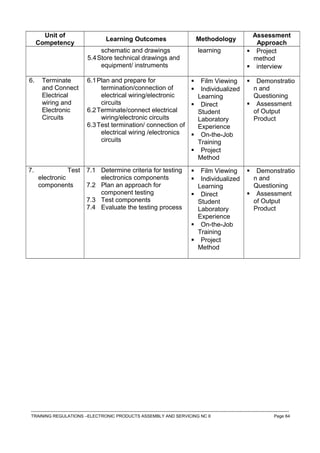
ELC724202 Terminate and connect electrical
wiring and electronic circuits
ELC724205 Test electronic components
Code CORE COMPETENCIES
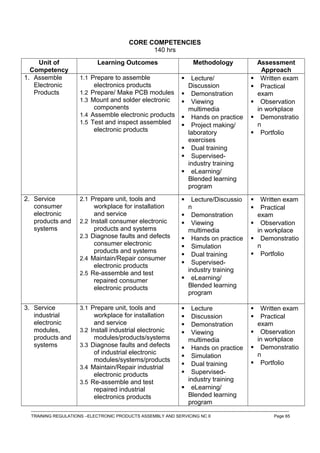
ELC724335 Assemble Electronic Products
ELC724336 Service consumer electronic
products and systems
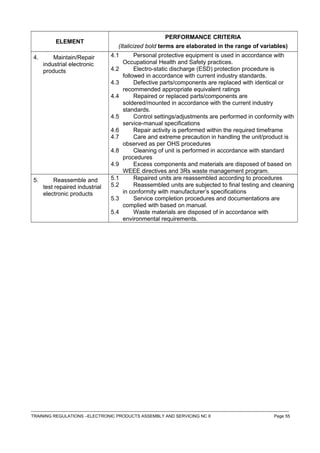
ELC724337 Service industrial electronic
modules, products and systems
A person who has achieved this Qualification is competent to be:
------------------------------------------------------------------------------------------------------------------------------------------------------------------------------------
TRAINING REGULATIONS –ELECTRONIC PRODUCTS ASSEMBLY AND SERVICING NC II Page 4
• Electronic Products Assembler
• Domestic Appliance Service Technician
• Audio-Video Service Technician
• Industrial Electronic Technician
• Electronic Production Line Assembler
• Factory Production Worker
SECTION 2: COMPETENCY STANDARDS
This section gives the details of the contents of the basic, common, and core units
of competency required for Electronic Products Assembly and Servicing NC II.
BASIC COMPETENCIES
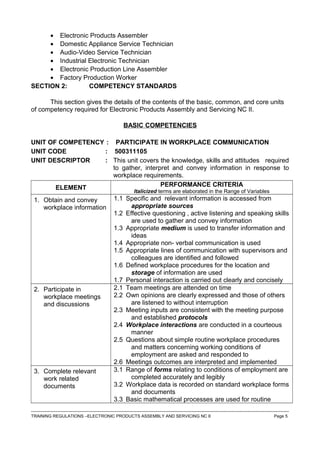
UNIT OF COMPETENCY : PARTICIPATE IN WORKPLACE COMMUNICATION
UNIT CODE : 500311105
UNIT DESCRIPTOR : This unit covers the knowledge, skills and attitudes required
to gather, interpret and convey information in response to
workplace requirements.
ELEMENT PERFORMANCE CRITERIA
Italicized terms are elaborated in the Range of Variables
1. Obtain and convey
workplace information
1.1 Specific and relevant information is accessed from
appropriate sources
1.2 Effective questioning , active listening and speaking skills
are used to gather and convey information
1.3 Appropriate medium is used to transfer information and
ideas
1.4 Appropriate non- verbal communication is used
1.5 Appropriate lines of communication with supervisors and
colleagues are identified and followed
1.6 Defined workplace procedures for the location and
storage of information are used
1.7 Personal interaction is carried out clearly and concisely
2. Participate in
workplace meetings
and discussions
2.1 Team meetings are attended on time
2.2 Own opinions are clearly expressed and those of others
are listened to without interruption
2.3 Meeting inputs are consistent with the meeting purpose
and established protocols
2.4 Workplace interactions are conducted in a courteous
manner
2.5 Questions about simple routine workplace procedures
and matters concerning working conditions of
employment are asked and responded to
2.6 Meetings outcomes are interpreted and implemented
3. Complete relevant
work related
documents
3.1 Range of forms relating to conditions of employment are
completed accurately and legibly
3.2 Workplace data is recorded on standard workplace forms
and documents
3.3 Basic mathematical processes are used for routine
------------------------------------------------------------------------------------------------------------------------------------------------------------------------------------
TRAINING REGULATIONS –ELECTRONIC PRODUCTS ASSEMBLY AND SERVICING NC II Page 5
calculations
3.4 Errors in recording information on forms/ documents are
identified and properly acted upon
3.5 Reporting requirements to supervisor are completed
according to organizational guidelines
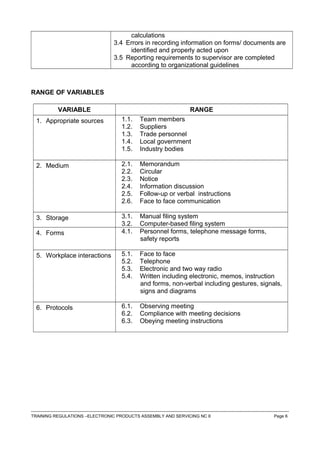
RANGE OF VARIABLES
VARIABLE RANGE
1. Appropriate sources 1.1. Team members
1.2. Suppliers
1.3. Trade personnel
1.4. Local government
1.5. Industry bodies
2. Medium 2.1. Memorandum
2.2. Circular
2.3. Notice
2.4. Information discussion
2.5. Follow-up or verbal instructions
2.6. Face to face communication
3. Storage 3.1. Manual filing system
3.2. Computer-based filing system
4. Forms 4.1. Personnel forms, telephone message forms,
safety reports
5. Workplace interactions 5.1. Face to face
5.2. Telephone
5.3. Electronic and two way radio
5.4. Written including electronic, memos, instruction
and forms, non-verbal including gestures, signals,
signs and diagrams
6. Protocols 6.1. Observing meeting
6.2. Compliance with meeting decisions
6.3. Obeying meeting instructions
------------------------------------------------------------------------------------------------------------------------------------------------------------------------------------
TRAINING REGULATIONS –ELECTRONIC PRODUCTS ASSEMBLY AND SERVICING NC II Page 6
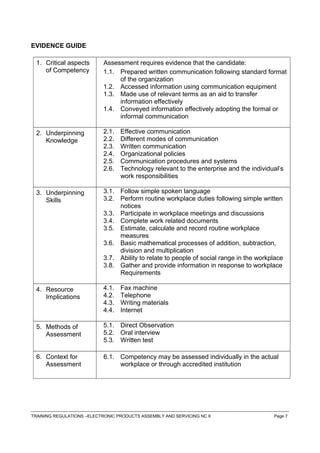
EVIDENCE GUIDE
1. Critical aspects
of Competency
Assessment requires evidence that the candidate:
1.1. Prepared written communication following standard format
of the organization
1.2. Accessed information using communication equipment
1.3. Made use of relevant terms as an aid to transfer
information effectively
1.4. Conveyed information effectively adopting the formal or
informal communication
2. Underpinning
Knowledge
2.1. Effective communication
2.2. Different modes of communication
2.3. Written communication
2.4. Organizational policies
2.5. Communication procedures and systems
2.6. Technology relevant to the enterprise and the individual’s
work responsibilities
3. Underpinning
Skills
3.1. Follow simple spoken language
3.2. Perform routine workplace duties following simple written
notices
3.3. Participate in workplace meetings and discussions
3.4. Complete work related documents
3.5. Estimate, calculate and record routine workplace
measures
3.6. Basic mathematical processes of addition, subtraction,
division and multiplication
3.7. Ability to relate to people of social range in the workplace
3.8. Gather and provide information in response to workplace
Requirements
4. Resource
Implications
4.1. Fax machine
4.2. Telephone
4.3. Writing materials
4.4. Internet
5. Methods of
Assessment
5.1. Direct Observation
5.2. Oral interview
5.3. Written test
6. Context for
Assessment
6.1. Competency may be assessed individually in the actual
workplace or through accredited institution
------------------------------------------------------------------------------------------------------------------------------------------------------------------------------------
TRAINING REGULATIONS –ELECTRONIC PRODUCTS ASSEMBLY AND SERVICING NC II Page 7
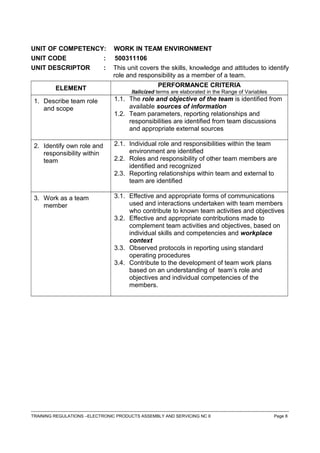
UNIT OF COMPETENCY: WORK IN TEAM ENVIRONMENT
UNIT CODE : 500311106
UNIT DESCRIPTOR : This unit covers the skills, knowledge and attitudes to identify
role and responsibility as a member of a team.
ELEMENT PERFORMANCE CRITERIA
Italicized terms are elaborated in the Range of Variables
1. Describe team role
and scope
1.1. The role and objective of the team is identified from
available sources of information
1.2. Team parameters, reporting relationships and
responsibilities are identified from team discussions
and appropriate external sources
2. Identify own role and
responsibility within
team
2.1. Individual role and responsibilities within the team
environment are identified
2.2. Roles and responsibility of other team members are
identified and recognized
2.3. Reporting relationships within team and external to
team are identified
3. Work as a team
member
3.1. Effective and appropriate forms of communications
used and interactions undertaken with team members
who contribute to known team activities and objectives
3.2. Effective and appropriate contributions made to
complement team activities and objectives, based on
individual skills and competencies and workplace
context
3.3. Observed protocols in reporting using standard
operating procedures
3.4. Contribute to the development of team work plans
based on an understanding of team’s role and
objectives and individual competencies of the
members.
------------------------------------------------------------------------------------------------------------------------------------------------------------------------------------
TRAINING REGULATIONS –ELECTRONIC PRODUCTS ASSEMBLY AND SERVICING NC II Page 8
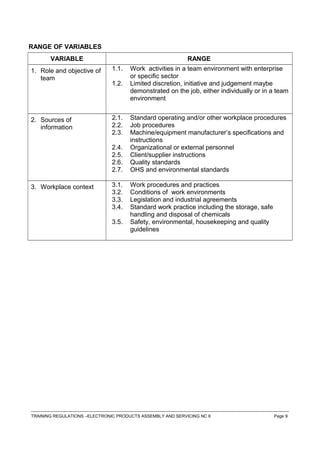
RANGE OF VARIABLES
VARIABLE RANGE
1. Role and objective of
team
1.1. Work activities in a team environment with enterprise
or specific sector
1.2. Limited discretion, initiative and judgement maybe
demonstrated on the job, either individually or in a team
environment
2. Sources of
information
2.1. Standard operating and/or other workplace procedures
2.2. Job procedures
2.3. Machine/equipment manufacturer’s specifications and
instructions
2.4. Organizational or external personnel
2.5. Client/supplier instructions
2.6. Quality standards
2.7. OHS and environmental standards
3. Workplace context 3.1. Work procedures and practices
3.2. Conditions of work environments
3.3. Legislation and industrial agreements
3.4. Standard work practice including the storage, safe
handling and disposal of chemicals
3.5. Safety, environmental, housekeeping and quality
guidelines
------------------------------------------------------------------------------------------------------------------------------------------------------------------------------------
TRAINING REGULATIONS –ELECTRONIC PRODUCTS ASSEMBLY AND SERVICING NC II Page 9
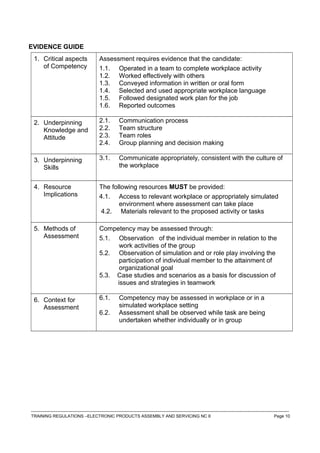
EVIDENCE GUIDE
1. Critical aspects
of Competency
Assessment requires evidence that the candidate:
1.1. Operated in a team to complete workplace activity
1.2. Worked effectively with others
1.3. Conveyed information in written or oral form
1.4. Selected and used appropriate workplace language
1.5. Followed designated work plan for the job
1.6. Reported outcomes
2. Underpinning
Knowledge and
Attitude
2.1. Communication process
2.2. Team structure
2.3. Team roles
2.4. Group planning and decision making
3. Underpinning
Skills
3.1. Communicate appropriately, consistent with the culture of
the workplace
4. Resource
Implications
The following resources MUST be provided:
4.1. Access to relevant workplace or appropriately simulated
environment where assessment can take place
4.2. Materials relevant to the proposed activity or tasks
5. Methods of
Assessment
Competency may be assessed through:
5.1. Observation of the individual member in relation to the
work activities of the group
5.2. Observation of simulation and or role play involving the
participation of individual member to the attainment of
organizational goal
5.3. Case studies and scenarios as a basis for discussion of
issues and strategies in teamwork
6. Context for
Assessment
6.1. Competency may be assessed in workplace or in a
simulated workplace setting
6.2. Assessment shall be observed while task are being
undertaken whether individually or in group
------------------------------------------------------------------------------------------------------------------------------------------------------------------------------------
TRAINING REGULATIONS –ELECTRONIC PRODUCTS ASSEMBLY AND SERVICING NC II Page 10
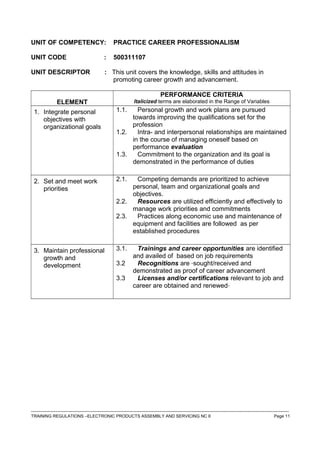
UNIT OF COMPETENCY: PRACTICE CAREER PROFESSIONALISM
UNIT CODE : 500311107
UNIT DESCRIPTOR : This unit covers the knowledge, skills and attitudes in
promoting career growth and advancement.
ELEMENT
PERFORMANCE CRITERIA
Italicized terms are elaborated in the Range of Variables
1. Integrate personal
objectives with
organizational goals
1.1. Personal growth and work plans are pursued
towards improving the qualifications set for the
profession
1.2. Intra- and interpersonal relationships are maintained
in the course of managing oneself based on
performance evaluation
1.3. Commitment to the organization and its goal is
demonstrated in the performance of duties
2. Set and meet work
priorities
2.1. Competing demands are prioritized to achieve
personal, team and organizational goals and
objectives.
2.2. Resources are utilized efficiently and effectively to
manage work priorities and commitments
2.3. Practices along economic use and maintenance of
equipment and facilities are followed as per
established procedures
3. Maintain professional
growth and
development
3.1. Trainings and career opportunities are identified
and availed of based on job requirements
3.2 Recognitions are sought/received and
demonstrated as proof of career advancement
3.3 Licenses and/or certifications relevant to job and
career are obtained and renewed
------------------------------------------------------------------------------------------------------------------------------------------------------------------------------------
TRAINING REGULATIONS –ELECTRONIC PRODUCTS ASSEMBLY AND SERVICING NC II Page 11
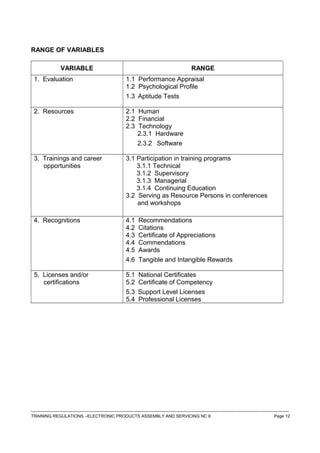
RANGE OF VARIABLES
VARIABLE RANGE
1. Evaluation 1.1 Performance Appraisal
1.2 Psychological Profile
1.3 Aptitude Tests
2. Resources 2.1 Human
2.2 Financial
2.3 Technology
2.3.1 Hardware
2.3.2 Software
3. Trainings and career
opportunities
3.1 Participation in training programs
3.1.1 Technical
3.1.2 Supervisory
3.1.3 Managerial
3.1.4 Continuing Education
3.2 Serving as Resource Persons in conferences
and workshops
4. Recognitions 4.1 Recommendations
4.2 Citations
4.3 Certificate of Appreciations
4.4 Commendations
4.5 Awards
4.6 Tangible and Intangible Rewards
5. Licenses and/or
certifications
5.1 National Certificates
5.2 Certificate of Competency
5.3 Support Level Licenses
5.4 Professional Licenses
------------------------------------------------------------------------------------------------------------------------------------------------------------------------------------
TRAINING REGULATIONS –ELECTRONIC PRODUCTS ASSEMBLY AND SERVICING NC II Page 12
EVIDENCE GUIDE
1. Critical aspects
of Competency
Assessment requires evidence that the candidate:
1.1 Attained job targets within key result areas (KRAs)
1.2 Maintained intra - and interpersonal relationship in the
course of managing oneself based on performance
evaluation
1.3 Completed trainings and career opportunities which are
based on the requirements of the industries
1.4 Acquired and maintained licenses and/or certifications
according to the requirement of the qualification
2. Underpinning
Knowledge
2.1 Work values and ethics (Code of Conduct, Code of Ethics,
etc.)
2.2 Company policies
2.3 Company operations, procedures and standards
2.4 Fundamental rights at work including gender sensitivity
2.5 Personal hygiene practices
3. Underpinning
Skills
3.1 Appropriate practice of personal hygiene
3.2 Intra and Interpersonal skills
3.3 Communication skills
4. Resource
Implications
The following resources MUST be provided:
4.1 Workplace or assessment location
4.2 Case studies/scenarios
5. Methods of
Assessment
Competency may be assessed through:
5.1 Portfolio Assessment
5.2 Interview
5.3 Simulation/Role-plays
5.4 Observation
5.5 Third Party Reports
5.6 Exams and Tests
6. Context for
Assessment
6.1 Competency may be assessed in the work place or in a
simulated work place setting
------------------------------------------------------------------------------------------------------------------------------------------------------------------------------------
TRAINING REGULATIONS –ELECTRONIC PRODUCTS ASSEMBLY AND SERVICING NC II Page 13
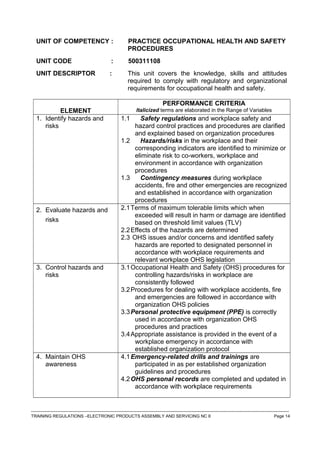
UNIT OF COMPETENCY : PRACTICE OCCUPATIONAL HEALTH AND SAFETY
PROCEDURES
UNIT CODE : 500311108
UNIT DESCRIPTOR : This unit covers the knowledge, skills and attitudes
required to comply with regulatory and organizational
requirements for occupational health and safety.
ELEMENT
PERFORMANCE CRITERIA
Italicized terms are elaborated in the Range of Variables
1. Identify hazards and
risks
1.1 Safety regulations and workplace safety and
hazard control practices and procedures are clarified
and explained based on organization procedures
1.2 Hazards/risks in the workplace and their
corresponding indicators are identified to minimize or
eliminate risk to co-workers, workplace and
environment in accordance with organization
procedures
1.3 Contingency measures during workplace
accidents, fire and other emergencies are recognized
and established in accordance with organization
procedures
2. Evaluate hazards and
risks
2.1Terms of maximum tolerable limits which when
exceeded will result in harm or damage are identified
based on threshold limit values (TLV)
2.2Effects of the hazards are determined
2.3 OHS issues and/or concerns and identified safety
hazards are reported to designated personnel in
accordance with workplace requirements and
relevant workplace OHS legislation
3. Control hazards and
risks
3.1Occupational Health and Safety (OHS) procedures for
controlling hazards/risks in workplace are
consistently followed
3.2Procedures for dealing with workplace accidents, fire
and emergencies are followed in accordance with
organization OHS policies
3.3Personal protective equipment (PPE) is correctly
used in accordance with organization OHS
procedures and practices
3.4Appropriate assistance is provided in the event of a
workplace emergency in accordance with
established organization protocol
4. Maintain OHS
awareness
4.1Emergency-related drills and trainings are
participated in as per established organization
guidelines and procedures
4.2OHS personal records are completed and updated in
accordance with workplace requirements
------------------------------------------------------------------------------------------------------------------------------------------------------------------------------------
TRAINING REGULATIONS –ELECTRONIC PRODUCTS ASSEMBLY AND SERVICING NC II Page 14
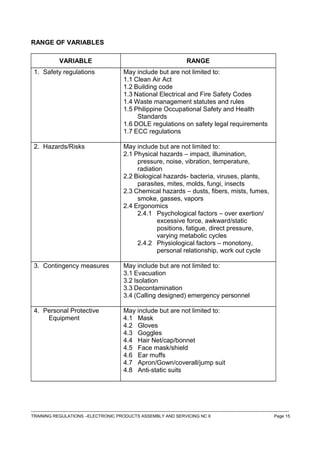
RANGE OF VARIABLES
VARIABLE RANGE
1. Safety regulations May include but are not limited to:
1.1 Clean Air Act
1.2 Building code
1.3 National Electrical and Fire Safety Codes
1.4 Waste management statutes and rules
1.5 Philippine Occupational Safety and Health
Standards
1.6 DOLE regulations on safety legal requirements
1.7 ECC regulations
2. Hazards/Risks May include but are not limited to:
2.1 Physical hazards – impact, illumination,
pressure, noise, vibration, temperature,
radiation
2.2 Biological hazards- bacteria, viruses, plants,
parasites, mites, molds, fungi, insects
2.3 Chemical hazards – dusts, fibers, mists, fumes,
smoke, gasses, vapors
2.4 Ergonomics
2.4.1 Psychological factors – over exertion/
excessive force, awkward/static
positions, fatigue, direct pressure,
varying metabolic cycles
2.4.2 Physiological factors – monotony,
personal relationship, work out cycle
3. Contingency measures May include but are not limited to:
3.1 Evacuation
3.2 Isolation
3.3 Decontamination
3.4 (Calling designed) emergency personnel
4. Personal Protective
Equipment
May include but are not limited to:
4.1 Mask
4.2 Gloves
4.3 Goggles
4.4 Hair Net/cap/bonnet
4.5 Face mask/shield
4.6 Ear muffs
4.7 Apron/Gown/coverall/jump suit
4.8 Anti-static suits
------------------------------------------------------------------------------------------------------------------------------------------------------------------------------------
TRAINING REGULATIONS –ELECTRONIC PRODUCTS ASSEMBLY AND SERVICING NC II Page 15
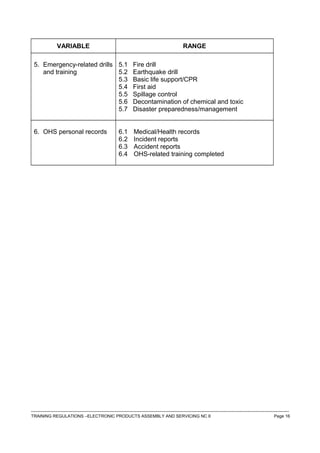
VARIABLE RANGE
5. Emergency-related drills
and training
5.1 Fire drill
5.2 Earthquake drill
5.3 Basic life support/CPR
5.4 First aid
5.5 Spillage control
5.6 Decontamination of chemical and toxic
5.7 Disaster preparedness/management
6. OHS personal records 6.1 Medical/Health records
6.2 Incident reports
6.3 Accident reports
6.4 OHS-related training completed
------------------------------------------------------------------------------------------------------------------------------------------------------------------------------------
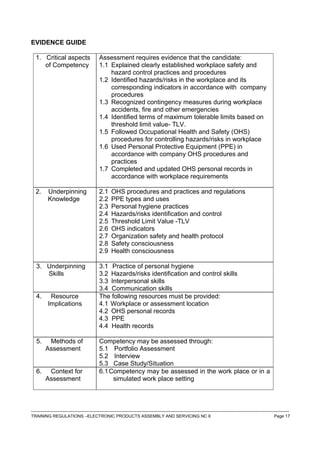
TRAINING REGULATIONS –ELECTRONIC PRODUCTS ASSEMBLY AND SERVICING NC II Page 16
EVIDENCE GUIDE
1. Critical aspects
of Competency
Assessment requires evidence that the candidate:
1.1 Explained clearly established workplace safety and
hazard control practices and procedures
1.2 Identified hazards/risks in the workplace and its
corresponding indicators in accordance with company
procedures
1.3 Recognized contingency measures during workplace
accidents, fire and other emergencies
1.4 Identified terms of maximum tolerable limits based on
threshold limit value- TLV.
1.5 Followed Occupational Health and Safety (OHS)
procedures for controlling hazards/risks in workplace
1.6 Used Personal Protective Equipment (PPE) in
accordance with company OHS procedures and
practices
1.7 Completed and updated OHS personal records in
accordance with workplace requirements
2. Underpinning
Knowledge
2.1 OHS procedures and practices and regulations
2.2 PPE types and uses
2.3 Personal hygiene practices
2.4 Hazards/risks identification and control
2.5 Threshold Limit Value -TLV
2.6 OHS indicators
2.7 Organization safety and health protocol
2.8 Safety consciousness
2.9 Health consciousness
3. Underpinning
Skills
3.1 Practice of personal hygiene
3.2 Hazards/risks identification and control skills
3.3 Interpersonal skills
3.4 Communication skills
4. Resource
Implications
The following resources must be provided:
4.1 Workplace or assessment location
4.2 OHS personal records
4.3 PPE
4.4 Health records
5. Methods of
Assessment
Competency may be assessed through:
5.1 Portfolio Assessment
5.2 Interview
5.3 Case Study/Situation
6. Context for
Assessment
6.1Competency may be assessed in the work place or in a
simulated work place setting
------------------------------------------------------------------------------------------------------------------------------------------------------------------------------------
TRAINING REGULATIONS –ELECTRONIC PRODUCTS ASSEMBLY AND SERVICING NC II Page 17
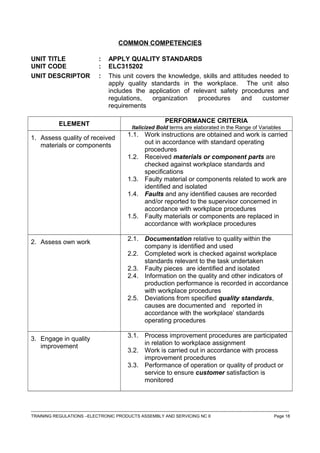
COMMON COMPETENCIES
UNIT TITLE : APPLY QUALITY STANDARDS
UNIT CODE : ELC315202
UNIT DESCRIPTOR : This unit covers the knowledge, skills and attitudes needed to
apply quality standards in the workplace. The unit also
includes the application of relevant safety procedures and
regulations, organization procedures and customer
requirements
ELEMENT PERFORMANCE CRITERIA
Italicized Bold terms are elaborated in the Range of Variables
1. Assess quality of received
materials or components
1.1. Work instructions are obtained and work is carried
out in accordance with standard operating
procedures
1.2. Received materials or component parts are
checked against workplace standards and
specifications
1.3. Faulty material or components related to work are
identified and isolated
1.4. Faults and any identified causes are recorded
and/or reported to the supervisor concerned in
accordance with workplace procedures
1.5. Faulty materials or components are replaced in
accordance with workplace procedures
2. Assess own work
2.1. Documentation relative to quality within the
company is identified and used
2.2. Completed work is checked against workplace
standards relevant to the task undertaken
2.3. Faulty pieces are identified and isolated
2.4. Information on the quality and other indicators of
production performance is recorded in accordance
with workplace procedures
2.5. Deviations from specified quality standards,
causes are documented and reported in
accordance with the workplace’ standards
operating procedures
3. Engage in quality
improvement
3.1. Process improvement procedures are participated
in relation to workplace assignment
3.2. Work is carried out in accordance with process
improvement procedures
3.3. Performance of operation or quality of product or
service to ensure customer satisfaction is
monitored
------------------------------------------------------------------------------------------------------------------------------------------------------------------------------------
TRAINING REGULATIONS –ELECTRONIC PRODUCTS ASSEMBLY AND SERVICING NC II Page 18
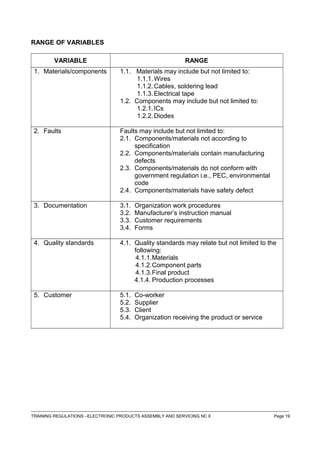
RANGE OF VARIABLES
VARIABLE RANGE
1. Materials/components 1.1. Materials may include but not limited to:
1.1.1.Wires
1.1.2.Cables, soldering lead
1.1.3.Electrical tape
1.2. Components may include but not limited to:
1.2.1.ICs
1.2.2.Diodes
2. Faults Faults may include but not limited to:
2.1. Components/materials not according to
specification
2.2. Components/materials contain manufacturing
defects
2.3. Components/materials do not conform with
government regulation i.e., PEC, environmental
code
2.4. Components/materials have safety defect
3. Documentation 3.1. Organization work procedures
3.2. Manufacturer’s instruction manual
3.3. Customer requirements
3.4. Forms
4. Quality standards 4.1. Quality standards may relate but not limited to the
following:
4.1.1.Materials
4.1.2.Component parts
4.1.3.Final product
4.1.4. Production processes
5. Customer 5.1. Co-worker
5.2. Supplier
5.3. Client
5.4. Organization receiving the product or service
------------------------------------------------------------------------------------------------------------------------------------------------------------------------------------
TRAINING REGULATIONS –ELECTRONIC PRODUCTS ASSEMBLY AND SERVICING NC II Page 19
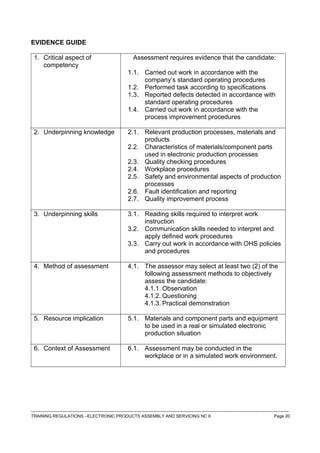
EVIDENCE GUIDE
1. Critical aspect of
competency
Assessment requires evidence that the candidate:
1.1. Carried out work in accordance with the
company’s standard operating procedures
1.2. Performed task according to specifications
1.3. Reported defects detected in accordance with
standard operating procedures
1.4. Carried out work in accordance with the
process improvement procedures
2. Underpinning knowledge 2.1. Relevant production processes, materials and
products
2.2. Characteristics of materials/component parts
used in electronic production processes
2.3. Quality checking procedures
2.4. Workplace procedures
2.5. Safety and environmental aspects of production
processes
2.6. Fault identification and reporting
2.7. Quality improvement process
3. Underpinning skills 3.1. Reading skills required to interpret work
instruction
3.2. Communication skills needed to interpret and
apply defined work procedures
3.3. Carry out work in accordance with OHS policies
and procedures
4. Method of assessment 4.1. The assessor may select at least two (2) of the
following assessment methods to objectively
assess the candidate:
4.1.1. Observation
4.1.2. Questioning
4.1.3. Practical demonstration
5. Resource implication 5.1. Materials and component parts and equipment
to be used in a real or simulated electronic
production situation
6. Context of Assessment 6.1. Assessment may be conducted in the
workplace or in a simulated work environment.
------------------------------------------------------------------------------------------------------------------------------------------------------------------------------------
TRAINING REGULATIONS –ELECTRONIC PRODUCTS ASSEMBLY AND SERVICING NC II Page 20
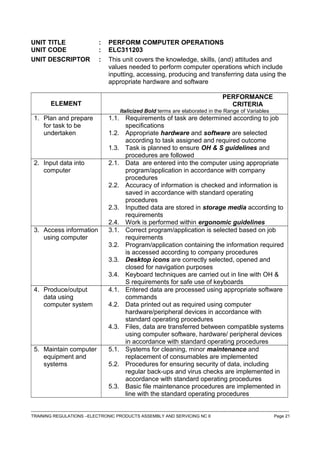
UNIT TITLE : PERFORM COMPUTER OPERATIONS
UNIT CODE : ELC311203
UNIT DESCRIPTOR : This unit covers the knowledge, skills, (and) attitudes and
values needed to perform computer operations which include
inputting, accessing, producing and transferring data using the
appropriate hardware and software
ELEMENT
PERFORMANCE
CRITERIA
Italicized Bold terms are elaborated in the Range of Variables
1. Plan and prepare
for task to be
undertaken
1.1. Requirements of task are determined according to job
specifications
1.2. Appropriate hardware and software are selected
according to task assigned and required outcome
1.3. Task is planned to ensure OH & S guidelines and
procedures are followed
2. Input data into
computer
2.1. Data are entered into the computer using appropriate
program/application in accordance with company
procedures
2.2. Accuracy of information is checked and information is
saved in accordance with standard operating
procedures
2.3. Inputted data are stored in storage media according to
requirements
2.4. Work is performed within ergonomic guidelines
3. Access information
using computer
3.1. Correct program/application is selected based on job
requirements
3.2. Program/application containing the information required
is accessed according to company procedures
3.3. Desktop icons are correctly selected, opened and
closed for navigation purposes
3.4. Keyboard techniques are carried out in line with OH &
S requirements for safe use of keyboards
4. Produce/output
data using
computer system
4.1. Entered data are processed using appropriate software
commands
4.2. Data printed out as required using computer
hardware/peripheral devices in accordance with
standard operating procedures
4.3. Files, data are transferred between compatible systems
using computer software, hardware/ peripheral devices
in accordance with standard operating procedures
5. Maintain computer
equipment and
systems
5.1. Systems for cleaning, minor maintenance and
replacement of consumables are implemented
5.2. Procedures for ensuring security of data, including
regular back-ups and virus checks are implemented in
accordance with standard operating procedures
5.3. Basic file maintenance procedures are implemented in
line with the standard operating procedures
------------------------------------------------------------------------------------------------------------------------------------------------------------------------------------
TRAINING REGULATIONS –ELECTRONIC PRODUCTS ASSEMBLY AND SERVICING NC II Page 21
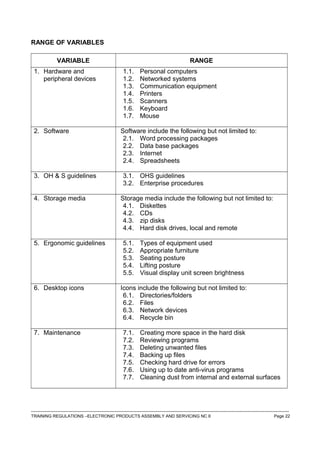
RANGE OF VARIABLES
VARIABLE RANGE
1. Hardware and
peripheral devices
1.1. Personal computers
1.2. Networked systems
1.3. Communication equipment
1.4. Printers
1.5. Scanners
1.6. Keyboard
1.7. Mouse
2. Software Software include the following but not limited to:
2.1. Word processing packages
2.2. Data base packages
2.3. Internet
2.4. Spreadsheets
3. OH & S guidelines 3.1. OHS guidelines
3.2. Enterprise procedures
4. Storage media Storage media include the following but not limited to:
4.1. Diskettes
4.2. CDs
4.3. zip disks
4.4. Hard disk drives, local and remote
5. Ergonomic guidelines 5.1. Types of equipment used
5.2. Appropriate furniture
5.3. Seating posture
5.4. Lifting posture
5.5. Visual display unit screen brightness
6. Desktop icons Icons include the following but not limited to:
6.1. Directories/folders
6.2. Files
6.3. Network devices
6.4. Recycle bin
7. Maintenance 7.1. Creating more space in the hard disk
7.2. Reviewing programs
7.3. Deleting unwanted files
7.4. Backing up files
7.5. Checking hard drive for errors
7.6. Using up to date anti-virus programs
7.7. Cleaning dust from internal and external surfaces
------------------------------------------------------------------------------------------------------------------------------------------------------------------------------------
TRAINING REGULATIONS –ELECTRONIC PRODUCTS ASSEMBLY AND SERVICING NC II Page 22
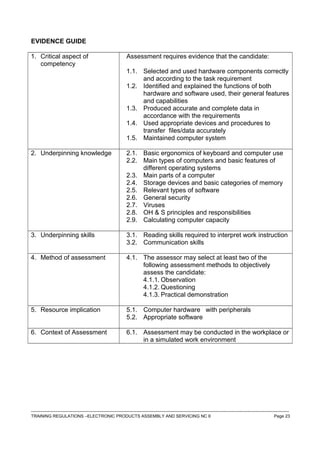
EVIDENCE GUIDE
1. Critical aspect of
competency
Assessment requires evidence that the candidate:
1.1. Selected and used hardware components correctly
and according to the task requirement
1.2. Identified and explained the functions of both
hardware and software used, their general features
and capabilities
1.3. Produced accurate and complete data in
accordance with the requirements
1.4. Used appropriate devices and procedures to
transfer files/data accurately
1.5. Maintained computer system
2. Underpinning knowledge 2.1. Basic ergonomics of keyboard and computer use
2.2. Main types of computers and basic features of
different operating systems
2.3. Main parts of a computer
2.4. Storage devices and basic categories of memory
2.5. Relevant types of software
2.6. General security
2.7. Viruses
2.8. OH & S principles and responsibilities
2.9. Calculating computer capacity
3. Underpinning skills 3.1. Reading skills required to interpret work instruction
3.2. Communication skills
4. Method of assessment 4.1. The assessor may select at least two of the
following assessment methods to objectively
assess the candidate:
4.1.1. Observation
4.1.2. Questioning
4.1.3. Practical demonstration
5. Resource implication 5.1. Computer hardware with peripherals
5.2. Appropriate software
6. Context of Assessment 6.1. Assessment may be conducted in the workplace or
in a simulated work environment
------------------------------------------------------------------------------------------------------------------------------------------------------------------------------------
TRAINING REGULATIONS –ELECTRONIC PRODUCTS ASSEMBLY AND SERVICING NC II Page 23
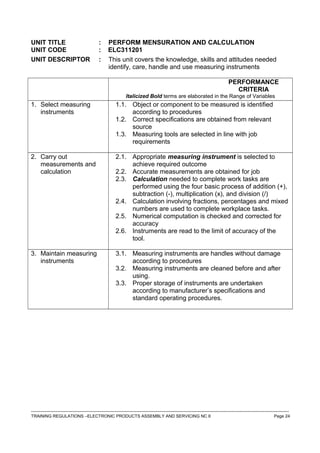
UNIT TITLE : PERFORM MENSURATION AND CALCULATION
UNIT CODE : ELC311201
UNIT DESCRIPTOR : This unit covers the knowledge, skills and attitudes needed
identify, care, handle and use measuring instruments
PERFORMANCE
CRITERIA
Italicized Bold terms are elaborated in the Range of Variables
1. Select measuring
instruments
1.1. Object or component to be measured is identified
according to procedures
1.2. Correct specifications are obtained from relevant
source
1.3. Measuring tools are selected in line with job
requirements
2. Carry out
measurements and
calculation
2.1. Appropriate measuring instrument is selected to
achieve required outcome
2.2. Accurate measurements are obtained for job
2.3. Calculation needed to complete work tasks are
performed using the four basic process of addition (+),
subtraction (-), multiplication (x), and division (/)
2.4. Calculation involving fractions, percentages and mixed
numbers are used to complete workplace tasks.
2.5. Numerical computation is checked and corrected for
accuracy
2.6. Instruments are read to the limit of accuracy of the
tool.
3. Maintain measuring
instruments
3.1. Measuring instruments are handles without damage
according to procedures
3.2. Measuring instruments are cleaned before and after
using.
3.3. Proper storage of instruments are undertaken
according to manufacturer’s specifications and
standard operating procedures.
------------------------------------------------------------------------------------------------------------------------------------------------------------------------------------
TRAINING REGULATIONS –ELECTRONIC PRODUCTS ASSEMBLY AND SERVICING NC II Page 24
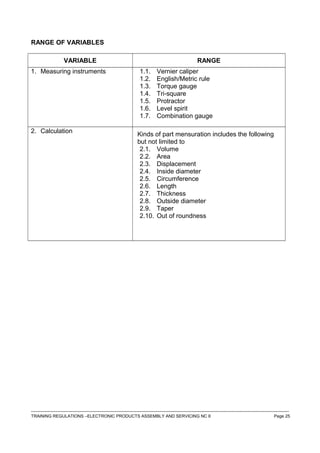
RANGE OF VARIABLES
VARIABLE RANGE
1. Measuring instruments 1.1. Vernier caliper
1.2. English/Metric rule
1.3. Torque gauge
1.4. Tri-square
1.5. Protractor
1.6. Level spirit
1.7. Combination gauge
2. Calculation
Kinds of part mensuration includes the following
but not limited to
2.1. Volume
2.2. Area
2.3. Displacement
2.4. Inside diameter
2.5. Circumference
2.6. Length
2.7. Thickness
2.8. Outside diameter
2.9. Taper
2.10. Out of roundness
------------------------------------------------------------------------------------------------------------------------------------------------------------------------------------
TRAINING REGULATIONS –ELECTRONIC PRODUCTS ASSEMBLY AND SERVICING NC II Page 25
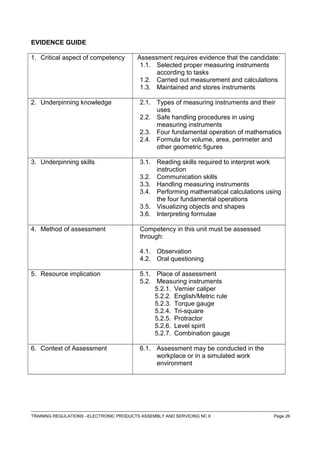
EVIDENCE GUIDE
1. Critical aspect of competency Assessment requires evidence that the candidate:
1.1. Selected proper measuring instruments
according to tasks
1.2. Carried out measurement and calculations
1.3. Maintained and stores instruments
2. Underpinning knowledge 2.1. Types of measuring instruments and their
uses
2.2. Safe handling procedures in using
measuring instruments
2.3. Four fundamental operation of mathematics
2.4. Formula for volume, area, perimeter and
other geometric figures
3. Underpinning skills 3.1. Reading skills required to interpret work
instruction
3.2. Communication skills
3.3. Handling measuring instruments
3.4. Performing mathematical calculations using
the four fundamental operations
3.5. Visualizing objects and shapes
3.6. Interpreting formulae
4. Method of assessment Competency in this unit must be assessed
through:
4.1. Observation
4.2. Oral questioning
5. Resource implication 5.1. Place of assessment
5.2. Measuring instruments
5.2.1. Vernier caliper
5.2.2. English/Metric rule
5.2.3. Torque gauge
5.2.4. Tri-square
5.2.5. Protractor
5.2.6. Level spirit
5.2.7. Combination gauge
6. Context of Assessment 6.1. Assessment may be conducted in the
workplace or in a simulated work
environment
------------------------------------------------------------------------------------------------------------------------------------------------------------------------------------
TRAINING REGULATIONS –ELECTRONIC PRODUCTS ASSEMBLY AND SERVICING NC II Page 26
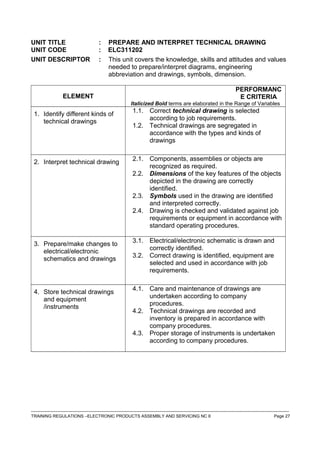
UNIT TITLE : PREPARE AND INTERPRET TECHNICAL DRAWING
UNIT CODE : ELC311202
UNIT DESCRIPTOR : This unit covers the knowledge, skills and attitudes and values
needed to prepare/interpret diagrams, engineering
abbreviation and drawings, symbols, dimension.
ELEMENT
PERFORMANC
E CRITERIA
Italicized Bold terms are elaborated in the Range of Variables
1. Identify different kinds of
technical drawings
1.1. Correct technical drawing is selected
according to job requirements.
1.2. Technical drawings are segregated in
accordance with the types and kinds of
drawings
2. Interpret technical drawing
2.1. Components, assemblies or objects are
recognized as required.
2.2. Dimensions of the key features of the objects
depicted in the drawing are correctly
identified.
2.3. Symbols used in the drawing are identified
and interpreted correctly.
2.4. Drawing is checked and validated against job
requirements or equipment in accordance with
standard operating procedures.
3. Prepare/make changes to
electrical/electronic
schematics and drawings
3.1. Electrical/electronic schematic is drawn and
correctly identified.
3.2. Correct drawing is identified, equipment are
selected and used in accordance with job
requirements.
4. Store technical drawings
and equipment
/instruments
4.1. Care and maintenance of drawings are
undertaken according to company
procedures.
4.2. Technical drawings are recorded and
inventory is prepared in accordance with
company procedures.
4.3. Proper storage of instruments is undertaken
according to company procedures.
------------------------------------------------------------------------------------------------------------------------------------------------------------------------------------
TRAINING REGULATIONS –ELECTRONIC PRODUCTS ASSEMBLY AND SERVICING NC II Page 27
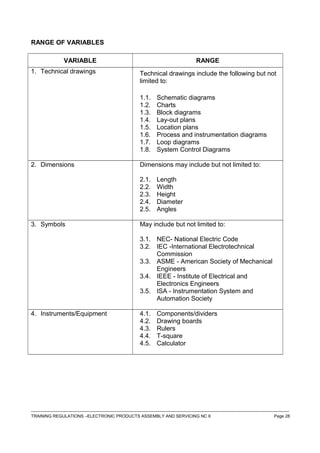
RANGE OF VARIABLES
VARIABLE RANGE
1. Technical drawings Technical drawings include the following but not
limited to:
1.1. Schematic diagrams
1.2. Charts
1.3. Block diagrams
1.4. Lay-out plans
1.5. Location plans
1.6. Process and instrumentation diagrams
1.7. Loop diagrams
1.8. System Control Diagrams
2. Dimensions Dimensions may include but not limited to:
2.1. Length
2.2. Width
2.3. Height
2.4. Diameter
2.5. Angles
3. Symbols May include but not limited to:
3.1. NEC- National Electric Code
3.2. IEC -International Electrotechnical
Commission
3.3. ASME - American Society of Mechanical
Engineers
3.4. IEEE - Institute of Electrical and
Electronics Engineers
3.5. ISA - Instrumentation System and
Automation Society
4. Instruments/Equipment 4.1. Components/dividers
4.2. Drawing boards
4.3. Rulers
4.4. T-square
4.5. Calculator
------------------------------------------------------------------------------------------------------------------------------------------------------------------------------------
TRAINING REGULATIONS –ELECTRONIC PRODUCTS ASSEMBLY AND SERVICING NC II Page 28
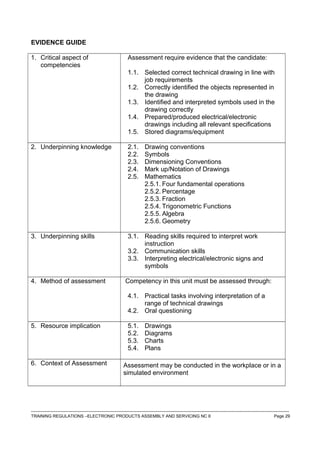
EVIDENCE GUIDE
1. Critical aspect of
competencies
Assessment require evidence that the candidate:
1.1. Selected correct technical drawing in line with
job requirements
1.2. Correctly identified the objects represented in
the drawing
1.3. Identified and interpreted symbols used in the
drawing correctly
1.4. Prepared/produced electrical/electronic
drawings including all relevant specifications
1.5. Stored diagrams/equipment
2. Underpinning knowledge 2.1. Drawing conventions
2.2. Symbols
2.3. Dimensioning Conventions
2.4. Mark up/Notation of Drawings
2.5. Mathematics
2.5.1. Four fundamental operations
2.5.2. Percentage
2.5.3. Fraction
2.5.4. Trigonometric Functions
2.5.5. Algebra
2.5.6. Geometry
3. Underpinning skills 3.1. Reading skills required to interpret work
instruction
3.2. Communication skills
3.3. Interpreting electrical/electronic signs and
symbols
4. Method of assessment Competency in this unit must be assessed through:
4.1. Practical tasks involving interpretation of a
range of technical drawings
4.2. Oral questioning
5. Resource implication 5.1. Drawings
5.2. Diagrams
5.3. Charts
5.4. Plans
6. Context of Assessment Assessment may be conducted in the workplace or in a
simulated environment
------------------------------------------------------------------------------------------------------------------------------------------------------------------------------------
TRAINING REGULATIONS –ELECTRONIC PRODUCTS ASSEMBLY AND SERVICING NC II Page 29
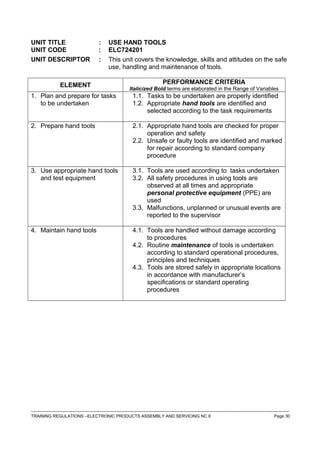
UNIT TITLE : USE HAND TOOLS
UNIT CODE : ELC724201
UNIT DESCRIPTOR : This unit covers the knowledge, skills and attitudes on the safe
use, handling and maintenance of tools.
ELEMENT PERFORMANCE CRITERIA
Italicized Bold terms are elaborated in the Range of Variables
1. Plan and prepare for tasks
to be undertaken
1.1. Tasks to be undertaken are properly identified
1.2. Appropriate hand tools are identified and
selected according to the task requirements
2. Prepare hand tools 2.1. Appropriate hand tools are checked for proper
operation and safety
2.2. Unsafe or faulty tools are identified and marked
for repair according to standard company
procedure
3. Use appropriate hand tools
and test equipment
3.1. Tools are used according to tasks undertaken
3.2. All safety procedures in using tools are
observed at all times and appropriate
personal protective equipment (PPE) are
used
3.3. Malfunctions, unplanned or unusual events are
reported to the supervisor
4. Maintain hand tools 4.1. Tools are handled without damage according
to procedures
4.2. Routine maintenance of tools is undertaken
according to standard operational procedures,
principles and techniques
4.3. Tools are stored safely in appropriate locations
in accordance with manufacturer’s
specifications or standard operating
procedures
------------------------------------------------------------------------------------------------------------------------------------------------------------------------------------
TRAINING REGULATIONS –ELECTRONIC PRODUCTS ASSEMBLY AND SERVICING NC II Page 30
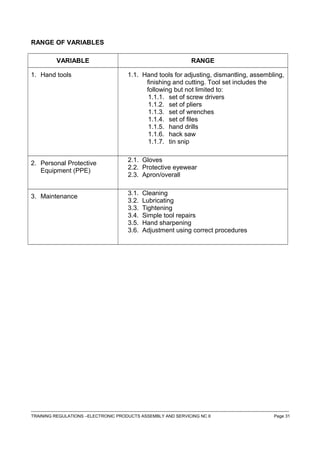
RANGE OF VARIABLES
VARIABLE RANGE
1. Hand tools 1.1. Hand tools for adjusting, dismantling, assembling,
finishing and cutting. Tool set includes the
following but not limited to:
1.1.1. set of screw drivers
1.1.2. set of pliers
1.1.3. set of wrenches
1.1.4. set of files
1.1.5. hand drills
1.1.6. hack saw
1.1.7. tin snip
2. Personal Protective
Equipment (PPE)
2.1. Gloves
2.2. Protective eyewear
2.3. Apron/overall
3. Maintenance
3.1. Cleaning
3.2. Lubricating
3.3. Tightening
3.4. Simple tool repairs
3.5. Hand sharpening
3.6. Adjustment using correct procedures
------------------------------------------------------------------------------------------------------------------------------------------------------------------------------------
TRAINING REGULATIONS –ELECTRONIC PRODUCTS ASSEMBLY AND SERVICING NC II Page 31
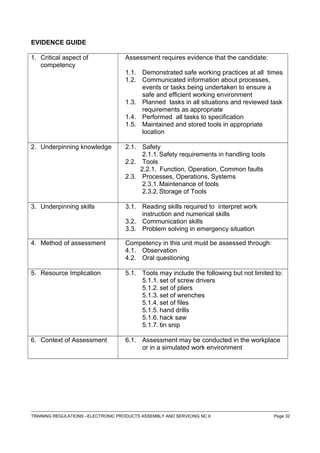
EVIDENCE GUIDE
1. Critical aspect of
competency
Assessment requires evidence that the candidate:
1.1. Demonstrated safe working practices at all times
1.2. Communicated information about processes,
events or tasks being undertaken to ensure a
safe and efficient working environment
1.3. Planned tasks in all situations and reviewed task
requirements as appropriate
1.4. Performed all tasks to specification
1.5. Maintained and stored tools in appropriate
location
2. Underpinning knowledge 2.1. Safety
2.1.1.Safety requirements in handling tools
2.2. Tools
2.2.1. Function, Operation, Common faults
2.3. Processes, Operations, Systems
2.3.1.Maintenance of tools
2.3.2.Storage of Tools
3. Underpinning skills 3.1. Reading skills required to interpret work
instruction and numerical skills
3.2. Communication skills
3.3. Problem solving in emergency situation
4. Method of assessment Competency in this unit must be assessed through:
4.1. Observation
4.2. Oral questioning
5. Resource Implication 5.1. Tools may include the following but not limited to:
5.1.1. set of screw drivers
5.1.2. set of pliers
5.1.3. set of wrenches
5.1.4. set of files
5.1.5. hand drills
5.1.6. hack saw
5.1.7. tin snip
6. Context of Assessment 6.1. Assessment may be conducted in the workplace
or in a simulated work environment
------------------------------------------------------------------------------------------------------------------------------------------------------------------------------------
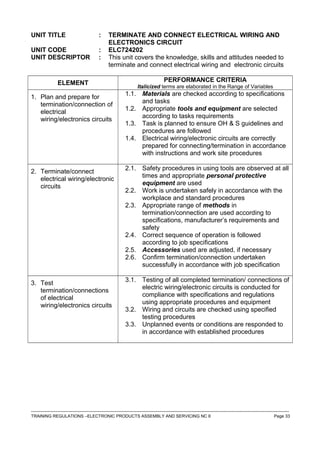
TRAINING REGULATIONS –ELECTRONIC PRODUCTS ASSEMBLY AND SERVICING NC II Page 32
UNIT TITLE : TERMINATE AND CONNECT ELECTRICAL WIRING AND
ELECTRONICS CIRCUIT
UNIT CODE : ELC724202
UNIT DESCRIPTOR : This unit covers the knowledge, skills and attitudes needed to
terminate and connect electrical wiring and electronic circuits
ELEMENT PERFORMANCE CRITERIA
Italicized terms are elaborated in the Range of Variables
1. Plan and prepare for
termination/connection of
electrical
wiring/electronics circuits
1.1. Materials are checked according to specifications
and tasks
1.2. Appropriate tools and equipment are selected
according to tasks requirements
1.3. Task is planned to ensure OH & S guidelines and
procedures are followed
1.4. Electrical wiring/electronic circuits are correctly
prepared for connecting/termination in accordance
with instructions and work site procedures
2. Terminate/connect
electrical wiring/electronic
circuits
2.1. Safety procedures in using tools are observed at all
times and appropriate personal protective
equipment are used
2.2. Work is undertaken safely in accordance with the
workplace and standard procedures
2.3. Appropriate range of methods in
termination/connection are used according to
specifications, manufacturer’s requirements and
safety
2.4. Correct sequence of operation is followed
according to job specifications
2.5. Accessories used are adjusted, if necessary
2.6. Confirm termination/connection undertaken
successfully in accordance with job specification
3. Test
termination/connections
of electrical
wiring/electronics circuits
3.1. Testing of all completed termination/ connections of
electric wiring/electronic circuits is conducted for
compliance with specifications and regulations
using appropriate procedures and equipment
3.2. Wiring and circuits are checked using specified
testing procedures
3.3. Unplanned events or conditions are responded to
in accordance with established procedures
------------------------------------------------------------------------------------------------------------------------------------------------------------------------------------
TRAINING REGULATIONS –ELECTRONIC PRODUCTS ASSEMBLY AND SERVICING NC II Page 33
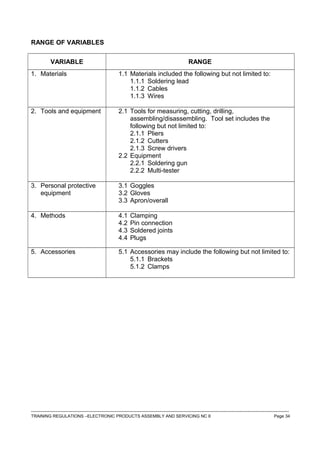
RANGE OF VARIABLES
VARIABLE RANGE
1. Materials 1.1 Materials included the following but not limited to:
1.1.1 Soldering lead
1.1.2 Cables
1.1.3 Wires
2. Tools and equipment 2.1 Tools for measuring, cutting, drilling,
assembling/disassembling. Tool set includes the
following but not limited to:
2.1.1 Pliers
2.1.2 Cutters
2.1.3 Screw drivers
2.2 Equipment
2.2.1 Soldering gun
2.2.2 Multi-tester
3. Personal protective
equipment
3.1 Goggles
3.2 Gloves
3.3 Apron/overall
4. Methods 4.1 Clamping
4.2 Pin connection
4.3 Soldered joints
4.4 Plugs
5. Accessories 5.1 Accessories may include the following but not limited to:
5.1.1 Brackets
5.1.2 Clamps
------------------------------------------------------------------------------------------------------------------------------------------------------------------------------------
TRAINING REGULATIONS –ELECTRONIC PRODUCTS ASSEMBLY AND SERVICING NC II Page 34
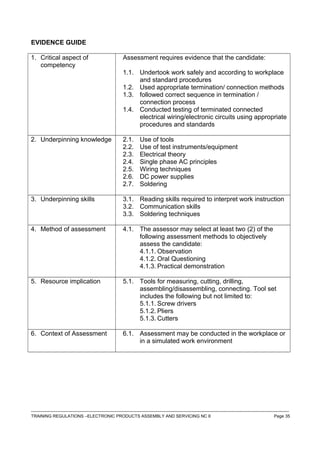
EVIDENCE GUIDE
1. Critical aspect of
competency
Assessment requires evidence that the candidate:
1.1. Undertook work safely and according to workplace
and standard procedures
1.2. Used appropriate termination/ connection methods
1.3. followed correct sequence in termination /
connection process
1.4. Conducted testing of terminated connected
electrical wiring/electronic circuits using appropriate
procedures and standards
2. Underpinning knowledge 2.1. Use of tools
2.2. Use of test instruments/equipment
2.3. Electrical theory
2.4. Single phase AC principles
2.5. Wiring techniques
2.6. DC power supplies
2.7. Soldering
3. Underpinning skills 3.1. Reading skills required to interpret work instruction
3.2. Communication skills
3.3. Soldering techniques
4. Method of assessment 4.1. The assessor may select at least two (2) of the
following assessment methods to objectively
assess the candidate:
4.1.1. Observation
4.1.2. Oral Questioning
4.1.3. Practical demonstration
5. Resource implication 5.1. Tools for measuring, cutting, drilling,
assembling/disassembling, connecting. Tool set
includes the following but not limited to:
5.1.1. Screw drivers
5.1.2. Pliers
5.1.3. Cutters
6. Context of Assessment 6.1. Assessment may be conducted in the workplace or
in a simulated work environment
------------------------------------------------------------------------------------------------------------------------------------------------------------------------------------
TRAINING REGULATIONS –ELECTRONIC PRODUCTS ASSEMBLY AND SERVICING NC II Page 35
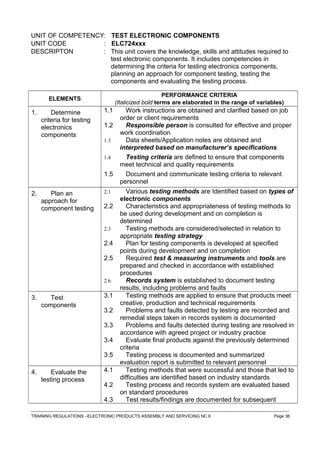
UNIT OF COMPETENCY: TEST ELECTRONIC COMPONENTS
UNIT CODE : ELC724xxx
DESCRIPTON : This unit covers the knowledge, skills and attitudes required to
test electronic components. It includes competencies in
determining the criteria for testing electronics components,
planning an approach for component testing, testing the
components and evaluating the testing process.
ELEMENTS
PERFORMANCE CRITERIA
(Italicized bold terms are elaborated in the range of variables)
1. Determine
criteria for testing
electronics
components
1.1 Work instructions are obtained and clarified based on job
order or client requirements
1.2 Responsible person is consulted for effective and proper
work coordination
1.3 Data sheets/Application notes are obtained and
interpreted based on manufacturer’s specifications
1.4 Testing criteria are defined to ensure that components
meet technical and quality requirements
1.5 Document and communicate testing criteria to relevant
personnel
2. Plan an
approach for
component testing
2.1 Various testing methods are Identified based on types of
electronic components
2.2 Characteristics and appropriateness of testing methods to
be used during development and on completion is
determined
2.3 Testing methods are considered/selected in relation to
appropriate testing strategy
2.4 Plan for testing components is developed at specified
points during development and on completion
2.5 Required test & measuring instruments and tools are
prepared and checked in accordance with established
procedures
2.6 Records system is established to document testing
results, including problems and faults
3. Test
components
3.1 Testing methods are applied to ensure that products meet
creative, production and technical requirements
3.2 Problems and faults detected by testing are recorded and
remedial steps taken in records system is documented
3.3 Problems and faults detected during testing are resolved in
accordance with agreed project or industry practice
3.4 Evaluate final products against the previously determined
criteria
3.5 Testing process is documented and summarized
evaluation report is submitted to relevant personnel
4. Evaluate the
testing process
4.1 Testing methods that were successful and those that led to
difficulties are identified based on industry standards
4.2 Testing process and records system are evaluated based
on standard procedures
4.3 Test results/findings are documented for subsequent
------------------------------------------------------------------------------------------------------------------------------------------------------------------------------------
TRAINING REGULATIONS –ELECTRONIC PRODUCTS ASSEMBLY AND SERVICING NC II Page 36
components testing.
------------------------------------------------------------------------------------------------------------------------------------------------------------------------------------
TRAINING REGULATIONS –ELECTRONIC PRODUCTS ASSEMBLY AND SERVICING NC II Page 37
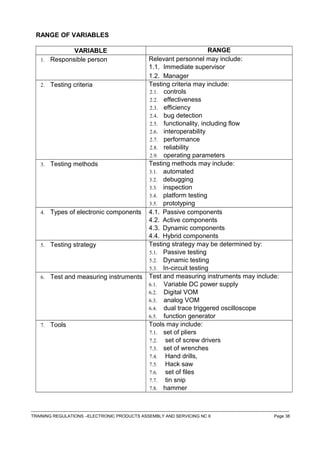
RANGE OF VARIABLES
VARIABLE RANGE
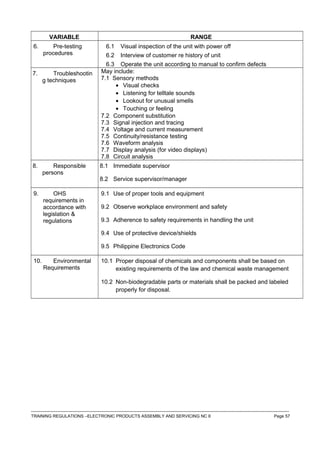
1. Responsible person Relevant personnel may include:
1.1. Immediate supervisor
1.2. Manager
2. Testing criteria Testing criteria may include:
2.1. controls
2.2. effectiveness
2.3. efficiency
2.4. bug detection
2.5. functionality, including flow
2.6. interoperability
2.7. performance
2.8. reliability
2.9. operating parameters
3. Testing methods Testing methods may include:
3.1. automated
3.2. debugging
3.3. inspection
3.4. platform testing
3.5. prototyping
4. Types of electronic components 4.1. Passive components
4.2. Active components
4.3. Dynamic components
4.4. Hybrid components
5. Testing strategy Testing strategy may be determined by:
5.1. Passive testing
5.2. Dynamic testing
5.3. In-circuit testing
6. Test and measuring instruments Test and measuring instruments may include:
6.1. Variable DC power supply
6.2. Digital VOM
6.3. analog VOM
6.4. dual trace triggered oscilloscope
6.5. function generator
7. Tools Tools may include:
7.1. set of pliers
7.2. set of screw drivers
7.3. set of wrenches
7.4. Hand drills,
7.5. Hack saw
7.6. set of files
7.7. tin snip
7.8. hammer
------------------------------------------------------------------------------------------------------------------------------------------------------------------------------------
TRAINING REGULATIONS –ELECTRONIC PRODUCTS ASSEMBLY AND SERVICING NC II Page 38
8. Records system Records system may include:
8.1. metadata that includes:
8.1.1. description of fault
8.1.2. identification of code
8.1.3. user responses
8.1.4. written or verbal comments
8.1.5. quantitative data
8.1.6. remedial action taken
8.1.7. retest result
8.1.8. date
8.1.9. tester's details
8.2. questionnaire
8.3. survey
------------------------------------------------------------------------------------------------------------------------------------------------------------------------------------
TRAINING REGULATIONS –ELECTRONIC PRODUCTS ASSEMBLY AND SERVICING NC II Page 39
EVIDENCE GUIDE
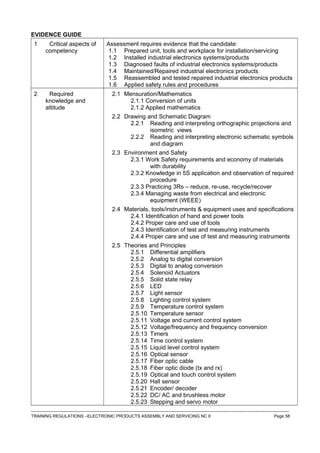
1 Critical aspects of
competency
Assessment requires evidence that the candidate:
1.1 Determined criteria for testing electronics components
1.2 Planned an approach for component testing
1.3 Tested components
1.4 Evaluated the testing process
2 Required
knowledge and
attitude
2.1 Mensuration/Mathematics
2.1.1 Conversion of Units
2.1.2 Applied Mathematics
2.2 Safety
2.2.1 Work Safety requirements and economy of
materials with durability
2.2.2 Knowledge in 5S application and observation of
required timeframe
2.2.3 Knowledge of proper handling and disposal of
chemicals
2.3 Materials, tools and equipment uses and specifications
2.3.1 Identification of hand and power tools
2.3.2 Proper care and use of tools
2.4 Systems and Processes
2.4.1 Principles of electrical/electronic circuits
2.4.2 Identifying sources of electricity
2.4.3 Identifying conductors and insulators
2.4.4 Describing resistance and identify resistors
2.4.5 Supplying different voltage using variable power
supply
2.4.6 Measuring resistance using VOM
2.4.7 Testing resistors
2.4.8 Measuring current and voltage using VOM
2.4.9 Analyzing simple circuit using ohms and power
law
2.4.10 Analyzing series/parallel circuits using ohms and
power law
2.4.11 Describing alternating current circuits
2.4.12 Observing waveform using oscilloscope
2.4.13 generating waveform in various frequency using
function generator
2.4.14 Measuring frequency using oscilloscope
2.4.15 Measuring capacitance using VOM
2.4.16 Describing capacitance and identifying
capacitors
2.4.17 Testing capacitors
2.4.18 Analyzing series/parallel capacitances
2.4.19 Describing inductance and identifying inductors
2.4.20 Testing inductors
2.4.21 analyzing series parallel inductors
2.4.22 describing the characteristic of transformers
2.4.23 describing and identifying semiconductor diode
------------------------------------------------------------------------------------------------------------------------------------------------------------------------------------
TRAINING REGULATIONS –ELECTRONIC PRODUCTS ASSEMBLY AND SERVICING NC II Page 40
2.4.24 testing semiconductor diode
2.4.25 analyzing rectifier circuits
2.4.26 describing and identifying bipolar transistor
2.4.27 testing bipolar transistor
2.4.28 analyzing amplifier circuit
2.4.29 analyzing multi-vibrator circuit
2.4.30 describing and analyzing digital gate
2.4.31 testing logic gates
2.4.32 analyzing logic networks
2.4.33 analyzing sequence circuits
3 Required skills 3.1 Work efficiently & systematically
3.2 Communication skills
3.3 Use and maintenance of tools and equipment
3.4 Skills in testing electronic components
3.5 Work safety practices and time management
3.6 Problem solving skills
3.7 Reading skills
4 Method of
assessment
Competency may be assessed through two or more of the
following methods:
4.1 Direct observation of application to tasks and questions
related to required knowledge
4.2 Demonstration with oral questioning
4.3 Third party report
4.4 Written test
4.5 Portfolio
5 Resource
implications
The following resources must be provided:
5.1 Tools and equipment (see range of variables)
5.2 Working area/bench
5.3 Electronic components
5.4 Testing instruments and equipment
5.5 Assessment rating sheet
5.6 Reporting forms
6 Context of
assessment
6.1 Assessment maybe conducted in the workplace or in a
simulated workplace setting
------------------------------------------------------------------------------------------------------------------------------------------------------------------------------------
TRAINING REGULATIONS –ELECTRONIC PRODUCTS ASSEMBLY AND SERVICING NC II Page 41
CORE COMPETENCIES
UNIT OF COMPETENCY: ASSEMBLE ELECTRONIC PRODUCTS
UNIT CODE : ELC724335
DESCRIPTON : This unit covers the knowledge, skills and attitudes required to
assemble electronic products and systems for consumer/
industrial uses/applications. It consist of competencies in
identifying and preparing electronic components and circuits,
preparing/making printed circuit board (PCB) modules, mounting
and soldering of components, assembling electronic products
and performing mechanical and electrical/electronic tests.
ELEMENTS
PERFORMANCE CRITERIA
(Italicized bold terms are elaborated in the range of variables)
1. Prepare
to assemble
electronic
products
1.1 Assembly workplace is prepared in accordance with OH&S
policies and procedures
1.2 Established risk control measures for work preparation are
followed.
1.3 Work instructions are obtained and clarified based on job order or
client requirements
1.4 Responsible person is consulted for effective and proper work
coordination
1.5 Required materials, tools and equipment are prepared and
checked in accordance with established procedures
1.6 Parts and components needed to complete the work are
identified, prepared and obtained according to requirements
2. Prepare/
Make PCB
modules
2.1 PCB layout is verified for conformity with the schematic diagram
in accordance with the layout rules
2.2 PCB layout is transferred to copper-cladded board following
acceptable methods and standards
2.3 Visual inspection is performed based on standards procedures.
2.4 Thru-hole is drilled based on standards procedures
2.5 PCB is cleaned based on standards procedures
2.6 Functionality of PCB is tested and visual inspection is performed
based on standards procedures
3. Mount
and solder
electronic
components
3.1 Knowledge of lead and lead-free soldering characteristics and
requirements are applied to mounting and soldering process in
accordance with OH&S standards
3.2 Components are mounted and soldered in accordance with
soldering principles.
3.3 Soldering/Desoldering techniques and procedures are applied in
accordance with established standards and requirements.
3.4 Soldered products are checked and complied with international
standards and task specifications
4. Perform
electronic
products
assembly
4.1 Work instructions is followed based on job order or client
requirements
4.2 Assembly procedures are performed in accordance with OH&S
policies and work instructions
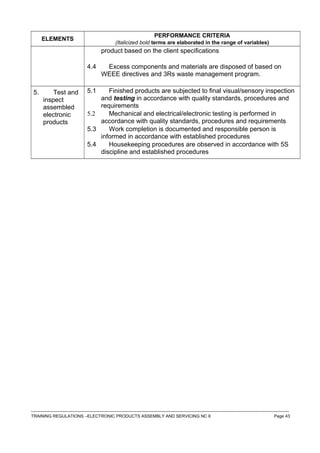
4.3 Modules and accessories are connected/integrated into the final
------------------------------------------------------------------------------------------------------------------------------------------------------------------------------------
TRAINING REGULATIONS –ELECTRONIC PRODUCTS ASSEMBLY AND SERVICING NC II Page 42
ELEMENTS
PERFORMANCE CRITERIA
(Italicized bold terms are elaborated in the range of variables)
product based on the client specifications
4.4 Excess components and materials are disposed of based on
WEEE directives and 3Rs waste management program.
5. Test and
inspect
assembled
electronic
products
5.1 Finished products are subjected to final visual/sensory inspection
and testing in accordance with quality standards, procedures and
requirements
5.2 Mechanical and electrical/electronic testing is performed in
accordance with quality standards, procedures and requirements
5.3 Work completion is documented and responsible person is
informed in accordance with established procedures
5.4 Housekeeping procedures are observed in accordance with 5S
discipline and established procedures
------------------------------------------------------------------------------------------------------------------------------------------------------------------------------------
TRAINING REGULATIONS –ELECTRONIC PRODUCTS ASSEMBLY AND SERVICING NC II Page 43
RANGE OF VARIABLES
VARIABLE RANGE
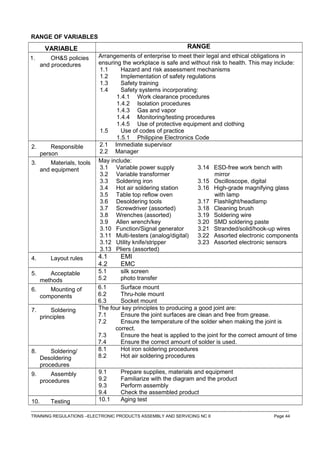
1. OH&S policies
and procedures
Arrangements of enterprise to meet their legal and ethical obligations in
ensuring the workplace is safe and without risk to health. This may include:
1.1 Hazard and risk assessment mechanisms
1.2 Implementation of safety regulations
1.3 Safety training
1.4 Safety systems incorporating:
1.4.1 Work clearance procedures
1.4.2 Isolation procedures
1.4.3 Gas and vapor
1.4.4 Monitoring/testing procedures
1.4.5 Use of protective equipment and clothing
1.5 Use of codes of practice
1.5.1 Philippine Electronics Code
2. Responsible
person
2.1 Immediate supervisor
2.2 Manager
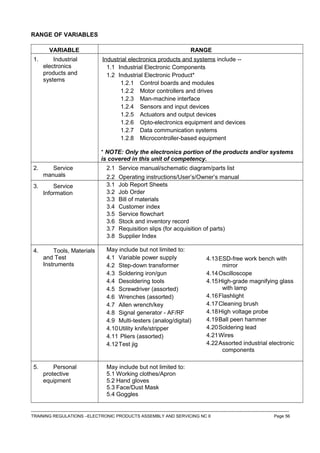
3. Materials, tools
and equipment
May include:
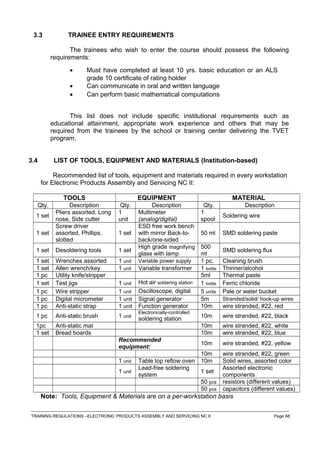
3.1 Variable power supply
3.2 Variable transformer
3.3 Soldering iron
3.4 Hot air soldering station
3.5 Table top reflow oven
3.6 Desoldering tools
3.7 Screwdriver (assorted)
3.8 Wrenches (assorted)
3.9 Allen wrench/key
3.10 Function/Signal generator
3.11 Multi-testers (analog/digital)
3.12 Utility knife/stripper
3.13 Pliers (assorted)
3.14 ESD-free work bench with
mirror
3.15 Oscilloscope, digital
3.16 High-grade magnifying glass
with lamp
3.17 Flashlight/headlamp
3.18 Cleaning brush
3.19 Soldering wire
3.20 SMD soldering paste
3.21 Stranded/solid/hook-up wires
3.22 Assorted electronic components
3.23 Assorted electronic sensors
4. Layout rules 4.1 EMI
4.2 EMC
5. Acceptable
methods
5.1 silk screen
5.2 photo transfer
6. Mounting of
components
6.1 Surface mount
6.2 Thru-hole mount
6.3 Socket mount
7. Soldering
principles
The four key principles to producing a good joint are:
7.1 Ensure the joint surfaces are clean and free from grease.
7.2 Ensure the temperature of the solder when making the joint is
correct.
7.3 Ensure the heat is applied to the joint for the correct amount of time
7.4 Ensure the correct amount of solder is used.
8. Soldering/
Desoldering
procedures
8.1 Hot iron soldering procedures
8.2 Hot air soldering procedures
9. Assembly
procedures
9.1 Prepare supplies, materials and equipment
9.2 Familiarize with the diagram and the product
9.3 Perform assembly
9.4 Check the assembled product
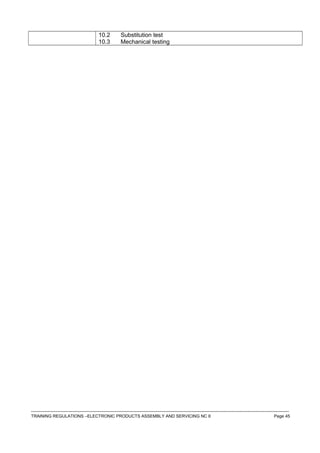
10. Testing 10.1 Aging test
------------------------------------------------------------------------------------------------------------------------------------------------------------------------------------
TRAINING REGULATIONS –ELECTRONIC PRODUCTS ASSEMBLY AND SERVICING NC II Page 44
10.2 Substitution test
10.3 Mechanical testing
------------------------------------------------------------------------------------------------------------------------------------------------------------------------------------
TRAINING REGULATIONS –ELECTRONIC PRODUCTS ASSEMBLY AND SERVICING NC II Page 45
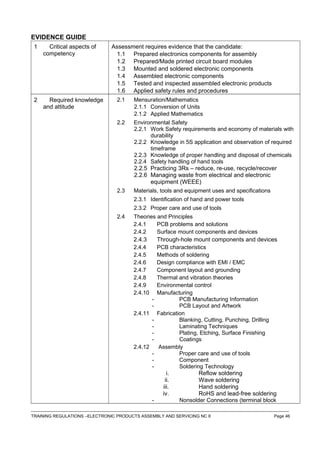
EVIDENCE GUIDE
1 Critical aspects of
competency
Assessment requires evidence that the candidate:
1.1 Prepared electronics components for assembly
1.2 Prepared/Made printed circuit board modules
1.3 Mounted and soldered electronic components
1.4 Assembled electronic components
1.5 Tested and inspected assembled electronic products
1.6 Applied safety rules and procedures
2 Required knowledge
and attitude
2.1 Mensuration/Mathematics
2.1.1 Conversion of Units
2.1.2 Applied Mathematics
2.2 Environmental Safety
2.2.1 Work Safety requirements and economy of materials with
durability
2.2.2 Knowledge in 5S application and observation of required
timeframe
2.2.3 Knowledge of proper handling and disposal of chemicals
2.2.4 Safety handling of hand tools
2.2.5 Practicing 3Rs – reduce, re-use, recycle/recover
2.2.6 Managing waste from electrical and electronic
equipment (WEEE)
2.3 Materials, tools and equipment uses and specifications
2.3.1 Identification of hand and power tools
2.3.2 Proper care and use of tools
2.4 Theories and Principles
2.4.1 PCB problems and solutions
2.4.2 Surface mount components and devices
2.4.3 Through-hole mount components and devices
2.4.4 PCB characteristics
2.4.5 Methods of soldering
2.4.6 Design compliance with EMI / EMC
2.4.7 Component layout and grounding
2.4.8 Thermal and vibration theories
2.4.9 Environmental control
2.4.10 Manufacturing
- PCB Manufacturing Information
- PCB Layout and Artwork
2.4.11 Fabrication
- Blanking, Cutting, Punching, Drilling
- Laminating Techniques
- Plating, Etching, Surface Finishing
- Coatings
2.4.12 Assembly
- Proper care and use of tools
- Component
- Soldering Technology
i. Reflow soldering
ii. Wave soldering
iii. Hand soldering
iv. RoHS and lead-free soldering
- Nonsolder Connections (terminal block
------------------------------------------------------------------------------------------------------------------------------------------------------------------------------------
TRAINING REGULATIONS –ELECTRONIC PRODUCTS ASSEMBLY AND SERVICING NC II Page 46
- Cleaning
- Repair and Rework
- Safety
- ESD protection
2.4.13 Testing of electronic products
2.5 3Rs waste management programs
2.6 Rules and conventions
2.6.1 Philippine Electronics Code
2.6.2 RoHS/WEEE Directives
2.6.3 RA 9292 – ECE Law
3 Required skills 3.1 assembling electronic products
3.2 Using and maintaining test instruments, tools, & equipment
3.3 splicing/joining wires
3.4 PCB preparation skills
3.5 Proper soldering/desoldering skills
3.6 Component testing
3.7 mounting various types of electronic components
3.8 Work safety practices and time management
3.9 interpreting schematic/block diagrams
4 Method of
assessment
Competency may be assessed through two or more of the following
methods:
4.1 Practical Demonstration w/ oral questioning
4.2 Interview
4.3 Portfolio
5 Resource
implications
The following resources must be provided:
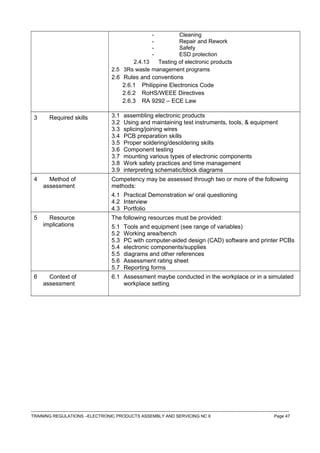
5.1 Tools and equipment (see range of variables)
5.2 Working area/bench
5.3 PC with computer-aided design (CAD) software and printer PCBs
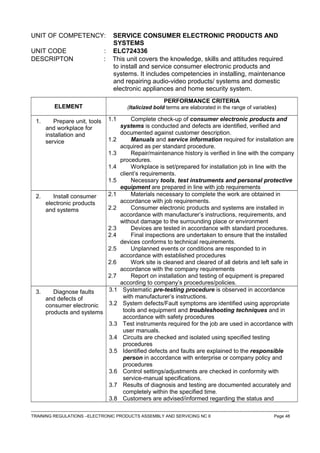
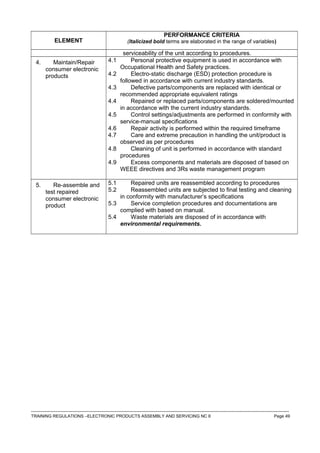
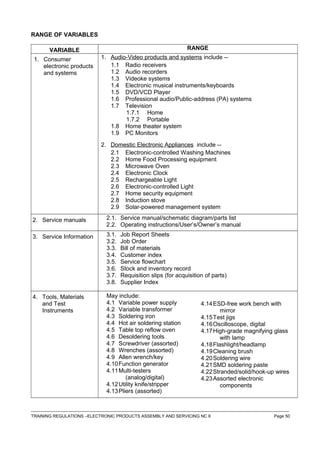
5.4 electronic components/supplies
5.5 diagrams and other references
5.6 Assessment rating sheet
5.7 Reporting forms
6 Context of
assessment
6.1 Assessment maybe conducted in the workplace or in a simulated
workplace setting
------------------------------------------------------------------------------------------------------------------------------------------------------------------------------------
TRAINING REGULATIONS –ELECTRONIC PRODUCTS ASSEMBLY AND SERVICING NC II Page 47
UNIT OF COMPETENCY: SERVICE CONSUMER ELECTRONIC PRODUCTS AND
SYSTEMS
UNIT CODE : ELC724336
DESCRIPTON : This unit covers the knowledge, skills and attitudes required
to install and service consumer electronic products and
systems. It includes competencies in installing, maintenance
and repairing audio-video products/ systems and domestic
electronic appliances and home security system.
ELEMENT
PERFORMANCE CRITERIA
(Italicized bold terms are elaborated in the range of variables)
1. Prepare unit, tools
and workplace for
installation and
service
1.1 Complete check-up of consumer electronic products and
systems is conducted and defects are identified, verified and
documented against customer description.
1.2 Manuals and service information required for installation are
acquired as per standard procedure.
1.3 Repair/maintenance history is verified in line with the company
procedures.
1.4 Workplace is set/prepared for installation job in line with the
client’s requirements.
1.5 Necessary tools, test instruments and personal protective
equipment are prepared in line with job requirements
2. Install consumer
electronic products
and systems
2.1 Materials necessary to complete the work are obtained in
accordance with job requirements.
2.2 Consumer electronic products and systems are installed in
accordance with manufacturer’s instructions, requirements, and
without damage to the surrounding place or environment
2.3 Devices are tested in accordance with standard procedures.
2.4 Final inspections are undertaken to ensure that the installed
devices conforms to technical requirements.
2.5 Unplanned events or conditions are responded to in
accordance with established procedures
2.6 Work site is cleaned and cleared of all debris and left safe in
accordance with the company requirements
2.7 Report on installation and testing of equipment is prepared
according to company’s procedures/policies.
3. Diagnose faults
and defects of
consumer electronic
products and systems
3.1 Systematic pre-testing procedure is observed in accordance
with manufacturer’s instructions.
3.2 System defects/Fault symptoms are identified using appropriate
tools and equipment and troubleshooting techniques and in
accordance with safety procedures
3.3 Test instruments required for the job are used in accordance with
user manuals.
3.4 Circuits are checked and isolated using specified testing
procedures
3.5 Identified defects and faults are explained to the responsible
person in accordance with enterprise or company policy and
procedures
3.6 Control settings/adjustments are checked in conformity with
service-manual specifications.
3.7 Results of diagnosis and testing are documented accurately and
completely within the specified time.
3.8 Customers are advised/informed regarding the status and
------------------------------------------------------------------------------------------------------------------------------------------------------------------------------------
TRAINING REGULATIONS –ELECTRONIC PRODUCTS ASSEMBLY AND SERVICING NC II Page 48
ELEMENT
PERFORMANCE CRITERIA
(Italicized bold terms are elaborated in the range of variables)
serviceability of the unit according to procedures.
4. Maintain/Repair
consumer electronic
products
4.1 Personal protective equipment is used in accordance with
Occupational Health and Safety practices.
4.2 Electro-static discharge (ESD) protection procedure is
followed in accordance with current industry standards.
4.3 Defective parts/components are replaced with identical or
recommended appropriate equivalent ratings
4.4 Repaired or replaced parts/components are soldered/mounted
in accordance with the current industry standards.
4.5 Control settings/adjustments are performed in conformity with
service-manual specifications
4.6 Repair activity is performed within the required timeframe
4.7 Care and extreme precaution in handling the unit/product is
observed as per procedures
4.8 Cleaning of unit is performed in accordance with standard
procedures
4.9 Excess components and materials are disposed of based on
WEEE directives and 3Rs waste management program
5. Re-assemble and
test repaired
consumer electronic
product
5.1 Repaired units are reassembled according to procedures
5.2 Reassembled units are subjected to final testing and cleaning
in conformity with manufacturer’s specifications
5.3 Service completion procedures and documentations are
complied with based on manual.
5.4 Waste materials are disposed of in accordance with
environmental requirements.
------------------------------------------------------------------------------------------------------------------------------------------------------------------------------------
TRAINING REGULATIONS –ELECTRONIC PRODUCTS ASSEMBLY AND SERVICING NC II Page 49
RANGE OF VARIABLES
VARIABLE RANGE
1. Consumer
electronic products
and systems
1. Audio-Video products and systems include --
1.1 Radio receivers
1.2 Audio recorders
1.3 Videoke systems
1.4 Electronic musical instruments/keyboards
1.5 DVD/VCD Player
1.6 Professional audio/Public-address (PA) systems
1.7 Television
1.7.1 Home
1.7.2 Portable
1.8 Home theater system
1.9 PC Monitors
2. Domestic Electronic Appliances include --
2.1 Electronic-controlled Washing Machines
2.2 Home Food Processing equipment
2.3 Microwave Oven
2.4 Electronic Clock
2.5 Rechargeable Light
2.6 Electronic-controlled Light
2.7 Home security equipment
2.8 Induction stove
2.9 Solar-powered management system
2. Service manuals 2.1. Service manual/schematic diagram/parts list
2.2. Operating instructions/User’s/Owner’s manual
3. Service Information 3.1. Job Report Sheets
3.2. Job Order
3.3. Bill of materials
3.4. Customer index
3.5. Service flowchart
3.6. Stock and inventory record
3.7. Requisition slips (for acquisition of parts)
3.8. Supplier Index
4. Tools, Materials
and Test
Instruments
May include:
4.1 Variable power supply
4.2 Variable transformer
4.3 Soldering iron
4.4 Hot air soldering station
4.5 Table top reflow oven
4.6 Desoldering tools
4.7 Screwdriver (assorted)
4.8 Wrenches (assorted)
4.9 Allen wrench/key
4.10Function generator
4.11Multi-testers
(analog/digital)
4.12Utility knife/stripper
4.13Pliers (assorted)
4.14ESD-free work bench with
mirror
4.15Test jigs
4.16Oscilloscope, digital
4.17High-grade magnifying glass
with lamp
4.18Flashlight/headlamp
4.19Cleaning brush
4.20Soldering wire
4.21SMD soldering paste
4.22Stranded/solid/hook-up wires
4.23Assorted electronic
components
------------------------------------------------------------------------------------------------------------------------------------------------------------------------------------
TRAINING REGULATIONS –ELECTRONIC PRODUCTS ASSEMBLY AND SERVICING NC II Page 50
VARIABLE RANGE
5. Pre-testing
procedures
5.1. Visual inspection of the unit with power off
5.2. Interview of customer re history of unit
5.3. Operate the unit according to manual to confirm defects
6. Troubleshooting
techniques
May include:
6.1 sensory methods
Visual checks
Listening for telltale sounds
Lookout for unusual smells
Touching or feeling
6.2 Component substitution
6.3 Signal injection and tracing
6.4 Voltage and current measurement
6.5 Continuity/resistance testing
6.6 Waveform analysis
6.7 Display analysis (for video displays)
6.8 Circuit analysis
7. Responsible
persons
7.1. Immediate supervisor
7.2. Service supervisor/manager
8. Environmental
Requirements
8.1. Proper disposal of chemicals and components shall be based on
existing requirements of the law and chemical waste
management
8.2. Non-biodegradable parts or materials shall be packed and
labeled properly for disposal.
8.3. WEEE requirements
------------------------------------------------------------------------------------------------------------------------------------------------------------------------------------
TRAINING REGULATIONS –ELECTRONIC PRODUCTS ASSEMBLY AND SERVICING NC II Page 51
EVIDENCE GUIDE
1 Critical aspects of
competency
Assessment requires evidence that the candidate:
1.1 Prepared the unit and required materials, tools equipment and
workplace properly for installation and service.
1.2 Installed consumer electronic products and systems
1.3 Diagnosed faults and defects
1.4 Maintained/Repaired consumer electronic products
1.5 Re-assembled and tested repaired consumer electronic product
1.6 Applied safety rules and procedures
2 Required
knowledge and
attitude
2.1 Mensuration/Mathematics
2.1.1 Conversion of units
2.1.2 Applied mathematics
2.2 Drawing and Schematic Diagram
2.2.1 Reading and interpreting orthographic
projections and isometric views
2.2.2 Reading and interpreting electronic
schematic symbols and diagram
2.3 Environmental Safety
2.3.1 Work Safety requirements and economy of materials
with durability
2.3.2 Knowledge in 5S application and observation of
required procedure
2.3.3 Practicing 3Rs – reduce, re-use, recycle/recover
2.3.4 Managing waste from electrical and electronic
equipment (WEEE)
2.4 Materials, tools/instruments & equipment uses and
specifications
2.4.1 Identification of hand and power tools
2.4.2 Proper care and use of tools
2.4.3 Identification of test and measuring instruments
2.4.4 Proper care and use of test and measuring instruments
2.5 System and Processes
2.5.1 Principles of electrical circuits
2.5.2 Fundamentals of direct current circuits
2.5.3 Fundamentals of alternating current circuits
2.5.4 Fundamentals of electronic components and circuits
2.5.5 Fundamentals of digital logics, components & circuits
2.5.6 Fundamentals of microprocessor circuits and
programming
2.5.7 Analysis of troubles and isolation techniques
2.5.8 Principles of sound and acoustics
2.5.9 Fundamentals of audio amplifiers
2.5.10 Fundamentals of audio source & noise reduction
system
2.5.11 Fundamentals of AM & FM Receivers
2.5.12 Principles of vision and color
2.5.13 Fundamentals of color television
2.5.14 Fundamentals of video sources & noise reduction
system
2.6 Theories and Principles
2.6.1 AM transmission and reception
2.6.2 FM transmission and reception
2.6.3 Analog TV transmission and reception
------------------------------------------------------------------------------------------------------------------------------------------------------------------------------------
TRAINING REGULATIONS –ELECTRONIC PRODUCTS ASSEMBLY AND SERVICING NC II Page 52
2.6.4 Digital HDTV transmission and reception
2.6.5 Audio Video sources and formats
2.6.6 Pulse Code Modulation
2.6.7 Home theater system
2.6.8 Digital noise reduction system
2.6.9 CCTV system
2.6.10 Infrared remote control system
2.6.11 Motor and motor control system
2.6.12 LED and lighting system
2.6.13 Heat and heating control system
2.6.14 Solar cell and battery management system
2.6.15 Microcontroller
2.6.16 Microcontroller interfacing
2.7 Consumer electronic products and systems installation
procedures
2.8 Systematic pre-testing procedures
2.9 System defects/Fault symptoms
2.10Mechanical and electrical/electronic testing
2.11Commissioning procedures
2.123Rs waste management programs
2.13Rules and conventions
2.13.1 Philippine Electronics Code
2.13.2 RoHS/WEEE Directives
2.13.3 RA 9292 – ECE Law commissioning
procedures
3 Required skills 3.1 Application of troubleshooting technique
3.2 Using and maintaining test instruments, tools, & equipment
3.3 Application of work safety practices and time management
3.4 Application of substitution technique
3.5 Soldering/desoldering and wiring/cabling techniques
3.6 Schematic diagram reading skills
4 Method of
assessment
Competency may be assessed through:
4.1 Practical Demonstration w/ oral questioning
4.2 Interview
4.3 Portfolio
5 Resource
implications
The following resources must be provided:
5.1 Tools, equipment and test instruments
5.2 Needed audio-video products and systems
5.3 Needed consumer appliances
5.4 Service manuals/schematics
5.5 ESD free working area/bench
5.6 Needed electronic spare parts/supplies
6 Context of
assessment
6.1 Assessment maybe conducted in the workplace or in a
simulated workplace setting
------------------------------------------------------------------------------------------------------------------------------------------------------------------------------------
TRAINING REGULATIONS –ELECTRONIC PRODUCTS ASSEMBLY AND SERVICING NC II Page 53
UNIT OF COMPETENCY: SERVICE INDUSTRIAL ELECTRONIC MODULES, PRODUCTS
AND SYSTEMS
UNIT CODE : ELC724337
DESCRIPTON : This unit covers the knowledge, skills and attitudes required to install
and service industrial electronic modules, products and systems. It
consists of competencies in installing, troubleshooting, maintenance
and repairing industrial electronic modules, products and systems.
ELEMENT
PERFORMANCE CRITERIA
(Italicized bold terms are elaborated in the range of variables)
1. Prepare unit, tools
and workplace for
installation / servicing
1.1 Complete check-up of industrial electronic components,
products and systems is conducted and defects are identified,
verified and documented against customer description.
1.2 Repair/maintenance history is verified in line with the company
procedures.
1.3 Service manuals and service information required for
repair/maintenance are acquired as per standard procedure.
1.4 Workplace is set/prepared for repair job in line with the company
requirements.
1.5 Necessary tools, test instruments and personal protective
equipment are prepared in line with job requirements
2. Install industrial
electronic modules/
products/ systems
2.1 Materials necessary to complete the work are obtained in
accordance with job requirements.
2.2 Industrial electronic modules/ products/systems are installed
in accordance with manufacturer’s instructions, requirements,
and without damage to the surrounding place or environment
2.3 Devices are tested in accordance with standard procedures.
2.4 Final inspections are undertaken to ensure that the installed
devices conforms to technical requirements.
2.5 Unplanned events or conditions are responded to in
accordance with established procedures
2.6 Work site is cleaned and cleared of all debris and left safe in
accordance with the company requirements
2.7 Report on installation and testing of equipment is prepared
according to company’s procedures/policies.
3. Diagnose faults and
defects of industrial
electronic modules/
products/systems
3.1 Systematic pre-testing procedure is observed in accordance
with manufacturer’s instructions.
3.2 System defects/Fault symptoms are identified using appropriate
tools and equipment and troubleshooting techniques and in
accordance with safety procedures
3.3 Test instruments required for the job are used in accordance
with user manuals.
3.4 Circuits are checked and isolated using specified testing
procedures
3.5 Identified defects and faults are explained to the responsible
person in accordance with enterprise or company policy and
procedures
3.6 Control settings/adjustments are checked in conformity with
service-manual specifications.
3.7 Results of diagnosis and testing are documented accurately and
completely within the specified time.
3.8 Customers are advised/informed regarding the status and
serviceability of the unit according to procedures.
------------------------------------------------------------------------------------------------------------------------------------------------------------------------------------
TRAINING REGULATIONS –ELECTRONIC PRODUCTS ASSEMBLY AND SERVICING NC II Page 54
ELEMENT
PERFORMANCE CRITERIA
(Italicized bold terms are elaborated in the range of variables)
4. Maintain/Repair
industrial electronic
products
4.1 Personal protective equipment is used in accordance with
Occupational Health and Safety practices.
4.2 Electro-static discharge (ESD) protection procedure is
followed in accordance with current industry standards.
4.3 Defective parts/components are replaced with identical or
recommended appropriate equivalent ratings
4.4 Repaired or replaced parts/components are
soldered/mounted in accordance with the current industry
standards.
4.5 Control settings/adjustments are performed in conformity with
service-manual specifications
4.6 Repair activity is performed within the required timeframe
4.7 Care and extreme precaution in handling the unit/product is
observed as per OHS procedures
4.8 Cleaning of unit is performed in accordance with standard
procedures
4.9 Excess components and materials are disposed of based on
WEEE directives and 3Rs waste management program.
5. Reassemble and
test repaired industrial
electronic products
5.1 Repaired units are reassembled according to procedures
5.2 Reassembled units are subjected to final testing and cleaning
in conformity with manufacturer’s specifications
5.3 Service completion procedures and documentations are
complied with based on manual.
5.4 Waste materials are disposed of in accordance with
environmental requirements.
------------------------------------------------------------------------------------------------------------------------------------------------------------------------------------
TRAINING REGULATIONS –ELECTRONIC PRODUCTS ASSEMBLY AND SERVICING NC II Page 55
RANGE OF VARIABLES
VARIABLE RANGE
1. Industrial
electronics
products and
systems
Industrial electronics products and systems include --
1.1 Industrial Electronic Components
1.2 Industrial Electronic Product*
1.2.1 Control boards and modules
1.2.2 Motor controllers and drives
1.2.3 Man-machine interface
1.2.4 Sensors and input devices
1.2.5 Actuators and output devices
1.2.6 Opto-electronics equipment and devices
1.2.7 Data communication systems
1.2.8 Microcontroller-based equipment
* NOTE: Only the electronics portion of the products and/or systems
is covered in this unit of competency.
2. Service
manuals
2.1 Service manual/schematic diagram/parts list
2.2 Operating instructions/User’s/Owner’s manual
3. Service
Information
3.1 Job Report Sheets
3.2 Job Order
3.3 Bill of materials
3.4 Customer index
3.5 Service flowchart
3.6 Stock and inventory record
3.7 Requisition slips (for acquisition of parts)
3.8 Supplier Index
4. Tools, Materials
and Test
Instruments
May include but not limited to:
4.1 Variable power supply
4.2 Step-down transformer
4.3 Soldering iron/gun
4.4 Desoldering tools
4.5 Screwdriver (assorted)
4.6 Wrenches (assorted)
4.7 Allen wrench/key
4.8 Signal generator - AF/RF
4.9 Multi-testers (analog/digital)
4.10Utility knife/stripper
4.11 Pliers (assorted)
4.12Test jig
4.13ESD-free work bench with
mirror
4.14Oscilloscope
4.15High-grade magnifying glass
with lamp
4.16Flashlight
4.17Cleaning brush
4.18High voltage probe
4.19Ball peen hammer
4.20Soldering lead
4.21Wires
4.22Assorted industrial electronic
components
5. Personal
protective
equipment
May include but not limited to:
5.1 Working clothes/Apron
5.2 Hand gloves
5.3 Face/Dust Mask
5.4 Goggles
------------------------------------------------------------------------------------------------------------------------------------------------------------------------------------
TRAINING REGULATIONS –ELECTRONIC PRODUCTS ASSEMBLY AND SERVICING NC II Page 56
VARIABLE RANGE
6. Pre-testing
procedures
6.1 Visual inspection of the unit with power off
6.2 Interview of customer re history of unit
6.3 Operate the unit according to manual to confirm defects
7. Troubleshootin
g techniques
May include:
7.1 Sensory methods
• Visual checks
• Listening for telltale sounds
• Lookout for unusual smells
• Touching or feeling
7.2 Component substitution
7.3 Signal injection and tracing
7.4 Voltage and current measurement
7.5 Continuity/resistance testing
7.6 Waveform analysis
7.7 Display analysis (for video displays)
7.8 Circuit analysis
8. Responsible
persons
8.1 Immediate supervisor
8.2 Service supervisor/manager
9. OHS
requirements in
accordance with
legislation &
regulations
9.1 Use of proper tools and equipment
9.2 Observe workplace environment and safety
9.3 Adherence to safety requirements in handling the unit
9.4 Use of protective device/shields
9.5 Philippine Electronics Code
10. Environmental
Requirements
10.1 Proper disposal of chemicals and components shall be based on
existing requirements of the law and chemical waste management
10.2 Non-biodegradable parts or materials shall be packed and labeled
properly for disposal.
------------------------------------------------------------------------------------------------------------------------------------------------------------------------------------
TRAINING REGULATIONS –ELECTRONIC PRODUCTS ASSEMBLY AND SERVICING NC II Page 57
EVIDENCE GUIDE
1 Critical aspects of
competency
Assessment requires evidence that the candidate:
1.1 Prepared unit, tools and workplace for installation/servicing
1.2 Installed industrial electronics systems/products
1.3 Diagnosed faults of industrial electronics systems/products
1.4 Maintained/Repaired industrial electronics products
1.5 Reassembled and tested repaired industrial electronics products
1.6 Applied safety rules and procedures
2 Required
knowledge and
attitude
2.1 Mensuration/Mathematics
2.1.1 Conversion of units
2.1.2 Applied mathematics
2.2 Drawing and Schematic Diagram
2.2.1 Reading and interpreting orthographic projections and
isometric views
2.2.2 Reading and interpreting electronic schematic symbols
and diagram
2.3 Environment and Safety
2.3.1 Work Safety requirements and economy of materials
with durability
2.3.2 Knowledge in 5S application and observation of required
procedure
2.3.3 Practicing 3Rs – reduce, re-use, recycle/recover
2.3.4 Managing waste from electrical and electronic
equipment (WEEE)
2.4 Materials, tools/instruments & equipment uses and specifications
2.4.1 Identification of hand and power tools
2.4.2 Proper care and use of tools
2.4.3 Identification of test and measuring instruments
2.4.4 Proper care and use of test and measuring instruments
2.5 Theories and Principles
2.5.1 Differential amplifiers
2.5.2 Analog to digital conversion
2.5.3 Digital to analog conversion
2.5.4 Solenoid Actuators
2.5.5 Solid state relay
2.5.6 LED
2.5.7 Light sensor
2.5.8 Lighting control system
2.5.9 Temperature control system
2.5.10 Temperature sensor
2.5.11 Voltage and current control system
2.5.12 Voltage/frequency and frequency conversion
2.5.13 Timers
2.5.14 Time control system
2.5.15 Liquid level control system
2.5.16 Optical sensor
2.5.17 Fiber optic cable
2.5.18 Fiber optic diode (tx and rx)
2.5.19 Optical and touch control system
2.5.20 Hall sensor
2.5.21 Encoder/ decoder
2.5.22 DC/ AC and brushless motor
2.5.23 Stepping and servo motor
------------------------------------------------------------------------------------------------------------------------------------------------------------------------------------
TRAINING REGULATIONS –ELECTRONIC PRODUCTS ASSEMBLY AND SERVICING NC II Page 58
2.5.24 Pulse Width Modulation
2.5.25 Rotation control system
2.5.26 Acoustic sensor
2.5.27 Acoustic control system
2.5.28 Teaching pendant
2.5.29 Basic Robotic principles
2.5.30 Ultrasonic sensor (tx and rx)
2.5.31 Ultrasonic control system
2.5.32 Infrared sensor
2.5.33 Motion sensor
2.5.34 Infrared control system
2.5.35 Strain gage
2.5.36 Pressure sensor
2.5.37 Pressure control system
2.5.38 Microcontroller
2.5.39 Microcontroller interfacing
2.6 3Rs waste management programs
2.7 Consumer electronic products and systems installation
procedures
2.8 Systematic pre-testing procedures
2.9 System defects/Fault symptoms
2.10 Mechanical and electrical/electronic testing
2.11 Rules and conventions
2.11.1 Philippine Electronics Code
2.11.2 RoHS/WEEE Directives
2.11.3 RA 9292 – ECE Law Commissioning procedures
3 Required skills 3.1 Application of troubleshooting technique
3.2 Using and maintaining test instruments, tools, & equipment
3.3 Application of work safety practices and time management
3.4 Application of substitution technique
3.5 Soldering/desoldering and wiring/cabling techniques
3.6 Schematic diagram reading skills
4 Method of
assessment
Competency may be assessed through:
4.1 Practical Demonstration w/ oral questioning
4.2 Interview
4.3 Portfolio
5 Resource
implications
The following resources must be provided:
5.1 Tools, equipment and test instruments
5.2 Access to Industrial electronic products and systems and work
environment, e.g.
5.2.1 Control boards and modules
5.2.2 Motor controllers and drives
5.2.3 Sensors and input devices
5.2.4 Actuators and output devices
5.2.5 Opto-electronics equipment and devices
5.2.6 Data communication systems
5.2.7 Microcontroller-based equipment
5.3 Service manuals/schematics
5.4 ESD free working area/bench
5.5 Complete electronic spare parts/supplies
6 Context of 6.1 Assessment maybe conducted in the workplace or in a simulated
------------------------------------------------------------------------------------------------------------------------------------------------------------------------------------
TRAINING REGULATIONS –ELECTRONIC PRODUCTS ASSEMBLY AND SERVICING NC II Page 59
assessment workplace setting
------------------------------------------------------------------------------------------------------------------------------------------------------------------------------------
TRAINING REGULATIONS –ELECTRONIC PRODUCTS ASSEMBLY AND SERVICING NC II Page 60
SECTION 3 TRAINING STANDARDS
3.1 CURRICULUM DESIGN
Course Title: Electronic Products Assembly and Servicing NC Level: NC II
Nominal Training Duration: 40 hrs – Basic Competencies
80 hrs – Common Competencies
140 hrs – Core Competencies
-------------------------------------------------
260 hrs – TOTAL
Course Description:
This course is designed to develop & enhance the knowledge, skills, & attitudes of
an Electronic Products Technician, in accordance with industry standards. It covers the
basic and common competencies in addition to the core competencies such as
assembling electronic products, fabricating PCB modules and installing and servicing
consumer and industrial electronic products and systems.
BASIC COMPETENCIES
40 hrs
Unit of
Competency
Learning Outcome Methodology
Assessment
Approach
1. Participate in
workplace
communication
1.1 Obtain and convey
workplace information.
1.2 Complete relevant work
related documents.
1.3 Participate in workplace
meeting and discussion.
Group
discussion
Interaction
• Demonstratio
n
• Observation
• Interviews/
questioning
2. Work in a team
environment
2.1 Describe and identify team
role and responsibility in a
team.
2.2 Describe work as a team
member.
Discussion
Interaction
• Demonstratio
n
• Observation
• Interviews/
questioning
3. Practice career
professionalism
3.1 Integrate personal objectives
with organizational goals.
3.2 Set and meet work priorities.
3.3 Maintain professional growth
and development.
Discussion
Interaction
• Demonstratio
n
• Observation
• Interviews/
questioning
4. Practice
occupational
health & safety
4.1 Identify hazards and risks.
4.2 Evaluate hazard and risks
4.3 Control hazards and risks
4.4 Maintain occupational health
and safety awareness
Discussion
Plant tour
Symposium
• Observation
• Interview
------------------------------------------------------------------------------------------------------------------------------------------------------------------------------------
TRAINING REGULATIONS –ELECTRONIC PRODUCTS ASSEMBLY AND SERVICING NC II Page 61
------------------------------------------------------------------------------------------------------------------------------------------------------------------------------------
TRAINING REGULATIONS –ELECTRONIC PRODUCTS ASSEMBLY AND SERVICING NC II Page 62
COMMON COMPETENCIES
80 hrs
Unit of
Competency
Learning Outcomes Methodology
Assessment
Approach
1. Appl
y Quality
Standards
1.1 Assess quality of received
materials
1.2 Assess own work
1.3 Engage in quality
improvement
 Field trip
 Symposium
 Film showing
 Simulation
 On-the-job
training
 Demonstratio
n &
questioning
 Observation
& questioning
 Third party
report
2. Perf
orm Computer
Operation
2.1Plan and prepare for task to
be undertaken
2.2Input data into computer
2.3Access information using
computer
2.4Produce output/data using
computer system
2.5Use basic functions of a web
browser to locate information
2.6Maintain computer equipment
and systems
 Modular
 Film showing
 Computer-
based training
(e-learning)
 Project
method
 On the job
training
 Demonstratio
n &
questioning
 Observation
& questioning
 Third party
report
 Assessment
of output
product
 Portfolio
 Computer-
based
assessment
3. Use Hand
Tools
3.1Plan and prepare for task to
be undertaken
3.2Prepare hand tools
3.3Use appropriate hand tools
and equipment
3.4Maintain hand tools
 Lecture /
Demonstration
 Distance
learning
 Film Showing
 Written/Oral
examination
 Practical
demonstration
 Observation
and
questioning
4. Perform
Mensuration
and
Calculation
4.1 Select measuring instruments
4.2 Carry out measurement and
calculation
4.3 Maintain measuring
instruments
 Self- paced/
modular
 Demonstratio
n
 Small group
discussion
 Distance
learning
 Written/Oral
examination
 Practical
demonstration
5. Prepare and
Interpret
Technical
Drawings
5.1Identify different kinds of
technical drawings
5.2Interpret technical drawing
5.3Prepare/make changes on
electrical/electronic
 Lecture/
demonstration
 Dualized
training
 Distance
 Written /oral
 examinations
 Direct
 observation
------------------------------------------------------------------------------------------------------------------------------------------------------------------------------------
TRAINING REGULATIONS –ELECTRONIC PRODUCTS ASSEMBLY AND SERVICING NC II Page 63
Unit of
Competency
Learning Outcomes Methodology
Assessment
Approach
schematic and drawings
5.4Store technical drawings and
equipment/ instruments
learning  Project
method
 interview
6. Terminate
and Connect
Electrical
wiring and
Electronic
Circuits
6.1Plan and prepare for
termination/connection of
electrical wiring/electronic
circuits
6.2Terminate/connect electrical
wiring/electronic circuits
6.3Test termination/ connection of
electrical wiring /electronics
circuits
 Film Viewing
 Individualized
Learning
 Direct
Student
Laboratory
Experience
 On-the-Job
Training
 Project
Method
 Demonstratio
n and
Questioning
 Assessment
of Output
Product
7. Test
electronic
components
7.1 Determine criteria for testing
electronics components
7.2 Plan an approach for
component testing
7.3 Test components
7.4 Evaluate the testing process
 Film Viewing
 Individualized
Learning
 Direct
Student
Laboratory
Experience
 On-the-Job
Training
 Project
Method
 Demonstratio
n and
Questioning
 Assessment
of Output
Product
------------------------------------------------------------------------------------------------------------------------------------------------------------------------------------
TRAINING REGULATIONS –ELECTRONIC PRODUCTS ASSEMBLY AND SERVICING NC II Page 64
CORE COMPETENCIES
140 hrs
Unit of
Competency
Learning Outcomes Methodology Assessment
Approach
1. Assemble
Electronic
Products
1.1 Prepare to assemble
electronics products
1.2 Prepare/ Make PCB modules
1.3 Mount and solder electronic
components
1.4 Assemble electronic products
1.5 Test and inspect assembled
electronic products
 Lecture/
Discussion
 Demonstration
 Viewing
multimedia
 Hands on practice
 Project making/
laboratory
exercises
 Dual training
 Supervised-
industry training
 eLearning/
Blended learning
program
 Written exam
 Practical
exam
 Observation
in workplace
 Demonstratio
n
 Portfolio
2. Service
consumer
electronic
products and
systems
2.1 Prepare unit, tools and
workplace for installation
and service
2.2 Install consumer electronic
products and systems
2.3 Diagnose faults and defects
consumer electronic
products and systems
2.4 Maintain/Repair consumer
electronic products
2.5 Re-assemble and test
repaired consumer
electronic products
 Lecture/Discussio
n
 Demonstration
 Viewing
multimedia
 Hands on practice
 Simulation
 Dual training
 Supervised-
industry training
 eLearning/
Blended learning
program
 Written exam
 Practical
exam
 Observation
in workplace
 Demonstratio
n
 Portfolio
3. Service
industrial
electronic
modules,
products and
systems
3.1 Prepare unit, tools and
workplace for installation
and service
3.2 Install industrial electronic
modules/products/systems
3.3 Diagnose faults and defects
of industrial electronic
modules/systems/products
3.4 Maintain/Repair industrial
electronic products
3.5 Re-assemble and test
repaired industrial
electronics products
 Lecture
 Discussion
 Demonstration
 Viewing
multimedia
 Hands on practice
 Simulation
 Dual training
 Supervised-
industry training
 eLearning/
Blended learning
program
 Written exam
 Practical
exam
 Observation
in workplace
 Demonstratio
n
 Portfolio
------------------------------------------------------------------------------------------------------------------------------------------------------------------------------------
TRAINING REGULATIONS –ELECTRONIC PRODUCTS ASSEMBLY AND SERVICING NC II Page 65
------------------------------------------------------------------------------------------------------------------------------------------------------------------------------------
TRAINING REGULATIONS –ELECTRONIC PRODUCTS ASSEMBLY AND SERVICING NC II Page 66
3.2 TRAINING DELIVERY
The delivery of training should adhere to the design of the curriculum.
Delivery should be guided by the 10 basic principles of the competency-based
TVET.
• The training is based on curriculum developed from the competency
standards;
• Learning is modular in its structure;
• Training delivery is individualized and self-paced;
• Training is based on work that must be performed;
• Training materials are directly related to the competency standards and
the curriculum modules;
• Assessment is based in the collection of evidence of the performance of
work to the industry required standard;
• Training is based both on and off-the-job components;
• Allows for recognition of prior learning (RPL) or current competencies;
• Training allows for multiple entry and exit; and
• Approved training programs are nationally accredited.
The competency-based TVET system recognizes various types of delivery
modes, both on and off-the-job as long as the learning is driven by the competency
standards specified by the industry. The following training modalities may be
adopted when designing training programs:
• The dualized mode of training delivery is preferred and recommended.
Thus programs would contain both in-school and in-industry training or
fieldwork components. Details can be referred to the Dual Training
System (DTS) Implementing Rules and Regulations.
• Modular/self-paced learning is a competency-based training modality
wherein the trainee is allowed to progress at his own pace. The trainer
only facilitates the training delivery.
• Peer teaching/mentoring is a training modality wherein fast learners are
given the opportunity to assist the slow learners.
• Supervised industry training or on-the-job training is an approach in
training designed to enhance the knowledge and skills of the trainee
through actual experience in the workplace to acquire a specific
competencies prescribed in the training regulations.
• Distance learning is a formal education process in which majority of the
instruction occurs when the students and instructors are not in the same
place. Distance learning may employ correspondence study, or audio,
video or computer technologies.
------------------------------------------------------------------------------------------------------------------------------------------------------------------------------------
TRAINING REGULATIONS –ELECTRONIC PRODUCTS ASSEMBLY AND SERVICING NC II Page 67
3.3 TRAINEE ENTRY REQUIREMENTS
The trainees who wish to enter the course should possess the following
requirements:
• Must have completed at least 10 yrs. basic education or an ALS
grade 10 certificate of rating holder
• Can communicate in oral and written language
• Can perform basic mathematical computations
This list does not include specific institutional requirements such as
educational attainment, appropriate work experience and others that may be
required from the trainees by the school or training center delivering the TVET
program.
3.4 LIST OF TOOLS, EQUIPMENT AND MATERIALS (Institution-based)
Recommended list of tools, equipment and materials required in every workstation
for Electronic Products Assembly and Servicing NC II:
TOOLS EQUIPMENT MATERIAL
Qty. Description Qty. Description Qty. Description
1 set
Pliers assorted, Long
nose, Side cutter
1
unit
Multimeter
(analog/digital)
1
spool
Soldering wire
1 set
Screw driver
assorted, Phillips,
slotted
1 set
ESD free work bench
with mirror Back-to-
back/one-sided
50 ml SMD soldering paste
1 set Desoldering tools 1 set
High grade magnifying
glass with lamp
500
ml
SMD soldering flux
1 set Wrenches assorted 1 unit Variable power supply 1 pc. Cleaning brush
1 set Allen wrench/key 1 unit Variable transformer 1 bottle Thinner/alcohol
1 pc Utility knife/stripper 5ml Thermal paste
1 set Test jigs 1 unit Hot air soldering station 1 bottle Ferric chloride
1 pc Wire stripper 1 unit Oscilloscope, digital 5 units Pale or water bucket
1 pc Digital micrometer 1 unit Signal generator 5m Stranded/solid/ hook-up wires
1 pc Anti-static strap 1 unit Function generator 10m wire stranded, #22, red
1 pc Anti-static brush 1 unit
Electronically-controlled
soldering station 10m wire stranded, #22, black
1pc Anti-static mat 10m wire stranded, #22, white
1 set Bread boards 10m wire stranded, #22, blue
Recommended
equipment:
10m wire stranded, #22, yellow
10m wire stranded, #22, green
1 unit Table top reflow oven 10m Solid wires, assorted color
1 unit
Lead-free soldering
system
1 set
Assorted electronic
components
50 pcs resistors (different values)
50 pcs capacitors (different values)
Note: Tools, Equipment & Materials are on a per-workstation basis
------------------------------------------------------------------------------------------------------------------------------------------------------------------------------------
TRAINING REGULATIONS –ELECTRONIC PRODUCTS ASSEMBLY AND SERVICING NC II Page 68
Equipment for consumer-electronics shop/laboratory -
EQUIPMENT
Qty. Description
1 lot
Audio-video product/appliance and component parts
• Radio receivers
• Audio recorders
• Videoke systems
• Electronic musical instruments/keyboards
• DVD/VCD player
• Professional audio/Public-address (PA) systems
• Television (Home/Portable)
• Home theater system
• PC monitors
Note: The training provider registering the full qualification shall provide access to at least
one (1) unit each of the above appliances/equipment for training purposes [i.e.
demonstration, assembly, disassembly, trouble simulation].
1 lot
Domestic electronic-controlled appliances consisting of –
• Electronic-controlled Washing Machines
• Microwave Oven
• Induction stove
• Rechargeable light
• Home security equipment
• Electronic-controlled air-conditioner/fan
Note: The training provider registering the full qualification shall provide access to at least
one (1) unit each of the above appliances/equipment for training purposes [i.e.
demonstration, assembly, disassembly, trouble simulation].
Note: As an alternative to the above arrangement where the training provider provides access to
equipment (in-center or through partner-facility) the provider shall make available the following
trainers/simulators within its premises -
1 lot trainer/simulator for radio-TV receivers
1 lot trainer/simulator for home security/CCTV system
1 lot trainer/simulator for domestic electronic appliance
• Microwave oven/ induction cooker
• Electronics controlled washing machine
• Ref and aircon control system(optional)
Equipment for industrial electronics products and systems shop/laboratory -
EQUIPMENT
Qty. Description
1 lot Industrial-electronics components
1 lot
Industrial-electronic product/device and component parts
• Control boards and modules
• Motor controllers and drives
• Man-machine interface
• Sensors and input devices
• Actuators and output devices
• Opto-electronics equipment and devices
• Data communication systems
• Microcontroller-based equipment
------------------------------------------------------------------------------------------------------------------------------------------------------------------------------------
TRAINING REGULATIONS –ELECTRONIC PRODUCTS ASSEMBLY AND SERVICING NC II Page 69
Note: The training provider may choose a specific industrial-electronics product/system with
component/spare parts or a trainer/simulator for a specific industrial-electronics product/system
(e.g., electronic motor controls system or an electronic surveillance system)
------------------------------------------------------------------------------------------------------------------------------------------------------------------------------------
TRAINING REGULATIONS –ELECTRONIC PRODUCTS ASSEMBLY AND SERVICING NC II Page 70
3.5 TRAINING FACILITIES
Recommended space requirements for the various teaching/learning areas are as
follows:
TEACHING/LEARNING/
FACILITIES AREAS
SIZE IN
METERS
QTY TOTAL AREA IN
SQ. METERS
Lecture Area* 5 x 5 1 25
Workshop Area**
(2trainees per Workstations)
1.5m x 2m
5 x 5 /
9 x 5
5 workstations /
10 workstations
25 /
45
Learning Resource Area 4 x 5 1 20
Tool Room/Storage Area 4 x 4 1 16
Wash ,Toilet & Locker Room 2 x 3 2 12
Sub- Total 98 /
118
Facilities / Equipment /
Circulation***
30 /
36
Total Area 5 workstations /
10 workstations
128 /
154
* Optional (good for minimum of 10 trainees)
** For the workshop area (maximum of 20 trainees)
***Area requirement is equivalent to 30% of the total teaching/learning areas
3.6 TRAINERS QUALIFICATIONS
Electronic Products Assembly and Servicing NC II
Trainer’s Qualification TQ I
• Holder of National TVET Trainer’s Certificate (NTTC) Level 1
• * Must have at least 2-years relevant industry experience.
* Optional: Only when required by the hiring institution.
3.7 INSTITUTIONAL ASSESSMENT
Institutional assessment is undertaken by trainees to determine their
achievement of units of competency. A certificate of achievement is issued for
each unit of competency.
As a matter of policy, graduates of programs registered with TESDA under
these training regulations are required to undergo mandatory national competency
assessment upon completion of the program.
------------------------------------------------------------------------------------------------------------------------------------------------------------------------------------
TRAINING REGULATIONS –ELECTRONIC PRODUCTS ASSEMBLY AND SERVICING NC II Page 71
SECTION 4: NATIONAL ASSESSMENT AND CERTIFICATION ARRANGEMENTS
4.1 To attain the National Qualification of Electronic Products Assembly and
Servicing NC II, the candidate must demonstrate competency in all the units
listed in Section 1. Successful candidates shall be awarded a National
Certificate II signed by the TESDA Director General.
4.2 The qualification of Electronic Products Assembly and Servicing NC II may
be attained through:
4.2.1 Accumulation of Certificates of Competency (COCs) in all the
following units of competencies:
4.2.1.1 Assemble electronic products
4.2.1.2 Service consumer electronic products and systems
4.2.1.3 Service industrial electronic modules, products and
systems
Successful candidates shall be awarded a Certificate of
Competency (COC) in each of the core units.
4.3 For individuals, who already possess National Certificate (NC) or Certificate of
Competency (COC) along Consumer Electronics Servicing NC II –
4.3.1. Portfolio assessment is applicable for COC #1 and COC #2, provided
the candidate is already employed and has related experience for the
past three (3) years or more along the qualification. However, if the
assessor finds the evidences presented inadequate, he may still
require the candidate to undergo the practical demonstration or
present other evidences in the form of Third Party Report, etc.
depending on the need for supplementary evidences.
4.3.2. Candidates are required to take assessment for COC #3 – “Service
industrial electronic modules, products and systems”.
4.4 Upon accumulation and submission of all COCs acquired for the relevant units
of competency comprising a qualification, an individual shall be issued the
corresponding National Certificate.
4.5 Assessment shall focus on the core units of competency. The basic and
common units shall be integrated or assessed concurrently with the core units.
4.6 The following are qualified to apply for assessment and certification:
4.6.1. Graduate of formal, non-formal, and informal, including enterprise-
based, training programs.
4.6.2. Experienced workers (wage employed or self employed)
4.7 The guidelines on assessment and certification are discussed in detail in the
“Procedures Manual on Assessment and Certification” and “Guidelines on the
Implementation of the Philippine TVET Qualification and Certification System
(PTQCS)”.
------------------------------------------------------------------------------------------------------------------------------------------------------------------------------------
TRAINING REGULATIONS –ELECTRONIC PRODUCTS ASSEMBLY AND SERVICING NC II Page 72
------------------------------------------------------------------------------------------------------------------------------------------------------------------------------------
TRAINING REGULATIONS –ELECTRONIC PRODUCTS ASSEMBLY AND SERVICING NC II Page 73
ANNEX A
COMPETENCY MAP – ELECTRONIC PRODUCTS ASSEMBLY AND SERVICING NC II
BASIC COMPETENCIES
Receive & Respond
to Workplace
Communication
Work with Others
Demonstrate work
values
Practice basic
housekeeping
procedures
Participate in
Workplace
Communication
Work in a Team
Environment
Practice career
professionalism
Practice
occupational health
& safety procedures
Lead Workplace
Communication
Lead Small Team
Develop and practice
negotiation skills
Solve Problems
Related to Work
Activities
Use mathematical
concepts and
techniques
Use relevant
technologies
Utilize Specialist
Communication Skills
Develop Team and
Individuals
Apply Problem
Solving Techniques
in the Workplace
Collect, analyze and
organize information
Plan and Organize
Work
Promote
environmental
protection
COMMON COMPETENCIES
Use Hand Tools
Perform
Mensuration and
Calculation
Prepare and
Interpret Technical
Drawing
Apply Quality
Standards
Perform Computer
Operations
Terminate &
Connect Electrical
Wiring & Electronic
Circuits
Test Electronic
Components
CORE COMPETENCIES
Install
Instrumentation and
Control Devices
Calibrate
Instrumentation and
Control Devices
Configure
Instrumentation and
Control Devices
Loop-Check
Instrumentation and
Control Loops
Maintain and Repair
Instrumentation &
Control Devices
Start-up
Instrumentation and
Control Systems
Diagnose and
Troubleshoot
Instrumentation and
Control Systems
Install Mechatronic
Devices
Configure and Adjust
Mechatronic Devices
Develop Mechatronic
Control Circuits and
Software Application
Programs
Maintain and Repair
Mechatronic Systems
Commission
Mechatronic
Systems
Diagnose and
Troubleshoot
Mechatronic
Systems
Service and Repair
Audio Systems and
Products
Service and Repair
Video Systems and
Products
Service and Repair
Business Machines
Assemble and
Disassemble
Consumer Electronic
Products
Maintain and Repair
Electronically
Controlled Domestic
Appliances
Maintain and Repair
Audio-Video Products
and Systems
Maintain and Repair
Cellular Phones
Assemble
Electronic Products
Service Consumer
Electronic Products
and Systems
Service Industrial
Electronic Products
and Systems
Commission
Consumer Electronic
Products and
Systems
Develop Servicing
Systems for
Consumer Electronic
Products
Train service
technician
Manage Servicing
Systems for
Consumer Electronic
Products & Systems
Train service
technician
supervisors
------------------------------------------------------------------------------------------------------------------------------------------------------------------------------------
TRAINING REGULATIONS –ELECTRONIC PRODUCTS ASSEMBLY AND SERVICING NC II Page 74
DEFINITION OF TERMS
GENERAL
1) ALS (Alternative Learning System) - It is a free education program implemented
by the Department of Education (DepEd) under the Bureau of Alternative Learning
System which benefits those who cannot afford formal schooling and follows
whatever is their available schedule.
2) Certification - is the process of verifying and validating the competencies of a
person through assessment
3) Certificate of Competency (COC) – is a certification issued to individuals who
pass the assessment for a single unit or cluster of units of competency
4) Common Competencies - are the skills and knowledge needed by all people
working in a particular industry
5) Competency - is the possession and application of knowledge, skills and
attitudes to perform work activities to the standard expected in the workplace
6) Competency Assessment - is the process of collecting evidence and making
judgments on whether competency has been achieved
7) Competency Standard (CS) - is the industry-determined specification of
competencies required for effective work performance
8) Context of Assessment - refers to the place where assessment is to be
conducted or carried out
9) Core Competencies - are the specific skills and knowledge needed in a particular
area of work - industry sector/occupation/job role
10) Critical aspects of competency - refers to the evidence that is essential for
successful performance of the unit of competency
11) Elective Competencies - are the additional skills and knowledge required by the
individual or enterprise for work
12) Elements - are the building blocks of a unit of competency. They describe in
outcome terms the functions that a person performs in the workplace.
13) Evidence Guide - is a component of the unit of competency that defines or
identifies the evidences required to determine the competence of the individual. It
provides information on critical aspects of competency, underpinning knowledge,
underpinning skills, resource implications, assessment method and context of
assessment
14) Level - refers to the category of skills and knowledge required to do a job
------------------------------------------------------------------------------------------------------------------------------------------------------------------------------------
TRAINING REGULATIONS –ELECTRONIC PRODUCTS ASSEMBLY AND SERVICING NC II Page 75
15) Method of Assessment - refers to the ways of collecting evidence and when,
evidence should be collected
16) National Certificate (NC) – is a certification issued to individuals who achieve all
the required units of competency for a national qualification defined under the
Training Regulations. NCs are aligned to specific levels within the PTQF
17) Performance Criteria - are evaluative statements that specify what is to be
assessed and the required level of performance
18) Qualification - is a cluster of units of competencies that meets job roles and is
significant in the workplace. It is also a certification awarded to a person on
successful completion of a course in recognition of having demonstrated
competencies in an industry sector
19) Range of Variables - describes the circumstances or context in which the work is
to be performed
20) Recognition of Prior Learning (RPL) – is the acknowledgement of an individual’s
skills, knowledge and attitudes gained from life and work experiences outside
registered training programs
21) Resource Implications - refers to the resources needed for the successful
performance of the work activity described in the unit of competency. It includes
work environment and conditions, materials, tools and equipment
22) Basic Competencies - are the skills and knowledge that everyone needs for work
23) Training Regulations (TR) – refers to the document promulgated and issued by
TESDA consisting of competency standards, national qualifications and training
guidelines for specific sectors/occupations. The TR serves as basis for
establishment of qualification and certification under the PTQF. It also serves as
guide for development of competency-based curricula and instructional materials
including registration of TVET programs offered by TVET providers
24) Underpinning Knowledge - refers to the competency that involves in applying
knowledge to perform work activities. It includes specific knowledge that is
essential to the performance of the competency
25) Underpinning Skills - refers to the list of the skills needed to achieve the
elements and performance criteria in the unit of competency. It includes generic
and industry specific skills
26) Unit of Competency – is a component of the competency standards stating a
specific key function or role in a particular job or occupation; it is the smallest
component of achievement that can be assessed and certified under the PTQF
------------------------------------------------------------------------------------------------------------------------------------------------------------------------------------
TRAINING REGULATIONS –ELECTRONIC PRODUCTS ASSEMBLY AND SERVICING NC II Page 76
SECTOR SPECIFIC
1. Equipment - A component part of an installation used for a particular purpose.
Equipment includes, but is not limited to, that contained in the following divisions. It
will necessarily include new and emerging technologies:
• Audio/visual equipment including televisions, radios, monitors, cameras,
closed circuit television, mono and stereo sound systems, gaming
machines, electronic display panels, cassette recorders, video cassette
recorders, CDROM players, tape recorders, sound and video duplication
equipment, digital versatile discs, digital audio tapes, professional and
domestic speaker systems, mixer desks.
• Appliances including portable electric tools, motor driven pumps, vacuum
cleaners, food preparation equipment, hair dryers, refrigerators, washing
machines, dish washers, paper shredders, water coolers, clothes dryers,
pest exterminators, electric motor driven industrial tools and equipment,
sanitary disposal units, radial and tangential fans and blowers.
2. Appliances - A fixed (for support only), hand-held (held in hand during normal
use), portable (moved whilst in operation or easily moved from one place to another
while connected to the supply) or stationary (can be moved, but not easily)
consuming device, other than a lamp.
3. Competent person - A person who has the relevant competencies described in
this competency
4. Component - That portion of a unit of equipment, which has been designed as a
discrete unit and that can be identified as such.
5. Consumer electronics - (abbreviated CE) are electronic equipment intended for
everyday use, most often in entertainment, communications and office productivity.
Consumer products include the broadcast receiver, personal computers, telephones,
MP3 players, audio equipment, televisions, calculators, GPS automotive electronics,
digital cameras and players and recorders using video media such as DVDs, VCRs
or camcorders including large and small household appliances.
6. Electronic components - are generally intended to be connected together, usually
by being soldered to a printed circuit board (PCB), to create an electronic circuit
with a particular function (for example an amplifier, radio receiver, or oscillator).
Components may be packaged singly, or in more complex groups as integrated
circuits. Some common electronic components are capacitors, inductors, resistors,
diodes, transistors, etc. Components are often categorized as active (e.g.
transistors and thyristors) or passive (e.g. resistors and capacitors).
------------------------------------------------------------------------------------------------------------------------------------------------------------------------------------
TRAINING REGULATIONS –ELECTRONIC PRODUCTS ASSEMBLY AND SERVICING NC II Page 77
7. Electronic products – are generally referred as electronic consumer products
such as large and small household appliances, televisions, audio/video machines
including its accessories, digital receivers, phones, lightings, health care, and soon
cameras, and video surveillance equipments.
8. Environment - The area surrounding the work site which can be directly or
indirectly affected by occurrences at the work site. It includes the atmosphere, soils,
drains, underground water tables, and the ecosystem. Protection of the
environment would require the proper disposal of waste materials, restriction of
burning off, the correct handling of toxic substances, the containment of CFCs and
the like.
9. Established procedures - Formal arrangements of an organization, enterprise or
statutory authority of how work is to be done.
10.Hazardous materials - Flammable gases and vapors and combustible dusts.
11.Industrial Electronics - the industry of making electronic products for industrial
purposes
12.Modifications - To make changes to the physical parameters or operational
function of a device, component or piece of equipment or apparatus.
13.Notification (notified) - Can include verbal, written, electronic or recorded
information at completion of work which may be required to be completed in
accordance with established procedures.
14.OH&S policies and procedures - Arrangements of an organization or enterprise
to meet their legal and ethical obligations of ensuring the workplace is safe and
without risk to health.
15.Printed circuit boards (PCBs) - is used to mechanically support and electrically
connect electronic components using conductive pathways, tracks or signal traces
etched from copper sheets laminated onto a non-conductive substrate. It is also
referred to as printed wiring board (PWB) or etched wiring board. Printed
circuit boards are used in virtually all but the simplest commercially produced
electronic devices.
16.Requirements - That to which equipment and procedures and their outcomes must
conform and includes statutory obligations and regulations and standards called-
up by legislation or regulations.
17.Servicing - Undertaking routine inspection, repair and maintenance of circuits,
systems or apparatus. Maintaining, fault finding and repair of equipment, plant and
machinery.
18.Standards - Technical documents, which set out specifications and other criteria
for equipment, materials, and methods to ensure they consistently, perform as
intended.
------------------------------------------------------------------------------------------------------------------------------------------------------------------------------------
TRAINING REGULATIONS –ELECTRONIC PRODUCTS ASSEMBLY AND SERVICING NC II Page 78
19.System - A group or combination of inter-related, inter-dependent or interlocking
elements forming a collective entity. Includes circuits, apparatus, equipment and
the like.
20.Termination - The act by means of which an electrical connection to an apparatus
is established; specifically a prepared joint or connection between a cable, cord or
conductor and a point in an electrical circuit such as a terminal or connection point.
Such terminations include soldering, crimping, clamping, wire wrapping, insulation
piercing/compression.
21.Testing devices - Devices and instruments used to ensure safety requirements
and operational functions are met, and to diagnose faults in apparatus, circuits or
systems.
22. WEEE Directives - the prevention of waste electrical and electronic equipment
(WEEE), and in addition, the reuse, recycling and other forms of recovery of such
wastes so as to reduce the disposal of waste. It also seeks to improve the
environmental performance of all operators involved in the life cycle of electrical
and electronic equipment, e.g. producers, distributors and consumers and in
particular those operators directly involved in the treatment of waste electrical and
electronic equipment.
23.Wiring systems - Permitted cables, enclosures, supports and accessories for
power, measurement, control or communications purposes.
------------------------------------------------------------------------------------------------------------------------------------------------------------------------------------
TRAINING REGULATIONS –ELECTRONIC PRODUCTS ASSEMBLY AND SERVICING NC II Page 79
ACKNOWLEDGEMENTS
The Technical Education and Skills Development Authority (TESDA) wishes to
extend gratitude and appreciation to the many representatives of business, industry,
academe and government agencies and labor groups who donated their time and
expertise to the development and validation of these Training Regulations.
• THE TECHNICAL EXPERT COMMITTEE (FY 2006)
ENGR. ALEX S.E. SY - Chairperson
President
CATIA Foundation, Inc.
Electronic Industries Association of the
Philippines
ENGR. JOEL B. BAJADOR - Member
Institute of Electronics Engineers of the
Philippines, Inc. (IECEP)
ENGR. EMMANUEL G. GONZALES - Member
Engineering/ECT Faculty Coach
Asian College of Science and Technology
(ACSAT)
ENGR. RONALDO B. RACELIS - Member
Proprietor, RKNJ Cellphone Repair/
Faculty, ACSAT
MR. RESTITUTO P. VELASCO - Member
Consumer Electronics Service Technician
Private Practitioner
• INSTITUTE OF ELECTRONICS ENGINEERS OF THE PHILIPPINES, INC.
• ELECTRONIC INDUSTRIES ASSOCIATION OF THE PHILIPPINES, INC.
• THE TESDA BOARD - STANDARDS SETTING AND SYSTEMS DEVELOPMENT
COMMITTEE
• THE MANAGEMENT AND STAFF OF TESDA SECRETARIAT
• Qualifications and Standards Office
(QSO)
------------------------------------------------------------------------------------------------------------------------------------------------------------------------------------
TRAINING REGULATIONS –ELECTRONIC PRODUCTS ASSEMBLY AND SERVICING NC II Page 80
FOR THE REVIEW / REVISION STAGE
THE TECHNICAL EXPERT COMMITTEE ( FY 2012 - 2013)
ENGR. ALEX S.E. SY - Chairperson
President, CATIA Foundation, Inc.
President, Electronic Industries Association
of the Philippines, Inc. (EIAPI)
ENGR. VICTOR GRUET - Member
Proprietor, Symphony IT Consulting
Secretary, Electronics Industries Association
of the Philippines, Inc. (EIAPI)
ENGR. EMMANUEL G. GONZALES - Member
Academic Director
INFOTECH
MR. SEVERINO BURGOS - Member
Supervising TESD Specialist
TTCTCE
MR. JULFORD ABASOLO – Member
Supervising TESD Specialist
TTCTCE
THE PANEL EXPERT ( VALIDATION – JANUARY 17, 2013)
MS. YOLANDA DE JESUS
Trainer, Electronics
TESDA Women’s Center, TESDA
ENGR. EMMANUEL R. ARAM
President and General Manager
Promethea Corporation
ENGR. CEFERINO V. ARQUIZA JR.
President and General Manager
Microcontrol Design Technology, Inc.
ENGR. GLENN VINCENT C. LOPEZ
Science Research Specialist II
ASTI - DOST
MR. NYL E. LANZUELA
Vice-President, Technical Services
Rollmaster Machinery
ENGR. RONALDO B. RACELIS
Deputy Program Director, Technology
Asian College (formerly ACSAT)
MR. VIRGILIO F. LANZUELA
Rollmaster Machinery
• ELECTRONIC INDUSTRIES ASSOCIATION OF THE PHILIPPINES, INC. (EIAPI)
• THE TESDA BOARD - STANDARDS SETTING AND SYSTEMS DEVELOPMENT
COMMITTEE
• THE MANAGEMENT AND STAFF OF TESDA SECRETARIAT
• Qualifications and Standards Office (QSO)
• Competency Assessment and Certification Office (CACO)
------------------------------------------------------------------------------------------------------------------------------------------------------------------------------------
TRAINING REGULATIONS –ELECTRONIC PRODUCTS ASSEMBLY AND SERVICING NC II Page 81
THE PANEL EXPERT ( VALIDATION – OCTOBER 4, 2013)
MS. GRACE PLACER
Allegro Microsystems
MS. CATHERINE S. PINCA
Integrated Microelectronics, Inc.
MS. JOSEPHINE SAÑOSA
HGST Phils. Corp.
MS. ROWENA S. RUIZ
HGST Phils. Corp.
MR. FROLAND M. TAJALE
Semiconductor and Electronics Industries in the
Philippines, Inc. (SEIPI)
MS. KATRINA LLORIN-MAGCALAYO
Semiconductor and Electronics Industries in
the Philippines, Inc. (SEIPI)
MR. ALVIN R. GONZALES
Temic Automotive Philippines
MS. MALENGEN S. MIRANDA
Temic Automotive Philippines
ENGR. ALEX S.E. SY
EIAPI / Alexan Commercial
ENGR. VICTOR GRUET
Symphony IT Consulting
MR. SEVERINO BURGOS
TTCTCE - TESDA
• SEMICONDUCTOR AND ELECTRONICS INDUSTRIES IN THE PHILIPPINES,
INC. (SEIPI)
• ELECTRONIC INDUSTRIES ASSOCIATION OF THE PHILIPPINES, INC. (EIAPI)
• THE TESDA BOARD - STANDARDS SETTING AND SYSTEMS DEVELOPMENT
COMMITTEE
• THE MANAGEMENT AND STAFF OF THE TESDA SECRETARIAT
• Qualifications and Standards Office (QSO)
° Competency Standards Division
° Curriculum and Training Aids Division
------------------------------------------------------------------------------------------------------------------------------------------------------------------------------------
TRAINING REGULATIONS –ELECTRONIC PRODUCTS ASSEMBLY AND SERVICING NC II Page 82
Mr. Zoilo C. Galang - CSD-QSO-TESDA
Mr. Samuel E. Calado Jr. - CSD-QSO-TESDA
Mr. Stephen I. Cezar - CSD-QSO-TESDA
Mr. Venzel Y. Concoles - CSD-QSO-TESDA
Mr. Arsenio A. Mateo, Jr. - CTAD-QSO-TESDA

Tr electronic products assembly and servicing nc ii

  • 1.
    TRAINING REGULATIONS ELECTRONIC PRODUCTS ASSEMBLY ANDSERVICING NC II ELECTRONICS SECTOR TECHNICAL EDUCATION AND SKILLS DEVELOPMENT AUTHORITY East Service Road, South Superhighway, Taguig City, Metro Manila
  • 2.
    TABLE OF CONTENTS ELECTRONICSSECTOR ELECTRONIC PRODUCTS ASSEMBLY AND SERVICING NATIONAL CERTIFICATE LEVEL II Page No. SECTION 1 ELECTRONIC PRODUCTS ASSEMBLY AND SERVICING NC II QUALIFICATION 1 SECTION 2 COMPETENCY STANDARDS 2 - 54 2.1 Basic Competencies 2 - 14 2.2 Common Competencies 15 - 37 2.3 Core Competencies 38 - 54 SECTION 3 TRAINING STANDARDS 55 - 61 3.1 Curriculum Design 55 - 58 3.2 Training Delivery 59 3.3 Trainee Entry Requirements 60 3.4 List of Tools, Equipment and Materials 60 3.5 Training Facilities 62 3.6 Trainer's Qualifications 62 3.7 Institutional Assessment 62 SECTION 4 ASSESSMENT AND CERTIFICATION ARRANGEMENTS 63 COMPETENCY MAP 64 DEFINITION OF TERMS 65 - 69 ACKNOWLEDGEMENT 70- 72
  • 3.
  • 4.
    TRAINING REGULATIONS FOR ELECTRONICPRODUCTS ASSEMBLY AND SERVICING NC II Section 1 ELECTRONIC PRODUCTS ASSEMBLY AND SERVICING NC II QUALIFICATION The ELECTRONIC PRODUCTS ASSEMBLY AND SERVICING NC II Qualification consists of competencies that a person must possess to assemble electronic products, prepare printed circuit boards (PCB) modules and to install and service consumer and industrial electronic products and systems. This Qualification is packaged from the competency map of the Electronics Industry (Service sector) as shown in Annex A. The units of competency comprising this qualification include the following: Code BASIC COMPETENCIES 5 00 311105 Participate in workplace communication 5 00 311106 Work in team environment 5 00 311107 Practice career professionalism 5 00 311108 Practice occupational health and safety procedures Code COMMON COMPETENCIES ELC315202 Apply quality standards ELC311203 Perform computer operations ELC311201 Perform mensuration and calculation ELC311202 Prepare and interpret technical drawing ELC724201 Use hand tools ELC724202 Terminate and connect electrical wiring and electronic circuits ELC724205 Test electronic components Code CORE COMPETENCIES ELC724335 Assemble Electronic Products ELC724336 Service consumer electronic products and systems ELC724337 Service industrial electronic modules, products and systems A person who has achieved this Qualification is competent to be: ------------------------------------------------------------------------------------------------------------------------------------------------------------------------------------ TRAINING REGULATIONS –ELECTRONIC PRODUCTS ASSEMBLY AND SERVICING NC II Page 4
  • 5.
    • Electronic ProductsAssembler • Domestic Appliance Service Technician • Audio-Video Service Technician • Industrial Electronic Technician • Electronic Production Line Assembler • Factory Production Worker SECTION 2: COMPETENCY STANDARDS This section gives the details of the contents of the basic, common, and core units of competency required for Electronic Products Assembly and Servicing NC II. BASIC COMPETENCIES UNIT OF COMPETENCY : PARTICIPATE IN WORKPLACE COMMUNICATION UNIT CODE : 500311105 UNIT DESCRIPTOR : This unit covers the knowledge, skills and attitudes required to gather, interpret and convey information in response to workplace requirements. ELEMENT PERFORMANCE CRITERIA Italicized terms are elaborated in the Range of Variables 1. Obtain and convey workplace information 1.1 Specific and relevant information is accessed from appropriate sources 1.2 Effective questioning , active listening and speaking skills are used to gather and convey information 1.3 Appropriate medium is used to transfer information and ideas 1.4 Appropriate non- verbal communication is used 1.5 Appropriate lines of communication with supervisors and colleagues are identified and followed 1.6 Defined workplace procedures for the location and storage of information are used 1.7 Personal interaction is carried out clearly and concisely 2. Participate in workplace meetings and discussions 2.1 Team meetings are attended on time 2.2 Own opinions are clearly expressed and those of others are listened to without interruption 2.3 Meeting inputs are consistent with the meeting purpose and established protocols 2.4 Workplace interactions are conducted in a courteous manner 2.5 Questions about simple routine workplace procedures and matters concerning working conditions of employment are asked and responded to 2.6 Meetings outcomes are interpreted and implemented 3. Complete relevant work related documents 3.1 Range of forms relating to conditions of employment are completed accurately and legibly 3.2 Workplace data is recorded on standard workplace forms and documents 3.3 Basic mathematical processes are used for routine ------------------------------------------------------------------------------------------------------------------------------------------------------------------------------------ TRAINING REGULATIONS –ELECTRONIC PRODUCTS ASSEMBLY AND SERVICING NC II Page 5
  • 6.
    calculations 3.4 Errors inrecording information on forms/ documents are identified and properly acted upon 3.5 Reporting requirements to supervisor are completed according to organizational guidelines RANGE OF VARIABLES VARIABLE RANGE 1. Appropriate sources 1.1. Team members 1.2. Suppliers 1.3. Trade personnel 1.4. Local government 1.5. Industry bodies 2. Medium 2.1. Memorandum 2.2. Circular 2.3. Notice 2.4. Information discussion 2.5. Follow-up or verbal instructions 2.6. Face to face communication 3. Storage 3.1. Manual filing system 3.2. Computer-based filing system 4. Forms 4.1. Personnel forms, telephone message forms, safety reports 5. Workplace interactions 5.1. Face to face 5.2. Telephone 5.3. Electronic and two way radio 5.4. Written including electronic, memos, instruction and forms, non-verbal including gestures, signals, signs and diagrams 6. Protocols 6.1. Observing meeting 6.2. Compliance with meeting decisions 6.3. Obeying meeting instructions ------------------------------------------------------------------------------------------------------------------------------------------------------------------------------------ TRAINING REGULATIONS –ELECTRONIC PRODUCTS ASSEMBLY AND SERVICING NC II Page 6
  • 7.
    EVIDENCE GUIDE 1. Criticalaspects of Competency Assessment requires evidence that the candidate: 1.1. Prepared written communication following standard format of the organization 1.2. Accessed information using communication equipment 1.3. Made use of relevant terms as an aid to transfer information effectively 1.4. Conveyed information effectively adopting the formal or informal communication 2. Underpinning Knowledge 2.1. Effective communication 2.2. Different modes of communication 2.3. Written communication 2.4. Organizational policies 2.5. Communication procedures and systems 2.6. Technology relevant to the enterprise and the individual’s work responsibilities 3. Underpinning Skills 3.1. Follow simple spoken language 3.2. Perform routine workplace duties following simple written notices 3.3. Participate in workplace meetings and discussions 3.4. Complete work related documents 3.5. Estimate, calculate and record routine workplace measures 3.6. Basic mathematical processes of addition, subtraction, division and multiplication 3.7. Ability to relate to people of social range in the workplace 3.8. Gather and provide information in response to workplace Requirements 4. Resource Implications 4.1. Fax machine 4.2. Telephone 4.3. Writing materials 4.4. Internet 5. Methods of Assessment 5.1. Direct Observation 5.2. Oral interview 5.3. Written test 6. Context for Assessment 6.1. Competency may be assessed individually in the actual workplace or through accredited institution ------------------------------------------------------------------------------------------------------------------------------------------------------------------------------------ TRAINING REGULATIONS –ELECTRONIC PRODUCTS ASSEMBLY AND SERVICING NC II Page 7
  • 8.
    UNIT OF COMPETENCY:WORK IN TEAM ENVIRONMENT UNIT CODE : 500311106 UNIT DESCRIPTOR : This unit covers the skills, knowledge and attitudes to identify role and responsibility as a member of a team. ELEMENT PERFORMANCE CRITERIA Italicized terms are elaborated in the Range of Variables 1. Describe team role and scope 1.1. The role and objective of the team is identified from available sources of information 1.2. Team parameters, reporting relationships and responsibilities are identified from team discussions and appropriate external sources 2. Identify own role and responsibility within team 2.1. Individual role and responsibilities within the team environment are identified 2.2. Roles and responsibility of other team members are identified and recognized 2.3. Reporting relationships within team and external to team are identified 3. Work as a team member 3.1. Effective and appropriate forms of communications used and interactions undertaken with team members who contribute to known team activities and objectives 3.2. Effective and appropriate contributions made to complement team activities and objectives, based on individual skills and competencies and workplace context 3.3. Observed protocols in reporting using standard operating procedures 3.4. Contribute to the development of team work plans based on an understanding of team’s role and objectives and individual competencies of the members. ------------------------------------------------------------------------------------------------------------------------------------------------------------------------------------ TRAINING REGULATIONS –ELECTRONIC PRODUCTS ASSEMBLY AND SERVICING NC II Page 8
  • 9.
    RANGE OF VARIABLES VARIABLERANGE 1. Role and objective of team 1.1. Work activities in a team environment with enterprise or specific sector 1.2. Limited discretion, initiative and judgement maybe demonstrated on the job, either individually or in a team environment 2. Sources of information 2.1. Standard operating and/or other workplace procedures 2.2. Job procedures 2.3. Machine/equipment manufacturer’s specifications and instructions 2.4. Organizational or external personnel 2.5. Client/supplier instructions 2.6. Quality standards 2.7. OHS and environmental standards 3. Workplace context 3.1. Work procedures and practices 3.2. Conditions of work environments 3.3. Legislation and industrial agreements 3.4. Standard work practice including the storage, safe handling and disposal of chemicals 3.5. Safety, environmental, housekeeping and quality guidelines ------------------------------------------------------------------------------------------------------------------------------------------------------------------------------------ TRAINING REGULATIONS –ELECTRONIC PRODUCTS ASSEMBLY AND SERVICING NC II Page 9
  • 10.
    EVIDENCE GUIDE 1. Criticalaspects of Competency Assessment requires evidence that the candidate: 1.1. Operated in a team to complete workplace activity 1.2. Worked effectively with others 1.3. Conveyed information in written or oral form 1.4. Selected and used appropriate workplace language 1.5. Followed designated work plan for the job 1.6. Reported outcomes 2. Underpinning Knowledge and Attitude 2.1. Communication process 2.2. Team structure 2.3. Team roles 2.4. Group planning and decision making 3. Underpinning Skills 3.1. Communicate appropriately, consistent with the culture of the workplace 4. Resource Implications The following resources MUST be provided: 4.1. Access to relevant workplace or appropriately simulated environment where assessment can take place 4.2. Materials relevant to the proposed activity or tasks 5. Methods of Assessment Competency may be assessed through: 5.1. Observation of the individual member in relation to the work activities of the group 5.2. Observation of simulation and or role play involving the participation of individual member to the attainment of organizational goal 5.3. Case studies and scenarios as a basis for discussion of issues and strategies in teamwork 6. Context for Assessment 6.1. Competency may be assessed in workplace or in a simulated workplace setting 6.2. Assessment shall be observed while task are being undertaken whether individually or in group ------------------------------------------------------------------------------------------------------------------------------------------------------------------------------------ TRAINING REGULATIONS –ELECTRONIC PRODUCTS ASSEMBLY AND SERVICING NC II Page 10
  • 11.
    UNIT OF COMPETENCY:PRACTICE CAREER PROFESSIONALISM UNIT CODE : 500311107 UNIT DESCRIPTOR : This unit covers the knowledge, skills and attitudes in promoting career growth and advancement. ELEMENT PERFORMANCE CRITERIA Italicized terms are elaborated in the Range of Variables 1. Integrate personal objectives with organizational goals 1.1. Personal growth and work plans are pursued towards improving the qualifications set for the profession 1.2. Intra- and interpersonal relationships are maintained in the course of managing oneself based on performance evaluation 1.3. Commitment to the organization and its goal is demonstrated in the performance of duties 2. Set and meet work priorities 2.1. Competing demands are prioritized to achieve personal, team and organizational goals and objectives. 2.2. Resources are utilized efficiently and effectively to manage work priorities and commitments 2.3. Practices along economic use and maintenance of equipment and facilities are followed as per established procedures 3. Maintain professional growth and development 3.1. Trainings and career opportunities are identified and availed of based on job requirements 3.2 Recognitions are sought/received and demonstrated as proof of career advancement 3.3 Licenses and/or certifications relevant to job and career are obtained and renewed ------------------------------------------------------------------------------------------------------------------------------------------------------------------------------------ TRAINING REGULATIONS –ELECTRONIC PRODUCTS ASSEMBLY AND SERVICING NC II Page 11
  • 12.
    RANGE OF VARIABLES VARIABLERANGE 1. Evaluation 1.1 Performance Appraisal 1.2 Psychological Profile 1.3 Aptitude Tests 2. Resources 2.1 Human 2.2 Financial 2.3 Technology 2.3.1 Hardware 2.3.2 Software 3. Trainings and career opportunities 3.1 Participation in training programs 3.1.1 Technical 3.1.2 Supervisory 3.1.3 Managerial 3.1.4 Continuing Education 3.2 Serving as Resource Persons in conferences and workshops 4. Recognitions 4.1 Recommendations 4.2 Citations 4.3 Certificate of Appreciations 4.4 Commendations 4.5 Awards 4.6 Tangible and Intangible Rewards 5. Licenses and/or certifications 5.1 National Certificates 5.2 Certificate of Competency 5.3 Support Level Licenses 5.4 Professional Licenses ------------------------------------------------------------------------------------------------------------------------------------------------------------------------------------ TRAINING REGULATIONS –ELECTRONIC PRODUCTS ASSEMBLY AND SERVICING NC II Page 12
  • 13.
    EVIDENCE GUIDE 1. Criticalaspects of Competency Assessment requires evidence that the candidate: 1.1 Attained job targets within key result areas (KRAs) 1.2 Maintained intra - and interpersonal relationship in the course of managing oneself based on performance evaluation 1.3 Completed trainings and career opportunities which are based on the requirements of the industries 1.4 Acquired and maintained licenses and/or certifications according to the requirement of the qualification 2. Underpinning Knowledge 2.1 Work values and ethics (Code of Conduct, Code of Ethics, etc.) 2.2 Company policies 2.3 Company operations, procedures and standards 2.4 Fundamental rights at work including gender sensitivity 2.5 Personal hygiene practices 3. Underpinning Skills 3.1 Appropriate practice of personal hygiene 3.2 Intra and Interpersonal skills 3.3 Communication skills 4. Resource Implications The following resources MUST be provided: 4.1 Workplace or assessment location 4.2 Case studies/scenarios 5. Methods of Assessment Competency may be assessed through: 5.1 Portfolio Assessment 5.2 Interview 5.3 Simulation/Role-plays 5.4 Observation 5.5 Third Party Reports 5.6 Exams and Tests 6. Context for Assessment 6.1 Competency may be assessed in the work place or in a simulated work place setting ------------------------------------------------------------------------------------------------------------------------------------------------------------------------------------ TRAINING REGULATIONS –ELECTRONIC PRODUCTS ASSEMBLY AND SERVICING NC II Page 13
  • 14.
    UNIT OF COMPETENCY: PRACTICE OCCUPATIONAL HEALTH AND SAFETY PROCEDURES UNIT CODE : 500311108 UNIT DESCRIPTOR : This unit covers the knowledge, skills and attitudes required to comply with regulatory and organizational requirements for occupational health and safety. ELEMENT PERFORMANCE CRITERIA Italicized terms are elaborated in the Range of Variables 1. Identify hazards and risks 1.1 Safety regulations and workplace safety and hazard control practices and procedures are clarified and explained based on organization procedures 1.2 Hazards/risks in the workplace and their corresponding indicators are identified to minimize or eliminate risk to co-workers, workplace and environment in accordance with organization procedures 1.3 Contingency measures during workplace accidents, fire and other emergencies are recognized and established in accordance with organization procedures 2. Evaluate hazards and risks 2.1Terms of maximum tolerable limits which when exceeded will result in harm or damage are identified based on threshold limit values (TLV) 2.2Effects of the hazards are determined 2.3 OHS issues and/or concerns and identified safety hazards are reported to designated personnel in accordance with workplace requirements and relevant workplace OHS legislation 3. Control hazards and risks 3.1Occupational Health and Safety (OHS) procedures for controlling hazards/risks in workplace are consistently followed 3.2Procedures for dealing with workplace accidents, fire and emergencies are followed in accordance with organization OHS policies 3.3Personal protective equipment (PPE) is correctly used in accordance with organization OHS procedures and practices 3.4Appropriate assistance is provided in the event of a workplace emergency in accordance with established organization protocol 4. Maintain OHS awareness 4.1Emergency-related drills and trainings are participated in as per established organization guidelines and procedures 4.2OHS personal records are completed and updated in accordance with workplace requirements ------------------------------------------------------------------------------------------------------------------------------------------------------------------------------------ TRAINING REGULATIONS –ELECTRONIC PRODUCTS ASSEMBLY AND SERVICING NC II Page 14
  • 15.
    RANGE OF VARIABLES VARIABLERANGE 1. Safety regulations May include but are not limited to: 1.1 Clean Air Act 1.2 Building code 1.3 National Electrical and Fire Safety Codes 1.4 Waste management statutes and rules 1.5 Philippine Occupational Safety and Health Standards 1.6 DOLE regulations on safety legal requirements 1.7 ECC regulations 2. Hazards/Risks May include but are not limited to: 2.1 Physical hazards – impact, illumination, pressure, noise, vibration, temperature, radiation 2.2 Biological hazards- bacteria, viruses, plants, parasites, mites, molds, fungi, insects 2.3 Chemical hazards – dusts, fibers, mists, fumes, smoke, gasses, vapors 2.4 Ergonomics 2.4.1 Psychological factors – over exertion/ excessive force, awkward/static positions, fatigue, direct pressure, varying metabolic cycles 2.4.2 Physiological factors – monotony, personal relationship, work out cycle 3. Contingency measures May include but are not limited to: 3.1 Evacuation 3.2 Isolation 3.3 Decontamination 3.4 (Calling designed) emergency personnel 4. Personal Protective Equipment May include but are not limited to: 4.1 Mask 4.2 Gloves 4.3 Goggles 4.4 Hair Net/cap/bonnet 4.5 Face mask/shield 4.6 Ear muffs 4.7 Apron/Gown/coverall/jump suit 4.8 Anti-static suits ------------------------------------------------------------------------------------------------------------------------------------------------------------------------------------ TRAINING REGULATIONS –ELECTRONIC PRODUCTS ASSEMBLY AND SERVICING NC II Page 15
  • 16.
    VARIABLE RANGE 5. Emergency-relateddrills and training 5.1 Fire drill 5.2 Earthquake drill 5.3 Basic life support/CPR 5.4 First aid 5.5 Spillage control 5.6 Decontamination of chemical and toxic 5.7 Disaster preparedness/management 6. OHS personal records 6.1 Medical/Health records 6.2 Incident reports 6.3 Accident reports 6.4 OHS-related training completed ------------------------------------------------------------------------------------------------------------------------------------------------------------------------------------ TRAINING REGULATIONS –ELECTRONIC PRODUCTS ASSEMBLY AND SERVICING NC II Page 16
  • 17.
    EVIDENCE GUIDE 1. Criticalaspects of Competency Assessment requires evidence that the candidate: 1.1 Explained clearly established workplace safety and hazard control practices and procedures 1.2 Identified hazards/risks in the workplace and its corresponding indicators in accordance with company procedures 1.3 Recognized contingency measures during workplace accidents, fire and other emergencies 1.4 Identified terms of maximum tolerable limits based on threshold limit value- TLV. 1.5 Followed Occupational Health and Safety (OHS) procedures for controlling hazards/risks in workplace 1.6 Used Personal Protective Equipment (PPE) in accordance with company OHS procedures and practices 1.7 Completed and updated OHS personal records in accordance with workplace requirements 2. Underpinning Knowledge 2.1 OHS procedures and practices and regulations 2.2 PPE types and uses 2.3 Personal hygiene practices 2.4 Hazards/risks identification and control 2.5 Threshold Limit Value -TLV 2.6 OHS indicators 2.7 Organization safety and health protocol 2.8 Safety consciousness 2.9 Health consciousness 3. Underpinning Skills 3.1 Practice of personal hygiene 3.2 Hazards/risks identification and control skills 3.3 Interpersonal skills 3.4 Communication skills 4. Resource Implications The following resources must be provided: 4.1 Workplace or assessment location 4.2 OHS personal records 4.3 PPE 4.4 Health records 5. Methods of Assessment Competency may be assessed through: 5.1 Portfolio Assessment 5.2 Interview 5.3 Case Study/Situation 6. Context for Assessment 6.1Competency may be assessed in the work place or in a simulated work place setting ------------------------------------------------------------------------------------------------------------------------------------------------------------------------------------ TRAINING REGULATIONS –ELECTRONIC PRODUCTS ASSEMBLY AND SERVICING NC II Page 17
  • 18.
    COMMON COMPETENCIES UNIT TITLE: APPLY QUALITY STANDARDS UNIT CODE : ELC315202 UNIT DESCRIPTOR : This unit covers the knowledge, skills and attitudes needed to apply quality standards in the workplace. The unit also includes the application of relevant safety procedures and regulations, organization procedures and customer requirements ELEMENT PERFORMANCE CRITERIA Italicized Bold terms are elaborated in the Range of Variables 1. Assess quality of received materials or components 1.1. Work instructions are obtained and work is carried out in accordance with standard operating procedures 1.2. Received materials or component parts are checked against workplace standards and specifications 1.3. Faulty material or components related to work are identified and isolated 1.4. Faults and any identified causes are recorded and/or reported to the supervisor concerned in accordance with workplace procedures 1.5. Faulty materials or components are replaced in accordance with workplace procedures 2. Assess own work 2.1. Documentation relative to quality within the company is identified and used 2.2. Completed work is checked against workplace standards relevant to the task undertaken 2.3. Faulty pieces are identified and isolated 2.4. Information on the quality and other indicators of production performance is recorded in accordance with workplace procedures 2.5. Deviations from specified quality standards, causes are documented and reported in accordance with the workplace’ standards operating procedures 3. Engage in quality improvement 3.1. Process improvement procedures are participated in relation to workplace assignment 3.2. Work is carried out in accordance with process improvement procedures 3.3. Performance of operation or quality of product or service to ensure customer satisfaction is monitored ------------------------------------------------------------------------------------------------------------------------------------------------------------------------------------ TRAINING REGULATIONS –ELECTRONIC PRODUCTS ASSEMBLY AND SERVICING NC II Page 18
  • 19.
    RANGE OF VARIABLES VARIABLERANGE 1. Materials/components 1.1. Materials may include but not limited to: 1.1.1.Wires 1.1.2.Cables, soldering lead 1.1.3.Electrical tape 1.2. Components may include but not limited to: 1.2.1.ICs 1.2.2.Diodes 2. Faults Faults may include but not limited to: 2.1. Components/materials not according to specification 2.2. Components/materials contain manufacturing defects 2.3. Components/materials do not conform with government regulation i.e., PEC, environmental code 2.4. Components/materials have safety defect 3. Documentation 3.1. Organization work procedures 3.2. Manufacturer’s instruction manual 3.3. Customer requirements 3.4. Forms 4. Quality standards 4.1. Quality standards may relate but not limited to the following: 4.1.1.Materials 4.1.2.Component parts 4.1.3.Final product 4.1.4. Production processes 5. Customer 5.1. Co-worker 5.2. Supplier 5.3. Client 5.4. Organization receiving the product or service ------------------------------------------------------------------------------------------------------------------------------------------------------------------------------------ TRAINING REGULATIONS –ELECTRONIC PRODUCTS ASSEMBLY AND SERVICING NC II Page 19
  • 20.
    EVIDENCE GUIDE 1. Criticalaspect of competency Assessment requires evidence that the candidate: 1.1. Carried out work in accordance with the company’s standard operating procedures 1.2. Performed task according to specifications 1.3. Reported defects detected in accordance with standard operating procedures 1.4. Carried out work in accordance with the process improvement procedures 2. Underpinning knowledge 2.1. Relevant production processes, materials and products 2.2. Characteristics of materials/component parts used in electronic production processes 2.3. Quality checking procedures 2.4. Workplace procedures 2.5. Safety and environmental aspects of production processes 2.6. Fault identification and reporting 2.7. Quality improvement process 3. Underpinning skills 3.1. Reading skills required to interpret work instruction 3.2. Communication skills needed to interpret and apply defined work procedures 3.3. Carry out work in accordance with OHS policies and procedures 4. Method of assessment 4.1. The assessor may select at least two (2) of the following assessment methods to objectively assess the candidate: 4.1.1. Observation 4.1.2. Questioning 4.1.3. Practical demonstration 5. Resource implication 5.1. Materials and component parts and equipment to be used in a real or simulated electronic production situation 6. Context of Assessment 6.1. Assessment may be conducted in the workplace or in a simulated work environment. ------------------------------------------------------------------------------------------------------------------------------------------------------------------------------------ TRAINING REGULATIONS –ELECTRONIC PRODUCTS ASSEMBLY AND SERVICING NC II Page 20
  • 21.
    UNIT TITLE :PERFORM COMPUTER OPERATIONS UNIT CODE : ELC311203 UNIT DESCRIPTOR : This unit covers the knowledge, skills, (and) attitudes and values needed to perform computer operations which include inputting, accessing, producing and transferring data using the appropriate hardware and software ELEMENT PERFORMANCE CRITERIA Italicized Bold terms are elaborated in the Range of Variables 1. Plan and prepare for task to be undertaken 1.1. Requirements of task are determined according to job specifications 1.2. Appropriate hardware and software are selected according to task assigned and required outcome 1.3. Task is planned to ensure OH & S guidelines and procedures are followed 2. Input data into computer 2.1. Data are entered into the computer using appropriate program/application in accordance with company procedures 2.2. Accuracy of information is checked and information is saved in accordance with standard operating procedures 2.3. Inputted data are stored in storage media according to requirements 2.4. Work is performed within ergonomic guidelines 3. Access information using computer 3.1. Correct program/application is selected based on job requirements 3.2. Program/application containing the information required is accessed according to company procedures 3.3. Desktop icons are correctly selected, opened and closed for navigation purposes 3.4. Keyboard techniques are carried out in line with OH & S requirements for safe use of keyboards 4. Produce/output data using computer system 4.1. Entered data are processed using appropriate software commands 4.2. Data printed out as required using computer hardware/peripheral devices in accordance with standard operating procedures 4.3. Files, data are transferred between compatible systems using computer software, hardware/ peripheral devices in accordance with standard operating procedures 5. Maintain computer equipment and systems 5.1. Systems for cleaning, minor maintenance and replacement of consumables are implemented 5.2. Procedures for ensuring security of data, including regular back-ups and virus checks are implemented in accordance with standard operating procedures 5.3. Basic file maintenance procedures are implemented in line with the standard operating procedures ------------------------------------------------------------------------------------------------------------------------------------------------------------------------------------ TRAINING REGULATIONS –ELECTRONIC PRODUCTS ASSEMBLY AND SERVICING NC II Page 21
  • 22.
    RANGE OF VARIABLES VARIABLERANGE 1. Hardware and peripheral devices 1.1. Personal computers 1.2. Networked systems 1.3. Communication equipment 1.4. Printers 1.5. Scanners 1.6. Keyboard 1.7. Mouse 2. Software Software include the following but not limited to: 2.1. Word processing packages 2.2. Data base packages 2.3. Internet 2.4. Spreadsheets 3. OH & S guidelines 3.1. OHS guidelines 3.2. Enterprise procedures 4. Storage media Storage media include the following but not limited to: 4.1. Diskettes 4.2. CDs 4.3. zip disks 4.4. Hard disk drives, local and remote 5. Ergonomic guidelines 5.1. Types of equipment used 5.2. Appropriate furniture 5.3. Seating posture 5.4. Lifting posture 5.5. Visual display unit screen brightness 6. Desktop icons Icons include the following but not limited to: 6.1. Directories/folders 6.2. Files 6.3. Network devices 6.4. Recycle bin 7. Maintenance 7.1. Creating more space in the hard disk 7.2. Reviewing programs 7.3. Deleting unwanted files 7.4. Backing up files 7.5. Checking hard drive for errors 7.6. Using up to date anti-virus programs 7.7. Cleaning dust from internal and external surfaces ------------------------------------------------------------------------------------------------------------------------------------------------------------------------------------ TRAINING REGULATIONS –ELECTRONIC PRODUCTS ASSEMBLY AND SERVICING NC II Page 22
  • 23.
    EVIDENCE GUIDE 1. Criticalaspect of competency Assessment requires evidence that the candidate: 1.1. Selected and used hardware components correctly and according to the task requirement 1.2. Identified and explained the functions of both hardware and software used, their general features and capabilities 1.3. Produced accurate and complete data in accordance with the requirements 1.4. Used appropriate devices and procedures to transfer files/data accurately 1.5. Maintained computer system 2. Underpinning knowledge 2.1. Basic ergonomics of keyboard and computer use 2.2. Main types of computers and basic features of different operating systems 2.3. Main parts of a computer 2.4. Storage devices and basic categories of memory 2.5. Relevant types of software 2.6. General security 2.7. Viruses 2.8. OH & S principles and responsibilities 2.9. Calculating computer capacity 3. Underpinning skills 3.1. Reading skills required to interpret work instruction 3.2. Communication skills 4. Method of assessment 4.1. The assessor may select at least two of the following assessment methods to objectively assess the candidate: 4.1.1. Observation 4.1.2. Questioning 4.1.3. Practical demonstration 5. Resource implication 5.1. Computer hardware with peripherals 5.2. Appropriate software 6. Context of Assessment 6.1. Assessment may be conducted in the workplace or in a simulated work environment ------------------------------------------------------------------------------------------------------------------------------------------------------------------------------------ TRAINING REGULATIONS –ELECTRONIC PRODUCTS ASSEMBLY AND SERVICING NC II Page 23
  • 24.
    UNIT TITLE :PERFORM MENSURATION AND CALCULATION UNIT CODE : ELC311201 UNIT DESCRIPTOR : This unit covers the knowledge, skills and attitudes needed identify, care, handle and use measuring instruments PERFORMANCE CRITERIA Italicized Bold terms are elaborated in the Range of Variables 1. Select measuring instruments 1.1. Object or component to be measured is identified according to procedures 1.2. Correct specifications are obtained from relevant source 1.3. Measuring tools are selected in line with job requirements 2. Carry out measurements and calculation 2.1. Appropriate measuring instrument is selected to achieve required outcome 2.2. Accurate measurements are obtained for job 2.3. Calculation needed to complete work tasks are performed using the four basic process of addition (+), subtraction (-), multiplication (x), and division (/) 2.4. Calculation involving fractions, percentages and mixed numbers are used to complete workplace tasks. 2.5. Numerical computation is checked and corrected for accuracy 2.6. Instruments are read to the limit of accuracy of the tool. 3. Maintain measuring instruments 3.1. Measuring instruments are handles without damage according to procedures 3.2. Measuring instruments are cleaned before and after using. 3.3. Proper storage of instruments are undertaken according to manufacturer’s specifications and standard operating procedures. ------------------------------------------------------------------------------------------------------------------------------------------------------------------------------------ TRAINING REGULATIONS –ELECTRONIC PRODUCTS ASSEMBLY AND SERVICING NC II Page 24
  • 25.
    RANGE OF VARIABLES VARIABLERANGE 1. Measuring instruments 1.1. Vernier caliper 1.2. English/Metric rule 1.3. Torque gauge 1.4. Tri-square 1.5. Protractor 1.6. Level spirit 1.7. Combination gauge 2. Calculation Kinds of part mensuration includes the following but not limited to 2.1. Volume 2.2. Area 2.3. Displacement 2.4. Inside diameter 2.5. Circumference 2.6. Length 2.7. Thickness 2.8. Outside diameter 2.9. Taper 2.10. Out of roundness ------------------------------------------------------------------------------------------------------------------------------------------------------------------------------------ TRAINING REGULATIONS –ELECTRONIC PRODUCTS ASSEMBLY AND SERVICING NC II Page 25
  • 26.
    EVIDENCE GUIDE 1. Criticalaspect of competency Assessment requires evidence that the candidate: 1.1. Selected proper measuring instruments according to tasks 1.2. Carried out measurement and calculations 1.3. Maintained and stores instruments 2. Underpinning knowledge 2.1. Types of measuring instruments and their uses 2.2. Safe handling procedures in using measuring instruments 2.3. Four fundamental operation of mathematics 2.4. Formula for volume, area, perimeter and other geometric figures 3. Underpinning skills 3.1. Reading skills required to interpret work instruction 3.2. Communication skills 3.3. Handling measuring instruments 3.4. Performing mathematical calculations using the four fundamental operations 3.5. Visualizing objects and shapes 3.6. Interpreting formulae 4. Method of assessment Competency in this unit must be assessed through: 4.1. Observation 4.2. Oral questioning 5. Resource implication 5.1. Place of assessment 5.2. Measuring instruments 5.2.1. Vernier caliper 5.2.2. English/Metric rule 5.2.3. Torque gauge 5.2.4. Tri-square 5.2.5. Protractor 5.2.6. Level spirit 5.2.7. Combination gauge 6. Context of Assessment 6.1. Assessment may be conducted in the workplace or in a simulated work environment ------------------------------------------------------------------------------------------------------------------------------------------------------------------------------------ TRAINING REGULATIONS –ELECTRONIC PRODUCTS ASSEMBLY AND SERVICING NC II Page 26
  • 27.
    UNIT TITLE :PREPARE AND INTERPRET TECHNICAL DRAWING UNIT CODE : ELC311202 UNIT DESCRIPTOR : This unit covers the knowledge, skills and attitudes and values needed to prepare/interpret diagrams, engineering abbreviation and drawings, symbols, dimension. ELEMENT PERFORMANC E CRITERIA Italicized Bold terms are elaborated in the Range of Variables 1. Identify different kinds of technical drawings 1.1. Correct technical drawing is selected according to job requirements. 1.2. Technical drawings are segregated in accordance with the types and kinds of drawings 2. Interpret technical drawing 2.1. Components, assemblies or objects are recognized as required. 2.2. Dimensions of the key features of the objects depicted in the drawing are correctly identified. 2.3. Symbols used in the drawing are identified and interpreted correctly. 2.4. Drawing is checked and validated against job requirements or equipment in accordance with standard operating procedures. 3. Prepare/make changes to electrical/electronic schematics and drawings 3.1. Electrical/electronic schematic is drawn and correctly identified. 3.2. Correct drawing is identified, equipment are selected and used in accordance with job requirements. 4. Store technical drawings and equipment /instruments 4.1. Care and maintenance of drawings are undertaken according to company procedures. 4.2. Technical drawings are recorded and inventory is prepared in accordance with company procedures. 4.3. Proper storage of instruments is undertaken according to company procedures. ------------------------------------------------------------------------------------------------------------------------------------------------------------------------------------ TRAINING REGULATIONS –ELECTRONIC PRODUCTS ASSEMBLY AND SERVICING NC II Page 27
  • 28.
    RANGE OF VARIABLES VARIABLERANGE 1. Technical drawings Technical drawings include the following but not limited to: 1.1. Schematic diagrams 1.2. Charts 1.3. Block diagrams 1.4. Lay-out plans 1.5. Location plans 1.6. Process and instrumentation diagrams 1.7. Loop diagrams 1.8. System Control Diagrams 2. Dimensions Dimensions may include but not limited to: 2.1. Length 2.2. Width 2.3. Height 2.4. Diameter 2.5. Angles 3. Symbols May include but not limited to: 3.1. NEC- National Electric Code 3.2. IEC -International Electrotechnical Commission 3.3. ASME - American Society of Mechanical Engineers 3.4. IEEE - Institute of Electrical and Electronics Engineers 3.5. ISA - Instrumentation System and Automation Society 4. Instruments/Equipment 4.1. Components/dividers 4.2. Drawing boards 4.3. Rulers 4.4. T-square 4.5. Calculator ------------------------------------------------------------------------------------------------------------------------------------------------------------------------------------ TRAINING REGULATIONS –ELECTRONIC PRODUCTS ASSEMBLY AND SERVICING NC II Page 28
  • 29.
    EVIDENCE GUIDE 1. Criticalaspect of competencies Assessment require evidence that the candidate: 1.1. Selected correct technical drawing in line with job requirements 1.2. Correctly identified the objects represented in the drawing 1.3. Identified and interpreted symbols used in the drawing correctly 1.4. Prepared/produced electrical/electronic drawings including all relevant specifications 1.5. Stored diagrams/equipment 2. Underpinning knowledge 2.1. Drawing conventions 2.2. Symbols 2.3. Dimensioning Conventions 2.4. Mark up/Notation of Drawings 2.5. Mathematics 2.5.1. Four fundamental operations 2.5.2. Percentage 2.5.3. Fraction 2.5.4. Trigonometric Functions 2.5.5. Algebra 2.5.6. Geometry 3. Underpinning skills 3.1. Reading skills required to interpret work instruction 3.2. Communication skills 3.3. Interpreting electrical/electronic signs and symbols 4. Method of assessment Competency in this unit must be assessed through: 4.1. Practical tasks involving interpretation of a range of technical drawings 4.2. Oral questioning 5. Resource implication 5.1. Drawings 5.2. Diagrams 5.3. Charts 5.4. Plans 6. Context of Assessment Assessment may be conducted in the workplace or in a simulated environment ------------------------------------------------------------------------------------------------------------------------------------------------------------------------------------ TRAINING REGULATIONS –ELECTRONIC PRODUCTS ASSEMBLY AND SERVICING NC II Page 29
  • 30.
    UNIT TITLE :USE HAND TOOLS UNIT CODE : ELC724201 UNIT DESCRIPTOR : This unit covers the knowledge, skills and attitudes on the safe use, handling and maintenance of tools. ELEMENT PERFORMANCE CRITERIA Italicized Bold terms are elaborated in the Range of Variables 1. Plan and prepare for tasks to be undertaken 1.1. Tasks to be undertaken are properly identified 1.2. Appropriate hand tools are identified and selected according to the task requirements 2. Prepare hand tools 2.1. Appropriate hand tools are checked for proper operation and safety 2.2. Unsafe or faulty tools are identified and marked for repair according to standard company procedure 3. Use appropriate hand tools and test equipment 3.1. Tools are used according to tasks undertaken 3.2. All safety procedures in using tools are observed at all times and appropriate personal protective equipment (PPE) are used 3.3. Malfunctions, unplanned or unusual events are reported to the supervisor 4. Maintain hand tools 4.1. Tools are handled without damage according to procedures 4.2. Routine maintenance of tools is undertaken according to standard operational procedures, principles and techniques 4.3. Tools are stored safely in appropriate locations in accordance with manufacturer’s specifications or standard operating procedures ------------------------------------------------------------------------------------------------------------------------------------------------------------------------------------ TRAINING REGULATIONS –ELECTRONIC PRODUCTS ASSEMBLY AND SERVICING NC II Page 30
  • 31.
    RANGE OF VARIABLES VARIABLERANGE 1. Hand tools 1.1. Hand tools for adjusting, dismantling, assembling, finishing and cutting. Tool set includes the following but not limited to: 1.1.1. set of screw drivers 1.1.2. set of pliers 1.1.3. set of wrenches 1.1.4. set of files 1.1.5. hand drills 1.1.6. hack saw 1.1.7. tin snip 2. Personal Protective Equipment (PPE) 2.1. Gloves 2.2. Protective eyewear 2.3. Apron/overall 3. Maintenance 3.1. Cleaning 3.2. Lubricating 3.3. Tightening 3.4. Simple tool repairs 3.5. Hand sharpening 3.6. Adjustment using correct procedures ------------------------------------------------------------------------------------------------------------------------------------------------------------------------------------ TRAINING REGULATIONS –ELECTRONIC PRODUCTS ASSEMBLY AND SERVICING NC II Page 31
  • 32.
    EVIDENCE GUIDE 1. Criticalaspect of competency Assessment requires evidence that the candidate: 1.1. Demonstrated safe working practices at all times 1.2. Communicated information about processes, events or tasks being undertaken to ensure a safe and efficient working environment 1.3. Planned tasks in all situations and reviewed task requirements as appropriate 1.4. Performed all tasks to specification 1.5. Maintained and stored tools in appropriate location 2. Underpinning knowledge 2.1. Safety 2.1.1.Safety requirements in handling tools 2.2. Tools 2.2.1. Function, Operation, Common faults 2.3. Processes, Operations, Systems 2.3.1.Maintenance of tools 2.3.2.Storage of Tools 3. Underpinning skills 3.1. Reading skills required to interpret work instruction and numerical skills 3.2. Communication skills 3.3. Problem solving in emergency situation 4. Method of assessment Competency in this unit must be assessed through: 4.1. Observation 4.2. Oral questioning 5. Resource Implication 5.1. Tools may include the following but not limited to: 5.1.1. set of screw drivers 5.1.2. set of pliers 5.1.3. set of wrenches 5.1.4. set of files 5.1.5. hand drills 5.1.6. hack saw 5.1.7. tin snip 6. Context of Assessment 6.1. Assessment may be conducted in the workplace or in a simulated work environment ------------------------------------------------------------------------------------------------------------------------------------------------------------------------------------ TRAINING REGULATIONS –ELECTRONIC PRODUCTS ASSEMBLY AND SERVICING NC II Page 32
  • 33.
    UNIT TITLE :TERMINATE AND CONNECT ELECTRICAL WIRING AND ELECTRONICS CIRCUIT UNIT CODE : ELC724202 UNIT DESCRIPTOR : This unit covers the knowledge, skills and attitudes needed to terminate and connect electrical wiring and electronic circuits ELEMENT PERFORMANCE CRITERIA Italicized terms are elaborated in the Range of Variables 1. Plan and prepare for termination/connection of electrical wiring/electronics circuits 1.1. Materials are checked according to specifications and tasks 1.2. Appropriate tools and equipment are selected according to tasks requirements 1.3. Task is planned to ensure OH & S guidelines and procedures are followed 1.4. Electrical wiring/electronic circuits are correctly prepared for connecting/termination in accordance with instructions and work site procedures 2. Terminate/connect electrical wiring/electronic circuits 2.1. Safety procedures in using tools are observed at all times and appropriate personal protective equipment are used 2.2. Work is undertaken safely in accordance with the workplace and standard procedures 2.3. Appropriate range of methods in termination/connection are used according to specifications, manufacturer’s requirements and safety 2.4. Correct sequence of operation is followed according to job specifications 2.5. Accessories used are adjusted, if necessary 2.6. Confirm termination/connection undertaken successfully in accordance with job specification 3. Test termination/connections of electrical wiring/electronics circuits 3.1. Testing of all completed termination/ connections of electric wiring/electronic circuits is conducted for compliance with specifications and regulations using appropriate procedures and equipment 3.2. Wiring and circuits are checked using specified testing procedures 3.3. Unplanned events or conditions are responded to in accordance with established procedures ------------------------------------------------------------------------------------------------------------------------------------------------------------------------------------ TRAINING REGULATIONS –ELECTRONIC PRODUCTS ASSEMBLY AND SERVICING NC II Page 33
  • 34.
    RANGE OF VARIABLES VARIABLERANGE 1. Materials 1.1 Materials included the following but not limited to: 1.1.1 Soldering lead 1.1.2 Cables 1.1.3 Wires 2. Tools and equipment 2.1 Tools for measuring, cutting, drilling, assembling/disassembling. Tool set includes the following but not limited to: 2.1.1 Pliers 2.1.2 Cutters 2.1.3 Screw drivers 2.2 Equipment 2.2.1 Soldering gun 2.2.2 Multi-tester 3. Personal protective equipment 3.1 Goggles 3.2 Gloves 3.3 Apron/overall 4. Methods 4.1 Clamping 4.2 Pin connection 4.3 Soldered joints 4.4 Plugs 5. Accessories 5.1 Accessories may include the following but not limited to: 5.1.1 Brackets 5.1.2 Clamps ------------------------------------------------------------------------------------------------------------------------------------------------------------------------------------ TRAINING REGULATIONS –ELECTRONIC PRODUCTS ASSEMBLY AND SERVICING NC II Page 34
  • 35.
    EVIDENCE GUIDE 1. Criticalaspect of competency Assessment requires evidence that the candidate: 1.1. Undertook work safely and according to workplace and standard procedures 1.2. Used appropriate termination/ connection methods 1.3. followed correct sequence in termination / connection process 1.4. Conducted testing of terminated connected electrical wiring/electronic circuits using appropriate procedures and standards 2. Underpinning knowledge 2.1. Use of tools 2.2. Use of test instruments/equipment 2.3. Electrical theory 2.4. Single phase AC principles 2.5. Wiring techniques 2.6. DC power supplies 2.7. Soldering 3. Underpinning skills 3.1. Reading skills required to interpret work instruction 3.2. Communication skills 3.3. Soldering techniques 4. Method of assessment 4.1. The assessor may select at least two (2) of the following assessment methods to objectively assess the candidate: 4.1.1. Observation 4.1.2. Oral Questioning 4.1.3. Practical demonstration 5. Resource implication 5.1. Tools for measuring, cutting, drilling, assembling/disassembling, connecting. Tool set includes the following but not limited to: 5.1.1. Screw drivers 5.1.2. Pliers 5.1.3. Cutters 6. Context of Assessment 6.1. Assessment may be conducted in the workplace or in a simulated work environment ------------------------------------------------------------------------------------------------------------------------------------------------------------------------------------ TRAINING REGULATIONS –ELECTRONIC PRODUCTS ASSEMBLY AND SERVICING NC II Page 35
  • 36.
    UNIT OF COMPETENCY:TEST ELECTRONIC COMPONENTS UNIT CODE : ELC724xxx DESCRIPTON : This unit covers the knowledge, skills and attitudes required to test electronic components. It includes competencies in determining the criteria for testing electronics components, planning an approach for component testing, testing the components and evaluating the testing process. ELEMENTS PERFORMANCE CRITERIA (Italicized bold terms are elaborated in the range of variables) 1. Determine criteria for testing electronics components 1.1 Work instructions are obtained and clarified based on job order or client requirements 1.2 Responsible person is consulted for effective and proper work coordination 1.3 Data sheets/Application notes are obtained and interpreted based on manufacturer’s specifications 1.4 Testing criteria are defined to ensure that components meet technical and quality requirements 1.5 Document and communicate testing criteria to relevant personnel 2. Plan an approach for component testing 2.1 Various testing methods are Identified based on types of electronic components 2.2 Characteristics and appropriateness of testing methods to be used during development and on completion is determined 2.3 Testing methods are considered/selected in relation to appropriate testing strategy 2.4 Plan for testing components is developed at specified points during development and on completion 2.5 Required test & measuring instruments and tools are prepared and checked in accordance with established procedures 2.6 Records system is established to document testing results, including problems and faults 3. Test components 3.1 Testing methods are applied to ensure that products meet creative, production and technical requirements 3.2 Problems and faults detected by testing are recorded and remedial steps taken in records system is documented 3.3 Problems and faults detected during testing are resolved in accordance with agreed project or industry practice 3.4 Evaluate final products against the previously determined criteria 3.5 Testing process is documented and summarized evaluation report is submitted to relevant personnel 4. Evaluate the testing process 4.1 Testing methods that were successful and those that led to difficulties are identified based on industry standards 4.2 Testing process and records system are evaluated based on standard procedures 4.3 Test results/findings are documented for subsequent ------------------------------------------------------------------------------------------------------------------------------------------------------------------------------------ TRAINING REGULATIONS –ELECTRONIC PRODUCTS ASSEMBLY AND SERVICING NC II Page 36
  • 37.
  • 38.
    RANGE OF VARIABLES VARIABLERANGE 1. Responsible person Relevant personnel may include: 1.1. Immediate supervisor 1.2. Manager 2. Testing criteria Testing criteria may include: 2.1. controls 2.2. effectiveness 2.3. efficiency 2.4. bug detection 2.5. functionality, including flow 2.6. interoperability 2.7. performance 2.8. reliability 2.9. operating parameters 3. Testing methods Testing methods may include: 3.1. automated 3.2. debugging 3.3. inspection 3.4. platform testing 3.5. prototyping 4. Types of electronic components 4.1. Passive components 4.2. Active components 4.3. Dynamic components 4.4. Hybrid components 5. Testing strategy Testing strategy may be determined by: 5.1. Passive testing 5.2. Dynamic testing 5.3. In-circuit testing 6. Test and measuring instruments Test and measuring instruments may include: 6.1. Variable DC power supply 6.2. Digital VOM 6.3. analog VOM 6.4. dual trace triggered oscilloscope 6.5. function generator 7. Tools Tools may include: 7.1. set of pliers 7.2. set of screw drivers 7.3. set of wrenches 7.4. Hand drills, 7.5. Hack saw 7.6. set of files 7.7. tin snip 7.8. hammer ------------------------------------------------------------------------------------------------------------------------------------------------------------------------------------ TRAINING REGULATIONS –ELECTRONIC PRODUCTS ASSEMBLY AND SERVICING NC II Page 38
  • 39.
    8. Records systemRecords system may include: 8.1. metadata that includes: 8.1.1. description of fault 8.1.2. identification of code 8.1.3. user responses 8.1.4. written or verbal comments 8.1.5. quantitative data 8.1.6. remedial action taken 8.1.7. retest result 8.1.8. date 8.1.9. tester's details 8.2. questionnaire 8.3. survey ------------------------------------------------------------------------------------------------------------------------------------------------------------------------------------ TRAINING REGULATIONS –ELECTRONIC PRODUCTS ASSEMBLY AND SERVICING NC II Page 39
  • 40.
    EVIDENCE GUIDE 1 Criticalaspects of competency Assessment requires evidence that the candidate: 1.1 Determined criteria for testing electronics components 1.2 Planned an approach for component testing 1.3 Tested components 1.4 Evaluated the testing process 2 Required knowledge and attitude 2.1 Mensuration/Mathematics 2.1.1 Conversion of Units 2.1.2 Applied Mathematics 2.2 Safety 2.2.1 Work Safety requirements and economy of materials with durability 2.2.2 Knowledge in 5S application and observation of required timeframe 2.2.3 Knowledge of proper handling and disposal of chemicals 2.3 Materials, tools and equipment uses and specifications 2.3.1 Identification of hand and power tools 2.3.2 Proper care and use of tools 2.4 Systems and Processes 2.4.1 Principles of electrical/electronic circuits 2.4.2 Identifying sources of electricity 2.4.3 Identifying conductors and insulators 2.4.4 Describing resistance and identify resistors 2.4.5 Supplying different voltage using variable power supply 2.4.6 Measuring resistance using VOM 2.4.7 Testing resistors 2.4.8 Measuring current and voltage using VOM 2.4.9 Analyzing simple circuit using ohms and power law 2.4.10 Analyzing series/parallel circuits using ohms and power law 2.4.11 Describing alternating current circuits 2.4.12 Observing waveform using oscilloscope 2.4.13 generating waveform in various frequency using function generator 2.4.14 Measuring frequency using oscilloscope 2.4.15 Measuring capacitance using VOM 2.4.16 Describing capacitance and identifying capacitors 2.4.17 Testing capacitors 2.4.18 Analyzing series/parallel capacitances 2.4.19 Describing inductance and identifying inductors 2.4.20 Testing inductors 2.4.21 analyzing series parallel inductors 2.4.22 describing the characteristic of transformers 2.4.23 describing and identifying semiconductor diode ------------------------------------------------------------------------------------------------------------------------------------------------------------------------------------ TRAINING REGULATIONS –ELECTRONIC PRODUCTS ASSEMBLY AND SERVICING NC II Page 40
  • 41.
    2.4.24 testing semiconductordiode 2.4.25 analyzing rectifier circuits 2.4.26 describing and identifying bipolar transistor 2.4.27 testing bipolar transistor 2.4.28 analyzing amplifier circuit 2.4.29 analyzing multi-vibrator circuit 2.4.30 describing and analyzing digital gate 2.4.31 testing logic gates 2.4.32 analyzing logic networks 2.4.33 analyzing sequence circuits 3 Required skills 3.1 Work efficiently & systematically 3.2 Communication skills 3.3 Use and maintenance of tools and equipment 3.4 Skills in testing electronic components 3.5 Work safety practices and time management 3.6 Problem solving skills 3.7 Reading skills 4 Method of assessment Competency may be assessed through two or more of the following methods: 4.1 Direct observation of application to tasks and questions related to required knowledge 4.2 Demonstration with oral questioning 4.3 Third party report 4.4 Written test 4.5 Portfolio 5 Resource implications The following resources must be provided: 5.1 Tools and equipment (see range of variables) 5.2 Working area/bench 5.3 Electronic components 5.4 Testing instruments and equipment 5.5 Assessment rating sheet 5.6 Reporting forms 6 Context of assessment 6.1 Assessment maybe conducted in the workplace or in a simulated workplace setting ------------------------------------------------------------------------------------------------------------------------------------------------------------------------------------ TRAINING REGULATIONS –ELECTRONIC PRODUCTS ASSEMBLY AND SERVICING NC II Page 41
  • 42.
    CORE COMPETENCIES UNIT OFCOMPETENCY: ASSEMBLE ELECTRONIC PRODUCTS UNIT CODE : ELC724335 DESCRIPTON : This unit covers the knowledge, skills and attitudes required to assemble electronic products and systems for consumer/ industrial uses/applications. It consist of competencies in identifying and preparing electronic components and circuits, preparing/making printed circuit board (PCB) modules, mounting and soldering of components, assembling electronic products and performing mechanical and electrical/electronic tests. ELEMENTS PERFORMANCE CRITERIA (Italicized bold terms are elaborated in the range of variables) 1. Prepare to assemble electronic products 1.1 Assembly workplace is prepared in accordance with OH&S policies and procedures 1.2 Established risk control measures for work preparation are followed. 1.3 Work instructions are obtained and clarified based on job order or client requirements 1.4 Responsible person is consulted for effective and proper work coordination 1.5 Required materials, tools and equipment are prepared and checked in accordance with established procedures 1.6 Parts and components needed to complete the work are identified, prepared and obtained according to requirements 2. Prepare/ Make PCB modules 2.1 PCB layout is verified for conformity with the schematic diagram in accordance with the layout rules 2.2 PCB layout is transferred to copper-cladded board following acceptable methods and standards 2.3 Visual inspection is performed based on standards procedures. 2.4 Thru-hole is drilled based on standards procedures 2.5 PCB is cleaned based on standards procedures 2.6 Functionality of PCB is tested and visual inspection is performed based on standards procedures 3. Mount and solder electronic components 3.1 Knowledge of lead and lead-free soldering characteristics and requirements are applied to mounting and soldering process in accordance with OH&S standards 3.2 Components are mounted and soldered in accordance with soldering principles. 3.3 Soldering/Desoldering techniques and procedures are applied in accordance with established standards and requirements. 3.4 Soldered products are checked and complied with international standards and task specifications 4. Perform electronic products assembly 4.1 Work instructions is followed based on job order or client requirements 4.2 Assembly procedures are performed in accordance with OH&S policies and work instructions 4.3 Modules and accessories are connected/integrated into the final ------------------------------------------------------------------------------------------------------------------------------------------------------------------------------------ TRAINING REGULATIONS –ELECTRONIC PRODUCTS ASSEMBLY AND SERVICING NC II Page 42
  • 43.
    ELEMENTS PERFORMANCE CRITERIA (Italicized boldterms are elaborated in the range of variables) product based on the client specifications 4.4 Excess components and materials are disposed of based on WEEE directives and 3Rs waste management program. 5. Test and inspect assembled electronic products 5.1 Finished products are subjected to final visual/sensory inspection and testing in accordance with quality standards, procedures and requirements 5.2 Mechanical and electrical/electronic testing is performed in accordance with quality standards, procedures and requirements 5.3 Work completion is documented and responsible person is informed in accordance with established procedures 5.4 Housekeeping procedures are observed in accordance with 5S discipline and established procedures ------------------------------------------------------------------------------------------------------------------------------------------------------------------------------------ TRAINING REGULATIONS –ELECTRONIC PRODUCTS ASSEMBLY AND SERVICING NC II Page 43
  • 44.
    RANGE OF VARIABLES VARIABLERANGE 1. OH&S policies and procedures Arrangements of enterprise to meet their legal and ethical obligations in ensuring the workplace is safe and without risk to health. This may include: 1.1 Hazard and risk assessment mechanisms 1.2 Implementation of safety regulations 1.3 Safety training 1.4 Safety systems incorporating: 1.4.1 Work clearance procedures 1.4.2 Isolation procedures 1.4.3 Gas and vapor 1.4.4 Monitoring/testing procedures 1.4.5 Use of protective equipment and clothing 1.5 Use of codes of practice 1.5.1 Philippine Electronics Code 2. Responsible person 2.1 Immediate supervisor 2.2 Manager 3. Materials, tools and equipment May include: 3.1 Variable power supply 3.2 Variable transformer 3.3 Soldering iron 3.4 Hot air soldering station 3.5 Table top reflow oven 3.6 Desoldering tools 3.7 Screwdriver (assorted) 3.8 Wrenches (assorted) 3.9 Allen wrench/key 3.10 Function/Signal generator 3.11 Multi-testers (analog/digital) 3.12 Utility knife/stripper 3.13 Pliers (assorted) 3.14 ESD-free work bench with mirror 3.15 Oscilloscope, digital 3.16 High-grade magnifying glass with lamp 3.17 Flashlight/headlamp 3.18 Cleaning brush 3.19 Soldering wire 3.20 SMD soldering paste 3.21 Stranded/solid/hook-up wires 3.22 Assorted electronic components 3.23 Assorted electronic sensors 4. Layout rules 4.1 EMI 4.2 EMC 5. Acceptable methods 5.1 silk screen 5.2 photo transfer 6. Mounting of components 6.1 Surface mount 6.2 Thru-hole mount 6.3 Socket mount 7. Soldering principles The four key principles to producing a good joint are: 7.1 Ensure the joint surfaces are clean and free from grease. 7.2 Ensure the temperature of the solder when making the joint is correct. 7.3 Ensure the heat is applied to the joint for the correct amount of time 7.4 Ensure the correct amount of solder is used. 8. Soldering/ Desoldering procedures 8.1 Hot iron soldering procedures 8.2 Hot air soldering procedures 9. Assembly procedures 9.1 Prepare supplies, materials and equipment 9.2 Familiarize with the diagram and the product 9.3 Perform assembly 9.4 Check the assembled product 10. Testing 10.1 Aging test ------------------------------------------------------------------------------------------------------------------------------------------------------------------------------------ TRAINING REGULATIONS –ELECTRONIC PRODUCTS ASSEMBLY AND SERVICING NC II Page 44
  • 45.
    10.2 Substitution test 10.3Mechanical testing ------------------------------------------------------------------------------------------------------------------------------------------------------------------------------------ TRAINING REGULATIONS –ELECTRONIC PRODUCTS ASSEMBLY AND SERVICING NC II Page 45
  • 46.
    EVIDENCE GUIDE 1 Criticalaspects of competency Assessment requires evidence that the candidate: 1.1 Prepared electronics components for assembly 1.2 Prepared/Made printed circuit board modules 1.3 Mounted and soldered electronic components 1.4 Assembled electronic components 1.5 Tested and inspected assembled electronic products 1.6 Applied safety rules and procedures 2 Required knowledge and attitude 2.1 Mensuration/Mathematics 2.1.1 Conversion of Units 2.1.2 Applied Mathematics 2.2 Environmental Safety 2.2.1 Work Safety requirements and economy of materials with durability 2.2.2 Knowledge in 5S application and observation of required timeframe 2.2.3 Knowledge of proper handling and disposal of chemicals 2.2.4 Safety handling of hand tools 2.2.5 Practicing 3Rs – reduce, re-use, recycle/recover 2.2.6 Managing waste from electrical and electronic equipment (WEEE) 2.3 Materials, tools and equipment uses and specifications 2.3.1 Identification of hand and power tools 2.3.2 Proper care and use of tools 2.4 Theories and Principles 2.4.1 PCB problems and solutions 2.4.2 Surface mount components and devices 2.4.3 Through-hole mount components and devices 2.4.4 PCB characteristics 2.4.5 Methods of soldering 2.4.6 Design compliance with EMI / EMC 2.4.7 Component layout and grounding 2.4.8 Thermal and vibration theories 2.4.9 Environmental control 2.4.10 Manufacturing - PCB Manufacturing Information - PCB Layout and Artwork 2.4.11 Fabrication - Blanking, Cutting, Punching, Drilling - Laminating Techniques - Plating, Etching, Surface Finishing - Coatings 2.4.12 Assembly - Proper care and use of tools - Component - Soldering Technology i. Reflow soldering ii. Wave soldering iii. Hand soldering iv. RoHS and lead-free soldering - Nonsolder Connections (terminal block ------------------------------------------------------------------------------------------------------------------------------------------------------------------------------------ TRAINING REGULATIONS –ELECTRONIC PRODUCTS ASSEMBLY AND SERVICING NC II Page 46
  • 47.
    - Cleaning - Repairand Rework - Safety - ESD protection 2.4.13 Testing of electronic products 2.5 3Rs waste management programs 2.6 Rules and conventions 2.6.1 Philippine Electronics Code 2.6.2 RoHS/WEEE Directives 2.6.3 RA 9292 – ECE Law 3 Required skills 3.1 assembling electronic products 3.2 Using and maintaining test instruments, tools, & equipment 3.3 splicing/joining wires 3.4 PCB preparation skills 3.5 Proper soldering/desoldering skills 3.6 Component testing 3.7 mounting various types of electronic components 3.8 Work safety practices and time management 3.9 interpreting schematic/block diagrams 4 Method of assessment Competency may be assessed through two or more of the following methods: 4.1 Practical Demonstration w/ oral questioning 4.2 Interview 4.3 Portfolio 5 Resource implications The following resources must be provided: 5.1 Tools and equipment (see range of variables) 5.2 Working area/bench 5.3 PC with computer-aided design (CAD) software and printer PCBs 5.4 electronic components/supplies 5.5 diagrams and other references 5.6 Assessment rating sheet 5.7 Reporting forms 6 Context of assessment 6.1 Assessment maybe conducted in the workplace or in a simulated workplace setting ------------------------------------------------------------------------------------------------------------------------------------------------------------------------------------ TRAINING REGULATIONS –ELECTRONIC PRODUCTS ASSEMBLY AND SERVICING NC II Page 47
  • 48.
    UNIT OF COMPETENCY:SERVICE CONSUMER ELECTRONIC PRODUCTS AND SYSTEMS UNIT CODE : ELC724336 DESCRIPTON : This unit covers the knowledge, skills and attitudes required to install and service consumer electronic products and systems. It includes competencies in installing, maintenance and repairing audio-video products/ systems and domestic electronic appliances and home security system. ELEMENT PERFORMANCE CRITERIA (Italicized bold terms are elaborated in the range of variables) 1. Prepare unit, tools and workplace for installation and service 1.1 Complete check-up of consumer electronic products and systems is conducted and defects are identified, verified and documented against customer description. 1.2 Manuals and service information required for installation are acquired as per standard procedure. 1.3 Repair/maintenance history is verified in line with the company procedures. 1.4 Workplace is set/prepared for installation job in line with the client’s requirements. 1.5 Necessary tools, test instruments and personal protective equipment are prepared in line with job requirements 2. Install consumer electronic products and systems 2.1 Materials necessary to complete the work are obtained in accordance with job requirements. 2.2 Consumer electronic products and systems are installed in accordance with manufacturer’s instructions, requirements, and without damage to the surrounding place or environment 2.3 Devices are tested in accordance with standard procedures. 2.4 Final inspections are undertaken to ensure that the installed devices conforms to technical requirements. 2.5 Unplanned events or conditions are responded to in accordance with established procedures 2.6 Work site is cleaned and cleared of all debris and left safe in accordance with the company requirements 2.7 Report on installation and testing of equipment is prepared according to company’s procedures/policies. 3. Diagnose faults and defects of consumer electronic products and systems 3.1 Systematic pre-testing procedure is observed in accordance with manufacturer’s instructions. 3.2 System defects/Fault symptoms are identified using appropriate tools and equipment and troubleshooting techniques and in accordance with safety procedures 3.3 Test instruments required for the job are used in accordance with user manuals. 3.4 Circuits are checked and isolated using specified testing procedures 3.5 Identified defects and faults are explained to the responsible person in accordance with enterprise or company policy and procedures 3.6 Control settings/adjustments are checked in conformity with service-manual specifications. 3.7 Results of diagnosis and testing are documented accurately and completely within the specified time. 3.8 Customers are advised/informed regarding the status and ------------------------------------------------------------------------------------------------------------------------------------------------------------------------------------ TRAINING REGULATIONS –ELECTRONIC PRODUCTS ASSEMBLY AND SERVICING NC II Page 48
  • 49.
    ELEMENT PERFORMANCE CRITERIA (Italicized boldterms are elaborated in the range of variables) serviceability of the unit according to procedures. 4. Maintain/Repair consumer electronic products 4.1 Personal protective equipment is used in accordance with Occupational Health and Safety practices. 4.2 Electro-static discharge (ESD) protection procedure is followed in accordance with current industry standards. 4.3 Defective parts/components are replaced with identical or recommended appropriate equivalent ratings 4.4 Repaired or replaced parts/components are soldered/mounted in accordance with the current industry standards. 4.5 Control settings/adjustments are performed in conformity with service-manual specifications 4.6 Repair activity is performed within the required timeframe 4.7 Care and extreme precaution in handling the unit/product is observed as per procedures 4.8 Cleaning of unit is performed in accordance with standard procedures 4.9 Excess components and materials are disposed of based on WEEE directives and 3Rs waste management program 5. Re-assemble and test repaired consumer electronic product 5.1 Repaired units are reassembled according to procedures 5.2 Reassembled units are subjected to final testing and cleaning in conformity with manufacturer’s specifications 5.3 Service completion procedures and documentations are complied with based on manual. 5.4 Waste materials are disposed of in accordance with environmental requirements. ------------------------------------------------------------------------------------------------------------------------------------------------------------------------------------ TRAINING REGULATIONS –ELECTRONIC PRODUCTS ASSEMBLY AND SERVICING NC II Page 49
  • 50.
    RANGE OF VARIABLES VARIABLERANGE 1. Consumer electronic products and systems 1. Audio-Video products and systems include -- 1.1 Radio receivers 1.2 Audio recorders 1.3 Videoke systems 1.4 Electronic musical instruments/keyboards 1.5 DVD/VCD Player 1.6 Professional audio/Public-address (PA) systems 1.7 Television 1.7.1 Home 1.7.2 Portable 1.8 Home theater system 1.9 PC Monitors 2. Domestic Electronic Appliances include -- 2.1 Electronic-controlled Washing Machines 2.2 Home Food Processing equipment 2.3 Microwave Oven 2.4 Electronic Clock 2.5 Rechargeable Light 2.6 Electronic-controlled Light 2.7 Home security equipment 2.8 Induction stove 2.9 Solar-powered management system 2. Service manuals 2.1. Service manual/schematic diagram/parts list 2.2. Operating instructions/User’s/Owner’s manual 3. Service Information 3.1. Job Report Sheets 3.2. Job Order 3.3. Bill of materials 3.4. Customer index 3.5. Service flowchart 3.6. Stock and inventory record 3.7. Requisition slips (for acquisition of parts) 3.8. Supplier Index 4. Tools, Materials and Test Instruments May include: 4.1 Variable power supply 4.2 Variable transformer 4.3 Soldering iron 4.4 Hot air soldering station 4.5 Table top reflow oven 4.6 Desoldering tools 4.7 Screwdriver (assorted) 4.8 Wrenches (assorted) 4.9 Allen wrench/key 4.10Function generator 4.11Multi-testers (analog/digital) 4.12Utility knife/stripper 4.13Pliers (assorted) 4.14ESD-free work bench with mirror 4.15Test jigs 4.16Oscilloscope, digital 4.17High-grade magnifying glass with lamp 4.18Flashlight/headlamp 4.19Cleaning brush 4.20Soldering wire 4.21SMD soldering paste 4.22Stranded/solid/hook-up wires 4.23Assorted electronic components ------------------------------------------------------------------------------------------------------------------------------------------------------------------------------------ TRAINING REGULATIONS –ELECTRONIC PRODUCTS ASSEMBLY AND SERVICING NC II Page 50
  • 51.
    VARIABLE RANGE 5. Pre-testing procedures 5.1.Visual inspection of the unit with power off 5.2. Interview of customer re history of unit 5.3. Operate the unit according to manual to confirm defects 6. Troubleshooting techniques May include: 6.1 sensory methods Visual checks Listening for telltale sounds Lookout for unusual smells Touching or feeling 6.2 Component substitution 6.3 Signal injection and tracing 6.4 Voltage and current measurement 6.5 Continuity/resistance testing 6.6 Waveform analysis 6.7 Display analysis (for video displays) 6.8 Circuit analysis 7. Responsible persons 7.1. Immediate supervisor 7.2. Service supervisor/manager 8. Environmental Requirements 8.1. Proper disposal of chemicals and components shall be based on existing requirements of the law and chemical waste management 8.2. Non-biodegradable parts or materials shall be packed and labeled properly for disposal. 8.3. WEEE requirements ------------------------------------------------------------------------------------------------------------------------------------------------------------------------------------ TRAINING REGULATIONS –ELECTRONIC PRODUCTS ASSEMBLY AND SERVICING NC II Page 51
  • 52.
    EVIDENCE GUIDE 1 Criticalaspects of competency Assessment requires evidence that the candidate: 1.1 Prepared the unit and required materials, tools equipment and workplace properly for installation and service. 1.2 Installed consumer electronic products and systems 1.3 Diagnosed faults and defects 1.4 Maintained/Repaired consumer electronic products 1.5 Re-assembled and tested repaired consumer electronic product 1.6 Applied safety rules and procedures 2 Required knowledge and attitude 2.1 Mensuration/Mathematics 2.1.1 Conversion of units 2.1.2 Applied mathematics 2.2 Drawing and Schematic Diagram 2.2.1 Reading and interpreting orthographic projections and isometric views 2.2.2 Reading and interpreting electronic schematic symbols and diagram 2.3 Environmental Safety 2.3.1 Work Safety requirements and economy of materials with durability 2.3.2 Knowledge in 5S application and observation of required procedure 2.3.3 Practicing 3Rs – reduce, re-use, recycle/recover 2.3.4 Managing waste from electrical and electronic equipment (WEEE) 2.4 Materials, tools/instruments & equipment uses and specifications 2.4.1 Identification of hand and power tools 2.4.2 Proper care and use of tools 2.4.3 Identification of test and measuring instruments 2.4.4 Proper care and use of test and measuring instruments 2.5 System and Processes 2.5.1 Principles of electrical circuits 2.5.2 Fundamentals of direct current circuits 2.5.3 Fundamentals of alternating current circuits 2.5.4 Fundamentals of electronic components and circuits 2.5.5 Fundamentals of digital logics, components & circuits 2.5.6 Fundamentals of microprocessor circuits and programming 2.5.7 Analysis of troubles and isolation techniques 2.5.8 Principles of sound and acoustics 2.5.9 Fundamentals of audio amplifiers 2.5.10 Fundamentals of audio source & noise reduction system 2.5.11 Fundamentals of AM & FM Receivers 2.5.12 Principles of vision and color 2.5.13 Fundamentals of color television 2.5.14 Fundamentals of video sources & noise reduction system 2.6 Theories and Principles 2.6.1 AM transmission and reception 2.6.2 FM transmission and reception 2.6.3 Analog TV transmission and reception ------------------------------------------------------------------------------------------------------------------------------------------------------------------------------------ TRAINING REGULATIONS –ELECTRONIC PRODUCTS ASSEMBLY AND SERVICING NC II Page 52
  • 53.
    2.6.4 Digital HDTVtransmission and reception 2.6.5 Audio Video sources and formats 2.6.6 Pulse Code Modulation 2.6.7 Home theater system 2.6.8 Digital noise reduction system 2.6.9 CCTV system 2.6.10 Infrared remote control system 2.6.11 Motor and motor control system 2.6.12 LED and lighting system 2.6.13 Heat and heating control system 2.6.14 Solar cell and battery management system 2.6.15 Microcontroller 2.6.16 Microcontroller interfacing 2.7 Consumer electronic products and systems installation procedures 2.8 Systematic pre-testing procedures 2.9 System defects/Fault symptoms 2.10Mechanical and electrical/electronic testing 2.11Commissioning procedures 2.123Rs waste management programs 2.13Rules and conventions 2.13.1 Philippine Electronics Code 2.13.2 RoHS/WEEE Directives 2.13.3 RA 9292 – ECE Law commissioning procedures 3 Required skills 3.1 Application of troubleshooting technique 3.2 Using and maintaining test instruments, tools, & equipment 3.3 Application of work safety practices and time management 3.4 Application of substitution technique 3.5 Soldering/desoldering and wiring/cabling techniques 3.6 Schematic diagram reading skills 4 Method of assessment Competency may be assessed through: 4.1 Practical Demonstration w/ oral questioning 4.2 Interview 4.3 Portfolio 5 Resource implications The following resources must be provided: 5.1 Tools, equipment and test instruments 5.2 Needed audio-video products and systems 5.3 Needed consumer appliances 5.4 Service manuals/schematics 5.5 ESD free working area/bench 5.6 Needed electronic spare parts/supplies 6 Context of assessment 6.1 Assessment maybe conducted in the workplace or in a simulated workplace setting ------------------------------------------------------------------------------------------------------------------------------------------------------------------------------------ TRAINING REGULATIONS –ELECTRONIC PRODUCTS ASSEMBLY AND SERVICING NC II Page 53
  • 54.
    UNIT OF COMPETENCY:SERVICE INDUSTRIAL ELECTRONIC MODULES, PRODUCTS AND SYSTEMS UNIT CODE : ELC724337 DESCRIPTON : This unit covers the knowledge, skills and attitudes required to install and service industrial electronic modules, products and systems. It consists of competencies in installing, troubleshooting, maintenance and repairing industrial electronic modules, products and systems. ELEMENT PERFORMANCE CRITERIA (Italicized bold terms are elaborated in the range of variables) 1. Prepare unit, tools and workplace for installation / servicing 1.1 Complete check-up of industrial electronic components, products and systems is conducted and defects are identified, verified and documented against customer description. 1.2 Repair/maintenance history is verified in line with the company procedures. 1.3 Service manuals and service information required for repair/maintenance are acquired as per standard procedure. 1.4 Workplace is set/prepared for repair job in line with the company requirements. 1.5 Necessary tools, test instruments and personal protective equipment are prepared in line with job requirements 2. Install industrial electronic modules/ products/ systems 2.1 Materials necessary to complete the work are obtained in accordance with job requirements. 2.2 Industrial electronic modules/ products/systems are installed in accordance with manufacturer’s instructions, requirements, and without damage to the surrounding place or environment 2.3 Devices are tested in accordance with standard procedures. 2.4 Final inspections are undertaken to ensure that the installed devices conforms to technical requirements. 2.5 Unplanned events or conditions are responded to in accordance with established procedures 2.6 Work site is cleaned and cleared of all debris and left safe in accordance with the company requirements 2.7 Report on installation and testing of equipment is prepared according to company’s procedures/policies. 3. Diagnose faults and defects of industrial electronic modules/ products/systems 3.1 Systematic pre-testing procedure is observed in accordance with manufacturer’s instructions. 3.2 System defects/Fault symptoms are identified using appropriate tools and equipment and troubleshooting techniques and in accordance with safety procedures 3.3 Test instruments required for the job are used in accordance with user manuals. 3.4 Circuits are checked and isolated using specified testing procedures 3.5 Identified defects and faults are explained to the responsible person in accordance with enterprise or company policy and procedures 3.6 Control settings/adjustments are checked in conformity with service-manual specifications. 3.7 Results of diagnosis and testing are documented accurately and completely within the specified time. 3.8 Customers are advised/informed regarding the status and serviceability of the unit according to procedures. ------------------------------------------------------------------------------------------------------------------------------------------------------------------------------------ TRAINING REGULATIONS –ELECTRONIC PRODUCTS ASSEMBLY AND SERVICING NC II Page 54
  • 55.
    ELEMENT PERFORMANCE CRITERIA (Italicized boldterms are elaborated in the range of variables) 4. Maintain/Repair industrial electronic products 4.1 Personal protective equipment is used in accordance with Occupational Health and Safety practices. 4.2 Electro-static discharge (ESD) protection procedure is followed in accordance with current industry standards. 4.3 Defective parts/components are replaced with identical or recommended appropriate equivalent ratings 4.4 Repaired or replaced parts/components are soldered/mounted in accordance with the current industry standards. 4.5 Control settings/adjustments are performed in conformity with service-manual specifications 4.6 Repair activity is performed within the required timeframe 4.7 Care and extreme precaution in handling the unit/product is observed as per OHS procedures 4.8 Cleaning of unit is performed in accordance with standard procedures 4.9 Excess components and materials are disposed of based on WEEE directives and 3Rs waste management program. 5. Reassemble and test repaired industrial electronic products 5.1 Repaired units are reassembled according to procedures 5.2 Reassembled units are subjected to final testing and cleaning in conformity with manufacturer’s specifications 5.3 Service completion procedures and documentations are complied with based on manual. 5.4 Waste materials are disposed of in accordance with environmental requirements. ------------------------------------------------------------------------------------------------------------------------------------------------------------------------------------ TRAINING REGULATIONS –ELECTRONIC PRODUCTS ASSEMBLY AND SERVICING NC II Page 55
  • 56.
    RANGE OF VARIABLES VARIABLERANGE 1. Industrial electronics products and systems Industrial electronics products and systems include -- 1.1 Industrial Electronic Components 1.2 Industrial Electronic Product* 1.2.1 Control boards and modules 1.2.2 Motor controllers and drives 1.2.3 Man-machine interface 1.2.4 Sensors and input devices 1.2.5 Actuators and output devices 1.2.6 Opto-electronics equipment and devices 1.2.7 Data communication systems 1.2.8 Microcontroller-based equipment * NOTE: Only the electronics portion of the products and/or systems is covered in this unit of competency. 2. Service manuals 2.1 Service manual/schematic diagram/parts list 2.2 Operating instructions/User’s/Owner’s manual 3. Service Information 3.1 Job Report Sheets 3.2 Job Order 3.3 Bill of materials 3.4 Customer index 3.5 Service flowchart 3.6 Stock and inventory record 3.7 Requisition slips (for acquisition of parts) 3.8 Supplier Index 4. Tools, Materials and Test Instruments May include but not limited to: 4.1 Variable power supply 4.2 Step-down transformer 4.3 Soldering iron/gun 4.4 Desoldering tools 4.5 Screwdriver (assorted) 4.6 Wrenches (assorted) 4.7 Allen wrench/key 4.8 Signal generator - AF/RF 4.9 Multi-testers (analog/digital) 4.10Utility knife/stripper 4.11 Pliers (assorted) 4.12Test jig 4.13ESD-free work bench with mirror 4.14Oscilloscope 4.15High-grade magnifying glass with lamp 4.16Flashlight 4.17Cleaning brush 4.18High voltage probe 4.19Ball peen hammer 4.20Soldering lead 4.21Wires 4.22Assorted industrial electronic components 5. Personal protective equipment May include but not limited to: 5.1 Working clothes/Apron 5.2 Hand gloves 5.3 Face/Dust Mask 5.4 Goggles ------------------------------------------------------------------------------------------------------------------------------------------------------------------------------------ TRAINING REGULATIONS –ELECTRONIC PRODUCTS ASSEMBLY AND SERVICING NC II Page 56
  • 57.
    VARIABLE RANGE 6. Pre-testing procedures 6.1Visual inspection of the unit with power off 6.2 Interview of customer re history of unit 6.3 Operate the unit according to manual to confirm defects 7. Troubleshootin g techniques May include: 7.1 Sensory methods • Visual checks • Listening for telltale sounds • Lookout for unusual smells • Touching or feeling 7.2 Component substitution 7.3 Signal injection and tracing 7.4 Voltage and current measurement 7.5 Continuity/resistance testing 7.6 Waveform analysis 7.7 Display analysis (for video displays) 7.8 Circuit analysis 8. Responsible persons 8.1 Immediate supervisor 8.2 Service supervisor/manager 9. OHS requirements in accordance with legislation & regulations 9.1 Use of proper tools and equipment 9.2 Observe workplace environment and safety 9.3 Adherence to safety requirements in handling the unit 9.4 Use of protective device/shields 9.5 Philippine Electronics Code 10. Environmental Requirements 10.1 Proper disposal of chemicals and components shall be based on existing requirements of the law and chemical waste management 10.2 Non-biodegradable parts or materials shall be packed and labeled properly for disposal. ------------------------------------------------------------------------------------------------------------------------------------------------------------------------------------ TRAINING REGULATIONS –ELECTRONIC PRODUCTS ASSEMBLY AND SERVICING NC II Page 57
  • 58.
    EVIDENCE GUIDE 1 Criticalaspects of competency Assessment requires evidence that the candidate: 1.1 Prepared unit, tools and workplace for installation/servicing 1.2 Installed industrial electronics systems/products 1.3 Diagnosed faults of industrial electronics systems/products 1.4 Maintained/Repaired industrial electronics products 1.5 Reassembled and tested repaired industrial electronics products 1.6 Applied safety rules and procedures 2 Required knowledge and attitude 2.1 Mensuration/Mathematics 2.1.1 Conversion of units 2.1.2 Applied mathematics 2.2 Drawing and Schematic Diagram 2.2.1 Reading and interpreting orthographic projections and isometric views 2.2.2 Reading and interpreting electronic schematic symbols and diagram 2.3 Environment and Safety 2.3.1 Work Safety requirements and economy of materials with durability 2.3.2 Knowledge in 5S application and observation of required procedure 2.3.3 Practicing 3Rs – reduce, re-use, recycle/recover 2.3.4 Managing waste from electrical and electronic equipment (WEEE) 2.4 Materials, tools/instruments & equipment uses and specifications 2.4.1 Identification of hand and power tools 2.4.2 Proper care and use of tools 2.4.3 Identification of test and measuring instruments 2.4.4 Proper care and use of test and measuring instruments 2.5 Theories and Principles 2.5.1 Differential amplifiers 2.5.2 Analog to digital conversion 2.5.3 Digital to analog conversion 2.5.4 Solenoid Actuators 2.5.5 Solid state relay 2.5.6 LED 2.5.7 Light sensor 2.5.8 Lighting control system 2.5.9 Temperature control system 2.5.10 Temperature sensor 2.5.11 Voltage and current control system 2.5.12 Voltage/frequency and frequency conversion 2.5.13 Timers 2.5.14 Time control system 2.5.15 Liquid level control system 2.5.16 Optical sensor 2.5.17 Fiber optic cable 2.5.18 Fiber optic diode (tx and rx) 2.5.19 Optical and touch control system 2.5.20 Hall sensor 2.5.21 Encoder/ decoder 2.5.22 DC/ AC and brushless motor 2.5.23 Stepping and servo motor ------------------------------------------------------------------------------------------------------------------------------------------------------------------------------------ TRAINING REGULATIONS –ELECTRONIC PRODUCTS ASSEMBLY AND SERVICING NC II Page 58
  • 59.
    2.5.24 Pulse WidthModulation 2.5.25 Rotation control system 2.5.26 Acoustic sensor 2.5.27 Acoustic control system 2.5.28 Teaching pendant 2.5.29 Basic Robotic principles 2.5.30 Ultrasonic sensor (tx and rx) 2.5.31 Ultrasonic control system 2.5.32 Infrared sensor 2.5.33 Motion sensor 2.5.34 Infrared control system 2.5.35 Strain gage 2.5.36 Pressure sensor 2.5.37 Pressure control system 2.5.38 Microcontroller 2.5.39 Microcontroller interfacing 2.6 3Rs waste management programs 2.7 Consumer electronic products and systems installation procedures 2.8 Systematic pre-testing procedures 2.9 System defects/Fault symptoms 2.10 Mechanical and electrical/electronic testing 2.11 Rules and conventions 2.11.1 Philippine Electronics Code 2.11.2 RoHS/WEEE Directives 2.11.3 RA 9292 – ECE Law Commissioning procedures 3 Required skills 3.1 Application of troubleshooting technique 3.2 Using and maintaining test instruments, tools, & equipment 3.3 Application of work safety practices and time management 3.4 Application of substitution technique 3.5 Soldering/desoldering and wiring/cabling techniques 3.6 Schematic diagram reading skills 4 Method of assessment Competency may be assessed through: 4.1 Practical Demonstration w/ oral questioning 4.2 Interview 4.3 Portfolio 5 Resource implications The following resources must be provided: 5.1 Tools, equipment and test instruments 5.2 Access to Industrial electronic products and systems and work environment, e.g. 5.2.1 Control boards and modules 5.2.2 Motor controllers and drives 5.2.3 Sensors and input devices 5.2.4 Actuators and output devices 5.2.5 Opto-electronics equipment and devices 5.2.6 Data communication systems 5.2.7 Microcontroller-based equipment 5.3 Service manuals/schematics 5.4 ESD free working area/bench 5.5 Complete electronic spare parts/supplies 6 Context of 6.1 Assessment maybe conducted in the workplace or in a simulated ------------------------------------------------------------------------------------------------------------------------------------------------------------------------------------ TRAINING REGULATIONS –ELECTRONIC PRODUCTS ASSEMBLY AND SERVICING NC II Page 59
  • 60.
  • 61.
    SECTION 3 TRAININGSTANDARDS 3.1 CURRICULUM DESIGN Course Title: Electronic Products Assembly and Servicing NC Level: NC II Nominal Training Duration: 40 hrs – Basic Competencies 80 hrs – Common Competencies 140 hrs – Core Competencies ------------------------------------------------- 260 hrs – TOTAL Course Description: This course is designed to develop & enhance the knowledge, skills, & attitudes of an Electronic Products Technician, in accordance with industry standards. It covers the basic and common competencies in addition to the core competencies such as assembling electronic products, fabricating PCB modules and installing and servicing consumer and industrial electronic products and systems. BASIC COMPETENCIES 40 hrs Unit of Competency Learning Outcome Methodology Assessment Approach 1. Participate in workplace communication 1.1 Obtain and convey workplace information. 1.2 Complete relevant work related documents. 1.3 Participate in workplace meeting and discussion. Group discussion Interaction • Demonstratio n • Observation • Interviews/ questioning 2. Work in a team environment 2.1 Describe and identify team role and responsibility in a team. 2.2 Describe work as a team member. Discussion Interaction • Demonstratio n • Observation • Interviews/ questioning 3. Practice career professionalism 3.1 Integrate personal objectives with organizational goals. 3.2 Set and meet work priorities. 3.3 Maintain professional growth and development. Discussion Interaction • Demonstratio n • Observation • Interviews/ questioning 4. Practice occupational health & safety 4.1 Identify hazards and risks. 4.2 Evaluate hazard and risks 4.3 Control hazards and risks 4.4 Maintain occupational health and safety awareness Discussion Plant tour Symposium • Observation • Interview ------------------------------------------------------------------------------------------------------------------------------------------------------------------------------------ TRAINING REGULATIONS –ELECTRONIC PRODUCTS ASSEMBLY AND SERVICING NC II Page 61
  • 62.
  • 63.
    COMMON COMPETENCIES 80 hrs Unitof Competency Learning Outcomes Methodology Assessment Approach 1. Appl y Quality Standards 1.1 Assess quality of received materials 1.2 Assess own work 1.3 Engage in quality improvement  Field trip  Symposium  Film showing  Simulation  On-the-job training  Demonstratio n & questioning  Observation & questioning  Third party report 2. Perf orm Computer Operation 2.1Plan and prepare for task to be undertaken 2.2Input data into computer 2.3Access information using computer 2.4Produce output/data using computer system 2.5Use basic functions of a web browser to locate information 2.6Maintain computer equipment and systems  Modular  Film showing  Computer- based training (e-learning)  Project method  On the job training  Demonstratio n & questioning  Observation & questioning  Third party report  Assessment of output product  Portfolio  Computer- based assessment 3. Use Hand Tools 3.1Plan and prepare for task to be undertaken 3.2Prepare hand tools 3.3Use appropriate hand tools and equipment 3.4Maintain hand tools  Lecture / Demonstration  Distance learning  Film Showing  Written/Oral examination  Practical demonstration  Observation and questioning 4. Perform Mensuration and Calculation 4.1 Select measuring instruments 4.2 Carry out measurement and calculation 4.3 Maintain measuring instruments  Self- paced/ modular  Demonstratio n  Small group discussion  Distance learning  Written/Oral examination  Practical demonstration 5. Prepare and Interpret Technical Drawings 5.1Identify different kinds of technical drawings 5.2Interpret technical drawing 5.3Prepare/make changes on electrical/electronic  Lecture/ demonstration  Dualized training  Distance  Written /oral  examinations  Direct  observation ------------------------------------------------------------------------------------------------------------------------------------------------------------------------------------ TRAINING REGULATIONS –ELECTRONIC PRODUCTS ASSEMBLY AND SERVICING NC II Page 63
  • 64.
    Unit of Competency Learning OutcomesMethodology Assessment Approach schematic and drawings 5.4Store technical drawings and equipment/ instruments learning  Project method  interview 6. Terminate and Connect Electrical wiring and Electronic Circuits 6.1Plan and prepare for termination/connection of electrical wiring/electronic circuits 6.2Terminate/connect electrical wiring/electronic circuits 6.3Test termination/ connection of electrical wiring /electronics circuits  Film Viewing  Individualized Learning  Direct Student Laboratory Experience  On-the-Job Training  Project Method  Demonstratio n and Questioning  Assessment of Output Product 7. Test electronic components 7.1 Determine criteria for testing electronics components 7.2 Plan an approach for component testing 7.3 Test components 7.4 Evaluate the testing process  Film Viewing  Individualized Learning  Direct Student Laboratory Experience  On-the-Job Training  Project Method  Demonstratio n and Questioning  Assessment of Output Product ------------------------------------------------------------------------------------------------------------------------------------------------------------------------------------ TRAINING REGULATIONS –ELECTRONIC PRODUCTS ASSEMBLY AND SERVICING NC II Page 64
  • 65.
    CORE COMPETENCIES 140 hrs Unitof Competency Learning Outcomes Methodology Assessment Approach 1. Assemble Electronic Products 1.1 Prepare to assemble electronics products 1.2 Prepare/ Make PCB modules 1.3 Mount and solder electronic components 1.4 Assemble electronic products 1.5 Test and inspect assembled electronic products  Lecture/ Discussion  Demonstration  Viewing multimedia  Hands on practice  Project making/ laboratory exercises  Dual training  Supervised- industry training  eLearning/ Blended learning program  Written exam  Practical exam  Observation in workplace  Demonstratio n  Portfolio 2. Service consumer electronic products and systems 2.1 Prepare unit, tools and workplace for installation and service 2.2 Install consumer electronic products and systems 2.3 Diagnose faults and defects consumer electronic products and systems 2.4 Maintain/Repair consumer electronic products 2.5 Re-assemble and test repaired consumer electronic products  Lecture/Discussio n  Demonstration  Viewing multimedia  Hands on practice  Simulation  Dual training  Supervised- industry training  eLearning/ Blended learning program  Written exam  Practical exam  Observation in workplace  Demonstratio n  Portfolio 3. Service industrial electronic modules, products and systems 3.1 Prepare unit, tools and workplace for installation and service 3.2 Install industrial electronic modules/products/systems 3.3 Diagnose faults and defects of industrial electronic modules/systems/products 3.4 Maintain/Repair industrial electronic products 3.5 Re-assemble and test repaired industrial electronics products  Lecture  Discussion  Demonstration  Viewing multimedia  Hands on practice  Simulation  Dual training  Supervised- industry training  eLearning/ Blended learning program  Written exam  Practical exam  Observation in workplace  Demonstratio n  Portfolio ------------------------------------------------------------------------------------------------------------------------------------------------------------------------------------ TRAINING REGULATIONS –ELECTRONIC PRODUCTS ASSEMBLY AND SERVICING NC II Page 65
  • 66.
  • 67.
    3.2 TRAINING DELIVERY Thedelivery of training should adhere to the design of the curriculum. Delivery should be guided by the 10 basic principles of the competency-based TVET. • The training is based on curriculum developed from the competency standards; • Learning is modular in its structure; • Training delivery is individualized and self-paced; • Training is based on work that must be performed; • Training materials are directly related to the competency standards and the curriculum modules; • Assessment is based in the collection of evidence of the performance of work to the industry required standard; • Training is based both on and off-the-job components; • Allows for recognition of prior learning (RPL) or current competencies; • Training allows for multiple entry and exit; and • Approved training programs are nationally accredited. The competency-based TVET system recognizes various types of delivery modes, both on and off-the-job as long as the learning is driven by the competency standards specified by the industry. The following training modalities may be adopted when designing training programs: • The dualized mode of training delivery is preferred and recommended. Thus programs would contain both in-school and in-industry training or fieldwork components. Details can be referred to the Dual Training System (DTS) Implementing Rules and Regulations. • Modular/self-paced learning is a competency-based training modality wherein the trainee is allowed to progress at his own pace. The trainer only facilitates the training delivery. • Peer teaching/mentoring is a training modality wherein fast learners are given the opportunity to assist the slow learners. • Supervised industry training or on-the-job training is an approach in training designed to enhance the knowledge and skills of the trainee through actual experience in the workplace to acquire a specific competencies prescribed in the training regulations. • Distance learning is a formal education process in which majority of the instruction occurs when the students and instructors are not in the same place. Distance learning may employ correspondence study, or audio, video or computer technologies. ------------------------------------------------------------------------------------------------------------------------------------------------------------------------------------ TRAINING REGULATIONS –ELECTRONIC PRODUCTS ASSEMBLY AND SERVICING NC II Page 67
  • 68.
    3.3 TRAINEE ENTRYREQUIREMENTS The trainees who wish to enter the course should possess the following requirements: • Must have completed at least 10 yrs. basic education or an ALS grade 10 certificate of rating holder • Can communicate in oral and written language • Can perform basic mathematical computations This list does not include specific institutional requirements such as educational attainment, appropriate work experience and others that may be required from the trainees by the school or training center delivering the TVET program. 3.4 LIST OF TOOLS, EQUIPMENT AND MATERIALS (Institution-based) Recommended list of tools, equipment and materials required in every workstation for Electronic Products Assembly and Servicing NC II: TOOLS EQUIPMENT MATERIAL Qty. Description Qty. Description Qty. Description 1 set Pliers assorted, Long nose, Side cutter 1 unit Multimeter (analog/digital) 1 spool Soldering wire 1 set Screw driver assorted, Phillips, slotted 1 set ESD free work bench with mirror Back-to- back/one-sided 50 ml SMD soldering paste 1 set Desoldering tools 1 set High grade magnifying glass with lamp 500 ml SMD soldering flux 1 set Wrenches assorted 1 unit Variable power supply 1 pc. Cleaning brush 1 set Allen wrench/key 1 unit Variable transformer 1 bottle Thinner/alcohol 1 pc Utility knife/stripper 5ml Thermal paste 1 set Test jigs 1 unit Hot air soldering station 1 bottle Ferric chloride 1 pc Wire stripper 1 unit Oscilloscope, digital 5 units Pale or water bucket 1 pc Digital micrometer 1 unit Signal generator 5m Stranded/solid/ hook-up wires 1 pc Anti-static strap 1 unit Function generator 10m wire stranded, #22, red 1 pc Anti-static brush 1 unit Electronically-controlled soldering station 10m wire stranded, #22, black 1pc Anti-static mat 10m wire stranded, #22, white 1 set Bread boards 10m wire stranded, #22, blue Recommended equipment: 10m wire stranded, #22, yellow 10m wire stranded, #22, green 1 unit Table top reflow oven 10m Solid wires, assorted color 1 unit Lead-free soldering system 1 set Assorted electronic components 50 pcs resistors (different values) 50 pcs capacitors (different values) Note: Tools, Equipment & Materials are on a per-workstation basis ------------------------------------------------------------------------------------------------------------------------------------------------------------------------------------ TRAINING REGULATIONS –ELECTRONIC PRODUCTS ASSEMBLY AND SERVICING NC II Page 68
  • 69.
    Equipment for consumer-electronicsshop/laboratory - EQUIPMENT Qty. Description 1 lot Audio-video product/appliance and component parts • Radio receivers • Audio recorders • Videoke systems • Electronic musical instruments/keyboards • DVD/VCD player • Professional audio/Public-address (PA) systems • Television (Home/Portable) • Home theater system • PC monitors Note: The training provider registering the full qualification shall provide access to at least one (1) unit each of the above appliances/equipment for training purposes [i.e. demonstration, assembly, disassembly, trouble simulation]. 1 lot Domestic electronic-controlled appliances consisting of – • Electronic-controlled Washing Machines • Microwave Oven • Induction stove • Rechargeable light • Home security equipment • Electronic-controlled air-conditioner/fan Note: The training provider registering the full qualification shall provide access to at least one (1) unit each of the above appliances/equipment for training purposes [i.e. demonstration, assembly, disassembly, trouble simulation]. Note: As an alternative to the above arrangement where the training provider provides access to equipment (in-center or through partner-facility) the provider shall make available the following trainers/simulators within its premises - 1 lot trainer/simulator for radio-TV receivers 1 lot trainer/simulator for home security/CCTV system 1 lot trainer/simulator for domestic electronic appliance • Microwave oven/ induction cooker • Electronics controlled washing machine • Ref and aircon control system(optional) Equipment for industrial electronics products and systems shop/laboratory - EQUIPMENT Qty. Description 1 lot Industrial-electronics components 1 lot Industrial-electronic product/device and component parts • Control boards and modules • Motor controllers and drives • Man-machine interface • Sensors and input devices • Actuators and output devices • Opto-electronics equipment and devices • Data communication systems • Microcontroller-based equipment ------------------------------------------------------------------------------------------------------------------------------------------------------------------------------------ TRAINING REGULATIONS –ELECTRONIC PRODUCTS ASSEMBLY AND SERVICING NC II Page 69
  • 70.
    Note: The trainingprovider may choose a specific industrial-electronics product/system with component/spare parts or a trainer/simulator for a specific industrial-electronics product/system (e.g., electronic motor controls system or an electronic surveillance system) ------------------------------------------------------------------------------------------------------------------------------------------------------------------------------------ TRAINING REGULATIONS –ELECTRONIC PRODUCTS ASSEMBLY AND SERVICING NC II Page 70
  • 71.
    3.5 TRAINING FACILITIES Recommendedspace requirements for the various teaching/learning areas are as follows: TEACHING/LEARNING/ FACILITIES AREAS SIZE IN METERS QTY TOTAL AREA IN SQ. METERS Lecture Area* 5 x 5 1 25 Workshop Area** (2trainees per Workstations) 1.5m x 2m 5 x 5 / 9 x 5 5 workstations / 10 workstations 25 / 45 Learning Resource Area 4 x 5 1 20 Tool Room/Storage Area 4 x 4 1 16 Wash ,Toilet & Locker Room 2 x 3 2 12 Sub- Total 98 / 118 Facilities / Equipment / Circulation*** 30 / 36 Total Area 5 workstations / 10 workstations 128 / 154 * Optional (good for minimum of 10 trainees) ** For the workshop area (maximum of 20 trainees) ***Area requirement is equivalent to 30% of the total teaching/learning areas 3.6 TRAINERS QUALIFICATIONS Electronic Products Assembly and Servicing NC II Trainer’s Qualification TQ I • Holder of National TVET Trainer’s Certificate (NTTC) Level 1 • * Must have at least 2-years relevant industry experience. * Optional: Only when required by the hiring institution. 3.7 INSTITUTIONAL ASSESSMENT Institutional assessment is undertaken by trainees to determine their achievement of units of competency. A certificate of achievement is issued for each unit of competency. As a matter of policy, graduates of programs registered with TESDA under these training regulations are required to undergo mandatory national competency assessment upon completion of the program. ------------------------------------------------------------------------------------------------------------------------------------------------------------------------------------ TRAINING REGULATIONS –ELECTRONIC PRODUCTS ASSEMBLY AND SERVICING NC II Page 71
  • 72.
    SECTION 4: NATIONALASSESSMENT AND CERTIFICATION ARRANGEMENTS 4.1 To attain the National Qualification of Electronic Products Assembly and Servicing NC II, the candidate must demonstrate competency in all the units listed in Section 1. Successful candidates shall be awarded a National Certificate II signed by the TESDA Director General. 4.2 The qualification of Electronic Products Assembly and Servicing NC II may be attained through: 4.2.1 Accumulation of Certificates of Competency (COCs) in all the following units of competencies: 4.2.1.1 Assemble electronic products 4.2.1.2 Service consumer electronic products and systems 4.2.1.3 Service industrial electronic modules, products and systems Successful candidates shall be awarded a Certificate of Competency (COC) in each of the core units. 4.3 For individuals, who already possess National Certificate (NC) or Certificate of Competency (COC) along Consumer Electronics Servicing NC II – 4.3.1. Portfolio assessment is applicable for COC #1 and COC #2, provided the candidate is already employed and has related experience for the past three (3) years or more along the qualification. However, if the assessor finds the evidences presented inadequate, he may still require the candidate to undergo the practical demonstration or present other evidences in the form of Third Party Report, etc. depending on the need for supplementary evidences. 4.3.2. Candidates are required to take assessment for COC #3 – “Service industrial electronic modules, products and systems”. 4.4 Upon accumulation and submission of all COCs acquired for the relevant units of competency comprising a qualification, an individual shall be issued the corresponding National Certificate. 4.5 Assessment shall focus on the core units of competency. The basic and common units shall be integrated or assessed concurrently with the core units. 4.6 The following are qualified to apply for assessment and certification: 4.6.1. Graduate of formal, non-formal, and informal, including enterprise- based, training programs. 4.6.2. Experienced workers (wage employed or self employed) 4.7 The guidelines on assessment and certification are discussed in detail in the “Procedures Manual on Assessment and Certification” and “Guidelines on the Implementation of the Philippine TVET Qualification and Certification System (PTQCS)”. ------------------------------------------------------------------------------------------------------------------------------------------------------------------------------------ TRAINING REGULATIONS –ELECTRONIC PRODUCTS ASSEMBLY AND SERVICING NC II Page 72
  • 73.
  • 74.
    ANNEX A COMPETENCY MAP– ELECTRONIC PRODUCTS ASSEMBLY AND SERVICING NC II BASIC COMPETENCIES Receive & Respond to Workplace Communication Work with Others Demonstrate work values Practice basic housekeeping procedures Participate in Workplace Communication Work in a Team Environment Practice career professionalism Practice occupational health & safety procedures Lead Workplace Communication Lead Small Team Develop and practice negotiation skills Solve Problems Related to Work Activities Use mathematical concepts and techniques Use relevant technologies Utilize Specialist Communication Skills Develop Team and Individuals Apply Problem Solving Techniques in the Workplace Collect, analyze and organize information Plan and Organize Work Promote environmental protection COMMON COMPETENCIES Use Hand Tools Perform Mensuration and Calculation Prepare and Interpret Technical Drawing Apply Quality Standards Perform Computer Operations Terminate & Connect Electrical Wiring & Electronic Circuits Test Electronic Components CORE COMPETENCIES Install Instrumentation and Control Devices Calibrate Instrumentation and Control Devices Configure Instrumentation and Control Devices Loop-Check Instrumentation and Control Loops Maintain and Repair Instrumentation & Control Devices Start-up Instrumentation and Control Systems Diagnose and Troubleshoot Instrumentation and Control Systems Install Mechatronic Devices Configure and Adjust Mechatronic Devices Develop Mechatronic Control Circuits and Software Application Programs Maintain and Repair Mechatronic Systems Commission Mechatronic Systems Diagnose and Troubleshoot Mechatronic Systems Service and Repair Audio Systems and Products Service and Repair Video Systems and Products Service and Repair Business Machines Assemble and Disassemble Consumer Electronic Products Maintain and Repair Electronically Controlled Domestic Appliances Maintain and Repair Audio-Video Products and Systems Maintain and Repair Cellular Phones Assemble Electronic Products Service Consumer Electronic Products and Systems Service Industrial Electronic Products and Systems Commission Consumer Electronic Products and Systems Develop Servicing Systems for Consumer Electronic Products Train service technician Manage Servicing Systems for Consumer Electronic Products & Systems Train service technician supervisors ------------------------------------------------------------------------------------------------------------------------------------------------------------------------------------ TRAINING REGULATIONS –ELECTRONIC PRODUCTS ASSEMBLY AND SERVICING NC II Page 74
  • 75.
    DEFINITION OF TERMS GENERAL 1)ALS (Alternative Learning System) - It is a free education program implemented by the Department of Education (DepEd) under the Bureau of Alternative Learning System which benefits those who cannot afford formal schooling and follows whatever is their available schedule. 2) Certification - is the process of verifying and validating the competencies of a person through assessment 3) Certificate of Competency (COC) – is a certification issued to individuals who pass the assessment for a single unit or cluster of units of competency 4) Common Competencies - are the skills and knowledge needed by all people working in a particular industry 5) Competency - is the possession and application of knowledge, skills and attitudes to perform work activities to the standard expected in the workplace 6) Competency Assessment - is the process of collecting evidence and making judgments on whether competency has been achieved 7) Competency Standard (CS) - is the industry-determined specification of competencies required for effective work performance 8) Context of Assessment - refers to the place where assessment is to be conducted or carried out 9) Core Competencies - are the specific skills and knowledge needed in a particular area of work - industry sector/occupation/job role 10) Critical aspects of competency - refers to the evidence that is essential for successful performance of the unit of competency 11) Elective Competencies - are the additional skills and knowledge required by the individual or enterprise for work 12) Elements - are the building blocks of a unit of competency. They describe in outcome terms the functions that a person performs in the workplace. 13) Evidence Guide - is a component of the unit of competency that defines or identifies the evidences required to determine the competence of the individual. It provides information on critical aspects of competency, underpinning knowledge, underpinning skills, resource implications, assessment method and context of assessment 14) Level - refers to the category of skills and knowledge required to do a job ------------------------------------------------------------------------------------------------------------------------------------------------------------------------------------ TRAINING REGULATIONS –ELECTRONIC PRODUCTS ASSEMBLY AND SERVICING NC II Page 75
  • 76.
    15) Method ofAssessment - refers to the ways of collecting evidence and when, evidence should be collected 16) National Certificate (NC) – is a certification issued to individuals who achieve all the required units of competency for a national qualification defined under the Training Regulations. NCs are aligned to specific levels within the PTQF 17) Performance Criteria - are evaluative statements that specify what is to be assessed and the required level of performance 18) Qualification - is a cluster of units of competencies that meets job roles and is significant in the workplace. It is also a certification awarded to a person on successful completion of a course in recognition of having demonstrated competencies in an industry sector 19) Range of Variables - describes the circumstances or context in which the work is to be performed 20) Recognition of Prior Learning (RPL) – is the acknowledgement of an individual’s skills, knowledge and attitudes gained from life and work experiences outside registered training programs 21) Resource Implications - refers to the resources needed for the successful performance of the work activity described in the unit of competency. It includes work environment and conditions, materials, tools and equipment 22) Basic Competencies - are the skills and knowledge that everyone needs for work 23) Training Regulations (TR) – refers to the document promulgated and issued by TESDA consisting of competency standards, national qualifications and training guidelines for specific sectors/occupations. The TR serves as basis for establishment of qualification and certification under the PTQF. It also serves as guide for development of competency-based curricula and instructional materials including registration of TVET programs offered by TVET providers 24) Underpinning Knowledge - refers to the competency that involves in applying knowledge to perform work activities. It includes specific knowledge that is essential to the performance of the competency 25) Underpinning Skills - refers to the list of the skills needed to achieve the elements and performance criteria in the unit of competency. It includes generic and industry specific skills 26) Unit of Competency – is a component of the competency standards stating a specific key function or role in a particular job or occupation; it is the smallest component of achievement that can be assessed and certified under the PTQF ------------------------------------------------------------------------------------------------------------------------------------------------------------------------------------ TRAINING REGULATIONS –ELECTRONIC PRODUCTS ASSEMBLY AND SERVICING NC II Page 76
  • 77.
    SECTOR SPECIFIC 1. Equipment- A component part of an installation used for a particular purpose. Equipment includes, but is not limited to, that contained in the following divisions. It will necessarily include new and emerging technologies: • Audio/visual equipment including televisions, radios, monitors, cameras, closed circuit television, mono and stereo sound systems, gaming machines, electronic display panels, cassette recorders, video cassette recorders, CDROM players, tape recorders, sound and video duplication equipment, digital versatile discs, digital audio tapes, professional and domestic speaker systems, mixer desks. • Appliances including portable electric tools, motor driven pumps, vacuum cleaners, food preparation equipment, hair dryers, refrigerators, washing machines, dish washers, paper shredders, water coolers, clothes dryers, pest exterminators, electric motor driven industrial tools and equipment, sanitary disposal units, radial and tangential fans and blowers. 2. Appliances - A fixed (for support only), hand-held (held in hand during normal use), portable (moved whilst in operation or easily moved from one place to another while connected to the supply) or stationary (can be moved, but not easily) consuming device, other than a lamp. 3. Competent person - A person who has the relevant competencies described in this competency 4. Component - That portion of a unit of equipment, which has been designed as a discrete unit and that can be identified as such. 5. Consumer electronics - (abbreviated CE) are electronic equipment intended for everyday use, most often in entertainment, communications and office productivity. Consumer products include the broadcast receiver, personal computers, telephones, MP3 players, audio equipment, televisions, calculators, GPS automotive electronics, digital cameras and players and recorders using video media such as DVDs, VCRs or camcorders including large and small household appliances. 6. Electronic components - are generally intended to be connected together, usually by being soldered to a printed circuit board (PCB), to create an electronic circuit with a particular function (for example an amplifier, radio receiver, or oscillator). Components may be packaged singly, or in more complex groups as integrated circuits. Some common electronic components are capacitors, inductors, resistors, diodes, transistors, etc. Components are often categorized as active (e.g. transistors and thyristors) or passive (e.g. resistors and capacitors). ------------------------------------------------------------------------------------------------------------------------------------------------------------------------------------ TRAINING REGULATIONS –ELECTRONIC PRODUCTS ASSEMBLY AND SERVICING NC II Page 77
  • 78.
    7. Electronic products– are generally referred as electronic consumer products such as large and small household appliances, televisions, audio/video machines including its accessories, digital receivers, phones, lightings, health care, and soon cameras, and video surveillance equipments. 8. Environment - The area surrounding the work site which can be directly or indirectly affected by occurrences at the work site. It includes the atmosphere, soils, drains, underground water tables, and the ecosystem. Protection of the environment would require the proper disposal of waste materials, restriction of burning off, the correct handling of toxic substances, the containment of CFCs and the like. 9. Established procedures - Formal arrangements of an organization, enterprise or statutory authority of how work is to be done. 10.Hazardous materials - Flammable gases and vapors and combustible dusts. 11.Industrial Electronics - the industry of making electronic products for industrial purposes 12.Modifications - To make changes to the physical parameters or operational function of a device, component or piece of equipment or apparatus. 13.Notification (notified) - Can include verbal, written, electronic or recorded information at completion of work which may be required to be completed in accordance with established procedures. 14.OH&S policies and procedures - Arrangements of an organization or enterprise to meet their legal and ethical obligations of ensuring the workplace is safe and without risk to health. 15.Printed circuit boards (PCBs) - is used to mechanically support and electrically connect electronic components using conductive pathways, tracks or signal traces etched from copper sheets laminated onto a non-conductive substrate. It is also referred to as printed wiring board (PWB) or etched wiring board. Printed circuit boards are used in virtually all but the simplest commercially produced electronic devices. 16.Requirements - That to which equipment and procedures and their outcomes must conform and includes statutory obligations and regulations and standards called- up by legislation or regulations. 17.Servicing - Undertaking routine inspection, repair and maintenance of circuits, systems or apparatus. Maintaining, fault finding and repair of equipment, plant and machinery. 18.Standards - Technical documents, which set out specifications and other criteria for equipment, materials, and methods to ensure they consistently, perform as intended. ------------------------------------------------------------------------------------------------------------------------------------------------------------------------------------ TRAINING REGULATIONS –ELECTRONIC PRODUCTS ASSEMBLY AND SERVICING NC II Page 78
  • 79.
    19.System - Agroup or combination of inter-related, inter-dependent or interlocking elements forming a collective entity. Includes circuits, apparatus, equipment and the like. 20.Termination - The act by means of which an electrical connection to an apparatus is established; specifically a prepared joint or connection between a cable, cord or conductor and a point in an electrical circuit such as a terminal or connection point. Such terminations include soldering, crimping, clamping, wire wrapping, insulation piercing/compression. 21.Testing devices - Devices and instruments used to ensure safety requirements and operational functions are met, and to diagnose faults in apparatus, circuits or systems. 22. WEEE Directives - the prevention of waste electrical and electronic equipment (WEEE), and in addition, the reuse, recycling and other forms of recovery of such wastes so as to reduce the disposal of waste. It also seeks to improve the environmental performance of all operators involved in the life cycle of electrical and electronic equipment, e.g. producers, distributors and consumers and in particular those operators directly involved in the treatment of waste electrical and electronic equipment. 23.Wiring systems - Permitted cables, enclosures, supports and accessories for power, measurement, control or communications purposes. ------------------------------------------------------------------------------------------------------------------------------------------------------------------------------------ TRAINING REGULATIONS –ELECTRONIC PRODUCTS ASSEMBLY AND SERVICING NC II Page 79
  • 80.
    ACKNOWLEDGEMENTS The Technical Educationand Skills Development Authority (TESDA) wishes to extend gratitude and appreciation to the many representatives of business, industry, academe and government agencies and labor groups who donated their time and expertise to the development and validation of these Training Regulations. • THE TECHNICAL EXPERT COMMITTEE (FY 2006) ENGR. ALEX S.E. SY - Chairperson President CATIA Foundation, Inc. Electronic Industries Association of the Philippines ENGR. JOEL B. BAJADOR - Member Institute of Electronics Engineers of the Philippines, Inc. (IECEP) ENGR. EMMANUEL G. GONZALES - Member Engineering/ECT Faculty Coach Asian College of Science and Technology (ACSAT) ENGR. RONALDO B. RACELIS - Member Proprietor, RKNJ Cellphone Repair/ Faculty, ACSAT MR. RESTITUTO P. VELASCO - Member Consumer Electronics Service Technician Private Practitioner • INSTITUTE OF ELECTRONICS ENGINEERS OF THE PHILIPPINES, INC. • ELECTRONIC INDUSTRIES ASSOCIATION OF THE PHILIPPINES, INC. • THE TESDA BOARD - STANDARDS SETTING AND SYSTEMS DEVELOPMENT COMMITTEE • THE MANAGEMENT AND STAFF OF TESDA SECRETARIAT • Qualifications and Standards Office (QSO) ------------------------------------------------------------------------------------------------------------------------------------------------------------------------------------ TRAINING REGULATIONS –ELECTRONIC PRODUCTS ASSEMBLY AND SERVICING NC II Page 80
  • 81.
    FOR THE REVIEW/ REVISION STAGE THE TECHNICAL EXPERT COMMITTEE ( FY 2012 - 2013) ENGR. ALEX S.E. SY - Chairperson President, CATIA Foundation, Inc. President, Electronic Industries Association of the Philippines, Inc. (EIAPI) ENGR. VICTOR GRUET - Member Proprietor, Symphony IT Consulting Secretary, Electronics Industries Association of the Philippines, Inc. (EIAPI) ENGR. EMMANUEL G. GONZALES - Member Academic Director INFOTECH MR. SEVERINO BURGOS - Member Supervising TESD Specialist TTCTCE MR. JULFORD ABASOLO – Member Supervising TESD Specialist TTCTCE THE PANEL EXPERT ( VALIDATION – JANUARY 17, 2013) MS. YOLANDA DE JESUS Trainer, Electronics TESDA Women’s Center, TESDA ENGR. EMMANUEL R. ARAM President and General Manager Promethea Corporation ENGR. CEFERINO V. ARQUIZA JR. President and General Manager Microcontrol Design Technology, Inc. ENGR. GLENN VINCENT C. LOPEZ Science Research Specialist II ASTI - DOST MR. NYL E. LANZUELA Vice-President, Technical Services Rollmaster Machinery ENGR. RONALDO B. RACELIS Deputy Program Director, Technology Asian College (formerly ACSAT) MR. VIRGILIO F. LANZUELA Rollmaster Machinery • ELECTRONIC INDUSTRIES ASSOCIATION OF THE PHILIPPINES, INC. (EIAPI) • THE TESDA BOARD - STANDARDS SETTING AND SYSTEMS DEVELOPMENT COMMITTEE • THE MANAGEMENT AND STAFF OF TESDA SECRETARIAT • Qualifications and Standards Office (QSO) • Competency Assessment and Certification Office (CACO) ------------------------------------------------------------------------------------------------------------------------------------------------------------------------------------ TRAINING REGULATIONS –ELECTRONIC PRODUCTS ASSEMBLY AND SERVICING NC II Page 81
  • 82.
    THE PANEL EXPERT( VALIDATION – OCTOBER 4, 2013) MS. GRACE PLACER Allegro Microsystems MS. CATHERINE S. PINCA Integrated Microelectronics, Inc. MS. JOSEPHINE SAÑOSA HGST Phils. Corp. MS. ROWENA S. RUIZ HGST Phils. Corp. MR. FROLAND M. TAJALE Semiconductor and Electronics Industries in the Philippines, Inc. (SEIPI) MS. KATRINA LLORIN-MAGCALAYO Semiconductor and Electronics Industries in the Philippines, Inc. (SEIPI) MR. ALVIN R. GONZALES Temic Automotive Philippines MS. MALENGEN S. MIRANDA Temic Automotive Philippines ENGR. ALEX S.E. SY EIAPI / Alexan Commercial ENGR. VICTOR GRUET Symphony IT Consulting MR. SEVERINO BURGOS TTCTCE - TESDA • SEMICONDUCTOR AND ELECTRONICS INDUSTRIES IN THE PHILIPPINES, INC. (SEIPI) • ELECTRONIC INDUSTRIES ASSOCIATION OF THE PHILIPPINES, INC. (EIAPI) • THE TESDA BOARD - STANDARDS SETTING AND SYSTEMS DEVELOPMENT COMMITTEE • THE MANAGEMENT AND STAFF OF THE TESDA SECRETARIAT • Qualifications and Standards Office (QSO) ° Competency Standards Division ° Curriculum and Training Aids Division ------------------------------------------------------------------------------------------------------------------------------------------------------------------------------------ TRAINING REGULATIONS –ELECTRONIC PRODUCTS ASSEMBLY AND SERVICING NC II Page 82 Mr. Zoilo C. Galang - CSD-QSO-TESDA Mr. Samuel E. Calado Jr. - CSD-QSO-TESDA Mr. Stephen I. Cezar - CSD-QSO-TESDA Mr. Venzel Y. Concoles - CSD-QSO-TESDA Mr. Arsenio A. Mateo, Jr. - CTAD-QSO-TESDA