How to attract and retain the best employees 
Rob Hayter, Director, 
TPP Recruitment
What we’ll cover… 
•Job descriptions & person specifications 
•Making your role appeal 
•Selling your organisation to candidates 
•Interview questions 
•Ensuring your new hires succeed
The most common mistakes 
•Not asking the right interview questions 
•Not recruiting for a cultural fit 
•Relying solely on interview 
•Not checking references
The most common mistakes 
•Automatically rejecting candidates 
•Copying and pasting 
•Missing the opportunity to sell your organisation
The most common mistakes 
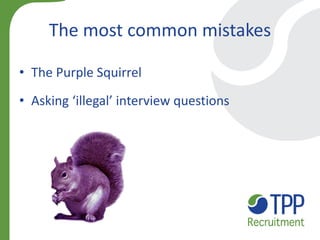
•The Purple Squirrel 
•Asking ‘illegal’ interview questions
The most common mistakes 
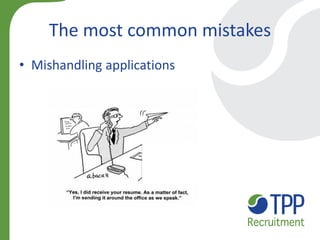
•Mishandling applications
Selling your organisation 
•Is it all about salary? 
•Career development 
•Values & culture 
•Flexible working & Pension 
•Benefits
What are your problems?
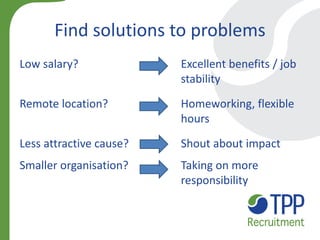
Low salary? 
Excellent benefits / job stability 
Remote location? 
Homeworking, flexible hours 
Less attractive cause? 
Shout about impact 
Smaller organisation? 
Taking on more responsibility 
Find solutions to problems
Job descriptions / Person spec 
•Forces you to think about skills and experience 
•Change role/shift team responsibilities 
•Helps the recruiter 
•Manage candidate expectations 
•Use as checklist for shortlisting and interviews 
•Use to assess performance after hire
Job descriptions / Person spec 
•Be specific 
•Leave room for development & growth 
•Do not discriminate on gender, age, ethnicity, sexuality or health 
•Ask employees and beneficiaries their opinion
Job descriptions / Person spec 
•Job title, position in the company, line manager and reports 
•Location 
•Salary and benefits 
•Overview, main purpose and objectives, duties 
•Skills/qualifications showing essential and desirable 
•Specialist requirements 
•Examples projects to illustrate the requirements
Job descriptions / Person spec 
•Technical, organisational and creative skills 
•Specific qualifications or education required 
•Overview of personality fit 
•Character traits that help do the job effectively 
•Preferred criteria, e.g. volunteering, causal knowledge
•Hands on Mangler 
•Good language skulls 
•Excellent communication skills written and herbal 
•Highly motivated team layer 
•Working crossly with customers 
•Excellency attention to detail 
•Provided justification to additional stuffing requirements
Selling your organisation 
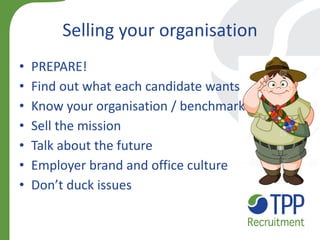
•PREPARE! 
•Find out what each candidate wants 
•Know your organisation / benchmark 
•Sell the mission 
•Talk about the future 
•Employer brand and office culture 
•Don’t duck issues
Conducting the interview 
•PREPARE (again!) 
•Listen and allow the candidate talk 
•Be positive 
•Share some information
Conducting the interview 
•Behavioural questioning: 
–Candidates give examples of specific past situations and how they behaved 
–Past performance predicts future behaviour 
–Judging competency, rather than interviewing skill 
–Follow up examples to get more detail 
–Difficult to exaggerate or ‘fudge’ answers
Interview Questions 
•What do you do when your schedule is interrupted? Give an example of how you handle it. 
•Have you had to convince a team to work on a project they weren't thrilled about? How did you do it? 
•What question didn’t we ask that you think we should have?
Place of Birth, Ethnicity or Religion 
•Don’t ask: What country are you from? Where were you born? 
•Do ask: Are you eligible to work in the UK? 
•Don’t ask: What is your native language? 
•Do ask: This job requires someone who speaks more than one language. What languages are you fluent in? 
•Don’t ask: What religion do you practice? Which religious holidays do you observe? 
•Do ask: Can you work in the days/schedule required for this role?
Marital Status, Children or Sexual Preference 
•Don’t ask: Do you have or plan to have children? 
•Do ask: Are you available to work overtime on occasion? Can you travel? 
•Don’t ask: How many children do you have? Do you have childcare arrangements in place if we need you to work out of hours? 
•Do ask: This job may require some overtime work on short notice. Is this a problem for you? What days/hours are you available to work? 
•Don’t ask: Is this your maiden name? 
•Do ask: Are any of your references or qualifications under another name? 
•Don’t ask: If you went on maternity leave, would you come back to work afterwards? 
•Do ask: What are your long term career goals?
Gender or Age 
•Don’t ask: We’ve always had a woman/man in this role. How do you think you will handle it? 
•Do ask: What can you bring to this role? 
•Don’t ask: How do you feel about managing men/women? 
•Do ask: Tell me about your previous experience of managing staff. 
•Don’t ask: How old are you? Just don’t! 
•Don’t ask: When did you graduate? 
•Do ask: Do you have a degree or other qualification related to this role?
Location 
•Don’t ask: How far would your commute be? 
•Do ask: Are you able to start work at 9am? Lifestyle Choices 
•Don’t ask: Do you belong to any clubs or organisations? 
•Do ask: Are you a member of any professional group that’s relevant to this role? 
•Don’t ask: Are you a member of the Territorial Army/Special Constabulary/Other Volunteer Force? 
•Do ask: Do you have any commitments that would require extensive time away from work?
Disability or Illness 
•Don’t ask: How many sick days did you take last year? 
•Do ask: How many unscheduled days of work did you miss last year? Height or weight 
•Don’t ask: How tall are you? 
•Do ask: Are you able to reach items on a shelf that’s five feet tall? 
•Don’t ask: How much do you weigh? 
•Do ask: Are you able to lift boxes weighing up to 50 pounds?
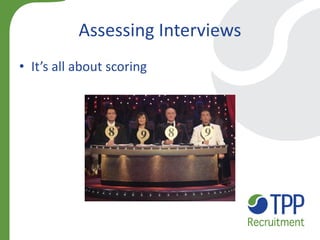
Assessing Interviews 
•It’s all about scoring
Onboarding
Onboarding 
•Make sure they have a workstation, email, telecoms, network drives etc set up 
•Order business cards 
•Make sure key events and meetings are in their diary 
•Update your org chart, telephone directories, staff list, seating plans 
•Book time for induction
Onboarding 
•Written plan of their objectives and responsibilities 
•Make sure it is clear what is needed to pass probation 
•Have all paperwork ready to be completed 
•Introductions plus assign a mentor or buddy 
•Run through your organisation’s formal policies, as well as informal conventions like dress code, sickness procedure etc
•Take them out to lunch with a group of colleagues 
•Set regular (weekly if possible) meetings 
•Arrange a formal progress meeting (often a probation review) after three months. 
•In the unfortunate situation where things are not working out, act promptly. 
Onboarding
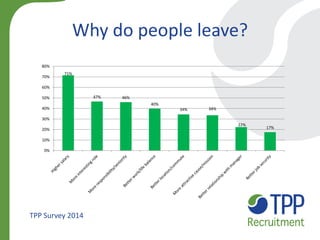
Why do people leave? 
71% 
47% 
46% 
40% 
34% 
34% 
22% 
17% 
0% 
10% 
20% 
30% 
40% 
50% 
60% 
70% 
80% 
TPP Survey 2014
Thank you for listening 
TPP Recruitment @TPPNotforProfit 
T: 020 7198 6000 @Rob_Hayter 
W: www.tpp.co.uk 
E: info@tpp.co.uk
Oddball questions 
1.Room, desk, or car - which do you clean first? 
2.What do you think of garden gnomes? 
3.Name five uses of a stapler without staples. 
4.How would you get an elephant into a refrigerator? 
5.How many people are using Facebook in San Francisco at 2:30PM on a Friday? 
6.If Germans were the tallest people in the world, how would you prove it? 
7.How would you cure world hunger? 
8.How many different ways can you get water from a lake at the foot of a mountain, up to the top of the mountain ? 
9.If you were a Microsoft Office program, which one would you be? 
10.Pepsi or Coke?

How to attract and retain the best employees

  • 1.
    How to attractand retain the best employees Rob Hayter, Director, TPP Recruitment
  • 2.
    What we’ll cover… •Job descriptions & person specifications •Making your role appeal •Selling your organisation to candidates •Interview questions •Ensuring your new hires succeed
  • 3.
    The most commonmistakes •Not asking the right interview questions •Not recruiting for a cultural fit •Relying solely on interview •Not checking references
  • 4.
    The most commonmistakes •Automatically rejecting candidates •Copying and pasting •Missing the opportunity to sell your organisation
  • 5.
    The most commonmistakes •The Purple Squirrel •Asking ‘illegal’ interview questions
  • 6.
    The most commonmistakes •Mishandling applications
  • 7.
    Selling your organisation •Is it all about salary? •Career development •Values & culture •Flexible working & Pension •Benefits
  • 8.
    What are yourproblems?
  • 9.
    Low salary? Excellentbenefits / job stability Remote location? Homeworking, flexible hours Less attractive cause? Shout about impact Smaller organisation? Taking on more responsibility Find solutions to problems
  • 10.
    Job descriptions /Person spec •Forces you to think about skills and experience •Change role/shift team responsibilities •Helps the recruiter •Manage candidate expectations •Use as checklist for shortlisting and interviews •Use to assess performance after hire
  • 11.
    Job descriptions /Person spec •Be specific •Leave room for development & growth •Do not discriminate on gender, age, ethnicity, sexuality or health •Ask employees and beneficiaries their opinion
  • 12.
    Job descriptions /Person spec •Job title, position in the company, line manager and reports •Location •Salary and benefits •Overview, main purpose and objectives, duties •Skills/qualifications showing essential and desirable •Specialist requirements •Examples projects to illustrate the requirements
  • 13.
    Job descriptions /Person spec •Technical, organisational and creative skills •Specific qualifications or education required •Overview of personality fit •Character traits that help do the job effectively •Preferred criteria, e.g. volunteering, causal knowledge
  • 15.
    •Hands on Mangler •Good language skulls •Excellent communication skills written and herbal •Highly motivated team layer •Working crossly with customers •Excellency attention to detail •Provided justification to additional stuffing requirements
  • 16.
    Selling your organisation •PREPARE! •Find out what each candidate wants •Know your organisation / benchmark •Sell the mission •Talk about the future •Employer brand and office culture •Don’t duck issues
  • 17.
    Conducting the interview •PREPARE (again!) •Listen and allow the candidate talk •Be positive •Share some information
  • 18.
    Conducting the interview •Behavioural questioning: –Candidates give examples of specific past situations and how they behaved –Past performance predicts future behaviour –Judging competency, rather than interviewing skill –Follow up examples to get more detail –Difficult to exaggerate or ‘fudge’ answers
  • 19.
    Interview Questions •Whatdo you do when your schedule is interrupted? Give an example of how you handle it. •Have you had to convince a team to work on a project they weren't thrilled about? How did you do it? •What question didn’t we ask that you think we should have?
  • 20.
    Place of Birth,Ethnicity or Religion •Don’t ask: What country are you from? Where were you born? •Do ask: Are you eligible to work in the UK? •Don’t ask: What is your native language? •Do ask: This job requires someone who speaks more than one language. What languages are you fluent in? •Don’t ask: What religion do you practice? Which religious holidays do you observe? •Do ask: Can you work in the days/schedule required for this role?
  • 21.
    Marital Status, Childrenor Sexual Preference •Don’t ask: Do you have or plan to have children? •Do ask: Are you available to work overtime on occasion? Can you travel? •Don’t ask: How many children do you have? Do you have childcare arrangements in place if we need you to work out of hours? •Do ask: This job may require some overtime work on short notice. Is this a problem for you? What days/hours are you available to work? •Don’t ask: Is this your maiden name? •Do ask: Are any of your references or qualifications under another name? •Don’t ask: If you went on maternity leave, would you come back to work afterwards? •Do ask: What are your long term career goals?
  • 22.
    Gender or Age •Don’t ask: We’ve always had a woman/man in this role. How do you think you will handle it? •Do ask: What can you bring to this role? •Don’t ask: How do you feel about managing men/women? •Do ask: Tell me about your previous experience of managing staff. •Don’t ask: How old are you? Just don’t! •Don’t ask: When did you graduate? •Do ask: Do you have a degree or other qualification related to this role?
  • 23.
    Location •Don’t ask:How far would your commute be? •Do ask: Are you able to start work at 9am? Lifestyle Choices •Don’t ask: Do you belong to any clubs or organisations? •Do ask: Are you a member of any professional group that’s relevant to this role? •Don’t ask: Are you a member of the Territorial Army/Special Constabulary/Other Volunteer Force? •Do ask: Do you have any commitments that would require extensive time away from work?
  • 24.
    Disability or Illness •Don’t ask: How many sick days did you take last year? •Do ask: How many unscheduled days of work did you miss last year? Height or weight •Don’t ask: How tall are you? •Do ask: Are you able to reach items on a shelf that’s five feet tall? •Don’t ask: How much do you weigh? •Do ask: Are you able to lift boxes weighing up to 50 pounds?
  • 25.
  • 26.
  • 27.
    Onboarding •Make surethey have a workstation, email, telecoms, network drives etc set up •Order business cards •Make sure key events and meetings are in their diary •Update your org chart, telephone directories, staff list, seating plans •Book time for induction
  • 28.
    Onboarding •Written planof their objectives and responsibilities •Make sure it is clear what is needed to pass probation •Have all paperwork ready to be completed •Introductions plus assign a mentor or buddy •Run through your organisation’s formal policies, as well as informal conventions like dress code, sickness procedure etc
  • 29.
    •Take them outto lunch with a group of colleagues •Set regular (weekly if possible) meetings •Arrange a formal progress meeting (often a probation review) after three months. •In the unfortunate situation where things are not working out, act promptly. Onboarding
  • 30.
    Why do peopleleave? 71% 47% 46% 40% 34% 34% 22% 17% 0% 10% 20% 30% 40% 50% 60% 70% 80% TPP Survey 2014
  • 31.
    Thank you forlistening TPP Recruitment @TPPNotforProfit T: 020 7198 6000 @Rob_Hayter W: www.tpp.co.uk E: info@tpp.co.uk
  • 32.
    Oddball questions 1.Room,desk, or car - which do you clean first? 2.What do you think of garden gnomes? 3.Name five uses of a stapler without staples. 4.How would you get an elephant into a refrigerator? 5.How many people are using Facebook in San Francisco at 2:30PM on a Friday? 6.If Germans were the tallest people in the world, how would you prove it? 7.How would you cure world hunger? 8.How many different ways can you get water from a lake at the foot of a mountain, up to the top of the mountain ? 9.If you were a Microsoft Office program, which one would you be? 10.Pepsi or Coke?