
Human Resource
Analytics
Presented By:- Sumeet Pareek
Malviya National Institute ofTechnology,
Department of Management Studies
Outline
• DataAnalytics and Business Analytics
• What is HR Analytics ?
• Evolution of HR Analytics
• Process of HR Analytics
• How does it help HR manager ?
• Software available for HR Analytics
• Conclusion
Data Analytics and Business
Analytics
• DataAnalytics: Science of converting raw data into a valuable
information.
• Data is a set of attributes associated with qualitative or
quantitative values
• Information is the inference that can be obtained from the data.
Data Analytics and Business
Analytics
• Business Analytics: Process of data-driven decision making.
• Analyzing past trend and patterns.
• Making decision for future.
• Why did it happen?
• Will it happen again?
• What will happen if we change ’x’?
• What else does the data tell us that never thought to ask?
What is HR Analytics
• Application of data analytics and business analytics.
• Also referred as talent analytics.
• Useful in effectively managing the employees
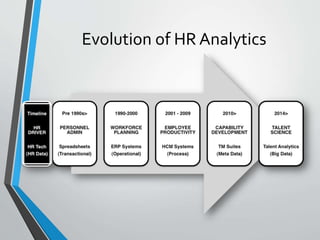
Evolution of HR Analytics
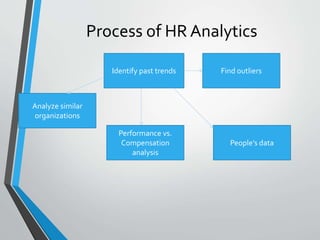
Process of HR Analytics
Identify past trends Find outliers
Performance vs.
Compensation
analysis
People’s data
Analyze similar
organizations
How does it Help ?
• HR manager can optimize the ROI on its human capital.
• Helps in building talent based strategies.
• Factors that can increase employee satisfaction and productivity.
• Manages applicants in better way on the basis of qualification.
• Helps in identifying high valued employees.
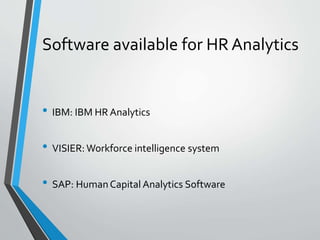
Software available for HR Analytics
• IBM: IBM HR Analytics
• VISIER: Workforce intelligence system
• SAP: HumanCapital Analytics Software
Conclusion
• HR analytics has a vast scope in future. It helps HR
manager in understanding past pattern in an
organization and better decision making. HR managers
nowadays are able to make decisions not just related to
workforce but also core business decisions as well.
Any Questions ?

Human resource analytics

  • 1.
    Human Resource Analytics Presented By:-Sumeet Pareek Malviya National Institute ofTechnology, Department of Management Studies
  • 2.
    Outline • DataAnalytics andBusiness Analytics • What is HR Analytics ? • Evolution of HR Analytics • Process of HR Analytics • How does it help HR manager ? • Software available for HR Analytics • Conclusion
  • 3.
    Data Analytics andBusiness Analytics • DataAnalytics: Science of converting raw data into a valuable information. • Data is a set of attributes associated with qualitative or quantitative values • Information is the inference that can be obtained from the data.
  • 4.
    Data Analytics andBusiness Analytics • Business Analytics: Process of data-driven decision making. • Analyzing past trend and patterns. • Making decision for future. • Why did it happen? • Will it happen again? • What will happen if we change ’x’? • What else does the data tell us that never thought to ask?
  • 5.
    What is HRAnalytics • Application of data analytics and business analytics. • Also referred as talent analytics. • Useful in effectively managing the employees
  • 6.
    Evolution of HRAnalytics
  • 7.
    Process of HRAnalytics Identify past trends Find outliers Performance vs. Compensation analysis People’s data Analyze similar organizations
  • 8.
    How does itHelp ? • HR manager can optimize the ROI on its human capital. • Helps in building talent based strategies. • Factors that can increase employee satisfaction and productivity. • Manages applicants in better way on the basis of qualification. • Helps in identifying high valued employees.
  • 9.
    Software available forHR Analytics • IBM: IBM HR Analytics • VISIER: Workforce intelligence system • SAP: HumanCapital Analytics Software
  • 10.
    Conclusion • HR analyticshas a vast scope in future. It helps HR manager in understanding past pattern in an organization and better decision making. HR managers nowadays are able to make decisions not just related to workforce but also core business decisions as well.
  • 11.

Editor's Notes

  • #7 Human capital management (HCM) is an approach to employee staffing that perceives people as assets (human capital) whose current value can be measured and whose future value can be enhanced through investment.
  • #8 Performance based compensation differential”. This metric expresses how much more high performers are paid compared to their average performing peers.  For example, a score of 1.2 means that on average high performers receive 20% more compensation than average performers. Turning this critical question into a single number allows for powerful insight across the organization; it means that different locations, business units and groups of employees can be easily compared using simple visual analyses.
  • #9 Performance based compensation differential a score of 1.2 means that on average high performers receive 20% more compensation than average performers. Turning this critical question into a single number allows for powerful insight across the organization; it means that different locations, business units and groups of employees can be easily compared using simple visual analyses.