TP
Half‐day Tutorial 
6/4/2013 1:00 PM 


"Influence Strategies for Software
Professionals"


Presented by:
Linda Rising
Independent Consultant


Brought to you by: 


340 Corporate Way, Suite 300, Orange Park, FL 32073 
888‐268‐8770 ∙ 904‐278‐0524 ∙ sqeinfo@sqe.com ∙ www.sqe.com
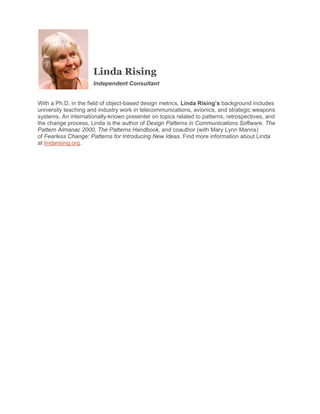
Linda Rising
Independent Consultant

With a Ph.D. in the field of object-based design metrics, Linda Rising’s background includes
university teaching and industry work in telecommunications, avionics, and strategic weapons
systems. An internationally-known presenter on topics related to patterns, retrospectives, and
the change process, Linda is the author of Design Patterns in Communications Software, The
Pattern Almanac 2000, The Patterns Handbook, and coauthor (with Mary Lynn Manns)
of Fearless Change: Patterns for Introducing New Ideas. Find more information about Linda
at lindarising.org.
 
Influence Strategies for
Software Professionals

Linda Rising
linda@lindarising.org
www.lindarising.org
@RisingLinda

Disclaimer: This provocative presentation is ideally the
beginning of a conversation. It won't take long for me
to tell you everything I know about cognitive
psychology, although I have been reading in the area
for several years now. I'm an amateur who has
sufficient interest in weird topics and a strange way of
connecting ideas that might or might not be of interest
to you. Thank you for your tolerance and understanding
of my meanderings and I hope you learn a little that
might help you in your life.
This is not an “academic” presentation, but those
interested in more information are invited to ask me for
references for any part of this talk and I will be happy
to make them available.
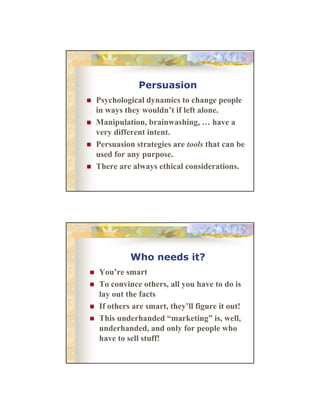
Persuasion
Psychological d
P h l i l dynamics to change people
i
h
l
in ways they wouldn’t if left alone.
Manipulation, brainwashing, … have a
very different intent.
Persuasion strategies are tools that can be
used for any purpose.
There are always ethical considerations.

Who needs it?
You’re
Y ’ smart
To convince others, all you have to do is
lay out the facts
If others are smart, they’ll figure it out!
This d h d d “marketing” i well,
Thi underhanded “
k ti ” is, ll
underhanded, and only for people who
have to sell stuff!
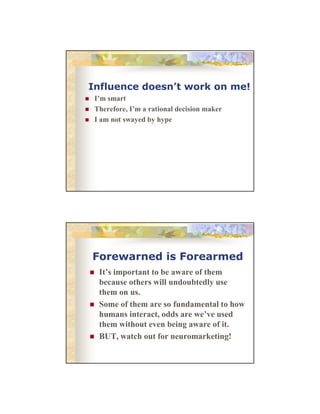
Influence doesn’t work on me!
I’m smart
Therefore, I’m a rational decision maker
I am not swayed by hype

Forewarned is Forearmed
It’s important to be aware of them
I’ i
b
f h
because others will undoubtedly use
them on us.
Some of them are so fundamental to how
humans interact, odds are we’ve used
we ve
them without even being aware of it.
BUT, watch out for neuromarketing!
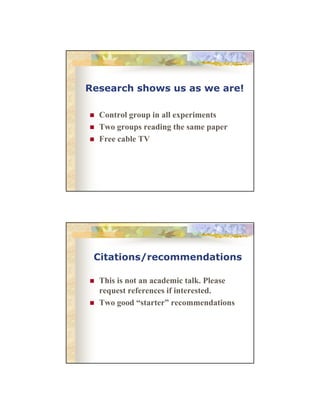
Research shows us as we are!
Control group in all experiments
Two groups reading the same paper
Free cable TV

Citations/recommendations
This is not an academic talk. Please
request references if interested.
Two good “starter” recommendations
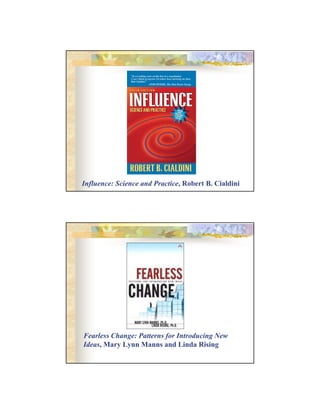
Influence: Science and Practice, Robert B. Cialdini

Fearless Change: Patterns for Introducing New
Ideas, Mary Lynn Manns and Linda Rising
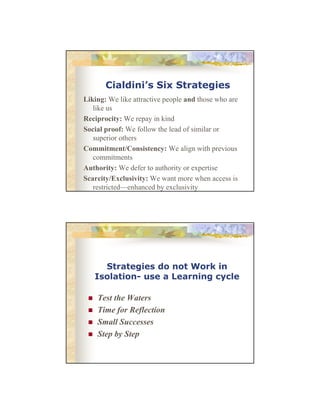
Cialdini’s Six Strategies
Liking: W like attractive people and th
Liki
We lik tt ti
l
d those who are
h
like us
Reciprocity: We repay in kind
Social proof: We follow the lead of similar or
superior others
Commitment/Consistency: We align with previous
commitments
Authority: We defer to authority or expertise
Scarcity/Exclusivity: We want more when access is
restricted—enhanced by exclusivity

Strategies do not Work in
g
Isolation- use a Learning cycle
Test the Waters
Time for Reflection
Small Successes
Step by Step
1-Liking: We like attractive
people and those who are like us
Attractive often = height, college lecturers, Ph.D.
taller than grad student
Judicial system
A person who has done a favor for you is more
likely to do another favor for you than if they
had received a favor from you. Ben Franklin Effect
Familiar names, easier typeface, easier to
pronounce, objects that are closer, words typed
with the right hand!

What can you do?
Look for: real commonality, areas for genuine
L kf
l
lit
f
i
compliments, opportunities for cooperation
Negotiation deadlock reduced from 30% to
6% by exchanging personal info beforehand
Do Food
Say, “We’re working with you,” or “We’re
just like you.”
Beware of others who claim to be like you or
appear to share interests.
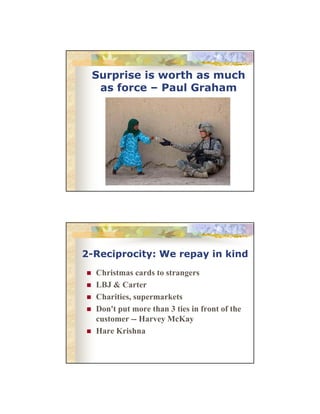
Surprise is worth as much
as force – Paul Graham

2-Reciprocity: We repay in kind
Christmas cards to strangers
LBJ & Carter
Charities, supermarkets
Don't put more than 3 ties in front of the
customer -- H
t
Harvey McKay
M K
Hare Krishna
Free stuff!
Consumers prefer getting something extra free
C
f
tti
thi
t f
to getting something cheaper (math illiterate).
Amazon free shipping – except in France
In one study: 40% bought a cupcake + 2
cookies for 75 cents BUT 73% bought the
cupcake f 75 cents when 2 cookies were
k for
h
ki
added for “free”

What can you do?
Be th first t i
B the fi t to give: service, information,
i i f
ti
concession, something nice – the more
unexpected the better – small, but thoughtful
Just Say Thanks - the more specific the better
“I’m sure you would have done the same for
me.” *NOT* “It was nothing!”
”
“I
hi !”
Say, “As we promised earlier…” or “We are
giving you…”
Beware of others bearing gifts
3-Social proof: We follow the
lead of similar or superior others
Canned laughter, fancy dinner party
Shills, street corner joke
Towel study: (1) environment, (2) socially
responsible, (3) saved money, (4) 29% (same
hotel) - 41% (same room)
Expedia: 11 people booked this hotel in the last
48 hours; 2 others are viewing this hotel right
now

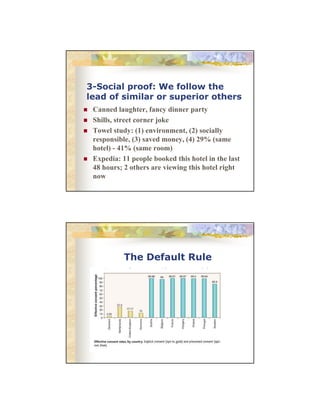
The Default Rule
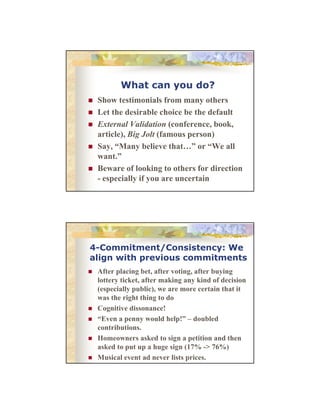
What can you do?
Show
Sh testimonials from many others
i
i l f
h
Let the desirable choice be the default
External Validation (conference, book,
article), Big Jolt (famous person)
Say, “Many believe that…” or “We all
S “M
b li
th t ” “W ll
want.”
Beware of looking to others for direction
- especially if you are uncertain

4-Commitment/Consistency: We
align with previous commitments
After l i b t ft
Aft placing bet, after voting, after buying
ti
ft b i
lottery ticket, after making any kind of decision
(especially public), we are more certain that it
was the right thing to do
Cognitive dissonance!
“Even a penny would help!” – d bl d
“E
ld h l !” doubled
contributions.
Homeowners asked to sign a petition and then
asked to put up a huge sign (17% -> 76%)
Musical event ad never lists prices.
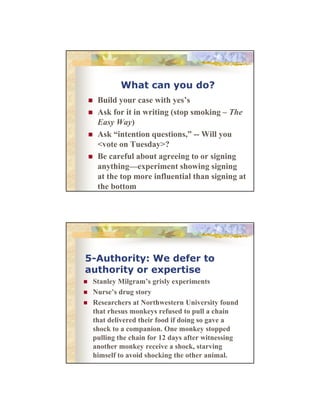
What can you do?
Build
B ild your case with yes’s
ih
’
Ask for it in writing (stop smoking – The
Easy Way)
Ask “intention questions,” -- Will you
<vote on Tuesday>?
Be careful about agreeing to or signing
anything—experiment showing signing
at the top more influential than signing at
the bottom

5-Authority: We defer to
authority or expertise
Stanley Milgram’s grisly experiments
Nurse’s drug story
Researchers at Northwestern University found
that rhesus monkeys refused to pull a chain
that delivered their food if doing so gave a
shock to a companion. One monkey stopped
pulling the chain for 12 days after witnessing
another monkey receive a shock, starving
himself to avoid shocking the other animal.
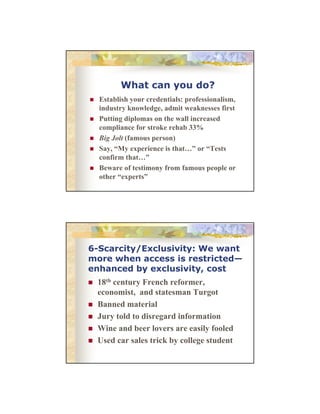
What can you do?
Establish
E t bli h your credentials: professionalism,
d ti l
f i
li
industry knowledge, admit weaknesses first
Putting diplomas on the wall increased
compliance for stroke rehab 33%
Big Jolt (famous person)
Say, “My experience is that…” or “Tests
confirm that…”
Beware of testimony from famous people or
other “experts”

6-Scarcity/Exclusivity: We want
more when access is restricted—
enhanced by exclusivity cost
exclusivity,
18th century French reformer,
economist, and statesman Turgot
Banned material
Jury told to disregard information
Wine and beer lovers are easily fooled
Used car sales trick by college student
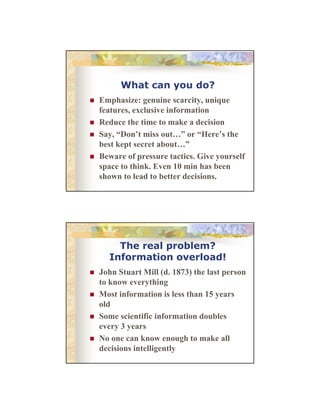
What can you do?
Emphasize:
E h i genuine scarcity, unique
i
i
i
features, exclusive information
Reduce the time to make a decision
Say, “Don’t miss out…” or “Here’s the
best kept secret about ”
about…
Beware of pressure tactics. Give yourself
space to think. Even 10 min has been
shown to lead to better decisions.

The real problem?
Information overload!
John Stuart Mill (d. 1873) the l person
J h S
(d
h last
to know everything
Most information is less than 15 years
old
Some scientific information doubles
every 3 years
No one can know enough to make all
decisions intelligently
Short cuts work!
Influence strategies are short-cuts
I fl
i
h
Most of the time these are good things,
that’s why we have evolved to use them.
We don’t have time to deliberate every
decision
Don’t beat yourself up or drive yourself
crazy! Just be reasonably cautious ☺!

Protection suggestions
Continually search for potentially
C i
ll
hf
i ll
relevant or contradictory evidence
Have a Champion Skeptic on the team
Seek diverse outside opinions to counter
overconfidence
If it’s not important, buy the ice cream
☺!
The last word
It’s
I ’ to our b fi to understand and use
benefit
d
d d
these strategies to influence others and
protect ourselves.
Remember there is an ethical component.
Experts have said that awareness is the
first step toward protecting yourself, but
there are no guarantees.
Good luck! Thanks for your attention!

Influence Strategies for Software Professionals

  • 1.
        TP Half‐day Tutorial  6/4/2013 1:00 PM                "Influence Strategies forSoftware Professionals"       Presented by: Linda Rising Independent Consultant                   Brought to you by:        340 Corporate Way, Suite 300, Orange Park, FL 32073  888‐268‐8770 ∙ 904‐278‐0524 ∙ sqeinfo@sqe.com ∙ www.sqe.com
  • 2.
    Linda Rising Independent Consultant Witha Ph.D. in the field of object-based design metrics, Linda Rising’s background includes university teaching and industry work in telecommunications, avionics, and strategic weapons systems. An internationally-known presenter on topics related to patterns, retrospectives, and the change process, Linda is the author of Design Patterns in Communications Software, The Pattern Almanac 2000, The Patterns Handbook, and coauthor (with Mary Lynn Manns) of Fearless Change: Patterns for Introducing New Ideas. Find more information about Linda at lindarising.org.  
  • 3.
    Influence Strategies for SoftwareProfessionals Linda Rising linda@lindarising.org www.lindarising.org @RisingLinda Disclaimer: This provocative presentation is ideally the beginning of a conversation. It won't take long for me to tell you everything I know about cognitive psychology, although I have been reading in the area for several years now. I'm an amateur who has sufficient interest in weird topics and a strange way of connecting ideas that might or might not be of interest to you. Thank you for your tolerance and understanding of my meanderings and I hope you learn a little that might help you in your life. This is not an “academic” presentation, but those interested in more information are invited to ask me for references for any part of this talk and I will be happy to make them available.
  • 4.
    Persuasion Psychological d P hl i l dynamics to change people i h l in ways they wouldn’t if left alone. Manipulation, brainwashing, … have a very different intent. Persuasion strategies are tools that can be used for any purpose. There are always ethical considerations. Who needs it? You’re Y ’ smart To convince others, all you have to do is lay out the facts If others are smart, they’ll figure it out! This d h d d “marketing” i well, Thi underhanded “ k ti ” is, ll underhanded, and only for people who have to sell stuff!
  • 5.
    Influence doesn’t workon me! I’m smart Therefore, I’m a rational decision maker I am not swayed by hype Forewarned is Forearmed It’s important to be aware of them I’ i b f h because others will undoubtedly use them on us. Some of them are so fundamental to how humans interact, odds are we’ve used we ve them without even being aware of it. BUT, watch out for neuromarketing!
  • 6.
    Research shows usas we are! Control group in all experiments Two groups reading the same paper Free cable TV Citations/recommendations This is not an academic talk. Please request references if interested. Two good “starter” recommendations
  • 7.
    Influence: Science andPractice, Robert B. Cialdini Fearless Change: Patterns for Introducing New Ideas, Mary Lynn Manns and Linda Rising
  • 8.
    Cialdini’s Six Strategies Liking:W like attractive people and th Liki We lik tt ti l d those who are h like us Reciprocity: We repay in kind Social proof: We follow the lead of similar or superior others Commitment/Consistency: We align with previous commitments Authority: We defer to authority or expertise Scarcity/Exclusivity: We want more when access is restricted—enhanced by exclusivity Strategies do not Work in g Isolation- use a Learning cycle Test the Waters Time for Reflection Small Successes Step by Step
  • 9.
    1-Liking: We likeattractive people and those who are like us Attractive often = height, college lecturers, Ph.D. taller than grad student Judicial system A person who has done a favor for you is more likely to do another favor for you than if they had received a favor from you. Ben Franklin Effect Familiar names, easier typeface, easier to pronounce, objects that are closer, words typed with the right hand! What can you do? Look for: real commonality, areas for genuine L kf l lit f i compliments, opportunities for cooperation Negotiation deadlock reduced from 30% to 6% by exchanging personal info beforehand Do Food Say, “We’re working with you,” or “We’re just like you.” Beware of others who claim to be like you or appear to share interests.
  • 10.
    Surprise is worthas much as force – Paul Graham 2-Reciprocity: We repay in kind Christmas cards to strangers LBJ & Carter Charities, supermarkets Don't put more than 3 ties in front of the customer -- H t Harvey McKay M K Hare Krishna
  • 11.
    Free stuff! Consumers prefergetting something extra free C f tti thi t f to getting something cheaper (math illiterate). Amazon free shipping – except in France In one study: 40% bought a cupcake + 2 cookies for 75 cents BUT 73% bought the cupcake f 75 cents when 2 cookies were k for h ki added for “free” What can you do? Be th first t i B the fi t to give: service, information, i i f ti concession, something nice – the more unexpected the better – small, but thoughtful Just Say Thanks - the more specific the better “I’m sure you would have done the same for me.” *NOT* “It was nothing!” ” “I hi !” Say, “As we promised earlier…” or “We are giving you…” Beware of others bearing gifts
  • 12.
    3-Social proof: Wefollow the lead of similar or superior others Canned laughter, fancy dinner party Shills, street corner joke Towel study: (1) environment, (2) socially responsible, (3) saved money, (4) 29% (same hotel) - 41% (same room) Expedia: 11 people booked this hotel in the last 48 hours; 2 others are viewing this hotel right now The Default Rule
  • 13.
    What can youdo? Show Sh testimonials from many others i i l f h Let the desirable choice be the default External Validation (conference, book, article), Big Jolt (famous person) Say, “Many believe that…” or “We all S “M b li th t ” “W ll want.” Beware of looking to others for direction - especially if you are uncertain 4-Commitment/Consistency: We align with previous commitments After l i b t ft Aft placing bet, after voting, after buying ti ft b i lottery ticket, after making any kind of decision (especially public), we are more certain that it was the right thing to do Cognitive dissonance! “Even a penny would help!” – d bl d “E ld h l !” doubled contributions. Homeowners asked to sign a petition and then asked to put up a huge sign (17% -> 76%) Musical event ad never lists prices.
  • 14.
    What can youdo? Build B ild your case with yes’s ih ’ Ask for it in writing (stop smoking – The Easy Way) Ask “intention questions,” -- Will you <vote on Tuesday>? Be careful about agreeing to or signing anything—experiment showing signing at the top more influential than signing at the bottom 5-Authority: We defer to authority or expertise Stanley Milgram’s grisly experiments Nurse’s drug story Researchers at Northwestern University found that rhesus monkeys refused to pull a chain that delivered their food if doing so gave a shock to a companion. One monkey stopped pulling the chain for 12 days after witnessing another monkey receive a shock, starving himself to avoid shocking the other animal.
  • 15.
    What can youdo? Establish E t bli h your credentials: professionalism, d ti l f i li industry knowledge, admit weaknesses first Putting diplomas on the wall increased compliance for stroke rehab 33% Big Jolt (famous person) Say, “My experience is that…” or “Tests confirm that…” Beware of testimony from famous people or other “experts” 6-Scarcity/Exclusivity: We want more when access is restricted— enhanced by exclusivity cost exclusivity, 18th century French reformer, economist, and statesman Turgot Banned material Jury told to disregard information Wine and beer lovers are easily fooled Used car sales trick by college student
  • 16.
    What can youdo? Emphasize: E h i genuine scarcity, unique i i i features, exclusive information Reduce the time to make a decision Say, “Don’t miss out…” or “Here’s the best kept secret about ” about… Beware of pressure tactics. Give yourself space to think. Even 10 min has been shown to lead to better decisions. The real problem? Information overload! John Stuart Mill (d. 1873) the l person J h S (d h last to know everything Most information is less than 15 years old Some scientific information doubles every 3 years No one can know enough to make all decisions intelligently
  • 17.
    Short cuts work! Influencestrategies are short-cuts I fl i h Most of the time these are good things, that’s why we have evolved to use them. We don’t have time to deliberate every decision Don’t beat yourself up or drive yourself crazy! Just be reasonably cautious ☺! Protection suggestions Continually search for potentially C i ll hf i ll relevant or contradictory evidence Have a Champion Skeptic on the team Seek diverse outside opinions to counter overconfidence If it’s not important, buy the ice cream ☺!
  • 18.
    The last word It’s I’ to our b fi to understand and use benefit d d d these strategies to influence others and protect ourselves. Remember there is an ethical component. Experts have said that awareness is the first step toward protecting yourself, but there are no guarantees. Good luck! Thanks for your attention!